M. Ed. (2013 – 2014)
School Of Education
Pondicherry University
CONTENTS
1. Introduction.
2.What is Teaching?
3.What are Models?
4.What is Teaching Models?
5.Concept of Teaching Models.
6.Definition of Models of Teaching.
7.Characteristics of Teaching Models
8.Function of teaching Models.
9. Types of Modern Teaching Models.
Information Processing Model
Social Interaction Model
Personal Interaction Model
Behavior Modification Model
9. Fundamental Elements of Teaching Model
 Focus
 Syntax
 Principles of Reactions
 The Social System
 The Supportive System
 Application context
10.Merits of Models of Teaching
CONTENTS
INTRODUCTION
Development of Models of teaching is the recent
innovation in teaching. An important purpose of discussing
models of teaching is to assist the teacher to have a wide
range of approaches for creating a proper interactive
environment for learning needs of the students.
Educators and psychologist have design
several types of teaching models which
provides suitable guidelines to the teachers
for modifying the behavior of the learners.
What is teaching?
H.C. Morrison(1934); Teaching is a system of
actions intended to produce learning.
Clarke (1970); Teaching refers to activities that
are designed & performed to produce change in
students’ behaviour.
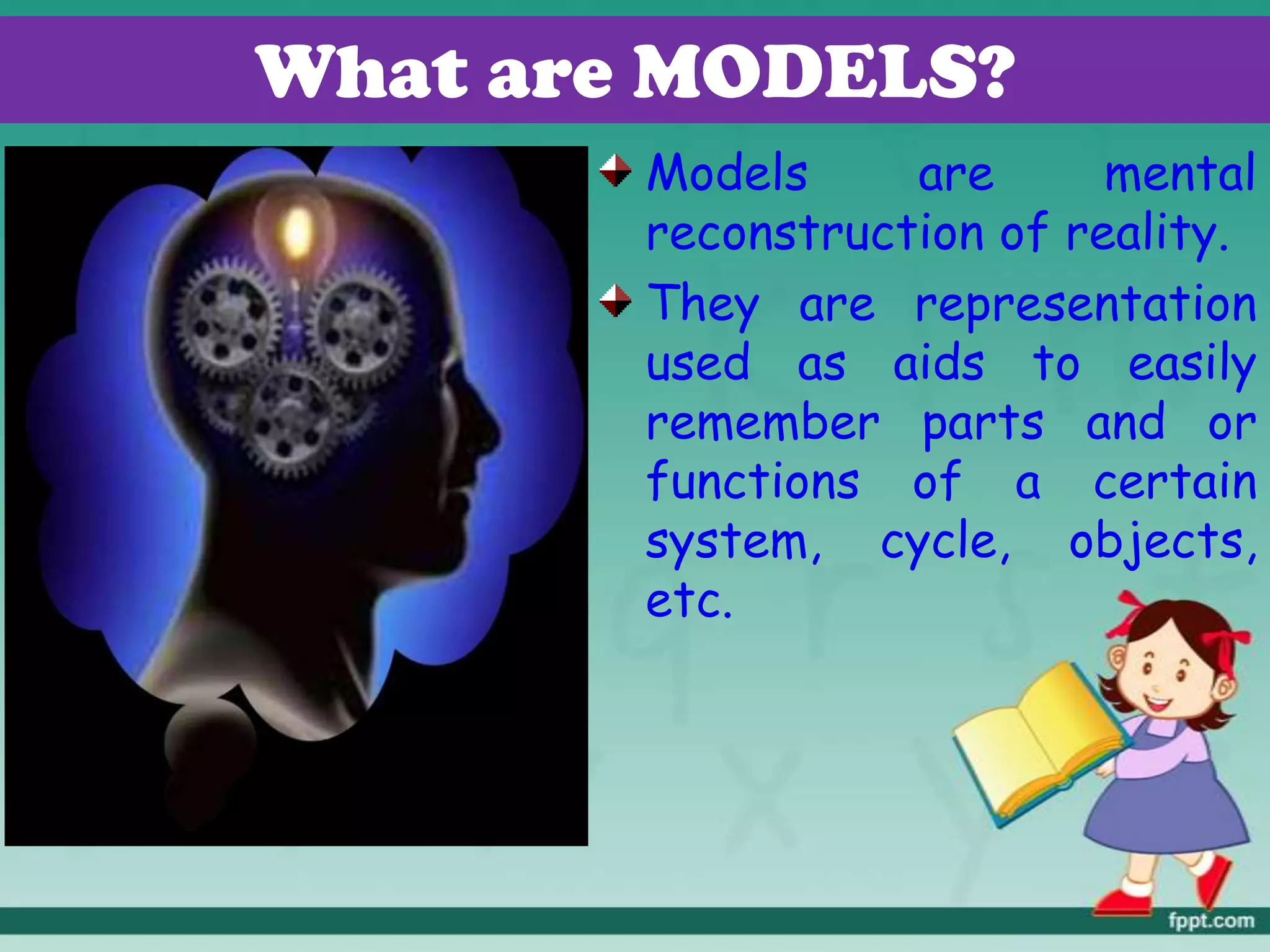
Models are mental
reconstruction of reality.
They are representation
used as aids to easily
remember parts and or
functions of a certain
system, cycle, objects,
etc.
What are MODELS?
What is Teaching Model?
“A model of teaching is a plan or pattern that
can be used to shape curriculums (long-term
courses of studies), to design instructional
materials, and to guide a teacher’s action in the
classroom and other settings”
- Joyce and Weil (1980)
Definition of Models of Teaching
JOYCE AND WEIL (1972); Teaching of model is
a pattern or plan, which can be a curriculum or
courses to select instructional materials and to
guide a teachers action.
Jangira (1983);“A model of teaching
is a set of interrelated components
arranged in a sequence which provides
guidelines to realise specific goal.
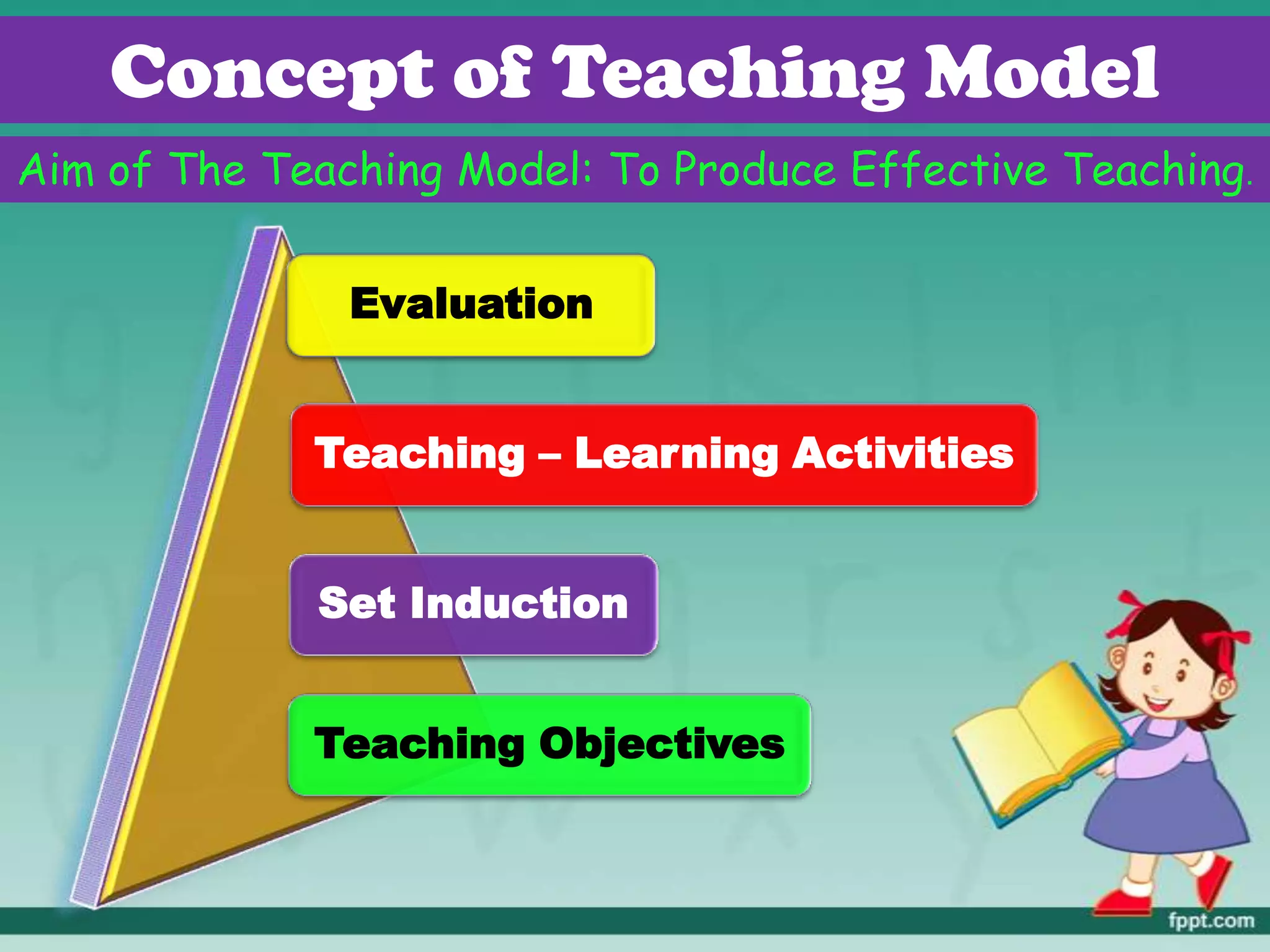
Concept of Teaching Model
Aim of The Teaching Model: To Produce Effective Teaching.
Teaching Objectives
Set Induction
Teaching – Learning Activities
Evaluation
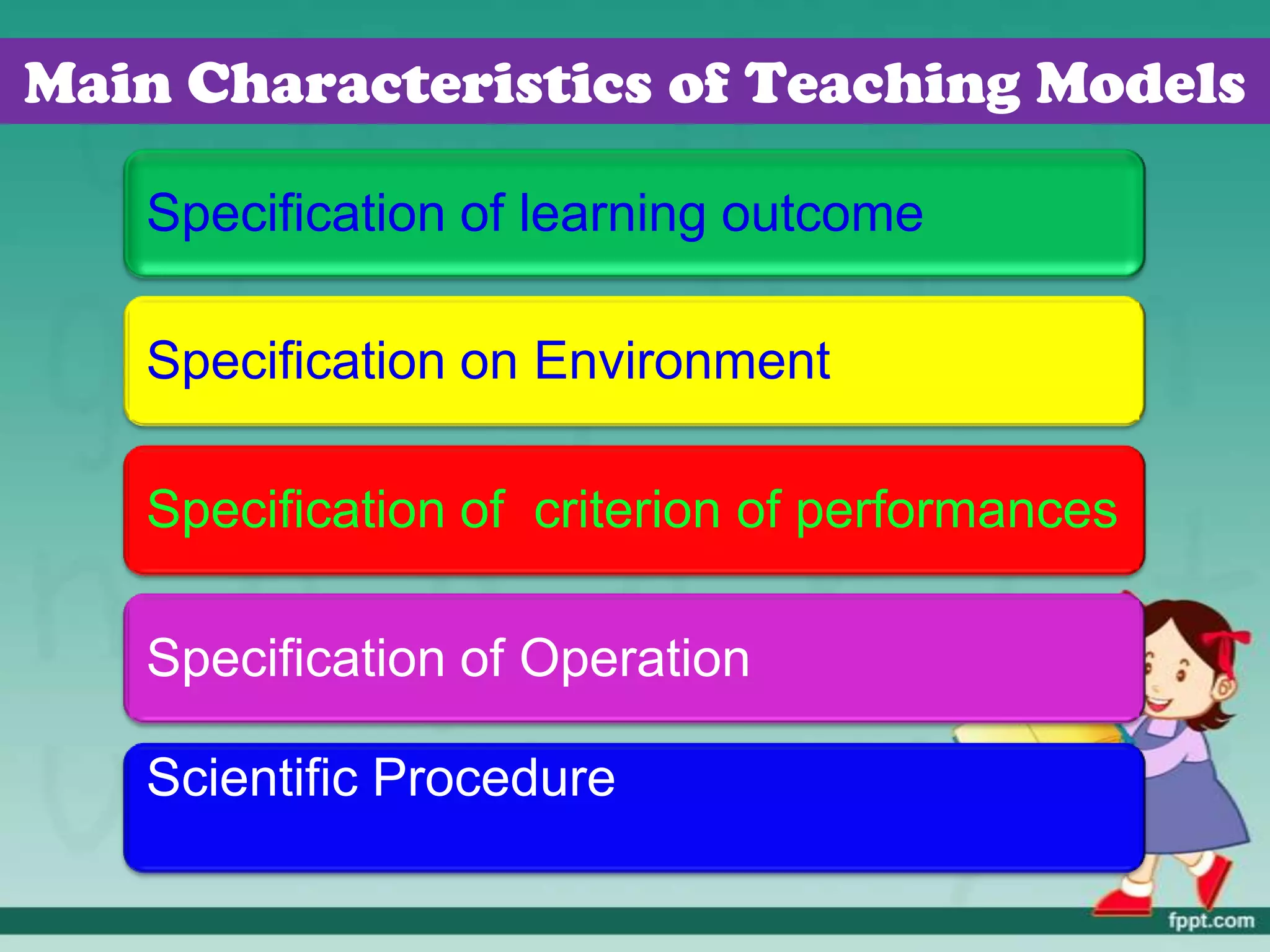
Main Characteristics of Teaching Models
Specification of learning outcome
Specification on Environment
Specification of criterion of performances
Specification of Operation
Scientific Procedure
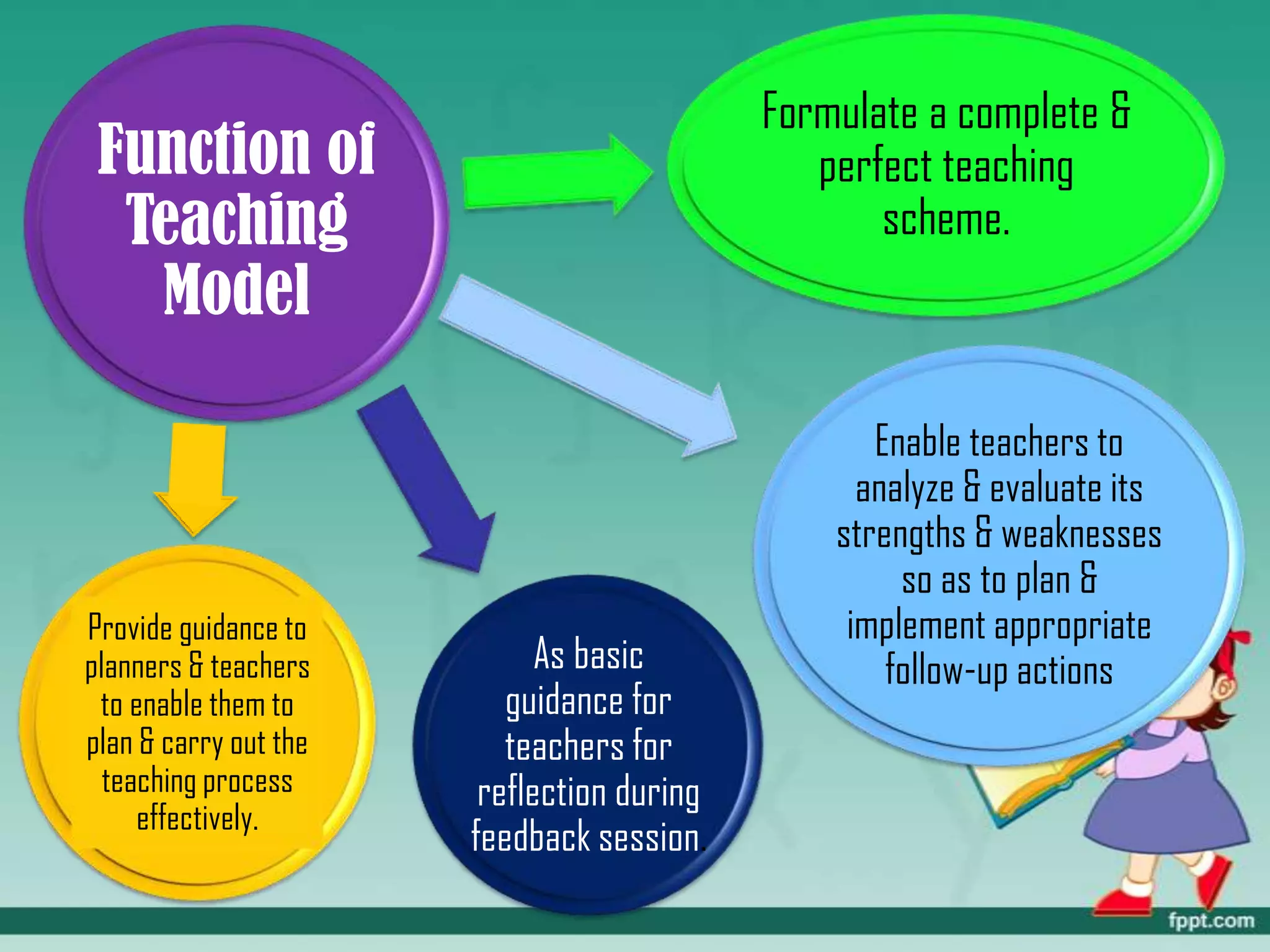
Function of
Teaching
Model
Formulate a complete &
perfect teaching
scheme.
Enable teachers to
analyze & evaluate its
strengths & weaknesses
so as to plan &
implement appropriate
follow-up actionsAs basic
guidance for
teachers for
reflection during
feedback session.
Provide guidance to
planners & teachers
to enable them to
plan & carry out the
teaching process
effectively.
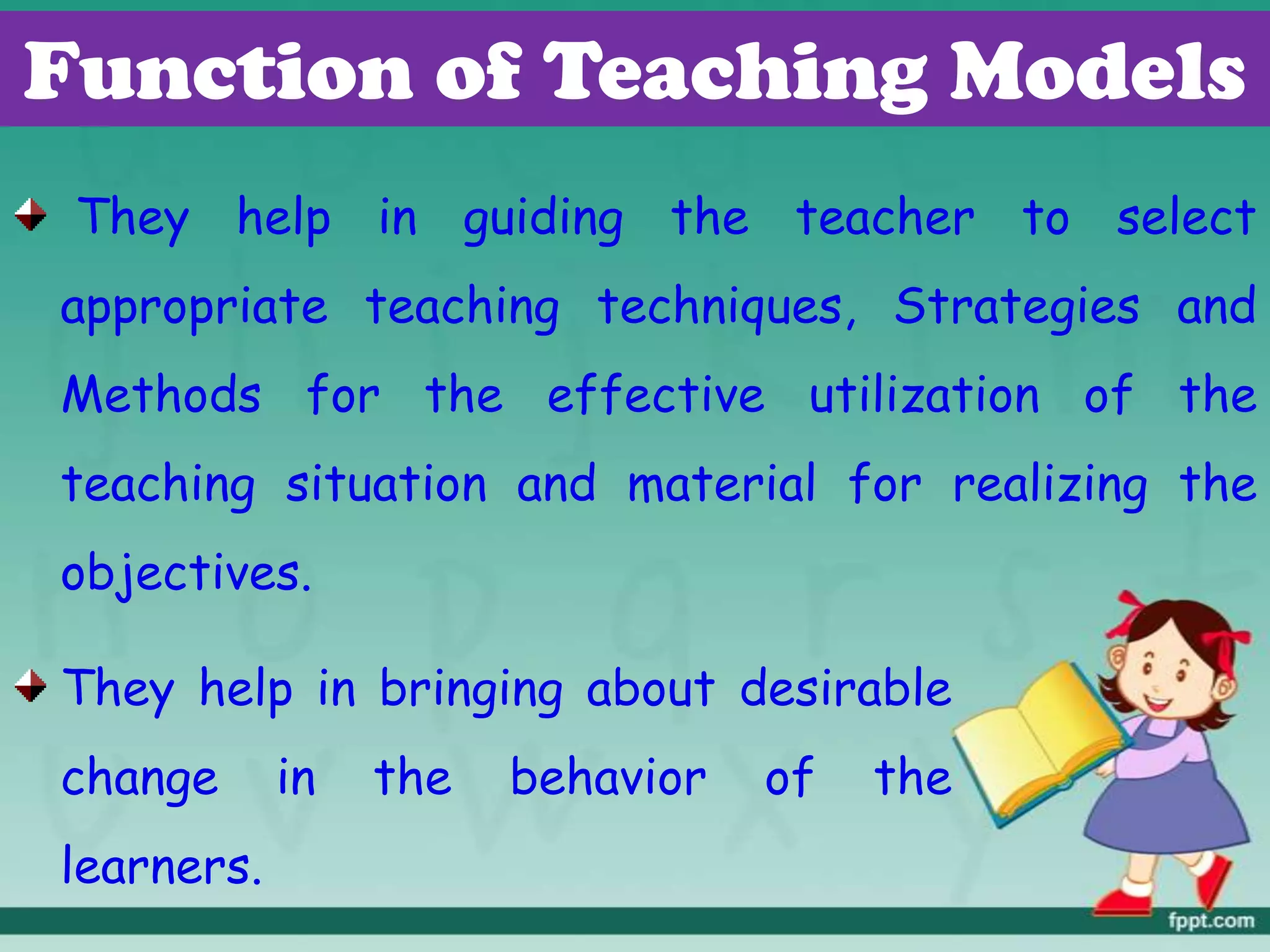
Function of Teaching Models
They help in guiding the teacher to select
appropriate teaching techniques, Strategies and
Methods for the effective utilization of the
teaching situation and material for realizing the
objectives.
They help in bringing about desirable
change in the behavior of the
learners.
They help in finding out ways and means of creating
favorable environmental situation for carrying out
teaching process.
They help in achieving desirable teacher – pupil
interaction during teaching.
Conti…..
They help in the construction of
curriculum or contents of a course.
They help in designing appropriate
educational activities.
Conti…..
They help in the proper selection of instruction
material for teaching the prepared course or
curriculum.
They assist procedure of material to create
interesting and effective materials and learning
source.
They stimulate the development of
new educational innovations.
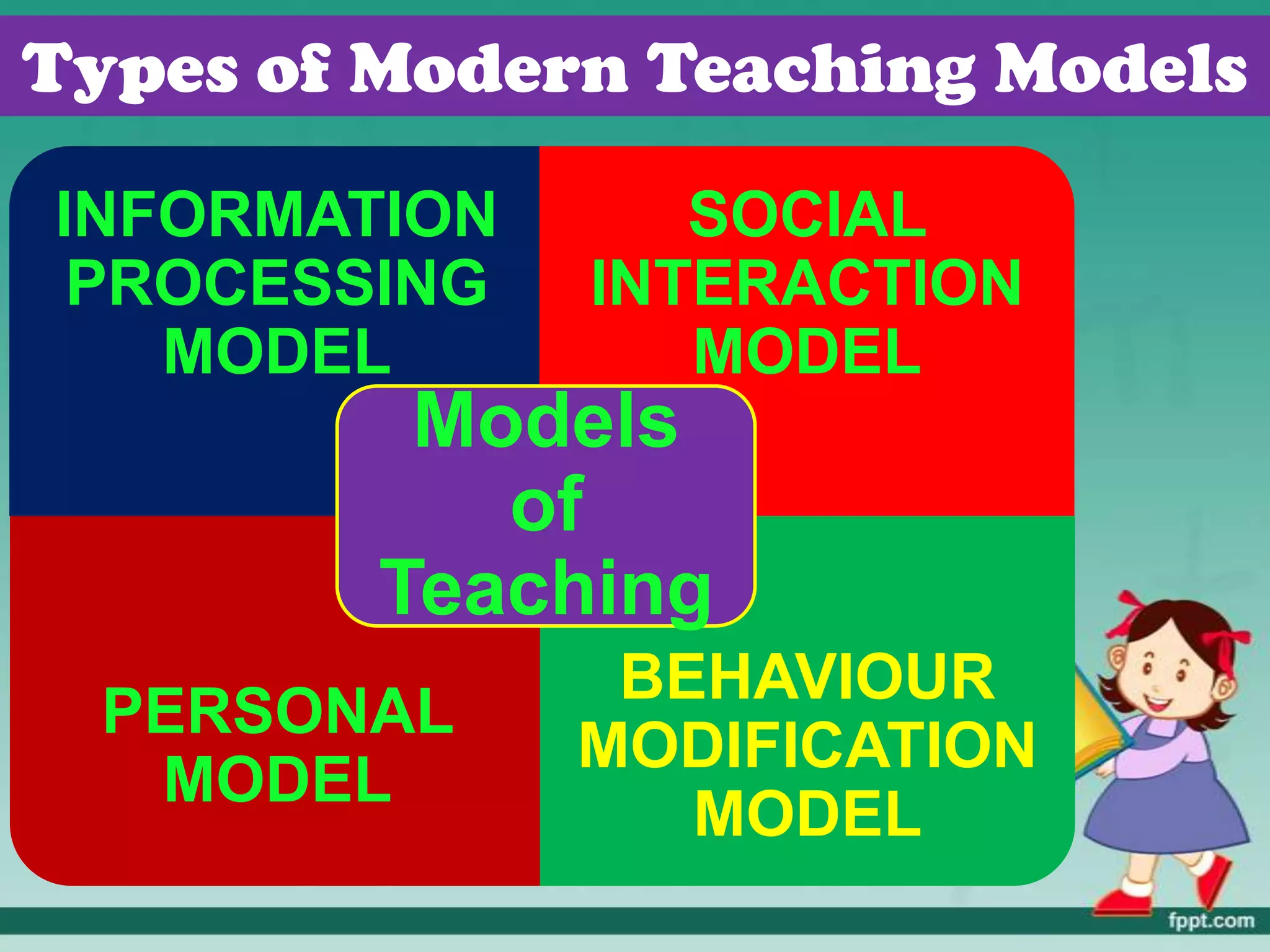
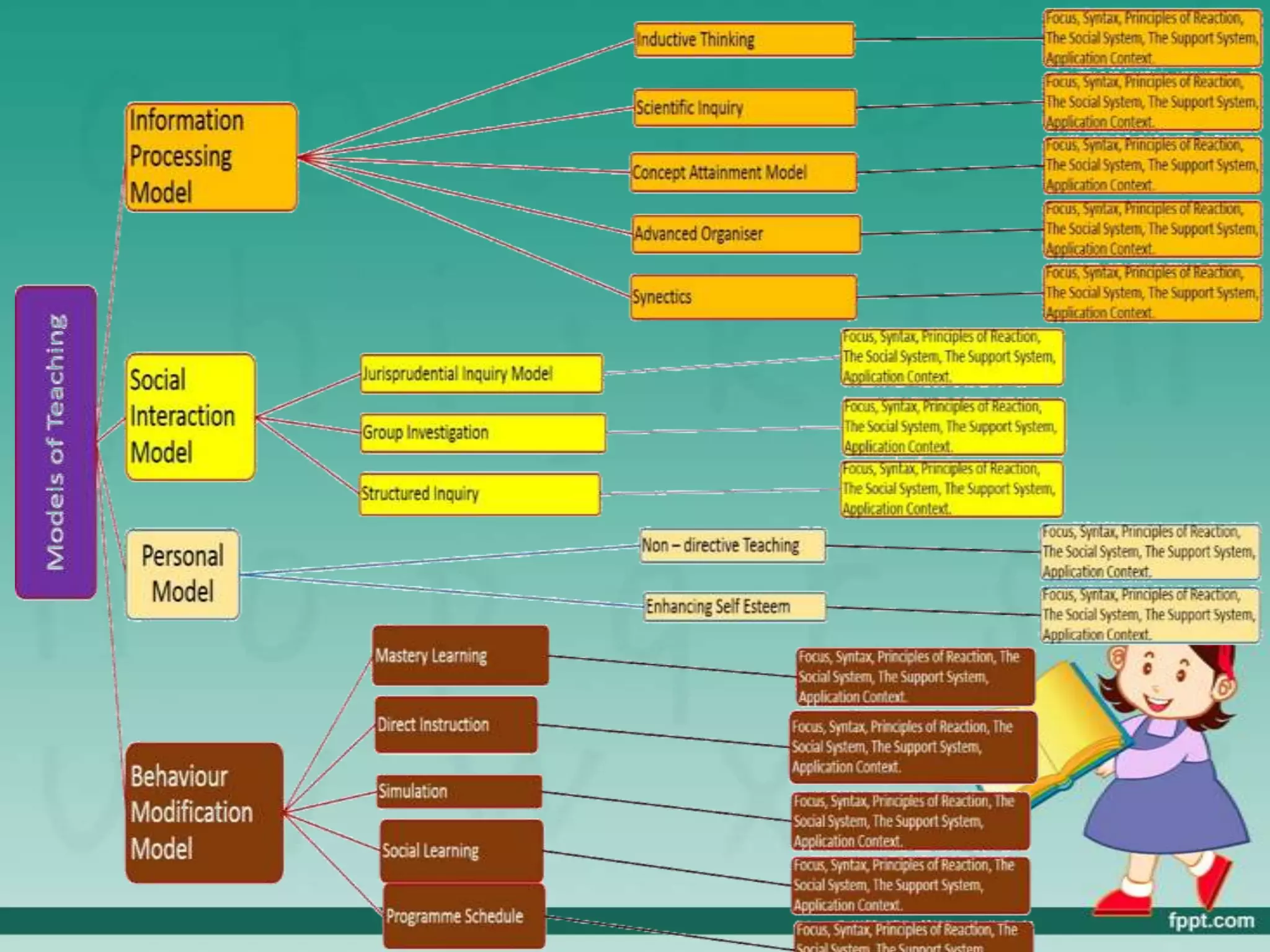
Types of Modern Teaching Models
INFORMATION
PROCESSING
MODEL
SOCIAL
INTERACTION
MODEL
PERSONAL
MODEL
BEHAVIOUR
MODIFICATION
MODEL
Models
of
Teaching
Types of Modern Teaching Models
INFORMATION PROCESSING MODEL
Information processing models refer to the way
people handle stimuli from the environment,
organize data, sense problem, generate concepts
and solution to problems and use verbal and
nonverbal symbols.
SOCIAL INTERACTION MODEL
Social interaction model stress the
relationship to the individual to other
person and to society.
Conti….
PERSONAL MODEL
Personal development models assist the individual in
the development of selfhood, they focus on the
emotional life of an individual .
BEHAVIOUR MODIFICATION MODEL
Behaviour modification models stress
on changing the behaviour of the
learner and describe them in terms of
visible behaviour
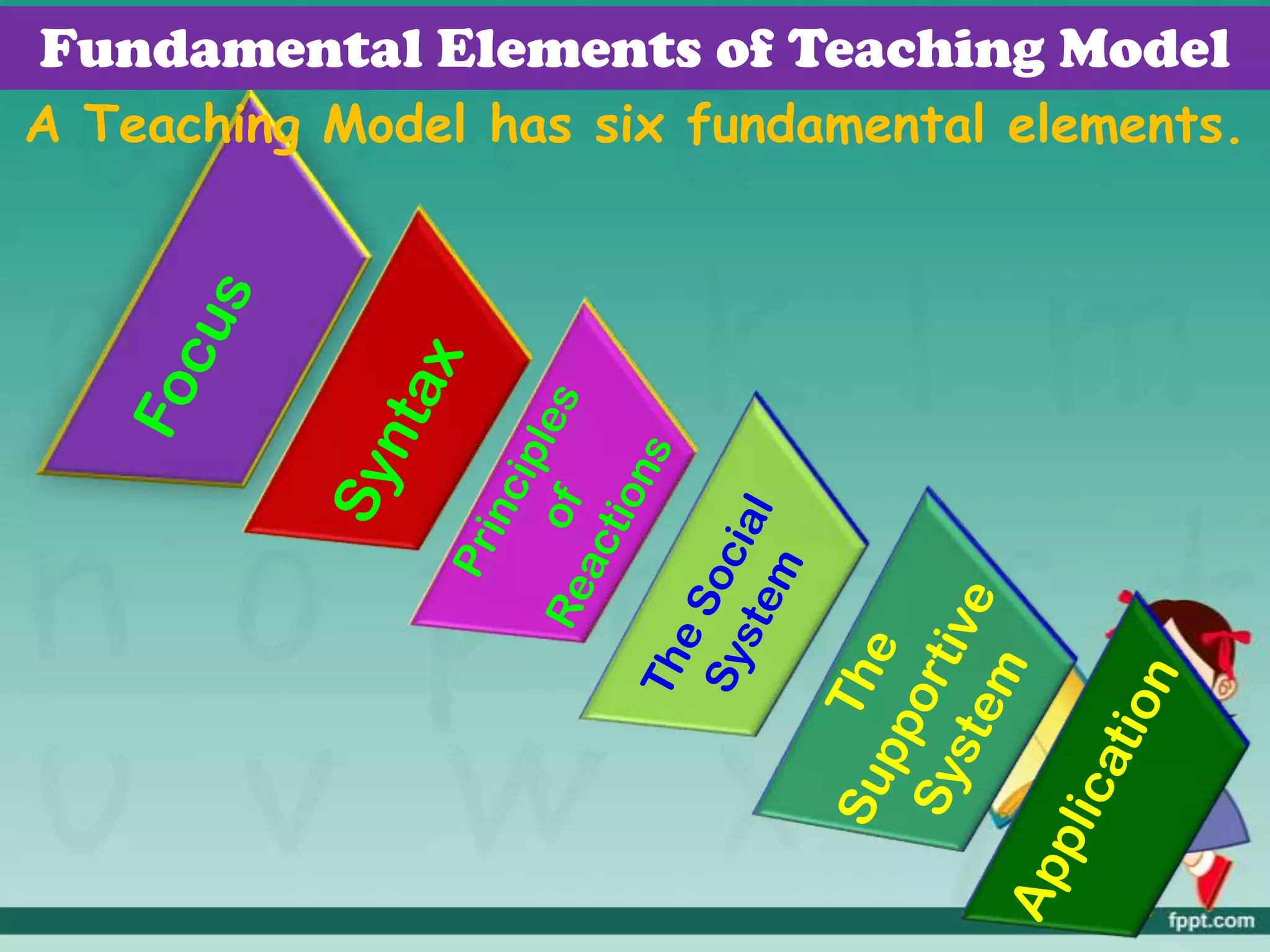
Fundamental Elements of Teaching Model
A Teaching Model has six fundamental elements.
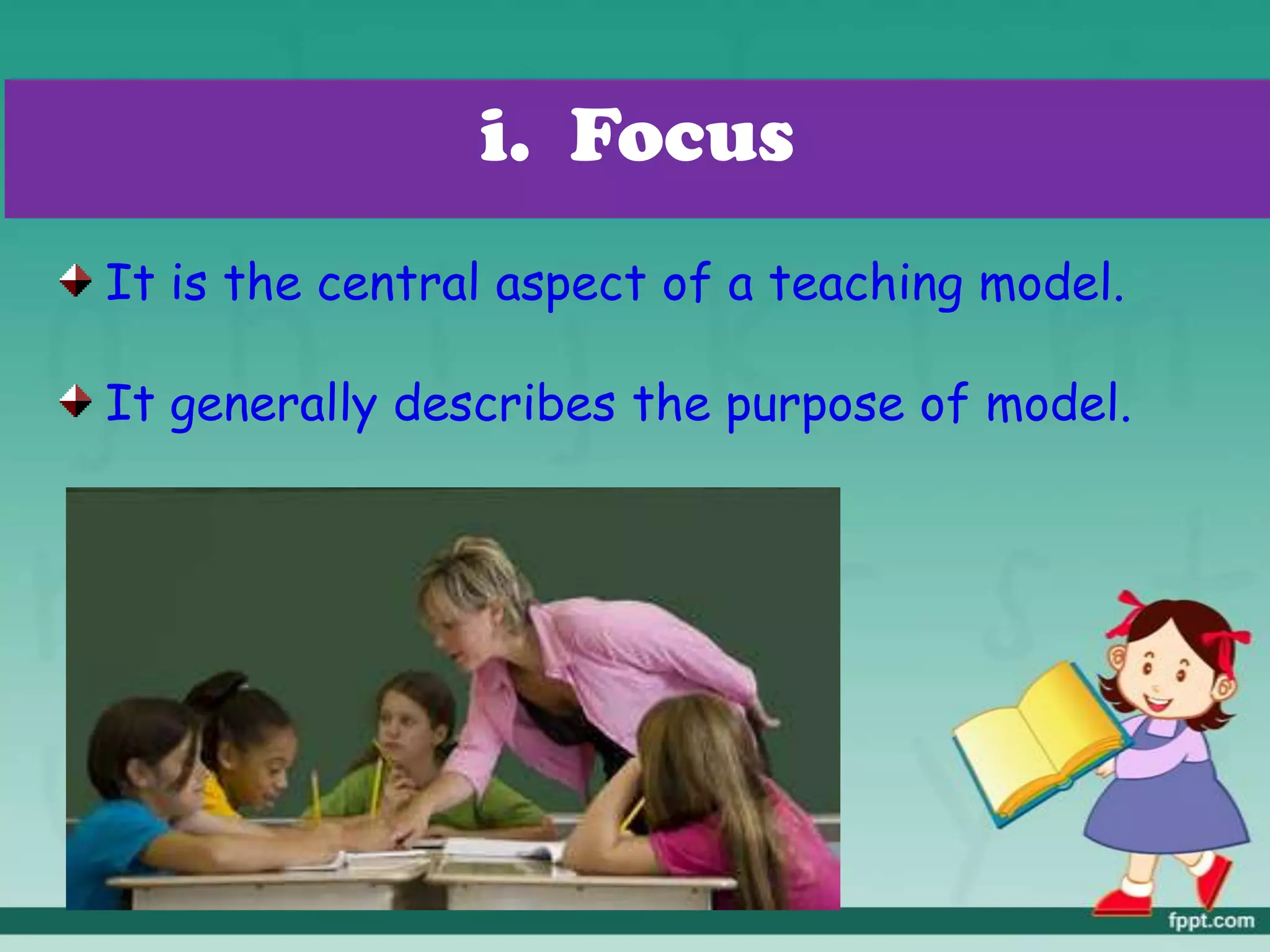
It is the central aspect of a teaching model.
It generally describes the purpose of model.
i. Focus
ii. Syntax
This is description of how the various phases in the
development of a lesson are sequenced when the
model is translated in to action.
The phases involved in the different models will
differ.
Syntax helps a teacher to use the model,
& how he should begin & proceed further.
iii. Principles of Reaction
This defines the nature of reaction expected from
the teacher to every pupil activity.
The principles of reaction give guidance to the
teacher as to how he is expected to react to each
activity of the learners, to suit the characteristics
of the model selected.
It helps to maintain interactive roles and
relationships between the teacher and students.
It emphasizes the kinds of norms that are
encouraged and the student behaviour that is
rewarded.
iv. The Social System
v. The Supportive System
Every model of teaching warrants certain
conditions and facilities for the realization of the
goal.
A description of this support system will help the
teacher ensure that he can apply model
successfully.
Support system demands some
special skill, knowledge & capacities
from the teacher or some special aid
like films, self instructional system &
a flexible schedule.
vi. Application
It describes the application aspect.
This element helps to describe the feasibility of
the models in varying contexts, achieving specific
educational goal and demanding specific work
environment.
Merits of models in Teaching
It is a natural way of teaching and learning.
It is helpful in developing the power of imagination
of the students.
It helps in the developments of reasoning power
of the students.
It saves the energy, time and efforts
of the teachers.
 It helps the students to analyze things
systematically.
 It keeps students actively engaged in the
classroom activity.
 Provide systematic procedure and
organized efforts.
Conti.….
 Give specific instructional designs
for particular type of instruction.
REFERENCES
• Essentials of Educational technology-
S.K.Mangal,Uma Mangal,PHI Learning Private
Limited,New Delhi,2011,pg no-(556-563)
• Pathak R. P., & Chaudhary Jagdeesh,(2012),
Educational Technology, New Delhi, Dorling
Kindersley (India) Pvt. Ltd.
• Joyce, Bruce,Weil,Marsha, Models of
teaching,(7thed.),Bacon,2004
Models of teaching smitarani behera final

Models of teaching smitarani behera final

  • 2.
    M. Ed. (2013– 2014) School Of Education Pondicherry University
  • 3.
    CONTENTS 1. Introduction. 2.What isTeaching? 3.What are Models? 4.What is Teaching Models? 5.Concept of Teaching Models. 6.Definition of Models of Teaching. 7.Characteristics of Teaching Models 8.Function of teaching Models. 9. Types of Modern Teaching Models. Information Processing Model Social Interaction Model Personal Interaction Model Behavior Modification Model
  • 4.
    9. Fundamental Elementsof Teaching Model  Focus  Syntax  Principles of Reactions  The Social System  The Supportive System  Application context 10.Merits of Models of Teaching CONTENTS
  • 5.
    INTRODUCTION Development of Modelsof teaching is the recent innovation in teaching. An important purpose of discussing models of teaching is to assist the teacher to have a wide range of approaches for creating a proper interactive environment for learning needs of the students. Educators and psychologist have design several types of teaching models which provides suitable guidelines to the teachers for modifying the behavior of the learners.
  • 6.
    What is teaching? H.C.Morrison(1934); Teaching is a system of actions intended to produce learning. Clarke (1970); Teaching refers to activities that are designed & performed to produce change in students’ behaviour.
  • 7.
    Models are mental reconstructionof reality. They are representation used as aids to easily remember parts and or functions of a certain system, cycle, objects, etc. What are MODELS?
  • 8.
    What is TeachingModel? “A model of teaching is a plan or pattern that can be used to shape curriculums (long-term courses of studies), to design instructional materials, and to guide a teacher’s action in the classroom and other settings” - Joyce and Weil (1980)
  • 9.
    Definition of Modelsof Teaching JOYCE AND WEIL (1972); Teaching of model is a pattern or plan, which can be a curriculum or courses to select instructional materials and to guide a teachers action. Jangira (1983);“A model of teaching is a set of interrelated components arranged in a sequence which provides guidelines to realise specific goal.
  • 10.
    Concept of TeachingModel Aim of The Teaching Model: To Produce Effective Teaching. Teaching Objectives Set Induction Teaching – Learning Activities Evaluation
  • 11.
    Main Characteristics ofTeaching Models Specification of learning outcome Specification on Environment Specification of criterion of performances Specification of Operation Scientific Procedure
  • 12.
    Function of Teaching Model Formulate acomplete & perfect teaching scheme. Enable teachers to analyze & evaluate its strengths & weaknesses so as to plan & implement appropriate follow-up actionsAs basic guidance for teachers for reflection during feedback session. Provide guidance to planners & teachers to enable them to plan & carry out the teaching process effectively.
  • 13.
    Function of TeachingModels They help in guiding the teacher to select appropriate teaching techniques, Strategies and Methods for the effective utilization of the teaching situation and material for realizing the objectives. They help in bringing about desirable change in the behavior of the learners.
  • 14.
    They help infinding out ways and means of creating favorable environmental situation for carrying out teaching process. They help in achieving desirable teacher – pupil interaction during teaching. Conti….. They help in the construction of curriculum or contents of a course. They help in designing appropriate educational activities.
  • 15.
    Conti….. They help inthe proper selection of instruction material for teaching the prepared course or curriculum. They assist procedure of material to create interesting and effective materials and learning source. They stimulate the development of new educational innovations.
  • 16.
    Types of ModernTeaching Models INFORMATION PROCESSING MODEL SOCIAL INTERACTION MODEL PERSONAL MODEL BEHAVIOUR MODIFICATION MODEL Models of Teaching
  • 17.
    Types of ModernTeaching Models INFORMATION PROCESSING MODEL Information processing models refer to the way people handle stimuli from the environment, organize data, sense problem, generate concepts and solution to problems and use verbal and nonverbal symbols. SOCIAL INTERACTION MODEL Social interaction model stress the relationship to the individual to other person and to society.
  • 18.
    Conti…. PERSONAL MODEL Personal developmentmodels assist the individual in the development of selfhood, they focus on the emotional life of an individual . BEHAVIOUR MODIFICATION MODEL Behaviour modification models stress on changing the behaviour of the learner and describe them in terms of visible behaviour
  • 19.
    Fundamental Elements ofTeaching Model A Teaching Model has six fundamental elements.
  • 20.
    It is thecentral aspect of a teaching model. It generally describes the purpose of model. i. Focus
  • 21.
    ii. Syntax This isdescription of how the various phases in the development of a lesson are sequenced when the model is translated in to action. The phases involved in the different models will differ. Syntax helps a teacher to use the model, & how he should begin & proceed further.
  • 22.
    iii. Principles ofReaction This defines the nature of reaction expected from the teacher to every pupil activity. The principles of reaction give guidance to the teacher as to how he is expected to react to each activity of the learners, to suit the characteristics of the model selected.
  • 23.
    It helps tomaintain interactive roles and relationships between the teacher and students. It emphasizes the kinds of norms that are encouraged and the student behaviour that is rewarded. iv. The Social System
  • 24.
    v. The SupportiveSystem Every model of teaching warrants certain conditions and facilities for the realization of the goal. A description of this support system will help the teacher ensure that he can apply model successfully. Support system demands some special skill, knowledge & capacities from the teacher or some special aid like films, self instructional system & a flexible schedule.
  • 25.
    vi. Application It describesthe application aspect. This element helps to describe the feasibility of the models in varying contexts, achieving specific educational goal and demanding specific work environment.
  • 26.
    Merits of modelsin Teaching It is a natural way of teaching and learning. It is helpful in developing the power of imagination of the students. It helps in the developments of reasoning power of the students. It saves the energy, time and efforts of the teachers.
  • 27.
     It helpsthe students to analyze things systematically.  It keeps students actively engaged in the classroom activity.  Provide systematic procedure and organized efforts. Conti.….  Give specific instructional designs for particular type of instruction.
  • 30.
    REFERENCES • Essentials ofEducational technology- S.K.Mangal,Uma Mangal,PHI Learning Private Limited,New Delhi,2011,pg no-(556-563) • Pathak R. P., & Chaudhary Jagdeesh,(2012), Educational Technology, New Delhi, Dorling Kindersley (India) Pvt. Ltd. • Joyce, Bruce,Weil,Marsha, Models of teaching,(7thed.),Bacon,2004