DR. C. BEULAH JAYARANI
M.Sc., M.A, M.Ed., M.Phil. (Edn), M.Phil. (ZOO), NET, Ph. D
ASST. PROFESSOR,
LOYOLA COLLEGE OF EDUCATION, CHENNAI - 34
MORRISON TECHNIQUE
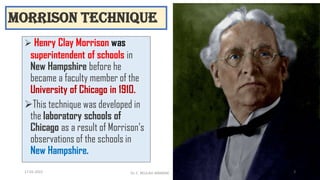
 Henry Clay Morrison was
superintendent of schools in
New Hampshire before he
became a faculty member of the
University of Chicago in 1910.
This technique was developed in
the laboratory schools of
Chicago as a result of Morrison’s
observations of the schools in
New Hampshire.
17-01-2022 Dr. C. BEULAH JAYARANI 2
MORRISON MASTERY LEARNING TECHNIQUE
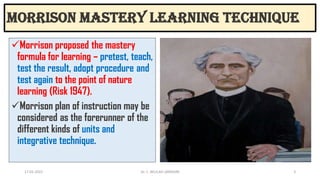
Morrison proposed the mastery
formula for learning – pretest, teach,
test the result, adopt procedure and
test again to the point of nature
learning (Risk 1947).
Morrison plan of instruction may be
considered as the forerunner of the
different kinds of units and
integrative technique.
17-01-2022 Dr. C. BEULAH JAYARANI 3
MORRISON TECHNIQUE
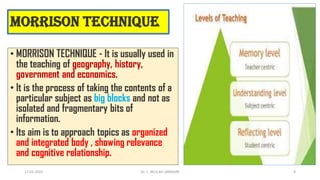
• MORRISON TECHNIQUE - It is usually used in
the teaching of geography, history,
government and economics.
• It is the process of taking the contents of a
particular subject as big blocks and not as
isolated and fragmentary bits of
information.
• Its aim is to approach topics as organized
and integrated body , showing relevance
and cognitive relationship.
17-01-2022 Dr. C. BEULAH JAYARANI 4
• Understanding level of teaching Teacher tries to
present his instructions at the understanding
level.
• Makes the pupils understand the
generalizations, principles & facts.
• Teacher tries to provide more & more
opportunities to develop the intellectual
behaviors of the pupils.
• Both pupils & the teachers participate in
developing the lesson while teaching occurs at
the understanding level.
17-01-2022 Dr. C. BEULAH JAYARANI 5
Morrison’s teaching Model
• Morrison’s model of
Understanding
• The model of understanding
– level teaching was
indoctrinated by Morrison, it
is named as “Morrison’s
teaching Model”
17-01-2022 Dr. C. BEULAH JAYARANI 6
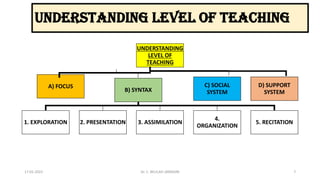
UNDERSTANDING LEVEL OF TEACHING
UNDERSTANDING
LEVEL OF
TEACHING
A) FOCUS
B) SYNTAX
1. EXPLORATION 2. PRESENTATION 3. ASSIMILATION
4.
ORGANIZATION
5. RECITATION
C) SOCIAL
SYSTEM
D) SUPPORT
SYSTEM
17-01-2022 Dr. C. BEULAH JAYARANI 7
Focus
The pupil should achieve the
mastery of the concept.
Teacher stresses upon the mastery
of the content so that a desirable
change may occur in the
personality of the pupils.
17-01-2022 Dr. C. BEULAH JAYARANI 8
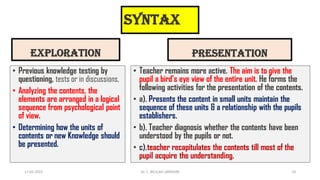
Syntax
Syntax divided
into five steps
Exploration Presentation Assimilation Organization Recitation
17-01-2022 Dr. C. BEULAH JAYARANI 9
Exploration
• Previous knowledge testing by
questioning, tests or in discussions,
• Analyzing the contents, the
elements are arranged in a logical
sequence from psychological point
of view.
• Determining how the units of
contents or new Knowledge should
be presented.
Presentation
• Teacher remains more active. The aim is to give the
pupil a bird’s eye view of the entire unit. He forms the
following activities for the presentation of the contents.
• a). Presents the content in small units maintain the
sequence of these units & a relationship with the pupils
establishers.
• b). Teacher diagnosis whether the contents have been
understood by the pupils or not.
• c).teacher recapitulates the contents till most of the
pupil acquire the understanding.
Syntax
17-01-2022 Dr. C. BEULAH JAYARANI 10
Assimilation
• Teacher provides pupils opportunities for
assimilation. Assimilation has the
following characteristics.
• a). Pupils are provided with occasions for
generation through assimilation.
• b). Opportunities are provided in order to
stress upon the depth of the content.
• c). At the time of assimilation, every pupil
studies in accordance with his
requirement.
• d). In assimilation, the pupils work themselves in
laboratories & libraries.
• e). Supervised study occurs.
• f). Both pupils & teachers remain active.
• g). The pupils perform individual activities &
teachers guide them according to the need
during supervision.
• h). During the assimilation period, the teacher
tests whether the pupils have achieved mastery
over the content or not by diagnostic test at the
end.
Syntax
17-01-2022 Dr. C. BEULAH JAYARANI 11
Organization
• Pupils are provided with the occasions
for representation, all the pupil write
contents in their own language.
• The teacher comes to the conclusion
whether the pupils can write the
contents without anybody’s help or not.
The re – presentation in the subjects like
mathematics, grammar & arithmetic etc,
has no importance.
Recitation
• Last step of understanding level teaching.
• The pupils present the contents orally before
the teacher & his mates.
• Now the class performs while the teacher
and the other pupils listen.
• In the unit recitation, the pupil has mastery
of what he is talking about and may give a
report or lecture for a given time.
• This step should be the liveliest part.
Syntax
17-01-2022 Dr. C. BEULAH JAYARANI 12
Social system
• Teacher controls the behavior of
the pupils by provides
motivation.
• Teacher imparts instruction to
the pupils they work themselves
with full involvement.
• Both extensive & intrinsic
motivation is used.
17-01-2022 Dr. C. BEULAH JAYARANI 13
Support System
• Support system does not remain static,
but it goes on changing. In assimilation,
the pupils have to pass the examination.
• Assimilation test pass – essentially for
their entry into organization &
recitation. End of organization period, a
written test takes place.
• Recitation is followed be an oral test. Both
oral & written tests (Essay type &
objective type) occur during the various
steps of understanding level of teaching.
17-01-2022 Dr. C. BEULAH JAYARANI 14
CONCLUSION
• It’s a more deliberate teaching method in which
students interact with concepts and, as the name
implies, comprehend the content. They evaluate the
concepts and bring together the facts and other notions
associated with them based on the students' prior
awareness and comprehension level.
• The teachers and students are equally involved in this
process and teachers make use of discussions,
lectures, explanations and similar methods in this
teaching level.
• The classroom environment is inclusive and engaging.
17-01-2022 Dr. C. BEULAH JAYARANI 15

Morrison teaching model

  • 1.
    DR. C. BEULAHJAYARANI M.Sc., M.A, M.Ed., M.Phil. (Edn), M.Phil. (ZOO), NET, Ph. D ASST. PROFESSOR, LOYOLA COLLEGE OF EDUCATION, CHENNAI - 34
  • 2.
    MORRISON TECHNIQUE  HenryClay Morrison was superintendent of schools in New Hampshire before he became a faculty member of the University of Chicago in 1910. This technique was developed in the laboratory schools of Chicago as a result of Morrison’s observations of the schools in New Hampshire. 17-01-2022 Dr. C. BEULAH JAYARANI 2
  • 3.
    MORRISON MASTERY LEARNINGTECHNIQUE Morrison proposed the mastery formula for learning – pretest, teach, test the result, adopt procedure and test again to the point of nature learning (Risk 1947). Morrison plan of instruction may be considered as the forerunner of the different kinds of units and integrative technique. 17-01-2022 Dr. C. BEULAH JAYARANI 3
  • 4.
    MORRISON TECHNIQUE • MORRISONTECHNIQUE - It is usually used in the teaching of geography, history, government and economics. • It is the process of taking the contents of a particular subject as big blocks and not as isolated and fragmentary bits of information. • Its aim is to approach topics as organized and integrated body , showing relevance and cognitive relationship. 17-01-2022 Dr. C. BEULAH JAYARANI 4
  • 5.
    • Understanding levelof teaching Teacher tries to present his instructions at the understanding level. • Makes the pupils understand the generalizations, principles & facts. • Teacher tries to provide more & more opportunities to develop the intellectual behaviors of the pupils. • Both pupils & the teachers participate in developing the lesson while teaching occurs at the understanding level. 17-01-2022 Dr. C. BEULAH JAYARANI 5
  • 6.
    Morrison’s teaching Model •Morrison’s model of Understanding • The model of understanding – level teaching was indoctrinated by Morrison, it is named as “Morrison’s teaching Model” 17-01-2022 Dr. C. BEULAH JAYARANI 6
  • 7.
    UNDERSTANDING LEVEL OFTEACHING UNDERSTANDING LEVEL OF TEACHING A) FOCUS B) SYNTAX 1. EXPLORATION 2. PRESENTATION 3. ASSIMILATION 4. ORGANIZATION 5. RECITATION C) SOCIAL SYSTEM D) SUPPORT SYSTEM 17-01-2022 Dr. C. BEULAH JAYARANI 7
  • 8.
    Focus The pupil shouldachieve the mastery of the concept. Teacher stresses upon the mastery of the content so that a desirable change may occur in the personality of the pupils. 17-01-2022 Dr. C. BEULAH JAYARANI 8
  • 9.
    Syntax Syntax divided into fivesteps Exploration Presentation Assimilation Organization Recitation 17-01-2022 Dr. C. BEULAH JAYARANI 9
  • 10.
    Exploration • Previous knowledgetesting by questioning, tests or in discussions, • Analyzing the contents, the elements are arranged in a logical sequence from psychological point of view. • Determining how the units of contents or new Knowledge should be presented. Presentation • Teacher remains more active. The aim is to give the pupil a bird’s eye view of the entire unit. He forms the following activities for the presentation of the contents. • a). Presents the content in small units maintain the sequence of these units & a relationship with the pupils establishers. • b). Teacher diagnosis whether the contents have been understood by the pupils or not. • c).teacher recapitulates the contents till most of the pupil acquire the understanding. Syntax 17-01-2022 Dr. C. BEULAH JAYARANI 10
  • 11.
    Assimilation • Teacher providespupils opportunities for assimilation. Assimilation has the following characteristics. • a). Pupils are provided with occasions for generation through assimilation. • b). Opportunities are provided in order to stress upon the depth of the content. • c). At the time of assimilation, every pupil studies in accordance with his requirement. • d). In assimilation, the pupils work themselves in laboratories & libraries. • e). Supervised study occurs. • f). Both pupils & teachers remain active. • g). The pupils perform individual activities & teachers guide them according to the need during supervision. • h). During the assimilation period, the teacher tests whether the pupils have achieved mastery over the content or not by diagnostic test at the end. Syntax 17-01-2022 Dr. C. BEULAH JAYARANI 11
  • 12.
    Organization • Pupils areprovided with the occasions for representation, all the pupil write contents in their own language. • The teacher comes to the conclusion whether the pupils can write the contents without anybody’s help or not. The re – presentation in the subjects like mathematics, grammar & arithmetic etc, has no importance. Recitation • Last step of understanding level teaching. • The pupils present the contents orally before the teacher & his mates. • Now the class performs while the teacher and the other pupils listen. • In the unit recitation, the pupil has mastery of what he is talking about and may give a report or lecture for a given time. • This step should be the liveliest part. Syntax 17-01-2022 Dr. C. BEULAH JAYARANI 12
  • 13.
    Social system • Teachercontrols the behavior of the pupils by provides motivation. • Teacher imparts instruction to the pupils they work themselves with full involvement. • Both extensive & intrinsic motivation is used. 17-01-2022 Dr. C. BEULAH JAYARANI 13
  • 14.
    Support System • Supportsystem does not remain static, but it goes on changing. In assimilation, the pupils have to pass the examination. • Assimilation test pass – essentially for their entry into organization & recitation. End of organization period, a written test takes place. • Recitation is followed be an oral test. Both oral & written tests (Essay type & objective type) occur during the various steps of understanding level of teaching. 17-01-2022 Dr. C. BEULAH JAYARANI 14
  • 15.
    CONCLUSION • It’s amore deliberate teaching method in which students interact with concepts and, as the name implies, comprehend the content. They evaluate the concepts and bring together the facts and other notions associated with them based on the students' prior awareness and comprehension level. • The teachers and students are equally involved in this process and teachers make use of discussions, lectures, explanations and similar methods in this teaching level. • The classroom environment is inclusive and engaging. 17-01-2022 Dr. C. BEULAH JAYARANI 15