MEMORY LEVEL OF TEACHING -
HERBARTIAN APPROACH
DR. C. BEULAH JAYARANI
M.Sc., M.A, M.Ed, M.Phil (Edn), M.Phil (ZOO), NET, Ph.D
ASST. PROFESSOR,
LOYOLA COLLEGE OF EDUCATION, CHENNAI - 34
Memory Level of Teaching
The facts & the information of the cognitive
level are forcibly supplied to the brains of the
pupils.
Signal learning, chain learning & stimulus –
response learning are emphasized.
Teacher – centered.
Both essay type & objective type
examinations are used to evaluate the learn
contents. This level has the maximum level of
motivation.
17-01-2022 Dr. C. BEULAH JAYARANI 2
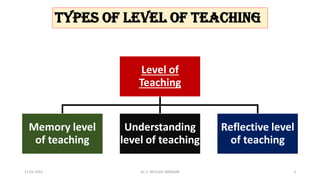
TYPES OF LEVEL OF TEACHING
Level of
Teaching
Memory level
of teaching
Understanding
level of teaching
Reflective level
of teaching
17-01-2022 Dr. C. BEULAH JAYARANI 3
INTRODUCTION
“ Nothing is so fatal for a teacher as
unpreparedness” - Davis
Education is the method by which a society
gets from one generation to the next.
A daily lesson plan is developed by a teacher
to guide class learning. Details will vary
depending on the preference of the
teacher, subject being covered, and the
needs of the students.
Interest develops when already strong and
vivid ideas are hospitable towards new ones,
thus past occasions motivate apperception of
current ones.
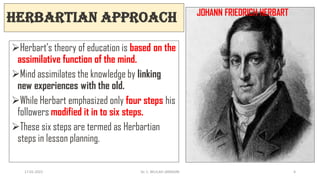
JOHANN FRIEDRICH HERBART
17-01-2022 Dr. C. BEULAH JAYARANI 4
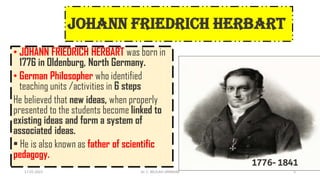
JOHANN FRIEDRICH HERBART
• JOHANN FRIEDRICH HERBART was born in
1776 in Oldenburg, North Germany.
• German Philosopher who identified
teaching units /activities in 6 steps
He believed that new ideas, when properly
presented to the students become linked to
existing ideas and form a system of
associated ideas.
• He is also known as father of scientific
pedagogy.
1776- 1841
17-01-2022 Dr. C. BEULAH JAYARANI 5
Herbartian Approach
Herbart’s theory of education is based on the
assimilative function of the mind.
Mind assimilates the knowledge by linking
new experiences with the old.
While Herbart emphasized only four steps his
followers modified it in to six steps.
These six steps are termed as Herbartian
steps in lesson planning.
JOHANN FRIEDRICH HERBART
17-01-2022 Dr. C. BEULAH JAYARANI 6
SIX STEPS OF HERBARTIANS ARE……
1. PREPARATION/ INTRODUCTION
2. PRESENTATION
3. ASSOCIATION AND COMPARISON
4. GENERALIZATION
5. APPLICATION
6. RECAPITULATION
17-01-2022 Dr. C. BEULAH JAYARANI 7
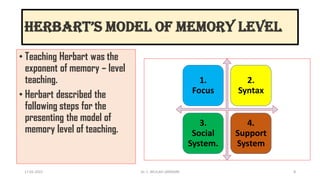
HERBART’S MOdEl OF MEMORy lEvEl
• Teaching Herbart was the
exponent of memory – level
teaching.
• Herbart described the
following steps for the
presenting the model of
memory level of teaching.
1.
Focus
2.
Syntax
3.
Social
System.
4.
Support
System
17-01-2022 Dr. C. BEULAH JAYARANI 8
Focus
Focus Emphasis on cramming of
facts & development of the following
capacities.
• 1. Training of mental aspects.
• 2. Providing knowledge of facts.
• 3. Retaining the learnt facts.
• 4. Recalling & Re – presenting the
learnt facts.
17-01-2022 Dr. C. BEULAH JAYARANI 9
Syntax
Syntax Herbert’s five steps:
• 1. a). Preparation. b). Statement
of aim
• 2. Presentation
• 3. Comparison of association
• 4. Generalization
• 5. Application
17-01-2022 Dr. C. BEULAH JAYARANI 10
The mind of the child must be prepared to receive new
knowledge. It is just like preparing the land before sawing the seed.
There are several techniques to prepare the students for learning.
Asking questions related to previous knowledge, narrating a
story, related to the topic, arousing curiosity by presenting an
exhibit or new facts, doing a simple experiment, narrating a
situation which leads to the lesson
It is better if the preparation stage culminates in the
announcement of the title of the lesson. By asking questions that
may reveal their ignorance, arouse interest and curiosity to
learn the new matter.
Through the use of chart, maps or pictures, through skillful
conversation it should be noted that this step should not in any
case take more than five minutes.
17-01-2022 Dr. C. BEULAH JAYARANI 11
Presentation
• In the presentation stage pupils acquire new ideas
and knowledge. Presenting new material by means
of concrete objects or actual experience.
• Both teacher and the pupils should be active
participants in the teaching learning process.
• The teacher should try to elicit from the students
as much as possible using questioning.
• Demonstration, charts, models and other
teaching aids shall be used to make the lesson
more interesting.
• Black board is to be used to summarize the
lesson.
17-01-2022 Dr. C. BEULAH JAYARANI 12
Comparison and Association
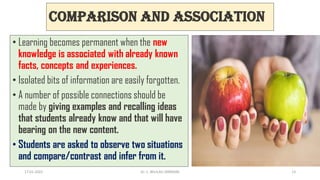
• Learning becomes permanent when the new
knowledge is associated with already known
facts, concepts and experiences.
• Isolated bits of information are easily forgotten.
• A number of possible connections should be
made by giving examples and recalling ideas
that students already know and that will have
bearing on the new content.
• Students are asked to observe two situations
and compare/contrast and infer from it.
17-01-2022 Dr. C. BEULAH JAYARANI 13
Generalization
Generalization is a process of abstraction. In this step the aim of the
lesson is achieved.
This step involves reflective thinking because the whole knowledge learnt in
preparation is to be systematized which leads to generalization , formulae,
rules etc., through comparison or association.
This step completes the enquiry by providing the answer to the problem with
which it began. Thus , the students get a new knowledge and helps the
learner to develop an understanding about a group of objects or events.
At this stage teacher converges the ideas into a generalized form in the
style of definition, principle or formula.
A procedure especially important to the instruction of adolescents and
designed to develop the mind beyond the level of perception and the
concrete.
17-01-2022 Dr. C. BEULAH JAYARANI 14
Application
The knowledge and understanding developed by
a student is worth only if he or she uses it in
new situations.
The application stage gives learner an
opportunity to make use of the acquired
knowledge in new or unfamiliar situations.
In this way , the new knowledge gained by the
pupils will become permanent in the minds of
the students and will not fade from
consciousness soon.
17-01-2022 Dr. C. BEULAH JAYARANI 15
Recapitulation
This is the last step. Teacher summarizes the
complete lesson. The understanding and
comprehension of the subject-matter taught by
the teacher can be tested by putting some
suitable questions on the topics to the students.
It is reviewing the students’ achievement.
This will also help the teacher to find out
whether his method of teaching is effective
and successful or not.
This is used for assessing or evaluating the
effectiveness of the lesson.
17-01-2022 Dr. C. BEULAH JAYARANI 16
Social system
• The process of teaching is social &
professional. Pupils & teacher are
members of this social system.
Teacher occupies the primary place &
pupils have secondary place. Function
of the Teacher:
• 1. Presenting the contents.
• 2. Controlling the pupils activities.
• 3. Providing motivation.
17-01-2022 Dr. C. BEULAH JAYARANI 17
Support System
• Cramming is stressed.
• Both oral & written examinations
are used.
• Essay type examination is more
useful.
• Recall & recognition are used
successfully through the
objective type examination.
17-01-2022 Dr. C. BEULAH JAYARANI 18
conclusion
• The objective of the Memory Level of teaching
is just to impart information or knowledge
to the learner.
• This knowledge or information is factual in
nature, which is acquired through a mechanical
process (i.e. memorization or rote learning).
• Memory level of teaching is a teacher-
dominated curriculum where methods like a
drill, revision, and question-answer series
are done
17-01-2022 Dr. C. BEULAH JAYARANI 19

MEMORY LEVEL OF TEACHING -HERBARTIAN APPROACH

  • 1.
    MEMORY LEVEL OFTEACHING - HERBARTIAN APPROACH DR. C. BEULAH JAYARANI M.Sc., M.A, M.Ed, M.Phil (Edn), M.Phil (ZOO), NET, Ph.D ASST. PROFESSOR, LOYOLA COLLEGE OF EDUCATION, CHENNAI - 34
  • 2.
    Memory Level ofTeaching The facts & the information of the cognitive level are forcibly supplied to the brains of the pupils. Signal learning, chain learning & stimulus – response learning are emphasized. Teacher – centered. Both essay type & objective type examinations are used to evaluate the learn contents. This level has the maximum level of motivation. 17-01-2022 Dr. C. BEULAH JAYARANI 2
  • 3.
    TYPES OF LEVELOF TEACHING Level of Teaching Memory level of teaching Understanding level of teaching Reflective level of teaching 17-01-2022 Dr. C. BEULAH JAYARANI 3
  • 4.
    INTRODUCTION “ Nothing isso fatal for a teacher as unpreparedness” - Davis Education is the method by which a society gets from one generation to the next. A daily lesson plan is developed by a teacher to guide class learning. Details will vary depending on the preference of the teacher, subject being covered, and the needs of the students. Interest develops when already strong and vivid ideas are hospitable towards new ones, thus past occasions motivate apperception of current ones. JOHANN FRIEDRICH HERBART 17-01-2022 Dr. C. BEULAH JAYARANI 4
  • 5.
    JOHANN FRIEDRICH HERBART •JOHANN FRIEDRICH HERBART was born in 1776 in Oldenburg, North Germany. • German Philosopher who identified teaching units /activities in 6 steps He believed that new ideas, when properly presented to the students become linked to existing ideas and form a system of associated ideas. • He is also known as father of scientific pedagogy. 1776- 1841 17-01-2022 Dr. C. BEULAH JAYARANI 5
  • 6.
    Herbartian Approach Herbart’s theoryof education is based on the assimilative function of the mind. Mind assimilates the knowledge by linking new experiences with the old. While Herbart emphasized only four steps his followers modified it in to six steps. These six steps are termed as Herbartian steps in lesson planning. JOHANN FRIEDRICH HERBART 17-01-2022 Dr. C. BEULAH JAYARANI 6
  • 7.
    SIX STEPS OFHERBARTIANS ARE…… 1. PREPARATION/ INTRODUCTION 2. PRESENTATION 3. ASSOCIATION AND COMPARISON 4. GENERALIZATION 5. APPLICATION 6. RECAPITULATION 17-01-2022 Dr. C. BEULAH JAYARANI 7
  • 8.
    HERBART’S MOdEl OFMEMORy lEvEl • Teaching Herbart was the exponent of memory – level teaching. • Herbart described the following steps for the presenting the model of memory level of teaching. 1. Focus 2. Syntax 3. Social System. 4. Support System 17-01-2022 Dr. C. BEULAH JAYARANI 8
  • 9.
    Focus Focus Emphasis oncramming of facts & development of the following capacities. • 1. Training of mental aspects. • 2. Providing knowledge of facts. • 3. Retaining the learnt facts. • 4. Recalling & Re – presenting the learnt facts. 17-01-2022 Dr. C. BEULAH JAYARANI 9
  • 10.
    Syntax Syntax Herbert’s fivesteps: • 1. a). Preparation. b). Statement of aim • 2. Presentation • 3. Comparison of association • 4. Generalization • 5. Application 17-01-2022 Dr. C. BEULAH JAYARANI 10
  • 11.
    The mind ofthe child must be prepared to receive new knowledge. It is just like preparing the land before sawing the seed. There are several techniques to prepare the students for learning. Asking questions related to previous knowledge, narrating a story, related to the topic, arousing curiosity by presenting an exhibit or new facts, doing a simple experiment, narrating a situation which leads to the lesson It is better if the preparation stage culminates in the announcement of the title of the lesson. By asking questions that may reveal their ignorance, arouse interest and curiosity to learn the new matter. Through the use of chart, maps or pictures, through skillful conversation it should be noted that this step should not in any case take more than five minutes. 17-01-2022 Dr. C. BEULAH JAYARANI 11
  • 12.
    Presentation • In thepresentation stage pupils acquire new ideas and knowledge. Presenting new material by means of concrete objects or actual experience. • Both teacher and the pupils should be active participants in the teaching learning process. • The teacher should try to elicit from the students as much as possible using questioning. • Demonstration, charts, models and other teaching aids shall be used to make the lesson more interesting. • Black board is to be used to summarize the lesson. 17-01-2022 Dr. C. BEULAH JAYARANI 12
  • 13.
    Comparison and Association •Learning becomes permanent when the new knowledge is associated with already known facts, concepts and experiences. • Isolated bits of information are easily forgotten. • A number of possible connections should be made by giving examples and recalling ideas that students already know and that will have bearing on the new content. • Students are asked to observe two situations and compare/contrast and infer from it. 17-01-2022 Dr. C. BEULAH JAYARANI 13
  • 14.
    Generalization Generalization is aprocess of abstraction. In this step the aim of the lesson is achieved. This step involves reflective thinking because the whole knowledge learnt in preparation is to be systematized which leads to generalization , formulae, rules etc., through comparison or association. This step completes the enquiry by providing the answer to the problem with which it began. Thus , the students get a new knowledge and helps the learner to develop an understanding about a group of objects or events. At this stage teacher converges the ideas into a generalized form in the style of definition, principle or formula. A procedure especially important to the instruction of adolescents and designed to develop the mind beyond the level of perception and the concrete. 17-01-2022 Dr. C. BEULAH JAYARANI 14
  • 15.
    Application The knowledge andunderstanding developed by a student is worth only if he or she uses it in new situations. The application stage gives learner an opportunity to make use of the acquired knowledge in new or unfamiliar situations. In this way , the new knowledge gained by the pupils will become permanent in the minds of the students and will not fade from consciousness soon. 17-01-2022 Dr. C. BEULAH JAYARANI 15
  • 16.
    Recapitulation This is thelast step. Teacher summarizes the complete lesson. The understanding and comprehension of the subject-matter taught by the teacher can be tested by putting some suitable questions on the topics to the students. It is reviewing the students’ achievement. This will also help the teacher to find out whether his method of teaching is effective and successful or not. This is used for assessing or evaluating the effectiveness of the lesson. 17-01-2022 Dr. C. BEULAH JAYARANI 16
  • 17.
    Social system • Theprocess of teaching is social & professional. Pupils & teacher are members of this social system. Teacher occupies the primary place & pupils have secondary place. Function of the Teacher: • 1. Presenting the contents. • 2. Controlling the pupils activities. • 3. Providing motivation. 17-01-2022 Dr. C. BEULAH JAYARANI 17
  • 18.
    Support System • Crammingis stressed. • Both oral & written examinations are used. • Essay type examination is more useful. • Recall & recognition are used successfully through the objective type examination. 17-01-2022 Dr. C. BEULAH JAYARANI 18
  • 19.
    conclusion • The objectiveof the Memory Level of teaching is just to impart information or knowledge to the learner. • This knowledge or information is factual in nature, which is acquired through a mechanical process (i.e. memorization or rote learning). • Memory level of teaching is a teacher- dominated curriculum where methods like a drill, revision, and question-answer series are done 17-01-2022 Dr. C. BEULAH JAYARANI 19