
Understanding By Design

The Backwards Approach to Curriculum
              Design

      Jeffrey Schlaudecker MD
Understanding by Design — a model of
instructional design

 How can you unpack content standards to identify
  the important big ideas that you want students to
  understand?
 How do you know that students truly understand and
  can apply their understanding in a meaningful way?
 How can you design courses and units to emphasize
  understanding rather than coverage?

 YOU DESIGN CURRICULUM BACKWARDS!
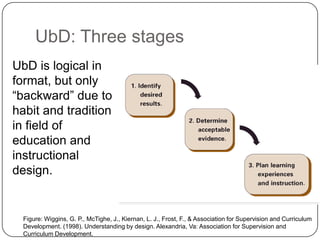
UbD: Three stages
UbD is logical in
format, but only
“backward” due to
habit and tradition
in field of
education and
instructional
design.


  Figure: Wiggins, G. P., McTighe, J., Kiernan, L. J., Frost, F., & Association for Supervision and Curriculum
  Development. (1998). Understanding by design. Alexandria, Va: Association for Supervision and
  Curriculum Development.
Understanding By Design
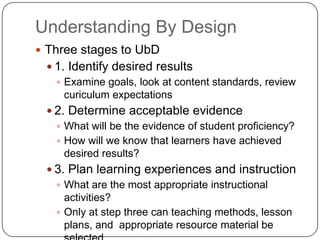
 Three stages to UbD
  1. Identify desired results
    Examine goals, look at content standards, review
     curiculum expectations
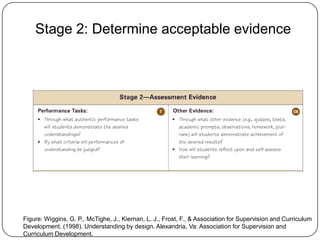
  2. Determine acceptable evidence
    What will be the evidence of student proficiency?
    How will we know that learners have achieved
     desired results?
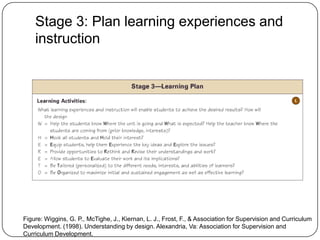
  3. Plan learning experiences and instruction
    What are the most appropriate instructional
     activities?
    Only at step three can teaching methods, lesson
     plans, and appropriate resource material be
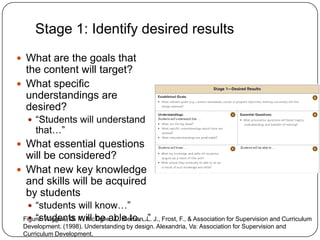
Stage 1: Identify desired results
 What are the goals that
  the content will target?
 What specific
  understandings are
  desired?
   “Students will understand
     that…”
 What essential questions
  will be considered?
 What new key knowledge
  and skills will be acquired
  by students
   “students will know…”
   “students will be able to…”
 Figure: Wiggins, G. P., McTighe, J., Kiernan, L. J., Frost, F., & Association for Supervision and Curriculum
 Development. (1998). Understanding by design. Alexandria, Va: Association for Supervision and
 Curriculum Development.
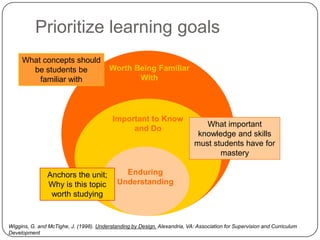
Prioritize learning goals
     What concepts should
       be students be                    Worth Being Familiar
         familiar with                          With


                                          Important to Know
                                                                               What important
                                               and Do
                                                                             knowledge and skills
                                                                            must students have for
                                                                                   mastery

                Anchors the unit;             Enduring
                Why is this topic           Understanding
                 worth studying


Wiggins, G. and McTighe, J. (1998). Understanding by Design. Alexandria, VA: Association for Supervision and Curriculum
Development
Stage 2: Determine acceptable evidence


Figure: Wiggins, G. P., McTighe, J., Kiernan, L. J., Frost, F., & Association for Supervision and Curriculum
Development. (1998). Understanding by design. Alexandria, Va: Association for Supervision and
Curriculum Development.
Stage 3: Plan learning experiences and
    instruction


Figure: Wiggins, G. P., McTighe, J., Kiernan, L. J., Frost, F., & Association for Supervision and Curriculum
Development. (1998). Understanding by design. Alexandria, Va: Association for Supervision and
Curriculum Development.
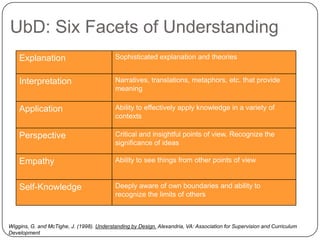
UbD: Six Facets of Understanding
    Explanation                             Sophisticated explanation and theories


    Interpretation                          Narratives, translations, metaphors, etc. that provide
                                            meaning

    Application                             Ability to effectively apply knowledge in a variety of
                                            contexts

    Perspective                             Critical and insightful points of view. Recognize the
                                            significance of ideas

    Empathy                                 Ability to see things from other points of view


    Self-Knowledge                          Deeply aware of own boundaries and ability to
                                            recognize the limits of others


Wiggins, G. and McTighe, J. (1998). Understanding by Design. Alexandria, VA: Association for Supervision and Curriculum
Development
Wiggins, G. P., McTighe, J., Kiernan, L. J., Frost, F., & Association
for Supervision and Curriculum Development. (1998).
Understanding by design. Alexandria, Va: Association for
Supervision and Curriculum Development.

Understanding by Design

  • 1.
    Understanding By Design TheBackwards Approach to Curriculum Design Jeffrey Schlaudecker MD
  • 2.
    Understanding by Design— a model of instructional design  How can you unpack content standards to identify the important big ideas that you want students to understand?  How do you know that students truly understand and can apply their understanding in a meaningful way?  How can you design courses and units to emphasize understanding rather than coverage?  YOU DESIGN CURRICULUM BACKWARDS!
  • 3.
    UbD: Three stages UbDis logical in format, but only “backward” due to habit and tradition in field of education and instructional design. Figure: Wiggins, G. P., McTighe, J., Kiernan, L. J., Frost, F., & Association for Supervision and Curriculum Development. (1998). Understanding by design. Alexandria, Va: Association for Supervision and Curriculum Development.
  • 4.
    Understanding By Design Three stages to UbD  1. Identify desired results  Examine goals, look at content standards, review curiculum expectations  2. Determine acceptable evidence  What will be the evidence of student proficiency?  How will we know that learners have achieved desired results?  3. Plan learning experiences and instruction  What are the most appropriate instructional activities?  Only at step three can teaching methods, lesson plans, and appropriate resource material be
  • 5.
    Stage 1: Identifydesired results  What are the goals that the content will target?  What specific understandings are desired?  “Students will understand that…”  What essential questions will be considered?  What new key knowledge and skills will be acquired by students  “students will know…”  “students will be able to…” Figure: Wiggins, G. P., McTighe, J., Kiernan, L. J., Frost, F., & Association for Supervision and Curriculum Development. (1998). Understanding by design. Alexandria, Va: Association for Supervision and Curriculum Development.
  • 6.
    Prioritize learning goals What concepts should be students be Worth Being Familiar familiar with With Important to Know What important and Do knowledge and skills must students have for mastery Anchors the unit; Enduring Why is this topic Understanding worth studying Wiggins, G. and McTighe, J. (1998). Understanding by Design. Alexandria, VA: Association for Supervision and Curriculum Development
  • 7.
    Stage 2: Determineacceptable evidence Figure: Wiggins, G. P., McTighe, J., Kiernan, L. J., Frost, F., & Association for Supervision and Curriculum Development. (1998). Understanding by design. Alexandria, Va: Association for Supervision and Curriculum Development.
  • 8.
    Stage 3: Planlearning experiences and instruction Figure: Wiggins, G. P., McTighe, J., Kiernan, L. J., Frost, F., & Association for Supervision and Curriculum Development. (1998). Understanding by design. Alexandria, Va: Association for Supervision and Curriculum Development.
  • 9.
    UbD: Six Facetsof Understanding Explanation Sophisticated explanation and theories Interpretation Narratives, translations, metaphors, etc. that provide meaning Application Ability to effectively apply knowledge in a variety of contexts Perspective Critical and insightful points of view. Recognize the significance of ideas Empathy Ability to see things from other points of view Self-Knowledge Deeply aware of own boundaries and ability to recognize the limits of others Wiggins, G. and McTighe, J. (1998). Understanding by Design. Alexandria, VA: Association for Supervision and Curriculum Development
  • 10.
    Wiggins, G. P.,McTighe, J., Kiernan, L. J., Frost, F., & Association for Supervision and Curriculum Development. (1998). Understanding by design. Alexandria, Va: Association for Supervision and Curriculum Development.