MODELS OF
TEACHING
NAME: MAHIMA SRIVASTAVA
CLASS: B.Ed.
SUBJECT : Technological Perspective Of
Education
MODELS OF TEACHING
INTRODUCTION:
➢ Models of teaching refers to
different models that help the
teachers to sharpen their teaching
skills.
➢ Useful in the classroom for
effective teaching.
➢ Enables teacher to evaluate &
analyse their strength & weakness
& work on them.
Definition
According to Bruce Joyce & Marsha
Well describe a model of teaching as
a plan or pattern that can be used to
shape curricula to design
instructional, material & to guide
instruction in classroom & other
settings.
TYPES OF MODEL
OF TEACHING
A) PHILOSOPHICAL
TEACHING MODEL
B ) PSYCHOLOGICAL
TEACHING MODEL
C ) MODERN MODEL
OF TEACHING
(A) PHILOSOPHICAL TEACHING
MODELS
I. INSIGHT MODEL (PLATO)
II. IMPRESSION MODEL (JOHN LOCKE)
III. RULE MODEL (KANT)
I. INSIGHT MODEL
➢Student should learn by doing.
➢Plato stressed on motivation & interest in
learning.
➢Knowledge which is acquired under compulsion
obtains no hold on the mind& he was against
the use of force in education.
➢Plato recommended a place where children love
to go & stay there & they play with things which
enhance their education by playing.
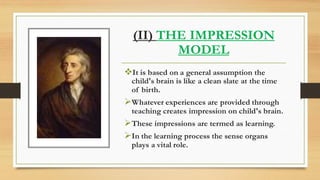
(II) THE IMPRESSION
MODEL
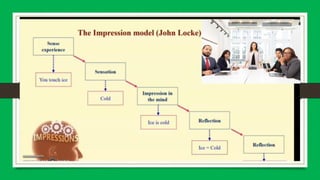
❖It is based on a general assumption the
child's brain is like a clean slate at the time
of birth.
➢Whatever experiences are provided through
teaching creates impression on child's brain.
➢These impressions are termed as learning.
➢In the learning process the sense organs
plays a vital role.
(III) RULE MODEL
❖Kant gives importance to logic because in it following
certain rules is essential.
➢The objective of rule model is to develop the logical
reasoning capacities of the students.
➢Planning ,organisation and interaction of teaching is
performed under specific rules.
(B) PSYCHOLOGICAL TEACHING
MODEL
I. BASIC TEACHING MODEL (ROBERT GLASSER)
II. INTERACTION MODEL (FLANDER)
III.COMPUTER BASED MODEL ( DANIEL DAVIS)
(I) BASIC
TEACHING MODEL
This model has following
elements.
INSTUCTIONAL OBJECTIVES
ENTERING BEHAVIOUR
I
NSTRUCTIONAL PROCEDURE
PERFORMANCE ASSESMENT
➢ This model was
developed by
Robert Glaser .
➢ He has
used psychological
laws & principles in
this model .
(II)INTERACTION MODEL OF
TECHING (N.A Flander)
❖Flander considered teaching process as an interaction process.
➢In this model the behaviour of student & teacher is analysed.
➢An interaction between a teacher & student is more emphasised in this
model.
➢Flanders instrument was designed for observing only the verbal
communication in the classroom and non -verbal gesture are not taken
into account.
➢He divided classroom behaviour in 10 categories known as Flander's
10 category system.
fiac
TEACHER TALK PUPIL TALK SILENCE
ACCEPT FEELING RESPONSE TEACHER SILENCE OR
CONFUSION
PRAISES OR
ENCOURAGE
INITIATION TO TALK
USES IDEAS OF PUPILS
ASK QUESTION
LECTURING
GIVING DIRECTION
CRITISING OR
JUSTIFYING
AUTHORITY
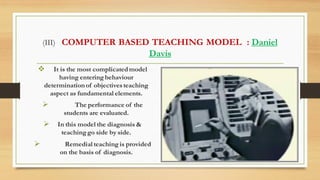
(III) COMPUTER BASED TEACHING MODEL : Daniel
Davis
❖ It is the most complicated model
having entering behaviour
determination of objectivesteaching
aspect as fundamental elements.
➢ The performance of the
students are evaluated.
➢ In this model the diagnosis &
teaching go side by side.
➢ Remedialteaching is provided
on the basis of diagnosis.
(C)MODERN TEACHING MODEL
I. INFORMATION PROCESSING MODEL
II. PERSONAL MODELS
III.SOCIAL INTERACTION MODEL
IV.BEHAVIOUR MODIFICATION MODEL
(I) INFORMATION
PROCESSING MODELS
➢This model is concerned with the intellectual development
of the individual & help to develop method of processing
information from the environment.
➢This model focus on intellectual capacity .
BRIEF REVIEW OF INFORMATION
PROCESSING MODEL
Teaching model
Concept attainment model ( Bruner)
Inquiry training model
Biological science inquiry model
Advance organization model
Cognitive Growth development (Jean Piaget)
PERSONAL MODELS
❖PERSONAL development is essentially emphasized in this
model.
➢More emphasis is given to the development of internal &
external power of pupil.
➢Primary goals are increase student self- worth.
➢To help student understand themself fully.
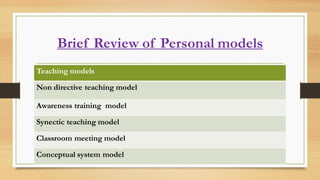
Brief Review of Personal models
Teaching models
Non directive teaching model
Awareness training model
Synectic teaching model
Classroom meeting model
Conceptual system model
(III) SOCIAL INTERACTION MODELS
❖This model emphasise the relationships of individual the
society or other person.
The primary goals are :
➢To develop skills to human relations.
➢To become aware of personal & social values.
➢To help students work together to identity & solve problems
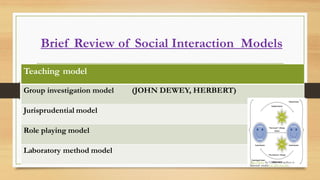
Brief Review of Social Interaction Models
Teaching model
Group investigation model (JOHN DEWEY, HERBERT)
Jurisprudential model
Role playing model
Laboratory method model
This Photo by Unknown author is
licensed under CC BY-SA-NC.
(IV) BEHAVIOUR
MODIFICATION MODEL
❖It emphasis on changing the
observable behaviour of the learner.
The specific goals are :
➢ To foster leadership quality.
➢ To master techniques for stress
reduction.
➢ To learn strategies for self- control
through operant methods of B.F.
Skinner
CONCLUSION
❖Models of teaching are important for teachers in many ways-
➢A teaching model can bring changes & rectification in teaching.
➢Improve quality of instruction.
➢Systematic approach to planning for instruction.
➢Facilitates students engagement in more meaningful ways.
➢So that students learn more rapidly & increase aptitude for learning &
retention.
MODELS OF TEACHING
MODELS OF TEACHING

MODELS OF TEACHING

  • 1.
    MODELS OF TEACHING NAME: MAHIMASRIVASTAVA CLASS: B.Ed. SUBJECT : Technological Perspective Of Education
  • 2.
    MODELS OF TEACHING INTRODUCTION: ➢Models of teaching refers to different models that help the teachers to sharpen their teaching skills. ➢ Useful in the classroom for effective teaching. ➢ Enables teacher to evaluate & analyse their strength & weakness & work on them. Definition According to Bruce Joyce & Marsha Well describe a model of teaching as a plan or pattern that can be used to shape curricula to design instructional, material & to guide instruction in classroom & other settings.
  • 3.
    TYPES OF MODEL OFTEACHING A) PHILOSOPHICAL TEACHING MODEL B ) PSYCHOLOGICAL TEACHING MODEL C ) MODERN MODEL OF TEACHING
  • 4.
    (A) PHILOSOPHICAL TEACHING MODELS I.INSIGHT MODEL (PLATO) II. IMPRESSION MODEL (JOHN LOCKE) III. RULE MODEL (KANT)
  • 5.
    I. INSIGHT MODEL ➢Studentshould learn by doing. ➢Plato stressed on motivation & interest in learning. ➢Knowledge which is acquired under compulsion obtains no hold on the mind& he was against the use of force in education. ➢Plato recommended a place where children love to go & stay there & they play with things which enhance their education by playing.
  • 6.
    (II) THE IMPRESSION MODEL ❖Itis based on a general assumption the child's brain is like a clean slate at the time of birth. ➢Whatever experiences are provided through teaching creates impression on child's brain. ➢These impressions are termed as learning. ➢In the learning process the sense organs plays a vital role.
  • 8.
    (III) RULE MODEL ❖Kantgives importance to logic because in it following certain rules is essential. ➢The objective of rule model is to develop the logical reasoning capacities of the students. ➢Planning ,organisation and interaction of teaching is performed under specific rules.
  • 9.
    (B) PSYCHOLOGICAL TEACHING MODEL I.BASIC TEACHING MODEL (ROBERT GLASSER) II. INTERACTION MODEL (FLANDER) III.COMPUTER BASED MODEL ( DANIEL DAVIS)
  • 10.
    (I) BASIC TEACHING MODEL Thismodel has following elements. INSTUCTIONAL OBJECTIVES ENTERING BEHAVIOUR I NSTRUCTIONAL PROCEDURE PERFORMANCE ASSESMENT ➢ This model was developed by Robert Glaser . ➢ He has used psychological laws & principles in this model .
  • 11.
    (II)INTERACTION MODEL OF TECHING(N.A Flander) ❖Flander considered teaching process as an interaction process. ➢In this model the behaviour of student & teacher is analysed. ➢An interaction between a teacher & student is more emphasised in this model. ➢Flanders instrument was designed for observing only the verbal communication in the classroom and non -verbal gesture are not taken into account. ➢He divided classroom behaviour in 10 categories known as Flander's 10 category system.
  • 12.
    fiac TEACHER TALK PUPILTALK SILENCE ACCEPT FEELING RESPONSE TEACHER SILENCE OR CONFUSION PRAISES OR ENCOURAGE INITIATION TO TALK USES IDEAS OF PUPILS ASK QUESTION LECTURING GIVING DIRECTION CRITISING OR JUSTIFYING AUTHORITY
  • 13.
    (III) COMPUTER BASEDTEACHING MODEL : Daniel Davis ❖ It is the most complicated model having entering behaviour determination of objectivesteaching aspect as fundamental elements. ➢ The performance of the students are evaluated. ➢ In this model the diagnosis & teaching go side by side. ➢ Remedialteaching is provided on the basis of diagnosis.
  • 14.
    (C)MODERN TEACHING MODEL I.INFORMATION PROCESSING MODEL II. PERSONAL MODELS III.SOCIAL INTERACTION MODEL IV.BEHAVIOUR MODIFICATION MODEL
  • 15.
    (I) INFORMATION PROCESSING MODELS ➢Thismodel is concerned with the intellectual development of the individual & help to develop method of processing information from the environment. ➢This model focus on intellectual capacity .
  • 16.
    BRIEF REVIEW OFINFORMATION PROCESSING MODEL Teaching model Concept attainment model ( Bruner) Inquiry training model Biological science inquiry model Advance organization model Cognitive Growth development (Jean Piaget)
  • 17.
    PERSONAL MODELS ❖PERSONAL developmentis essentially emphasized in this model. ➢More emphasis is given to the development of internal & external power of pupil. ➢Primary goals are increase student self- worth. ➢To help student understand themself fully.
  • 18.
    Brief Review ofPersonal models Teaching models Non directive teaching model Awareness training model Synectic teaching model Classroom meeting model Conceptual system model
  • 19.
    (III) SOCIAL INTERACTIONMODELS ❖This model emphasise the relationships of individual the society or other person. The primary goals are : ➢To develop skills to human relations. ➢To become aware of personal & social values. ➢To help students work together to identity & solve problems
  • 20.
    Brief Review ofSocial Interaction Models Teaching model Group investigation model (JOHN DEWEY, HERBERT) Jurisprudential model Role playing model Laboratory method model This Photo by Unknown author is licensed under CC BY-SA-NC.
  • 21.
    (IV) BEHAVIOUR MODIFICATION MODEL ❖Itemphasis on changing the observable behaviour of the learner. The specific goals are : ➢ To foster leadership quality. ➢ To master techniques for stress reduction. ➢ To learn strategies for self- control through operant methods of B.F. Skinner
  • 22.
    CONCLUSION ❖Models of teachingare important for teachers in many ways- ➢A teaching model can bring changes & rectification in teaching. ➢Improve quality of instruction. ➢Systematic approach to planning for instruction. ➢Facilitates students engagement in more meaningful ways. ➢So that students learn more rapidly & increase aptitude for learning & retention.