Dr. Manju Gehlawat
Assistant Professor
C. R. College of Education, Rohtak
INTRODUCTION TO THE
MODELS OF TEACHING
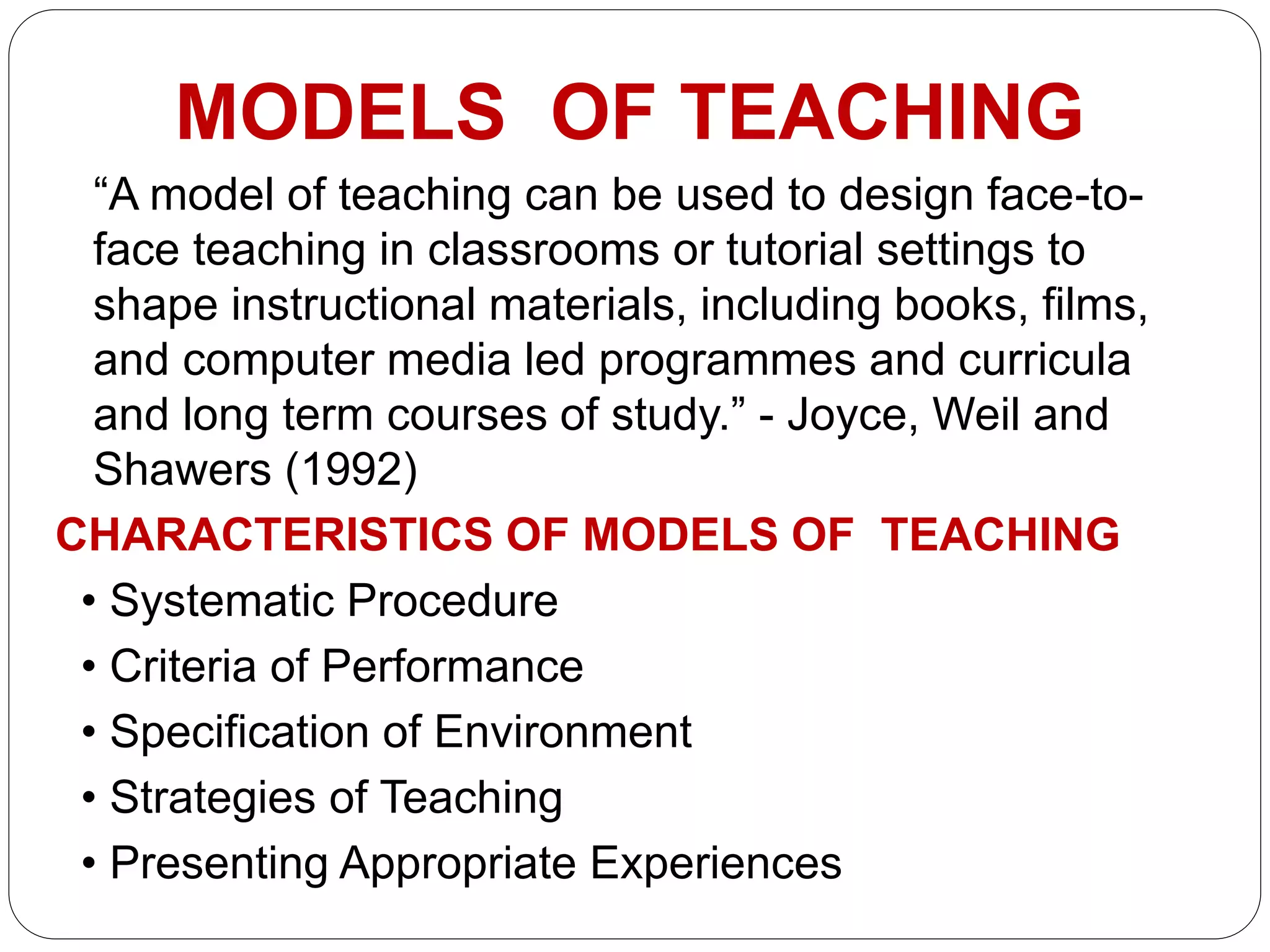
MODELS OF TEACHING
“A model of teaching can be used to design face-to-
face teaching in classrooms or tutorial settings to
shape instructional materials, including books, films,
and computer media led programmes and curricula
and long term courses of study.” - Joyce, Weil and
Shawers (1992)
CHARACTERISTICS OF MODELS OF TEACHING
• Systematic Procedure
• Criteria of Performance
• Specification of Environment
• Strategies of Teaching
• Presenting Appropriate Experiences
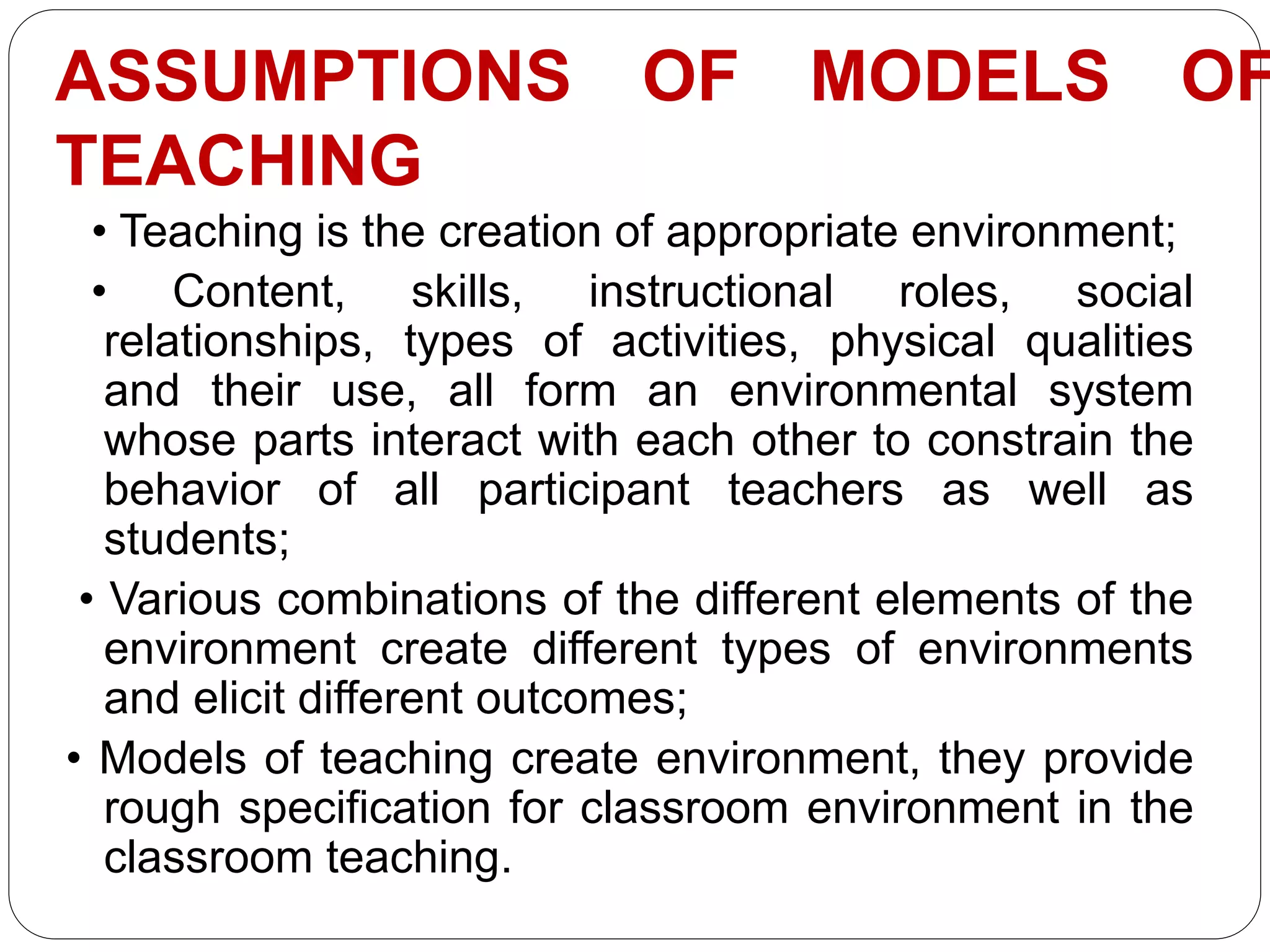
ASSUMPTIONS OF MODELS OF
TEACHING
• Teaching is the creation of appropriate environment;
• Content, skills, instructional roles, social
relationships, types of activities, physical qualities
and their use, all form an environmental system
whose parts interact with each other to constrain the
behavior of all participant teachers as well as
students;
• Various combinations of the different elements of the
environment create different types of environments
and elicit different outcomes;
• Models of teaching create environment, they provide
rough specification for classroom environment in the
classroom teaching.
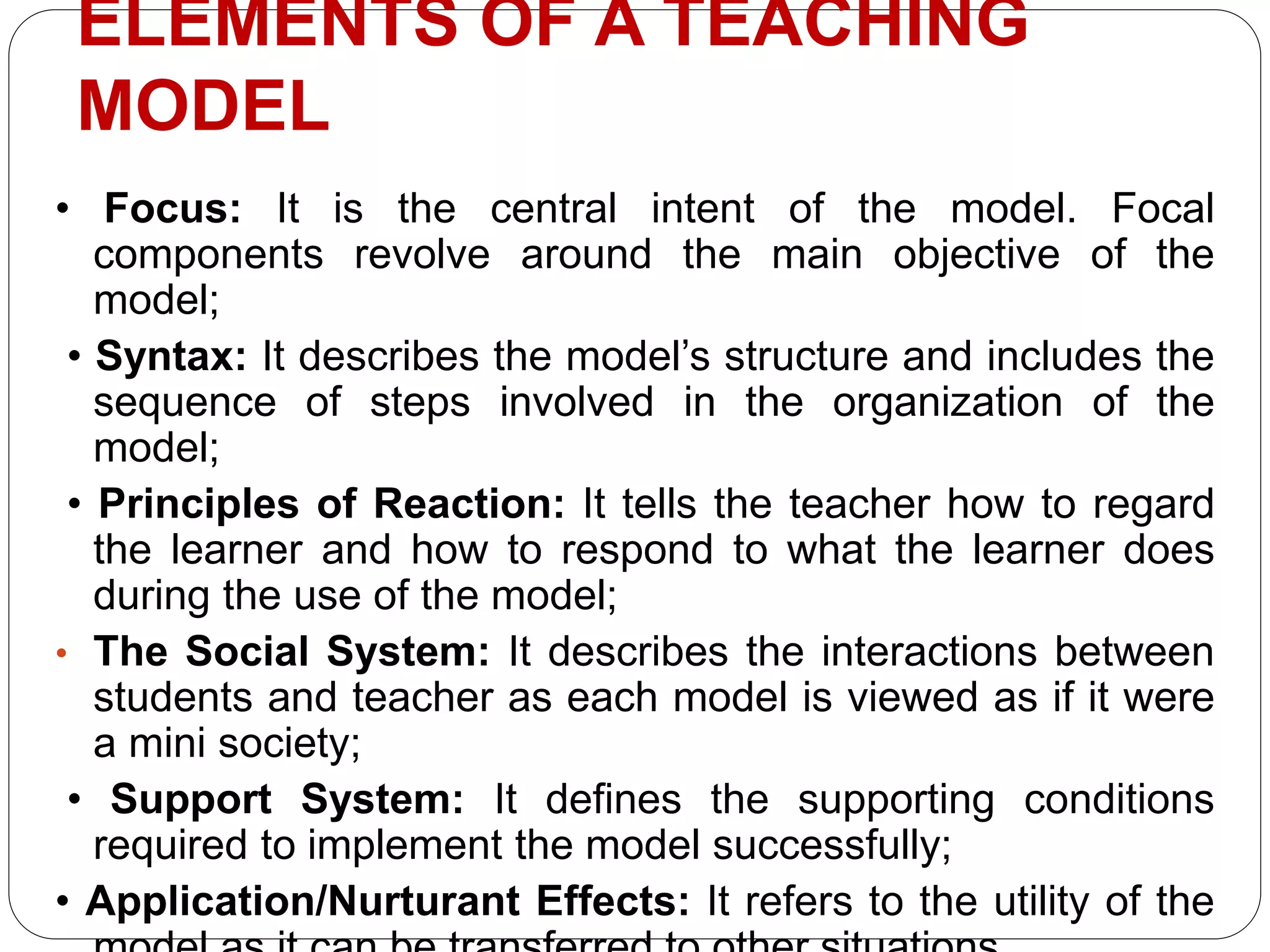
ELEMENTS OF A TEACHING
MODEL
• Focus: It is the central intent of the model. Focal
components revolve around the main objective of the
model;
• Syntax: It describes the model’s structure and includes the
sequence of steps involved in the organization of the
model;
• Principles of Reaction: It tells the teacher how to regard
the learner and how to respond to what the learner does
during the use of the model;
• The Social System: It describes the interactions between
students and teacher as each model is viewed as if it were
a mini society;
• Support System: It defines the supporting conditions
required to implement the model successfully;
• Application/Nurturant Effects: It refers to the utility of the
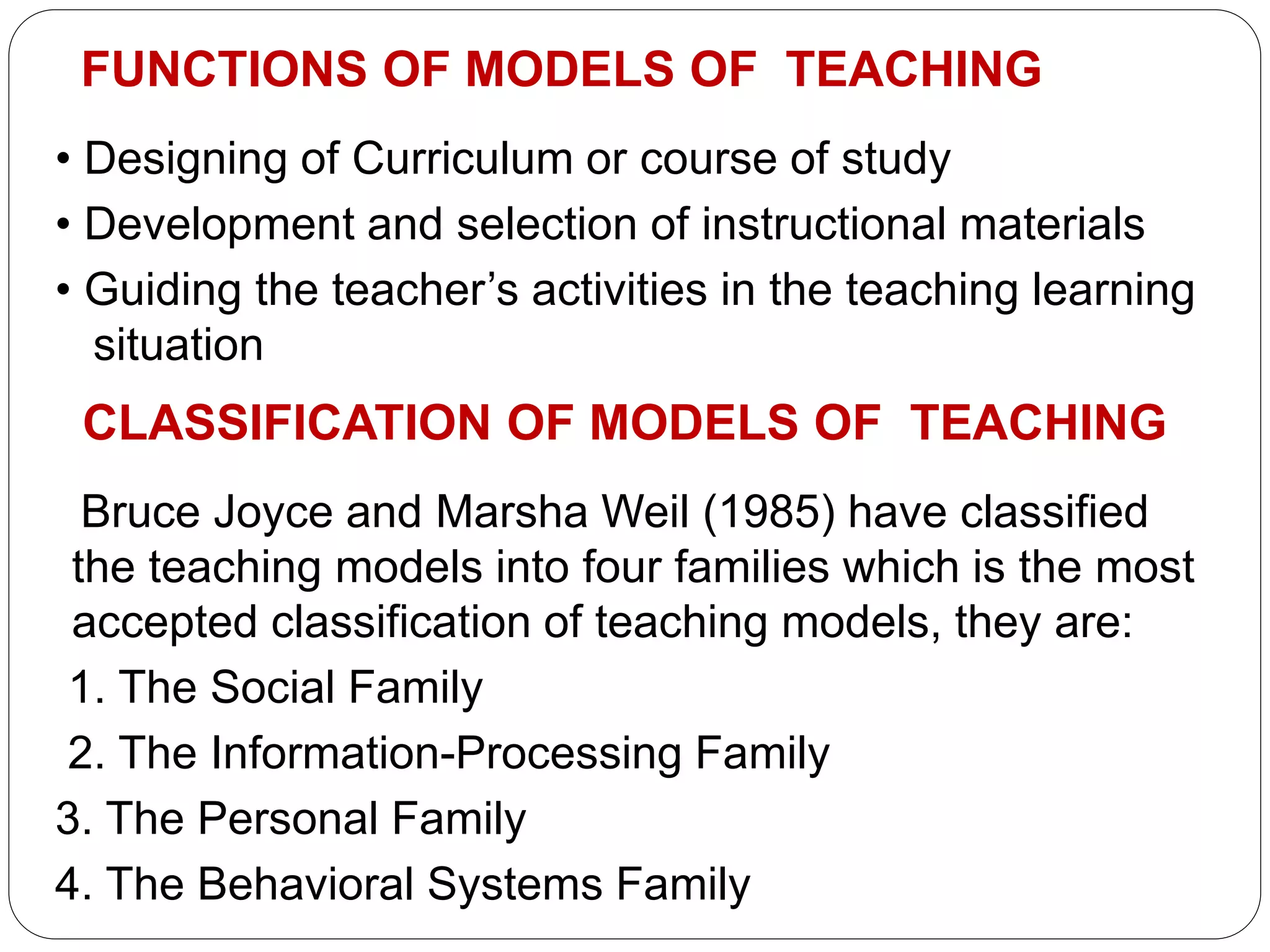
FUNCTIONS OF MODELS OF TEACHING
• Designing of Curriculum or course of study
• Development and selection of instructional materials
• Guiding the teacher’s activities in the teaching learning
situation
CLASSIFICATION OF MODELS OF TEACHING
Bruce Joyce and Marsha Weil (1985) have classified
the teaching models into four families which is the most
accepted classification of teaching models, they are:
1. The Social Family
2. The Information-Processing Family
3. The Personal Family
4. The Behavioral Systems Family
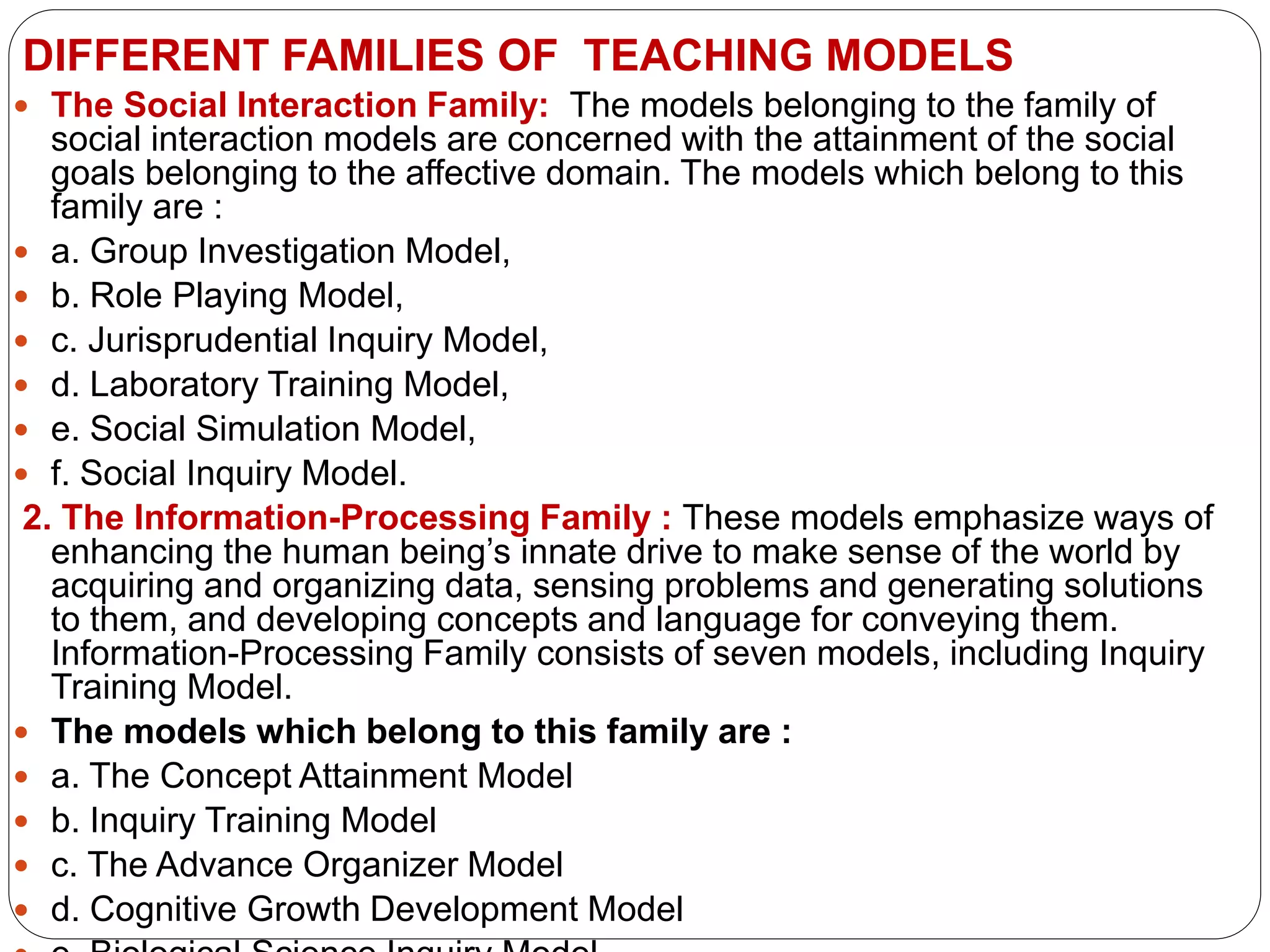
DIFFERENT FAMILIES OF TEACHING MODELS
 The Social Interaction Family: The models belonging to the family of
social interaction models are concerned with the attainment of the social
goals belonging to the affective domain. The models which belong to this
family are :
 a. Group Investigation Model,
 b. Role Playing Model,
 c. Jurisprudential Inquiry Model,
 d. Laboratory Training Model,
 e. Social Simulation Model,
 f. Social Inquiry Model.
2. The Information-Processing Family : These models emphasize ways of
enhancing the human being’s innate drive to make sense of the world by
acquiring and organizing data, sensing problems and generating solutions
to them, and developing concepts and language for conveying them.
Information-Processing Family consists of seven models, including Inquiry
Training Model.
 The models which belong to this family are :
 a. The Concept Attainment Model
 b. Inquiry Training Model
 c. The Advance Organizer Model
 d. Cognitive Growth Development Model
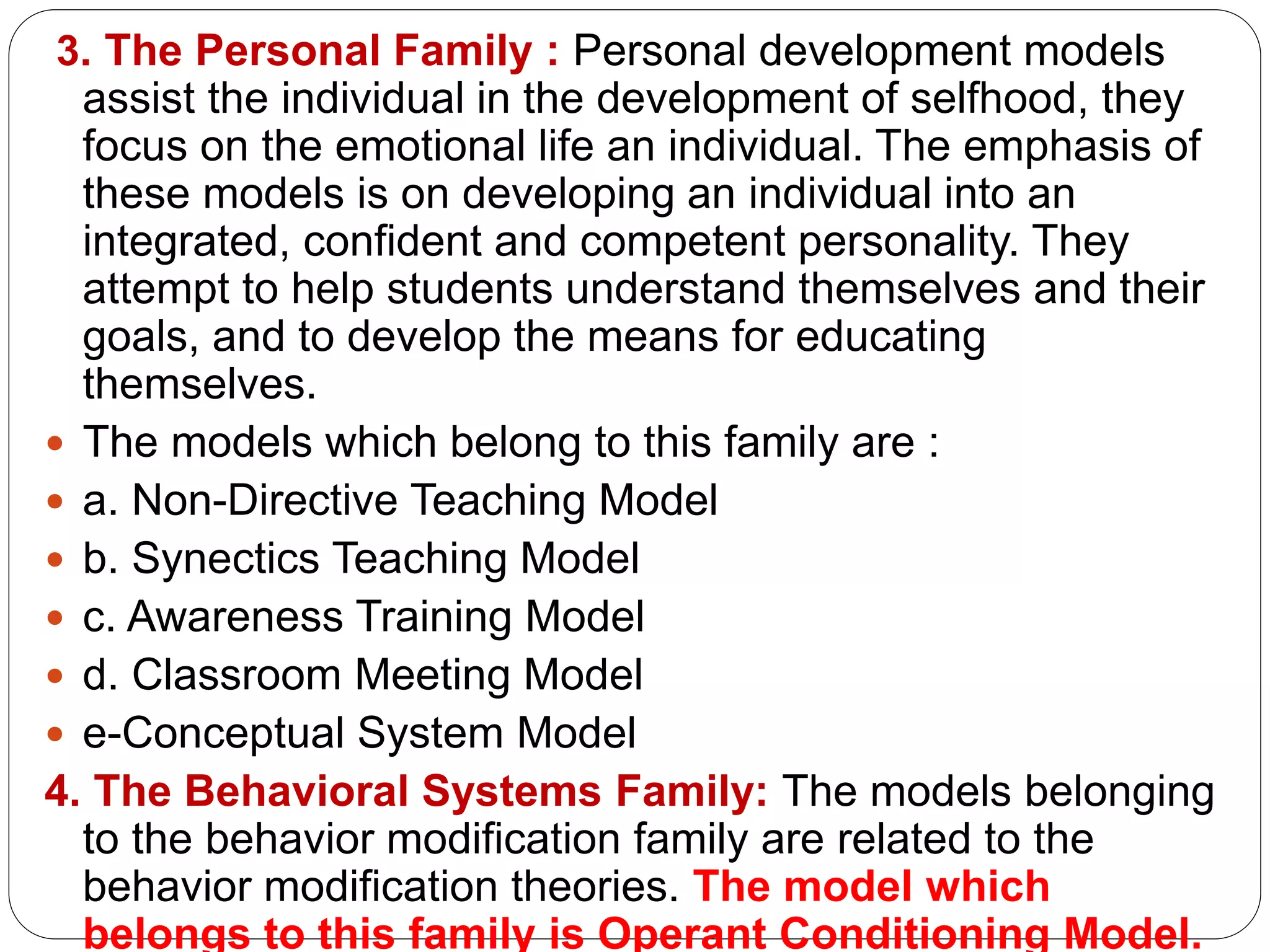
3. The Personal Family : Personal development models
assist the individual in the development of selfhood, they
focus on the emotional life an individual. The emphasis of
these models is on developing an individual into an
integrated, confident and competent personality. They
attempt to help students understand themselves and their
goals, and to develop the means for educating
themselves.
 The models which belong to this family are :
 a. Non-Directive Teaching Model
 b. Synectics Teaching Model
 c. Awareness Training Model
 d. Classroom Meeting Model
 e-Conceptual System Model
4. The Behavioral Systems Family: The models belonging
to the behavior modification family are related to the
behavior modification theories. The model which
belongs to this family is Operant Conditioning Model.
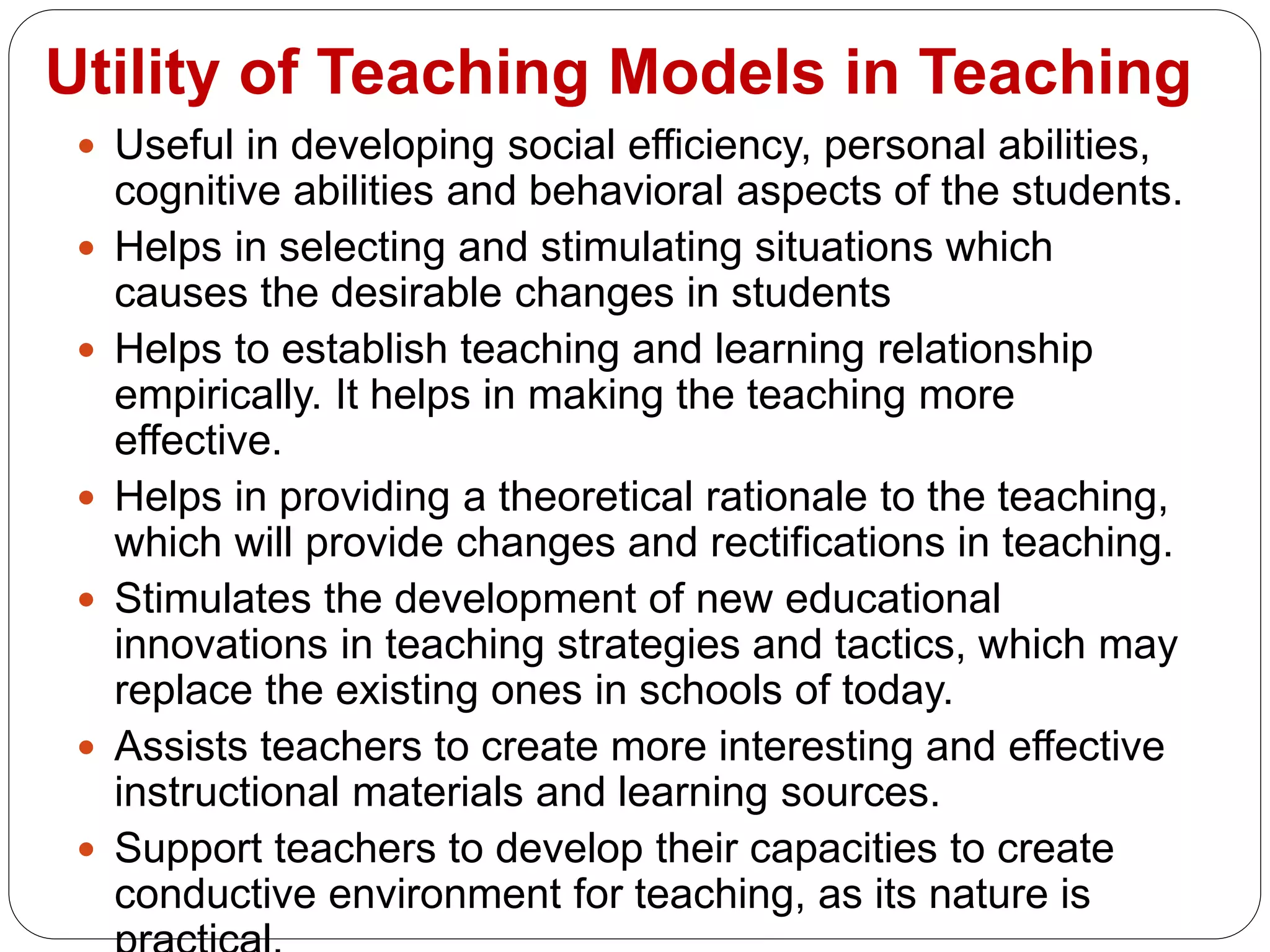
Utility of Teaching Models in Teaching
 Useful in developing social efficiency, personal abilities,
cognitive abilities and behavioral aspects of the students.
 Helps in selecting and stimulating situations which
causes the desirable changes in students
 Helps to establish teaching and learning relationship
empirically. It helps in making the teaching more
effective.
 Helps in providing a theoretical rationale to the teaching,
which will provide changes and rectifications in teaching.
 Stimulates the development of new educational
innovations in teaching strategies and tactics, which may
replace the existing ones in schools of today.
 Assists teachers to create more interesting and effective
instructional materials and learning sources.
 Support teachers to develop their capacities to create
conductive environment for teaching, as its nature is
References
• Joyce, B. Weil, & Calhoun, E. (2009). Models of
Teaching and Learning. 8th ed. Boston: Allyn and
Bacon.
• http://www.vkmaheshwari.com/WP/?p=1312

Models of teaching

  • 1.
    Dr. Manju Gehlawat AssistantProfessor C. R. College of Education, Rohtak INTRODUCTION TO THE MODELS OF TEACHING
  • 2.
    MODELS OF TEACHING “Amodel of teaching can be used to design face-to- face teaching in classrooms or tutorial settings to shape instructional materials, including books, films, and computer media led programmes and curricula and long term courses of study.” - Joyce, Weil and Shawers (1992) CHARACTERISTICS OF MODELS OF TEACHING • Systematic Procedure • Criteria of Performance • Specification of Environment • Strategies of Teaching • Presenting Appropriate Experiences
  • 3.
    ASSUMPTIONS OF MODELSOF TEACHING • Teaching is the creation of appropriate environment; • Content, skills, instructional roles, social relationships, types of activities, physical qualities and their use, all form an environmental system whose parts interact with each other to constrain the behavior of all participant teachers as well as students; • Various combinations of the different elements of the environment create different types of environments and elicit different outcomes; • Models of teaching create environment, they provide rough specification for classroom environment in the classroom teaching.
  • 4.
    ELEMENTS OF ATEACHING MODEL • Focus: It is the central intent of the model. Focal components revolve around the main objective of the model; • Syntax: It describes the model’s structure and includes the sequence of steps involved in the organization of the model; • Principles of Reaction: It tells the teacher how to regard the learner and how to respond to what the learner does during the use of the model; • The Social System: It describes the interactions between students and teacher as each model is viewed as if it were a mini society; • Support System: It defines the supporting conditions required to implement the model successfully; • Application/Nurturant Effects: It refers to the utility of the
  • 5.
    FUNCTIONS OF MODELSOF TEACHING • Designing of Curriculum or course of study • Development and selection of instructional materials • Guiding the teacher’s activities in the teaching learning situation CLASSIFICATION OF MODELS OF TEACHING Bruce Joyce and Marsha Weil (1985) have classified the teaching models into four families which is the most accepted classification of teaching models, they are: 1. The Social Family 2. The Information-Processing Family 3. The Personal Family 4. The Behavioral Systems Family
  • 6.
    DIFFERENT FAMILIES OFTEACHING MODELS  The Social Interaction Family: The models belonging to the family of social interaction models are concerned with the attainment of the social goals belonging to the affective domain. The models which belong to this family are :  a. Group Investigation Model,  b. Role Playing Model,  c. Jurisprudential Inquiry Model,  d. Laboratory Training Model,  e. Social Simulation Model,  f. Social Inquiry Model. 2. The Information-Processing Family : These models emphasize ways of enhancing the human being’s innate drive to make sense of the world by acquiring and organizing data, sensing problems and generating solutions to them, and developing concepts and language for conveying them. Information-Processing Family consists of seven models, including Inquiry Training Model.  The models which belong to this family are :  a. The Concept Attainment Model  b. Inquiry Training Model  c. The Advance Organizer Model  d. Cognitive Growth Development Model
  • 7.
    3. The PersonalFamily : Personal development models assist the individual in the development of selfhood, they focus on the emotional life an individual. The emphasis of these models is on developing an individual into an integrated, confident and competent personality. They attempt to help students understand themselves and their goals, and to develop the means for educating themselves.  The models which belong to this family are :  a. Non-Directive Teaching Model  b. Synectics Teaching Model  c. Awareness Training Model  d. Classroom Meeting Model  e-Conceptual System Model 4. The Behavioral Systems Family: The models belonging to the behavior modification family are related to the behavior modification theories. The model which belongs to this family is Operant Conditioning Model.
  • 8.
    Utility of TeachingModels in Teaching  Useful in developing social efficiency, personal abilities, cognitive abilities and behavioral aspects of the students.  Helps in selecting and stimulating situations which causes the desirable changes in students  Helps to establish teaching and learning relationship empirically. It helps in making the teaching more effective.  Helps in providing a theoretical rationale to the teaching, which will provide changes and rectifications in teaching.  Stimulates the development of new educational innovations in teaching strategies and tactics, which may replace the existing ones in schools of today.  Assists teachers to create more interesting and effective instructional materials and learning sources.  Support teachers to develop their capacities to create conductive environment for teaching, as its nature is
  • 9.
    References • Joyce, B.Weil, & Calhoun, E. (2009). Models of Teaching and Learning. 8th ed. Boston: Allyn and Bacon. • http://www.vkmaheshwari.com/WP/?p=1312