Models of
teaching
By:
Dr. Yudhister,Associate Professor
RLS College Of Education,
Sidhrawali(Gurugram), Haryana
Definitions of Models of
Teaching
 Acc. to Joyce and Weil:
Teaching models are just instructional designs. They describe the
process of specifying and producing particular environmental situations
which cause the students to interact in such a way that specific changes
occurs in his behavior.
 Paul de Eggan:
Models are prescriptive teaching strategies designed to accomplish particular
instructional goal.
 Acc.to Hyman:
The model is a way to talk, think about instruction in which certain
facts may be organized, classified and interpreted.
 Acc.to N.K.Jangira:
A model of teaching is a set of inter-related components arranged in
a sequence which provides guidelines to realize specific goals.
Characteristics of
Models of Teaching
 These are teaching strategies.
 These are sort of guidelines.
 These are prescriptive in nature.
 Scientific procedure.
 Helps in realization of objectives.
 Specification of operation.
 Based on some philosophy.
 Based on thinking.
 Specification of learning outcomes.
 Use of interest.
 Specification of performance
criteria.
 Specification of learning
Elements of Teaching
Models
 Focus:
 Syntax
 Principle of Reaction
 Social System
 Support System
 Application
Basic assumptions of Models of
Teaching
 Teaching is a means of generating environment of learning.
 Content and skill function as an instruction through which teacher
and students interact .
 Different types of teaching objectives are achieved by organizing
teaching elements in different way.
 Teaching models provides learning experiences for real behavior
outcomes.
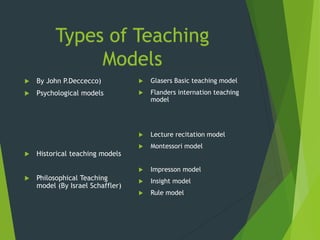
Types of Teaching
Models
 By John P.Deccecco)
 Psychological models
 Historical teaching models
 Philosophical Teaching
model (By Israel Schaffler)
 Glasers Basic teaching model
 Flanders internation teaching
model
 Lecture recitation model
 Montessori model
 Impresson model
 Insight model
 Rule model
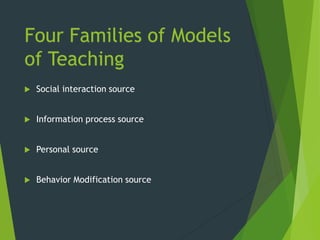
Four Families of Models
of Teaching
 Social interaction source
 Information process source
 Personal source
 Behavior Modification source
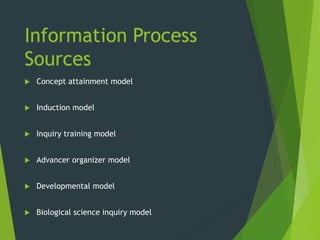
Information Process
Sources
 Concept attainment model
 Induction model
 Inquiry training model
 Advancer organizer model
 Developmental model
 Biological science inquiry model
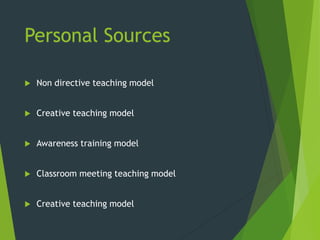
Personal Sources
 Non directive teaching model
 Creative teaching model
 Awareness training model
 Classroom meeting teaching model
 Creative teaching model
Social interaction
source
 Group investigation model
 Jurisprudential model
 Laboratory training model
 Social inquiry model
Behavior Modification
Source
 Skinners operant conditioning model
 Self control model
Thanks

Models of teaching

  • 1.
    Models of teaching By: Dr. Yudhister,AssociateProfessor RLS College Of Education, Sidhrawali(Gurugram), Haryana
  • 2.
    Definitions of Modelsof Teaching  Acc. to Joyce and Weil: Teaching models are just instructional designs. They describe the process of specifying and producing particular environmental situations which cause the students to interact in such a way that specific changes occurs in his behavior.  Paul de Eggan: Models are prescriptive teaching strategies designed to accomplish particular instructional goal.
  • 3.
     Acc.to Hyman: Themodel is a way to talk, think about instruction in which certain facts may be organized, classified and interpreted.  Acc.to N.K.Jangira: A model of teaching is a set of inter-related components arranged in a sequence which provides guidelines to realize specific goals.
  • 4.
    Characteristics of Models ofTeaching  These are teaching strategies.  These are sort of guidelines.  These are prescriptive in nature.  Scientific procedure.  Helps in realization of objectives.  Specification of operation.
  • 5.
     Based onsome philosophy.  Based on thinking.  Specification of learning outcomes.  Use of interest.  Specification of performance criteria.  Specification of learning
  • 6.
    Elements of Teaching Models Focus:  Syntax  Principle of Reaction  Social System  Support System  Application
  • 7.
    Basic assumptions ofModels of Teaching  Teaching is a means of generating environment of learning.  Content and skill function as an instruction through which teacher and students interact .  Different types of teaching objectives are achieved by organizing teaching elements in different way.  Teaching models provides learning experiences for real behavior outcomes.
  • 8.
    Types of Teaching Models By John P.Deccecco)  Psychological models  Historical teaching models  Philosophical Teaching model (By Israel Schaffler)  Glasers Basic teaching model  Flanders internation teaching model  Lecture recitation model  Montessori model  Impresson model  Insight model  Rule model
  • 9.
    Four Families ofModels of Teaching  Social interaction source  Information process source  Personal source  Behavior Modification source
  • 10.
    Information Process Sources  Conceptattainment model  Induction model  Inquiry training model  Advancer organizer model  Developmental model  Biological science inquiry model
  • 11.
    Personal Sources  Nondirective teaching model  Creative teaching model  Awareness training model  Classroom meeting teaching model  Creative teaching model
  • 12.
    Social interaction source  Groupinvestigation model  Jurisprudential model  Laboratory training model  Social inquiry model
  • 13.
    Behavior Modification Source  Skinnersoperant conditioning model  Self control model
  • 14.