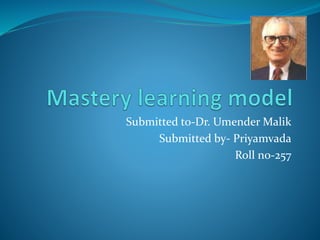
Submitted to-Dr. Umender Malik
Submitted by- Priyamvada
Roll no-257
content
 Introduction
 Definition of models of teaching
 Characteristics of models of teaching
 Types of model of teaching
 Mastery learning model
 Merits and demerits of mastery learning model
 References
Introduction
 The term ‘model’ carries different meaning in our day
to day life we look at the model of Taj Mahal and find
it an exact replica of the original . This is why models
prove a quite effective aid us a substitute for reality in
the class-room situation.
 The meaning of a model can also be made clear in
these words –’an effort to draw some meaning from
experience’. In the field of education , this effort helps
in educational talk related to the subject, i.e. helps in
the talk and thinking regarding guidance.
Definitions of teaching of models
 According to Joyce and weil .”Teaching models are just
instructional designs. They describes the process of
specifying and producing environmental situation which
cause the student to interact in such a way that specific
change occurs in his behavior.”
• According to N.k.jangira and others , “ A models of
teaching is a set of inter-related components arranged in
a sequence which provides guidelines to realize specific
goal.it helps in designed instructional activities and
environmental facilities, carrying out of these activities
and realization of the stipulated objectives
Characteristics of teaching models
 1.The development of teaching model is based
on certain assumptions.
 2.The teaching models depend on the
individual differences . Their structure is
psychological.
 3.The teaching models use the interests of the
pupils.
 4.These models are based on one or the other
philosophy.
 5.The basis of teaching models also includes
thinking.
 6.With the help of models , teaching can be
seen as an art.
 7.Models prove helpful in developing the
teacher’s personality qualitatively.
 8.Teaching models are based on scientific
procedure.
 9.All the teaching models have their own
specific mechanism.
 10.Teaching model determines what the pupils
have learnt after the instructions.
Types of teaching model
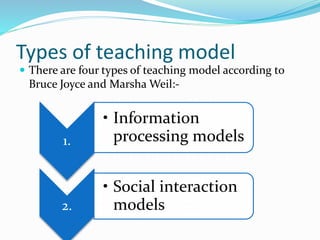
 There are four types of teaching model according to
Bruce Joyce and Marsha Weil:-
1.
• Information
processing models
2.
• Social interaction
models
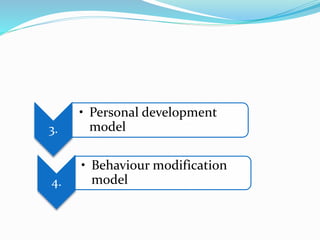
• Personal development
model
• Behaviour modification
model
3.
4.
Mastery learning model
 Mastery learning is an approach for organizing instructions
.This approach was formulated by John B. Carroll and
B.S.Bloom.mastery learning helps in attaining a
satisfactory level of performance in school subjects. It
belongs to the behavioral systems family of models as
classified by Joyce and Weil. Mastery learning provides a
compact and interesting way to increasing the likelihood
that more students will attain a satisfactory level of
performance in school subjects
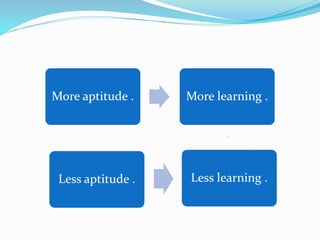
 The core theoretical ides in mastery learning is based on
the meaning of aptitude as suggested by John Carroll. ,
aptitude is that feature of student that is direct related to
achievement
More aptitude . More learning .
Less learning .Less aptitude .
 Is an instructional strategy in which students learn one
topic before moving on to the next subsequent topic.
 Students must demonstrate competence in one area before
proceeding to the next.
 Mastery learning is based on 3 assumptions:
1. Almost every student can learn a topic to mastery
2. Some students need more time than others
3. Some students need more help than others
Therefore most students can learn if given sufficient time and
instruction to do so.
Mastery Learning 4 Components
1. SMALL DISCRETE UNITS-The subject matter is
broken up into a bunch of little lessons that covers a
small amount of material
2. A LOGICAL SEQUENCE-The basic concepts and
procedures are learned before the more complex
ones
3. DEMOSTRATION OF MASTERY AT END OF EACH
LESSON- Students can’t move to the next lesson
until they show that they mastered the proceeding
lesson.
 4. ADDITIONAL ACTIVITIES FOR STUDENTS
NEEDING EXTRA HELP OR PRACTICE TO
ATTAIN MASTERY- Support and resources are
tailored to individual needs. Examples could
include a different instructional approach, different
material, study groups, or individual tutoring.
Characteristics of mastery learning
model
According to Bloom ,The characteristics of mastery
learning model are :-
 1.Mastery of any subject is defined in terms of sets of
measure objectives which represent the course of unit.
 2.The substance is then divided into a larger set of
relatively small learning unit. Each unit accompanies
its own objectives. These objectives are parts of larger
ones .These are considered essentials for there
mastery.
 3.Learning materials are then identified.
After this, the instructional strategy is
selected.
 4.Each unit is accompanied by brief
diagnostic tests to measure the pupils’
progress. Also these diagnostic tests
identified those particulars problems which
each pupil is facing.
 5.The data obtained from these diagnostic
tests is used to provide supplementary
instruction to the student to help him
overcome his problems.
Description of mastery learning model
in terms of the basic elements
Focus:- Its aim is to control the pace of the
students ,his aptitudes, his previous knowledge of the
subject. It is based on the assumption that all students
of a class can learn and attain the mastery level if
sufficient time ,adequate instructions and timely help
is provided to them according to their interests and
abilities. Therefore the model focuses to attain the
mastery level.
Syntax:-
The structure of model involve six steps :-
 Planning for Mastery
 Teaching for mastery
 formative evaluation for diagnosing mastery
 mastery providing for differential teaching
 Re-evaluation and remedial work for mastery
summative evaluation and mastery for other
learning units
g
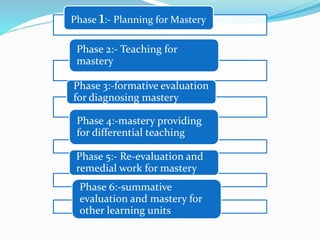
Phase 1:- Planning for Mastery
Phase 2:- Teaching for
mastery
Phase 3:-formative evaluation
for diagnosing mastery
Phase 4:-mastery providing
for differential teaching
Phase 5:- Re-evaluation and
remedial work for mastery
Phase 6:-summative
evaluation and mastery for
other learning units
Social system
 A social system of any teaching model provides
information regarding the teacher and the student
relationship. In this model , teacher plays an important role
. The teacher helps the student in attaining the mastery on
the subject by keeping in view their individual differences .
The teacher is entirely responsible for the success and
failure of the student.
 For the attainment of mastery by all student of the class,
the teacher has to organize the class in small groups, take
the help of early masters as monitor and help the student
individually as a tutor.so the model provide opportunities
not only for teacher-pupil interaction but pupil-pupil
interaction as well.
Support system
Implementation of this model requires some
additional support other than usually available in
normal classroom situation in the form of :
 Evaluation
 Remedial teaching
 Diagnostic test in every unit
Application
 Development of self confidence slow learner.
 Development of self initiation among students .
 Development of self analysis and inspiration among
students.
 Development of problem solving qualities in students.
 Helps obtaining mastery in school subject.
Merits of mastery learning model
 Helps students what they have learned and what they need
to learn better.
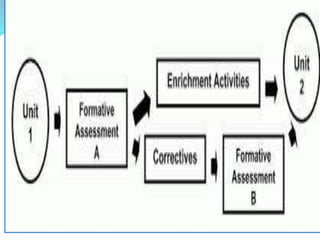
 Correctives are individualized.
 Prevents minor learning difficulties from accumulating and
becoming major learning problems.
 Help students overcome their individual learning
difficulties.
 Offers students a second chance at success.
 Special enrichment activities to broaden learning
experiences.
Reduces the variation in students achievement levels.
Students are given extended time to master the
learning objectives.
Can break cycle of failure .
Demerits
 Long process
 Time consuming
 No single method of instruction works for all.
 Teachers must increase variation in their
teaching to decrease variation in results.
 Students may need additional time to learn.
 Implementation of mastery learning will
require more time at first.
References
Mangal , S.K(2012).Essentials of Educational
Technology. New Delhi: PHI Learning Private Limited.
Sharma, G.R(1992). Technology of Teaching . New
Delhi : Sarup and Sons .
Mehra , vandana(1995). Educational Technology.
Delhi: S.S. Publishers .
 Mastery Learning Model
 Mastery Learning Model

Mastery Learning Model

  • 1.
    Submitted to-Dr. UmenderMalik Submitted by- Priyamvada Roll no-257
  • 2.
    content  Introduction  Definitionof models of teaching  Characteristics of models of teaching  Types of model of teaching  Mastery learning model  Merits and demerits of mastery learning model  References
  • 3.
    Introduction  The term‘model’ carries different meaning in our day to day life we look at the model of Taj Mahal and find it an exact replica of the original . This is why models prove a quite effective aid us a substitute for reality in the class-room situation.  The meaning of a model can also be made clear in these words –’an effort to draw some meaning from experience’. In the field of education , this effort helps in educational talk related to the subject, i.e. helps in the talk and thinking regarding guidance.
  • 4.
    Definitions of teachingof models  According to Joyce and weil .”Teaching models are just instructional designs. They describes the process of specifying and producing environmental situation which cause the student to interact in such a way that specific change occurs in his behavior.” • According to N.k.jangira and others , “ A models of teaching is a set of inter-related components arranged in a sequence which provides guidelines to realize specific goal.it helps in designed instructional activities and environmental facilities, carrying out of these activities and realization of the stipulated objectives
  • 5.
    Characteristics of teachingmodels  1.The development of teaching model is based on certain assumptions.  2.The teaching models depend on the individual differences . Their structure is psychological.  3.The teaching models use the interests of the pupils.  4.These models are based on one or the other philosophy.  5.The basis of teaching models also includes thinking.
  • 6.
     6.With thehelp of models , teaching can be seen as an art.  7.Models prove helpful in developing the teacher’s personality qualitatively.  8.Teaching models are based on scientific procedure.  9.All the teaching models have their own specific mechanism.  10.Teaching model determines what the pupils have learnt after the instructions.
  • 7.
    Types of teachingmodel  There are four types of teaching model according to Bruce Joyce and Marsha Weil:- 1. • Information processing models 2. • Social interaction models
  • 8.
    • Personal development model •Behaviour modification model 3. 4.
  • 9.
    Mastery learning model Mastery learning is an approach for organizing instructions .This approach was formulated by John B. Carroll and B.S.Bloom.mastery learning helps in attaining a satisfactory level of performance in school subjects. It belongs to the behavioral systems family of models as classified by Joyce and Weil. Mastery learning provides a compact and interesting way to increasing the likelihood that more students will attain a satisfactory level of performance in school subjects  The core theoretical ides in mastery learning is based on the meaning of aptitude as suggested by John Carroll. , aptitude is that feature of student that is direct related to achievement
  • 10.
    More aptitude .More learning . Less learning .Less aptitude .
  • 11.
     Is aninstructional strategy in which students learn one topic before moving on to the next subsequent topic.  Students must demonstrate competence in one area before proceeding to the next.  Mastery learning is based on 3 assumptions: 1. Almost every student can learn a topic to mastery 2. Some students need more time than others 3. Some students need more help than others Therefore most students can learn if given sufficient time and instruction to do so.
  • 12.
    Mastery Learning 4Components 1. SMALL DISCRETE UNITS-The subject matter is broken up into a bunch of little lessons that covers a small amount of material 2. A LOGICAL SEQUENCE-The basic concepts and procedures are learned before the more complex ones 3. DEMOSTRATION OF MASTERY AT END OF EACH LESSON- Students can’t move to the next lesson until they show that they mastered the proceeding lesson.
  • 13.
     4. ADDITIONALACTIVITIES FOR STUDENTS NEEDING EXTRA HELP OR PRACTICE TO ATTAIN MASTERY- Support and resources are tailored to individual needs. Examples could include a different instructional approach, different material, study groups, or individual tutoring.
  • 14.
    Characteristics of masterylearning model According to Bloom ,The characteristics of mastery learning model are :-  1.Mastery of any subject is defined in terms of sets of measure objectives which represent the course of unit.  2.The substance is then divided into a larger set of relatively small learning unit. Each unit accompanies its own objectives. These objectives are parts of larger ones .These are considered essentials for there mastery.
  • 15.
     3.Learning materialsare then identified. After this, the instructional strategy is selected.  4.Each unit is accompanied by brief diagnostic tests to measure the pupils’ progress. Also these diagnostic tests identified those particulars problems which each pupil is facing.  5.The data obtained from these diagnostic tests is used to provide supplementary instruction to the student to help him overcome his problems.
  • 16.
    Description of masterylearning model in terms of the basic elements Focus:- Its aim is to control the pace of the students ,his aptitudes, his previous knowledge of the subject. It is based on the assumption that all students of a class can learn and attain the mastery level if sufficient time ,adequate instructions and timely help is provided to them according to their interests and abilities. Therefore the model focuses to attain the mastery level.
  • 17.
    Syntax:- The structure ofmodel involve six steps :-  Planning for Mastery  Teaching for mastery  formative evaluation for diagnosing mastery  mastery providing for differential teaching  Re-evaluation and remedial work for mastery summative evaluation and mastery for other learning units g
  • 18.
    Phase 1:- Planningfor Mastery Phase 2:- Teaching for mastery Phase 3:-formative evaluation for diagnosing mastery Phase 4:-mastery providing for differential teaching Phase 5:- Re-evaluation and remedial work for mastery Phase 6:-summative evaluation and mastery for other learning units
  • 19.
    Social system  Asocial system of any teaching model provides information regarding the teacher and the student relationship. In this model , teacher plays an important role . The teacher helps the student in attaining the mastery on the subject by keeping in view their individual differences . The teacher is entirely responsible for the success and failure of the student.  For the attainment of mastery by all student of the class, the teacher has to organize the class in small groups, take the help of early masters as monitor and help the student individually as a tutor.so the model provide opportunities not only for teacher-pupil interaction but pupil-pupil interaction as well.
  • 20.
    Support system Implementation ofthis model requires some additional support other than usually available in normal classroom situation in the form of :  Evaluation  Remedial teaching  Diagnostic test in every unit
  • 22.
    Application  Development ofself confidence slow learner.  Development of self initiation among students .  Development of self analysis and inspiration among students.  Development of problem solving qualities in students.  Helps obtaining mastery in school subject.
  • 23.
    Merits of masterylearning model  Helps students what they have learned and what they need to learn better.  Correctives are individualized.  Prevents minor learning difficulties from accumulating and becoming major learning problems.  Help students overcome their individual learning difficulties.  Offers students a second chance at success.  Special enrichment activities to broaden learning experiences.
  • 24.
    Reduces the variationin students achievement levels. Students are given extended time to master the learning objectives. Can break cycle of failure .
  • 25.
    Demerits  Long process Time consuming  No single method of instruction works for all.  Teachers must increase variation in their teaching to decrease variation in results.  Students may need additional time to learn.  Implementation of mastery learning will require more time at first.
  • 26.
    References Mangal , S.K(2012).Essentialsof Educational Technology. New Delhi: PHI Learning Private Limited. Sharma, G.R(1992). Technology of Teaching . New Delhi : Sarup and Sons . Mehra , vandana(1995). Educational Technology. Delhi: S.S. Publishers .