C2- CONTEMPORARY INDIA AND EDUCATION
Unit-2 Understanding the Social Diversity
Synopsis
1. Introduction
2. Meaning and definition
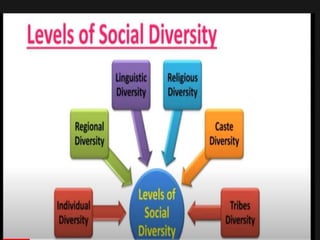
3. Levels of social diversity
4. Education for understanding the social
diversity in India
5. Role of education in creating positive
attitude towards diversity
6. Inter disciplinary nature of education
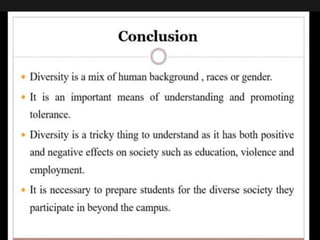
7. Conclusion
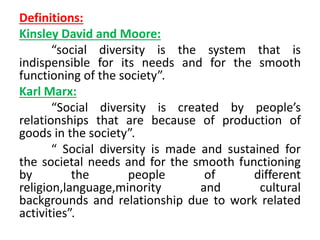
Definitions:
Kinsley David and Moore:
“social diversity is the system that is
indispensible for its needs and for the smooth
functioning of the society”.
Karl Marx:
“Social diversity is created by people’s
relationships that are because of production of
goods in the society”.
“ Social diversity is made and sustained for
the societal needs and for the smooth functioning
by the people of different
religion,language,minority and cultural
backgrounds and relationship due to work related
activities”.
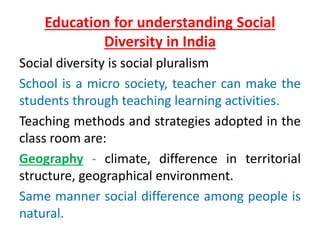
Education for understanding Social
Diversity in India
Social diversity is social pluralism
School is a micro society, teacher can make the
students through teaching learning activities.
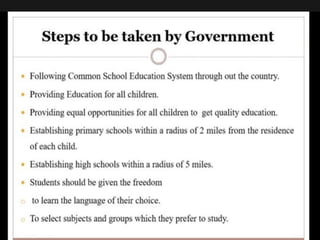
Teaching methods and strategies adopted in the
class room are:
Geography - climate, difference in territorial
structure, geographical environment.
Same manner social difference among people is
natural.
National festivals- equal importance to
each tradition
Daily assembly- include worship of
different religion
Stories- hard work and social service by
eminent industrialist, educationist and
voluntary social service of people.
Classroom activities- make them
understand that social diversity is really
helpful for the growth of the society.
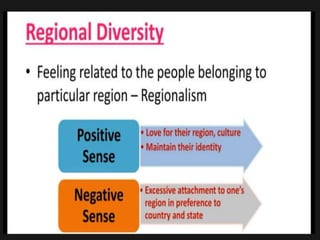
Regional level- Is due to geographical structure
of each territory.
• People in each territory adopt different
cultural activities, dress, food habit etc.
• Healthy competition, open mindedness make
the nation prosper.
Religion- all religion are equal, needs equal
respect, caste is due to the division of labour.
• Different view towards the caste is biased
attitude.
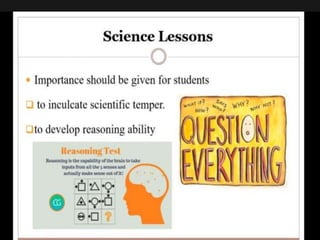
• Science teaching can create positive attitude
to all caste.
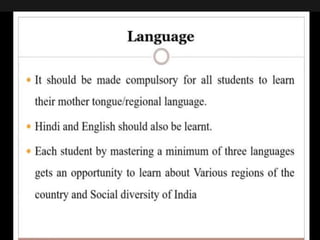
Language: Linguistic level difference give an
opportunity to enrich our language.
By learning different languages, we can make
contributions to that and our language also.
Other benefits are:
Improves memory, good multitasker, cultural
appreciation, better communicator, encourages
creativity, make brain bigger, sharpens mind,
enhance decision making, improves
performances in academic areas, more over our
language gets improved.
Balanced personality leads to unity in diversity
Social science: learn from tribes that how to
protect and conserve our environment.
 Preserve our natural resources
 Learn the social diversity at tribes level and
live united.
 Need of united people’s movement for
betterment of our country.
Biology: learn to compare biodiversity with
social diversity.
 Bio-diversity helps for ecological balance,
social diversity brings harmony and peace.
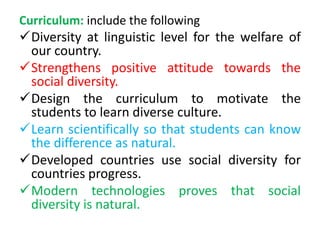
Curriculum: include the following
Diversity at linguistic level for the welfare of
our country.
Strengthens positive attitude towards the
social diversity.
Design the curriculum to motivate the
students to learn diverse culture.
Learn scientifically so that students can know
the difference as natural.
Developed countries use social diversity for
countries progress.
Modern technologies proves that social
diversity is natural.
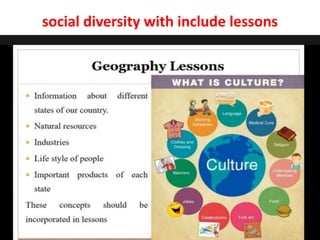
social diversity with include lessons
Role of education in Indian society to create a
positive attitude towards diversity
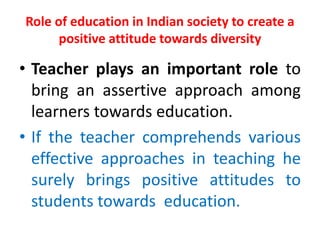
• Teacher plays an important role to
bring an assertive approach among
learners towards education.
• If the teacher comprehends various
effective approaches in teaching he
surely brings positive attitudes to
students towards education.
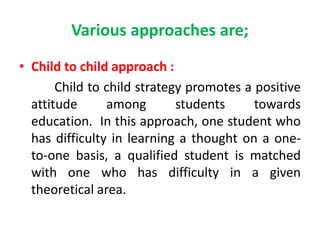
Various approaches are;
• Child to child approach :
Child to child strategy promotes a positive
attitude among students towards
education. In this approach, one student who
has difficulty in learning a thought on a one-
to-one basis, a qualified student is matched
with one who has difficulty in a given
theoretical area.
Cooperative learning:
Cooperative learning is a process to promote
an assertive approach towards education in
followers. The primary components associated in
this procedure are positive dependence or the
feeling that individual goal accomplishment relies
on the achievement of all group members,
student’s own efficiency, face-to-face
communication with companions, use of social
abilities and responsibility of society as a whole in
the completion of a given educational task.
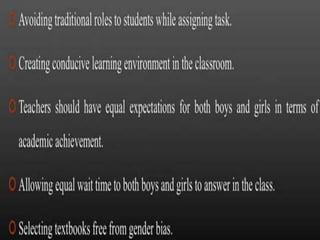
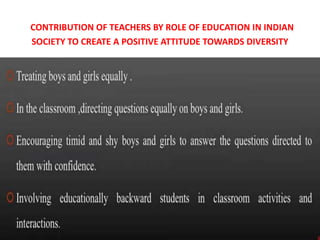
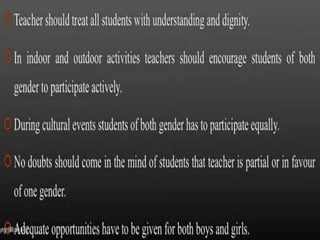
CONTRIBUTION OF TEACHERS BY ROLE OF EDUCATION IN INDIAN
SOCIETY TO CREATE A POSITIVE ATTITUDE TOWARDS DIVERSITY
INTERDISCIPLINARY
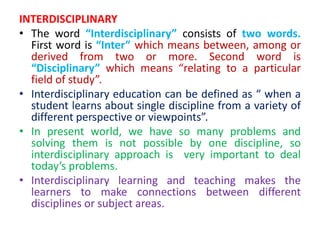
• The word “Interdisciplinary” consists of two words.
First word is “Inter” which means between, among or
derived from two or more. Second word is
“Disciplinary” which means “relating to a particular
field of study”.
• Interdisciplinary education can be defined as “ when a
student learns about single discipline from a variety of
different perspective or viewpoints”.
• In present world, we have so many problems and
solving them is not possible by one discipline, so
interdisciplinary approach is very important to deal
today’s problems.
• Interdisciplinary learning and teaching makes the
learners to make connections between different
disciplines or subject areas.
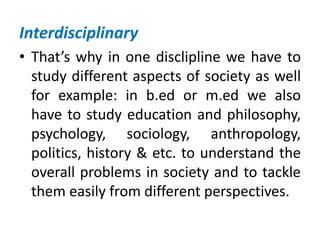
Interdisciplinary
• That’s why in one disclipline we have to
study different aspects of society as well
for example: in b.ed or m.ed we also
have to study education and philosophy,
psychology, sociology, anthropology,
politics, history & etc. to understand the
overall problems in society and to tackle
them easily from different perspectives.
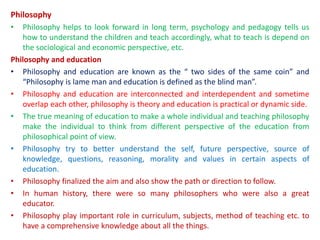
Philosophy
• Philosophy helps to look forward in long term, psychology and pedagogy tells us
how to understand the children and teach accordingly, what to teach is depend on
the sociological and economic perspective, etc.
Philosophy and education
• Philosophy and education are known as the “ two sides of the same coin” and
“Philosophy is lame man and education is defined as the blind man”.
• Philosophy and education are interconnected and interdependent and sometime
overlap each other, philosophy is theory and education is practical or dynamic side.
• The true meaning of education to make a whole individual and teaching philosophy
make the individual to think from different perspective of the education from
philosophical point of view.
• Philosophy try to better understand the self, future perspective, source of
knowledge, questions, reasoning, morality and values in certain aspects of
education.
• Philosophy finalized the aim and also show the path or direction to follow.
• In human history, there were so many philosophers who were also a great
educator.
• Philosophy play important role in curriculum, subjects, method of teaching etc. to
have a comprehensive knowledge about all the things.
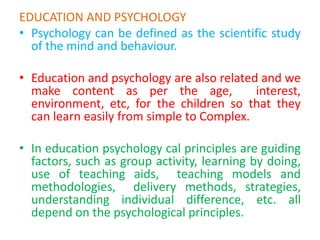
EDUCATION AND PSYCHOLOGY
• Psychology can be defined as the scientific study
of the mind and behaviour.
• Education and psychology are also related and we
make content as per the age, interest,
environment, etc, for the children so that they
can learn easily from simple to Complex.
• In education psychology cal principles are guiding
factors, such as group activity, learning by doing,
use of teaching aids, teaching models and
methodologies, delivery methods, strategies,
understanding individual difference, etc. all
depend on the psychological principles.
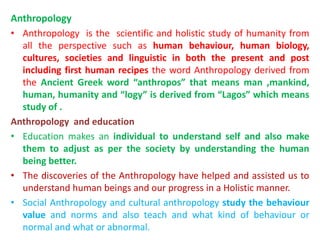
Anthropology
• Anthropology is the scientific and holistic study of humanity from
all the perspective such as human behaviour, human biology,
cultures, societies and linguistic in both the present and post
including first human recipes the word Anthropology derived from
the Ancient Greek word “anthropos” that means man ,mankind,
human, humanity and “logy” is derived from “Lagos” which means
study of .
Anthropology and education
• Education makes an individual to understand self and also make
them to adjust as per the society by understanding the human
being better.
• The discoveries of the Anthropology have helped and assisted us to
understand human beings and our progress in a Holistic manner.
• Social Anthropology and cultural anthropology study the behaviour
value and norms and also teach and what kind of behaviour or
normal and what or abnormal.
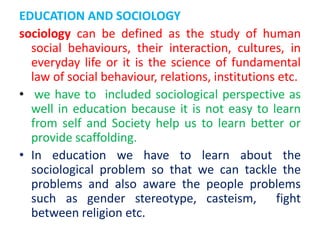
EDUCATION AND SOCIOLOGY
sociology can be defined as the study of human
social behaviours, their interaction, cultures, in
everyday life or it is the science of fundamental
law of social behaviour, relations, institutions etc.
• we have to included sociological perspective as
well in education because it is not easy to learn
from self and Society help us to learn better or
provide scaffolding.
• In education we have to learn about the
sociological problem so that we can tackle the
problems and also aware the people problems
such as gender stereotype, casteism, fight
between religion etc.
Education and History
THANK YOU

CONTEMPORARY INDIA AND EDUCATION - UNIT 2 (B.Ed. 1 YEAR - 1 SEMESTER)

  • 3.
    C2- CONTEMPORARY INDIAAND EDUCATION Unit-2 Understanding the Social Diversity Synopsis 1. Introduction 2. Meaning and definition 3. Levels of social diversity 4. Education for understanding the social diversity in India 5. Role of education in creating positive attitude towards diversity 6. Inter disciplinary nature of education 7. Conclusion
  • 7.
    Definitions: Kinsley David andMoore: “social diversity is the system that is indispensible for its needs and for the smooth functioning of the society”. Karl Marx: “Social diversity is created by people’s relationships that are because of production of goods in the society”. “ Social diversity is made and sustained for the societal needs and for the smooth functioning by the people of different religion,language,minority and cultural backgrounds and relationship due to work related activities”.
  • 18.
    Education for understandingSocial Diversity in India Social diversity is social pluralism School is a micro society, teacher can make the students through teaching learning activities. Teaching methods and strategies adopted in the class room are: Geography - climate, difference in territorial structure, geographical environment. Same manner social difference among people is natural.
  • 19.
    National festivals- equalimportance to each tradition Daily assembly- include worship of different religion Stories- hard work and social service by eminent industrialist, educationist and voluntary social service of people. Classroom activities- make them understand that social diversity is really helpful for the growth of the society.
  • 20.
    Regional level- Isdue to geographical structure of each territory. • People in each territory adopt different cultural activities, dress, food habit etc. • Healthy competition, open mindedness make the nation prosper. Religion- all religion are equal, needs equal respect, caste is due to the division of labour. • Different view towards the caste is biased attitude. • Science teaching can create positive attitude to all caste.
  • 21.
    Language: Linguistic leveldifference give an opportunity to enrich our language. By learning different languages, we can make contributions to that and our language also. Other benefits are: Improves memory, good multitasker, cultural appreciation, better communicator, encourages creativity, make brain bigger, sharpens mind, enhance decision making, improves performances in academic areas, more over our language gets improved. Balanced personality leads to unity in diversity
  • 22.
    Social science: learnfrom tribes that how to protect and conserve our environment.  Preserve our natural resources  Learn the social diversity at tribes level and live united.  Need of united people’s movement for betterment of our country. Biology: learn to compare biodiversity with social diversity.  Bio-diversity helps for ecological balance, social diversity brings harmony and peace.
  • 23.
    Curriculum: include thefollowing Diversity at linguistic level for the welfare of our country. Strengthens positive attitude towards the social diversity. Design the curriculum to motivate the students to learn diverse culture. Learn scientifically so that students can know the difference as natural. Developed countries use social diversity for countries progress. Modern technologies proves that social diversity is natural.
  • 24.
    social diversity withinclude lessons
  • 30.
    Role of educationin Indian society to create a positive attitude towards diversity • Teacher plays an important role to bring an assertive approach among learners towards education. • If the teacher comprehends various effective approaches in teaching he surely brings positive attitudes to students towards education.
  • 31.
    Various approaches are; •Child to child approach : Child to child strategy promotes a positive attitude among students towards education. In this approach, one student who has difficulty in learning a thought on a one- to-one basis, a qualified student is matched with one who has difficulty in a given theoretical area.
  • 32.
    Cooperative learning: Cooperative learningis a process to promote an assertive approach towards education in followers. The primary components associated in this procedure are positive dependence or the feeling that individual goal accomplishment relies on the achievement of all group members, student’s own efficiency, face-to-face communication with companions, use of social abilities and responsibility of society as a whole in the completion of a given educational task.
  • 33.
    CONTRIBUTION OF TEACHERSBY ROLE OF EDUCATION IN INDIAN SOCIETY TO CREATE A POSITIVE ATTITUDE TOWARDS DIVERSITY
  • 38.
    INTERDISCIPLINARY • The word“Interdisciplinary” consists of two words. First word is “Inter” which means between, among or derived from two or more. Second word is “Disciplinary” which means “relating to a particular field of study”. • Interdisciplinary education can be defined as “ when a student learns about single discipline from a variety of different perspective or viewpoints”. • In present world, we have so many problems and solving them is not possible by one discipline, so interdisciplinary approach is very important to deal today’s problems. • Interdisciplinary learning and teaching makes the learners to make connections between different disciplines or subject areas.
  • 39.
    Interdisciplinary • That’s whyin one disclipline we have to study different aspects of society as well for example: in b.ed or m.ed we also have to study education and philosophy, psychology, sociology, anthropology, politics, history & etc. to understand the overall problems in society and to tackle them easily from different perspectives.
  • 40.
    Philosophy • Philosophy helpsto look forward in long term, psychology and pedagogy tells us how to understand the children and teach accordingly, what to teach is depend on the sociological and economic perspective, etc. Philosophy and education • Philosophy and education are known as the “ two sides of the same coin” and “Philosophy is lame man and education is defined as the blind man”. • Philosophy and education are interconnected and interdependent and sometime overlap each other, philosophy is theory and education is practical or dynamic side. • The true meaning of education to make a whole individual and teaching philosophy make the individual to think from different perspective of the education from philosophical point of view. • Philosophy try to better understand the self, future perspective, source of knowledge, questions, reasoning, morality and values in certain aspects of education. • Philosophy finalized the aim and also show the path or direction to follow. • In human history, there were so many philosophers who were also a great educator. • Philosophy play important role in curriculum, subjects, method of teaching etc. to have a comprehensive knowledge about all the things.
  • 41.
    EDUCATION AND PSYCHOLOGY •Psychology can be defined as the scientific study of the mind and behaviour. • Education and psychology are also related and we make content as per the age, interest, environment, etc, for the children so that they can learn easily from simple to Complex. • In education psychology cal principles are guiding factors, such as group activity, learning by doing, use of teaching aids, teaching models and methodologies, delivery methods, strategies, understanding individual difference, etc. all depend on the psychological principles.
  • 42.
    Anthropology • Anthropology isthe scientific and holistic study of humanity from all the perspective such as human behaviour, human biology, cultures, societies and linguistic in both the present and post including first human recipes the word Anthropology derived from the Ancient Greek word “anthropos” that means man ,mankind, human, humanity and “logy” is derived from “Lagos” which means study of . Anthropology and education • Education makes an individual to understand self and also make them to adjust as per the society by understanding the human being better. • The discoveries of the Anthropology have helped and assisted us to understand human beings and our progress in a Holistic manner. • Social Anthropology and cultural anthropology study the behaviour value and norms and also teach and what kind of behaviour or normal and what or abnormal.
  • 43.
    EDUCATION AND SOCIOLOGY sociologycan be defined as the study of human social behaviours, their interaction, cultures, in everyday life or it is the science of fundamental law of social behaviour, relations, institutions etc. • we have to included sociological perspective as well in education because it is not easy to learn from self and Society help us to learn better or provide scaffolding. • In education we have to learn about the sociological problem so that we can tackle the problems and also aware the people problems such as gender stereotype, casteism, fight between religion etc.
  • 48.
  • 50.