SEMESTER - III
MED 306 Inclusive Education
Unit 3: Inclusive Instruction design
Inclusive Curriculum
By Asst. Prof. Madhuri Sheth
Dr. D. y. Patil College of Education, Pimpri
Syllabus
Unit – III Inclusive Instruction design
• 3.1 Inclusive Curriculum – modification, classification,
according to the needs of the students
• 3.2 Models in inclusive education
• 3.3 Inclusive Lesson planning and Instructional strategies
• 3.4 Collaboration & co-operative learning
• 3.5 Peer-mediated instruction and interventions
Unit – IV Organization and Assessment of Inclusive Classroom
• 4.1 Physical layout of Inclusive classroom
• 4.2 Special assistance to children
• 4.3 Meeting student’s personal care and medication needs.
• 4.4 Promoting Social competence in inclusive classroom.
• 4.5 Educational reports, intelligence tests, Achievement tests,
teacher based assessments.
Practical: Critical study of any Special teacher
training college or Institutes
• Study following Points of special teacher training institute need to include
in file:
• 1] Introduction
• 2] Objectives
• 3] Vision
• 4] Mission
• 5] Infrastructural Facilities
• 6] Section wise work: Administration and academic work
• 7] Other activities of institute
• 8] Educational Importance
• 9] Special features of institute
• 9] Interview/ Questionnaire analysis
• 10] Report writing of visit
• 11] photos of visit
Inclusive curriculum
• An inclusive curriculum is universal and intended to improve
the experience, skills and attainment of all students including
those in protected characteristic groups.
• Curriculum should consists of……….
– understand the importance of setting realistic and
achievable goals
– Use creative teaching methodology
– Pay special attention to accommodation and modifications
followed in the classroom for teaching and assessment of
students
Inclusive curriculum
• Curriculum objectives, teaching methods, assessment
techniques, learning environment, syllabus/content
• Learning goals suitable to all students with diverse needs
• Teachers may use
– differentiated instruction techniques,
– technology for various purposes
– Modify the physical environment
– Integrate adaptive technologies
– adopt culturally responsive language
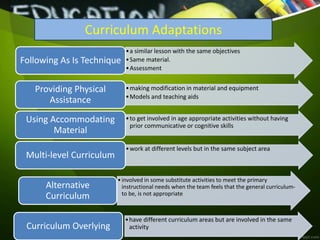
Curriculum Adaptations
•a similar lesson with the same objectives
•Same material.
•Assessment
Following As Is Technique
•making modification in material and equipment
•Models and teaching aids
Providing Physical
Assistance
•to get involved in age appropriate activities without having
prior communicative or cognitive skills
Using Accommodating
Material
•work at different levels but in the same subject area
Multi-level Curriculum
•involved in some substitute activities to meet the primary
instructional needs when the team feels that the general curriculum-
to be, is not appropriate
Alternative
Curriculum
•have different curriculum areas but are involved in the same
activity
Curriculum Overlying
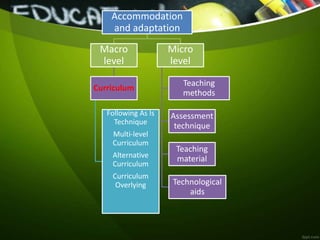
Accommodation
and adaptation
Macro
level
Curriculum
Following As Is
Technique
Multi-level
Curriculum
Alternative
Curriculum
Curriculum
Overlying
Micro
level
Teaching
methods
Assessment
technique
Teaching
material
Technological
aids
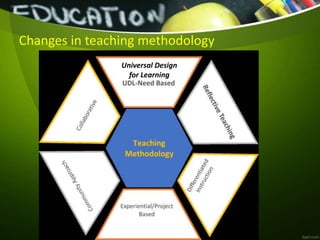
Changes in teaching methodology
Universal Design
for Learning
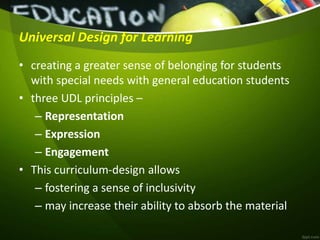
Universal Design for Learning
• creating a greater sense of belonging for students
with special needs with general education students
• three UDL principles –
– Representation
– Expression
– Engagement
• This curriculum-design allows
– fostering a sense of inclusivity
– may increase their ability to absorb the material
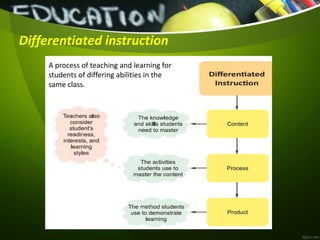
Differentiated instruction
A process of teaching and learning for
students of differing abilities in the
same class.
Seven Wonders of Learning
• Feeling, Touching, Seeing, Hearing, Tasting, Laughing,
and Loving are the seven wonders of learning
• It is method in which general education and special
education teachers work in collaboration
• to plan lesson teaching strategies
• monitor the progress of students
• manage the classroom for overall development of all.
Collaborative Teaching
Buddy System
• A Buddy is appointed from the class, keeping in mind the
needs and personality of the student.
• A Buddy can be paired in several ways:
– New admission with older students
– A low achiever with a high achiever
– Behavioral challenging with adults
– Quiet child with a talkative child.
– Academically bright with one having academic difficulties.
• A timely rewarding of the Buddy helps in maintaining the
positive behaviour and willingness to help other students.
Some of the major issues related to Special Needs
Children Curriculum are as follows:
• Opportunity not for all
• Disability related concepts and studies are ignored
• Rigid examination system
• School infrastructural difficulties
• Negative attitude of teachers
• Stigmas about CWSN
• Insufficient institutional materials
• Lack of/limited involvement in sports
• Few trained sign language teachers
Curricular Adaptations and Modifications
• According to NCERT (2015), “Adaptation refers to
adjusting assessments, material, curriculum, or
classroom environment to accommodate a
student’s needs so he/she can participate in, and
achieve the teaching-learning goals”
• Curricular adaptations allow students with
disabilities to participate in inclusive
environments by compensating for learners’
weaknesses.
• equal opportunity to all
Modifications can be made in:
• Teaching and learning environment inside the classroom and
the school;
• Teaching and learning strategies to meet the individual
differences;
• Teaching and learning support materials that enhance a
learner’s performance and allow at least partial participation
in a learning activity;
• Level of support by all means (manpower and technology);
and
• Flexibility in assessment.
Importance of Curriculum adaptation
• Facilitates the teaching-learning process
• Simplify and reduce the content
• All learners get access to quality and meaningful
learning experiences.
• CWSN do not feel excluded
principles should be considered for adapting the
curriculum:
• should not change the original concept of the
curriculum
• objective of the instructional material should remain
same
• Providing same experiences, compensatory activities
should be planned
• Facilitate maximum participation of children
• Assessment criteria can also be modified
Curriculum Accommodations
• Students receiving accommodations read the
same material and take the same tests as their
peers without disabilities.
• The changes do not alter or lower the
standards or expectations for a subject or test.
• Example: students lacking reading skills
provided with audio tape version of textbook.
Alterations such as ………
• seating the child in front
• alterations in class work and homework such as
individualising assignments, regarding length,
number, due date, topic
• alterations in examinations such as multiple
choice questions, oral examinations, reading of
question paper, allowance for spelling errors
• Instructional strategies
• Learning material
Accommodations & Adaptations for Cognitive
Impairments & Intellectual Disabilities
• Seated at a distraction-free place
• Provided printed materials early
• Given reading handouts in the form of graphic
organizers, mind maps, pictures
• Short sentences and a simple vocabulary
• information in both oral and written formats
• more than one way for demonstrating or explaining
• Allowed use of technology
• flexibility in classroom procedures
• use of captioned videos
Accommodations & Adaptations for Physical
Impairment
• Welcoming and comfortable environment in class
• proper seating places
• Ensure free movement
• opportunities for participation by planning alternative
activities in advance
• to use assistive technology like screen reading software,
recorders, keyboards, grippers, thick pencils
• peer buddy for assistance in classroom
Accommodation & Adaptations for
Visually Impaired /Low Vision
• Provided magnifying glass with light
• increase of font size of the smart board while teaching
• Provided oral information along with written by the
teacher reading aloud
• Granted extra time for completing the work
• Allowed use of a Smart Board with text conversion
software that allows the student to access the electronic
version of the notes with a Screen Reading or Voice
Software.
• Seated away from the window to avoid glare.
Types of Assistive Technologies
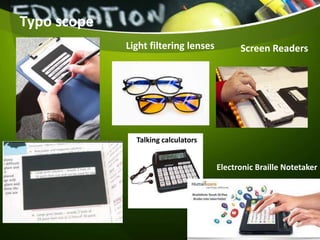
• Visual Aids:
• convert on-screen text into Braille,
• Magnify certain portions of the screen text
• Even convert certain portions of the text into audio.
• Some commonly used visual aids are:
– Typo scope
– Light filtering lenses
– Screen Readers
– Talking calculators
– Electronic Braille Notetaker
Typo scope
Light filtering lenses Screen Readers
Talking calculators
Electronic Braille Notetaker
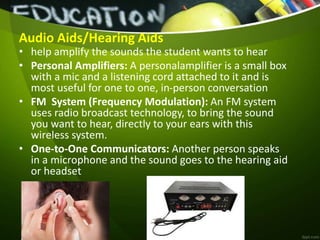
Audio Aids/Hearing Aids
• help amplify the sounds the student wants to hear
• Personal Amplifiers: A personalamplifier is a small box
with a mic and a listening cord attached to it and is
most useful for one to one, in-person conversation
• FM System (Frequency Modulation): An FM system
uses radio broadcast technology, to bring the sound
you want to hear, directly to your ears with this
wireless system.
• One-to-One Communicators: Another person speaks
in a microphone and the sound goes to the hearing aid
or headset
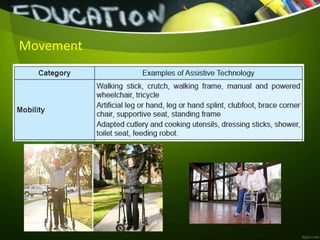
Movement
Conclusion
• Inclusive Curriculum should takes into consideration
and caters for the diverse needs, previous
experiences, interests and personal characteristics of
all learners. It attempts to ensure that all students
are part of the shared learning experiences of the
classroom and that equal opportunities are provided
regardless of learner differences.

Inclusive curriculum.pptx

  • 1.
    SEMESTER - III MED306 Inclusive Education Unit 3: Inclusive Instruction design Inclusive Curriculum By Asst. Prof. Madhuri Sheth Dr. D. y. Patil College of Education, Pimpri
  • 2.
    Syllabus Unit – IIIInclusive Instruction design • 3.1 Inclusive Curriculum – modification, classification, according to the needs of the students • 3.2 Models in inclusive education • 3.3 Inclusive Lesson planning and Instructional strategies • 3.4 Collaboration & co-operative learning • 3.5 Peer-mediated instruction and interventions Unit – IV Organization and Assessment of Inclusive Classroom • 4.1 Physical layout of Inclusive classroom • 4.2 Special assistance to children • 4.3 Meeting student’s personal care and medication needs. • 4.4 Promoting Social competence in inclusive classroom. • 4.5 Educational reports, intelligence tests, Achievement tests, teacher based assessments.
  • 3.
    Practical: Critical studyof any Special teacher training college or Institutes • Study following Points of special teacher training institute need to include in file: • 1] Introduction • 2] Objectives • 3] Vision • 4] Mission • 5] Infrastructural Facilities • 6] Section wise work: Administration and academic work • 7] Other activities of institute • 8] Educational Importance • 9] Special features of institute • 9] Interview/ Questionnaire analysis • 10] Report writing of visit • 11] photos of visit
  • 4.
    Inclusive curriculum • Aninclusive curriculum is universal and intended to improve the experience, skills and attainment of all students including those in protected characteristic groups. • Curriculum should consists of………. – understand the importance of setting realistic and achievable goals – Use creative teaching methodology – Pay special attention to accommodation and modifications followed in the classroom for teaching and assessment of students
  • 5.
    Inclusive curriculum • Curriculumobjectives, teaching methods, assessment techniques, learning environment, syllabus/content • Learning goals suitable to all students with diverse needs • Teachers may use – differentiated instruction techniques, – technology for various purposes – Modify the physical environment – Integrate adaptive technologies – adopt culturally responsive language
  • 6.
    Curriculum Adaptations •a similarlesson with the same objectives •Same material. •Assessment Following As Is Technique •making modification in material and equipment •Models and teaching aids Providing Physical Assistance •to get involved in age appropriate activities without having prior communicative or cognitive skills Using Accommodating Material •work at different levels but in the same subject area Multi-level Curriculum •involved in some substitute activities to meet the primary instructional needs when the team feels that the general curriculum- to be, is not appropriate Alternative Curriculum •have different curriculum areas but are involved in the same activity Curriculum Overlying
  • 7.
    Accommodation and adaptation Macro level Curriculum Following AsIs Technique Multi-level Curriculum Alternative Curriculum Curriculum Overlying Micro level Teaching methods Assessment technique Teaching material Technological aids
  • 8.
    Changes in teachingmethodology Universal Design for Learning
  • 9.
    Universal Design forLearning • creating a greater sense of belonging for students with special needs with general education students • three UDL principles – – Representation – Expression – Engagement • This curriculum-design allows – fostering a sense of inclusivity – may increase their ability to absorb the material
  • 10.
    Differentiated instruction A processof teaching and learning for students of differing abilities in the same class.
  • 11.
    Seven Wonders ofLearning • Feeling, Touching, Seeing, Hearing, Tasting, Laughing, and Loving are the seven wonders of learning • It is method in which general education and special education teachers work in collaboration • to plan lesson teaching strategies • monitor the progress of students • manage the classroom for overall development of all. Collaborative Teaching
  • 12.
    Buddy System • ABuddy is appointed from the class, keeping in mind the needs and personality of the student. • A Buddy can be paired in several ways: – New admission with older students – A low achiever with a high achiever – Behavioral challenging with adults – Quiet child with a talkative child. – Academically bright with one having academic difficulties. • A timely rewarding of the Buddy helps in maintaining the positive behaviour and willingness to help other students.
  • 13.
    Some of themajor issues related to Special Needs Children Curriculum are as follows: • Opportunity not for all • Disability related concepts and studies are ignored • Rigid examination system • School infrastructural difficulties • Negative attitude of teachers • Stigmas about CWSN • Insufficient institutional materials • Lack of/limited involvement in sports • Few trained sign language teachers
  • 14.
    Curricular Adaptations andModifications • According to NCERT (2015), “Adaptation refers to adjusting assessments, material, curriculum, or classroom environment to accommodate a student’s needs so he/she can participate in, and achieve the teaching-learning goals” • Curricular adaptations allow students with disabilities to participate in inclusive environments by compensating for learners’ weaknesses. • equal opportunity to all
  • 15.
    Modifications can bemade in: • Teaching and learning environment inside the classroom and the school; • Teaching and learning strategies to meet the individual differences; • Teaching and learning support materials that enhance a learner’s performance and allow at least partial participation in a learning activity; • Level of support by all means (manpower and technology); and • Flexibility in assessment.
  • 16.
    Importance of Curriculumadaptation • Facilitates the teaching-learning process • Simplify and reduce the content • All learners get access to quality and meaningful learning experiences. • CWSN do not feel excluded
  • 17.
    principles should beconsidered for adapting the curriculum: • should not change the original concept of the curriculum • objective of the instructional material should remain same • Providing same experiences, compensatory activities should be planned • Facilitate maximum participation of children • Assessment criteria can also be modified
  • 18.
    Curriculum Accommodations • Studentsreceiving accommodations read the same material and take the same tests as their peers without disabilities. • The changes do not alter or lower the standards or expectations for a subject or test. • Example: students lacking reading skills provided with audio tape version of textbook.
  • 19.
    Alterations such as……… • seating the child in front • alterations in class work and homework such as individualising assignments, regarding length, number, due date, topic • alterations in examinations such as multiple choice questions, oral examinations, reading of question paper, allowance for spelling errors • Instructional strategies • Learning material
  • 22.
    Accommodations & Adaptationsfor Cognitive Impairments & Intellectual Disabilities • Seated at a distraction-free place • Provided printed materials early • Given reading handouts in the form of graphic organizers, mind maps, pictures • Short sentences and a simple vocabulary • information in both oral and written formats • more than one way for demonstrating or explaining • Allowed use of technology • flexibility in classroom procedures • use of captioned videos
  • 23.
    Accommodations & Adaptationsfor Physical Impairment • Welcoming and comfortable environment in class • proper seating places • Ensure free movement • opportunities for participation by planning alternative activities in advance • to use assistive technology like screen reading software, recorders, keyboards, grippers, thick pencils • peer buddy for assistance in classroom
  • 24.
    Accommodation & Adaptationsfor Visually Impaired /Low Vision • Provided magnifying glass with light • increase of font size of the smart board while teaching • Provided oral information along with written by the teacher reading aloud • Granted extra time for completing the work • Allowed use of a Smart Board with text conversion software that allows the student to access the electronic version of the notes with a Screen Reading or Voice Software. • Seated away from the window to avoid glare.
  • 25.
    Types of AssistiveTechnologies • Visual Aids: • convert on-screen text into Braille, • Magnify certain portions of the screen text • Even convert certain portions of the text into audio. • Some commonly used visual aids are: – Typo scope – Light filtering lenses – Screen Readers – Talking calculators – Electronic Braille Notetaker
  • 26.
    Typo scope Light filteringlenses Screen Readers Talking calculators Electronic Braille Notetaker
  • 27.
    Audio Aids/Hearing Aids •help amplify the sounds the student wants to hear • Personal Amplifiers: A personalamplifier is a small box with a mic and a listening cord attached to it and is most useful for one to one, in-person conversation • FM System (Frequency Modulation): An FM system uses radio broadcast technology, to bring the sound you want to hear, directly to your ears with this wireless system. • One-to-One Communicators: Another person speaks in a microphone and the sound goes to the hearing aid or headset
  • 28.
  • 29.
    Conclusion • Inclusive Curriculumshould takes into consideration and caters for the diverse needs, previous experiences, interests and personal characteristics of all learners. It attempts to ensure that all students are part of the shared learning experiences of the classroom and that equal opportunities are provided regardless of learner differences.