MODEL OF
TEACHING
PROF D. B. GHULE
INTRODUCTION
The term model is used to mean a teaching
episode done by an experienced teacher in which
a highly focused teaching behavior is
demonstrated, in it an individual demonstrating
particular patterns which the trainee learns
through imitation. It is a way to talk and think
about instruction in which certain facts may be
organized, classified and interpreted.
2
Bruce Joyce and Marsha Weil describe a
Model of Teaching as a plan or pattern that
can be used to shape curricula, to design
instructional materials and to guide
instruction in the classroom and other
settings. Thus, teaching models are just
instructional designs. They describe the
process and producing particular
environmental situations which cause the
student to interact in such a way that specific
change occurs in his behavior.
3
MEANING
Teaching model is the model which is designed for
specific purposes the teaching of information concepts,
ways of thinking, and the study of social values and so
on by asking students to engage in particular cognitive
and social tasks. Some models Centre on delivery by
the instructor while others develop as the learners
respond to tasks and the student is regarded as a
partner in the educational enterprise.
20XX
Presentation title
4
5
DEFINITIONS
Teaching models have been defined in a number of ways. Some of the
important definitions of teaching model are given here to have a wider
perspective of this concept.
1) Allen and Ryan (1969):Modelling is an individual demonstrating particular
pattern which the trainee learns through imitation
2) Bandura (1969): "Modelling demonstrates that virtually all learning
phenomena resulting from direct experiences can occur on a vicarious
basis through observation of other person's behavior and its
consequences for them.“
3) B.K. Passi LC. Singh and D. N. Sansanwal (1991): A model of teaching
consists of guidelines for designing educational activities and
environments. Model of teaching is a plan that can also be utilized to
shape courses or studies, to design instructional material and to guide
instruction."
20XX
Presentation title
6
4) Joyce and Weil (1972):Teaching model is a pattern or plan,
which can be used to shape a curriculum or course to select
instructional materials and to guide a teacher's actions.“
5) N.K. Jangiro and Ajit Singh (1983):A model of teaching is a
set of inter-related components arranged in a sequence which
provides guidelines to realize a specific goal. It helps in
designing instructional activities and environmental facilities,
carrying out of these activities and realization of the stipulated
objectives.
6) Paul D. Eggen et al (1979): "Models are prescriptive
teaching strategies designed to accomplish particular
instructional goals."
20XX
Presentation title
7
Specifications
of Teaching
Models
The teaching models are made on bases of
some specifications. These are based on the
following specifications:
1) Specification of Environmental specifies in
definite terms the environmental conditions
under which a student's response should be
observed.
2) Specification of Operation: It specifies the
mechanism that provides for the reaction of
students and interaction with the environment.
20XX
Presentation title
9
3) Specification of Criterion of Performance It
specifies the criterion of performance which is
accepted by the students. The behavioral
outcome which the learner would demonstrate
after completing specific instructional
sequences is delineated in the teaching
models.
4) Specification of Learning Outcome: It specifies
what the student will perform after completing
an instructional sequence
20XX
Presentation title
10
Characteristics of
a Teaching Model
Characteristics of the teaching models are as follows:
1) Encourage Art of Teaching: Teaching is considered
as an art. Teaching models encourages this art by
providing learning environment.
2) Development of Inherent Abilities: Teaching models
bring about the qualitative development of
personality as it helps in developing human abilities.
It also increases the teacher's social competency
20XX
Presentation title
12
3) Based on Individual Differences: Teaching model
uses the student's interest, as it is constructed on
the basis of individual differences.
4) Influenced by Philosophy: Every teaching model is
influenced by the philosophy of education. Hence,
teachers formulate different models of teaching
under the influence of the philosophy they believe.
5) Answers Fundamental Questions: in every teaching
model answers to all the fundamental questions
pertaining to the behavior of students and teachers
are included
20XX
Presentation title
13
6) Providing Appropriate Experiences: Teaching models
provides proper experiences to both teacher and
student. Selecting the content and presenting it for
learning before the students is the main essentiality of
teaching. This difficulty is solved when a teacher
presents appropriate experience before the students
7) Maxims of Teaching: The basis of teaching model is the
maxims of teaching. They are the foundation of each
teaching model.
8) Practice and Concentration: The development of a
teaching model is based on regular and continuous
practice and concentration. The proper development of a
teaching model is only possible when the assumptions
are made clear by related thinking. 20XX
Presentation title
14
Sources of
models of
teaching
Four important sources from which all the models of teaching
have been derived are given below:
1) The Social Interaction Sources: The model of teaching of this
category emphasizes the importance of social relationship of
the person and are based on the assumption that social
relation is the vehicle of education.
2) The Information Processing Sources: The other source of a
model of teaching is the information processing capability of
the learner which means the way in which people handle
stimuli, organize data, sense problems and solve them. The
model of this category emphasizes the use of specific
strategies within academic disciplines which lead to the
development of creativity and general intellectual ability of
learners.
20XX
Presentation title
16
3) The Personal Sources: Personal and emotional life of the
individual and their internal organization as it affects
relationship with this environment are the sources of this
category of models.
4) Behavior Modification as a Source: The operant conditioning
theory built by B.F. Skinner is the origin of this type of model
which is purely a psychological model and is used in most of
the teaching strategies developed in the last two decades.
20XX
Presentation title
17
Assumption of Models of
Teaching
Each model is based on the assumption
that teaching is the creation of appropriate
environment and various components of
the environment are interdependent
20XX
Presentation title
18
19 Presentation title 20XX
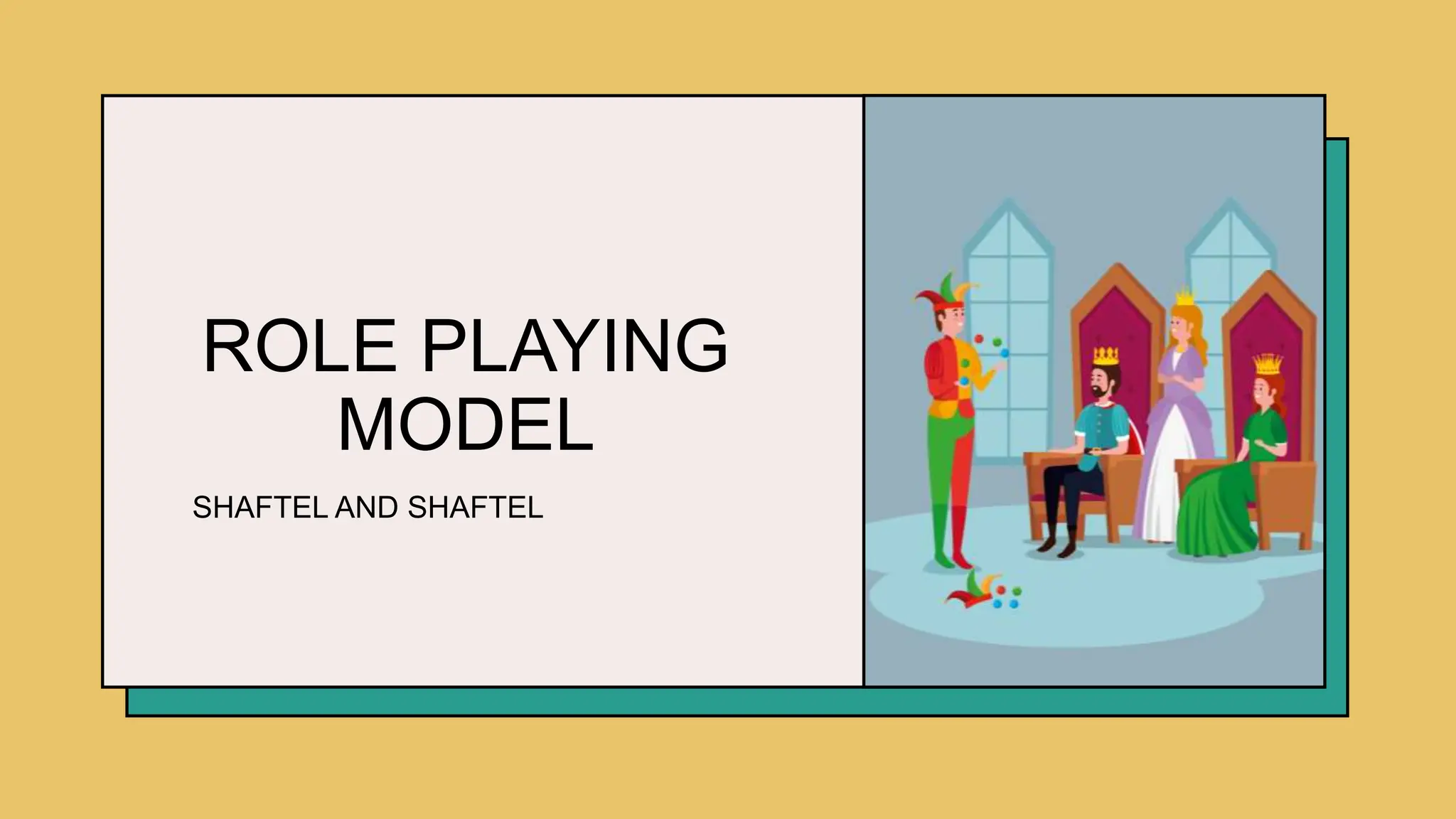
ROLE PLAYING
MODEL
SHAFTEL AND SHAFTEL
INTRODUCTION
Role playing leads students top understand social
behavior, their role in social interactions and ways
of solving problems more effectively. The model
asks students to "act out conflicts, to learn to take
the roles of others and to observe social
behavior. With adaptation this model can us used
with student of all ages. This mode is introduced
by Fannie Shaftel and George Shaftel. It is used
to open up discussions of values and how they
operate in daily life. The main aim of this model is
to help students to understand social values and
develop their social values.
21
22 Presentation title 20XX
23 Presentation title 20XX
Following are the basic assumptions of the role
playing model:
1) It advocates an experience based learning
situation.
2) It can draw out student's feelings.
3) Emotions and ideas can be brought to
consciousness and enhanced by the group.
BASIC ASSUMMPTIONS
SYNTAX
Phase 1- Warm up the
Group:
i. Identity or
introduce the
problem.
ii. Make problem
explicit.
iii. Interpret problem
using story and
explore issues.
iv. Explain role
playing.
Phase 2- Select
Participants
i) Analyze role.
ii) Select role
players.
Phase 3- Set the Stage
i) Stateline of
action.
ii) Restate role.
iii) Get inside
problem
situation.
24 Presentation title 20XX
Phase 4- Prepare the
Observers
i. Decide what to
look for.
ii. Assign
observation
task.
Phase 5- Enact
i) Begin role
play.
ii) Maintain role
play.
iii) Break role
play..
Phase 6- Discuss and
Evaluate
i) Review action
of role play.
ii) Discuss major
focus.
iii) Develop next
enactment.
25 Presentation title 20XX
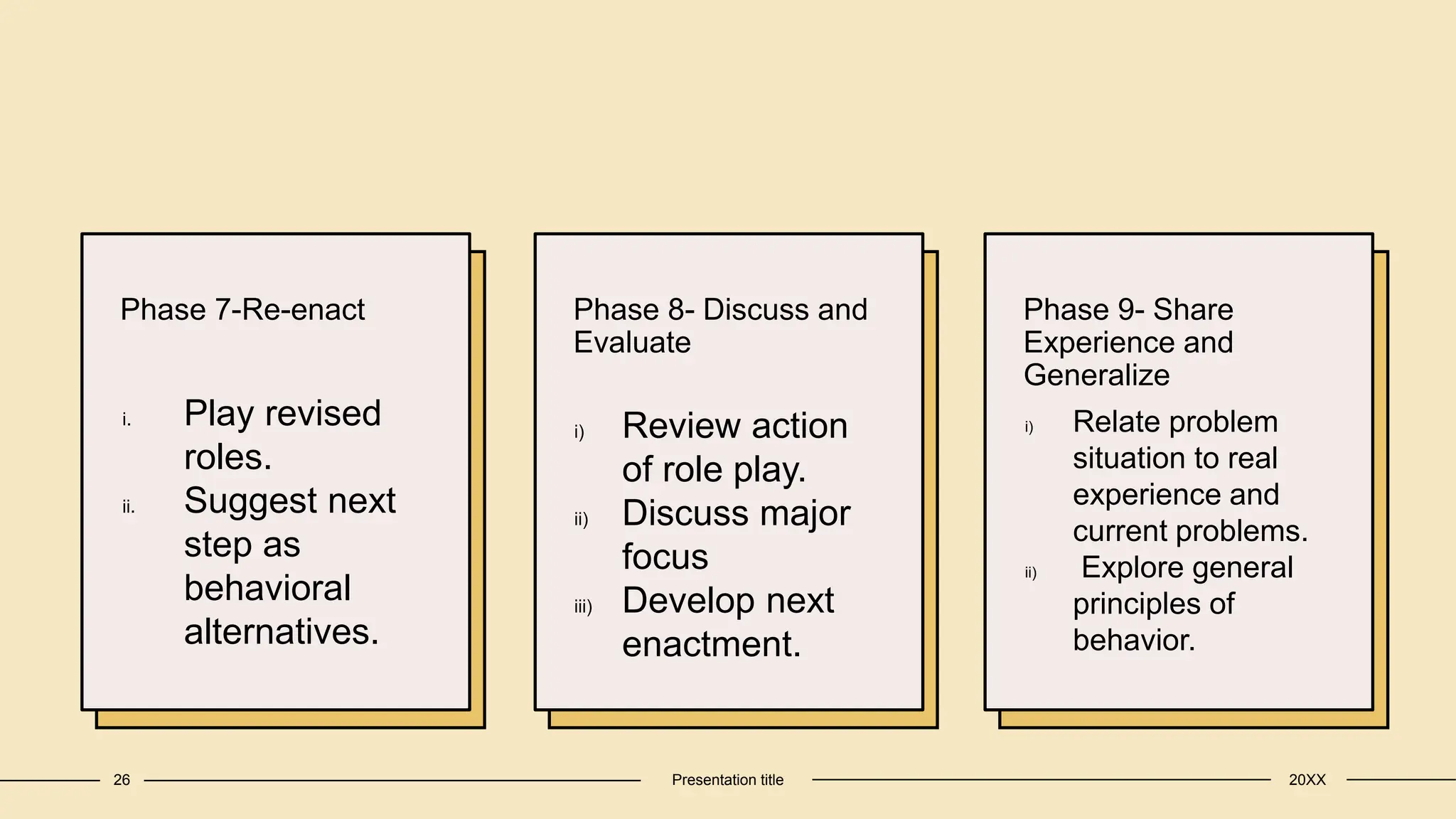
Phase 7-Re-enact
i. Play revised
roles.
ii. Suggest next
step as
behavioral
alternatives.
Phase 8- Discuss and
Evaluate
i) Review action
of role play.
ii) Discuss major
focus
iii) Develop next
enactment.
Phase 9- Share
Experience and
Generalize
i) Relate problem
situation to real
experience and
current problems.
ii) Explore general
principles of
behavior.
26 Presentation title 20XX
Social System
•a) Moderately structured.
•b) Teacher as initiator and guide.
•c) Content of enactment and discussion is
determined largely by students.
27 Presentation title 20XX
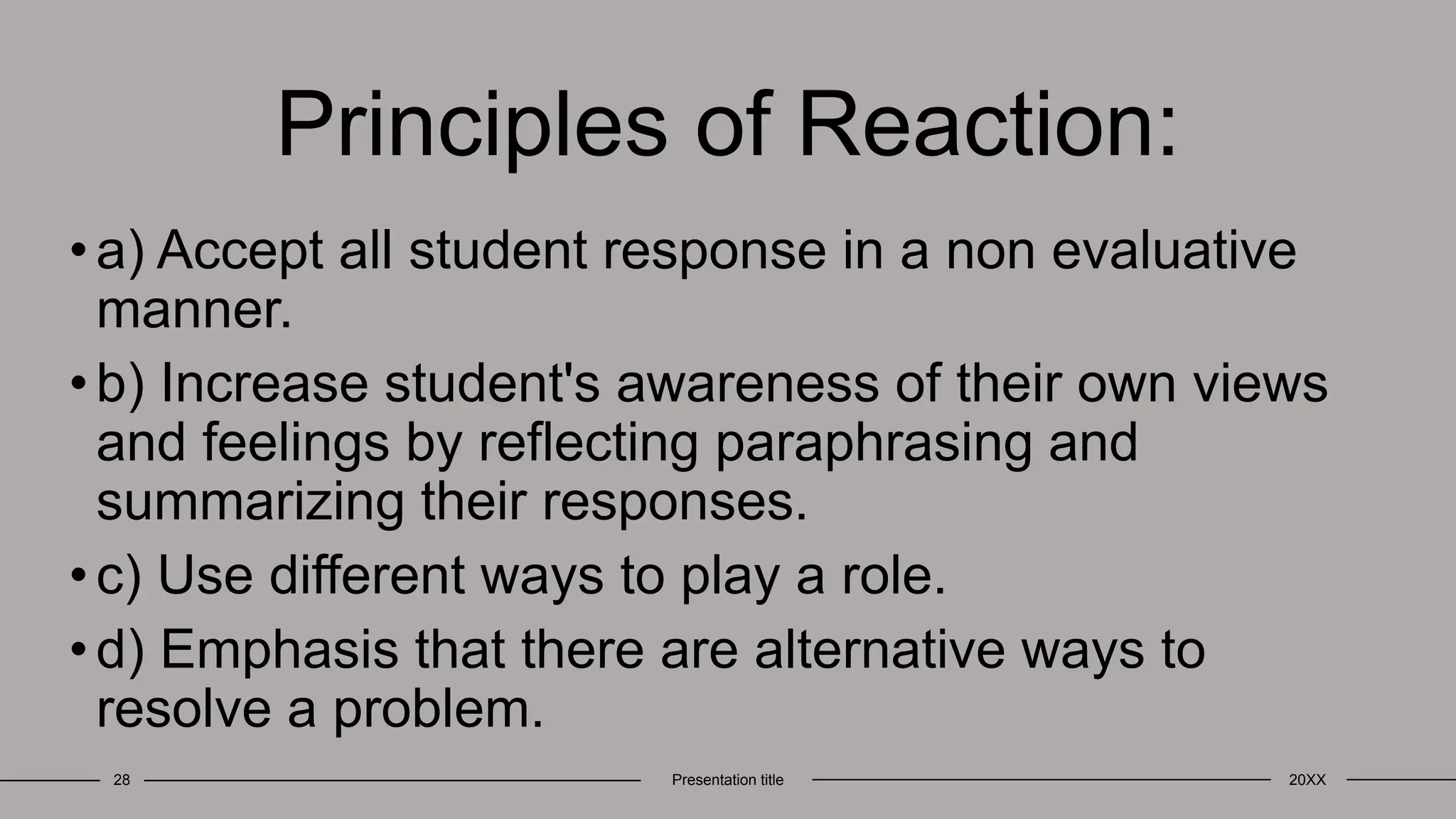
Principles of Reaction:
•a) Accept all student response in a non evaluative
manner.
•b) Increase student's awareness of their own views
and feelings by reflecting paraphrasing and
summarizing their responses.
•c) Use different ways to play a role.
•d) Emphasis that there are alternative ways to
resolve a problem.
28 Presentation title 20XX
Support System
•a) Initial problem situation.
•b) Resource material related to the problem.
•c) A teacher who is aware of role playing.
29 Presentation title 20XX
Instructional Effects
•Role playing is specifically designed to foster
the analysis of personal values and behavior,
the development of strategies for solving
interpersonal problems; and the development
of empathy toward others.
30 Presentation title 20XX
Nurturant Effects
•These effects include the acquisition of
information about social problems and values
and comfort in expressing one's opinions.
31 Presentation title 20XX
32 Presentation title 20XX
BENEFITS
OF ROLE
MODEL
TEACHING
Role-playing develops communication and
social skills among the students.
Students recognize the content’s relevance
in dealing with real-world situations.
Role-playing creates the feeling of observing
real events.
By playing roles in classrooms, students
acquire the skill to apply their learning content
in a real-life context.
Students adopt a decision-making persona through
role-playing that allows them to deviate from their
usual self-imposed limitations or boundaries.
33
BENEFI
TS
While playing roles, students engage in
higher-order thinking and learn content
more comprehensively.
When real scenarios or contexts are
unavailable, instructors can create user
scenarios to set the parameters of the role
play.
The teacher, instructor in some cases, and
students receive immediate feedback on
specific learning.
Role-playing methods are inexpensive and
easy to implement.
The role-playing method allows children to
explore, investigate and experiment.
A mentor is someone
who sees more talent and
ability within you, than
you see in yourself, and
helps bring it out of you.
35
Thank you
PROF D. B. GHULE

Role Playing Model - MODEL OF TEACHING PPT

  • 1.
  • 2.
    INTRODUCTION The term modelis used to mean a teaching episode done by an experienced teacher in which a highly focused teaching behavior is demonstrated, in it an individual demonstrating particular patterns which the trainee learns through imitation. It is a way to talk and think about instruction in which certain facts may be organized, classified and interpreted. 2
  • 3.
    Bruce Joyce andMarsha Weil describe a Model of Teaching as a plan or pattern that can be used to shape curricula, to design instructional materials and to guide instruction in the classroom and other settings. Thus, teaching models are just instructional designs. They describe the process and producing particular environmental situations which cause the student to interact in such a way that specific change occurs in his behavior. 3
  • 4.
    MEANING Teaching model isthe model which is designed for specific purposes the teaching of information concepts, ways of thinking, and the study of social values and so on by asking students to engage in particular cognitive and social tasks. Some models Centre on delivery by the instructor while others develop as the learners respond to tasks and the student is regarded as a partner in the educational enterprise. 20XX Presentation title 4
  • 5.
  • 6.
    DEFINITIONS Teaching models havebeen defined in a number of ways. Some of the important definitions of teaching model are given here to have a wider perspective of this concept. 1) Allen and Ryan (1969):Modelling is an individual demonstrating particular pattern which the trainee learns through imitation 2) Bandura (1969): "Modelling demonstrates that virtually all learning phenomena resulting from direct experiences can occur on a vicarious basis through observation of other person's behavior and its consequences for them.“ 3) B.K. Passi LC. Singh and D. N. Sansanwal (1991): A model of teaching consists of guidelines for designing educational activities and environments. Model of teaching is a plan that can also be utilized to shape courses or studies, to design instructional material and to guide instruction." 20XX Presentation title 6
  • 7.
    4) Joyce andWeil (1972):Teaching model is a pattern or plan, which can be used to shape a curriculum or course to select instructional materials and to guide a teacher's actions.“ 5) N.K. Jangiro and Ajit Singh (1983):A model of teaching is a set of inter-related components arranged in a sequence which provides guidelines to realize a specific goal. It helps in designing instructional activities and environmental facilities, carrying out of these activities and realization of the stipulated objectives. 6) Paul D. Eggen et al (1979): "Models are prescriptive teaching strategies designed to accomplish particular instructional goals." 20XX Presentation title 7
  • 8.
  • 9.
    The teaching modelsare made on bases of some specifications. These are based on the following specifications: 1) Specification of Environmental specifies in definite terms the environmental conditions under which a student's response should be observed. 2) Specification of Operation: It specifies the mechanism that provides for the reaction of students and interaction with the environment. 20XX Presentation title 9
  • 10.
    3) Specification ofCriterion of Performance It specifies the criterion of performance which is accepted by the students. The behavioral outcome which the learner would demonstrate after completing specific instructional sequences is delineated in the teaching models. 4) Specification of Learning Outcome: It specifies what the student will perform after completing an instructional sequence 20XX Presentation title 10
  • 11.
  • 12.
    Characteristics of theteaching models are as follows: 1) Encourage Art of Teaching: Teaching is considered as an art. Teaching models encourages this art by providing learning environment. 2) Development of Inherent Abilities: Teaching models bring about the qualitative development of personality as it helps in developing human abilities. It also increases the teacher's social competency 20XX Presentation title 12
  • 13.
    3) Based onIndividual Differences: Teaching model uses the student's interest, as it is constructed on the basis of individual differences. 4) Influenced by Philosophy: Every teaching model is influenced by the philosophy of education. Hence, teachers formulate different models of teaching under the influence of the philosophy they believe. 5) Answers Fundamental Questions: in every teaching model answers to all the fundamental questions pertaining to the behavior of students and teachers are included 20XX Presentation title 13
  • 14.
    6) Providing AppropriateExperiences: Teaching models provides proper experiences to both teacher and student. Selecting the content and presenting it for learning before the students is the main essentiality of teaching. This difficulty is solved when a teacher presents appropriate experience before the students 7) Maxims of Teaching: The basis of teaching model is the maxims of teaching. They are the foundation of each teaching model. 8) Practice and Concentration: The development of a teaching model is based on regular and continuous practice and concentration. The proper development of a teaching model is only possible when the assumptions are made clear by related thinking. 20XX Presentation title 14
  • 15.
  • 16.
    Four important sourcesfrom which all the models of teaching have been derived are given below: 1) The Social Interaction Sources: The model of teaching of this category emphasizes the importance of social relationship of the person and are based on the assumption that social relation is the vehicle of education. 2) The Information Processing Sources: The other source of a model of teaching is the information processing capability of the learner which means the way in which people handle stimuli, organize data, sense problems and solve them. The model of this category emphasizes the use of specific strategies within academic disciplines which lead to the development of creativity and general intellectual ability of learners. 20XX Presentation title 16
  • 17.
    3) The PersonalSources: Personal and emotional life of the individual and their internal organization as it affects relationship with this environment are the sources of this category of models. 4) Behavior Modification as a Source: The operant conditioning theory built by B.F. Skinner is the origin of this type of model which is purely a psychological model and is used in most of the teaching strategies developed in the last two decades. 20XX Presentation title 17
  • 18.
    Assumption of Modelsof Teaching Each model is based on the assumption that teaching is the creation of appropriate environment and various components of the environment are interdependent 20XX Presentation title 18
  • 19.
  • 20.
  • 21.
    INTRODUCTION Role playing leadsstudents top understand social behavior, their role in social interactions and ways of solving problems more effectively. The model asks students to "act out conflicts, to learn to take the roles of others and to observe social behavior. With adaptation this model can us used with student of all ages. This mode is introduced by Fannie Shaftel and George Shaftel. It is used to open up discussions of values and how they operate in daily life. The main aim of this model is to help students to understand social values and develop their social values. 21
  • 22.
  • 23.
    23 Presentation title20XX Following are the basic assumptions of the role playing model: 1) It advocates an experience based learning situation. 2) It can draw out student's feelings. 3) Emotions and ideas can be brought to consciousness and enhanced by the group. BASIC ASSUMMPTIONS
  • 24.
    SYNTAX Phase 1- Warmup the Group: i. Identity or introduce the problem. ii. Make problem explicit. iii. Interpret problem using story and explore issues. iv. Explain role playing. Phase 2- Select Participants i) Analyze role. ii) Select role players. Phase 3- Set the Stage i) Stateline of action. ii) Restate role. iii) Get inside problem situation. 24 Presentation title 20XX
  • 25.
    Phase 4- Preparethe Observers i. Decide what to look for. ii. Assign observation task. Phase 5- Enact i) Begin role play. ii) Maintain role play. iii) Break role play.. Phase 6- Discuss and Evaluate i) Review action of role play. ii) Discuss major focus. iii) Develop next enactment. 25 Presentation title 20XX
  • 26.
    Phase 7-Re-enact i. Playrevised roles. ii. Suggest next step as behavioral alternatives. Phase 8- Discuss and Evaluate i) Review action of role play. ii) Discuss major focus iii) Develop next enactment. Phase 9- Share Experience and Generalize i) Relate problem situation to real experience and current problems. ii) Explore general principles of behavior. 26 Presentation title 20XX
  • 27.
    Social System •a) Moderatelystructured. •b) Teacher as initiator and guide. •c) Content of enactment and discussion is determined largely by students. 27 Presentation title 20XX
  • 28.
    Principles of Reaction: •a)Accept all student response in a non evaluative manner. •b) Increase student's awareness of their own views and feelings by reflecting paraphrasing and summarizing their responses. •c) Use different ways to play a role. •d) Emphasis that there are alternative ways to resolve a problem. 28 Presentation title 20XX
  • 29.
    Support System •a) Initialproblem situation. •b) Resource material related to the problem. •c) A teacher who is aware of role playing. 29 Presentation title 20XX
  • 30.
    Instructional Effects •Role playingis specifically designed to foster the analysis of personal values and behavior, the development of strategies for solving interpersonal problems; and the development of empathy toward others. 30 Presentation title 20XX
  • 31.
    Nurturant Effects •These effectsinclude the acquisition of information about social problems and values and comfort in expressing one's opinions. 31 Presentation title 20XX
  • 32.
  • 33.
    BENEFITS OF ROLE MODEL TEACHING Role-playing developscommunication and social skills among the students. Students recognize the content’s relevance in dealing with real-world situations. Role-playing creates the feeling of observing real events. By playing roles in classrooms, students acquire the skill to apply their learning content in a real-life context. Students adopt a decision-making persona through role-playing that allows them to deviate from their usual self-imposed limitations or boundaries. 33
  • 34.
    BENEFI TS While playing roles,students engage in higher-order thinking and learn content more comprehensively. When real scenarios or contexts are unavailable, instructors can create user scenarios to set the parameters of the role play. The teacher, instructor in some cases, and students receive immediate feedback on specific learning. Role-playing methods are inexpensive and easy to implement. The role-playing method allows children to explore, investigate and experiment.
  • 35.
    A mentor issomeone who sees more talent and ability within you, than you see in yourself, and helps bring it out of you. 35
  • 36.