MODELS OF TEACHING


 diputr@gmail.com
 Mgucte vaiom
              dipu, mgucte vaikom   1
A model of teaching is a
pattern or plan which can be
taken up with a view to shape
a curriculum or course, select
appropriate instructional
material and to guide the
teacher’s action

                  dipu, mgucte vaikom   2
DEFINITION

 BRUCE JOYCE AND MARSHA WEIL
 “Teaching models are just instructional
  designs . They describe the process of
  specifying and producing particular
  environmental situations which cause the
  student interact in such a way that specific
  changes occur in his behavior”


                           dipu, mgucte vaikom   3
Role of teaching models
 It may help the teacher to develop his capacity to
  teach larger number of children and create
  conducive environment for their learning.
 It may help the curriculum makers to plan
  learning centered curriculum which provides a
  variety of educational experiences to children.
 It may help to create more interesting and
  effective instructional material and learning
  sources.
 It may stimulate the development of new and
  better forms and opportunities for education,
  that will replaces schools of today.
                            dipu, mgucte vaikom        4
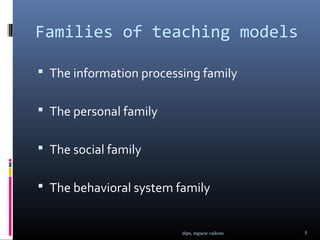
Families of teaching models

 The information processing family


 The personal family


 The social family


 The behavioral system family


                         dipu, mgucte vaikom   5
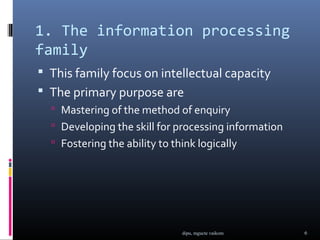
1. The information processing
family
 This family focus on intellectual capacity
 The primary purpose are
   Mastering of the method of enquiry
   Developing the skill for processing information
   Fostering the ability to think logically


                               dipu, mgucte vaikom    6
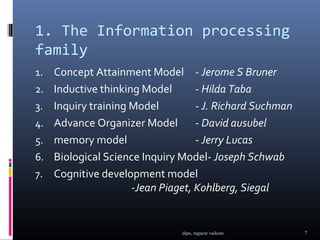
1. The Information processing
family
1. Concept Attainment Model         - Jerome S Bruner
2.   Inductive thinking Model       - Hilda Taba
3.   Inquiry training Model         - J. Richard Suchman
4.   Advance Organizer Model        - David ausubel
5.   memory model                   - Jerry Lucas
6.   Biological Science Inquiry Model- Joseph Schwab
7.   Cognitive development model
                      -Jean Piaget, Kohlberg, Siegal


                                dipu, mgucte vaikom        7
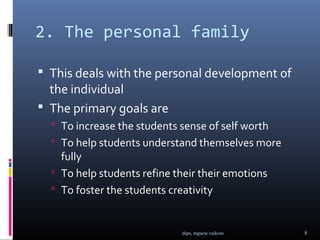
2. The personal family

 This deals with the personal development of
  the individual
 The primary goals are
   To increase the students sense of self worth
   To help students understand themselves more
    fully
   To help students refine their their emotions
   To foster the students creativity


                             dipu, mgucte vaikom   8
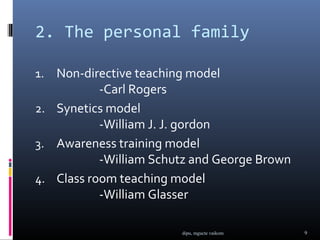
2. The personal family

1. Non-directive teaching model
           -Carl Rogers
2. Synetics model
           -William J. J. gordon
3. Awareness training model
           -William Schutz and George Brown
4. Class room teaching model
           -William Glasser

                        dipu, mgucte vaikom   9
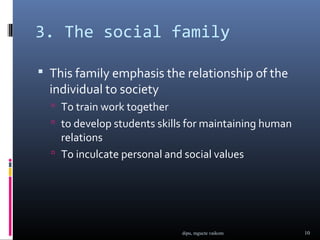
3. The social family

 This family emphasis the relationship of the
  individual to society
   To train work together
   to develop students skills for maintaining human
    relations
   To inculcate personal and social values


                             dipu, mgucte vaikom       10
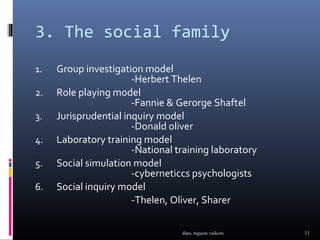
3. The social family
1.   Group investigation model
                       -Herbert Thelen
2.   Role playing model
                       -Fannie & Gerorge Shaftel
3.   Jurisprudential inquiry model
                       -Donald oliver
4.   Laboratory training model
                       -National training laboratory
5.   Social simulation model
                       -cyberneticcs psychologists
6.   Social inquiry model
                       -Thelen, Oliver, Sharer

                                  dipu, mgucte vaikom   11
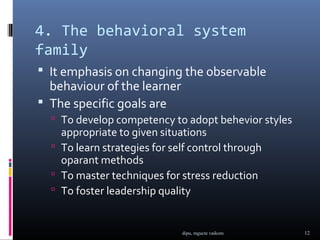
4. The behavioral system
family
 It emphasis on changing the observable
  behaviour of the learner
 The specific goals are
   To develop competency to adopt behevior styles
    appropriate to given situations
   To learn strategies for self control through
    oparant methods
   To master techniques for stress reduction
   To foster leadership quality


                              dipu, mgucte vaikom    12
4. The behavioral system
family
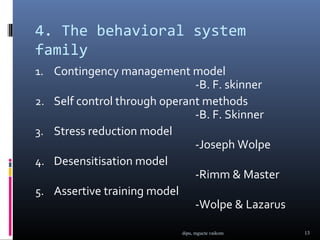
1. Contingency management model
                                -B. F. skinner
2.   Self control through operant methods
                                -B. F. Skinner
3.   Stress reduction model
                                -Joseph Wolpe
4.   Desensitisation model
                                -Rimm & Master
5.   Assertive training model
                                -Wolpe & Lazarus

                            dipu, mgucte vaikom    13
Key concepts for describing
teaching models
    Four major components are included in all
     teaching models. Each of these components
     will vary with the models.
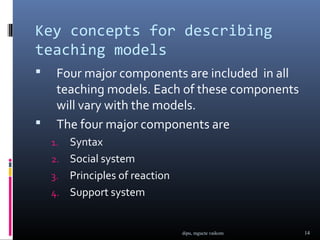
    The four major components are
    1. Syntax
    2. Social system
    3. Principles of reaction
    4. Support system


                                dipu, mgucte vaikom   14
1. Syntax

 This is description of how the various phases
  in the development of a lesson are
  sequenced when the model is translated in to
  action.
 The phases involved in the different models
  will differ.


                          dipu, mgucte vaikom     15
For Example,
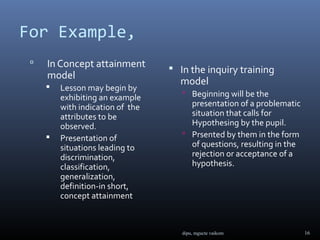
    In Concept attainment         In the inquiry training
     model
                                    model
        Lesson may begin by
                                      Beginning will be the
         exhibiting an example
         with indication of the        presentation of a problematic
         attributes to be              situation that calls for
         observed.                     Hypothesing by the pupil.
                                      Prsented by them in the form
        Presentation of
         situations leading to         of questions, resulting in the
         discrimination,               rejection or acceptance of a
         classification,               hypothesis.
         generalization,
         definition-in short,
         concept attainment


                                     dipu, mgucte vaikom                16
2. Social system

 The relation ship between the teacher and
  the learners as well as the role played by each
  in the activities that take place define the
  nature of social system.


                           dipu, mgucte vaikom      17
 Highly structured.
    The activities of the pupil will more controlled by
  external restrictions with a pre determined
  structuring.
 Low structured
    the teacher withdraws to the maximum possible and
  free interaction among the learners.
 Moderately structured
    the nature of lesson depends upon the roles,
  relationships, norms and the nature of activities of
  teacher and the learner.


                              dipu, mgucte vaikom         18
3. Principles of reaction
  [rules to be followed]
 This defines the nature of reaction expected
  from the teacher to every pupil activity.

 The principles of reaction give guidance to the
  teacher as to how he is expected to react to each
  activity of the learners, to suit the characteristics
  of the model selected.


                               dipu, mgucte vaikom        19
4. Support system

 Every model of teaching warrants certain
  conditions and facilities for the realization of
  the goal.
 A description of this support system ion
  advance will help the teacher ensure that he
  can apply the model successfully.


                            dipu, mgucte vaikom      20
f. Instructional and Nurturant
effect
 Direct / instructional effect of a lesson as
  purposefully envisaged by the teacher.
 Indirect / nurturant effects that might happen
  as a byproduct.


                            dipu, mgucte vaikom    21

Models of teaching

  • 1.
    MODELS OF TEACHING diputr@gmail.com Mgucte vaiom dipu, mgucte vaikom 1
  • 2.
    A model ofteaching is a pattern or plan which can be taken up with a view to shape a curriculum or course, select appropriate instructional material and to guide the teacher’s action dipu, mgucte vaikom 2
  • 3.
    DEFINITION  BRUCE JOYCEAND MARSHA WEIL  “Teaching models are just instructional designs . They describe the process of specifying and producing particular environmental situations which cause the student interact in such a way that specific changes occur in his behavior” dipu, mgucte vaikom 3
  • 4.
    Role of teachingmodels  It may help the teacher to develop his capacity to teach larger number of children and create conducive environment for their learning.  It may help the curriculum makers to plan learning centered curriculum which provides a variety of educational experiences to children.  It may help to create more interesting and effective instructional material and learning sources.  It may stimulate the development of new and better forms and opportunities for education, that will replaces schools of today. dipu, mgucte vaikom 4
  • 5.
    Families of teachingmodels  The information processing family  The personal family  The social family  The behavioral system family dipu, mgucte vaikom 5
  • 6.
    1. The informationprocessing family  This family focus on intellectual capacity  The primary purpose are  Mastering of the method of enquiry  Developing the skill for processing information  Fostering the ability to think logically dipu, mgucte vaikom 6
  • 7.
    1. The Informationprocessing family 1. Concept Attainment Model - Jerome S Bruner 2. Inductive thinking Model - Hilda Taba 3. Inquiry training Model - J. Richard Suchman 4. Advance Organizer Model - David ausubel 5. memory model - Jerry Lucas 6. Biological Science Inquiry Model- Joseph Schwab 7. Cognitive development model -Jean Piaget, Kohlberg, Siegal dipu, mgucte vaikom 7
  • 8.
    2. The personalfamily  This deals with the personal development of the individual  The primary goals are  To increase the students sense of self worth  To help students understand themselves more fully  To help students refine their their emotions  To foster the students creativity dipu, mgucte vaikom 8
  • 9.
    2. The personalfamily 1. Non-directive teaching model -Carl Rogers 2. Synetics model -William J. J. gordon 3. Awareness training model -William Schutz and George Brown 4. Class room teaching model -William Glasser dipu, mgucte vaikom 9
  • 10.
    3. The socialfamily  This family emphasis the relationship of the individual to society  To train work together  to develop students skills for maintaining human relations  To inculcate personal and social values dipu, mgucte vaikom 10
  • 11.
    3. The socialfamily 1. Group investigation model -Herbert Thelen 2. Role playing model -Fannie & Gerorge Shaftel 3. Jurisprudential inquiry model -Donald oliver 4. Laboratory training model -National training laboratory 5. Social simulation model -cyberneticcs psychologists 6. Social inquiry model -Thelen, Oliver, Sharer dipu, mgucte vaikom 11
  • 12.
    4. The behavioralsystem family  It emphasis on changing the observable behaviour of the learner  The specific goals are  To develop competency to adopt behevior styles appropriate to given situations  To learn strategies for self control through oparant methods  To master techniques for stress reduction  To foster leadership quality dipu, mgucte vaikom 12
  • 13.
    4. The behavioralsystem family 1. Contingency management model -B. F. skinner 2. Self control through operant methods -B. F. Skinner 3. Stress reduction model -Joseph Wolpe 4. Desensitisation model -Rimm & Master 5. Assertive training model -Wolpe & Lazarus dipu, mgucte vaikom 13
  • 14.
    Key concepts fordescribing teaching models  Four major components are included in all teaching models. Each of these components will vary with the models.  The four major components are 1. Syntax 2. Social system 3. Principles of reaction 4. Support system dipu, mgucte vaikom 14
  • 15.
    1. Syntax  Thisis description of how the various phases in the development of a lesson are sequenced when the model is translated in to action.  The phases involved in the different models will differ. dipu, mgucte vaikom 15
  • 16.
    For Example,  In Concept attainment  In the inquiry training model model  Lesson may begin by  Beginning will be the exhibiting an example with indication of the presentation of a problematic attributes to be situation that calls for observed. Hypothesing by the pupil.  Prsented by them in the form  Presentation of situations leading to of questions, resulting in the discrimination, rejection or acceptance of a classification, hypothesis. generalization, definition-in short, concept attainment dipu, mgucte vaikom 16
  • 17.
    2. Social system The relation ship between the teacher and the learners as well as the role played by each in the activities that take place define the nature of social system. dipu, mgucte vaikom 17
  • 18.
     Highly structured. The activities of the pupil will more controlled by external restrictions with a pre determined structuring.  Low structured the teacher withdraws to the maximum possible and free interaction among the learners.  Moderately structured the nature of lesson depends upon the roles, relationships, norms and the nature of activities of teacher and the learner. dipu, mgucte vaikom 18
  • 19.
    3. Principles ofreaction [rules to be followed]  This defines the nature of reaction expected from the teacher to every pupil activity.  The principles of reaction give guidance to the teacher as to how he is expected to react to each activity of the learners, to suit the characteristics of the model selected. dipu, mgucte vaikom 19
  • 20.
    4. Support system Every model of teaching warrants certain conditions and facilities for the realization of the goal.  A description of this support system ion advance will help the teacher ensure that he can apply the model successfully. dipu, mgucte vaikom 20
  • 21.
    f. Instructional andNurturant effect  Direct / instructional effect of a lesson as purposefully envisaged by the teacher.  Indirect / nurturant effects that might happen as a byproduct. dipu, mgucte vaikom 21