ICH STABILITY
TESTING GUIDELINES
Q1A-Q1F => STABILITY GUDELINES
 Ms. DURGADEVI G,
DEPARTMENT OF PHARMACEUTICAL ANALYSIS,
COIMBATORE.
ICH
• “International Conference on Harmonization of Technical Requirements for
Registration of Pharmaceuticals for Human Use”.
• ICH is a joint initiative involving both regulators and research-based industry representatives
of the EU, Japan and the US in scientific and technical discussions of the testing
procedures required to assess and ensure the safety, quality and efficacy of medicines.
DRUG STABILITY
• “A measure of how pharmaceutical products maintains its quality attribute over a time.”
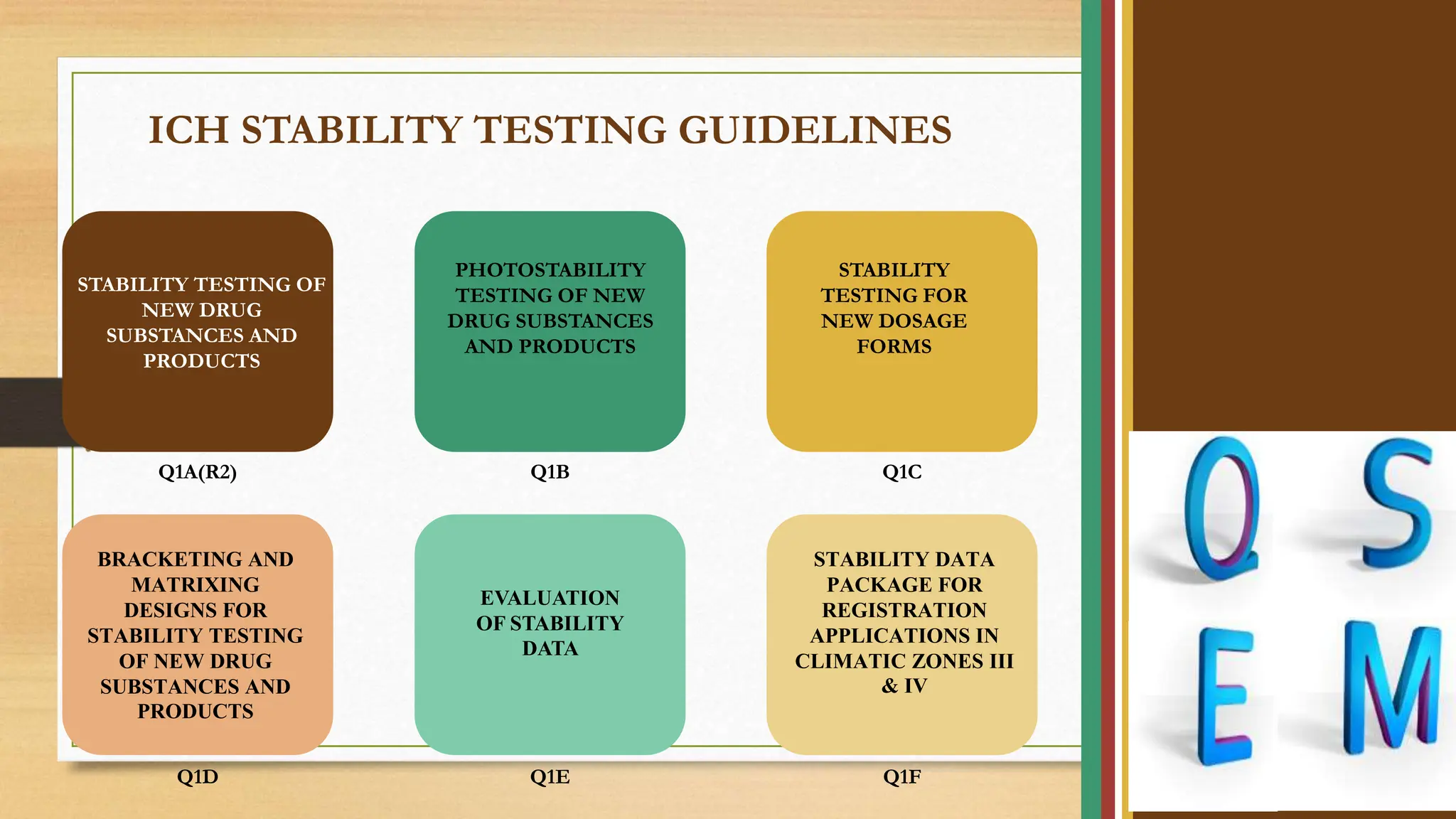
ICH STABILITY TESTING GUIDELINES
Q1A(R2)
Q1D
Q1B
Q1E
Q1C
Q1F
STABILITY TESTING OF
NEW DRUG
SUBSTANCES AND
PRODUCTS
PHOTOSTABILITY
TESTING OF NEW
DRUG SUBSTANCES
AND PRODUCTS
STABILITY
TESTING FOR
NEW DOSAGE
FORMS
BRACKETING AND
MATRIXING
DESIGNS FOR
STABILITY TESTING
OF NEW DRUG
SUBSTANCES AND
PRODUCTS
EVALUATION
OF STABILITY
DATA
STABILITY DATA
PACKAGE FOR
REGISTRATION
APPLICATIONS IN
CLIMATIC ZONES III
& IV
Q1A(R2)
STABILITY TESTING OF NEW DRUG
SUBSTANCES AND PRODUCTS
• The purpose of stability testing is to provide evidence on how the quality of
a drug substance or drug product varies with time under the influence of a
variety of environmental factors such as temperature, humidity, and light,
and to establish a re-test period for the drug substance or a shelf life
for the drug product and recommended storage conditions.
.
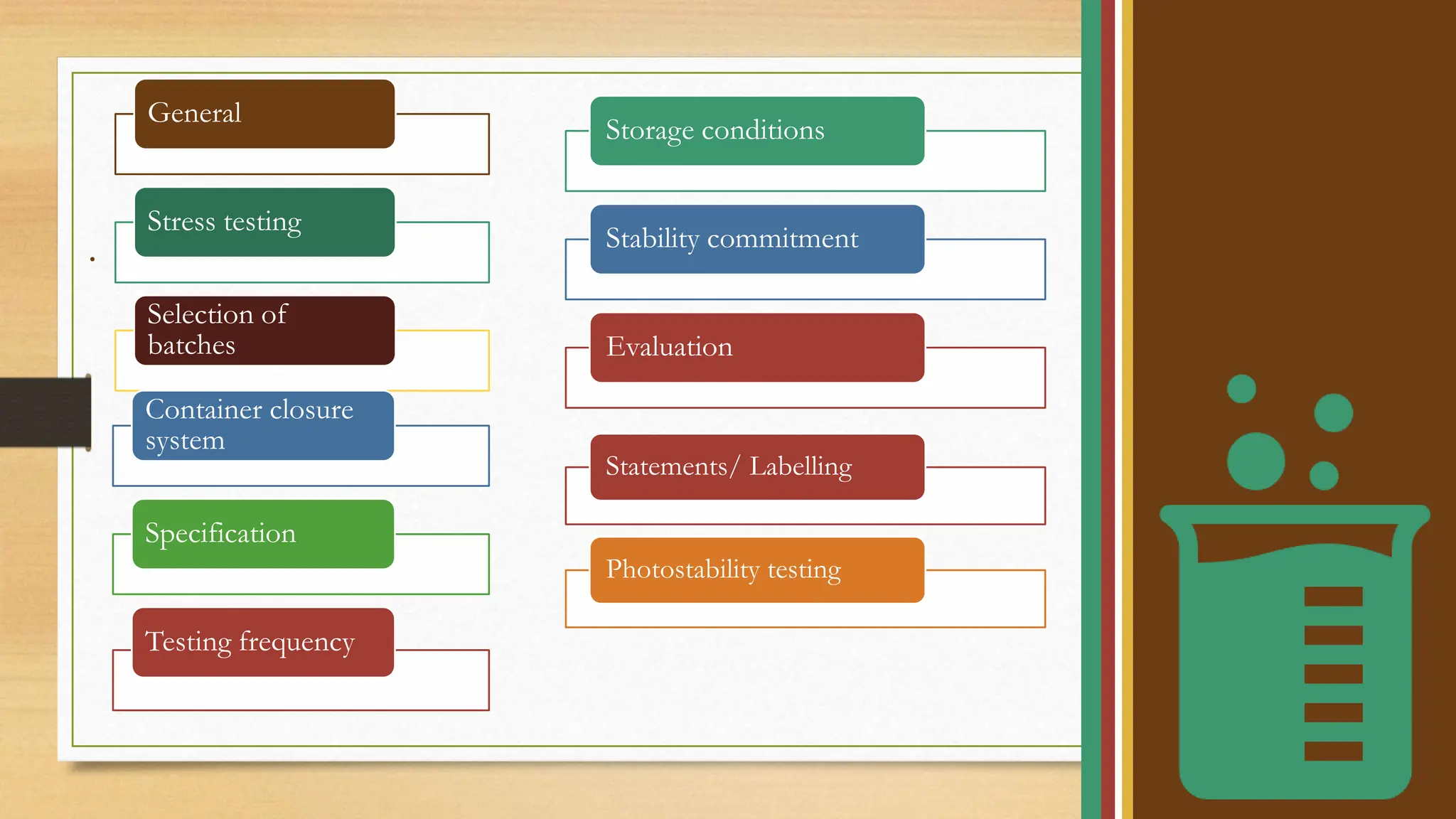
General
Stress testing
Selection of
batches
Container closure
system
Specification
Testing frequency
Storage conditions
Stability commitment
Evaluation
Statements/ Labelling
Photostability testing
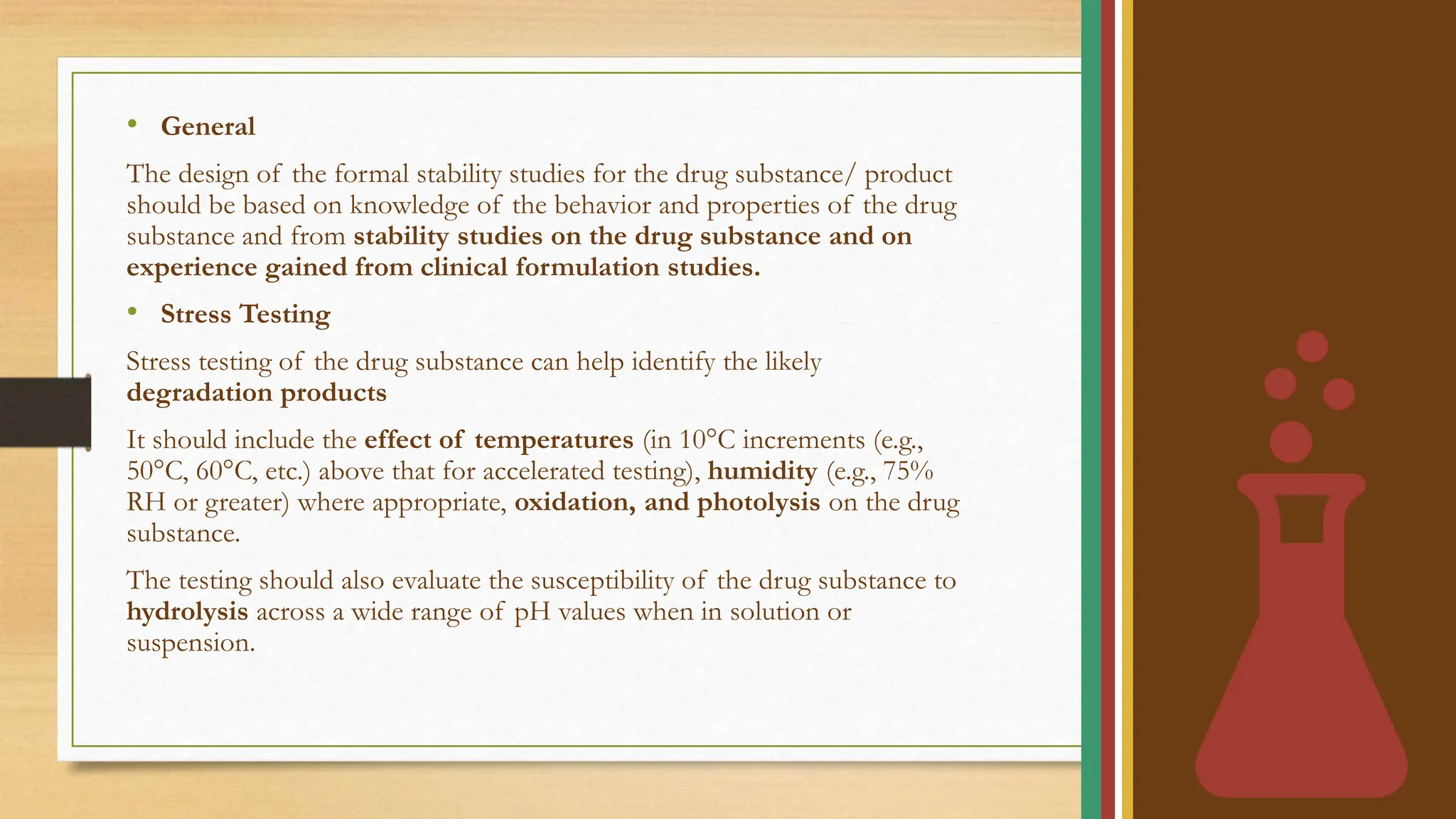
• General
The design of the formal stability studies for the drug substance/ product
should be based on knowledge of the behavior and properties of the drug
substance and from stability studies on the drug substance and on
experience gained from clinical formulation studies.
• Stress Testing
Stress testing of the drug substance can help identify the likely
degradation products
It should include the effect of temperatures (in 10°C increments (e.g.,
50°C, 60°C, etc.) above that for accelerated testing), humidity (e.g., 75%
RH or greater) where appropriate, oxidation, and photolysis on the drug
substance.
The testing should also evaluate the susceptibility of the drug substance to
hydrolysis across a wide range of pH values when in solution or
suspension.
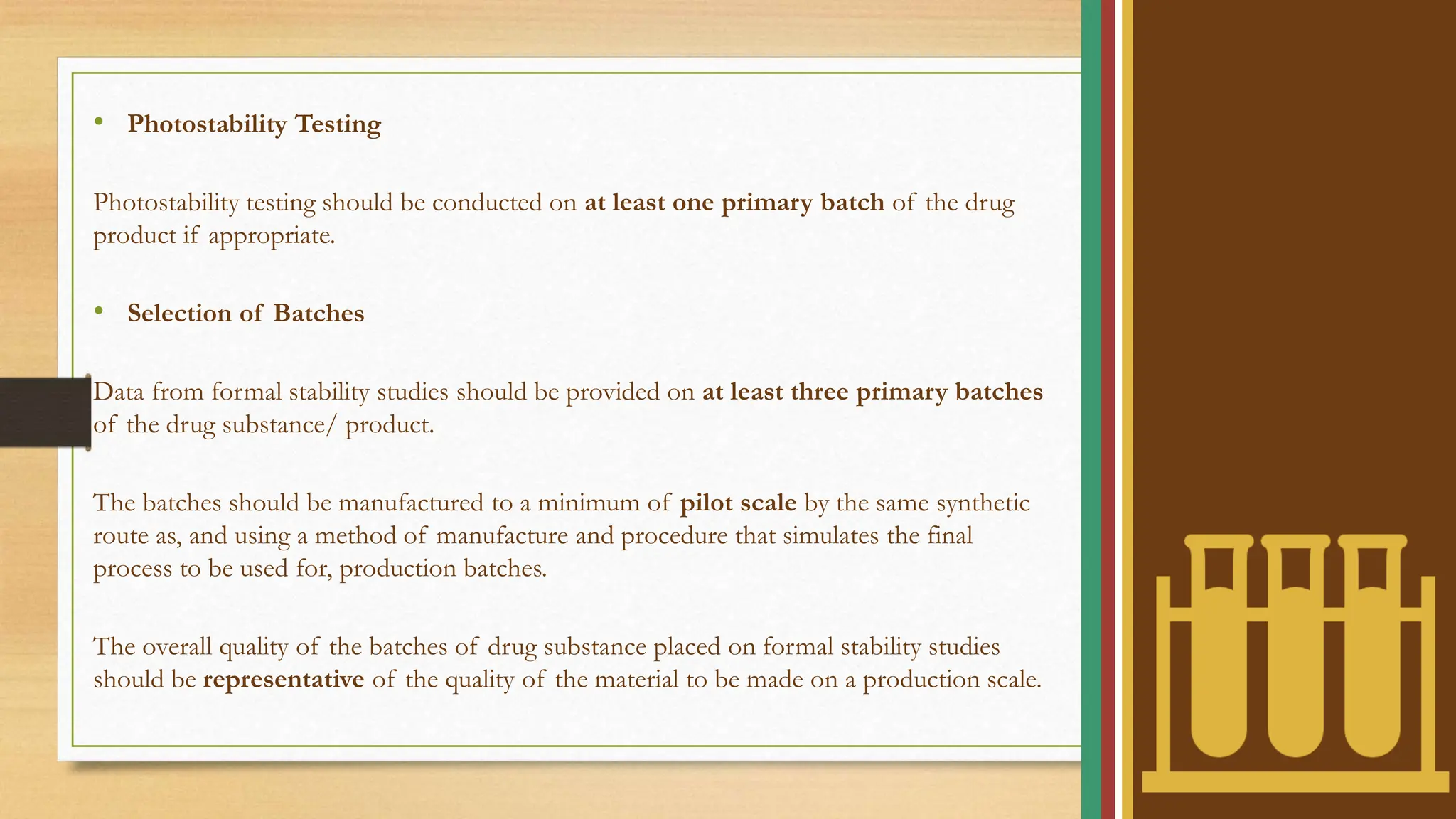
• Photostability Testing
Photostability testing should be conducted on at least one primary batch of the drug
product if appropriate.
• Selection of Batches
Data from formal stability studies should be provided on at least three primary batches
of the drug substance/ product.
The batches should be manufactured to a minimum of pilot scale by the same synthetic
route as, and using a method of manufacture and procedure that simulates the final
process to be used for, production batches.
The overall quality of the batches of drug substance placed on formal stability studies
should be representative of the quality of the material to be made on a production scale.
• Container Closure System
The stability studies should be conducted on the drug substance/ product packaged in a
container closure system that is the same as or simulates the packaging proposed for
storage and distribution and marketing (including, as appropriate, any secondary
packaging and container label).
• Specification
Specification, which is a list of tests, reference to analytical procedures, and
proposed acceptance criteria and shelf life specifications is addressed in ICH Q6A
and Q6B.
In addition, specification for degradation products in a drug substance is discussed
in Q3A and drug product is addressed in Q3B.
The testing should cover, as appropriate, the physical, chemical, biological, and
microbiological attributes. Validated stability-indicating analytical procedures should be
applied.
• Testing Frequency
For drug substances with a proposed re-test period of at least 12
months, the frequency of testing at the long term storage condition
should normally be every 3 months over the first year, every 6
months over the second year, and annually thereafter through the
proposed re-test period.
At the accelerated storage condition, a minimum of three time
points, including the initial and final time points (e.g., 0, 3, and 6
months), from a 6-month study is recommended.
When testing at the intermediate storage condition is called for as a
result of significant change at the accelerated storage condition, a
minimum of four time points, including the initial and final time points
(e.g., 0, 6, 9, 12 months), from a 12- month study is recommended.
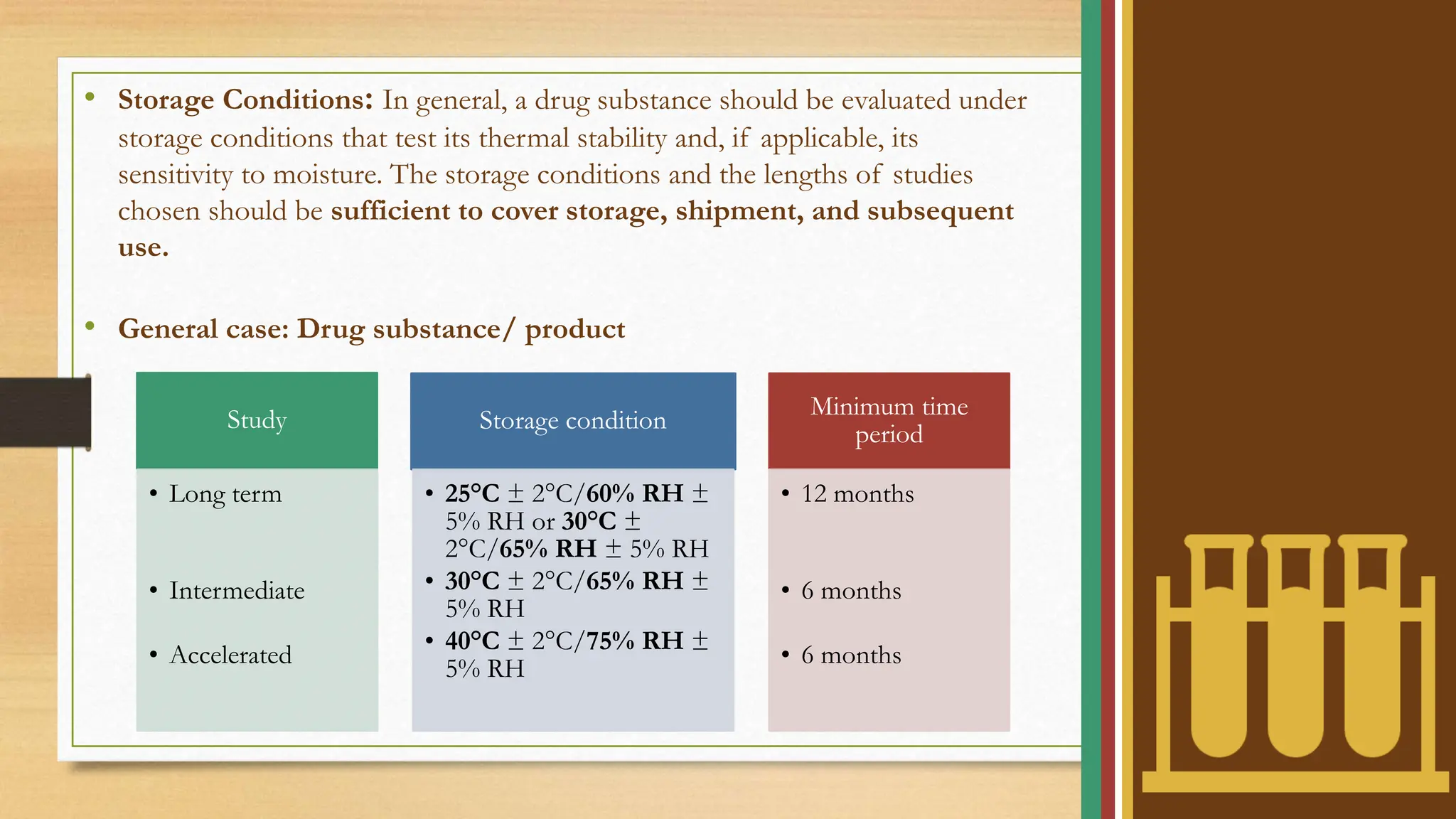
• Storage Conditions: In general, a drug substance should be evaluated under
storage conditions that test its thermal stability and, if applicable, its
sensitivity to moisture. The storage conditions and the lengths of studies
chosen should be sufficient to cover storage, shipment, and subsequent
use.
• General case: Drug substance/ product
Study
• Long term
• Intermediate
• Accelerated
Storage condition
• 25°C ± 2°C/60% RH ±
5% RH or 30°C ±
2°C/65% RH ± 5% RH
• 30°C ± 2°C/65% RH ±
5% RH
• 40°C ± 2°C/75% RH ±
5% RH
Minimum time
period
• 12 months
• 6 months
• 6 months
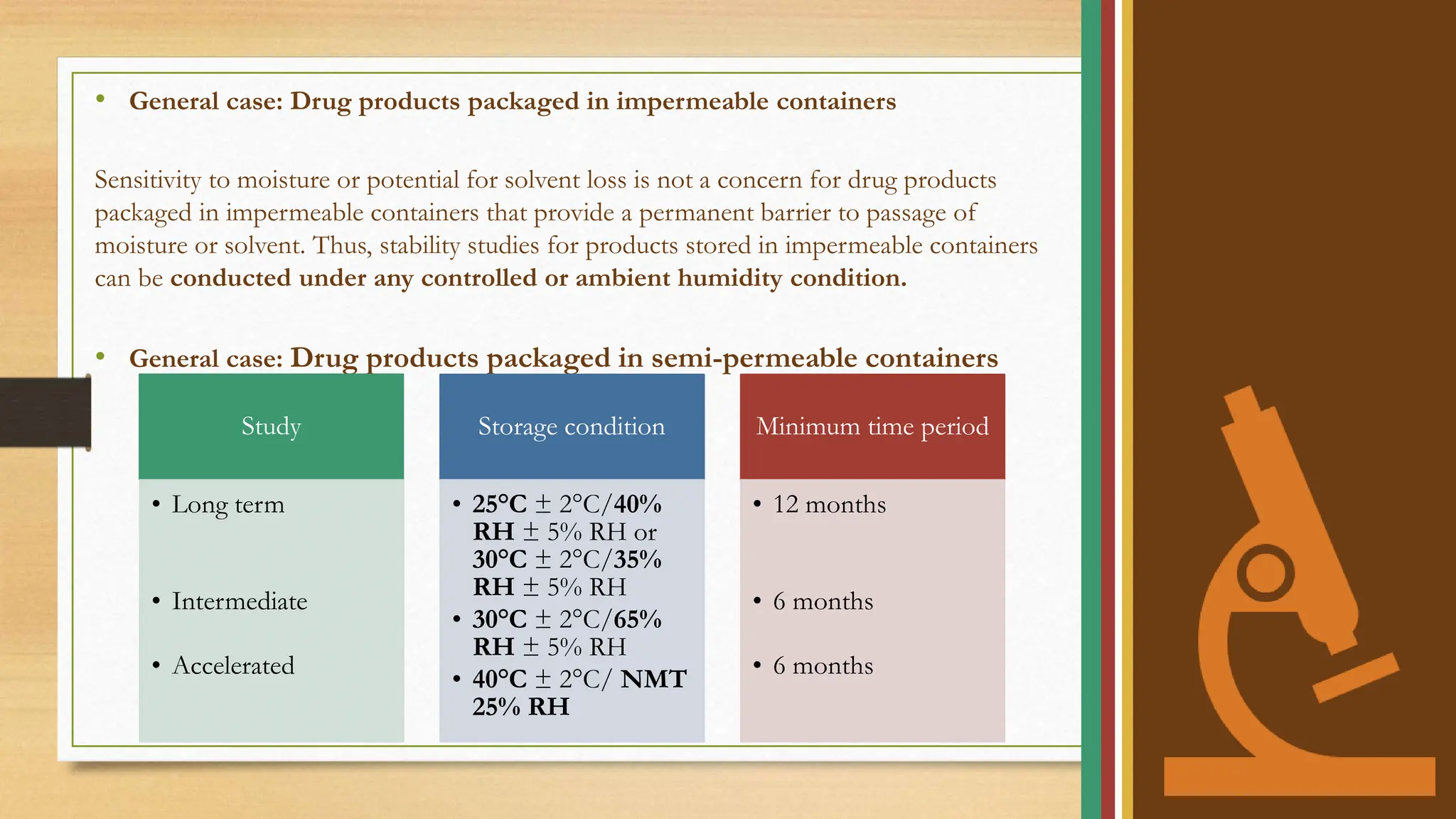
• General case: Drug products packaged in impermeable containers
Sensitivity to moisture or potential for solvent loss is not a concern for drug products
packaged in impermeable containers that provide a permanent barrier to passage of
moisture or solvent. Thus, stability studies for products stored in impermeable containers
can be conducted under any controlled or ambient humidity condition.
• General case: Drug products packaged in semi-permeable containers
Study
• Long term
• Intermediate
• Accelerated
Storage condition
• 25°C ± 2°C/40%
RH ± 5% RH or
30°C ± 2°C/35%
RH ± 5% RH
• 30°C ± 2°C/65%
RH ± 5% RH
• 40°C ± 2°C/ NMT
25% RH
Minimum time period
• 12 months
• 6 months
• 6 months
• Drug substances intended for storage in a refrigerator
• Drug substances intended for storage in a freezer
Study
• Long term
• Accelerated
Storage condition
• 5°C ± 3°C
• 25°C ± 2°C/60%
RH ± 5% RH
Minimum time
period covered by
data at submission
• 12 months
• 6 months
Study
• Long term
Storage condition
• - 20°C ± 5°C
Minimum time
period covered by
data at submission
• 12 months
• Stability Commitment
When available long term stability data on primary batches do not cover the proposed re-test
period/ shelf life period granted at the time of approval, a commitment should be made to
continue the stability studies post approval in order to firmly establish the re-test period.
1. If the submission includes data from stability studies on at least three production
batches, a commitment should be made to continue these studies through the
proposed re-test period/ shelf life (Accelerated studies for 6 months).
2. If the submission includes data from stability studies on fewer than three production
batches, a commitment should be made to continue these studies through the
proposed re-test period / shelf life (Accelerated studies for 6 months) and to
place additional production batches, to a total of at least three, on long term
stability studies through the proposed retest period / shelf life (Accelerated
studies for 6 months).
3. If the submission does not include stability data on production batches, a
commitment should be made to place the first three production batches on long
term stability studies through the proposed re-test period / shelf life (Accelerated
studies for 6 months).
• Evaluation
The purpose of the stability study is to establish, based on testing a minimum
of three batches of the drug substance and evaluating the stability
information (including, as appropriate, results of the physical, chemical,
biological, and microbiological tests), a re-test period applicable to all future
batches of the drug substance/ dosage form manufactured under similar
circumstances.
• Statements/Labeling
A storage statement should be established for the labeling in accordance with
relevant national/regional requirements. The statement should be based on the
stability evaluation of the drug substance/ product. Where applicable, specific
instructions should be provided, particularly for drug substances /
products that cannot tolerate freezing. Terms such as “ambient conditions”
or “room temperature” should be avoided.
Accelerated testing:
Studies designed to increase the
rate of chemical degradation or
physical change of a drug
substance or drug product by
using exaggerated storage
conditions as part of the formal
stability studies.
Long term testing:
Stability studies under the
recommended storage condition
for the re-test period or shelf life
proposed (or approved) for
labeling
Bracketing:
The design of a stability schedule
such that only samples on the
extremes of certain design
factors, e.g., strength, package
size, are tested at all time points
as in a full design.
Matrixing:
The design of a stability schedule
such that a selected subset of the
total number of possible samples
for all factor combinations is
tested at a specified time point.
Q1B
STABILITY TESTING: PHOTOSTABILITY TESTING OF NEW
DRUG SUBSTANCES AND PRODUCTS
• This document is an annex to the main stability Guideline, and gives
guidance on the basic testing protocol required to evaluate the light
sensitivity and stability of new drugs and products.
• Preamble
• Light Sources
• Procedure
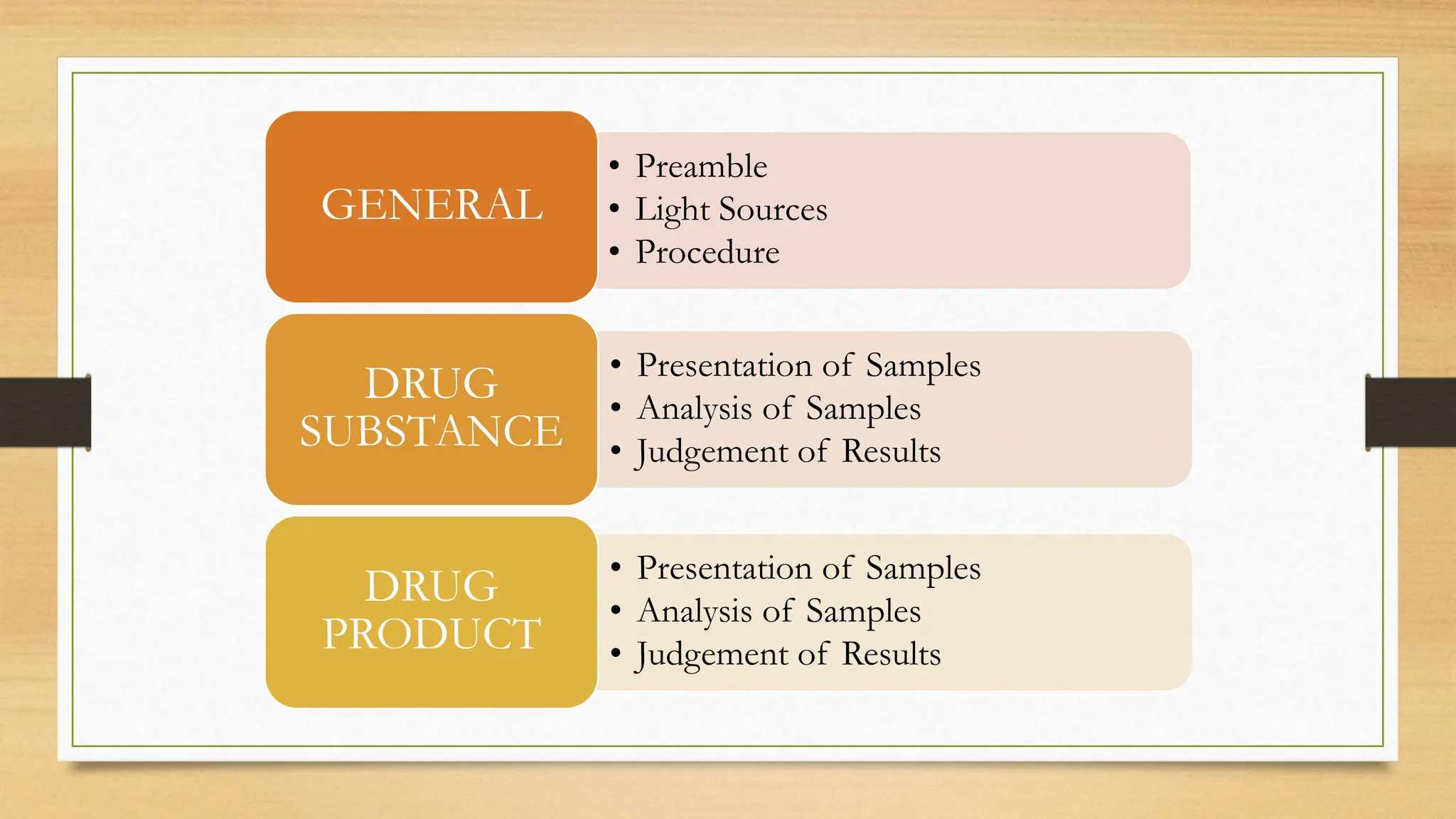
GENERAL
• Presentation of Samples
• Analysis of Samples
• Judgement of Results
DRUG
SUBSTANCE
• Presentation of Samples
• Analysis of Samples
• Judgement of Results
DRUG
PRODUCT
• GENERAL
The ICH Harmonized Tripartite Guideline covering the Stability Testing of New
Drug Substances and Products (hereafter referred to as the Parent Guideline) notes
that light testing should be an integral part of stress testing.
• Preamble
The intrinsic photostability characteristics of new drug substances and products
should be evaluated to demonstrate that, as appropriate, light exposure does
not result in unacceptable change.
A systematic approach to photostability testing is recommended covering, as
appropriate, studies such as:
i) Tests on the drug substance;
ii) Tests on the exposed drug product outside of the immediate pack; and
if necessary ;
iii) Tests on the drug product in the immediate pack; and if necessary
iv) Tests on the drug product in the marketing pack.
• Light Sources
The applicant should either maintain an appropriate control of
temperature to minimize the effect of localized temperature
changes or include a dark control in the same environment unless
otherwise justified.
• Procedure
For confirmatory studies, samples should be exposed to light
providing an overall illumination of not less than 1.2 million lux
hours and an integrated near ultraviolet energy of not less than
200 watt hours/square meter to allow direct comparisons to be
made between the drug substance and drug product.
• DRUG SUBSTANCE
For drug substances, photostability testing should consist of two parts: forced
degradation testing and confirmatory testing.
The purpose of forced degradation testing studies is to evaluate the overall
photosensitivity of the material for method development purposes and/or degradation
pathway elucidation.
Confirmatory studies should then be undertaken to provide the information
necessary for handling, packaging, and labeling
• DRUG PRODUCT
Normally, the studies on drug products should be carried out in a sequential
manner starting with testing the fully exposed product then progressing as
necessary to the product in the immediate pack and then in the marketing
pack. Testing should progress until the results demonstrate that the drug
product is adequately protected from exposure to light.
• Presentation of Samples
For samples of solid drug substances, an appropriate amount of
sample should be taken and placed in a suitable glass or plastic dish
and protected with a suitable transparent cover if considered
necessary. Drug substances that are liquids should be exposed in
chemically inert and transparent containers.
• Analysis of Samples
At the end of the exposure period, the samples should be examined
for any changes in physical properties (e.g., appearance, clarity,
or color of solution, dissolution/disintegration for dosage forms
such as capsules, etc.).
• Judgement of Results
The forced degradation studies should be designed to provide suitable information to
develop and validate test methods for the confirmatory studies. These test methods
should be capable of resolving and detecting photolytic degradants that appear
during the confirmatory studies.
The confirmatory studies should identify precautionary measures needed in
manufacturing or in formulation of the drug product, and if light resistant packaging is
needed.
Depending on the extent of change special labeling or packaging may be needed to
mitigate exposure to light. When evaluating the results of photostability studies to
determine whether change due to exposure to light is acceptable, it is important to
consider the results obtained from other formal stability studies in order to assure that
the product will be within proposed specifications during the shelf life.
Q1C
STABILITY TESTING FOR NEW DOSAGE FORMS
• This addresses the recommendations on what should be submitted regarding stability of new
dosage forms by the owner of the original application, after the original submission for new drug
substances and products.
• NEW DOSAGE FORMS
A new dosage form is defined as a drug product which is a different
pharmaceutical product type, but contains the same active substance as
included in the existing drug product approved by the pertinent regulatory
authority.
Such pharmaceutical product types include products of different
administration route (e.g., oral to parenteral), new specific
functionality/delivery systems (e.g., immediate release tablet to modified
release tablet) and different dosage forms of the same administration route
(e.g., capsule to tablet, solution to suspension).
Stability protocols for new dosage forms should follow the guidance in the
parent stability guideline in principle. However, a reduced stability database at
submission time (e.g., 6 months accelerated and 6 months long term data
from ongoing studies) may be acceptable in certain justified cases.
Q1D BRACKETING AND MATRIXING DESIGNS FOR STABILITY TESTING OF
NEW DRUG SUBSTANCES AND PRODUCTS
• This guideline is intended to address recommendations on the application of bracketing and
matrixing to stability studies conducted in accordance with principles outlined in the ICH
Q1A(R) Harmonised Tripartite guideline on Stability Testing of New Drug Substances and Products
• Bracketing
Bracketing is the design of a stability schedule such that only samples
on the extremes of certain design factors (e.g., strength, container
size and/or fill) are tested at all time points as in a full design. The
design assumes that the stability of any intermediate levels is
represented by the stability of the extremes tested.
Design Factors: Design factors are variables (e.g., strength,
container size and/or fill) to be evaluated in a study design for their
effect on product stability.
Strength: Bracketing can be applied to studies with multiple
strengths of identical or closely related formulations.
Container Closure Sizes and/or Fills: Bracketing can be applied to
studies of the same container closure system where either
container size or fill varies while the other remains constant.
• Matrixing
o Matrixing is the design of a stability schedule such that a selected subset of the total
number of possible samples for all factor combinations would be tested at a
specified time point. The design assumes that the stability of each subset of samples
tested represents the stability of all samples at a given time point.
o The differences in the samples for the same drug product should be identified as, for
example, covering different batches, different strengths, different sizes of the
same container closure system, and possibly, in some cases, different container
closure systems. When a secondary packaging system contributes to the stability
of the drug product, matrixing can be performed across the packaging systems.
Each storage condition should be treated separately under its own matrixing
design.
o Design Factors: Matrixing designs can be applied to strengths with identical or
closely related formulations. Examples include (1) capsules of different strengths
made with different fill plug sizes from the same powder blend, (2) tablets of
different strengths manufactured by compressing varying amounts of the same
granulation, and (3) oral solutions of different strengths with formulations that
differ only in minor excipients (e.g., colourants or flavourings).
Q1E Evaluation for Stability data
• This document extends the main stability Guideline by explaining possible situations where
extrapolation of retest periods or shelf-lives beyond the real-time data may be appropriate.
Furthermore, it provides examples of statistical approaches to stability data analysis.
• Data presentation
Data for all attributes should be presented in an appropriate format (e.g., tabular,
graphical, narrative) and an evaluation of such data should be included in the
application. The values of quantitative attributes at all time points should be reported as
measured (e.g., assay as percent of label claim).
Statistical analysis is performed, the procedure used and the assumptions underlying the
model should be stated and justified. A tabulated summary of the outcome of
statistical analysis and/or graphical presentation of the long-term data should be
included.
• Extrapolation
Extrapolation is the practice of using a known data set to infer information about
future data. Extrapolation to extend the retest period or shelf life beyond the period
covered by long-term data can be proposed in the application, particularly if no
significant change is observed at the accelerated condition.
Q1F: Stability Data Package for Registration Applications in
Climatic Zones III and IV
• Describes harmonized global stability testing requirements in order to facilitate access to medicines by
reducing the number of different storage conditions.
• WHO conducted a survey amongst their member states to find consensus on 30°C/ 65% RH as the
long term storage conditions for hot-dry and hot-humid regions.
THANK YOU!

ICH STABILITY TESTING GUIDELINES (ICH Q1A-Q1F).pptx

  • 1.
    ICH STABILITY TESTING GUIDELINES Q1A-Q1F=> STABILITY GUDELINES  Ms. DURGADEVI G, DEPARTMENT OF PHARMACEUTICAL ANALYSIS, COIMBATORE.
  • 2.
    ICH • “International Conferenceon Harmonization of Technical Requirements for Registration of Pharmaceuticals for Human Use”. • ICH is a joint initiative involving both regulators and research-based industry representatives of the EU, Japan and the US in scientific and technical discussions of the testing procedures required to assess and ensure the safety, quality and efficacy of medicines.
  • 3.
    DRUG STABILITY • “Ameasure of how pharmaceutical products maintains its quality attribute over a time.”
  • 4.
    ICH STABILITY TESTINGGUIDELINES Q1A(R2) Q1D Q1B Q1E Q1C Q1F STABILITY TESTING OF NEW DRUG SUBSTANCES AND PRODUCTS PHOTOSTABILITY TESTING OF NEW DRUG SUBSTANCES AND PRODUCTS STABILITY TESTING FOR NEW DOSAGE FORMS BRACKETING AND MATRIXING DESIGNS FOR STABILITY TESTING OF NEW DRUG SUBSTANCES AND PRODUCTS EVALUATION OF STABILITY DATA STABILITY DATA PACKAGE FOR REGISTRATION APPLICATIONS IN CLIMATIC ZONES III & IV
  • 5.
    Q1A(R2) STABILITY TESTING OFNEW DRUG SUBSTANCES AND PRODUCTS • The purpose of stability testing is to provide evidence on how the quality of a drug substance or drug product varies with time under the influence of a variety of environmental factors such as temperature, humidity, and light, and to establish a re-test period for the drug substance or a shelf life for the drug product and recommended storage conditions.
  • 6.
    . General Stress testing Selection of batches Containerclosure system Specification Testing frequency Storage conditions Stability commitment Evaluation Statements/ Labelling Photostability testing
  • 7.
    • General The designof the formal stability studies for the drug substance/ product should be based on knowledge of the behavior and properties of the drug substance and from stability studies on the drug substance and on experience gained from clinical formulation studies. • Stress Testing Stress testing of the drug substance can help identify the likely degradation products It should include the effect of temperatures (in 10°C increments (e.g., 50°C, 60°C, etc.) above that for accelerated testing), humidity (e.g., 75% RH or greater) where appropriate, oxidation, and photolysis on the drug substance. The testing should also evaluate the susceptibility of the drug substance to hydrolysis across a wide range of pH values when in solution or suspension.
  • 8.
    • Photostability Testing Photostabilitytesting should be conducted on at least one primary batch of the drug product if appropriate. • Selection of Batches Data from formal stability studies should be provided on at least three primary batches of the drug substance/ product. The batches should be manufactured to a minimum of pilot scale by the same synthetic route as, and using a method of manufacture and procedure that simulates the final process to be used for, production batches. The overall quality of the batches of drug substance placed on formal stability studies should be representative of the quality of the material to be made on a production scale.
  • 9.
    • Container ClosureSystem The stability studies should be conducted on the drug substance/ product packaged in a container closure system that is the same as or simulates the packaging proposed for storage and distribution and marketing (including, as appropriate, any secondary packaging and container label). • Specification Specification, which is a list of tests, reference to analytical procedures, and proposed acceptance criteria and shelf life specifications is addressed in ICH Q6A and Q6B. In addition, specification for degradation products in a drug substance is discussed in Q3A and drug product is addressed in Q3B. The testing should cover, as appropriate, the physical, chemical, biological, and microbiological attributes. Validated stability-indicating analytical procedures should be applied.
  • 10.
    • Testing Frequency Fordrug substances with a proposed re-test period of at least 12 months, the frequency of testing at the long term storage condition should normally be every 3 months over the first year, every 6 months over the second year, and annually thereafter through the proposed re-test period. At the accelerated storage condition, a minimum of three time points, including the initial and final time points (e.g., 0, 3, and 6 months), from a 6-month study is recommended. When testing at the intermediate storage condition is called for as a result of significant change at the accelerated storage condition, a minimum of four time points, including the initial and final time points (e.g., 0, 6, 9, 12 months), from a 12- month study is recommended.
  • 11.
    • Storage Conditions:In general, a drug substance should be evaluated under storage conditions that test its thermal stability and, if applicable, its sensitivity to moisture. The storage conditions and the lengths of studies chosen should be sufficient to cover storage, shipment, and subsequent use. • General case: Drug substance/ product Study • Long term • Intermediate • Accelerated Storage condition • 25°C ± 2°C/60% RH ± 5% RH or 30°C ± 2°C/65% RH ± 5% RH • 30°C ± 2°C/65% RH ± 5% RH • 40°C ± 2°C/75% RH ± 5% RH Minimum time period • 12 months • 6 months • 6 months
  • 12.
    • General case:Drug products packaged in impermeable containers Sensitivity to moisture or potential for solvent loss is not a concern for drug products packaged in impermeable containers that provide a permanent barrier to passage of moisture or solvent. Thus, stability studies for products stored in impermeable containers can be conducted under any controlled or ambient humidity condition. • General case: Drug products packaged in semi-permeable containers Study • Long term • Intermediate • Accelerated Storage condition • 25°C ± 2°C/40% RH ± 5% RH or 30°C ± 2°C/35% RH ± 5% RH • 30°C ± 2°C/65% RH ± 5% RH • 40°C ± 2°C/ NMT 25% RH Minimum time period • 12 months • 6 months • 6 months
  • 13.
    • Drug substancesintended for storage in a refrigerator • Drug substances intended for storage in a freezer Study • Long term • Accelerated Storage condition • 5°C ± 3°C • 25°C ± 2°C/60% RH ± 5% RH Minimum time period covered by data at submission • 12 months • 6 months Study • Long term Storage condition • - 20°C ± 5°C Minimum time period covered by data at submission • 12 months
  • 14.
    • Stability Commitment Whenavailable long term stability data on primary batches do not cover the proposed re-test period/ shelf life period granted at the time of approval, a commitment should be made to continue the stability studies post approval in order to firmly establish the re-test period. 1. If the submission includes data from stability studies on at least three production batches, a commitment should be made to continue these studies through the proposed re-test period/ shelf life (Accelerated studies for 6 months). 2. If the submission includes data from stability studies on fewer than three production batches, a commitment should be made to continue these studies through the proposed re-test period / shelf life (Accelerated studies for 6 months) and to place additional production batches, to a total of at least three, on long term stability studies through the proposed retest period / shelf life (Accelerated studies for 6 months). 3. If the submission does not include stability data on production batches, a commitment should be made to place the first three production batches on long term stability studies through the proposed re-test period / shelf life (Accelerated studies for 6 months).
  • 15.
    • Evaluation The purposeof the stability study is to establish, based on testing a minimum of three batches of the drug substance and evaluating the stability information (including, as appropriate, results of the physical, chemical, biological, and microbiological tests), a re-test period applicable to all future batches of the drug substance/ dosage form manufactured under similar circumstances. • Statements/Labeling A storage statement should be established for the labeling in accordance with relevant national/regional requirements. The statement should be based on the stability evaluation of the drug substance/ product. Where applicable, specific instructions should be provided, particularly for drug substances / products that cannot tolerate freezing. Terms such as “ambient conditions” or “room temperature” should be avoided.
  • 16.
    Accelerated testing: Studies designedto increase the rate of chemical degradation or physical change of a drug substance or drug product by using exaggerated storage conditions as part of the formal stability studies. Long term testing: Stability studies under the recommended storage condition for the re-test period or shelf life proposed (or approved) for labeling Bracketing: The design of a stability schedule such that only samples on the extremes of certain design factors, e.g., strength, package size, are tested at all time points as in a full design. Matrixing: The design of a stability schedule such that a selected subset of the total number of possible samples for all factor combinations is tested at a specified time point.
  • 17.
    Q1B STABILITY TESTING: PHOTOSTABILITYTESTING OF NEW DRUG SUBSTANCES AND PRODUCTS • This document is an annex to the main stability Guideline, and gives guidance on the basic testing protocol required to evaluate the light sensitivity and stability of new drugs and products.
  • 18.
    • Preamble • LightSources • Procedure GENERAL • Presentation of Samples • Analysis of Samples • Judgement of Results DRUG SUBSTANCE • Presentation of Samples • Analysis of Samples • Judgement of Results DRUG PRODUCT
  • 19.
    • GENERAL The ICHHarmonized Tripartite Guideline covering the Stability Testing of New Drug Substances and Products (hereafter referred to as the Parent Guideline) notes that light testing should be an integral part of stress testing. • Preamble The intrinsic photostability characteristics of new drug substances and products should be evaluated to demonstrate that, as appropriate, light exposure does not result in unacceptable change. A systematic approach to photostability testing is recommended covering, as appropriate, studies such as: i) Tests on the drug substance; ii) Tests on the exposed drug product outside of the immediate pack; and if necessary ; iii) Tests on the drug product in the immediate pack; and if necessary iv) Tests on the drug product in the marketing pack.
  • 20.
    • Light Sources Theapplicant should either maintain an appropriate control of temperature to minimize the effect of localized temperature changes or include a dark control in the same environment unless otherwise justified. • Procedure For confirmatory studies, samples should be exposed to light providing an overall illumination of not less than 1.2 million lux hours and an integrated near ultraviolet energy of not less than 200 watt hours/square meter to allow direct comparisons to be made between the drug substance and drug product.
  • 21.
    • DRUG SUBSTANCE Fordrug substances, photostability testing should consist of two parts: forced degradation testing and confirmatory testing. The purpose of forced degradation testing studies is to evaluate the overall photosensitivity of the material for method development purposes and/or degradation pathway elucidation. Confirmatory studies should then be undertaken to provide the information necessary for handling, packaging, and labeling • DRUG PRODUCT Normally, the studies on drug products should be carried out in a sequential manner starting with testing the fully exposed product then progressing as necessary to the product in the immediate pack and then in the marketing pack. Testing should progress until the results demonstrate that the drug product is adequately protected from exposure to light.
  • 22.
    • Presentation ofSamples For samples of solid drug substances, an appropriate amount of sample should be taken and placed in a suitable glass or plastic dish and protected with a suitable transparent cover if considered necessary. Drug substances that are liquids should be exposed in chemically inert and transparent containers. • Analysis of Samples At the end of the exposure period, the samples should be examined for any changes in physical properties (e.g., appearance, clarity, or color of solution, dissolution/disintegration for dosage forms such as capsules, etc.).
  • 23.
    • Judgement ofResults The forced degradation studies should be designed to provide suitable information to develop and validate test methods for the confirmatory studies. These test methods should be capable of resolving and detecting photolytic degradants that appear during the confirmatory studies. The confirmatory studies should identify precautionary measures needed in manufacturing or in formulation of the drug product, and if light resistant packaging is needed. Depending on the extent of change special labeling or packaging may be needed to mitigate exposure to light. When evaluating the results of photostability studies to determine whether change due to exposure to light is acceptable, it is important to consider the results obtained from other formal stability studies in order to assure that the product will be within proposed specifications during the shelf life.
  • 24.
    Q1C STABILITY TESTING FORNEW DOSAGE FORMS • This addresses the recommendations on what should be submitted regarding stability of new dosage forms by the owner of the original application, after the original submission for new drug substances and products.
  • 25.
    • NEW DOSAGEFORMS A new dosage form is defined as a drug product which is a different pharmaceutical product type, but contains the same active substance as included in the existing drug product approved by the pertinent regulatory authority. Such pharmaceutical product types include products of different administration route (e.g., oral to parenteral), new specific functionality/delivery systems (e.g., immediate release tablet to modified release tablet) and different dosage forms of the same administration route (e.g., capsule to tablet, solution to suspension). Stability protocols for new dosage forms should follow the guidance in the parent stability guideline in principle. However, a reduced stability database at submission time (e.g., 6 months accelerated and 6 months long term data from ongoing studies) may be acceptable in certain justified cases.
  • 26.
    Q1D BRACKETING ANDMATRIXING DESIGNS FOR STABILITY TESTING OF NEW DRUG SUBSTANCES AND PRODUCTS • This guideline is intended to address recommendations on the application of bracketing and matrixing to stability studies conducted in accordance with principles outlined in the ICH Q1A(R) Harmonised Tripartite guideline on Stability Testing of New Drug Substances and Products
  • 27.
    • Bracketing Bracketing isthe design of a stability schedule such that only samples on the extremes of certain design factors (e.g., strength, container size and/or fill) are tested at all time points as in a full design. The design assumes that the stability of any intermediate levels is represented by the stability of the extremes tested. Design Factors: Design factors are variables (e.g., strength, container size and/or fill) to be evaluated in a study design for their effect on product stability. Strength: Bracketing can be applied to studies with multiple strengths of identical or closely related formulations. Container Closure Sizes and/or Fills: Bracketing can be applied to studies of the same container closure system where either container size or fill varies while the other remains constant.
  • 28.
    • Matrixing o Matrixingis the design of a stability schedule such that a selected subset of the total number of possible samples for all factor combinations would be tested at a specified time point. The design assumes that the stability of each subset of samples tested represents the stability of all samples at a given time point. o The differences in the samples for the same drug product should be identified as, for example, covering different batches, different strengths, different sizes of the same container closure system, and possibly, in some cases, different container closure systems. When a secondary packaging system contributes to the stability of the drug product, matrixing can be performed across the packaging systems. Each storage condition should be treated separately under its own matrixing design. o Design Factors: Matrixing designs can be applied to strengths with identical or closely related formulations. Examples include (1) capsules of different strengths made with different fill plug sizes from the same powder blend, (2) tablets of different strengths manufactured by compressing varying amounts of the same granulation, and (3) oral solutions of different strengths with formulations that differ only in minor excipients (e.g., colourants or flavourings).
  • 29.
    Q1E Evaluation forStability data • This document extends the main stability Guideline by explaining possible situations where extrapolation of retest periods or shelf-lives beyond the real-time data may be appropriate. Furthermore, it provides examples of statistical approaches to stability data analysis.
  • 30.
    • Data presentation Datafor all attributes should be presented in an appropriate format (e.g., tabular, graphical, narrative) and an evaluation of such data should be included in the application. The values of quantitative attributes at all time points should be reported as measured (e.g., assay as percent of label claim). Statistical analysis is performed, the procedure used and the assumptions underlying the model should be stated and justified. A tabulated summary of the outcome of statistical analysis and/or graphical presentation of the long-term data should be included. • Extrapolation Extrapolation is the practice of using a known data set to infer information about future data. Extrapolation to extend the retest period or shelf life beyond the period covered by long-term data can be proposed in the application, particularly if no significant change is observed at the accelerated condition.
  • 31.
    Q1F: Stability DataPackage for Registration Applications in Climatic Zones III and IV • Describes harmonized global stability testing requirements in order to facilitate access to medicines by reducing the number of different storage conditions. • WHO conducted a survey amongst their member states to find consensus on 30°C/ 65% RH as the long term storage conditions for hot-dry and hot-humid regions.
  • 32.