BY LALIT KUMAR
Balance
Calibration
Balance
Calibration
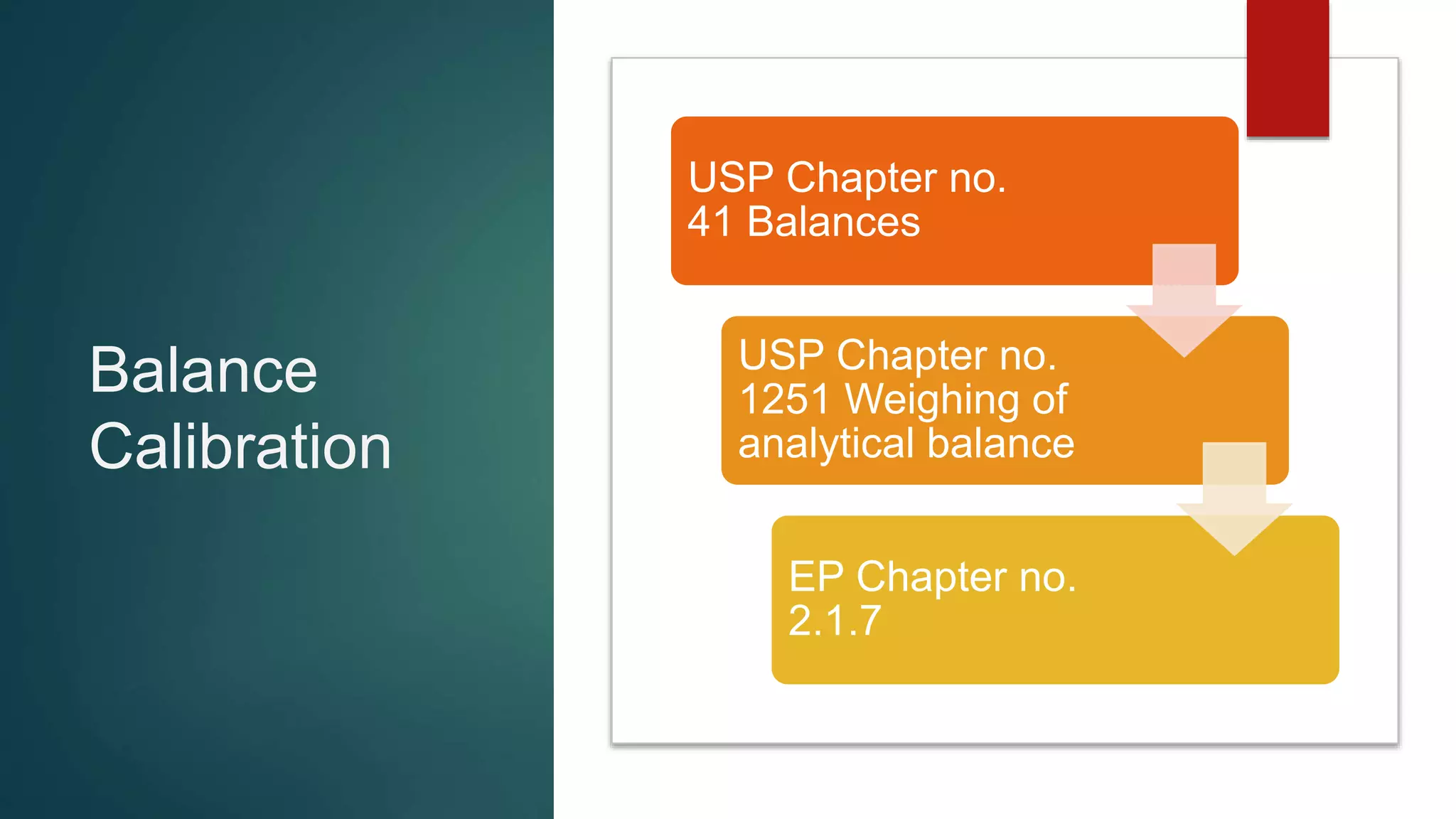
USP Chapter no.
41 Balances
USP Chapter no.
1251 Weighing of
analytical balance
EP Chapter no.
2.1.7
Important term and excel formula
 Least count
 Sprit level
 Acceptance criteria Tolerance
 True value versus Display value
 Operating range
 Accuracy versus Precision
 Standard deviation
 Percentage
 Relative Standard Deviations
 correlation coefficients
 Mean
 Scale interval
 Nominal value versus Certificate value
Method of
Calibration
Repeatability
Accuracy
Sensitivity
Linearity
Eccentricity
Repeatability or
Measurement of
Uncertainty
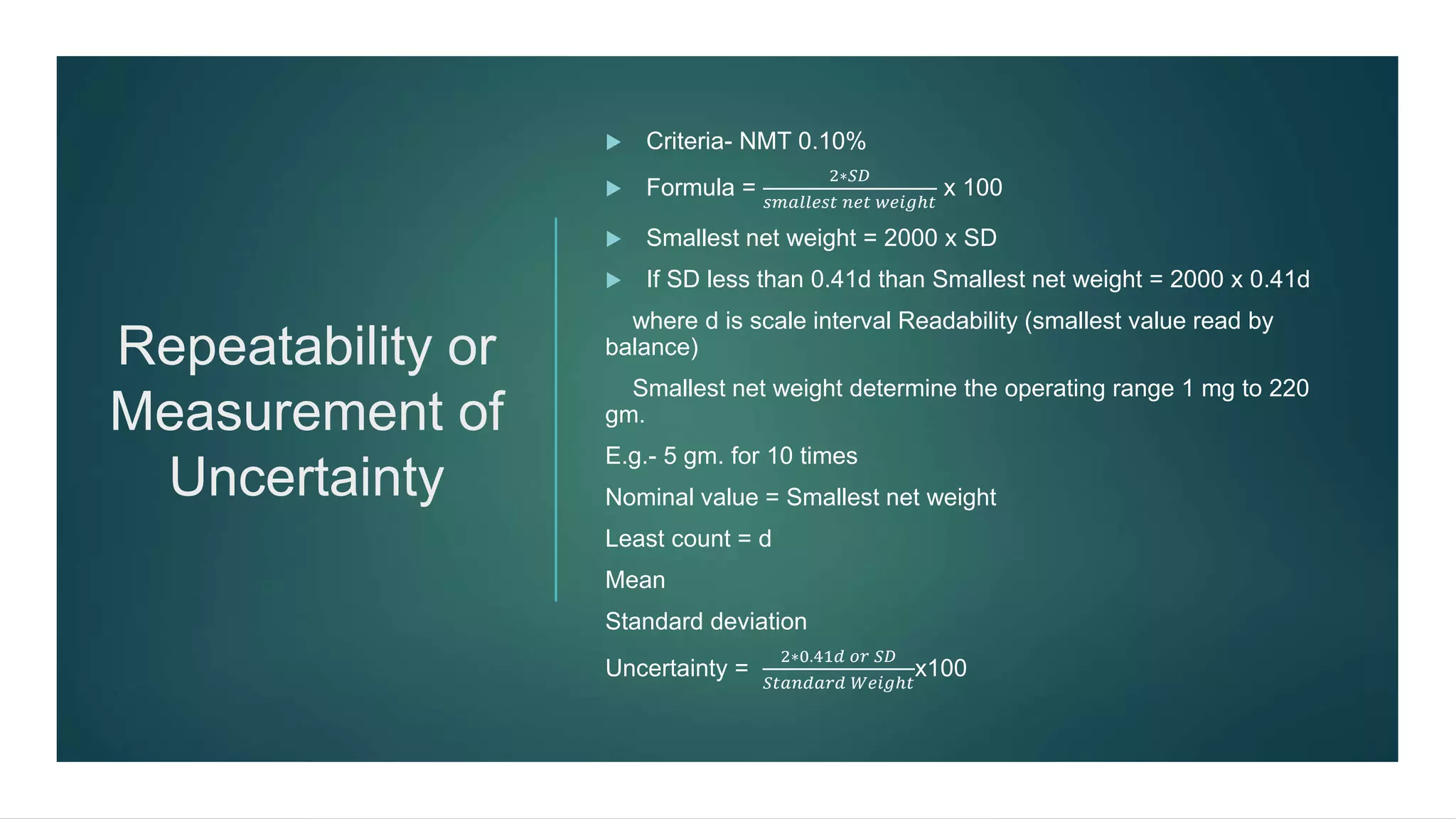
 Criteria- NMT 0.10%
 Formula =
2∗𝑆𝐷
𝑠𝑚𝑎𝑙𝑙𝑒𝑠𝑡 𝑛𝑒𝑡 𝑤𝑒𝑖𝑔ℎ𝑡
x 100
 Smallest net weight = 2000 x SD
 If SD less than 0.41d than Smallest net weight = 2000 x 0.41d
where d is scale interval Readability (smallest value read by
balance)
Smallest net weight determine the operating range 1 mg to 220
gm.
E.g.- 5 gm. for 10 times
Nominal value = Smallest net weight
Least count = d
Mean
Standard deviation
Uncertainty =
2∗0.41𝑑 𝑜𝑟 𝑆𝐷
𝑆𝑡𝑎𝑛𝑑𝑎𝑟𝑑 𝑊𝑒𝑖𝑔ℎ𝑡
x100
Accuracy
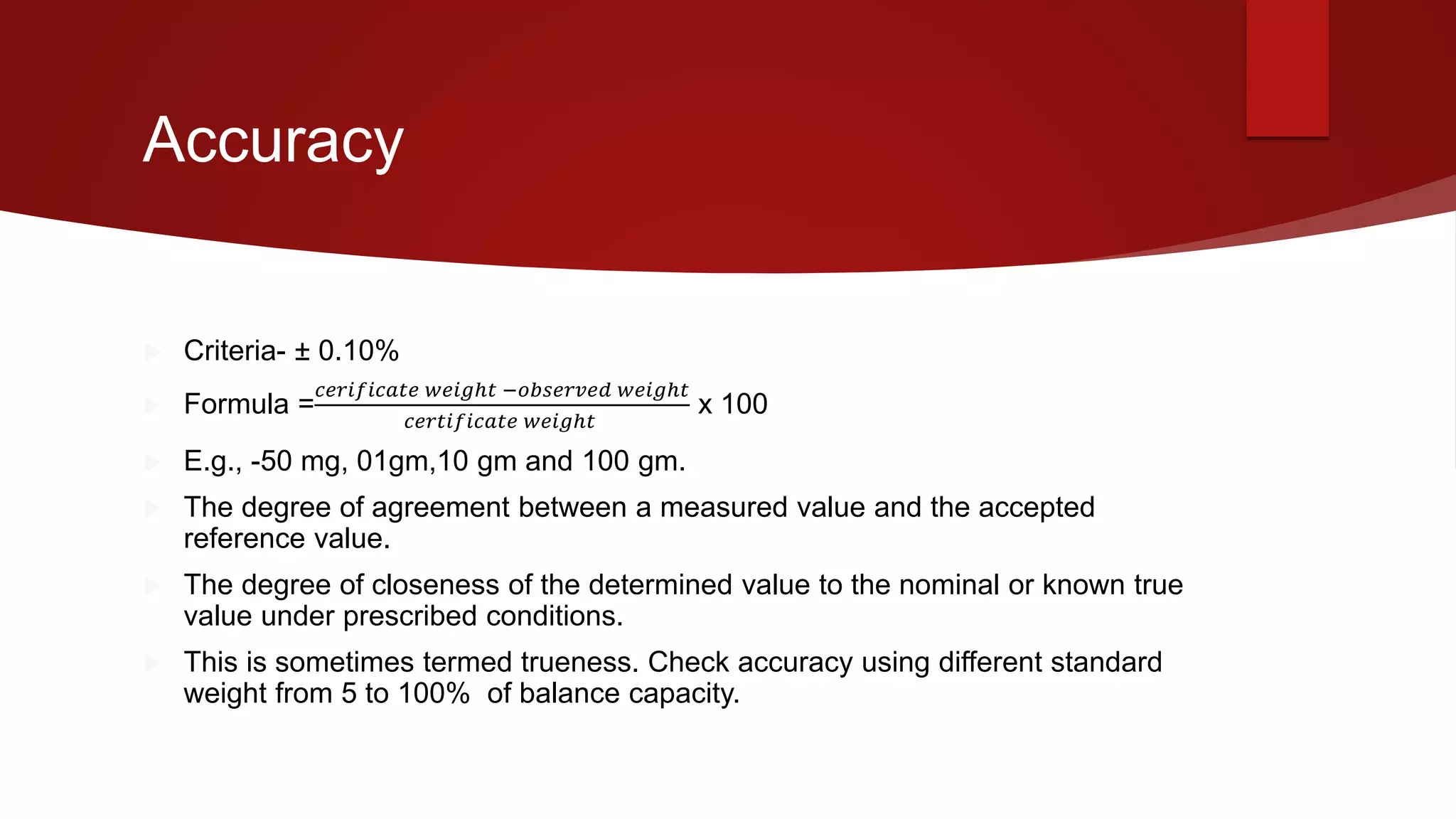
 Criteria- ± 0.10%
 Formula =
𝑐𝑒𝑟𝑖𝑓𝑖𝑐𝑎𝑡𝑒 𝑤𝑒𝑖𝑔ℎ𝑡 −𝑜𝑏𝑠𝑒𝑟𝑣𝑒𝑑 𝑤𝑒𝑖𝑔ℎ𝑡
𝑐𝑒𝑟𝑡𝑖𝑓𝑖𝑐𝑎𝑡𝑒 𝑤𝑒𝑖𝑔ℎ𝑡
x 100
 E.g., -50 mg, 01gm,10 gm and 100 gm.
 The degree of agreement between a measured value and the accepted
reference value.
 The degree of closeness of the determined value to the nominal or known true
value under prescribed conditions.
 This is sometimes termed trueness. Check accuracy using different standard
weight from 5 to 100% of balance capacity.
Sensitivity
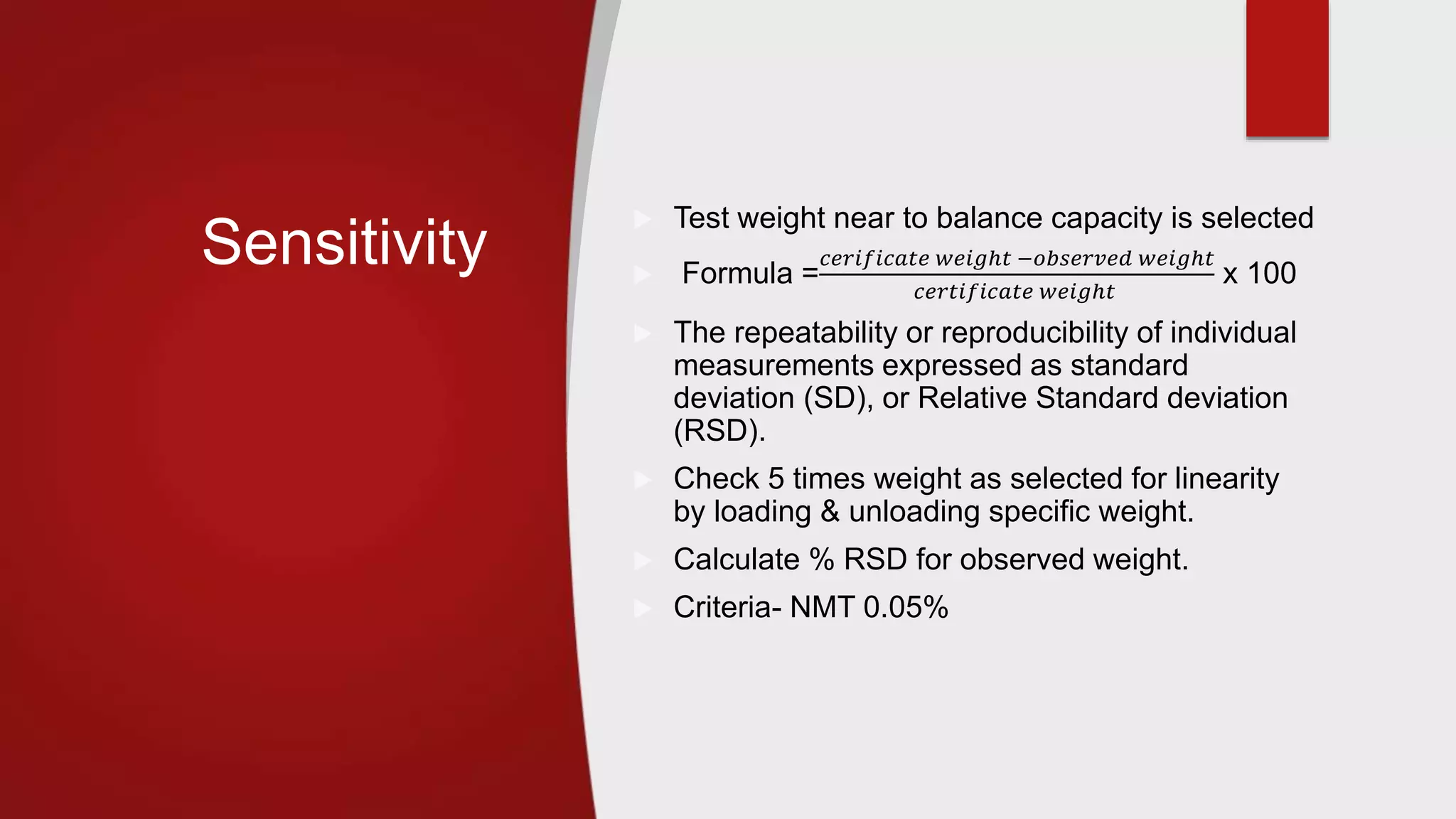
 Test weight near to balance capacity is selected
 Formula =
𝑐𝑒𝑟𝑖𝑓𝑖𝑐𝑎𝑡𝑒 𝑤𝑒𝑖𝑔ℎ𝑡 −𝑜𝑏𝑠𝑒𝑟𝑣𝑒𝑑 𝑤𝑒𝑖𝑔ℎ𝑡
𝑐𝑒𝑟𝑡𝑖𝑓𝑖𝑐𝑎𝑡𝑒 𝑤𝑒𝑖𝑔ℎ𝑡
x 100
 The repeatability or reproducibility of individual
measurements expressed as standard
deviation (SD), or Relative Standard deviation
(RSD).
 Check 5 times weight as selected for linearity
by loading & unloading specific weight.
 Calculate % RSD for observed weight.
 Criteria- NMT 0.05%
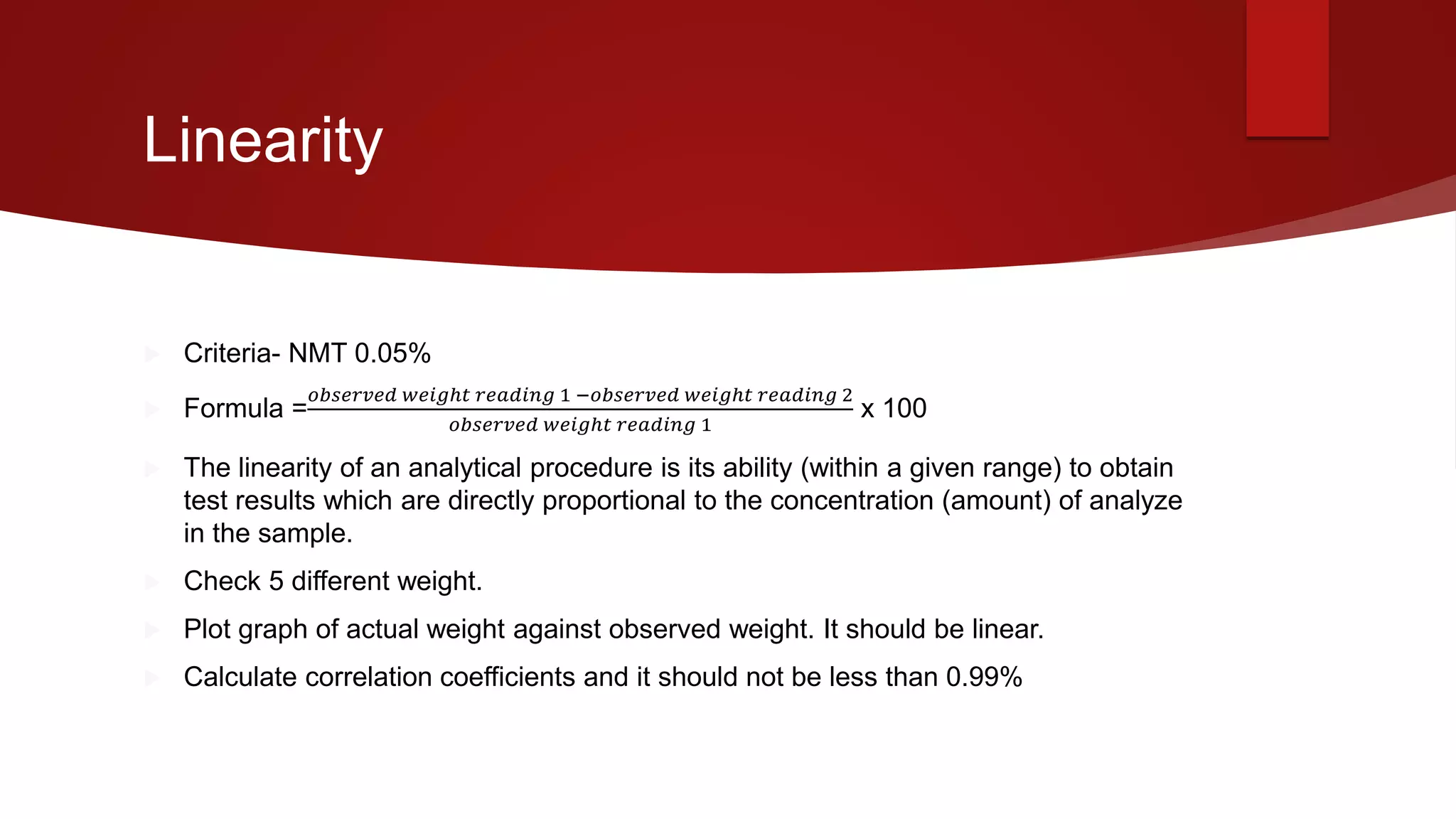
Linearity
 Criteria- NMT 0.05%
 Formula =
𝑜𝑏𝑠𝑒𝑟𝑣𝑒𝑑 𝑤𝑒𝑖𝑔ℎ𝑡 𝑟𝑒𝑎𝑑𝑖𝑛𝑔 1 −𝑜𝑏𝑠𝑒𝑟𝑣𝑒𝑑 𝑤𝑒𝑖𝑔ℎ𝑡 𝑟𝑒𝑎𝑑𝑖𝑛𝑔 2
𝑜𝑏𝑠𝑒𝑟𝑣𝑒𝑑 𝑤𝑒𝑖𝑔ℎ𝑡 𝑟𝑒𝑎𝑑𝑖𝑛𝑔 1
x 100
 The linearity of an analytical procedure is its ability (within a given range) to obtain
test results which are directly proportional to the concentration (amount) of analyze
in the sample.
 Check 5 different weight.
 Plot graph of actual weight against observed weight. It should be linear.
 Calculate correlation coefficients and it should not be less than 0.99%
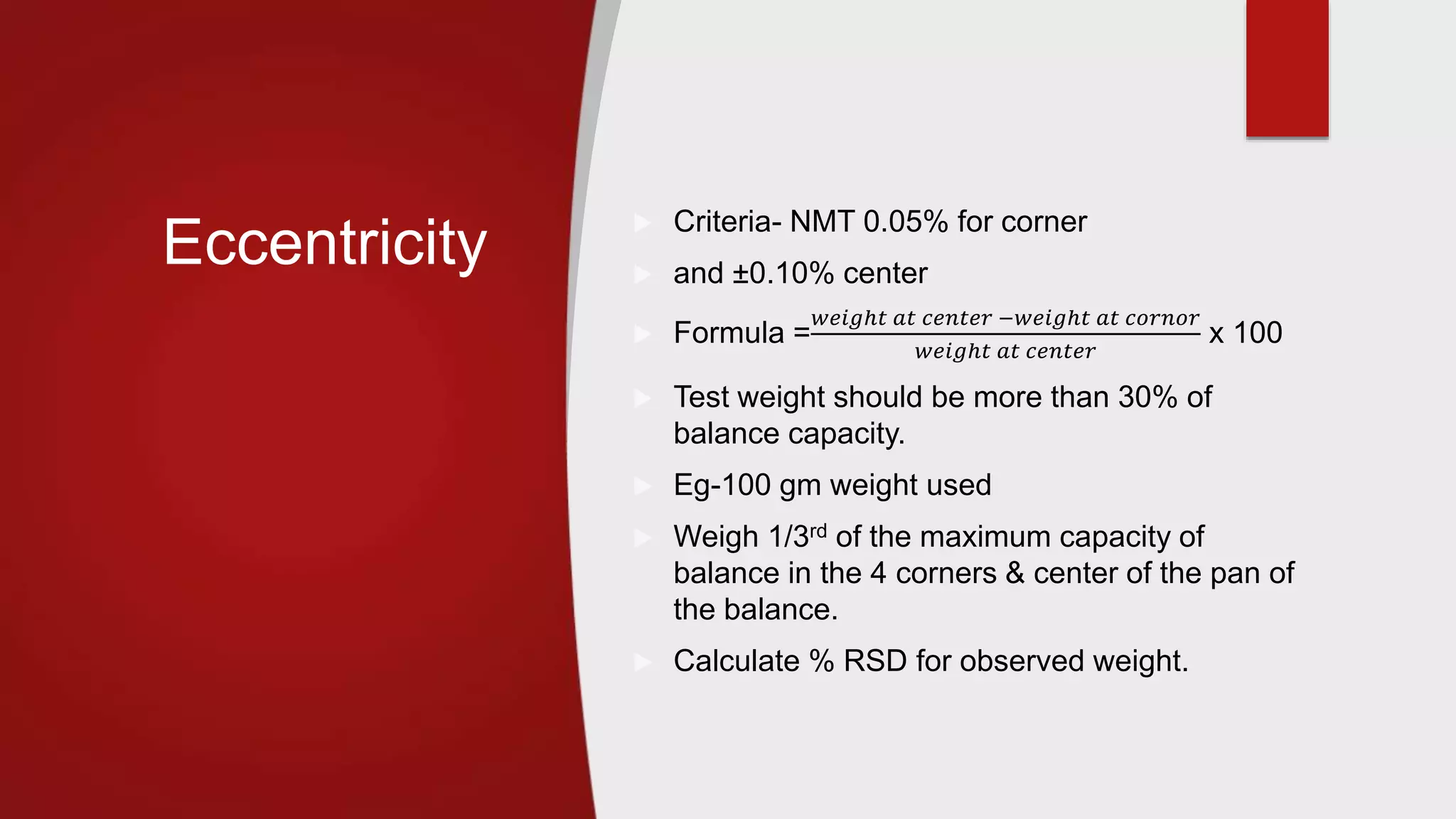
Eccentricity
 Criteria- NMT 0.05% for corner
 and ±0.10% center
 Formula =
𝑤𝑒𝑖𝑔ℎ𝑡 𝑎𝑡 𝑐𝑒𝑛𝑡𝑒𝑟 −𝑤𝑒𝑖𝑔ℎ𝑡 𝑎𝑡 𝑐𝑜𝑟𝑛𝑜𝑟
𝑤𝑒𝑖𝑔ℎ𝑡 𝑎𝑡 𝑐𝑒𝑛𝑡𝑒𝑟
x 100
 Test weight should be more than 30% of
balance capacity.
 Eg-100 gm weight used
 Weigh 1/3rd of the maximum capacity of
balance in the 4 corners & center of the pan of
the balance.
 Calculate % RSD for observed weight.

Balance calibration.pptx

  • 1.
  • 2.
    Balance Calibration USP Chapter no. 41Balances USP Chapter no. 1251 Weighing of analytical balance EP Chapter no. 2.1.7
  • 3.
    Important term andexcel formula  Least count  Sprit level  Acceptance criteria Tolerance  True value versus Display value  Operating range  Accuracy versus Precision  Standard deviation  Percentage  Relative Standard Deviations  correlation coefficients  Mean  Scale interval  Nominal value versus Certificate value
  • 4.
  • 5.
    Repeatability or Measurement of Uncertainty Criteria- NMT 0.10%  Formula = 2∗𝑆𝐷 𝑠𝑚𝑎𝑙𝑙𝑒𝑠𝑡 𝑛𝑒𝑡 𝑤𝑒𝑖𝑔ℎ𝑡 x 100  Smallest net weight = 2000 x SD  If SD less than 0.41d than Smallest net weight = 2000 x 0.41d where d is scale interval Readability (smallest value read by balance) Smallest net weight determine the operating range 1 mg to 220 gm. E.g.- 5 gm. for 10 times Nominal value = Smallest net weight Least count = d Mean Standard deviation Uncertainty = 2∗0.41𝑑 𝑜𝑟 𝑆𝐷 𝑆𝑡𝑎𝑛𝑑𝑎𝑟𝑑 𝑊𝑒𝑖𝑔ℎ𝑡 x100
  • 6.
    Accuracy  Criteria- ±0.10%  Formula = 𝑐𝑒𝑟𝑖𝑓𝑖𝑐𝑎𝑡𝑒 𝑤𝑒𝑖𝑔ℎ𝑡 −𝑜𝑏𝑠𝑒𝑟𝑣𝑒𝑑 𝑤𝑒𝑖𝑔ℎ𝑡 𝑐𝑒𝑟𝑡𝑖𝑓𝑖𝑐𝑎𝑡𝑒 𝑤𝑒𝑖𝑔ℎ𝑡 x 100  E.g., -50 mg, 01gm,10 gm and 100 gm.  The degree of agreement between a measured value and the accepted reference value.  The degree of closeness of the determined value to the nominal or known true value under prescribed conditions.  This is sometimes termed trueness. Check accuracy using different standard weight from 5 to 100% of balance capacity.
  • 7.
    Sensitivity  Test weightnear to balance capacity is selected  Formula = 𝑐𝑒𝑟𝑖𝑓𝑖𝑐𝑎𝑡𝑒 𝑤𝑒𝑖𝑔ℎ𝑡 −𝑜𝑏𝑠𝑒𝑟𝑣𝑒𝑑 𝑤𝑒𝑖𝑔ℎ𝑡 𝑐𝑒𝑟𝑡𝑖𝑓𝑖𝑐𝑎𝑡𝑒 𝑤𝑒𝑖𝑔ℎ𝑡 x 100  The repeatability or reproducibility of individual measurements expressed as standard deviation (SD), or Relative Standard deviation (RSD).  Check 5 times weight as selected for linearity by loading & unloading specific weight.  Calculate % RSD for observed weight.  Criteria- NMT 0.05%
  • 8.
    Linearity  Criteria- NMT0.05%  Formula = 𝑜𝑏𝑠𝑒𝑟𝑣𝑒𝑑 𝑤𝑒𝑖𝑔ℎ𝑡 𝑟𝑒𝑎𝑑𝑖𝑛𝑔 1 −𝑜𝑏𝑠𝑒𝑟𝑣𝑒𝑑 𝑤𝑒𝑖𝑔ℎ𝑡 𝑟𝑒𝑎𝑑𝑖𝑛𝑔 2 𝑜𝑏𝑠𝑒𝑟𝑣𝑒𝑑 𝑤𝑒𝑖𝑔ℎ𝑡 𝑟𝑒𝑎𝑑𝑖𝑛𝑔 1 x 100  The linearity of an analytical procedure is its ability (within a given range) to obtain test results which are directly proportional to the concentration (amount) of analyze in the sample.  Check 5 different weight.  Plot graph of actual weight against observed weight. It should be linear.  Calculate correlation coefficients and it should not be less than 0.99%
  • 9.
    Eccentricity  Criteria- NMT0.05% for corner  and ±0.10% center  Formula = 𝑤𝑒𝑖𝑔ℎ𝑡 𝑎𝑡 𝑐𝑒𝑛𝑡𝑒𝑟 −𝑤𝑒𝑖𝑔ℎ𝑡 𝑎𝑡 𝑐𝑜𝑟𝑛𝑜𝑟 𝑤𝑒𝑖𝑔ℎ𝑡 𝑎𝑡 𝑐𝑒𝑛𝑡𝑒𝑟 x 100  Test weight should be more than 30% of balance capacity.  Eg-100 gm weight used  Weigh 1/3rd of the maximum capacity of balance in the 4 corners & center of the pan of the balance.  Calculate % RSD for observed weight.