ELEMENTS by ICP                                                           7300
                                       (Nitric/Perchloric Acid Ashing)

        MW: Table 1                               CAS: Table 2                           RTECS: Table 2

METHOD: 7300, Issue 3                               EVALUATION: PARTIAL                              Issue 1: 15 August 1990
                                                                                                     Issue 3: 15 March 2003

OSHA: Table 2                                                    PROPERTIES: Table 1
NIOSH: Table 2
ACGIH: Table 2

ELEMENTS: aluminum*                calcium             lanthanum           nickel             strontium         tungsten*
          antimony*                chromium*           lithium*            potassium          tellurium         vanadium*
          arsenic                  cobalt*             magnesium           phosphorus         tin               yittrium
          barium                   copper              manganese*          selenium           thallium          zinc
          beryllium*               iron                molybdenum*         silver             titanium          zirconium*
          cadmium                  lead*
          *Some compounds          of these elements require special sample treatment.

                        SAMPLING                                                         MEASUREMENT

SAMPLER:           FILTER                                        TECHNIQUE:         INDUCTIVELY COUPLED ARGON
                   (0.8-µm, cellulose ester membrane, or                            PLASMA, ATOMIC EMISSION
                   5.0-µm, polyvinyl chloride membrane)                             SPECTROSCOPY (ICP-AES)

FLOWRATE:          1 to 4 L/min                                  ANALYTE:           elements above

VOL-MIN:           Table 1                                       ASHING
  -MAX:            Table 1                                       REAGENTS:          conc. HNO3 / conc. HClO4 (4:1), 5 mL;
                                                                                    2mL increments added as needed
SHIPMENT:          routine
                                                                 CONDITIONS:        room temperature, 30 min; 150 °C to near
SAMPLE                                                                              dryness
STABILITY:         stable                                        FINAL
                                                                 SOLUTION:          4% HNO3 , 1% HClO4 , 25 mL
BLANKS:            2 to 10 field blanks per set
                                                                 WAVELENGTH:        depends upon element; Table 3

                        ACCURACY                                 BACKGROUND
                                                                 CORRECTION:        spectral wavelength shift

RANGE STUDIED:                     not determined                CALIBRATION:       elements in 4% HNO 3 , 1% HClO4

BIAS:                              not determined                RANGE:             varies with element [1]

                                                                 ESTIMATED LOD: Tables 3 and 4
OVERALL PRECISION (Ö r T ):        not determined
                                                                 PRECISION ( þ ):   Tables 3 and 4
ACCURACY:                          not determined


APPLICABILITY: The working range of this method is 0.005 to 2.0 mg/m3 for each element in a 500-L air sample. This is
simultaneous elemental analysis, not compound specific. Verify that the types of compounds in the samples are soluble with
the ashing procedure selected.


INTERFERENCES: Spectral interferences are the primary interferences encountered in ICP-AES analysis. These are
minimized by judicious wavelength selection, interelement correction factors and background correction [1-4].


OTHER METHODS: This issue updates issues 1 and 2 of Method 7300, which replaced P&CAM 351 [3] for trace elements.
Flame atomic absorption spectroscopy (e.g., Methods 70XX) is an alternate analytical technique for many of these elements.
Graphite furnace AAS (e.g., 7102 for Be, 7105 for Pb) is more sensitive.


                                  NIOSH Manual of Analytical Methods (NMAM), Fourth Edition
ELEM ENT S (ICP): ME TH OD 7300, Issue 3, dated 1 5 March 2003 - Page 2 of 8


 REAGENTS:                                                  EQUIPMENT:

 1. Nitric acid (HNO 3), conc., ultra pure.                 1. Sam pler: cellulose ester m em brane filter,
 2. Pe rchloric acid (H ClO 4), con c., ultra p ure.*           0.8-µm pore size; or polyvinyl chloride
 3. Ashing acid: 4:1 (v/v) HNO 3:HClO 4. Mix 4                  m em brane, 5.0-µm pore size; 37-m m
    volumes conc. HNO 3 with 1 volume conc.                     diam eter, in cassette filter holder.
    HClO 4.                                                  2. Personal sa m pling pum p, 1 to 4 L/m in, with
 4. Ca libration s tock solutions, 1000 µg/m L.                 flexible connecting tubing.
    Com mercially available, or prepared per                 3. Inductively coupled plasma-atomic emission
    instrument manufacturer's recomm endation                   spectrometer, equipped as specified by the
    (see step 12 ).                                             manufacturer for analysis of elements of
 5. Dilution acid, 4% HNO 3, 1% HC lO 4. Add 50                 interest.
    mL ashing acid to 600 mL water; dilute to 1 L.           4. Regulator, two-stage, for argon.
 6. Argon.                                                   5. Beakers, Phillips, 125-mL, or Griffin, 50-mL,
 7. Distilled,deionized water.                                  with watch glass c overs .**
                                                             6. Volum etric flasks , 10-, 25-,10 0-m L., and 1-L **
                                                             7. Ass orted vo lum etric pipets as need ed.**
     *    See SPECIAL PRECAUTIONS.                           8. Hotplate, surface temperature 150 °C.

                                                                ** Clean all glasswa re with conc. nitric acid
                                                                   and rinse thoroughly in distilled water
                                                                   before use.


 SPECIAL PRECAUTIONS: All perchloric acid digestion s are req uired to be done in a perchloric acid
 hood. When working with concentrated acids, wear protective clothing and gloves.


SAMPLING:

 1. Calibrate each personal sampling pump with a representative sampler in line.
 2. Sa m ple at an accurately known flow rate between 1 and 4 L/min for a total sample size of 200 to 2000
    L (see Ta ble 1) for T W A m eas urem ents . Do not exceed a filter loading of ap prox imately 2 m g total dust.


SAMPLE PREPARATION:

 3. Open the cassette filter holders and transfer the samples and blanks to clean beakers.
 4. Add 5 mL ashing acid. Cover with a watchglass. Let stand 30 min at room tem perature.
    NOTE: Start a reagent blank at this step.
 5. Heat on hotplate (120 °C) until ca. 0.5 mL remains.
    NOT E 1: Recovery of lead from som e pa int m atrices m ay require other d igestion tec hniques . See
               Method 7082 (Lead by Flame AA S) for an alterna tive hotplate digestion procedure or Method
               7302 for a microwave digestion procedure.
    NOTE 2: Som e species of Al, Be, Co, Cr, Li, Mn, Mo, V, and Zr will not be completely solubilized by this
               procedure. Alternative solubilization techniques for most of these elements can be found
               elsewhe re [5-1 0]. For exa m ple, aq ua re gia m ay be n eed ed fo r Mn [6,12].
 6. Add 2 m L ashing acid and repeat step 5. Rep eat this step until the solution is clear.
 7. Rem ove watchg lass and rinse into the beake r with distilled water.
 8. Increase the tem perature to 150 °C and take the s am ple to near dryness (ca. 0.5 m L).
 9. Dissolve the residue in 2 to 3 mL dilution acid.
10. Transfer the solutions quantitatively to 25-mL volumetric flasks.
11. Dilute to volume with dilution acid.
    NOTE: If more sensitivity is required, the final sample volume m ay be held to 10 mL.


                              NIOSH Manual of Analytical Methods (NMAM), Fourth Edition
ELEM ENT S (ICP): ME TH OD 7300, Issue 3, dated 1 5 March 2003 - Page 3 of 8

CALIBRATION AND QUALITY CONTRO L:

12. Calibrate the spectrometer according to the manufacturers recomm endations.
    NOTE: Typically, an acid blank and 1.0 µg/m L m ultielem ent w ork ing sta nda rds are u sed . The following
            multielement combinations are chemically compatible in 4% HNO 3/1% HC lO 4:
            a. Al, As, Ba, Be, Ca, Cd, Co, Cr, Cu, Fe, La, In, Na
            b. Ag, K, Li, Mg, Mn, Ni, P, Pb, Se, Sr, Tl, V, Y, Zn, Sc
            c. Mo, Sb, Sn, Te, Ti, W , Zr
            d. Acid blank
13. Analyze a standard for every ten samples.
14. Check recoveries with at least two spiked blank filters per ten samples.


MEASUREMENT:

15. Set spec trome ter to conditions spe cified by manufac turer.
16. Analyze standards and samples.
    NOTE: If the values for the sam ples are a bove the rang e of th e standa rds, dilute the solutions w ith
            dilution acid, reanalyze and apply the appropriate dilution factor in the calculations.


CALCULATIONS:

17. Obta in the solution con cen trations for the sam ple, C s (µg/m L), an d the average m edia blank , C b (µg/m L),
    from the ins trum ent.
18. Using the solution volum es o f sam ple, V s (m L), an d m edia blank , V b (mL), calculate the concentration,
    C (m g/m 3), of each elem ent in the air volum e sam pled, V (L):


     NOTE: µg/L / m g/m 3


EVALUATION OF METHOD:

Issues 1 and 2
Method, 7300 was originally evaluated in 1981 [2,3]. The precision and recovery data were determined at 2.5
and 1000 µg of each element per sample on spiked filters. The m easurements used for the method evaluation
in Issues 1 and 2 were determined with a Jarrell-Ash Model 1160 Inductively Coupled Plasma Spectrometer
operated according to manufacturer's instructions.

Issue 3
In this update of NIOSH Method 7300, the precision and recovery data were determined at approximately 3x
and 10x the instrumental detection limits on comm ercially prepared spiked filters [12] using 25.0 mL as the
final sample volume. Tables 3 and 4 list the precision and recovery data, instrumental detection limits, and
analytical wavelengths for m ixed cellulos e es ter (M CE ) and polyvinyl chloride (P VC ) filters. PVC Filters which
can be used for total dust measurem ents and then digested for m etals m eas urem ents were tested and found
to give good results. The values in Tables 3 and 4 were determined with a Spectro Analytical Instruments
Model End On Plasma (EOP)(axial) operated according to manufacturer’s instructions.


                               NIOSH Manual of Analytical Methods (NMAM), Fourth Edition
ELEM ENT S (ICP): ME TH OD 7300, Issue 3, dated 1 5 March 2003 - Page 4 of 8

REFERENCES:

 [1] Millson M, Andrews R [2002]. Backup data report, Method 7300, unpublished report, NIOSH/DART.
 [2] Hull RD [1981]. Multielement Analysis of Industrial Hygiene Sam ples, NIO SH Internal Re port, presented
     at the American Industrial Hygiene Conference, Portland, Oregon.
 [3] NIOSH [1982]. NIO SH Ma nua l of Analytical Metho ds, 2nd e d., V. 7, P&CAM 351 (Elements by ICP),
     U.S. Department of Health and Human Services, Publ. (NIOSH) 82-100.
 [4] NIOSH [1994]. Elements by ICP: Method 7300, Issue 2. In: Eller PM , Cassinelli ME, eds., NIOSH
     Manual of Analytical M etho ds, 4 th ed. Cincinnati, OH: U.S. Department of Health and Human Services,
     Centers for Disease Control and Prevention, National Institute for Oc cupational Safety and Health, DHHS
     (NIOSH) Publication No. 94-113.
 [5] NIOSH [1994]. Lead by FAAS: Method 7082. In: Eller PM, Cassinelli ME, eds., NIOSH Manual of
     Analytical Me thod s, 4 th ed. Cincinnati, OH: U.S. Department of Health and H um an Services, C enters
     for Dise ase Control an d Prevention, N ation al Institute for Occupational Safety and Health, DHHS
     (NIOSH) Publication No. 94-113.
 [6] NIOS H [1977]. NIO SH M anual of Analytical Method s, 2nd ed., V. 2, S5 (Man ganes e), U.S. Department
     of Health, Education, and W elfare, Publ. (NIOSH) 77-157-B.
 [7] NIOSH [1994]. Tungsten, soluble/insoluble: Method 7074. In: Eller PM , Cassinelli ME, eds., NIOSH
     Manual of Analytical M etho ds, 4 th ed. Cincinnati, OH: U.S. Department of Health and Human Services,
     Centers for Disease Control and Prevention, National Institute for Occupational Safety and Health, DHHS
     (NIOSH) Publication No. 94-113.
 [8] NIOSH [1979]. NIOSH Manual of Analytical Methods, 2nd ed., V. 5, P&CAM 173 (Metals by Ato m ic
     Absorption), U.S. Department of Health, Education, and Welfare, Publ. (NIOSH) 79-141.
 [9] NIO SH [1977]. NIO SH Ma nua l of Analytical Metho ds, 2nd e d., V. 3, S183 (T in), S185 (Zirconium ), and
     S376 (Molybdenum), U.S. Department of Health, Education, and W elfare, Publ. (NIOSH) 77-157-C.
[10] ISO [2001]. W orkplace air - Determination of metals and metalloids in airborne particulate matter by
     inductively coupled plasma atomic emission spectrometry - Part 2: Sample preparation. International
     Orga nization for Standa rdization. ISO 152 02-2:2001(E ).
[11] ASTM [1985]. 1985 Annual Book of A ST M Sta ndards, Vo l. 11.01; Standard Specification for Reagent
     W ater; ASTM , Philadelphia, PA, D11 93-77 (198 5).
[12] Certification Inorganic Ventures for spikes.


METHOD REVISED BY:

Mark Millson and Ronnee Andrews, NIOSH/DART.

Method originally written by Mark Millson, NIOSH/DART, and R. DeLon Hull, Ph.D., NIOSH/DSHEF S, James
B. Perkins, David L. W heeler, and Keith Nicholson, DataChem Labortories, Salt Lake City, UT.


                             NIOSH Manual of Analytical Methods (NMAM), Fourth Edition
ELEM ENT S (ICP): ME TH OD 7300, Issue 3, dated 1 5 March 2003 - Page 5 of 8


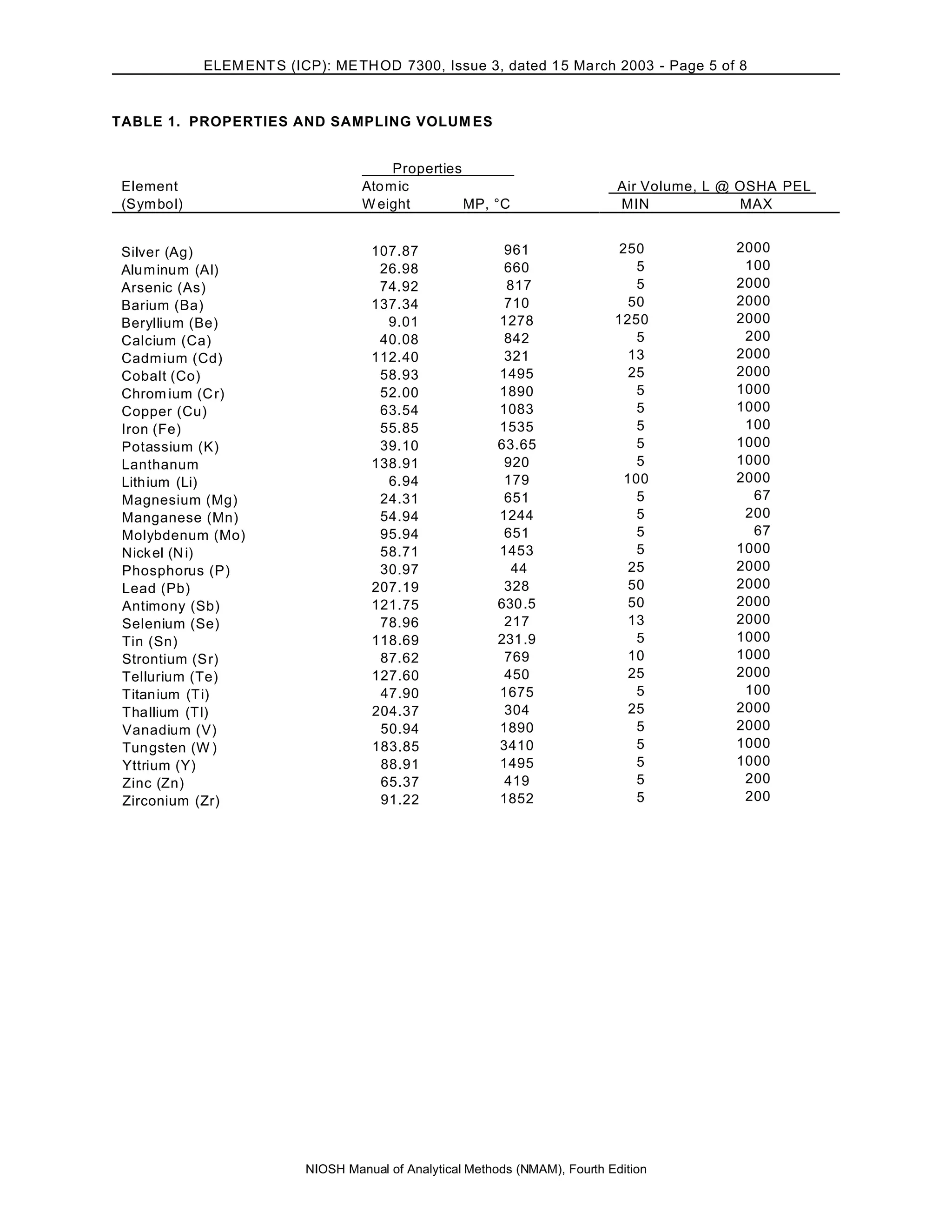
TABLE 1. PROPERTIES AND SAMPLING VOLUM ES


                                         Properties
 Element                            Ato m ic                                   Air Volume, L @ OSHA PEL
 (Sym bol)                          W eight         MP, °C                     MIN             MAX


 Silver (Ag)                         107.87                 961                250           2000
 Alu m inum (Al)                      26.98                 660                   5           100
 Arsenic (As)                         74.92                 817                   5          2000
 Barium (Ba)                         137.34                 710                  50          2000
 Beryllium (Be)                        9.01                1278               1250           2000
 Calcium (Ca)                         40.08                 842                   5           200
 Cadm ium (Cd)                       112.40                 321                  13          2000
 Cobalt (Co)                          58.93                1495                  25          2000
 Chrom ium (C r)                      52.00                1890                   5          1000
 Copper (Cu)                          63.54                1083                   5          1000
 Iron (Fe)                            55.85                1535                   5           100
 Potassium (K)                        39.10                63.65                  5          1000
 Lanthanum                           138.91                 920                   5          1000
 Lith ium (Li)                         6.94                 179                 100          2000
 Magnesium (Mg)                       24.31                 651                   5            67
 Manganese (Mn)                       54.94                1244                   5           200
 Molybdenum (Mo)                      95.94                 651                   5            67
 Nick el (N i)                        58.71                1453                   5          1000
 Phosphorus (P)                       30.97                  44                  25          2000
 Lead (Pb)                           207.19                 328                  50          2000
 Antimony (Sb)                       121.75                630 .5                50          2000
 Selenium (Se)                        78.96                 217                  13          2000
 Tin (Sn)                            118.69                231 .9                 5          1000
 Strontium (S r)                      87.62                 769                  10          1000
 Tellurium (Te)                      127.60                 450                  25          2000
 Titan ium (Ti)                       47.90                1675                   5           100
 Thallium (Tl)                       204.37                 304                  25          2000
 Vanadium (V)                         50.94                1890                   5          2000
 Tun gsten (W )                      183.85                3410                   5          1000
 Yttrium (Y)                          88.91                1495                   5          1000
 Zinc (Zn)                            65.37                 419                   5           200
 Zirconium (Zr)                       91.22                1852                   5           200


                           NIOSH Manual of Analytical Methods (NMAM), Fourth Edition
ELEM ENT S (ICP): ME TH OD 7300, Issue 3, dated 1 5 March 2003 - Page 6 of 8

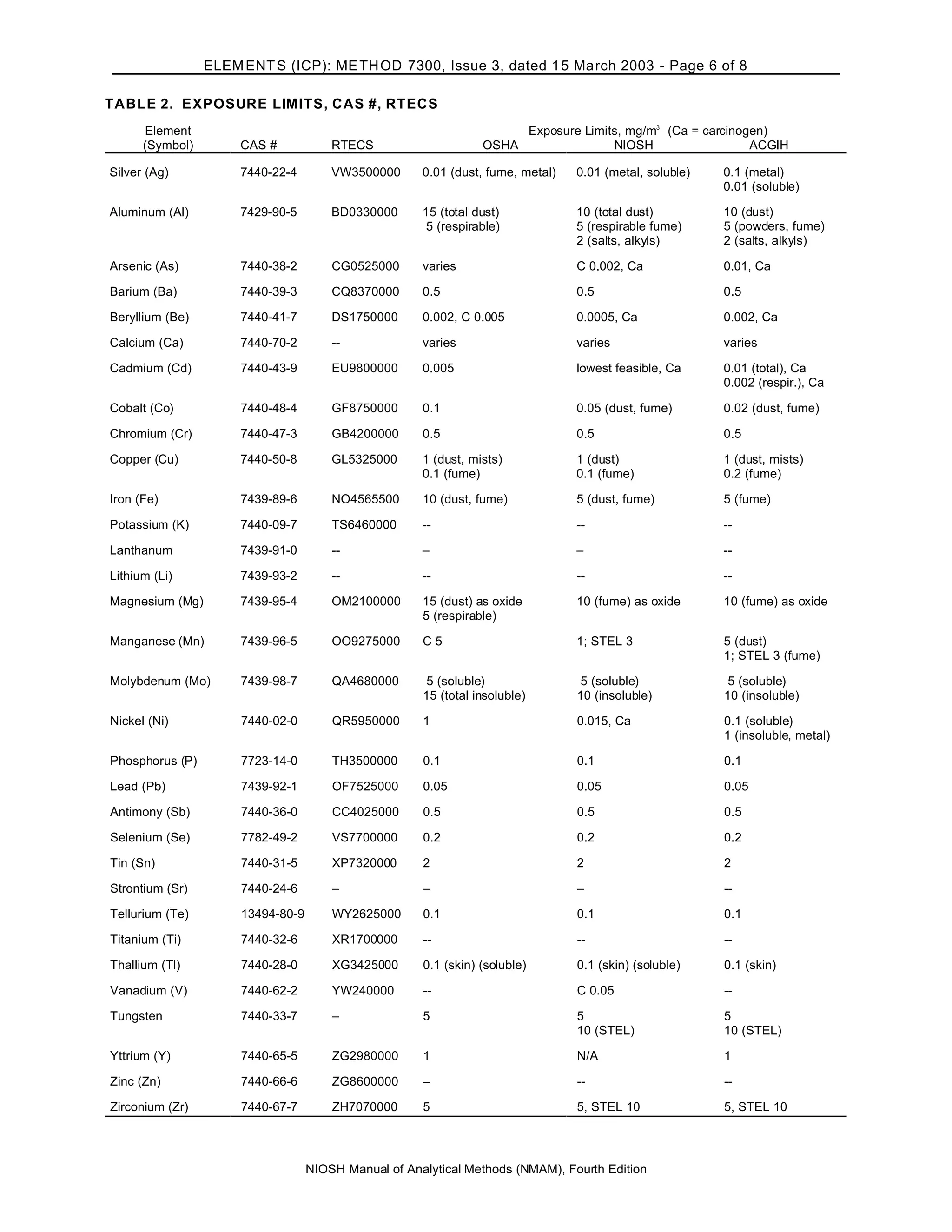
TABLE 2. EXPOSURE LIMITS, CAS #, RTECS
      Element                                                         Exposure Limits, mg/m3 (Ca = carcinogen)
      (Symbol)        CAS #            RTECS                     OSHA               NIOSH                  ACGIH

Silver (Ag)           7440-22-4        VW3500000      0.01 (dust, fume, metal)   0.01 (metal, soluble)   0.1 (metal)
                                                                                                         0.01 (soluble)

Aluminum (Al)         7429-90-5        BD0330000      15 (total dust)            10 (total dust)         10 (dust)
                                                       5 (respirable)            5 (respirable fume)     5 (powders, fume)
                                                                                 2 (salts, alkyls)       2 (salts, alkyls)

Arsenic (As)          7440-38-2        CG0525000      varies                     C 0.002, Ca             0.01, Ca

Barium (Ba)           7440-39-3        CQ8370000      0.5                        0.5                     0.5

Beryllium (Be)        7440-41-7        DS1750000      0.002, C 0.005             0.0005, Ca              0.002, Ca

Calcium (Ca)          7440-70-2        --             varies                     varies                  varies

Cadmium (Cd)          7440-43-9        EU9800000      0.005                      lowest feasible, Ca     0.01 (total), Ca
                                                                                                         0.002 (respir.), Ca

Cobalt (Co)           7440-48-4        GF8750000      0.1                        0.05 (dust, fume)       0.02 (dust, fume)

Chromium (Cr)         7440-47-3        GB4200000      0.5                        0.5                     0.5

Copper (Cu)           7440-50-8        GL5325000      1 (dust, mists)            1 (dust)                1 (dust, mists)
                                                      0.1 (fume)                 0.1 (fume)              0.2 (fume)

Iron (Fe)             7439-89-6        NO4565500      10 (dust, fume)            5 (dust, fume)          5 (fume)

Potassium (K)         7440-09-7        TS6460000      --                         --                      --

Lanthanum             7439-91-0        --             –                          –                       --

Lithium (Li)          7439-93-2        --             --                         --                      --

Magnesium (Mg)        7439-95-4        OM2100000      15 (dust) as oxide         10 (fume) as oxide      10 (fume) as oxide
                                                      5 (respirable)

Manganese (Mn)        7439-96-5        OO9275000      C5                         1; STEL 3               5 (dust)
                                                                                                         1; STEL 3 (fume)

Molybdenum (Mo)       7439-98-7        QA4680000       5 (soluble)                5 (soluble)             5 (soluble)
                                                      15 (total insoluble)       10 (insoluble)          10 (insoluble)

Nickel (Ni)           7440-02-0        QR5950000      1                          0.015, Ca               0.1 (soluble)
                                                                                                         1 (insoluble, metal)

Phosphorus (P)        7723-14-0        TH3500000      0.1                        0.1                     0.1

Lead (Pb)             7439-92-1        OF7525000      0.05                       0.05                    0.05

Antimony (Sb)         7440-36-0        CC4025000      0.5                        0.5                     0.5

Selenium (Se)         7782-49-2        VS7700000      0.2                        0.2                     0.2

Tin (Sn)              7440-31-5        XP7320000      2                          2                       2

Strontium (Sr)        7440-24-6        –              –                          –                       --

Tellurium (Te)        13494-80-9       WY2625000      0.1                        0.1                     0.1

Titanium (Ti)         7440-32-6        XR1700000      --                         --                      --

Thallium (Tl)         7440-28-0        XG3425000      0.1 (skin) (soluble)       0.1 (skin) (soluble)    0.1 (skin)

Vanadium (V)          7440-62-2        YW240000       --                         C 0.05                  --

Tungsten              7440-33-7        –              5                          5                       5
                                                                                 10 (STEL)               10 (STEL)

Yttrium (Y)           7440-65-5        ZG2980000      1                          N/A                     1

Zinc (Zn)             7440-66-6        ZG8600000      –                          --                      --

Zirconium (Zr)        7440-67-7        ZH7070000      5                          5, STEL 10              5, STEL 10


                                   NIOSH Manual of Analytical Methods (NMAM), Fourth Edition
ELEM ENT S (ICP): ME TH OD 7300, Issue 3, dated 1 5 March 2003 - Page 7 of 8


TABLE 3.       M EASU REM ENT PRO CED UR ES AN D D ATA [1].
               M ixed C ellulose Ester Filters (0.45 µm )

           wavelength Est. LOD LOD Certified % R ecovery Percent                  Certified      %        Percent
Element       nm         µg/   ng/m L 3x LOD     (c)      RSD                     10x LOD     Reco very    RSD
   (a)                 Filter           (b)              (N=25)                      (b)         (c)      (N=25)

      Ag       328       0.042       1.7     0.77        102 .9        2.64         3.21        98.3       1.53
      Al       167       0.115       4.6     1.54        105 .4        11.5         6.40       101 .5      1.98
      As       189       0.140       5.6     3.08         94.9         2.28         12.9        93.9       1.30
      Ba       455       0.005       0.2     0.31        101 .8        1.72         1.29        97.7       0.69
      Be       313       0.005       0.2     0.31        100 .0        1.44         1.29        98.4       0.75
      Ca       317       0.908      36.3     15.4         98.7         6.65         64.0       100 .2      1.30
      Cd       226       0.0075      0.3     0.31         99.8         1.99         1.29        97.5       0.88
      Co       228       0.012       0.5     0.31        100 .8        1.97         1.29        98.4       0.90
      Cr       267       0.020       0.8     0.31         93.4         16.3         1.29       101 .2     2.79
      Cu       324       0.068       2.7     1.54        102 .8        1.47         6.40       100 .6     0.92
      Fe       259       0.095       3.8     1.54        103 .3        5.46         6.40        98.0      0.95
      K        766        1.73      69.3     23.0         90.8         1.51         96.4        97.6      0.80
      La       408       0.048       1.9     0.77        102 .8        2.23         3.21       100 .1     0.92
      Li       670       0.010       0.4     0.31        110 .0        1.91         1.29        97.7      0.81
      Mg       279       0.098       3.9     1.54        101 .1        8.35         6.40        98.0      1.53
      Mn       257       0.005       0.2     0.31        101 .0        1.77         1.29        94.7      0.73
      Mo       202       0.020       0.8     0.31        105 .3        2.47         1.29        98.6      1.09
      Ni       231       0.020       0.8     0.31        109 .6        3.54         1.29       101 .2     1.38
      P        178       0.092       3.7     1.54         84.4         6.19         6.40        82.5      4.75
      Pb       168       0.062       2.5     1.54        109 .4        2.41         6.40       101 .7     0.88
      Sb       206       0.192       7.7     3.08         90.2         11.4         12.9        41.3      32.58
      Se       196       0.135       5.4      2.3         87.6         11.6         9.64        84.9      4.78
      Sn       189       0.040       1.6     0.77         90.2         18.0         3.21         49       21.79
      Sr       407       0.005       0.2     0.31        101 .0        1.55         1.29        97.3      0.65
      Te       214       0.078       3.1     1.54        102 .0        2.67         6.40        97.4      1.24
      Ti       334       0.050       2.0     0.77         98.4         2.04         3.21        93.4      1.08
      Tl       190       0.092       3.7     1.54        100 .9        2.48         6.40        99.1      0.80
      V        292       0.028       1.1     0.77        103 .2        1.92         3.21        98.3      0.84
      W        207       0.075       3.0     1.54         72.2         10.1         6.40        57.6      14.72
      Y        371       0.012       0.5     0.31        100 .5        1.80         1.29        97.4      0.75
      Zn       213       0.310      12.4     4.60        102 .2        1.87         19.3        95.3      0.90
      Zr       339       0.022       0.9     0.31         88.0         19.4         1.29         25       57.87

(a)    Bo ld values are qualitative only because of low rec overy.
(b)    Values are certified by Inorganic Ventures INC. at 3x and 10x the approximate instrumental LOD
(c)    Values reported were obtained with a Spectro Analytical Instruments EOP ICP; perform anc e m ay vary with
       instrument and should be independently verified.


                               NIOSH Manual of Analytical Methods (NMAM), Fourth Edition
ELEM ENT S (ICP): ME TH OD 7300, Issue 3, dated 1 5 March 2003 - Page 8 of 8

TABLE 4. M EASU REM ENT PRO CED UR ES AN D D ATA [1].
      Polyvinyl Chloride Filter (5.0 :m )

        wav elength Est. LOD LOD                 Certified        %         Percent Certified 17 %    Percent
Element     nm       :g per  ng/m L              3x LOD        Reco very     RSD    10x LOD Reco very  RSD
   (c)                filter                       (b)           (a)        (N=25)     (b)       (a)  (N=25)

      Ag        328        0.042       1.7         0.78          104 .2       8.20           3.18   81.8     18.9
      Al        167        0.115        4.6        1.56           77.4       115.24          6.40    92.9    20.9
      As        189        0.140        5.6        3.10          100 .7       5.13          12.70    96.9     3.2
      Ba        455        0.005        0.2        0.31          102 .4       3.89          1.270    99.8     2.0
      Be        313        0.005        0.2        0.31          106 .8       3.53          1.270   102 .8    2.1
      Ca        317        0.908       36.3        15.6           68.1        12.66         64.00    96.8     5.3
      Cd        226        0.0075       0.3        0.31          105 .2       5.57           1.27   101 .9    2.8
      Co        228        0.012        0.5        0.31          109 .3       4.67           1.27   102 .8    2.8
      Cr        267        0.020        0.8        0.31          109 .4       5.31           1.27   103 .4    4.1
      Cu        324        0.068        2.7        1.56          104 .9       5.18           6.40   101 .8    2.4
      Fe        259        0.095        3.8        1.56           88.7        46.82          6.40    99.1     9.7
      K         766         1.73       69.3        23.4           96.4        4.70          95.00    99.2     2.2
      La        408        0.048        1.9        0.78           45.5        4.19           3.18    98.8     2.6
      Li        670        0.010        0.4        0.31          107 .7       4.80           1.27   110 .4    2.7
      Mg        279        0.098        3.9        1.56           54.8        20.59          6.40    64.5     5.7
      Mn        257        0.005        0.2        0.31          101 .9       4.18           1.27    99.3     2.4
      Mo        202        0.020        0.8        0.31          106 .6       5.82           1.27    98.1     3.8
      Ni        231        0.020        0.8        0.31          111 .0       5.89           1.27   103 .6    3.2
      P         178        0.092        3.7        1.56          101 .9       17.82          6.40    86.5    10.4
      Pb        168         0.062       2.5        1.56          109 .6        6.12          6.40   103 .2    2.9
      Sb        206         0.192       7.7        3.10           64.6        22.54         12.70    38.1    30.5
      Se        196         0.135       5.4        2.30           83.1        26.23          9.50    76.0    17.2
      Sn        189         0.040       1.6        0.78           85.7        27.29          3.18    52.0    29.4
      Sr        407         0.005       0.2        0.31           71.8         4.09          1.27    81.2     2.7
      Te        214         0.078       3.1        1.56          109 .6        7.49          6.40    97.3     3.8
      Ti        334         0.050       2.0        0.78          101 .0        9.46          3.18    92.4     5.5
      Tl        190         0.092       3.7        1.56          110 .3        4.04          6.40   101 .9    2.0
       V        292         0.028       1.1        0.78          108 .3        3.94          3.18   102 .5    2.6
      W         207         0.075       3.0        1.56           74.9        15.79          6.40    44.7    19.6
       Y        371         0.012       0.5        0.31          101 .5        3.63          1.27   101 .4    2.5
      Zn        213         0.310      12.4        4.70           91.0       68.69           19.1   101 .0    9.6
      Zr        339         0.022       0.9        0.31           70.7       54.20           1.27    40.4    42.1


(a)    Values reported were obtained with a Spectro Analytical Instruments EOP ICP; perform anc e m ay vary with
       instrument and should be independently verified.
(b)    Values are c ertified b y Inorganic Ven tures INC . at 3x and 10x the appro xim ate ins trum enta l LOD [12].
(c)    Bo ld values are qualitative only because of low recove ry. Other digestion techniques m ay be m ore
       appropriate for these elements and their compounds.


                                NIOSH Manual of Analytical Methods (NMAM), Fourth Edition

Fumos metálicos niosh

  • 1.
    ELEMENTS by ICP 7300 (Nitric/Perchloric Acid Ashing) MW: Table 1 CAS: Table 2 RTECS: Table 2 METHOD: 7300, Issue 3 EVALUATION: PARTIAL Issue 1: 15 August 1990 Issue 3: 15 March 2003 OSHA: Table 2 PROPERTIES: Table 1 NIOSH: Table 2 ACGIH: Table 2 ELEMENTS: aluminum* calcium lanthanum nickel strontium tungsten* antimony* chromium* lithium* potassium tellurium vanadium* arsenic cobalt* magnesium phosphorus tin yittrium barium copper manganese* selenium thallium zinc beryllium* iron molybdenum* silver titanium zirconium* cadmium lead* *Some compounds of these elements require special sample treatment. SAMPLING MEASUREMENT SAMPLER: FILTER TECHNIQUE: INDUCTIVELY COUPLED ARGON (0.8-µm, cellulose ester membrane, or PLASMA, ATOMIC EMISSION 5.0-µm, polyvinyl chloride membrane) SPECTROSCOPY (ICP-AES) FLOWRATE: 1 to 4 L/min ANALYTE: elements above VOL-MIN: Table 1 ASHING -MAX: Table 1 REAGENTS: conc. HNO3 / conc. HClO4 (4:1), 5 mL; 2mL increments added as needed SHIPMENT: routine CONDITIONS: room temperature, 30 min; 150 °C to near SAMPLE dryness STABILITY: stable FINAL SOLUTION: 4% HNO3 , 1% HClO4 , 25 mL BLANKS: 2 to 10 field blanks per set WAVELENGTH: depends upon element; Table 3 ACCURACY BACKGROUND CORRECTION: spectral wavelength shift RANGE STUDIED: not determined CALIBRATION: elements in 4% HNO 3 , 1% HClO4 BIAS: not determined RANGE: varies with element [1] ESTIMATED LOD: Tables 3 and 4 OVERALL PRECISION (Ö r T ): not determined PRECISION ( þ ): Tables 3 and 4 ACCURACY: not determined APPLICABILITY: The working range of this method is 0.005 to 2.0 mg/m3 for each element in a 500-L air sample. This is simultaneous elemental analysis, not compound specific. Verify that the types of compounds in the samples are soluble with the ashing procedure selected. INTERFERENCES: Spectral interferences are the primary interferences encountered in ICP-AES analysis. These are minimized by judicious wavelength selection, interelement correction factors and background correction [1-4]. OTHER METHODS: This issue updates issues 1 and 2 of Method 7300, which replaced P&CAM 351 [3] for trace elements. Flame atomic absorption spectroscopy (e.g., Methods 70XX) is an alternate analytical technique for many of these elements. Graphite furnace AAS (e.g., 7102 for Be, 7105 for Pb) is more sensitive. NIOSH Manual of Analytical Methods (NMAM), Fourth Edition
  • 2.
    ELEM ENT S(ICP): ME TH OD 7300, Issue 3, dated 1 5 March 2003 - Page 2 of 8 REAGENTS: EQUIPMENT: 1. Nitric acid (HNO 3), conc., ultra pure. 1. Sam pler: cellulose ester m em brane filter, 2. Pe rchloric acid (H ClO 4), con c., ultra p ure.* 0.8-µm pore size; or polyvinyl chloride 3. Ashing acid: 4:1 (v/v) HNO 3:HClO 4. Mix 4 m em brane, 5.0-µm pore size; 37-m m volumes conc. HNO 3 with 1 volume conc. diam eter, in cassette filter holder. HClO 4. 2. Personal sa m pling pum p, 1 to 4 L/m in, with 4. Ca libration s tock solutions, 1000 µg/m L. flexible connecting tubing. Com mercially available, or prepared per 3. Inductively coupled plasma-atomic emission instrument manufacturer's recomm endation spectrometer, equipped as specified by the (see step 12 ). manufacturer for analysis of elements of 5. Dilution acid, 4% HNO 3, 1% HC lO 4. Add 50 interest. mL ashing acid to 600 mL water; dilute to 1 L. 4. Regulator, two-stage, for argon. 6. Argon. 5. Beakers, Phillips, 125-mL, or Griffin, 50-mL, 7. Distilled,deionized water. with watch glass c overs .** 6. Volum etric flasks , 10-, 25-,10 0-m L., and 1-L ** 7. Ass orted vo lum etric pipets as need ed.** * See SPECIAL PRECAUTIONS. 8. Hotplate, surface temperature 150 °C. ** Clean all glasswa re with conc. nitric acid and rinse thoroughly in distilled water before use. SPECIAL PRECAUTIONS: All perchloric acid digestion s are req uired to be done in a perchloric acid hood. When working with concentrated acids, wear protective clothing and gloves. SAMPLING: 1. Calibrate each personal sampling pump with a representative sampler in line. 2. Sa m ple at an accurately known flow rate between 1 and 4 L/min for a total sample size of 200 to 2000 L (see Ta ble 1) for T W A m eas urem ents . Do not exceed a filter loading of ap prox imately 2 m g total dust. SAMPLE PREPARATION: 3. Open the cassette filter holders and transfer the samples and blanks to clean beakers. 4. Add 5 mL ashing acid. Cover with a watchglass. Let stand 30 min at room tem perature. NOTE: Start a reagent blank at this step. 5. Heat on hotplate (120 °C) until ca. 0.5 mL remains. NOT E 1: Recovery of lead from som e pa int m atrices m ay require other d igestion tec hniques . See Method 7082 (Lead by Flame AA S) for an alterna tive hotplate digestion procedure or Method 7302 for a microwave digestion procedure. NOTE 2: Som e species of Al, Be, Co, Cr, Li, Mn, Mo, V, and Zr will not be completely solubilized by this procedure. Alternative solubilization techniques for most of these elements can be found elsewhe re [5-1 0]. For exa m ple, aq ua re gia m ay be n eed ed fo r Mn [6,12]. 6. Add 2 m L ashing acid and repeat step 5. Rep eat this step until the solution is clear. 7. Rem ove watchg lass and rinse into the beake r with distilled water. 8. Increase the tem perature to 150 °C and take the s am ple to near dryness (ca. 0.5 m L). 9. Dissolve the residue in 2 to 3 mL dilution acid. 10. Transfer the solutions quantitatively to 25-mL volumetric flasks. 11. Dilute to volume with dilution acid. NOTE: If more sensitivity is required, the final sample volume m ay be held to 10 mL. NIOSH Manual of Analytical Methods (NMAM), Fourth Edition
  • 3.
    ELEM ENT S(ICP): ME TH OD 7300, Issue 3, dated 1 5 March 2003 - Page 3 of 8 CALIBRATION AND QUALITY CONTRO L: 12. Calibrate the spectrometer according to the manufacturers recomm endations. NOTE: Typically, an acid blank and 1.0 µg/m L m ultielem ent w ork ing sta nda rds are u sed . The following multielement combinations are chemically compatible in 4% HNO 3/1% HC lO 4: a. Al, As, Ba, Be, Ca, Cd, Co, Cr, Cu, Fe, La, In, Na b. Ag, K, Li, Mg, Mn, Ni, P, Pb, Se, Sr, Tl, V, Y, Zn, Sc c. Mo, Sb, Sn, Te, Ti, W , Zr d. Acid blank 13. Analyze a standard for every ten samples. 14. Check recoveries with at least two spiked blank filters per ten samples. MEASUREMENT: 15. Set spec trome ter to conditions spe cified by manufac turer. 16. Analyze standards and samples. NOTE: If the values for the sam ples are a bove the rang e of th e standa rds, dilute the solutions w ith dilution acid, reanalyze and apply the appropriate dilution factor in the calculations. CALCULATIONS: 17. Obta in the solution con cen trations for the sam ple, C s (µg/m L), an d the average m edia blank , C b (µg/m L), from the ins trum ent. 18. Using the solution volum es o f sam ple, V s (m L), an d m edia blank , V b (mL), calculate the concentration, C (m g/m 3), of each elem ent in the air volum e sam pled, V (L): NOTE: µg/L / m g/m 3 EVALUATION OF METHOD: Issues 1 and 2 Method, 7300 was originally evaluated in 1981 [2,3]. The precision and recovery data were determined at 2.5 and 1000 µg of each element per sample on spiked filters. The m easurements used for the method evaluation in Issues 1 and 2 were determined with a Jarrell-Ash Model 1160 Inductively Coupled Plasma Spectrometer operated according to manufacturer's instructions. Issue 3 In this update of NIOSH Method 7300, the precision and recovery data were determined at approximately 3x and 10x the instrumental detection limits on comm ercially prepared spiked filters [12] using 25.0 mL as the final sample volume. Tables 3 and 4 list the precision and recovery data, instrumental detection limits, and analytical wavelengths for m ixed cellulos e es ter (M CE ) and polyvinyl chloride (P VC ) filters. PVC Filters which can be used for total dust measurem ents and then digested for m etals m eas urem ents were tested and found to give good results. The values in Tables 3 and 4 were determined with a Spectro Analytical Instruments Model End On Plasma (EOP)(axial) operated according to manufacturer’s instructions. NIOSH Manual of Analytical Methods (NMAM), Fourth Edition
  • 4.
    ELEM ENT S(ICP): ME TH OD 7300, Issue 3, dated 1 5 March 2003 - Page 4 of 8 REFERENCES: [1] Millson M, Andrews R [2002]. Backup data report, Method 7300, unpublished report, NIOSH/DART. [2] Hull RD [1981]. Multielement Analysis of Industrial Hygiene Sam ples, NIO SH Internal Re port, presented at the American Industrial Hygiene Conference, Portland, Oregon. [3] NIOSH [1982]. NIO SH Ma nua l of Analytical Metho ds, 2nd e d., V. 7, P&CAM 351 (Elements by ICP), U.S. Department of Health and Human Services, Publ. (NIOSH) 82-100. [4] NIOSH [1994]. Elements by ICP: Method 7300, Issue 2. In: Eller PM , Cassinelli ME, eds., NIOSH Manual of Analytical M etho ds, 4 th ed. Cincinnati, OH: U.S. Department of Health and Human Services, Centers for Disease Control and Prevention, National Institute for Oc cupational Safety and Health, DHHS (NIOSH) Publication No. 94-113. [5] NIOSH [1994]. Lead by FAAS: Method 7082. In: Eller PM, Cassinelli ME, eds., NIOSH Manual of Analytical Me thod s, 4 th ed. Cincinnati, OH: U.S. Department of Health and H um an Services, C enters for Dise ase Control an d Prevention, N ation al Institute for Occupational Safety and Health, DHHS (NIOSH) Publication No. 94-113. [6] NIOS H [1977]. NIO SH M anual of Analytical Method s, 2nd ed., V. 2, S5 (Man ganes e), U.S. Department of Health, Education, and W elfare, Publ. (NIOSH) 77-157-B. [7] NIOSH [1994]. Tungsten, soluble/insoluble: Method 7074. In: Eller PM , Cassinelli ME, eds., NIOSH Manual of Analytical M etho ds, 4 th ed. Cincinnati, OH: U.S. Department of Health and Human Services, Centers for Disease Control and Prevention, National Institute for Occupational Safety and Health, DHHS (NIOSH) Publication No. 94-113. [8] NIOSH [1979]. NIOSH Manual of Analytical Methods, 2nd ed., V. 5, P&CAM 173 (Metals by Ato m ic Absorption), U.S. Department of Health, Education, and Welfare, Publ. (NIOSH) 79-141. [9] NIO SH [1977]. NIO SH Ma nua l of Analytical Metho ds, 2nd e d., V. 3, S183 (T in), S185 (Zirconium ), and S376 (Molybdenum), U.S. Department of Health, Education, and W elfare, Publ. (NIOSH) 77-157-C. [10] ISO [2001]. W orkplace air - Determination of metals and metalloids in airborne particulate matter by inductively coupled plasma atomic emission spectrometry - Part 2: Sample preparation. International Orga nization for Standa rdization. ISO 152 02-2:2001(E ). [11] ASTM [1985]. 1985 Annual Book of A ST M Sta ndards, Vo l. 11.01; Standard Specification for Reagent W ater; ASTM , Philadelphia, PA, D11 93-77 (198 5). [12] Certification Inorganic Ventures for spikes. METHOD REVISED BY: Mark Millson and Ronnee Andrews, NIOSH/DART. Method originally written by Mark Millson, NIOSH/DART, and R. DeLon Hull, Ph.D., NIOSH/DSHEF S, James B. Perkins, David L. W heeler, and Keith Nicholson, DataChem Labortories, Salt Lake City, UT. NIOSH Manual of Analytical Methods (NMAM), Fourth Edition
  • 5.
    ELEM ENT S(ICP): ME TH OD 7300, Issue 3, dated 1 5 March 2003 - Page 5 of 8 TABLE 1. PROPERTIES AND SAMPLING VOLUM ES Properties Element Ato m ic Air Volume, L @ OSHA PEL (Sym bol) W eight MP, °C MIN MAX Silver (Ag) 107.87 961 250 2000 Alu m inum (Al) 26.98 660 5 100 Arsenic (As) 74.92 817 5 2000 Barium (Ba) 137.34 710 50 2000 Beryllium (Be) 9.01 1278 1250 2000 Calcium (Ca) 40.08 842 5 200 Cadm ium (Cd) 112.40 321 13 2000 Cobalt (Co) 58.93 1495 25 2000 Chrom ium (C r) 52.00 1890 5 1000 Copper (Cu) 63.54 1083 5 1000 Iron (Fe) 55.85 1535 5 100 Potassium (K) 39.10 63.65 5 1000 Lanthanum 138.91 920 5 1000 Lith ium (Li) 6.94 179 100 2000 Magnesium (Mg) 24.31 651 5 67 Manganese (Mn) 54.94 1244 5 200 Molybdenum (Mo) 95.94 651 5 67 Nick el (N i) 58.71 1453 5 1000 Phosphorus (P) 30.97 44 25 2000 Lead (Pb) 207.19 328 50 2000 Antimony (Sb) 121.75 630 .5 50 2000 Selenium (Se) 78.96 217 13 2000 Tin (Sn) 118.69 231 .9 5 1000 Strontium (S r) 87.62 769 10 1000 Tellurium (Te) 127.60 450 25 2000 Titan ium (Ti) 47.90 1675 5 100 Thallium (Tl) 204.37 304 25 2000 Vanadium (V) 50.94 1890 5 2000 Tun gsten (W ) 183.85 3410 5 1000 Yttrium (Y) 88.91 1495 5 1000 Zinc (Zn) 65.37 419 5 200 Zirconium (Zr) 91.22 1852 5 200 NIOSH Manual of Analytical Methods (NMAM), Fourth Edition
  • 6.
    ELEM ENT S(ICP): ME TH OD 7300, Issue 3, dated 1 5 March 2003 - Page 6 of 8 TABLE 2. EXPOSURE LIMITS, CAS #, RTECS Element Exposure Limits, mg/m3 (Ca = carcinogen) (Symbol) CAS # RTECS OSHA NIOSH ACGIH Silver (Ag) 7440-22-4 VW3500000 0.01 (dust, fume, metal) 0.01 (metal, soluble) 0.1 (metal) 0.01 (soluble) Aluminum (Al) 7429-90-5 BD0330000 15 (total dust) 10 (total dust) 10 (dust) 5 (respirable) 5 (respirable fume) 5 (powders, fume) 2 (salts, alkyls) 2 (salts, alkyls) Arsenic (As) 7440-38-2 CG0525000 varies C 0.002, Ca 0.01, Ca Barium (Ba) 7440-39-3 CQ8370000 0.5 0.5 0.5 Beryllium (Be) 7440-41-7 DS1750000 0.002, C 0.005 0.0005, Ca 0.002, Ca Calcium (Ca) 7440-70-2 -- varies varies varies Cadmium (Cd) 7440-43-9 EU9800000 0.005 lowest feasible, Ca 0.01 (total), Ca 0.002 (respir.), Ca Cobalt (Co) 7440-48-4 GF8750000 0.1 0.05 (dust, fume) 0.02 (dust, fume) Chromium (Cr) 7440-47-3 GB4200000 0.5 0.5 0.5 Copper (Cu) 7440-50-8 GL5325000 1 (dust, mists) 1 (dust) 1 (dust, mists) 0.1 (fume) 0.1 (fume) 0.2 (fume) Iron (Fe) 7439-89-6 NO4565500 10 (dust, fume) 5 (dust, fume) 5 (fume) Potassium (K) 7440-09-7 TS6460000 -- -- -- Lanthanum 7439-91-0 -- – – -- Lithium (Li) 7439-93-2 -- -- -- -- Magnesium (Mg) 7439-95-4 OM2100000 15 (dust) as oxide 10 (fume) as oxide 10 (fume) as oxide 5 (respirable) Manganese (Mn) 7439-96-5 OO9275000 C5 1; STEL 3 5 (dust) 1; STEL 3 (fume) Molybdenum (Mo) 7439-98-7 QA4680000 5 (soluble) 5 (soluble) 5 (soluble) 15 (total insoluble) 10 (insoluble) 10 (insoluble) Nickel (Ni) 7440-02-0 QR5950000 1 0.015, Ca 0.1 (soluble) 1 (insoluble, metal) Phosphorus (P) 7723-14-0 TH3500000 0.1 0.1 0.1 Lead (Pb) 7439-92-1 OF7525000 0.05 0.05 0.05 Antimony (Sb) 7440-36-0 CC4025000 0.5 0.5 0.5 Selenium (Se) 7782-49-2 VS7700000 0.2 0.2 0.2 Tin (Sn) 7440-31-5 XP7320000 2 2 2 Strontium (Sr) 7440-24-6 – – – -- Tellurium (Te) 13494-80-9 WY2625000 0.1 0.1 0.1 Titanium (Ti) 7440-32-6 XR1700000 -- -- -- Thallium (Tl) 7440-28-0 XG3425000 0.1 (skin) (soluble) 0.1 (skin) (soluble) 0.1 (skin) Vanadium (V) 7440-62-2 YW240000 -- C 0.05 -- Tungsten 7440-33-7 – 5 5 5 10 (STEL) 10 (STEL) Yttrium (Y) 7440-65-5 ZG2980000 1 N/A 1 Zinc (Zn) 7440-66-6 ZG8600000 – -- -- Zirconium (Zr) 7440-67-7 ZH7070000 5 5, STEL 10 5, STEL 10 NIOSH Manual of Analytical Methods (NMAM), Fourth Edition
  • 7.
    ELEM ENT S(ICP): ME TH OD 7300, Issue 3, dated 1 5 March 2003 - Page 7 of 8 TABLE 3. M EASU REM ENT PRO CED UR ES AN D D ATA [1]. M ixed C ellulose Ester Filters (0.45 µm ) wavelength Est. LOD LOD Certified % R ecovery Percent Certified % Percent Element nm µg/ ng/m L 3x LOD (c) RSD 10x LOD Reco very RSD (a) Filter (b) (N=25) (b) (c) (N=25) Ag 328 0.042 1.7 0.77 102 .9 2.64 3.21 98.3 1.53 Al 167 0.115 4.6 1.54 105 .4 11.5 6.40 101 .5 1.98 As 189 0.140 5.6 3.08 94.9 2.28 12.9 93.9 1.30 Ba 455 0.005 0.2 0.31 101 .8 1.72 1.29 97.7 0.69 Be 313 0.005 0.2 0.31 100 .0 1.44 1.29 98.4 0.75 Ca 317 0.908 36.3 15.4 98.7 6.65 64.0 100 .2 1.30 Cd 226 0.0075 0.3 0.31 99.8 1.99 1.29 97.5 0.88 Co 228 0.012 0.5 0.31 100 .8 1.97 1.29 98.4 0.90 Cr 267 0.020 0.8 0.31 93.4 16.3 1.29 101 .2 2.79 Cu 324 0.068 2.7 1.54 102 .8 1.47 6.40 100 .6 0.92 Fe 259 0.095 3.8 1.54 103 .3 5.46 6.40 98.0 0.95 K 766 1.73 69.3 23.0 90.8 1.51 96.4 97.6 0.80 La 408 0.048 1.9 0.77 102 .8 2.23 3.21 100 .1 0.92 Li 670 0.010 0.4 0.31 110 .0 1.91 1.29 97.7 0.81 Mg 279 0.098 3.9 1.54 101 .1 8.35 6.40 98.0 1.53 Mn 257 0.005 0.2 0.31 101 .0 1.77 1.29 94.7 0.73 Mo 202 0.020 0.8 0.31 105 .3 2.47 1.29 98.6 1.09 Ni 231 0.020 0.8 0.31 109 .6 3.54 1.29 101 .2 1.38 P 178 0.092 3.7 1.54 84.4 6.19 6.40 82.5 4.75 Pb 168 0.062 2.5 1.54 109 .4 2.41 6.40 101 .7 0.88 Sb 206 0.192 7.7 3.08 90.2 11.4 12.9 41.3 32.58 Se 196 0.135 5.4 2.3 87.6 11.6 9.64 84.9 4.78 Sn 189 0.040 1.6 0.77 90.2 18.0 3.21 49 21.79 Sr 407 0.005 0.2 0.31 101 .0 1.55 1.29 97.3 0.65 Te 214 0.078 3.1 1.54 102 .0 2.67 6.40 97.4 1.24 Ti 334 0.050 2.0 0.77 98.4 2.04 3.21 93.4 1.08 Tl 190 0.092 3.7 1.54 100 .9 2.48 6.40 99.1 0.80 V 292 0.028 1.1 0.77 103 .2 1.92 3.21 98.3 0.84 W 207 0.075 3.0 1.54 72.2 10.1 6.40 57.6 14.72 Y 371 0.012 0.5 0.31 100 .5 1.80 1.29 97.4 0.75 Zn 213 0.310 12.4 4.60 102 .2 1.87 19.3 95.3 0.90 Zr 339 0.022 0.9 0.31 88.0 19.4 1.29 25 57.87 (a) Bo ld values are qualitative only because of low rec overy. (b) Values are certified by Inorganic Ventures INC. at 3x and 10x the approximate instrumental LOD (c) Values reported were obtained with a Spectro Analytical Instruments EOP ICP; perform anc e m ay vary with instrument and should be independently verified. NIOSH Manual of Analytical Methods (NMAM), Fourth Edition
  • 8.
    ELEM ENT S(ICP): ME TH OD 7300, Issue 3, dated 1 5 March 2003 - Page 8 of 8 TABLE 4. M EASU REM ENT PRO CED UR ES AN D D ATA [1]. Polyvinyl Chloride Filter (5.0 :m ) wav elength Est. LOD LOD Certified % Percent Certified 17 % Percent Element nm :g per ng/m L 3x LOD Reco very RSD 10x LOD Reco very RSD (c) filter (b) (a) (N=25) (b) (a) (N=25) Ag 328 0.042 1.7 0.78 104 .2 8.20 3.18 81.8 18.9 Al 167 0.115 4.6 1.56 77.4 115.24 6.40 92.9 20.9 As 189 0.140 5.6 3.10 100 .7 5.13 12.70 96.9 3.2 Ba 455 0.005 0.2 0.31 102 .4 3.89 1.270 99.8 2.0 Be 313 0.005 0.2 0.31 106 .8 3.53 1.270 102 .8 2.1 Ca 317 0.908 36.3 15.6 68.1 12.66 64.00 96.8 5.3 Cd 226 0.0075 0.3 0.31 105 .2 5.57 1.27 101 .9 2.8 Co 228 0.012 0.5 0.31 109 .3 4.67 1.27 102 .8 2.8 Cr 267 0.020 0.8 0.31 109 .4 5.31 1.27 103 .4 4.1 Cu 324 0.068 2.7 1.56 104 .9 5.18 6.40 101 .8 2.4 Fe 259 0.095 3.8 1.56 88.7 46.82 6.40 99.1 9.7 K 766 1.73 69.3 23.4 96.4 4.70 95.00 99.2 2.2 La 408 0.048 1.9 0.78 45.5 4.19 3.18 98.8 2.6 Li 670 0.010 0.4 0.31 107 .7 4.80 1.27 110 .4 2.7 Mg 279 0.098 3.9 1.56 54.8 20.59 6.40 64.5 5.7 Mn 257 0.005 0.2 0.31 101 .9 4.18 1.27 99.3 2.4 Mo 202 0.020 0.8 0.31 106 .6 5.82 1.27 98.1 3.8 Ni 231 0.020 0.8 0.31 111 .0 5.89 1.27 103 .6 3.2 P 178 0.092 3.7 1.56 101 .9 17.82 6.40 86.5 10.4 Pb 168 0.062 2.5 1.56 109 .6 6.12 6.40 103 .2 2.9 Sb 206 0.192 7.7 3.10 64.6 22.54 12.70 38.1 30.5 Se 196 0.135 5.4 2.30 83.1 26.23 9.50 76.0 17.2 Sn 189 0.040 1.6 0.78 85.7 27.29 3.18 52.0 29.4 Sr 407 0.005 0.2 0.31 71.8 4.09 1.27 81.2 2.7 Te 214 0.078 3.1 1.56 109 .6 7.49 6.40 97.3 3.8 Ti 334 0.050 2.0 0.78 101 .0 9.46 3.18 92.4 5.5 Tl 190 0.092 3.7 1.56 110 .3 4.04 6.40 101 .9 2.0 V 292 0.028 1.1 0.78 108 .3 3.94 3.18 102 .5 2.6 W 207 0.075 3.0 1.56 74.9 15.79 6.40 44.7 19.6 Y 371 0.012 0.5 0.31 101 .5 3.63 1.27 101 .4 2.5 Zn 213 0.310 12.4 4.70 91.0 68.69 19.1 101 .0 9.6 Zr 339 0.022 0.9 0.31 70.7 54.20 1.27 40.4 42.1 (a) Values reported were obtained with a Spectro Analytical Instruments EOP ICP; perform anc e m ay vary with instrument and should be independently verified. (b) Values are c ertified b y Inorganic Ven tures INC . at 3x and 10x the appro xim ate ins trum enta l LOD [12]. (c) Bo ld values are qualitative only because of low recove ry. Other digestion techniques m ay be m ore appropriate for these elements and their compounds. NIOSH Manual of Analytical Methods (NMAM), Fourth Edition