DNA MICROARRAY
BY
A.MANOJ KUMAR
DNA MICROARRAY
DNA microarrays are solid supports, usually of
glass or silicon, upon which DNA is attached in
an organized pre-determined grid fashion.
Each spot of DNA, called a probe, represents
a single gene.
DNA microarrays can analyze the expression
of tens of thousands of genes simultaneously.
There are several synonyms of DNA
microarrays such as DNA chips, gene chips, DNA
arrays, gene arrays, and biochips.
PRINCIPLE
 The principle of DNA microarrays lies on the
hybridization between the nucleic acid strands.
 The property of complementary nucleic acid
sequences is to specifically pair with each other by
forming hydrogen bonds between complementary
nucleotide base pairs.
 For this, samples are labeled using fluorescent
dyes.
At least two samples are hybridized to chip.
 Complementary nucleic acid sequences
between the sample and the probe attached on the
chip get paired via hydrogen bonds.
 The non-specific bonding sequences while
remain unattached and washed out during the washing step
of the process.
 Fluorescently labeled target sequences that bind
to a probe sequence generate a signal.
 The signal depends on the hybridization
conditions (ex: temperature), washing after hybridization etc
while the total strength of the signal, depends upon the
amount of target sample present.
 Using this technology the presence of one genomic
or cDNA sequence in 1,00,000 or more sequences can be
screened in a single hybridization.
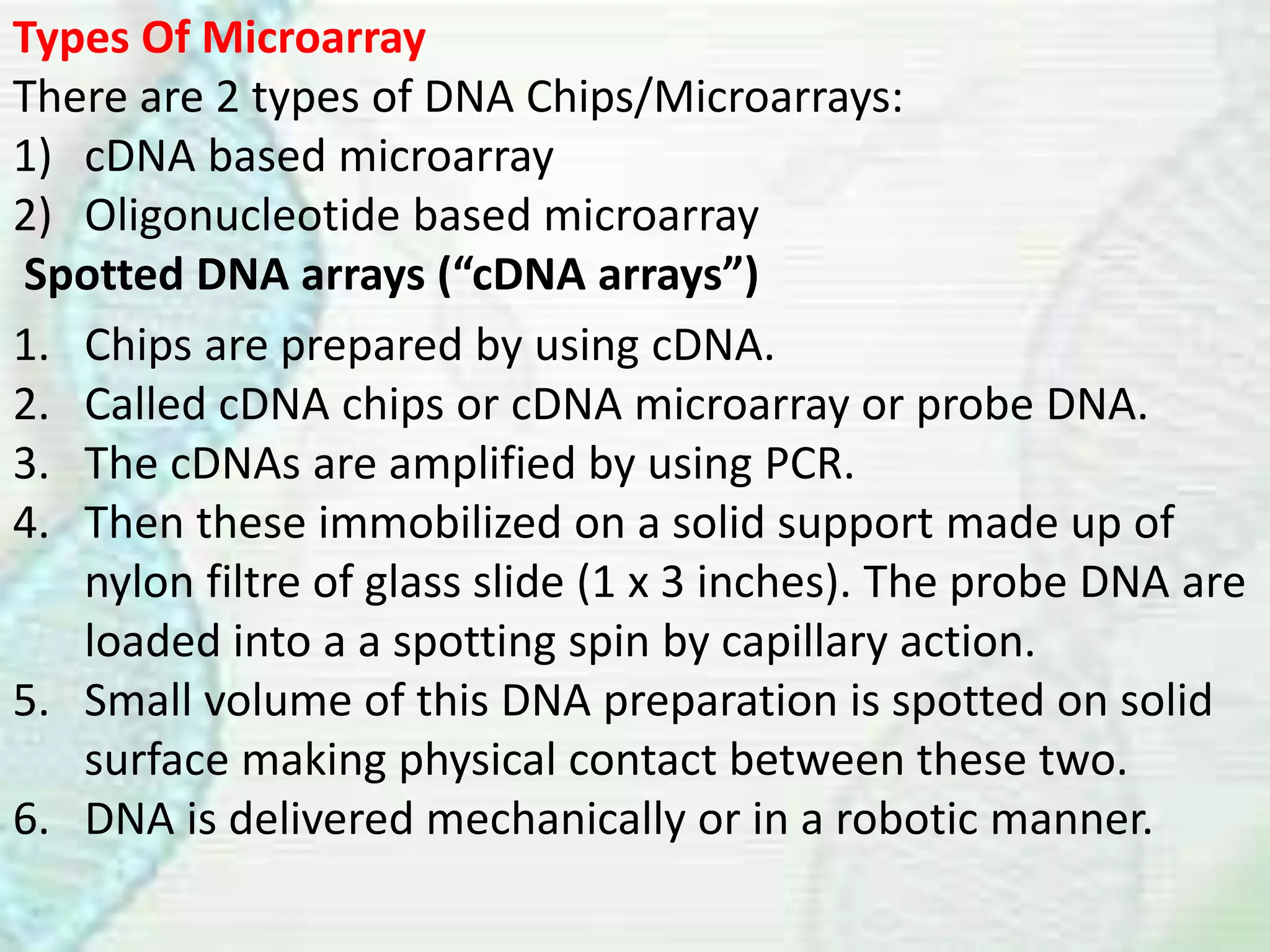
Types Of Microarray
There are 2 types of DNA Chips/Microarrays:
1) cDNA based microarray
2) Oligonucleotide based microarray
Spotted DNA arrays (“cDNA arrays”)
1. Chips are prepared by using cDNA.
2. Called cDNA chips or cDNA microarray or probe DNA.
3. The cDNAs are amplified by using PCR.
4. Then these immobilized on a solid support made up of
nylon filtre of glass slide (1 x 3 inches). The probe DNA are
loaded into a a spotting spin by capillary action.
5. Small volume of this DNA preparation is spotted on solid
surface making physical contact between these two.
6. DNA is delivered mechanically or in a robotic manner.
Oligonucleotide arrays (Gene Chips)
1. In oligonucleotide microarrays, short DNA oligonucleotides
are spotted onto the array.
2. Small number of 20-25mers/gene.
3. The main feature of oligonucleotide microarray is that each
gene is normally represented by more than one probe.
4. Enabled by photolithography from the computer industry
Off the shelf
Requirements of DNA Microarray Technique
here are certain requirements for designing a DNA
microarray system, viz:
1. DNA Chip
2. Target sample (Fluorescently labelled)
3. Fluorescent dyes
4. Probes
5. Scanner
PROCEDURE
Collection of samples
• The sample may be a cell/tissue of the
organism that we wish to conduct the study on.
•Two types of samples are collected: healthy cells
and infected cells, for comparison and to obtain
the results.
Isolation of mRNA
•RNA is extracted from the sample using a
column or solvent like phenol-chloroform.
•From the extracted RNA, mRNA is separated
leaving behind rRNA and tRNA.
•As mRNA has a poly-A tail, column beads with
poly-T-tails are used to bind mRNA.
•After the extraction, the column is rinsed with
buffer to isolate mRNA from the beads.
Creation of labeled cDNA
To create cDNA (complementary DNA strand), reverse
transcription of the mRNA is done.
Both the samples are then incorporated with different
fluorescent dyes for producing fluorescent cDNA strands.
This helps in distinguishing the sample category of the
cDNAs.
Hybridization
The labeled cDNAs from both the samples are placed in
the DNA microarray so that each cDNA gets hybridized to its
complementary strand; they are also thoroughly washed to
remove unbounded sequences.
Collection and analysis
•The collection of data is done by using a
microarray scanner.
•This scanner consists of a laser, a computer, and
a camera. The laser excites fluorescence of the
cDNA, generating signals.
•When the laser scans the array, the camera
records the images produced.
•Then the computer stores the data and provides
the results immediately. The data thus produced
are then analyzed.
•The difference in the intensity of the colors for
each spot determines the character of the gene
in that particular spot.
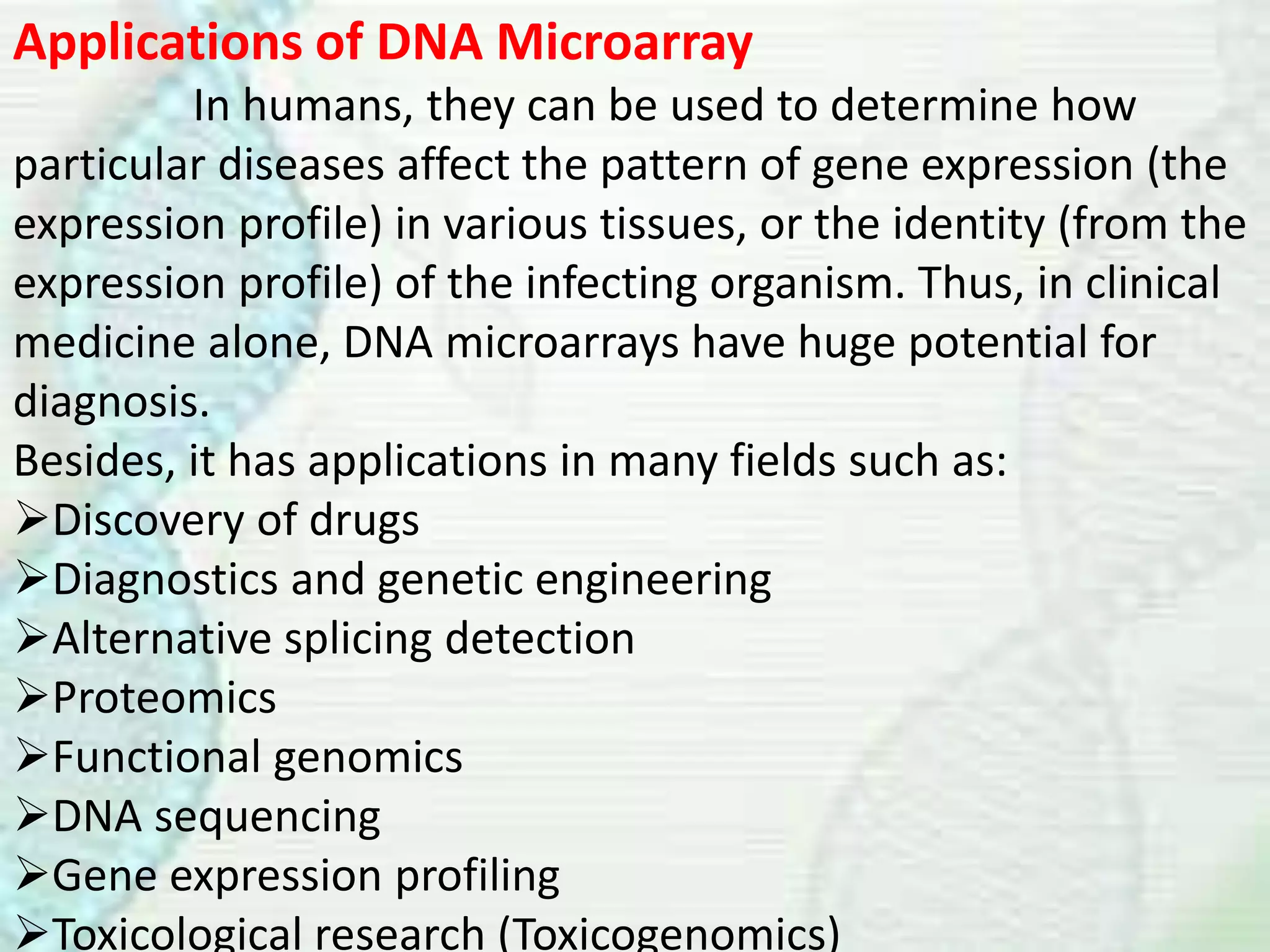
Applications of DNA Microarray
In humans, they can be used to determine how
particular diseases affect the pattern of gene expression (the
expression profile) in various tissues, or the identity (from the
expression profile) of the infecting organism. Thus, in clinical
medicine alone, DNA microarrays have huge potential for
diagnosis.
Besides, it has applications in many fields such as:
Discovery of drugs
Diagnostics and genetic engineering
Alternative splicing detection
Proteomics
Functional genomics
DNA sequencing
Gene expression profiling
Toxicological research (Toxicogenomics)
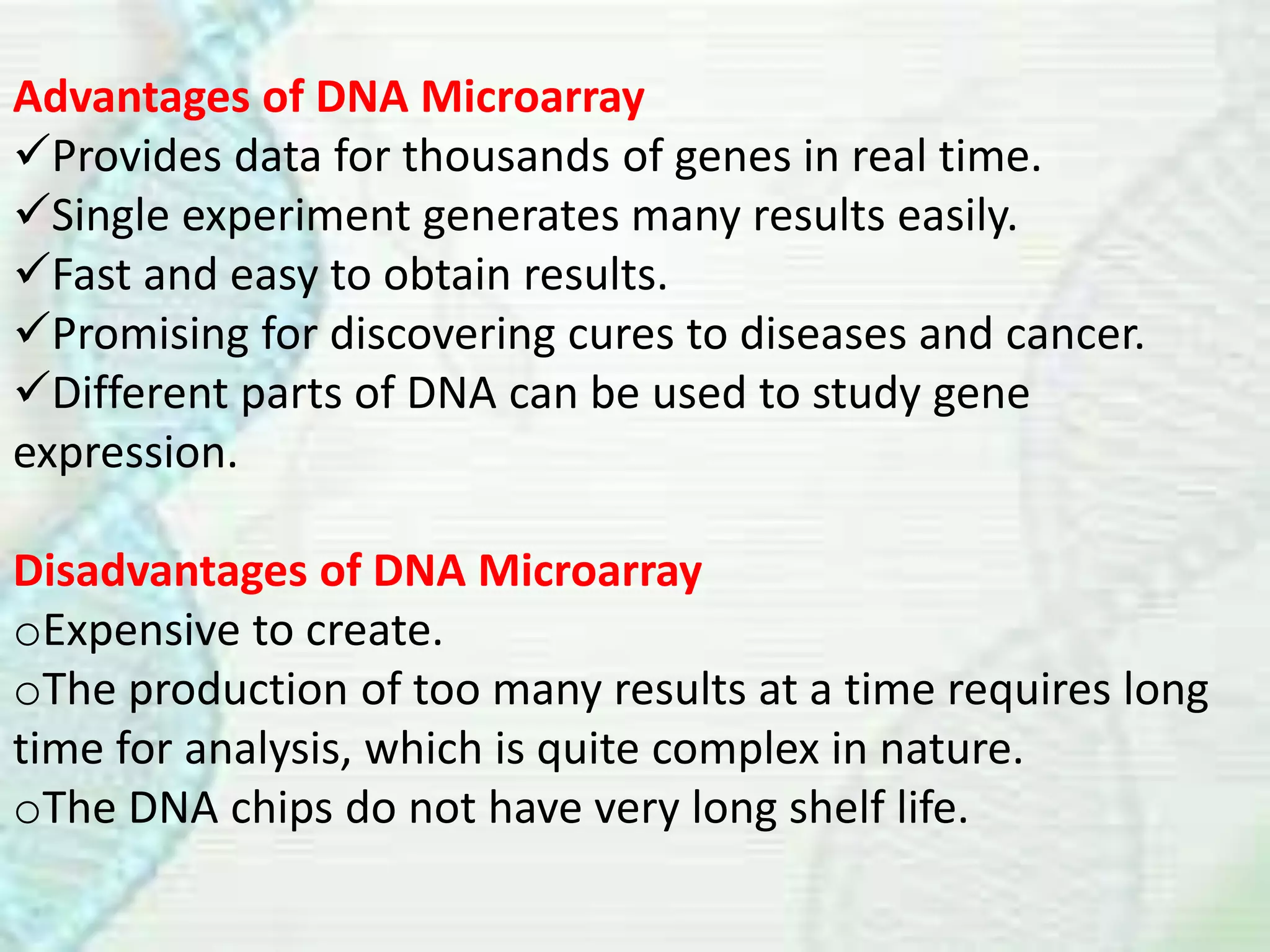
Advantages of DNA Microarray
Provides data for thousands of genes in real time.
Single experiment generates many results easily.
Fast and easy to obtain results.
Promising for discovering cures to diseases and cancer.
Different parts of DNA can be used to study gene
expression.
Disadvantages of DNA Microarray
oExpensive to create.
oThe production of too many results at a time requires long
time for analysis, which is quite complex in nature.
oThe DNA chips do not have very long shelf life.
THANK YOU…

DNA microarray

  • 1.
  • 2.
    DNA MICROARRAY DNA microarraysare solid supports, usually of glass or silicon, upon which DNA is attached in an organized pre-determined grid fashion. Each spot of DNA, called a probe, represents a single gene. DNA microarrays can analyze the expression of tens of thousands of genes simultaneously. There are several synonyms of DNA microarrays such as DNA chips, gene chips, DNA arrays, gene arrays, and biochips.
  • 3.
    PRINCIPLE  The principleof DNA microarrays lies on the hybridization between the nucleic acid strands.  The property of complementary nucleic acid sequences is to specifically pair with each other by forming hydrogen bonds between complementary nucleotide base pairs.  For this, samples are labeled using fluorescent dyes. At least two samples are hybridized to chip.  Complementary nucleic acid sequences between the sample and the probe attached on the chip get paired via hydrogen bonds.
  • 4.
     The non-specificbonding sequences while remain unattached and washed out during the washing step of the process.  Fluorescently labeled target sequences that bind to a probe sequence generate a signal.  The signal depends on the hybridization conditions (ex: temperature), washing after hybridization etc while the total strength of the signal, depends upon the amount of target sample present.  Using this technology the presence of one genomic or cDNA sequence in 1,00,000 or more sequences can be screened in a single hybridization.
  • 6.
    Types Of Microarray Thereare 2 types of DNA Chips/Microarrays: 1) cDNA based microarray 2) Oligonucleotide based microarray Spotted DNA arrays (“cDNA arrays”) 1. Chips are prepared by using cDNA. 2. Called cDNA chips or cDNA microarray or probe DNA. 3. The cDNAs are amplified by using PCR. 4. Then these immobilized on a solid support made up of nylon filtre of glass slide (1 x 3 inches). The probe DNA are loaded into a a spotting spin by capillary action. 5. Small volume of this DNA preparation is spotted on solid surface making physical contact between these two. 6. DNA is delivered mechanically or in a robotic manner.
  • 7.
    Oligonucleotide arrays (GeneChips) 1. In oligonucleotide microarrays, short DNA oligonucleotides are spotted onto the array. 2. Small number of 20-25mers/gene. 3. The main feature of oligonucleotide microarray is that each gene is normally represented by more than one probe. 4. Enabled by photolithography from the computer industry Off the shelf Requirements of DNA Microarray Technique here are certain requirements for designing a DNA microarray system, viz: 1. DNA Chip 2. Target sample (Fluorescently labelled) 3. Fluorescent dyes 4. Probes 5. Scanner
  • 8.
    PROCEDURE Collection of samples •The sample may be a cell/tissue of the organism that we wish to conduct the study on. •Two types of samples are collected: healthy cells and infected cells, for comparison and to obtain the results. Isolation of mRNA •RNA is extracted from the sample using a column or solvent like phenol-chloroform. •From the extracted RNA, mRNA is separated leaving behind rRNA and tRNA. •As mRNA has a poly-A tail, column beads with poly-T-tails are used to bind mRNA. •After the extraction, the column is rinsed with buffer to isolate mRNA from the beads.
  • 9.
    Creation of labeledcDNA To create cDNA (complementary DNA strand), reverse transcription of the mRNA is done. Both the samples are then incorporated with different fluorescent dyes for producing fluorescent cDNA strands. This helps in distinguishing the sample category of the cDNAs. Hybridization The labeled cDNAs from both the samples are placed in the DNA microarray so that each cDNA gets hybridized to its complementary strand; they are also thoroughly washed to remove unbounded sequences.
  • 10.
    Collection and analysis •Thecollection of data is done by using a microarray scanner. •This scanner consists of a laser, a computer, and a camera. The laser excites fluorescence of the cDNA, generating signals. •When the laser scans the array, the camera records the images produced. •Then the computer stores the data and provides the results immediately. The data thus produced are then analyzed. •The difference in the intensity of the colors for each spot determines the character of the gene in that particular spot.
  • 11.
    Applications of DNAMicroarray In humans, they can be used to determine how particular diseases affect the pattern of gene expression (the expression profile) in various tissues, or the identity (from the expression profile) of the infecting organism. Thus, in clinical medicine alone, DNA microarrays have huge potential for diagnosis. Besides, it has applications in many fields such as: Discovery of drugs Diagnostics and genetic engineering Alternative splicing detection Proteomics Functional genomics DNA sequencing Gene expression profiling Toxicological research (Toxicogenomics)
  • 12.
    Advantages of DNAMicroarray Provides data for thousands of genes in real time. Single experiment generates many results easily. Fast and easy to obtain results. Promising for discovering cures to diseases and cancer. Different parts of DNA can be used to study gene expression. Disadvantages of DNA Microarray oExpensive to create. oThe production of too many results at a time requires long time for analysis, which is quite complex in nature. oThe DNA chips do not have very long shelf life.
  • 13.