Practical Immunology
Lab 2
Enzyme-Linked
Immunosorbent Assay
By:
Lecturer Shaima’a Al-
Salihy
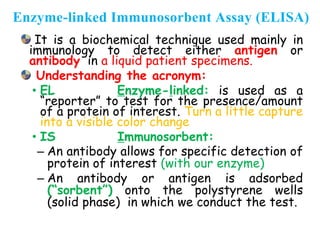
It is a biochemical technique used mainly in
immunology to detect either antigen or
antibody in a liquid patient specimens.
Understanding the acronym:
• EL Enzyme-linked: is used as a
“reporter” to test for the presence/amount
of a protein of interest. Turn a little capture
into a visible color change
• IS Immunosorbent:
– An antibody allows for specific detection of
protein of interest (with our enzyme)
– An antibody or antigen is adsorbed
(“sorbent”) onto the polystyrene wells
(solid phase) in which we conduct the test.
Enzyme-linked Immunosorbent Assay (ELISA)
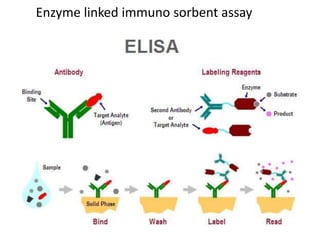
Enzyme linked immuno sorbent assay
3
Enzyme-linked Immunosorbent Assay (ELISA)
- Principle: It is based on covalently linkage of an enzyme to an
antibody. Enzyme-linked antibody detects the protein of
interest and reacts with a chromogenic (colorless) substrate
to generate a colored reaction product.
- Uses: it is used for
1. Measuring antibody levels (allergies, vaccines)
2. Detection of viruses (hepatitis, HIV, venereal diseases)
3. Detection of hormonal changes (pregnancy)
4. Detection of circulatory inflammatory markers (cytokines)
• This method can be divided to:
1- Direct ELISA
2. Indirect ELISA
3. Sandwich (antigen-capture) ELISA
4. Competitive ELISA
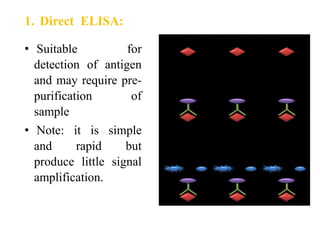
1. Direct ELISA:
• Suitable for
detection of antigen
and may require pre-
purification of
sample
• Note: it is simple
and rapid but
produce little signal
amplification.
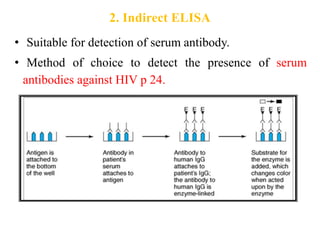
2. Indirect ELISA
• Suitable for detection of serum antibody.
• Method of choice to detect the presence of serum
antibodies against HIV p 24.
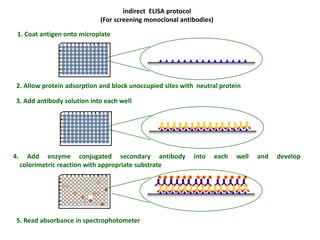
indirect ELISA protocol
(For screening monoclonal antibodies)
1. Coat antigen onto microplate
2. Allow protein adsorption and block unoccupied sites with neutral protein
3. Add antibody solution into each well
4. Add enzyme conjugated secondary antibody into each well and develop
colorimetric reaction with appropriate substrate
5. Read absorbance in spectrophotometer
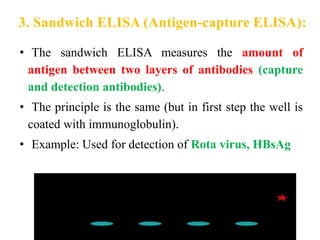
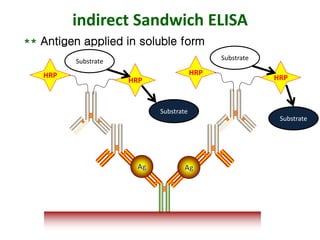
3. Sandwich ELISA (Antigen-capture ELISA):
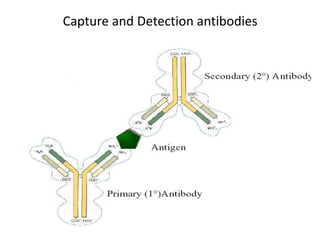
• The sandwich ELISA measures the amount of
antigen between two layers of antibodies (capture
and detection antibodies).
• The principle is the same (but in first step the well is
coated with immunoglobulin).
• Example: Used for detection of Rota virus, HBsAg
Capture and Detection antibodies
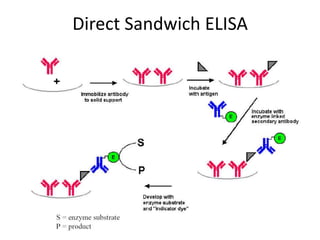
Direct Sandwich ELISA
indirect Sandwich ELISA
** Antigen applied in soluble form
HRP
HRP HRP
HRP
Substrate
Substrate
Substrate
Substrate
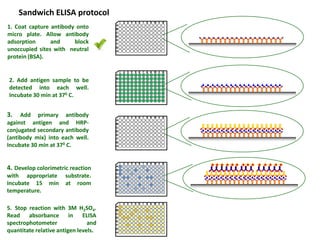
Sandwich ELISA protocol
1. Coat capture antibody onto
micro plate. Allow antibody
adsorption and block
unoccupied sites with neutral
protein (BSA).
2. Add antigen sample to be
detected into each well.
Incubate 30 min at 370 C.
4. Develop colorimetric reaction
with appropriate substrate.
Incubate 15 min at room
temperature.
5. Stop reaction with 3M H2SO4.
Read absorbance in ELISA
spectrophotometer and
quantitate relative antigen levels.
3. Add primary antibody
against antigen and HRP-
conjugated secondary antibody
(antibody mix) into each well.
Incubate 30 min at 370 C.
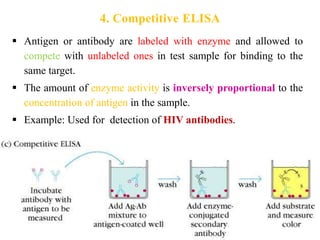
4. Competitive ELISA
 Antigen or antibody are labeled with enzyme and allowed to
compete with unlabeled ones in test sample for binding to the
same target.
 The amount of enzyme activity is inversely proportional to the
concentration of antigen in the sample.
 Example: Used for detection of HIV antibodies.
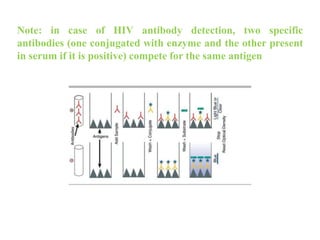
Note: in case of HIV antibody detection, two specific
antibodies (one conjugated with enzyme and the other present
in serum if it is positive) compete for the same antigen
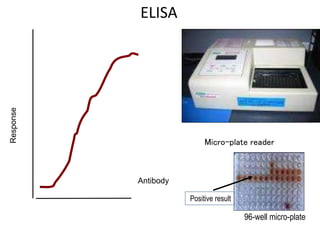
ELISA
Micro-plate reader
96-well micro-plate
Positive result
Ag Ag
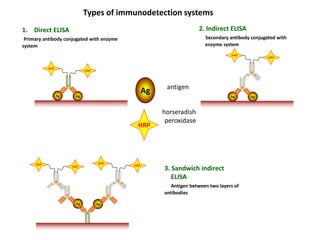
Types of immunodetection systems
1. Direct ELISA
Primary antibody conjugated with enzyme
system
2. Indirect ELISA
Secondary antibody conjugated with
enzyme system
3. Sandwich indirect
ELISA
Antigen between two layers of
antibodies
Ag Ag Ag
Ag
HRP
HRP
HRP
HRP HRP
HRP
HRP
HRP
HRP
horseradish
peroxidase
antigen
Ag
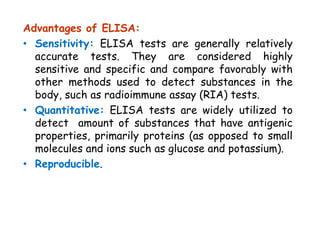
Advantages of ELISA:
• Sensitivity: ELISA tests are generally relatively
accurate tests. They are considered highly
sensitive and specific and compare favorably with
other methods used to detect substances in the
body, such as radioimmune assay (RIA) tests.
• Quantitative: ELISA tests are widely utilized to
detect amount of substances that have antigenic
properties, primarily proteins (as opposed to small
molecules and ions such as glucose and potassium).
• Reproducible.
Limitations:
– Expensive initial investment
– Variable sensitivity / specificity of variable
tests
– Cross contamination
Questions?
Enzyme-Linked Immunosorbent Assay.pptx

Enzyme-Linked Immunosorbent Assay.pptx

  • 1.
    Practical Immunology Lab 2 Enzyme-Linked ImmunosorbentAssay By: Lecturer Shaima’a Al- Salihy
  • 2.
    It is abiochemical technique used mainly in immunology to detect either antigen or antibody in a liquid patient specimens. Understanding the acronym: • EL Enzyme-linked: is used as a “reporter” to test for the presence/amount of a protein of interest. Turn a little capture into a visible color change • IS Immunosorbent: – An antibody allows for specific detection of protein of interest (with our enzyme) – An antibody or antigen is adsorbed (“sorbent”) onto the polystyrene wells (solid phase) in which we conduct the test. Enzyme-linked Immunosorbent Assay (ELISA)
  • 3.
    Enzyme linked immunosorbent assay 3
  • 4.
    Enzyme-linked Immunosorbent Assay(ELISA) - Principle: It is based on covalently linkage of an enzyme to an antibody. Enzyme-linked antibody detects the protein of interest and reacts with a chromogenic (colorless) substrate to generate a colored reaction product. - Uses: it is used for 1. Measuring antibody levels (allergies, vaccines) 2. Detection of viruses (hepatitis, HIV, venereal diseases) 3. Detection of hormonal changes (pregnancy) 4. Detection of circulatory inflammatory markers (cytokines)
  • 5.
    • This methodcan be divided to: 1- Direct ELISA 2. Indirect ELISA 3. Sandwich (antigen-capture) ELISA 4. Competitive ELISA
  • 6.
    1. Direct ELISA: •Suitable for detection of antigen and may require pre- purification of sample • Note: it is simple and rapid but produce little signal amplification.
  • 7.
    2. Indirect ELISA •Suitable for detection of serum antibody. • Method of choice to detect the presence of serum antibodies against HIV p 24.
  • 8.
    indirect ELISA protocol (Forscreening monoclonal antibodies) 1. Coat antigen onto microplate 2. Allow protein adsorption and block unoccupied sites with neutral protein 3. Add antibody solution into each well 4. Add enzyme conjugated secondary antibody into each well and develop colorimetric reaction with appropriate substrate 5. Read absorbance in spectrophotometer
  • 9.
    3. Sandwich ELISA(Antigen-capture ELISA): • The sandwich ELISA measures the amount of antigen between two layers of antibodies (capture and detection antibodies). • The principle is the same (but in first step the well is coated with immunoglobulin). • Example: Used for detection of Rota virus, HBsAg
  • 10.
  • 11.
  • 12.
    indirect Sandwich ELISA **Antigen applied in soluble form HRP HRP HRP HRP Substrate Substrate Substrate Substrate
  • 13.
    Sandwich ELISA protocol 1.Coat capture antibody onto micro plate. Allow antibody adsorption and block unoccupied sites with neutral protein (BSA). 2. Add antigen sample to be detected into each well. Incubate 30 min at 370 C. 4. Develop colorimetric reaction with appropriate substrate. Incubate 15 min at room temperature. 5. Stop reaction with 3M H2SO4. Read absorbance in ELISA spectrophotometer and quantitate relative antigen levels. 3. Add primary antibody against antigen and HRP- conjugated secondary antibody (antibody mix) into each well. Incubate 30 min at 370 C.
  • 14.
    4. Competitive ELISA Antigen or antibody are labeled with enzyme and allowed to compete with unlabeled ones in test sample for binding to the same target.  The amount of enzyme activity is inversely proportional to the concentration of antigen in the sample.  Example: Used for detection of HIV antibodies.
  • 15.
    Note: in caseof HIV antibody detection, two specific antibodies (one conjugated with enzyme and the other present in serum if it is positive) compete for the same antigen
  • 16.
  • 17.
    Ag Ag Types ofimmunodetection systems 1. Direct ELISA Primary antibody conjugated with enzyme system 2. Indirect ELISA Secondary antibody conjugated with enzyme system 3. Sandwich indirect ELISA Antigen between two layers of antibodies Ag Ag Ag Ag HRP HRP HRP HRP HRP HRP HRP HRP HRP horseradish peroxidase antigen Ag
  • 18.
    Advantages of ELISA: •Sensitivity: ELISA tests are generally relatively accurate tests. They are considered highly sensitive and specific and compare favorably with other methods used to detect substances in the body, such as radioimmune assay (RIA) tests. • Quantitative: ELISA tests are widely utilized to detect amount of substances that have antigenic properties, primarily proteins (as opposed to small molecules and ions such as glucose and potassium). • Reproducible.
  • 19.
    Limitations: – Expensive initialinvestment – Variable sensitivity / specificity of variable tests – Cross contamination
  • 20.