M.PRASAD NAIDU
Msc Medical Biochemistry,
Ph.D Research scholar.
Explain in your own words, what is DNA?
1. DNA is deoxyribonucleicantidisestablishmentarianism, a
complex string of syllables found inside your body in tiny
genes called chromosomes.
2. The information in your DNA determines your unique
biological characteristics, such as eye color, Social Security
number, and age. There is surprisingly little difference
between DNA in humans, Democrats, and Republicans.
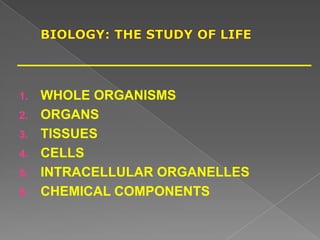
1. WHOLE ORGANISMS
2. ORGANS
3. TISSUES
4. CELLS
5. INTRACELLULAR ORGANELLES
6. CHEMICAL COMPONENTS
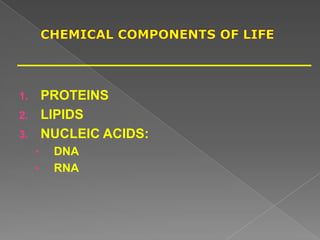
1. PROTEINS
2. LIPIDS
3. NUCLEIC ACIDS:
• DNA
• RNA
Molecular biology techniques utilize
DNA, RNA, and enzymes that
interact with nucleic acids to
understand biology at a molecular
level.
Molecular Pathology is a subspecialty of
pathology that utilizes molecular biology
techniques to:
Detect normal and disease states
(diagnosis)
Predict disease progression (prognosis)
INHERITED DISEASES (GENETICS)
› Cystic fibrosis
› Sickle cell anemia
› Predispositions to cancer
INFECTIOUS DISEASES
› Bacteria
› Viruses
› Fungi
HEMATOPATHOLOGY
› Leukemias
› Lymphomas
SOLID TUMORS
› Breast cancer
› Colon cancer
› Brain cancer
FORENSICS
IDENTITY TESTING
› HLA
› parentage
 Genetic material of all known organisms
 DNA: deoxyribonucleic acid
 RNA: ribonucleic acid (e.g., some viruses)
 Consist of chemically linked sequences of
nucleotides
 Nitrogenous base
 Pentose- 5-carbon sugar (ribose or
deoxyribose)
 Phosphate group
 The sequence of bases provides the genetic
information
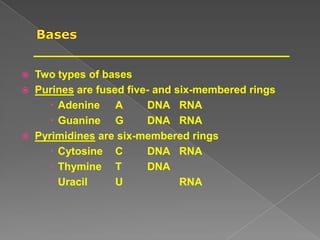
 Two types of bases
 Purines are fused five- and six-membered rings
 Adenine A DNA RNA
 Guanine G DNA RNA
 Pyrimidines are six-membered rings
 Cytosine C DNA RNA
 Thymine T DNA
 Uracil U RNA
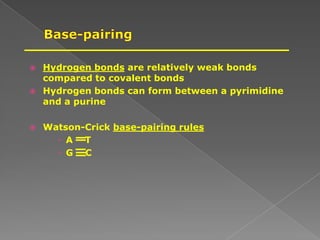
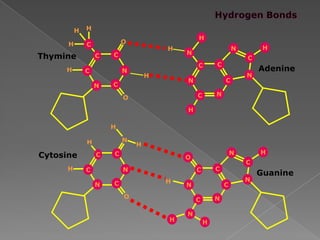
 Hydrogen bonds are relatively weak bonds
compared to covalent bonds
 Hydrogen bonds can form between a pyrimidine
and a purine
 Watson-Crick base-pairing rules
 A T
 G C
H
H
H H
O
O
H
C
C
C C
N
N
C
Thymine
H
N
H
H
N
C C
C
C
N
N H
N
C
Adenine
H
O
N
H C
C C
N
N
C
Cytosine
H
H
H
N
C C
C
C
N
N H
N
C
Guanine
N
H
O
H
5’ 5’
3’
3’
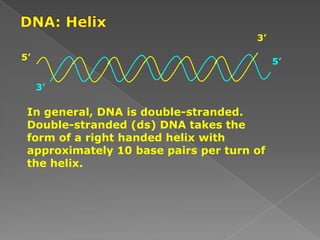
In general, DNA is double-stranded.
Double-stranded (ds) DNA takes the
form of a right handed helix with
approximately 10 base pairs per turn of
the helix.
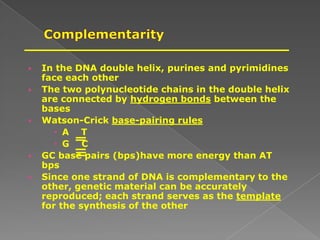
 In the DNA double helix, purines and pyrimidines
face each other
 The two polynucleotide chains in the double helix
are connected by hydrogen bonds between the
bases
 Watson-Crick base-pairing rules
 A T
 G C
 GC base pairs (bps)have more energy than AT
bps
 Since one strand of DNA is complementary to the
other, genetic material can be accurately
reproduced; each strand serves as the template
for the synthesis of the other
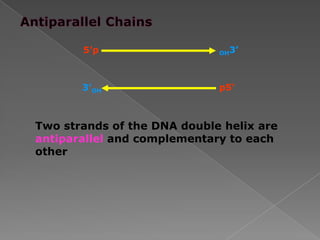
5’p OH3’
3’OH p5’
Two strands of the DNA double helix are
antiparallel and complementary to each
other
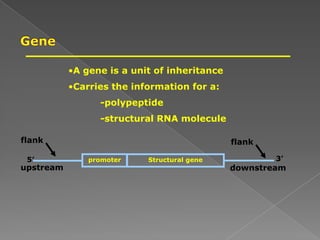
promoter Structural gene
flank flank
upstream downstream
5’ 3’
•A gene is a unit of inheritance
•Carries the information for a:
-polypeptide
-structural RNA molecule
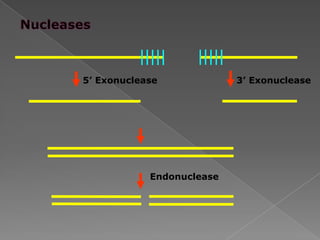
Endonuclease
5’ Exonuclease 3’ Exonuclease
 Specific endonucleases
 Recognize specific short sequences of DNA and
cleave the DNA at or near the recognition
sequence
 Recognition sequences: usually 4 or 6 bases but
there are some that are 5, 8, or longer
 Recognition sequences are palindromes
 Palindrome: sequence of DNA that is the same
when one strand is read from left to right or the
other strand is read from right to left– consists of
adjacent inverted repeats
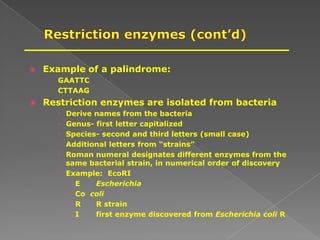
 Example of a palindrome:
GAATTC
CTTAAG
 Restriction enzymes are isolated from bacteria
 Derive names from the bacteria
 Genus- first letter capitalized
 Species- second and third letters (small case)
 Additional letters from “strains”
 Roman numeral designates different enzymes from the
same bacterial strain, in numerical order of discovery
 Example: EcoRI
 E Escherichia
 Co coli
 R R strain
 I first enzyme discovered from Escherichia coli R
 Nucleic acid hybridization is the formation of a
duplex between two complementary sequences
 Intermolecular hybridization: between two
polynucleotide chains which have complementary
bases
› DNA-DNA
› DNA-RNA
› RNA-RNA
 Annealing is another term used to describe the
hybridization of two complementary molecules
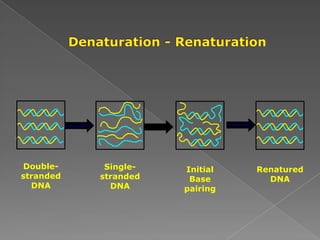
Double-
stranded
DNA
Denaturation
Single-
stranded
DNA
Initial
Base
pairing
Renatured
DNA
Renaturation
 Probe is a nucleic acid that
› can be labeled with a marker which allows
identification and quantitation
› will hybridize to another nucleic acid on the basis of
base complementarity
 Types of labels
› Radioactive (32P, 35S, 14C, 3H)
› Fluorescent
 FISH: fluorescent in situ hybridization
 chromosomes
› Biotinylated (avidin-streptavidin)
 Solid support hybridization: DNA or RNA is
immobilized on an inert support so that self-
annealing is prevented
 Bound sequences are available for hybridization
with an added nucleic acid (probe).
 Filter hybridization is the most common
application:
 Southern Blots
 Dot/Slot Blots
 Northern Blots
 In-silica hybridization (glass slides)
 in situ hybridization (tissue)
 Chromosomal (FISH)
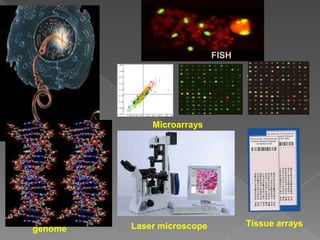
 Microarrays
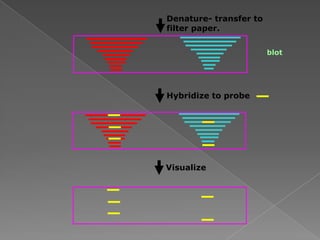
 Southern blotting is a procedure for transferring
denatured DNA from an agarose gel to a solid
support filter where it can be hybridized with a
complementary nucleic acid probe
 The DNA is separated by size so that specific
fragments can be identified
 Procedure:
› Restriction digest to make different sized fragments
› Agarose gel electrophoresis to separate by size
› Since only single strands bind to the filter, the DNA
must be denatured.
› Denaturation to permit binding to the filter (NaOH)
› Transfer to filter paper (capillary flow)
› Hybridization to probe
› Visualization of probe
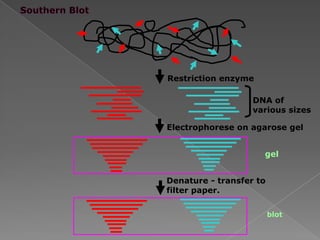
Restriction enzyme
DNA of
various sizes
Electrophorese on agarose gel
gel
Denature - transfer to
filter paper.
blot
Hybridize to probe
Visualize
Denature- transfer to
filter paper.
blot
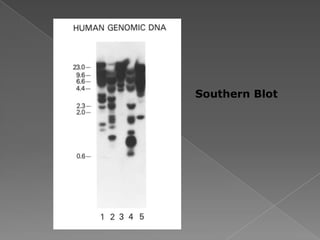
Southern Blot
 DNA or RNA is bound directly to a solid support
filter
 No size separation
 Ideal for multiple samples and quantitative
measurements
 Important to establish specificity of conditions
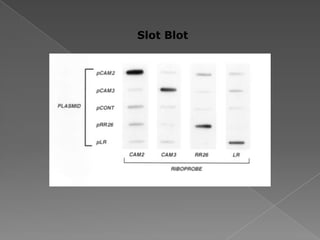
Slot Blot
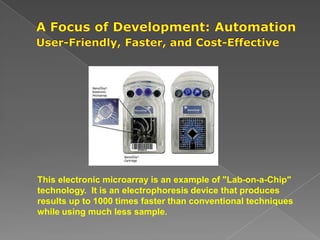
This electronic microarray is an example of "Lab-on-a-Chip"
technology. It is an electrophoresis device that produces
results up to 1000 times faster than conventional techniques
while using much less sample.
Control Signals
Region-Specific Signal
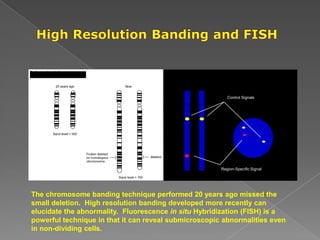
The chromosome banding technique performed 20 years ago missed the
small deletion. High resolution banding developed more recently can
elucidate the abnormality. Fluorescence in situ Hybridization (FISH) is a
powerful technique in that it can reveal submicroscopic abnormalities even
in non-dividing cells.
 PCR is the in vitro enzymatic
synthesis and amplification of
specific DNA sequences
 Can amplify one molecule of DNA
into billions of copies in a few
hours
 Detection of chromosomal translocations
› Amplification across a translocation sequence
 Chromosome painting
 Detection of residual disease
 Infectious disease
 Forensics
 HLA typing
 Detection of Loss of Suppressor Genes
› Loss of Heterozygosity (LOH)
 Genome: The entire DNA of an organism
› Humans
 diploid (chromosome pairs)
 6 x 10⁹ bp per diploid genome
 Haploid genome is one set of chromosomes
 Chromosome: structure found within a cell
nucleus consisting of a continuous length of ds
DNA
› Humans
 22 pairs of autosomal chromosomes
 2 sex chromosomes
40,000 genes
Speaking a language of molecular
fingerprints
Gene expression is another
language of complexity
 Locus: a position on a
chromosome
 Allele: alternate form of DNA at a
specific locus on the chromosome
 Each individual inherits two copies
of DNA
 Maternal
 Paternal
 Homozygous alleles: the two copies
are identical
 Heterozygous alleles: the two copies
are different
 RFLP is a polymorphic allele identified by the
presence or absence of a specific restriction
endonuclease recognition site:
› GAATTC versus GATTTC
 RFLP is usually identified by digestion of genomic
DNA with specific restriction enzymes followed
by Southern blotting
 Regions of DNA with polymorphisms:
› Introns
› Flanking sequences
› Exons
 Most genes have small sequence
differences between individuals
 Occur every 1350 bp on average
 Some of these polymorphisms may affect:
 How well the protein works
 How the protein interacts with another protein
or substrate
 The different gene forms containing
polymorphisms are called alleles
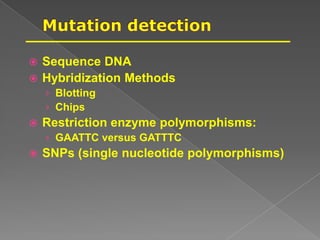
 Sequence DNA
 Hybridization Methods
› Blotting
› Chips
 Restriction enzyme polymorphisms:
› GAATTC versus GATTTC
 SNPs (single nucleotide polymorphisms)
Single nucleotide polymorphisms
Distinction from mutations
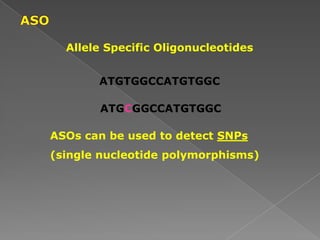
Allele Specific Oligonucleotides
ATGTGGCCATGTGGC
ATGCGGCCATGTGGC
ASOs can be used to detect SNPs
(single nucleotide polymorphisms)
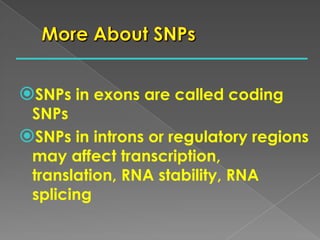
SNPs in exons are called coding
SNPs
SNPs in introns or regulatory regions
may affect transcription,
translation, RNA stability, RNA
splicing
Cytochrome P450
Uptake and metabolsim of drugs
Seizure disorders
Psychiatric disorders
Cancer therapy
aRA
r = 0.91
log10(ratio),T3-3
Microarrays
FISH
Laser microscopegenome
Tissue arrays
Molecular biology tecniques

Molecular biology tecniques

  • 1.
    M.PRASAD NAIDU Msc MedicalBiochemistry, Ph.D Research scholar.
  • 2.
    Explain in yourown words, what is DNA? 1. DNA is deoxyribonucleicantidisestablishmentarianism, a complex string of syllables found inside your body in tiny genes called chromosomes. 2. The information in your DNA determines your unique biological characteristics, such as eye color, Social Security number, and age. There is surprisingly little difference between DNA in humans, Democrats, and Republicans.
  • 4.
    1. WHOLE ORGANISMS 2.ORGANS 3. TISSUES 4. CELLS 5. INTRACELLULAR ORGANELLES 6. CHEMICAL COMPONENTS
  • 5.
    1. PROTEINS 2. LIPIDS 3.NUCLEIC ACIDS: • DNA • RNA
  • 6.
    Molecular biology techniquesutilize DNA, RNA, and enzymes that interact with nucleic acids to understand biology at a molecular level.
  • 7.
    Molecular Pathology isa subspecialty of pathology that utilizes molecular biology techniques to: Detect normal and disease states (diagnosis) Predict disease progression (prognosis)
  • 8.
    INHERITED DISEASES (GENETICS) ›Cystic fibrosis › Sickle cell anemia › Predispositions to cancer INFECTIOUS DISEASES › Bacteria › Viruses › Fungi
  • 9.
    HEMATOPATHOLOGY › Leukemias › Lymphomas SOLIDTUMORS › Breast cancer › Colon cancer › Brain cancer
  • 10.
  • 11.
     Genetic materialof all known organisms  DNA: deoxyribonucleic acid  RNA: ribonucleic acid (e.g., some viruses)  Consist of chemically linked sequences of nucleotides  Nitrogenous base  Pentose- 5-carbon sugar (ribose or deoxyribose)  Phosphate group  The sequence of bases provides the genetic information
  • 12.
     Two typesof bases  Purines are fused five- and six-membered rings  Adenine A DNA RNA  Guanine G DNA RNA  Pyrimidines are six-membered rings  Cytosine C DNA RNA  Thymine T DNA  Uracil U RNA
  • 13.
     Hydrogen bondsare relatively weak bonds compared to covalent bonds  Hydrogen bonds can form between a pyrimidine and a purine  Watson-Crick base-pairing rules  A T  G C
  • 14.
    H H H H O O H C C C C N N C Thymine H N H H N CC C C N N H N C Adenine H O N H C C C N N C Cytosine H H H N C C C C N N H N C Guanine N H O H
  • 15.
    5’ 5’ 3’ 3’ In general,DNA is double-stranded. Double-stranded (ds) DNA takes the form of a right handed helix with approximately 10 base pairs per turn of the helix.
  • 16.
     In theDNA double helix, purines and pyrimidines face each other  The two polynucleotide chains in the double helix are connected by hydrogen bonds between the bases  Watson-Crick base-pairing rules  A T  G C  GC base pairs (bps)have more energy than AT bps  Since one strand of DNA is complementary to the other, genetic material can be accurately reproduced; each strand serves as the template for the synthesis of the other
  • 17.
    5’p OH3’ 3’OH p5’ Twostrands of the DNA double helix are antiparallel and complementary to each other
  • 18.
    promoter Structural gene flankflank upstream downstream 5’ 3’ •A gene is a unit of inheritance •Carries the information for a: -polypeptide -structural RNA molecule
  • 19.
  • 20.
     Specific endonucleases Recognize specific short sequences of DNA and cleave the DNA at or near the recognition sequence  Recognition sequences: usually 4 or 6 bases but there are some that are 5, 8, or longer  Recognition sequences are palindromes  Palindrome: sequence of DNA that is the same when one strand is read from left to right or the other strand is read from right to left– consists of adjacent inverted repeats
  • 21.
     Example ofa palindrome: GAATTC CTTAAG  Restriction enzymes are isolated from bacteria  Derive names from the bacteria  Genus- first letter capitalized  Species- second and third letters (small case)  Additional letters from “strains”  Roman numeral designates different enzymes from the same bacterial strain, in numerical order of discovery  Example: EcoRI  E Escherichia  Co coli  R R strain  I first enzyme discovered from Escherichia coli R
  • 22.
     Nucleic acidhybridization is the formation of a duplex between two complementary sequences  Intermolecular hybridization: between two polynucleotide chains which have complementary bases › DNA-DNA › DNA-RNA › RNA-RNA  Annealing is another term used to describe the hybridization of two complementary molecules
  • 23.
  • 24.
     Probe isa nucleic acid that › can be labeled with a marker which allows identification and quantitation › will hybridize to another nucleic acid on the basis of base complementarity  Types of labels › Radioactive (32P, 35S, 14C, 3H) › Fluorescent  FISH: fluorescent in situ hybridization  chromosomes › Biotinylated (avidin-streptavidin)
  • 25.
     Solid supporthybridization: DNA or RNA is immobilized on an inert support so that self- annealing is prevented  Bound sequences are available for hybridization with an added nucleic acid (probe).  Filter hybridization is the most common application:  Southern Blots  Dot/Slot Blots  Northern Blots  In-silica hybridization (glass slides)  in situ hybridization (tissue)  Chromosomal (FISH)  Microarrays
  • 26.
     Southern blottingis a procedure for transferring denatured DNA from an agarose gel to a solid support filter where it can be hybridized with a complementary nucleic acid probe  The DNA is separated by size so that specific fragments can be identified  Procedure: › Restriction digest to make different sized fragments › Agarose gel electrophoresis to separate by size › Since only single strands bind to the filter, the DNA must be denatured. › Denaturation to permit binding to the filter (NaOH) › Transfer to filter paper (capillary flow) › Hybridization to probe › Visualization of probe
  • 27.
    Restriction enzyme DNA of varioussizes Electrophorese on agarose gel gel Denature - transfer to filter paper. blot
  • 28.
    Hybridize to probe Visualize Denature-transfer to filter paper. blot
  • 29.
  • 30.
     DNA orRNA is bound directly to a solid support filter  No size separation  Ideal for multiple samples and quantitative measurements  Important to establish specificity of conditions
  • 31.
  • 32.
    This electronic microarrayis an example of "Lab-on-a-Chip" technology. It is an electrophoresis device that produces results up to 1000 times faster than conventional techniques while using much less sample.
  • 33.
    Control Signals Region-Specific Signal Thechromosome banding technique performed 20 years ago missed the small deletion. High resolution banding developed more recently can elucidate the abnormality. Fluorescence in situ Hybridization (FISH) is a powerful technique in that it can reveal submicroscopic abnormalities even in non-dividing cells.
  • 34.
     PCR isthe in vitro enzymatic synthesis and amplification of specific DNA sequences  Can amplify one molecule of DNA into billions of copies in a few hours
  • 35.
     Detection ofchromosomal translocations › Amplification across a translocation sequence  Chromosome painting  Detection of residual disease  Infectious disease  Forensics  HLA typing  Detection of Loss of Suppressor Genes › Loss of Heterozygosity (LOH)
  • 36.
     Genome: Theentire DNA of an organism › Humans  diploid (chromosome pairs)  6 x 10⁹ bp per diploid genome  Haploid genome is one set of chromosomes  Chromosome: structure found within a cell nucleus consisting of a continuous length of ds DNA › Humans  22 pairs of autosomal chromosomes  2 sex chromosomes
  • 37.
    40,000 genes Speaking alanguage of molecular fingerprints Gene expression is another language of complexity
  • 38.
     Locus: aposition on a chromosome  Allele: alternate form of DNA at a specific locus on the chromosome  Each individual inherits two copies of DNA  Maternal  Paternal  Homozygous alleles: the two copies are identical  Heterozygous alleles: the two copies are different
  • 39.
     RFLP isa polymorphic allele identified by the presence or absence of a specific restriction endonuclease recognition site: › GAATTC versus GATTTC  RFLP is usually identified by digestion of genomic DNA with specific restriction enzymes followed by Southern blotting  Regions of DNA with polymorphisms: › Introns › Flanking sequences › Exons
  • 40.
     Most geneshave small sequence differences between individuals  Occur every 1350 bp on average  Some of these polymorphisms may affect:  How well the protein works  How the protein interacts with another protein or substrate  The different gene forms containing polymorphisms are called alleles
  • 41.
     Sequence DNA Hybridization Methods › Blotting › Chips  Restriction enzyme polymorphisms: › GAATTC versus GATTTC  SNPs (single nucleotide polymorphisms)
  • 42.
  • 43.
    Allele Specific Oligonucleotides ATGTGGCCATGTGGC ATGCGGCCATGTGGC ASOscan be used to detect SNPs (single nucleotide polymorphisms)
  • 44.
    SNPs in exonsare called coding SNPs SNPs in introns or regulatory regions may affect transcription, translation, RNA stability, RNA splicing
  • 45.
    Cytochrome P450 Uptake andmetabolsim of drugs Seizure disorders Psychiatric disorders Cancer therapy
  • 46.