Gene Knockout animal models
Swetha Suresh (14MBT0025)
Rinu Mary Rajan (14MBT0007)
Gene Knockout
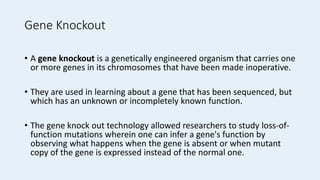
• A gene knockout is a genetically engineered organism that carries one
or more genes in its chromosomes that have been made inoperative.
• They are used in learning about a gene that has been sequenced, but
which has an unknown or incompletely known function.
• The gene knock out technology allowed researchers to study loss-of-
function mutations wherein one can infer a gene's function by
observing what happens when the gene is absent or when mutant
copy of the gene is expressed instead of the normal one.
Model Organisims
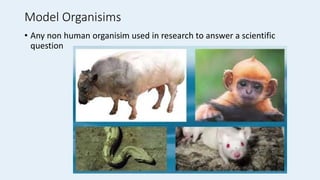
• Any non human organisim used in research to answer a scientific
question
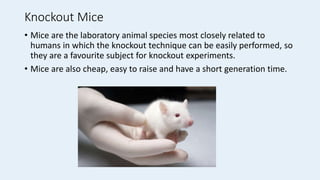
Knockout Mice
• Mice are the laboratory animal species most closely related to
humans in which the knockout technique can be easily performed, so
they are a favourite subject for knockout experiments.
• Mice are also cheap, easy to raise and have a short generation time.
Uses
• Knocking out the activity of a gene provides valuable information
about what that gene normally does.
• Humans share many genes with mice. Consequently, observing the
characteristics of knockout mice gives researchers information that
can be used to better understand how a similar gene may cause or
contribute to disease in humans.
• Examples of research in which knockout mice have been useful
include studying and modelling different kinds of cancer, obesity,
heart disease, diabetes, arthritis, substance abuse, anxiety, aging and
Parkinson disease.
Cont.
• Knockout mice also offer a biological context in which drugs and other
therapies can be developed and tested.
• Many of these mouse models are named after the gene that has been
inactivated. Examples:
o P53 knockout mouse is where the p53 gene, a tumour suppressor
gene is knocked out.
o "Methuselah" is a knockout mouse model noted for longevity
o "Frantic" is a model useful for studying anxiety disorders
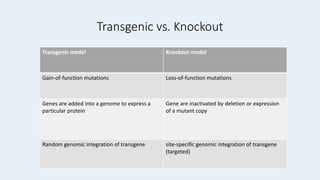
Transgenic vs. Knockout
Transgenic model Knockout model
Gain-of-function mutations Loss-of-function mutations
Genes are added into a genome to express a
particular protein
Gene are inactivated by deletion or expression
of a mutant copy
Random genomic integration of transgene site-specific genomic integration of transgene
(targeted)
Production of knockout mice
Depending upon method of insertion of artificial DNA into the
chromosome of ES cells, there are 2 methods to produce knockout
mouse in vitro:
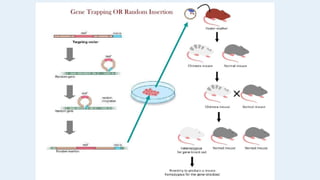
o Gene Targeting (Homologous Recombination)
o Gene Trapping
Which production method is best?
• Gene Targeting - Adv. - if the DNA sequence of the target gene is known,
researchers can precisely knock out the gene at a high rate of efficiency.
• Gene Trapping – Adv. - researchers do not need to know the DNA
sequences of specific genes in order to knock them out. Also, a single
Vector can be used to knock out various genes.
Disadv. - not every successful insertion of artificial DNA into a gene leads
to a loss of function. Also considerable time must be spent conducting tests
to identify ES cells in which gene(s) actually have been knocked out.
So Gene Targeting (by homologous recombination) is widely used.
Production of knockout mice (by Gene Targeting)
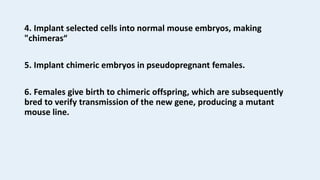
1. Harvesting of Embryonic stem cells from a mouse blastocyst.
2. Introducing the artificial DNA into the ES cells in the culture.
3. Screen ES cells and select those whose DNA includes the new
gene.
Positive selection
• It involves the isolation of a target cell population by using an antibody that
specifically binds that population.
• Positive selection markers are used to enrich for recombination events
Eg. Encoding Antibiotic resistance gene Neomycin
Negative selection
• It involves the depletion of all cell types except your cell type of interest.
• Negative selection markers used to enrich for homologous recombination events
over random insertions
Eg. Use of Herpes Simplex Virus (HSV) Thymidine Kinase (TK) gene
coupled with gancyclovir treatment.
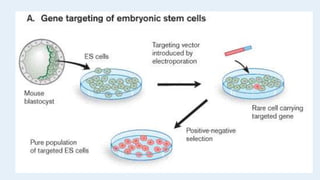
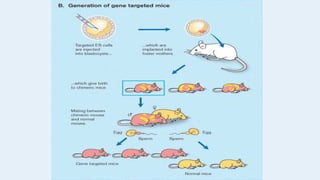
4. Implant selected cells into normal mouse embryos, making
"chimeras“
5. Implant chimeric embryos in pseudopregnant females.
6. Females give birth to chimeric offspring, which are subsequently
bred to verify transmission of the new gene, producing a mutant
mouse line.
•
Some experiment results..
 Knocking out p53 gene
• p53, a tumour suppressor gene is deleted or mutated in half of
human cancers.
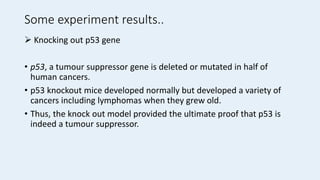
• p53 knockout mice developed normally but developed a variety of
cancers including lymphomas when they grew old.
• Thus, the knock out model provided the ultimate proof that p53 is
indeed a tumour suppressor.
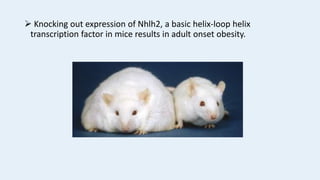
 Knocking out expression of Nhlh2, a basic helix-loop helix
transcription factor in mice results in adult onset obesity.
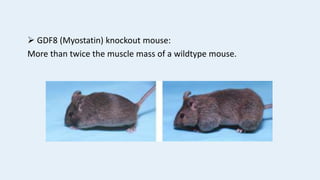
 GDF8 (Myostatin) knockout mouse:
More than twice the muscle mass of a wildtype mouse.
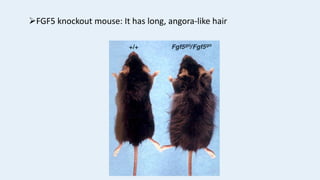
FGF5 knockout mouse: It has long, angora-like hair
• The gene knockout models revealed that cells need more than one
mutant gene to become cancerous.
• For example when you knock out p53, it takes many months for
cancer to arise.
• Similarly, mice engineered to express a mutant Rb gene indeed
developed tumors, but not the ones researchers were expecting.
• Thus, cells need more genetic alterations than just one.
Applications
• To determine the function of gene products.
• To create mouse model of human genetic diseases.
• To characterize genetic regulatory regions.
• To establish link between mutant phenotypes & particular
transcriptional units.
Limitations
• About 15 percent of gene knockouts are developmentally lethal,
which means that the genetically altered embryos cannot grow into
adult mice.
• In some instances, the gene may serve a different function in adults
than in developing embryos.
• Knocking out a gene also may fail to produce an observable change in
a mouse or may even produce different characteristics from those
observed in humans in which the same gene is inactivated
Gene knockout animal models

Gene knockout animal models

  • 1.
    Gene Knockout animalmodels Swetha Suresh (14MBT0025) Rinu Mary Rajan (14MBT0007)
  • 2.
    Gene Knockout • Agene knockout is a genetically engineered organism that carries one or more genes in its chromosomes that have been made inoperative. • They are used in learning about a gene that has been sequenced, but which has an unknown or incompletely known function. • The gene knock out technology allowed researchers to study loss-of- function mutations wherein one can infer a gene's function by observing what happens when the gene is absent or when mutant copy of the gene is expressed instead of the normal one.
  • 4.
    Model Organisims • Anynon human organisim used in research to answer a scientific question
  • 5.
    Knockout Mice • Miceare the laboratory animal species most closely related to humans in which the knockout technique can be easily performed, so they are a favourite subject for knockout experiments. • Mice are also cheap, easy to raise and have a short generation time.
  • 6.
    Uses • Knocking outthe activity of a gene provides valuable information about what that gene normally does. • Humans share many genes with mice. Consequently, observing the characteristics of knockout mice gives researchers information that can be used to better understand how a similar gene may cause or contribute to disease in humans. • Examples of research in which knockout mice have been useful include studying and modelling different kinds of cancer, obesity, heart disease, diabetes, arthritis, substance abuse, anxiety, aging and Parkinson disease.
  • 7.
    Cont. • Knockout micealso offer a biological context in which drugs and other therapies can be developed and tested. • Many of these mouse models are named after the gene that has been inactivated. Examples: o P53 knockout mouse is where the p53 gene, a tumour suppressor gene is knocked out. o "Methuselah" is a knockout mouse model noted for longevity o "Frantic" is a model useful for studying anxiety disorders
  • 8.
    Transgenic vs. Knockout Transgenicmodel Knockout model Gain-of-function mutations Loss-of-function mutations Genes are added into a genome to express a particular protein Gene are inactivated by deletion or expression of a mutant copy Random genomic integration of transgene site-specific genomic integration of transgene (targeted)
  • 9.
    Production of knockoutmice Depending upon method of insertion of artificial DNA into the chromosome of ES cells, there are 2 methods to produce knockout mouse in vitro: o Gene Targeting (Homologous Recombination) o Gene Trapping
  • 10.
    Which production methodis best? • Gene Targeting - Adv. - if the DNA sequence of the target gene is known, researchers can precisely knock out the gene at a high rate of efficiency. • Gene Trapping – Adv. - researchers do not need to know the DNA sequences of specific genes in order to knock them out. Also, a single Vector can be used to knock out various genes. Disadv. - not every successful insertion of artificial DNA into a gene leads to a loss of function. Also considerable time must be spent conducting tests to identify ES cells in which gene(s) actually have been knocked out. So Gene Targeting (by homologous recombination) is widely used.
  • 11.
    Production of knockoutmice (by Gene Targeting) 1. Harvesting of Embryonic stem cells from a mouse blastocyst. 2. Introducing the artificial DNA into the ES cells in the culture.
  • 12.
    3. Screen EScells and select those whose DNA includes the new gene. Positive selection • It involves the isolation of a target cell population by using an antibody that specifically binds that population. • Positive selection markers are used to enrich for recombination events Eg. Encoding Antibiotic resistance gene Neomycin Negative selection • It involves the depletion of all cell types except your cell type of interest. • Negative selection markers used to enrich for homologous recombination events over random insertions Eg. Use of Herpes Simplex Virus (HSV) Thymidine Kinase (TK) gene coupled with gancyclovir treatment.
  • 13.
    4. Implant selectedcells into normal mouse embryos, making "chimeras“ 5. Implant chimeric embryos in pseudopregnant females. 6. Females give birth to chimeric offspring, which are subsequently bred to verify transmission of the new gene, producing a mutant mouse line.
  • 14.
  • 17.
    Some experiment results.. Knocking out p53 gene • p53, a tumour suppressor gene is deleted or mutated in half of human cancers. • p53 knockout mice developed normally but developed a variety of cancers including lymphomas when they grew old. • Thus, the knock out model provided the ultimate proof that p53 is indeed a tumour suppressor.
  • 18.
     Knocking outexpression of Nhlh2, a basic helix-loop helix transcription factor in mice results in adult onset obesity.
  • 19.
     GDF8 (Myostatin)knockout mouse: More than twice the muscle mass of a wildtype mouse.
  • 20.
    FGF5 knockout mouse:It has long, angora-like hair
  • 21.
    • The geneknockout models revealed that cells need more than one mutant gene to become cancerous. • For example when you knock out p53, it takes many months for cancer to arise. • Similarly, mice engineered to express a mutant Rb gene indeed developed tumors, but not the ones researchers were expecting. • Thus, cells need more genetic alterations than just one.
  • 22.
    Applications • To determinethe function of gene products. • To create mouse model of human genetic diseases. • To characterize genetic regulatory regions. • To establish link between mutant phenotypes & particular transcriptional units.
  • 23.
    Limitations • About 15percent of gene knockouts are developmentally lethal, which means that the genetically altered embryos cannot grow into adult mice. • In some instances, the gene may serve a different function in adults than in developing embryos. • Knocking out a gene also may fail to produce an observable change in a mouse or may even produce different characteristics from those observed in humans in which the same gene is inactivated

Editor's Notes

  • #22 Instead of eye tumors, the animals suffered from pituitary and thyroid gland cancers. It was later found that found that a second gene protected the eye cells from cancer, and both mutations were required for tumors to form.