Immunofluorescence Assay
Definition of IFA
Immunofluorescence is the labeling of
antibodies with fluorescent dyes (such as
fluorescein isothiocyanate (FITC), and using
these Abs to identify Ags or Abs.
Principle
Fluorescent antibodies are labeled with
fluorescein isothiocyanate (FITC) dye, or
other fluorochrome.
The fluorochrome absorbs light of a certain
wavelength (e.g., UV light), and emits the
light energy in the form of light at a
different (visible) wavelength.
Types of Fluorescent dyes
The fluorochrome fluorescein isothiocyanate
(FITC), which absorbs UV light and emits it
as green light, is used most frequently with
Apple green color (caution: bleaches out
quickly!)
Tetramethyl rhodamine isothiocyanate
(RITC) with red color
Acridine orange.
Types of IFA
Direct (DFA)
Identify the presence of antigens.
The immunofluorescence reaction is direct
when known labeled antibody interacts directly
with unknown antigen.
Such "labeled" antibody can be used to
identify antigens, e.g., on the surface of viral-
infected cells in aspirates or histological
sections.
It is also used in the identification of viruses
grown in cell culture.
Processing of assay
In a DFA , a sample containing the suspected
antigen is fixed to a microscope slide.
The fluorescent antibody is added and allowed
to react with the antigen.
After rinsing to remove unbound antibody, the
slide is viewed with a fluorescent microscope
with a UV light source.
If the suspected antigen is present, the labeled
antibodies will have bound to it and will emit
an apple green color .
FITC-labeled
antibody
Sample with suspected
antigen
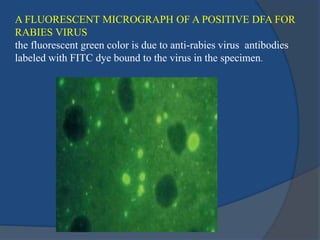
A FLUORESCENT MICROGRAPH OF A POSITIVE DFA FOR
RABIES VIRUS
the fluorescent green color is due to anti-rabies virus antibodies
labeled with FITC dye bound to the virus in the specimen.
Positive immunofluorescence test for rabies
virus antigen. (Source: CDC)
(Virology Laboratory, Yale-New Haven Hospital)
Indirect (IFA)
Use to detect the presence of antibody in a sample.
often more sensitive than direct immunofluorescence,
because more labeled antibody adheres per antigenic
site.
Furthermore, the labeled antiglobulin becomes a
"universal reagent"; i.e., it is independent of the nature
of the antigen used because the antibody to IgG is
reactive with all human IgG.
 Indirect immunofluorescence can be used for the
detection of antibodies directed against particular
microbial antigens, or self-tissue antigens, within a
patient’s serum.
Indirect IFA is a two-stage process.
 Known antigen is attached to a slide, the patient's serum
(unlabeled) is added, and the preparation is washed.
 If the patient's serum contains antibody against the
antigen, it will remain fixed to it on the slide and can be
detected on addition of a fluorescent dye–labeled
antibody to human IgG and examination by UV
microscopy.
Homologous antigen
Sample with suspected antibody
FITC-labeled antibody
A POSITIVE IFA FOR INFLUENZA B VIRUS
Infected cells fluoresce an apple green color. Uninfected cells appear
reddish due to a second stain (Evans blue) in the preparation.
Advantages of direct immunofluorescence
1. Rapid.
2. Simple.
3. Specific.
Disadvantages of direct immunofluorescence
1. Lower signal (less sensitive)
2. Generally higher cost.
3. Less flexibility.
4. Difficulties with the labeling procedure when
commercially labeled direct conjugates are
unavailable.
Advantages of indirect immunofluorescence
 Greater sensitivity than direct immunofluorescence.
 Commercially produced secondary antibodies are
relatively inexpensive, available in an array of colors,
and quality controlled.
Disadvantages of indirect immunofluorescence
 Cross-reactivity (not specific).
 Samples with endogenous immunoglobulin may
exhibit a high background.
Disadvantages of IF assays
 They require subjective interpretation and are
therefore labor-intensive to carry out and are
dependent upon operator expertise.
 Faint rapidly.
Questions?
Immunofluroscence.pptx

Immunofluroscence.pptx

  • 1.
  • 2.
    Definition of IFA Immunofluorescenceis the labeling of antibodies with fluorescent dyes (such as fluorescein isothiocyanate (FITC), and using these Abs to identify Ags or Abs.
  • 3.
    Principle Fluorescent antibodies arelabeled with fluorescein isothiocyanate (FITC) dye, or other fluorochrome. The fluorochrome absorbs light of a certain wavelength (e.g., UV light), and emits the light energy in the form of light at a different (visible) wavelength.
  • 4.
    Types of Fluorescentdyes The fluorochrome fluorescein isothiocyanate (FITC), which absorbs UV light and emits it as green light, is used most frequently with Apple green color (caution: bleaches out quickly!) Tetramethyl rhodamine isothiocyanate (RITC) with red color Acridine orange.
  • 5.
    Types of IFA Direct(DFA) Identify the presence of antigens. The immunofluorescence reaction is direct when known labeled antibody interacts directly with unknown antigen.
  • 6.
    Such "labeled" antibodycan be used to identify antigens, e.g., on the surface of viral- infected cells in aspirates or histological sections. It is also used in the identification of viruses grown in cell culture.
  • 7.
    Processing of assay Ina DFA , a sample containing the suspected antigen is fixed to a microscope slide. The fluorescent antibody is added and allowed to react with the antigen. After rinsing to remove unbound antibody, the slide is viewed with a fluorescent microscope with a UV light source. If the suspected antigen is present, the labeled antibodies will have bound to it and will emit an apple green color .
  • 8.
  • 9.
    A FLUORESCENT MICROGRAPHOF A POSITIVE DFA FOR RABIES VIRUS the fluorescent green color is due to anti-rabies virus antibodies labeled with FITC dye bound to the virus in the specimen.
  • 10.
    Positive immunofluorescence testfor rabies virus antigen. (Source: CDC) (Virology Laboratory, Yale-New Haven Hospital)
  • 11.
    Indirect (IFA) Use todetect the presence of antibody in a sample. often more sensitive than direct immunofluorescence, because more labeled antibody adheres per antigenic site. Furthermore, the labeled antiglobulin becomes a "universal reagent"; i.e., it is independent of the nature of the antigen used because the antibody to IgG is reactive with all human IgG.
  • 12.
     Indirect immunofluorescencecan be used for the detection of antibodies directed against particular microbial antigens, or self-tissue antigens, within a patient’s serum.
  • 13.
    Indirect IFA isa two-stage process.  Known antigen is attached to a slide, the patient's serum (unlabeled) is added, and the preparation is washed.  If the patient's serum contains antibody against the antigen, it will remain fixed to it on the slide and can be detected on addition of a fluorescent dye–labeled antibody to human IgG and examination by UV microscopy.
  • 14.
    Homologous antigen Sample withsuspected antibody FITC-labeled antibody
  • 15.
    A POSITIVE IFAFOR INFLUENZA B VIRUS Infected cells fluoresce an apple green color. Uninfected cells appear reddish due to a second stain (Evans blue) in the preparation.
  • 21.
    Advantages of directimmunofluorescence 1. Rapid. 2. Simple. 3. Specific. Disadvantages of direct immunofluorescence 1. Lower signal (less sensitive) 2. Generally higher cost. 3. Less flexibility. 4. Difficulties with the labeling procedure when commercially labeled direct conjugates are unavailable.
  • 22.
    Advantages of indirectimmunofluorescence  Greater sensitivity than direct immunofluorescence.  Commercially produced secondary antibodies are relatively inexpensive, available in an array of colors, and quality controlled. Disadvantages of indirect immunofluorescence  Cross-reactivity (not specific).  Samples with endogenous immunoglobulin may exhibit a high background.
  • 23.
    Disadvantages of IFassays  They require subjective interpretation and are therefore labor-intensive to carry out and are dependent upon operator expertise.  Faint rapidly.
  • 24.