Department of Instrumentation & Control Engineering, MIT, Manipal
Lecture #02
MEMS – An Overview
1
Department of Instrumentation & Control Engineering, MIT, Manipal
Contents
1. Advantages and limitations
2. Applications
3. Visual Examples of MEMS Devices
2
S.Meenatchisundaram, Department of Instrumentation & Control Engineering, MIT, Manipal
Advantages and limitations
Advantages:
Small systems tend to move or stop more quickly due to low mechanical
inertia.
It is thus ideal for precision movements and for rapid actuation.
Miniaturized systems encounter less thermal distortion and mechanical
vibration due to low mass.
Miniaturized devices are particularly suited for biomedical and aerospace
applications due to their minute sizes and weight.
Small systems have higher dimensional stability at high temperature due
to low thermal expansion.
Smaller size of the systems means less space requirements.
3
S.Meenatchisundaram, Department of Instrumentation & Control Engineering, MIT, Manipal
Advantages and limitations
This allows the packaging of more functional components in a single
device.
Less material requirements mean low cost of production and transportation.
Ready mass production in batches.
Higher surface to volume ratio.
Limitations:
Friction is greater than inertia. Capillary, electrostatic and atomic forces as
well as stiction at a micro-level can be significant.
Heat dissipation is greater than heat storage and consequently thermal
transport properties could be a problem or, conversely, a great benefit.
4
S.Meenatchisundaram, Department of Instrumentation & Control Engineering, MIT, Manipal
Advantages and limitations
Fluidic or mass transport properties are extremely important. Tiny flow spaces
are prone to blockages but can conversely regulate fluid movement.
Material properties (Young’s modulus, Poisson’s ratio, grain structure) and
mechanical theory (residual stress, wear and fatigue etc.) may be size dependent.
Integration with on-chip circuitry is complex and device/domain specific. Lab-
on-a-chip systems components may not scale down comparably.
Miniature device packaging and testing is not straightforward. Certain MEMS
sensors require environmental access as well as protection from other
external influences.
Testing is not rapid and is expensive in comparison with conventional IC
devices.
Cost – for the success of a MEMS device, it needs to leverage its IC batch
fabrication resources and be mass-produced. Hence mass-market drivers must
be found to generate the high volume production.
5
• Automobile Industry
Tire pressure sensor
Engine oil sensor
Combustion sensor
Fuel rail pressure sensor
• Safety
Air Bag Deployment system
Antilock braking systems
Navigation (micro gyroscope)
• Engine and power train
Airflow control
Fuel pump pressure and fuel injection
control
Crankshaft positioning
• Health care Industry
Disposable blood pressure transducer (DPT)
Intrauterine pressure sensor (IUP)
Angioplasty pressure sensor
Infusion pump pressure sensor
Sphygmomanometer
Lung capacity meters
Kidney dialysis equipment
• Aerospace Industry
Cockpit Instrumentation
Micro gyroscope
Micro satellite
• Industrial Products
Water level controls
Refrigeration systems
Manufacturing process sensor
• Consumer products
Smart Toys
Sport shoes with automatic cushioning
control
Washers with water level controls
Vacuum cleaning
• Telecommunications
Optical switching and fiber-optic couplings
RF switches
Tunable resonators
Applications
6S.Meenatchisundaram, Department of Instrumentation & Control Engineering, MIT, Manipal
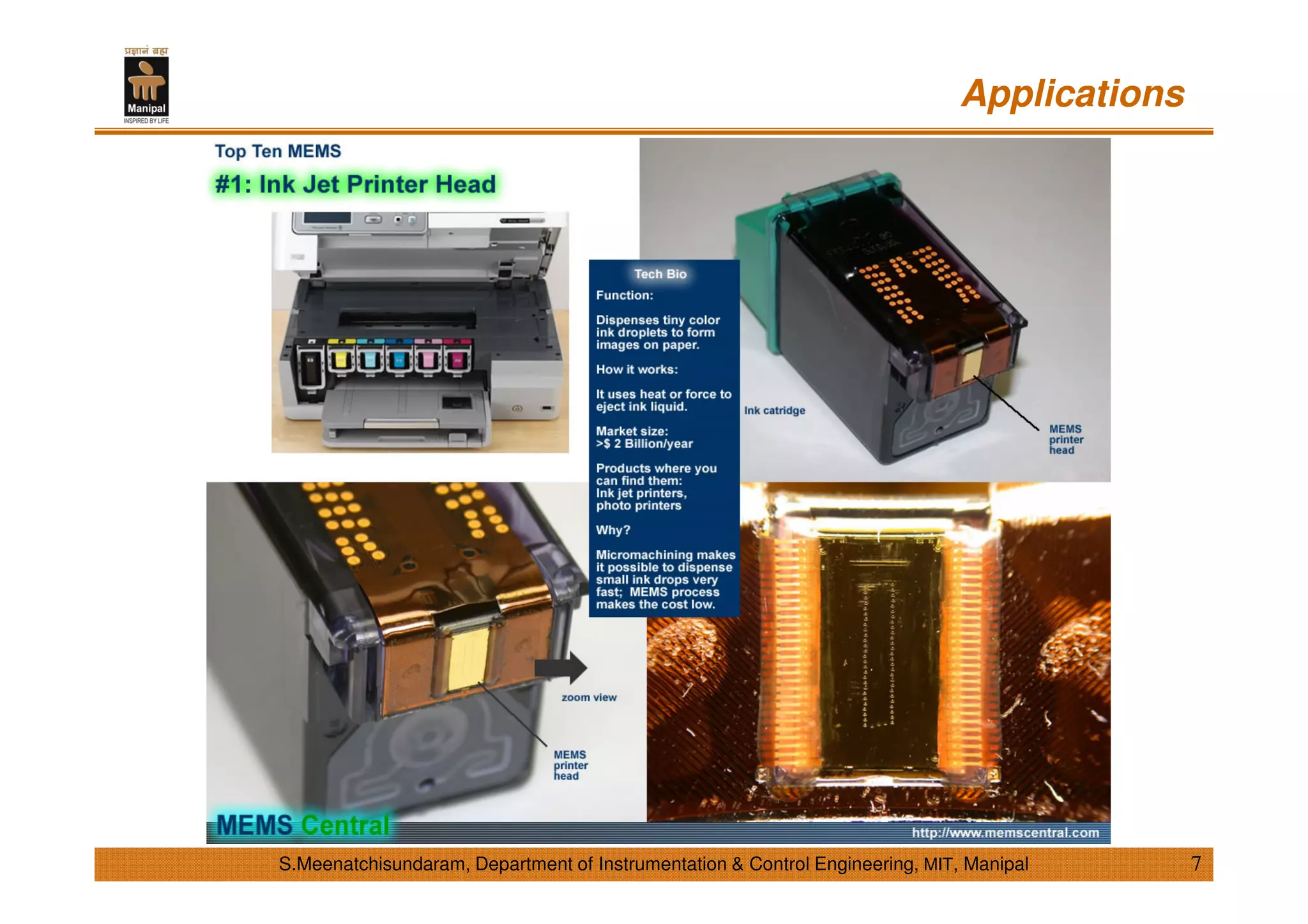
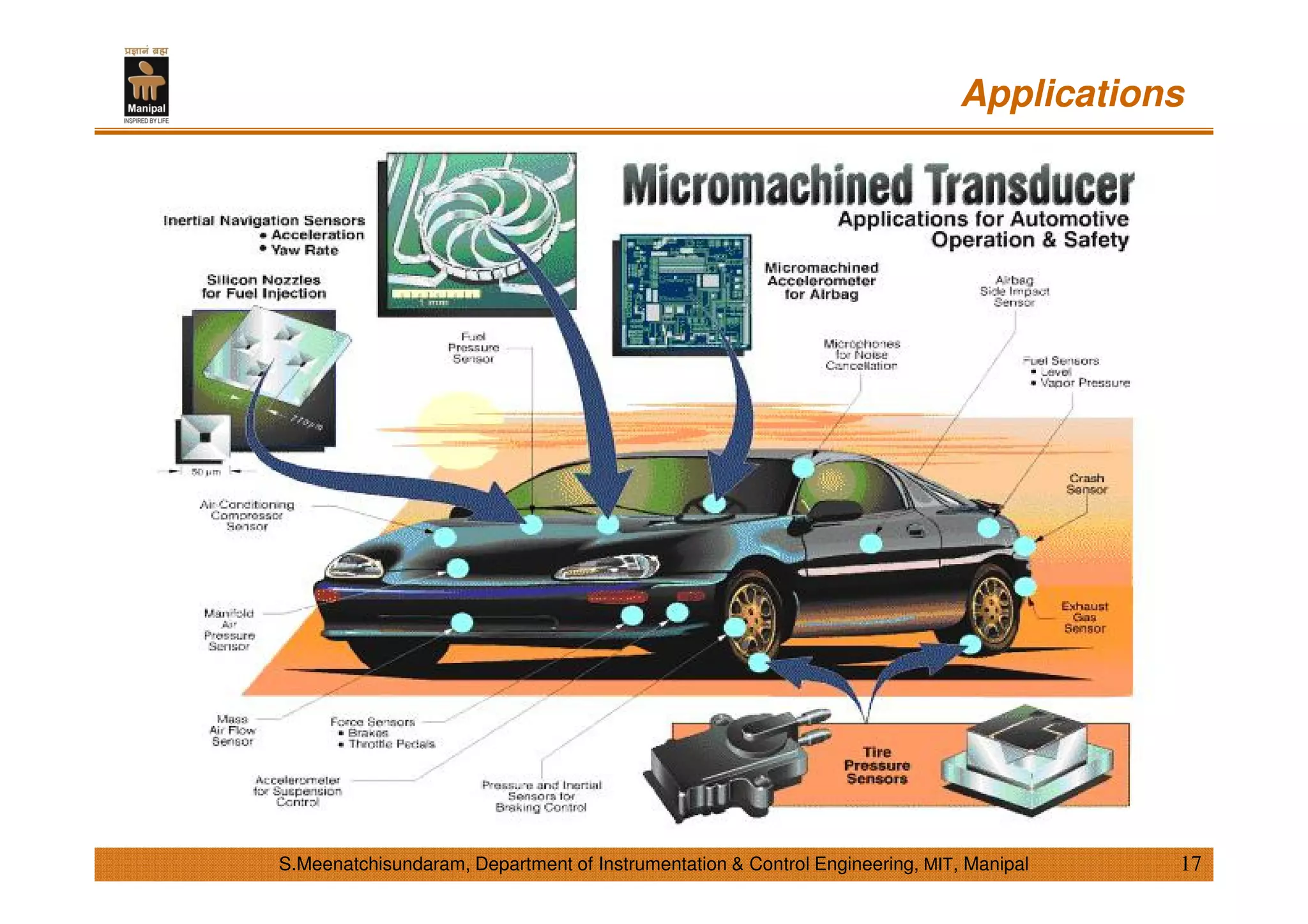
Applications
7S.Meenatchisundaram, Department of Instrumentation & Control Engineering, MIT, Manipal
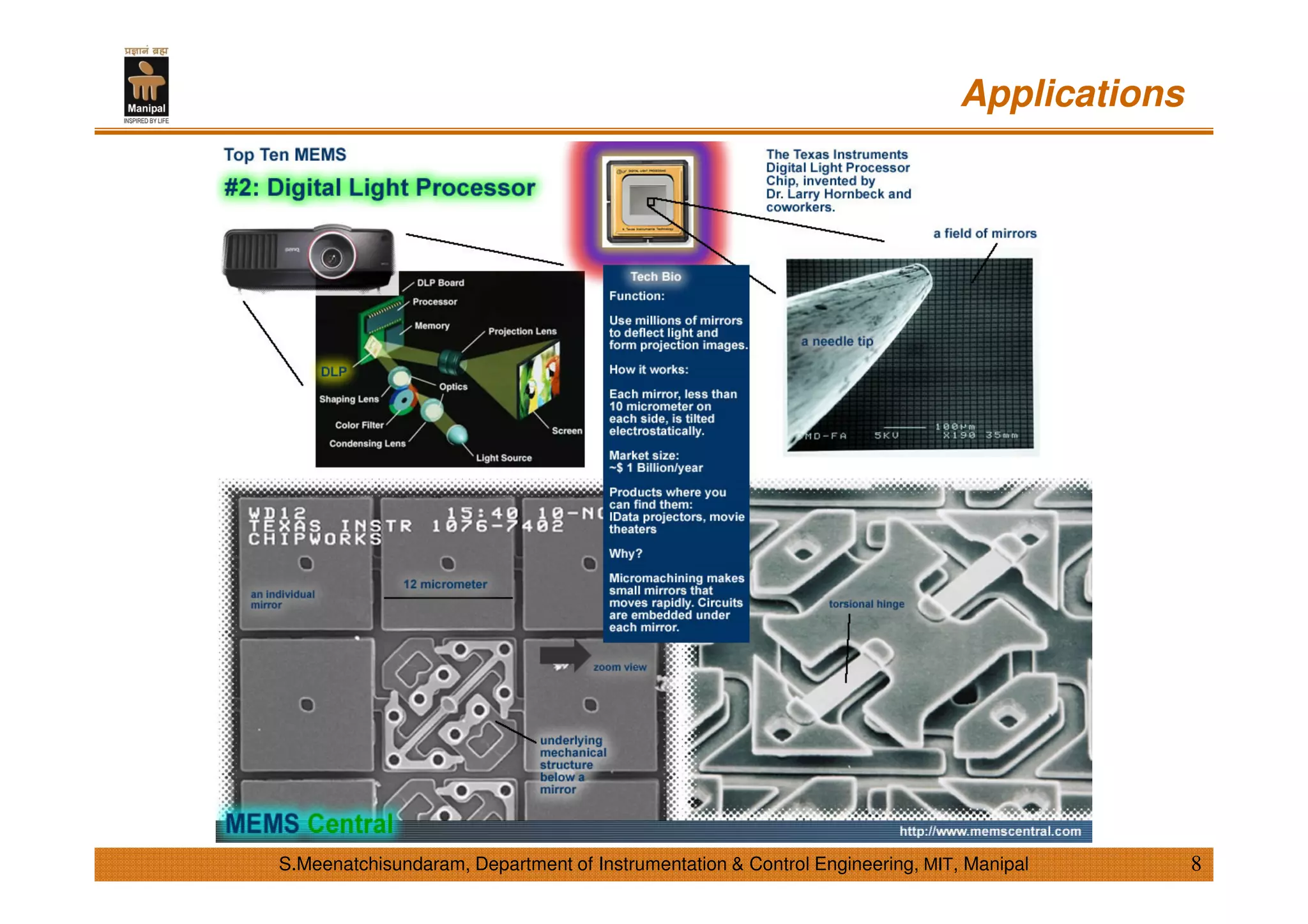
Applications
8S.Meenatchisundaram, Department of Instrumentation & Control Engineering, MIT, Manipal
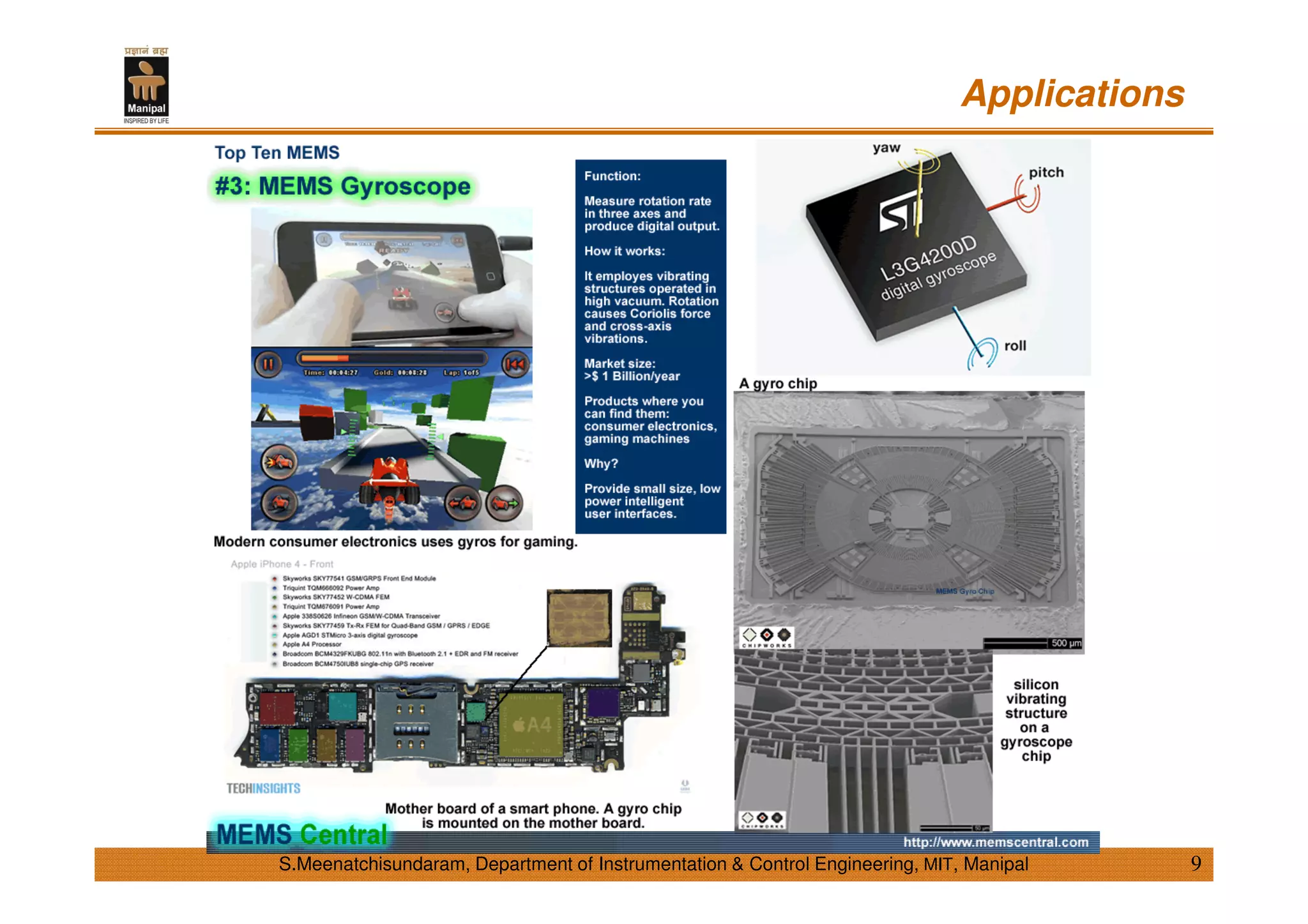
Applications
9S.Meenatchisundaram, Department of Instrumentation & Control Engineering, MIT, Manipal
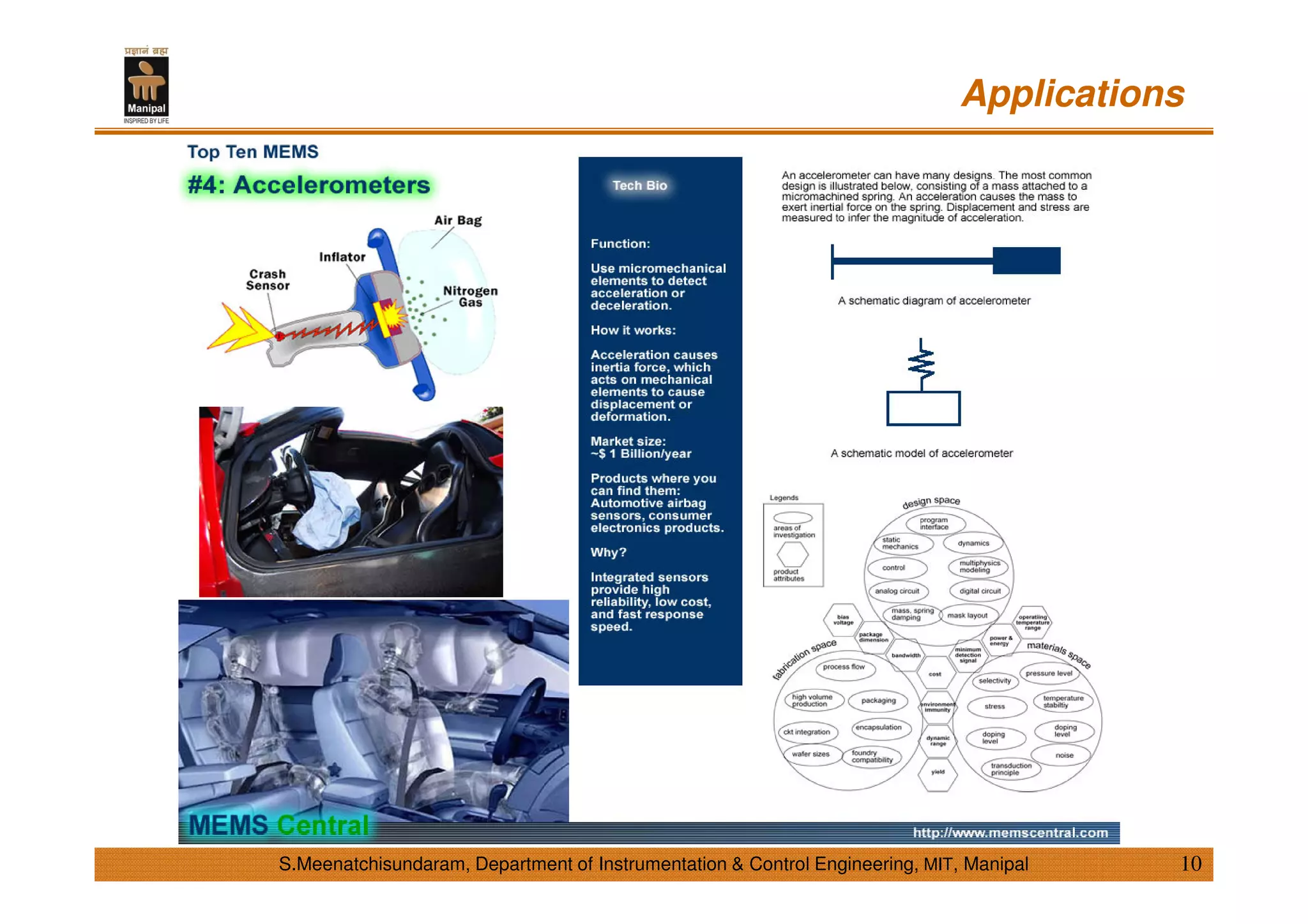
Applications
10S.Meenatchisundaram, Department of Instrumentation & Control Engineering, MIT, Manipal
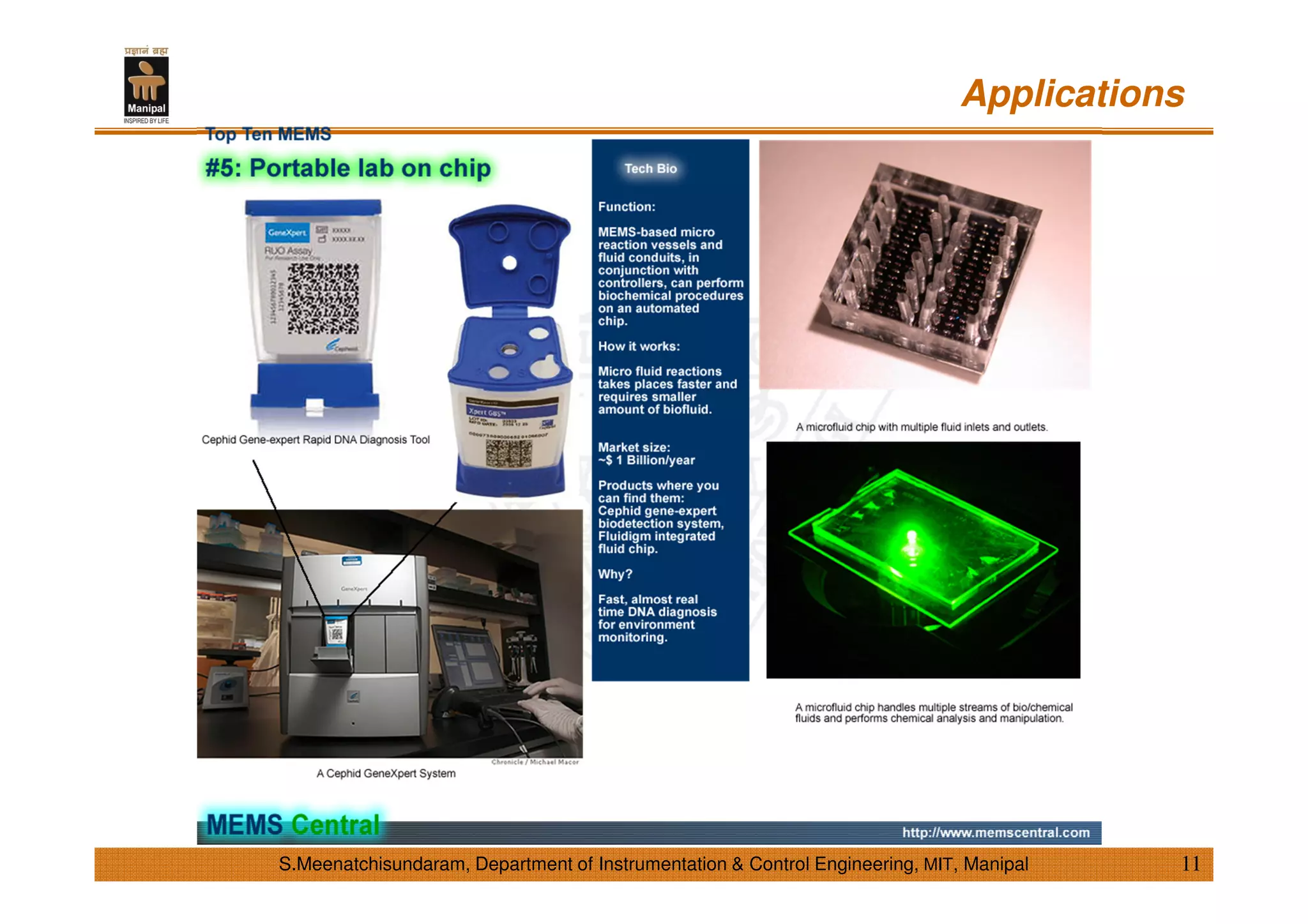
Applications
11S.Meenatchisundaram, Department of Instrumentation & Control Engineering, MIT, Manipal
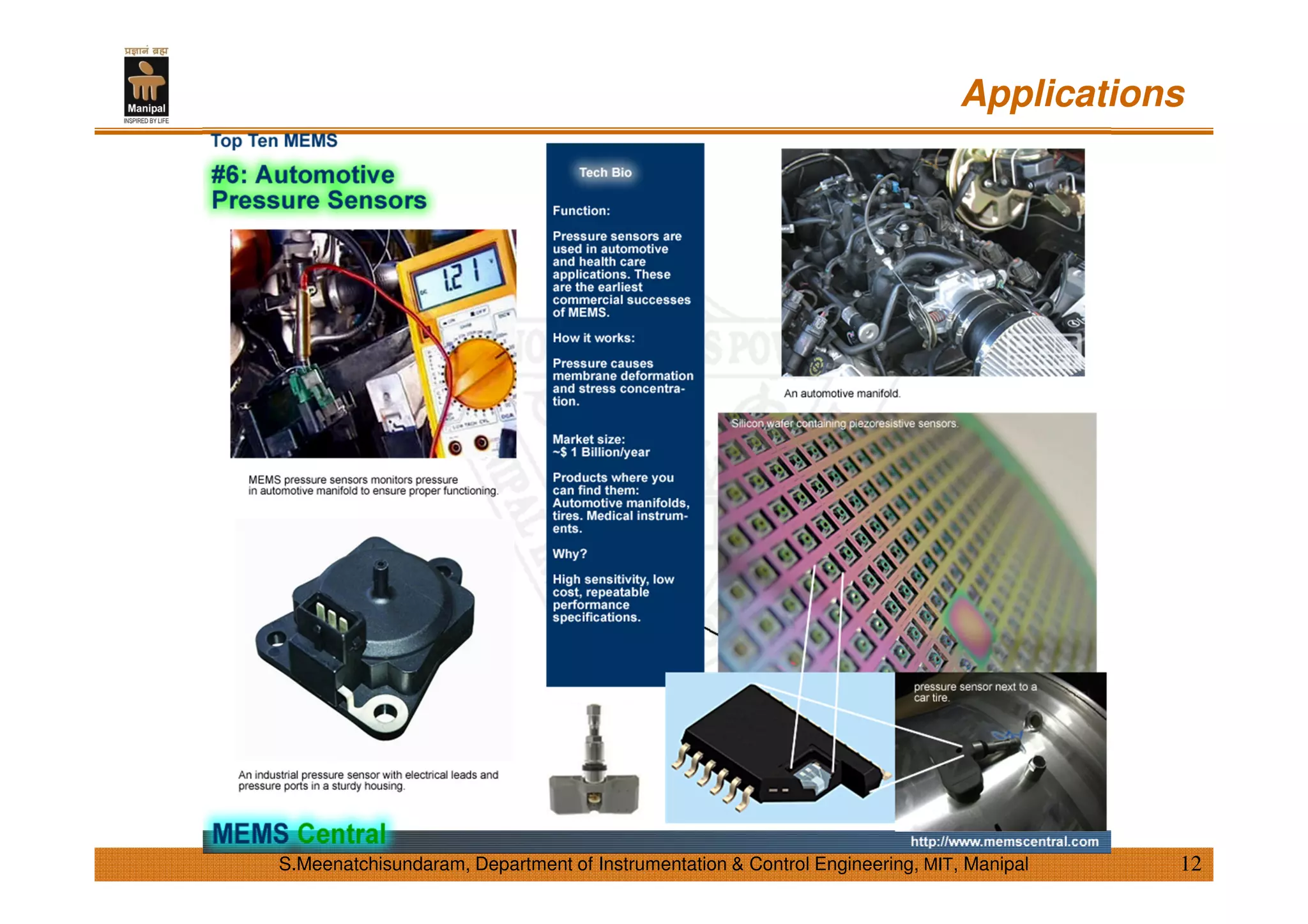
Applications
12S.Meenatchisundaram, Department of Instrumentation & Control Engineering, MIT, Manipal
Applications
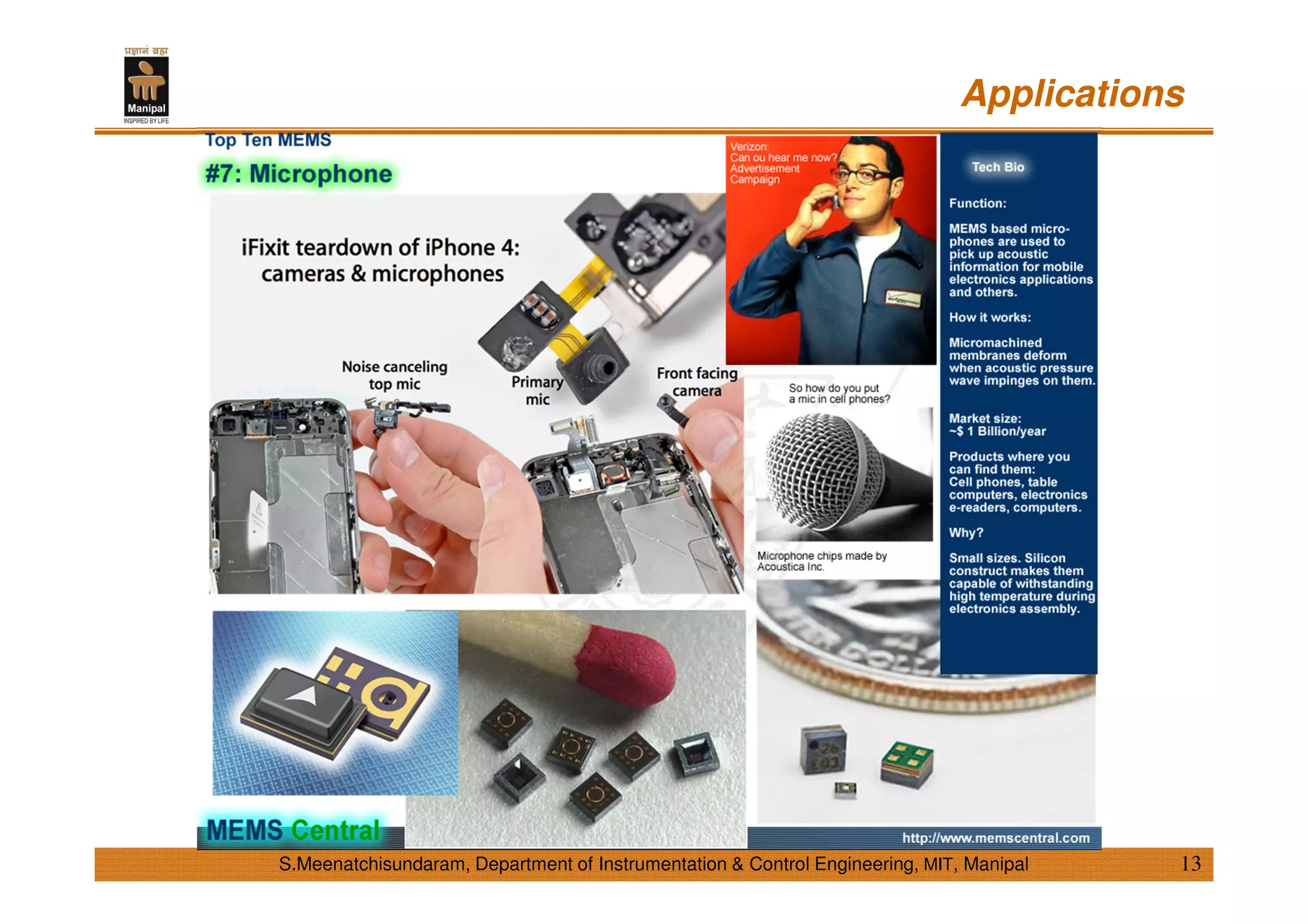
13S.Meenatchisundaram, Department of Instrumentation & Control Engineering, MIT, Manipal
Applications
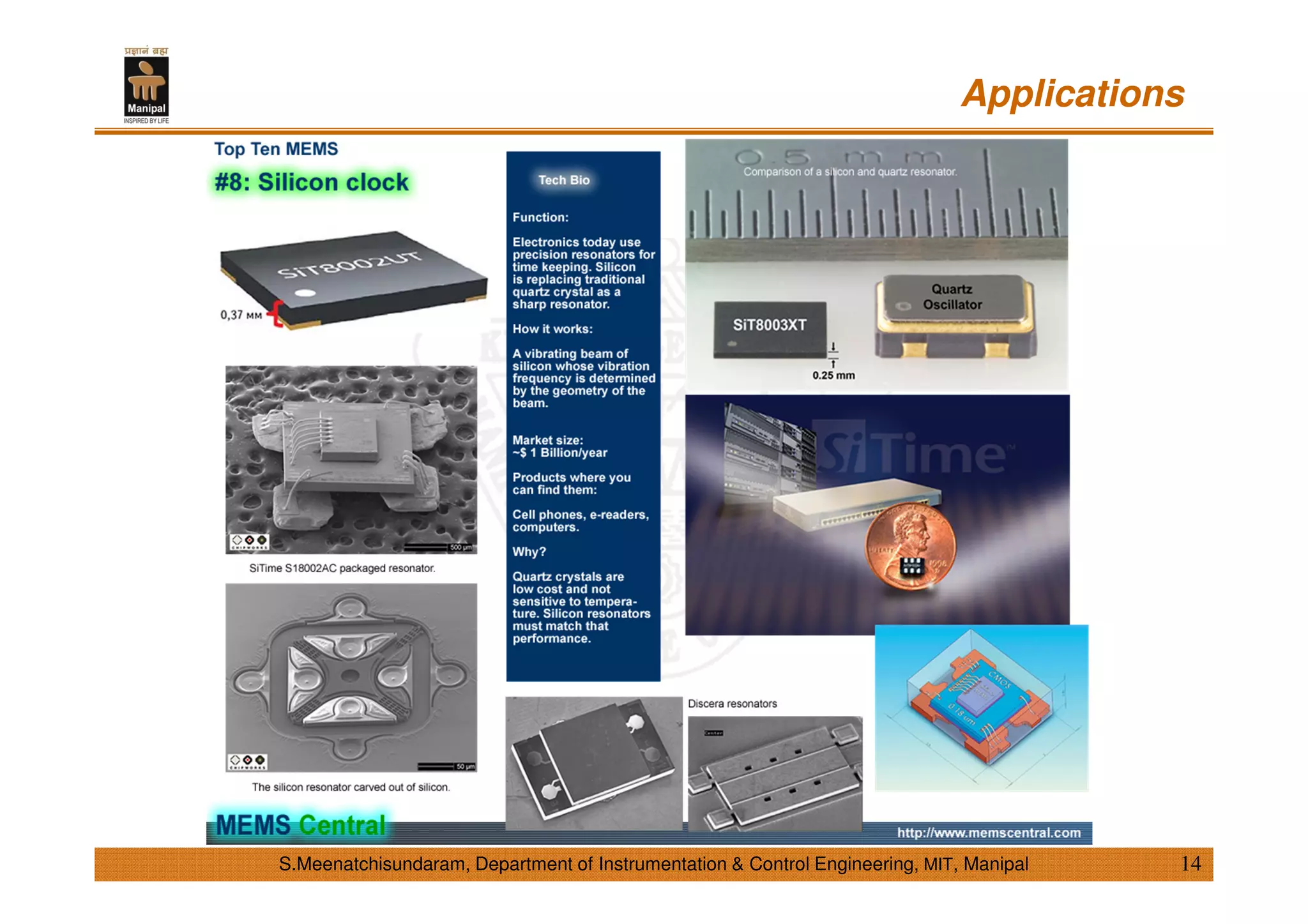
14S.Meenatchisundaram, Department of Instrumentation & Control Engineering, MIT, Manipal
Applications
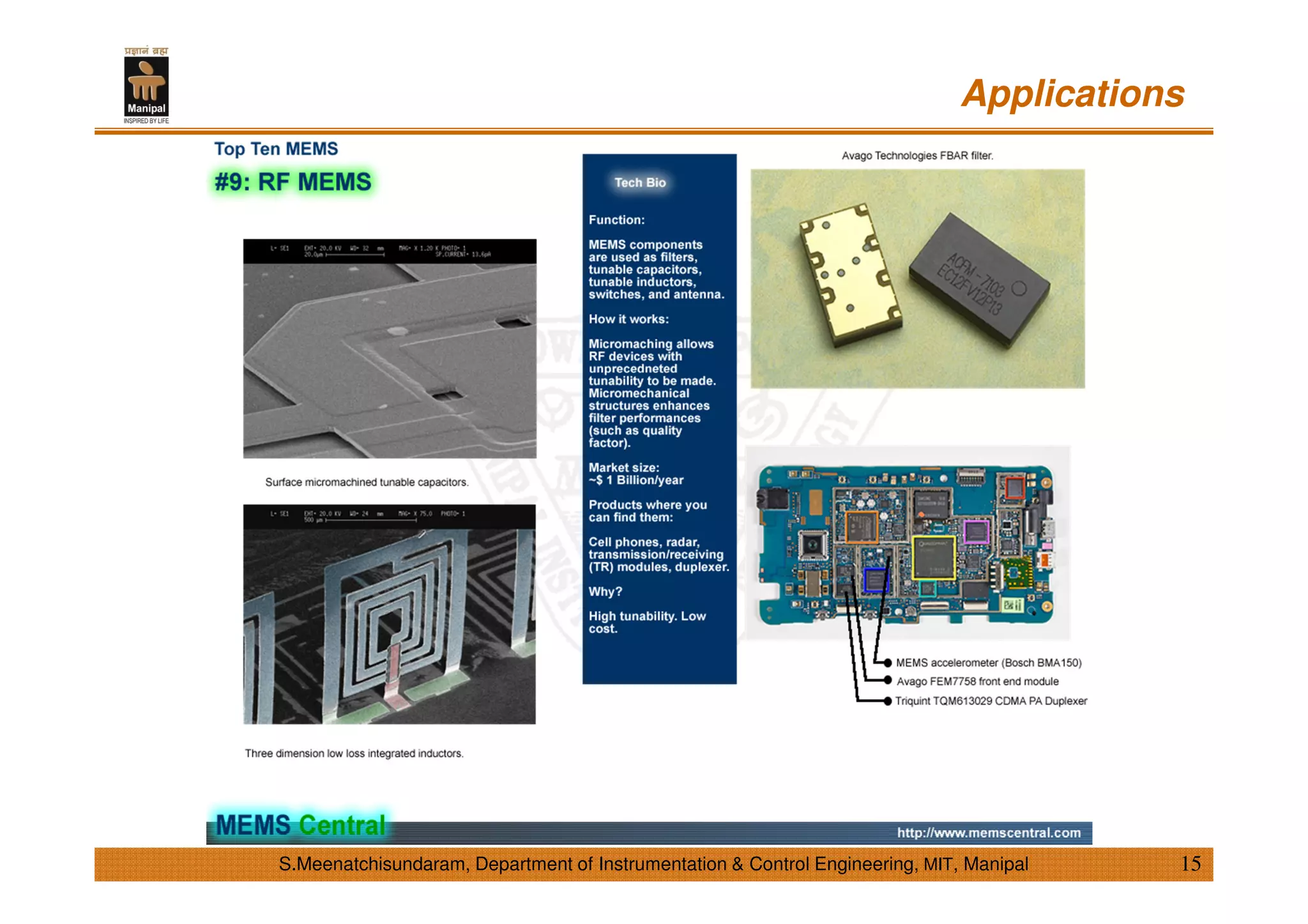
15S.Meenatchisundaram, Department of Instrumentation & Control Engineering, MIT, Manipal
Applications
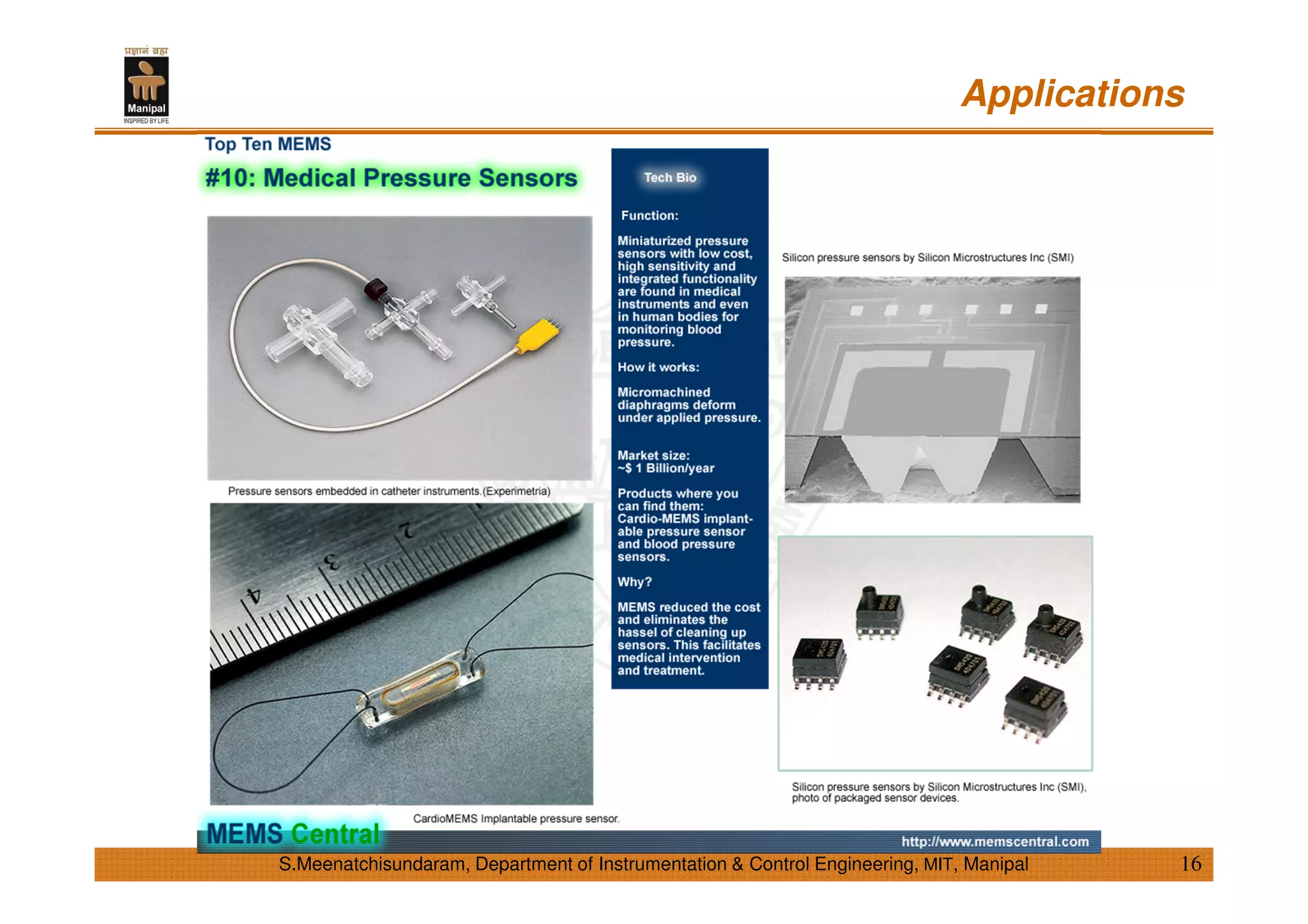
16S.Meenatchisundaram, Department of Instrumentation & Control Engineering, MIT, Manipal
Applications
17S.Meenatchisundaram, Department of Instrumentation & Control Engineering, MIT, Manipal
Visual Examples
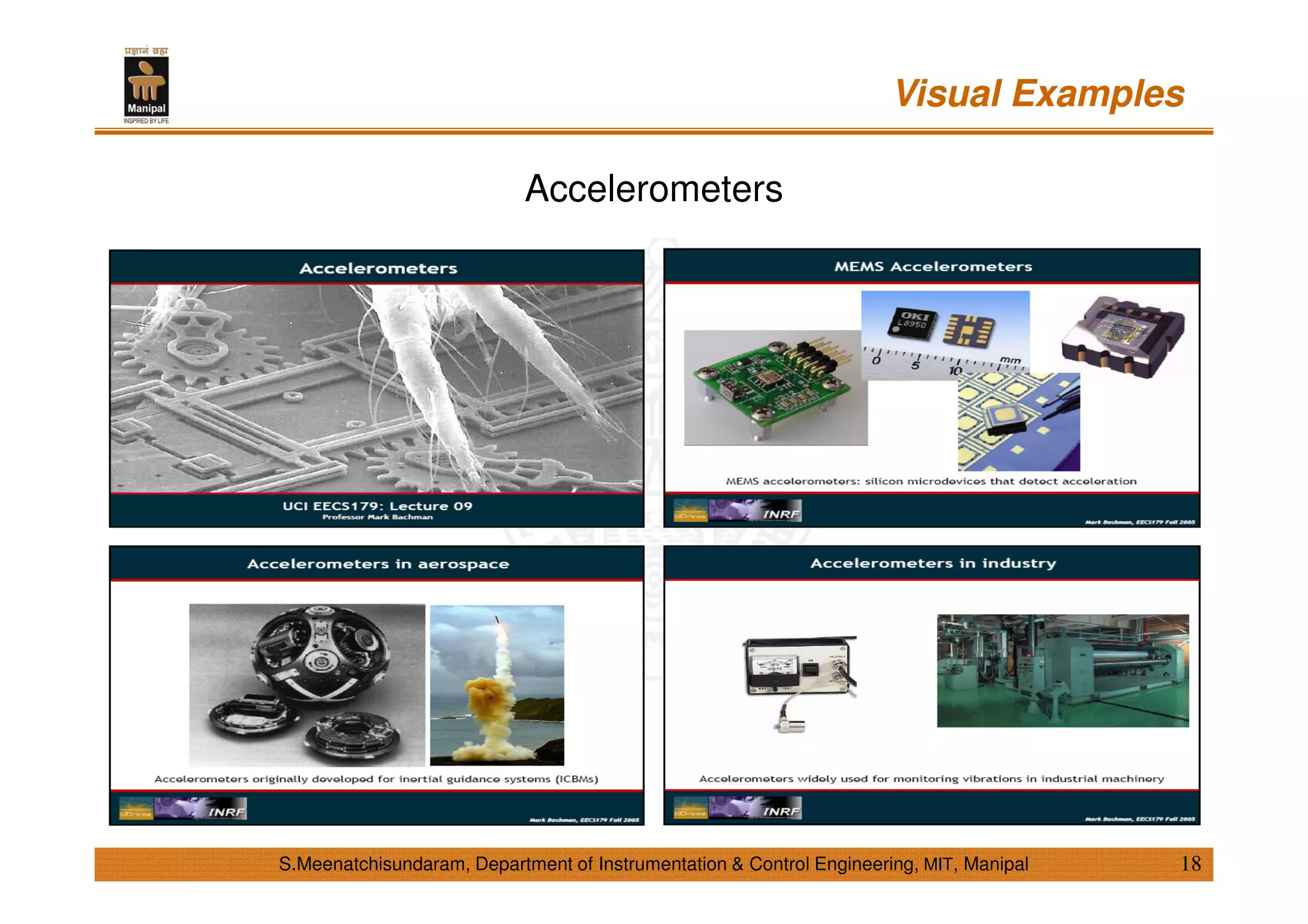
18S.Meenatchisundaram, Department of Instrumentation & Control Engineering, MIT, Manipal
Accelerometers
Visual Examples
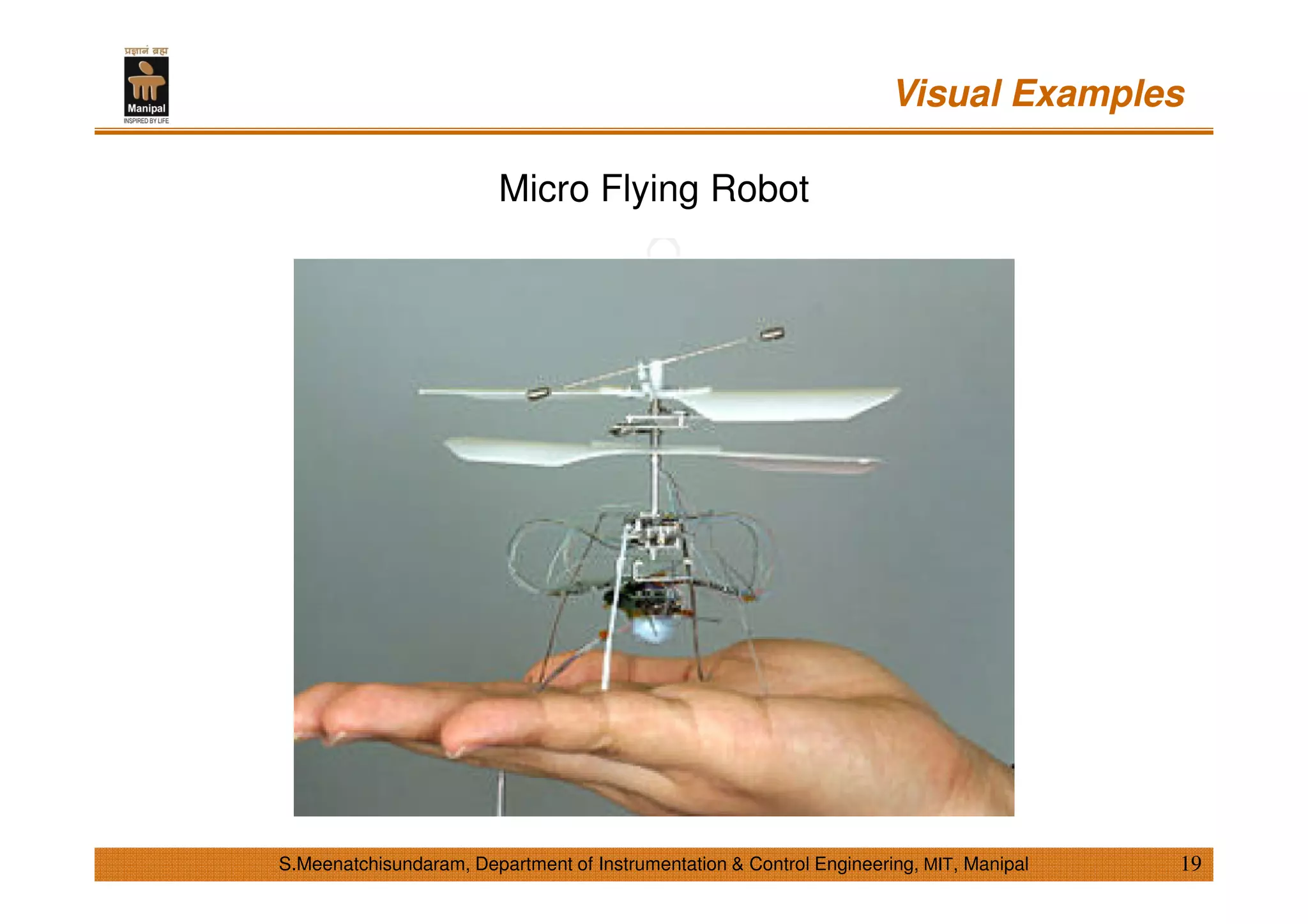
19S.Meenatchisundaram, Department of Instrumentation & Control Engineering, MIT, Manipal
Micro Flying Robot
Visual Examples
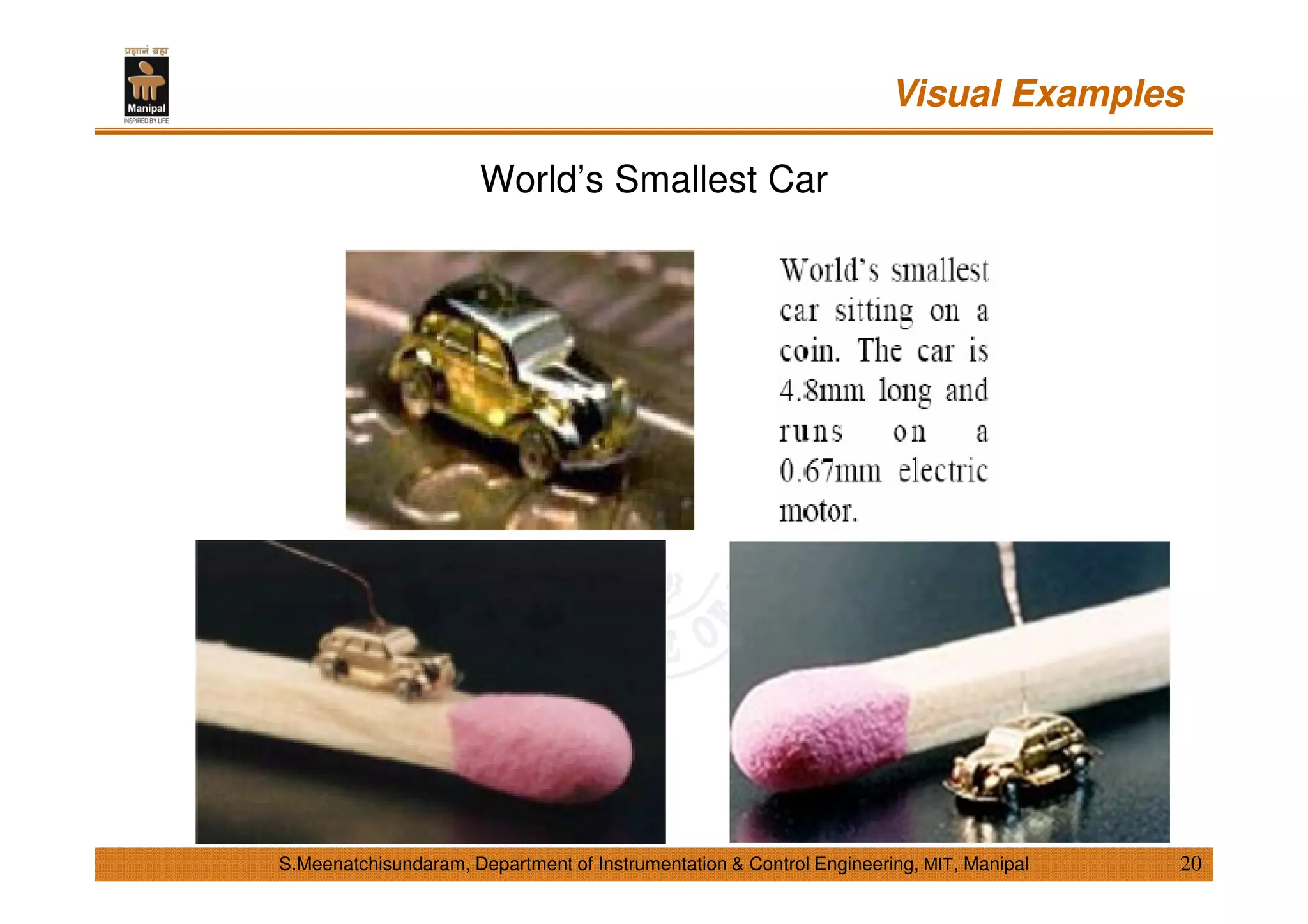
20S.Meenatchisundaram, Department of Instrumentation & Control Engineering, MIT, Manipal
World’s Smallest Car
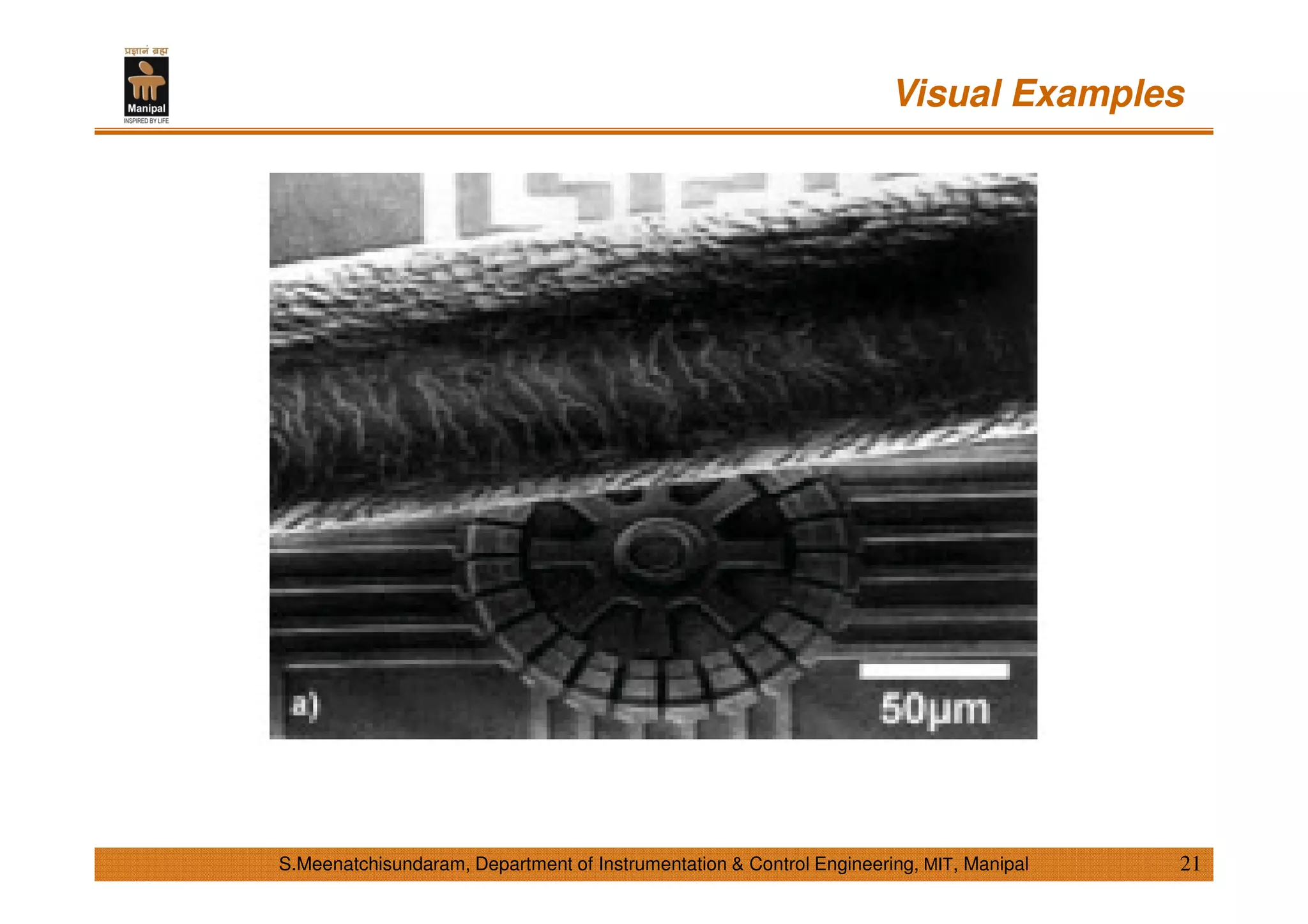
Visual Examples
21S.Meenatchisundaram, Department of Instrumentation & Control Engineering, MIT, Manipal
Visual Examples
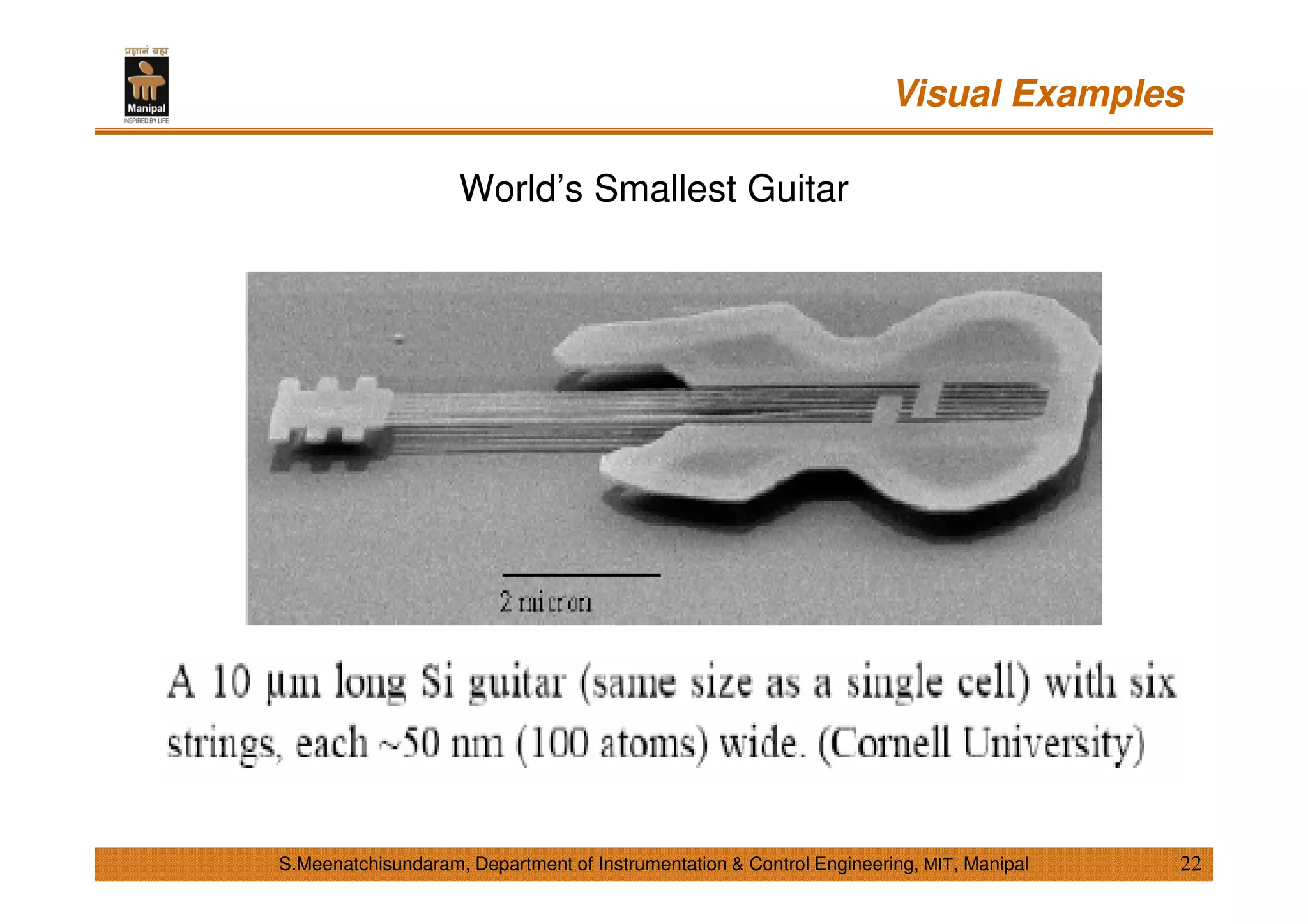
22S.Meenatchisundaram, Department of Instrumentation & Control Engineering, MIT, Manipal
World’s Smallest Guitar
Visual Examples
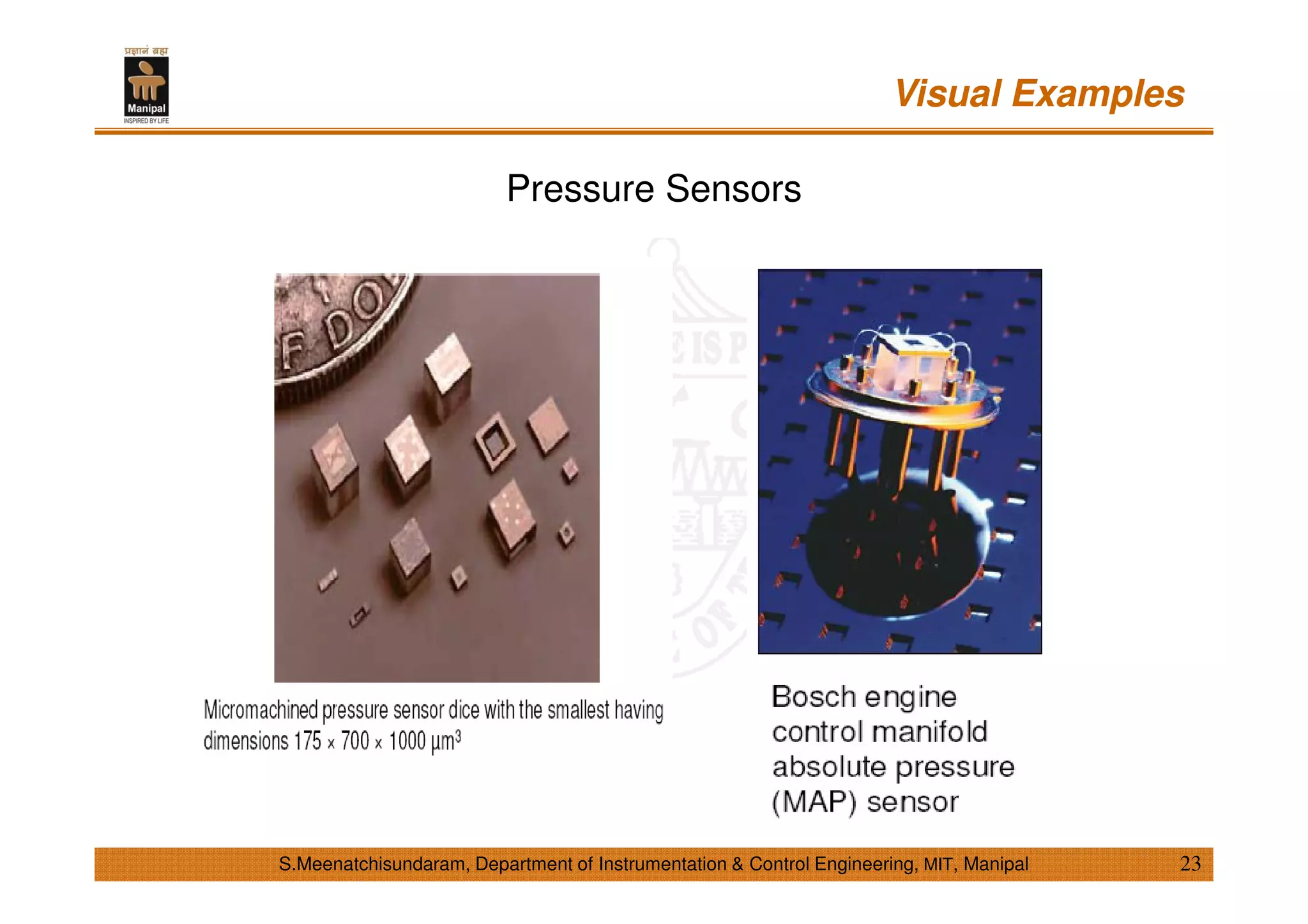
23S.Meenatchisundaram, Department of Instrumentation & Control Engineering, MIT, Manipal
Pressure Sensors
Visual Examples
24S.Meenatchisundaram, Department of Instrumentation & Control Engineering, MIT, Manipal
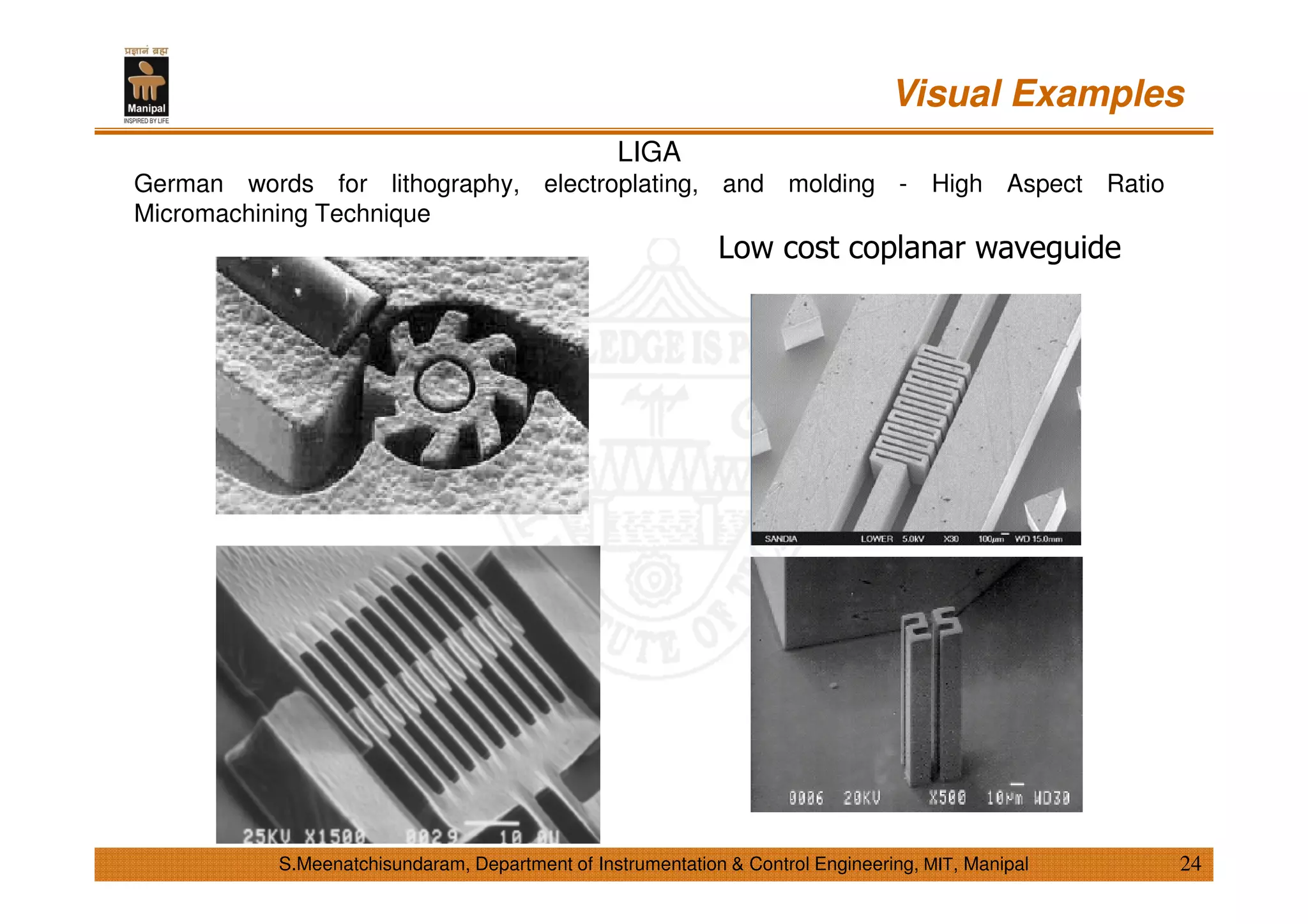
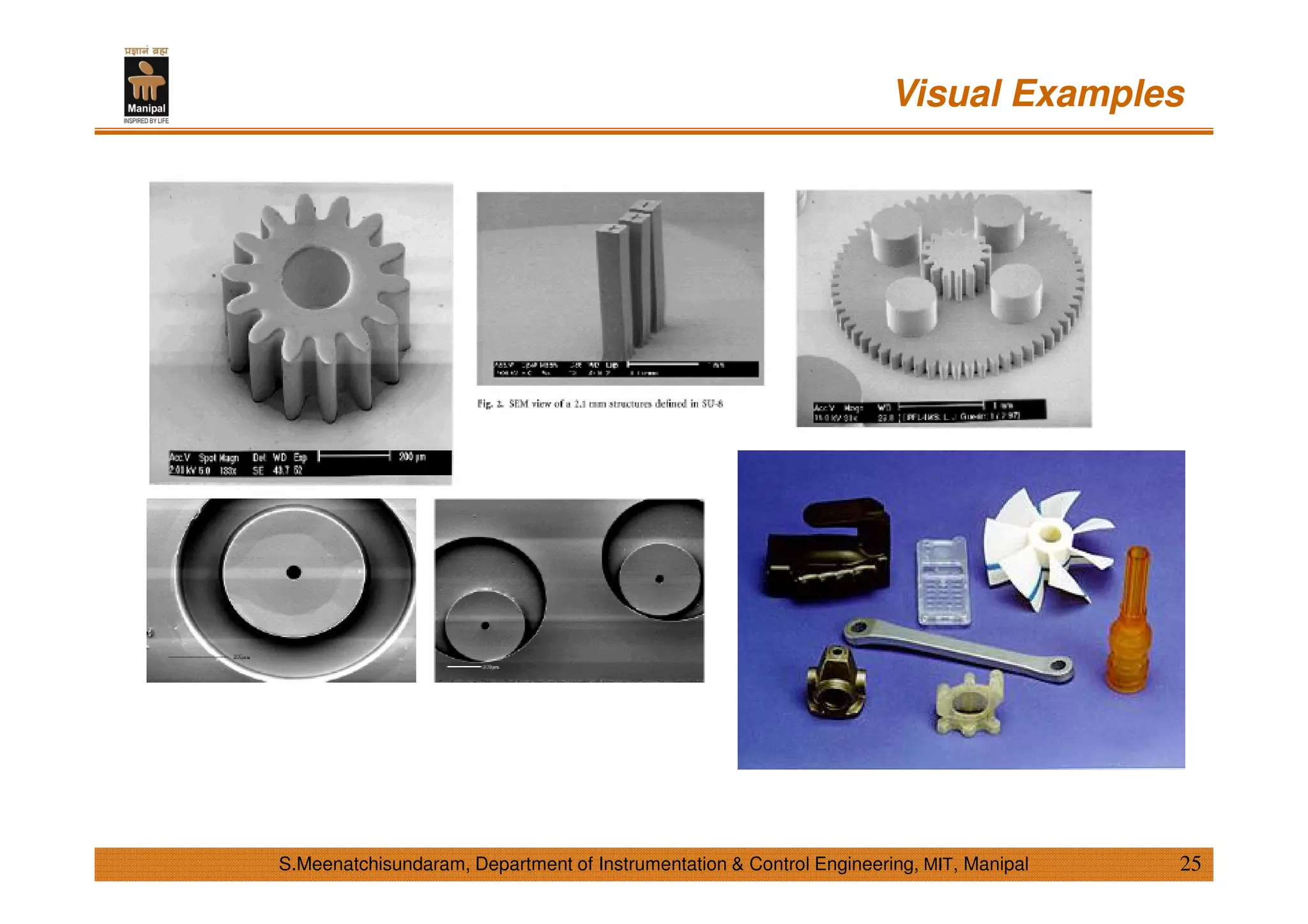
LIGA
German words for lithography, electroplating, and molding - High Aspect Ratio
Micromachining Technique
Low cost coplanar waveguide
Visual Examples
25S.Meenatchisundaram, Department of Instrumentation & Control Engineering, MIT, Manipal

Micro Electro Mechanical Systems (MEMS) Class Materials - Lecture 02

  • 1.
    Department of Instrumentation& Control Engineering, MIT, Manipal Lecture #02 MEMS – An Overview 1
  • 2.
    Department of Instrumentation& Control Engineering, MIT, Manipal Contents 1. Advantages and limitations 2. Applications 3. Visual Examples of MEMS Devices 2
  • 3.
    S.Meenatchisundaram, Department ofInstrumentation & Control Engineering, MIT, Manipal Advantages and limitations Advantages: Small systems tend to move or stop more quickly due to low mechanical inertia. It is thus ideal for precision movements and for rapid actuation. Miniaturized systems encounter less thermal distortion and mechanical vibration due to low mass. Miniaturized devices are particularly suited for biomedical and aerospace applications due to their minute sizes and weight. Small systems have higher dimensional stability at high temperature due to low thermal expansion. Smaller size of the systems means less space requirements. 3
  • 4.
    S.Meenatchisundaram, Department ofInstrumentation & Control Engineering, MIT, Manipal Advantages and limitations This allows the packaging of more functional components in a single device. Less material requirements mean low cost of production and transportation. Ready mass production in batches. Higher surface to volume ratio. Limitations: Friction is greater than inertia. Capillary, electrostatic and atomic forces as well as stiction at a micro-level can be significant. Heat dissipation is greater than heat storage and consequently thermal transport properties could be a problem or, conversely, a great benefit. 4
  • 5.
    S.Meenatchisundaram, Department ofInstrumentation & Control Engineering, MIT, Manipal Advantages and limitations Fluidic or mass transport properties are extremely important. Tiny flow spaces are prone to blockages but can conversely regulate fluid movement. Material properties (Young’s modulus, Poisson’s ratio, grain structure) and mechanical theory (residual stress, wear and fatigue etc.) may be size dependent. Integration with on-chip circuitry is complex and device/domain specific. Lab- on-a-chip systems components may not scale down comparably. Miniature device packaging and testing is not straightforward. Certain MEMS sensors require environmental access as well as protection from other external influences. Testing is not rapid and is expensive in comparison with conventional IC devices. Cost – for the success of a MEMS device, it needs to leverage its IC batch fabrication resources and be mass-produced. Hence mass-market drivers must be found to generate the high volume production. 5
  • 6.
    • Automobile Industry Tirepressure sensor Engine oil sensor Combustion sensor Fuel rail pressure sensor • Safety Air Bag Deployment system Antilock braking systems Navigation (micro gyroscope) • Engine and power train Airflow control Fuel pump pressure and fuel injection control Crankshaft positioning • Health care Industry Disposable blood pressure transducer (DPT) Intrauterine pressure sensor (IUP) Angioplasty pressure sensor Infusion pump pressure sensor Sphygmomanometer Lung capacity meters Kidney dialysis equipment • Aerospace Industry Cockpit Instrumentation Micro gyroscope Micro satellite • Industrial Products Water level controls Refrigeration systems Manufacturing process sensor • Consumer products Smart Toys Sport shoes with automatic cushioning control Washers with water level controls Vacuum cleaning • Telecommunications Optical switching and fiber-optic couplings RF switches Tunable resonators Applications 6S.Meenatchisundaram, Department of Instrumentation & Control Engineering, MIT, Manipal
  • 7.
    Applications 7S.Meenatchisundaram, Department ofInstrumentation & Control Engineering, MIT, Manipal
  • 8.
    Applications 8S.Meenatchisundaram, Department ofInstrumentation & Control Engineering, MIT, Manipal
  • 9.
    Applications 9S.Meenatchisundaram, Department ofInstrumentation & Control Engineering, MIT, Manipal
  • 10.
    Applications 10S.Meenatchisundaram, Department ofInstrumentation & Control Engineering, MIT, Manipal
  • 11.
    Applications 11S.Meenatchisundaram, Department ofInstrumentation & Control Engineering, MIT, Manipal
  • 12.
    Applications 12S.Meenatchisundaram, Department ofInstrumentation & Control Engineering, MIT, Manipal
  • 13.
    Applications 13S.Meenatchisundaram, Department ofInstrumentation & Control Engineering, MIT, Manipal
  • 14.
    Applications 14S.Meenatchisundaram, Department ofInstrumentation & Control Engineering, MIT, Manipal
  • 15.
    Applications 15S.Meenatchisundaram, Department ofInstrumentation & Control Engineering, MIT, Manipal
  • 16.
    Applications 16S.Meenatchisundaram, Department ofInstrumentation & Control Engineering, MIT, Manipal
  • 17.
    Applications 17S.Meenatchisundaram, Department ofInstrumentation & Control Engineering, MIT, Manipal
  • 18.
    Visual Examples 18S.Meenatchisundaram, Departmentof Instrumentation & Control Engineering, MIT, Manipal Accelerometers
  • 19.
    Visual Examples 19S.Meenatchisundaram, Departmentof Instrumentation & Control Engineering, MIT, Manipal Micro Flying Robot
  • 20.
    Visual Examples 20S.Meenatchisundaram, Departmentof Instrumentation & Control Engineering, MIT, Manipal World’s Smallest Car
  • 21.
    Visual Examples 21S.Meenatchisundaram, Departmentof Instrumentation & Control Engineering, MIT, Manipal
  • 22.
    Visual Examples 22S.Meenatchisundaram, Departmentof Instrumentation & Control Engineering, MIT, Manipal World’s Smallest Guitar
  • 23.
    Visual Examples 23S.Meenatchisundaram, Departmentof Instrumentation & Control Engineering, MIT, Manipal Pressure Sensors
  • 24.
    Visual Examples 24S.Meenatchisundaram, Departmentof Instrumentation & Control Engineering, MIT, Manipal LIGA German words for lithography, electroplating, and molding - High Aspect Ratio Micromachining Technique Low cost coplanar waveguide
  • 25.
    Visual Examples 25S.Meenatchisundaram, Departmentof Instrumentation & Control Engineering, MIT, Manipal