MEMS
Micro Electro Mechanical Systems
By
T. JD Reddy
Introduction
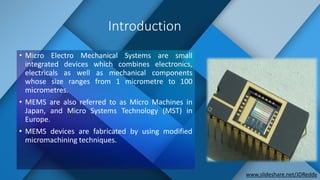
• Micro Electro Mechanical Systems are small
integrated devices which combines electronics,
electricals as well as mechanical components
whose size ranges from 1 micrometre to 100
micrometres.
• MEMS are also referred to as Micro Machines in
Japan, and Micro Systems Technology (MST) in
Europe.
• MEMS devices are fabricated by using modified
micromachining techniques.
www.slideshare.net/JDReddy
History
• MEMS were first proposed in 1960s.
• They were commercialized in 1980s.
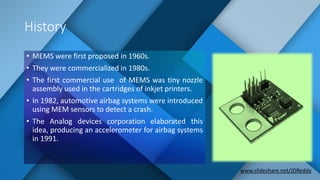
• The first commercial use of MEMS was tiny nozzle
assembly used in the cartridges of inkjet printers.
• In 1982, automotive airbag systems were introduced
using MEM sensors to detect a crash.
• The Analog devices corporation elaborated this
idea, producing an accelerometer for airbag systems
in 1991.
www.slideshare.net/JDReddy
Materials Used
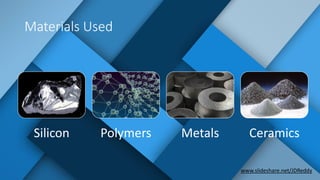
Silicon Polymers Metals Ceramics
www.slideshare.net/JDReddy
silicon
• Silicon is the material which is used to create most integrated circuits
used in consumer electronics in the modern industry.
• Silicon also has significant advantages engendered through its
material properties.
• In single crystal form, silicon is an almost perfect Hookean material,
meaning that when it is flexed there is virtually no hysteresis and
hence almost no energy dissipation.
• Silicon is very reliable as it suffers very little fatigue and can have
service lifetimes in the range of billions to trillions of cycles without
breaking.
www.slideshare.net/JDReddy
polymers
• Even though the electronics industry provides an economy of scale for
the silicon industry, crystalline silicon is still a complex and relatively
expensive material to produce.
• Polymers on the other hand can be produced in huge volumes, with a
great variety of material characteristics.
• MEMS devices can be made from polymers by processes such as
injection moulding, embossing or stereo lithography and are
especially well suited to microfluidic applications such as disposable
blood testing cartridges.
www.slideshare.net/JDReddy
metals
• Metals can also be used to create MEMS elements.
• While metals do not have some of the advantages displayed by silicon
in terms of mechanical properties, when used within their limitations,
metals can exhibit very high degrees of reliability.
• Metals can be deposited by electroplating, evaporation, sputtering
processes.
• Commonly used metals include gold, nickel, aluminium, copper,
chromium, titanium, tungsten, platinum, and silver.
www.slideshare.net/JDReddy
ceramics
• The nitrides of silicon, aluminium and titanium as well as silicon carbide
and other ceramics are increasingly applied in MEMS fabrication due to
advantageous combinations of material properties.
• Aluminium nitride crystallizes in the wurtzite structure and thus shows
pyroelectric and piezoelectric properties enabling sensors, for instance,
with sensitivity, to normal and shear forces.
• Moreover, the high resistance of titanium nitride against bio corrosion
qualifies the material for applications in bio genic environments and in bio
sensors.
www.slideshare.net/JDReddy
Applications
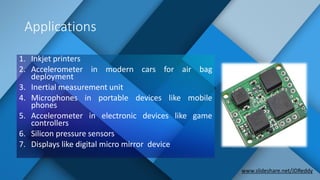
1. Inkjet printers
2. Accelerometer in modern cars for air bag
deployment
3. Inertial measurement unit
4. Microphones in portable devices like mobile
phones
5. Accelerometer in electronic devices like game
controllers
6. Silicon pressure sensors
7. Displays like digital micro mirror device
www.slideshare.net/JDReddy
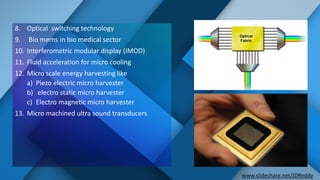
8. Optical switching technology
9. Bio mems in bio medical sector
10. Interferometric modular display (IMOD)
11. Fluid acceleration for micro cooling
12. Micro scale energy harvesting like
a) Piezo electric micro harvester
b) electro static micro harvester
c) Electro magnetic micro harvester
13. Micro machined ultra sound transducers
www.slideshare.net/JDReddy
Advantages
• Minimized use of materials.
• Improved reproducibility.
• Improved sensitivity, accuracy and reliability.
• Low power consumption.
• Easier to alter the parts of a device as compared to its macro counterpart.
www.slideshare.net/JDReddy
Disadvantages
• Poly silicon is brittle material, hence it can be broken under stress.
• Understanding the mechanical properties of mems is very hard as it is very
small.
• Sometimes designs can be very complex.
www.slideshare.net/JDReddy
conclusion
• The MEMS technology bought drastic changes in technology in past few decades.
• It will be the promising career for researchers and investors.
• This technology is base for the next era of human development.
• MEMS can be used in many multidisciplinary fields like biomedical, biomechanics,
aerospace industries.
www.slideshare.net/JDReddy
Thank you
T. JD Reddy
www.slideshare.net/JDReddy

Mems (micro electro mechanical systems)

  • 1.
    MEMS Micro Electro MechanicalSystems By T. JD Reddy
  • 2.
    Introduction • Micro ElectroMechanical Systems are small integrated devices which combines electronics, electricals as well as mechanical components whose size ranges from 1 micrometre to 100 micrometres. • MEMS are also referred to as Micro Machines in Japan, and Micro Systems Technology (MST) in Europe. • MEMS devices are fabricated by using modified micromachining techniques. www.slideshare.net/JDReddy
  • 3.
    History • MEMS werefirst proposed in 1960s. • They were commercialized in 1980s. • The first commercial use of MEMS was tiny nozzle assembly used in the cartridges of inkjet printers. • In 1982, automotive airbag systems were introduced using MEM sensors to detect a crash. • The Analog devices corporation elaborated this idea, producing an accelerometer for airbag systems in 1991. www.slideshare.net/JDReddy
  • 4.
    Materials Used Silicon PolymersMetals Ceramics www.slideshare.net/JDReddy
  • 5.
    silicon • Silicon isthe material which is used to create most integrated circuits used in consumer electronics in the modern industry. • Silicon also has significant advantages engendered through its material properties. • In single crystal form, silicon is an almost perfect Hookean material, meaning that when it is flexed there is virtually no hysteresis and hence almost no energy dissipation. • Silicon is very reliable as it suffers very little fatigue and can have service lifetimes in the range of billions to trillions of cycles without breaking. www.slideshare.net/JDReddy
  • 6.
    polymers • Even thoughthe electronics industry provides an economy of scale for the silicon industry, crystalline silicon is still a complex and relatively expensive material to produce. • Polymers on the other hand can be produced in huge volumes, with a great variety of material characteristics. • MEMS devices can be made from polymers by processes such as injection moulding, embossing or stereo lithography and are especially well suited to microfluidic applications such as disposable blood testing cartridges. www.slideshare.net/JDReddy
  • 7.
    metals • Metals canalso be used to create MEMS elements. • While metals do not have some of the advantages displayed by silicon in terms of mechanical properties, when used within their limitations, metals can exhibit very high degrees of reliability. • Metals can be deposited by electroplating, evaporation, sputtering processes. • Commonly used metals include gold, nickel, aluminium, copper, chromium, titanium, tungsten, platinum, and silver. www.slideshare.net/JDReddy
  • 8.
    ceramics • The nitridesof silicon, aluminium and titanium as well as silicon carbide and other ceramics are increasingly applied in MEMS fabrication due to advantageous combinations of material properties. • Aluminium nitride crystallizes in the wurtzite structure and thus shows pyroelectric and piezoelectric properties enabling sensors, for instance, with sensitivity, to normal and shear forces. • Moreover, the high resistance of titanium nitride against bio corrosion qualifies the material for applications in bio genic environments and in bio sensors. www.slideshare.net/JDReddy
  • 9.
    Applications 1. Inkjet printers 2.Accelerometer in modern cars for air bag deployment 3. Inertial measurement unit 4. Microphones in portable devices like mobile phones 5. Accelerometer in electronic devices like game controllers 6. Silicon pressure sensors 7. Displays like digital micro mirror device www.slideshare.net/JDReddy
  • 10.
    8. Optical switchingtechnology 9. Bio mems in bio medical sector 10. Interferometric modular display (IMOD) 11. Fluid acceleration for micro cooling 12. Micro scale energy harvesting like a) Piezo electric micro harvester b) electro static micro harvester c) Electro magnetic micro harvester 13. Micro machined ultra sound transducers www.slideshare.net/JDReddy
  • 11.
    Advantages • Minimized useof materials. • Improved reproducibility. • Improved sensitivity, accuracy and reliability. • Low power consumption. • Easier to alter the parts of a device as compared to its macro counterpart. www.slideshare.net/JDReddy
  • 12.
    Disadvantages • Poly siliconis brittle material, hence it can be broken under stress. • Understanding the mechanical properties of mems is very hard as it is very small. • Sometimes designs can be very complex. www.slideshare.net/JDReddy
  • 13.
    conclusion • The MEMStechnology bought drastic changes in technology in past few decades. • It will be the promising career for researchers and investors. • This technology is base for the next era of human development. • MEMS can be used in many multidisciplinary fields like biomedical, biomechanics, aerospace industries. www.slideshare.net/JDReddy
  • 14.
    Thank you T. JDReddy www.slideshare.net/JDReddy