S.Meenatchisundaram, Department of Instrumentation & Control Engineering, MIT, Manipal
Micro Electro Mechanical Systems
MEMS - Small Devices for Large Jobs
S. Meenatchisundaram
Faculty
ICE, MIT, Manipal
meenasundar@gmail.com
1
S.Meenatchisundaram, Department of Instrumentation & Control Engineering, MIT, Manipal
Lecture #01
Micro Electro Mechanical Systems
– An Overview
2
S.Meenatchisundaram, Department of Instrumentation & Control Engineering, MIT, Manipal
Reference Books & Materials
Tai Ran Hsu, MEMS and Microsystems Design and Manufacture, Tata Mc
Graw Hill, 2002.
Chang Liu, Foundations of MEMS, 2 ed., Prentice Hall, 2012.
M. Bao, Analysis and Design Principles of MEMS Devices, 1 ed., Elsevier,
2005.
S. Beebey, G. Ensell and N. White, MEMS Mechanical Sensors,
Boston: Artech House, 2004.
Stephen Senturia, Microsystem Design, Springer, 2001.
An Introduction to MEMS, Prime Faraday Technology Watch – January 2002
3
S.Meenatchisundaram, Department of Instrumentation & Control Engineering, MIT, Manipal
Contents
1. What is MEMS?
2. Evolution of MEMS
3. Moore’s law and beyond
4
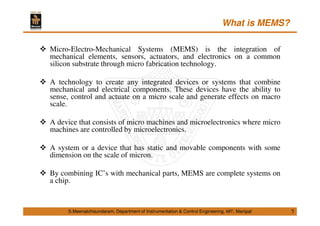
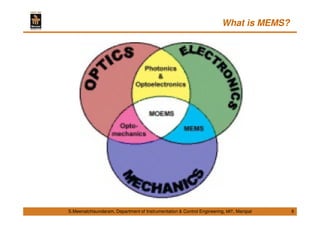
Micro-Electro-Mechanical Systems (MEMS) is the integration of
mechanical elements, sensors, actuators, and electronics on a common
silicon substrate through micro fabrication technology.
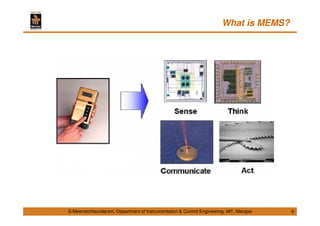
A technology to create any integrated devices or systems that combine
mechanical and electrical components. These devices have the ability to
sense, control and actuate on a micro scale and generate effects on macro
scale.
A device that consists of micro machines and microelectronics where micro
machines are controlled by microelectronics.
A system or a device that has static and movable components with some
dimension on the scale of micron.
By combining IC’s with mechanical parts, MEMS are complete systems on
a chip.
What is MEMS?
5S.Meenatchisundaram, Department of Instrumentation & Control Engineering, MIT, Manipal
What is MEMS?
6S.Meenatchisundaram, Department of Instrumentation & Control Engineering, MIT, Manipal
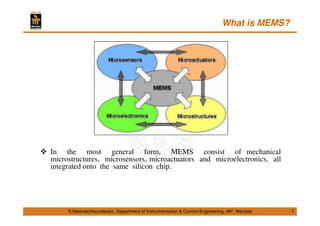
In the most general form, MEMS consist of mechanical
microstructures, microsensors, microactuators and microelectronics, all
integrated onto the same silicon chip.
What is MEMS?
7S.Meenatchisundaram, Department of Instrumentation & Control Engineering, MIT, Manipal
What is MEMS?
8S.Meenatchisundaram, Department of Instrumentation & Control Engineering, MIT, Manipal
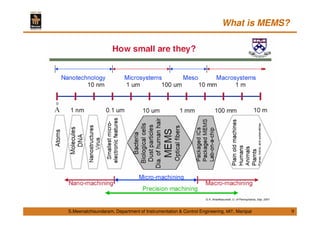
What is MEMS?
9S.Meenatchisundaram, Department of Instrumentation & Control Engineering, MIT, Manipal
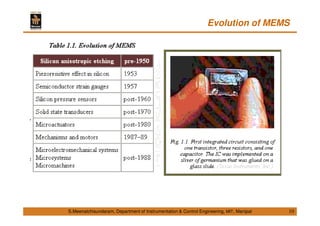
Evolution of MEMS
10S.Meenatchisundaram, Department of Instrumentation & Control Engineering, MIT, Manipal
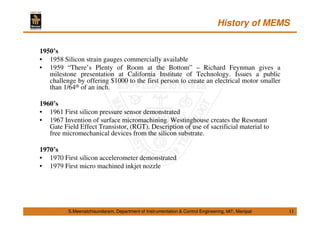
1950’s
• 1958 Silicon strain gauges commercially available
• 1959 “There’s Plenty of Room at the Bottom” – Richard Feynman gives a
milestone presentation at California Institute of Technology. Issues a public
challenge by offering $1000 to the first person to create an electrical motor smaller
than 1/64th of an inch.
1960’s
• 1961 First silicon pressure sensor demonstrated
• 1967 Invention of surface micromachining. Westinghouse creates the Resonant
Gate Field Effect Transistor, (RGT). Description of use of sacrificial material to
free micromechanical devices from the silicon substrate.
1970’s
• 1970 First silicon accelerometer demonstrated
• 1979 First micro machined inkjet nozzle
History of MEMS
11S.Meenatchisundaram, Department of Instrumentation & Control Engineering, MIT, Manipal
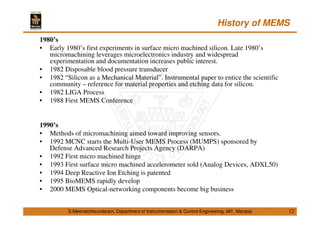
1980’s
• Early 1980’s first experiments in surface micro machined silicon. Late 1980’s
micromachining leverages microelectronics industry and widespread
experimentation and documentation increases public interest.
• 1982 Disposable blood pressure transducer
• 1982 “Silicon as a Mechanical Material”. Instrumental paper to entice the scientific
community – reference for material properties and etching data for silicon.
• 1982 LIGA Process
• 1988 First MEMS Conference
1990’s
• Methods of micromachining aimed toward improving sensors.
• 1992 MCNC starts the Multi-User MEMS Process (MUMPS) sponsored by
Defense Advanced Research Projects Agency (DARPA)
• 1992 First micro machined hinge
• 1993 First surface micro machined accelerometer sold (Analog Devices, ADXL50)
• 1994 Deep Reactive Ion Etching is patented
• 1995 BioMEMS rapidly develop
• 2000 MEMS Optical-networking components become big business
History of MEMS
12S.Meenatchisundaram, Department of Instrumentation & Control Engineering, MIT, Manipal
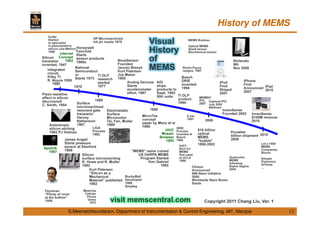
History of MEMS
13S.Meenatchisundaram, Department of Instrumentation & Control Engineering, MIT, Manipal
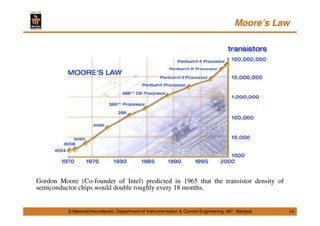
Moore’s Law
Gordon Moore (Co-founder of Intel) predicted in 1965 that the transistor density of
semiconductor chips would double roughly every 18 months.
14S.Meenatchisundaram, Department of Instrumentation & Control Engineering, MIT, Manipal
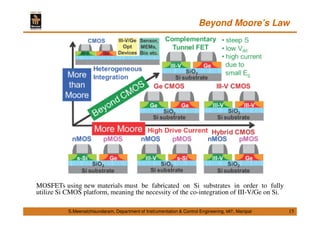
Beyond Moore’s Law
MOSFETs using new materials must be fabricated on Si substrates in order to fully
utilize Si CMOS platform, meaning the necessity of the co-integration of III-V/Ge on Si.
15S.Meenatchisundaram, Department of Instrumentation & Control Engineering, MIT, Manipal

Micro Electro Mechanical Systems (MEMS) Class Materials - Lecture 01

  • 1.
    S.Meenatchisundaram, Department ofInstrumentation & Control Engineering, MIT, Manipal Micro Electro Mechanical Systems MEMS - Small Devices for Large Jobs S. Meenatchisundaram Faculty ICE, MIT, Manipal meenasundar@gmail.com 1
  • 2.
    S.Meenatchisundaram, Department ofInstrumentation & Control Engineering, MIT, Manipal Lecture #01 Micro Electro Mechanical Systems – An Overview 2
  • 3.
    S.Meenatchisundaram, Department ofInstrumentation & Control Engineering, MIT, Manipal Reference Books & Materials Tai Ran Hsu, MEMS and Microsystems Design and Manufacture, Tata Mc Graw Hill, 2002. Chang Liu, Foundations of MEMS, 2 ed., Prentice Hall, 2012. M. Bao, Analysis and Design Principles of MEMS Devices, 1 ed., Elsevier, 2005. S. Beebey, G. Ensell and N. White, MEMS Mechanical Sensors, Boston: Artech House, 2004. Stephen Senturia, Microsystem Design, Springer, 2001. An Introduction to MEMS, Prime Faraday Technology Watch – January 2002 3
  • 4.
    S.Meenatchisundaram, Department ofInstrumentation & Control Engineering, MIT, Manipal Contents 1. What is MEMS? 2. Evolution of MEMS 3. Moore’s law and beyond 4
  • 5.
    Micro-Electro-Mechanical Systems (MEMS)is the integration of mechanical elements, sensors, actuators, and electronics on a common silicon substrate through micro fabrication technology. A technology to create any integrated devices or systems that combine mechanical and electrical components. These devices have the ability to sense, control and actuate on a micro scale and generate effects on macro scale. A device that consists of micro machines and microelectronics where micro machines are controlled by microelectronics. A system or a device that has static and movable components with some dimension on the scale of micron. By combining IC’s with mechanical parts, MEMS are complete systems on a chip. What is MEMS? 5S.Meenatchisundaram, Department of Instrumentation & Control Engineering, MIT, Manipal
  • 6.
    What is MEMS? 6S.Meenatchisundaram,Department of Instrumentation & Control Engineering, MIT, Manipal
  • 7.
    In the mostgeneral form, MEMS consist of mechanical microstructures, microsensors, microactuators and microelectronics, all integrated onto the same silicon chip. What is MEMS? 7S.Meenatchisundaram, Department of Instrumentation & Control Engineering, MIT, Manipal
  • 8.
    What is MEMS? 8S.Meenatchisundaram,Department of Instrumentation & Control Engineering, MIT, Manipal
  • 9.
    What is MEMS? 9S.Meenatchisundaram,Department of Instrumentation & Control Engineering, MIT, Manipal
  • 10.
    Evolution of MEMS 10S.Meenatchisundaram,Department of Instrumentation & Control Engineering, MIT, Manipal
  • 11.
    1950’s • 1958 Siliconstrain gauges commercially available • 1959 “There’s Plenty of Room at the Bottom” – Richard Feynman gives a milestone presentation at California Institute of Technology. Issues a public challenge by offering $1000 to the first person to create an electrical motor smaller than 1/64th of an inch. 1960’s • 1961 First silicon pressure sensor demonstrated • 1967 Invention of surface micromachining. Westinghouse creates the Resonant Gate Field Effect Transistor, (RGT). Description of use of sacrificial material to free micromechanical devices from the silicon substrate. 1970’s • 1970 First silicon accelerometer demonstrated • 1979 First micro machined inkjet nozzle History of MEMS 11S.Meenatchisundaram, Department of Instrumentation & Control Engineering, MIT, Manipal
  • 12.
    1980’s • Early 1980’sfirst experiments in surface micro machined silicon. Late 1980’s micromachining leverages microelectronics industry and widespread experimentation and documentation increases public interest. • 1982 Disposable blood pressure transducer • 1982 “Silicon as a Mechanical Material”. Instrumental paper to entice the scientific community – reference for material properties and etching data for silicon. • 1982 LIGA Process • 1988 First MEMS Conference 1990’s • Methods of micromachining aimed toward improving sensors. • 1992 MCNC starts the Multi-User MEMS Process (MUMPS) sponsored by Defense Advanced Research Projects Agency (DARPA) • 1992 First micro machined hinge • 1993 First surface micro machined accelerometer sold (Analog Devices, ADXL50) • 1994 Deep Reactive Ion Etching is patented • 1995 BioMEMS rapidly develop • 2000 MEMS Optical-networking components become big business History of MEMS 12S.Meenatchisundaram, Department of Instrumentation & Control Engineering, MIT, Manipal
  • 13.
    History of MEMS 13S.Meenatchisundaram,Department of Instrumentation & Control Engineering, MIT, Manipal
  • 14.
    Moore’s Law Gordon Moore(Co-founder of Intel) predicted in 1965 that the transistor density of semiconductor chips would double roughly every 18 months. 14S.Meenatchisundaram, Department of Instrumentation & Control Engineering, MIT, Manipal
  • 15.
    Beyond Moore’s Law MOSFETsusing new materials must be fabricated on Si substrates in order to fully utilize Si CMOS platform, meaning the necessity of the co-integration of III-V/Ge on Si. 15S.Meenatchisundaram, Department of Instrumentation & Control Engineering, MIT, Manipal