Optical SwitchingOptical Switching
Switch Fabrics, Techniques and ArchitecturesSwitch Fabrics, Techniques and Architectures
원종호 (INC lab)
Oct 30, 2006
SNU INC lab. 2
Outline
 Introduction
 Optical Switch
 Optical Packet Switch
 Optical Burst Switch
 GMPLS
 Conclusion
SNU INC lab. 3
Introduction
 Internet traffic has doubled per year
 New services like VOD, IPTV
 DWDM (Dense Wavelength Division Multiplexing) is developed
– Can transport tens to hundreds of wavelengths per fiber
 Then, What is problem?
– Slow O/E/O conversion.
– Electronic equipment is dependent on the data rate &
protocol. (non-transparent)
 Goal?
– All optical!
SNU INC lab. 4
Optical switch - OXC
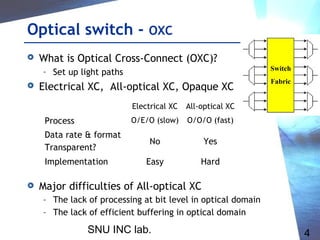
 What is Optical Cross-Connect (OXC)?
– Set up light paths
 Electrical XC, All-optical XC, Opaque XC
Switch
Fabric
Electrical XC All-optical XC
Process O/E/O (slow) O/O/O (fast)
Data rate & format
Transparent?
No Yes
Implementation Easy Hard
 Major difficulties of All-optical XC
– The lack of processing at bit level in optical domain
– The lack of efficient buffering in optical domain
SNU INC lab. 5
Optical switch - Optical Switch Fabrics
 Optical Switch Fabrics
– Allow switching directly in the optical domain (All-optical)
 Important parameters
– Switching time ( )↓
– Insertion loss ( and loss uniformity at all input-output↓
connections)
– Crosstalk ( )↓
– Extinction ratio (ratio of ON-OFF power) ( )↑
– Polarization-dependent loss ( )↓
– Reliability, energy usage, scalability, temperature resistance
SNU INC lab. 6
Optical switch - Optical Switch Fabrics
 Main optical switching technologies
– Opto-mechanical Switch
• Use prisms, mirrors, directional couplers.
• Lack of scalability
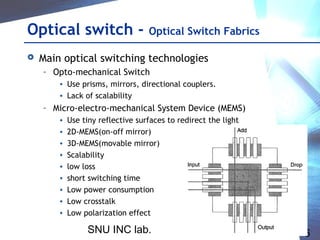
– Micro-electro-mechanical System Device (MEMS)
• Use tiny reflective surfaces to redirect the light
• 2D-MEMS(on-off mirror)
• 3D-MEMS(movable mirror)
• Scalability
• low loss
• short switching time
• Low power consumption
• Low crosstalk
• Low polarization effect
SNU INC lab. 7
Optical switch - Optical Switch Fabrics
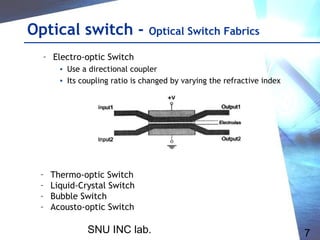
– Electro-optic Switch
• Use a directional coupler
• Its coupling ratio is changed by varying the refractive index
– Thermo-optic Switch
– Liquid-Crystal Switch
– Bubble Switch
– Acousto-optic Switch
SNU INC lab. 8
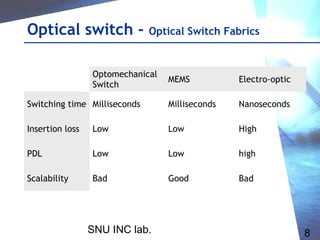
Optical switch - Optical Switch Fabrics
Optomechanical
Switch
MEMS Electro-optic
Switching time Milliseconds Milliseconds Nanoseconds
Insertion loss Low Low High
PDL Low Low high
Scalability Bad Good Bad
SNU INC lab. 9
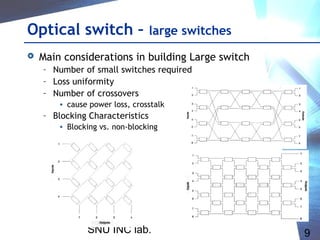
Optical switch – large switches
 Main considerations in building Large switch
– Number of small switches required
– Loss uniformity
– Number of crossovers
• cause power loss, crosstalk
– Blocking Characteristics
• Blocking vs. non-blocking
SNU INC lab. 10
Optical Packet Switching
 Optical Circuit Switching
– Limited circuit
– Low efficiency (due to fixed bandwidth)
 Optical Packet Switching
– Using Packet ( = Header (for routing) + Data )
 If Optical Packet Switching is realized, it can
– allocate WDM channels on demand (microsecond)
– share network resource efficiently
– support burst traffic efficiently
– offer high-speed data rate/format transparency &
configurability
SNU INC lab. 11
Optical Packet Switching
 What is the problem in implementing OPS?
– Long Switching time
– Buffer is needed
 Long switching time is due to
– Extracting the routing information from the header
– Controlling switching matrix electronically
– Performing the switching and buffering functions
 Buffer at Optical domain is needed
– Data should be buffered while header is processed
– When a contention is occurred
– When the bandwidth is not sufficient
 We don’t have perfect solutions yet.
SNU INC lab. 12
Optical Packet Switching
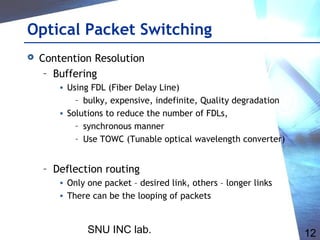
 Contention Resolution
– Buffering
• Using FDL (Fiber Delay Line)
– bulky, expensive, indefinite, Quality degradation
• Solutions to reduce the number of FDLs,
– synchronous manner
– Use TOWC (Tunable optical wavelength converter)
– Deflection routing
• Only one packet – desired link, others – longer links
• There can be the looping of packets
SNU INC lab. 13
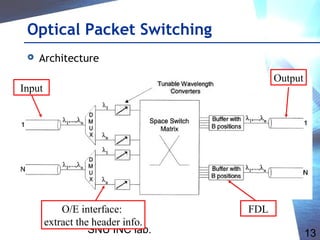
Optical Packet Switching
 Architecture
Output
Input
O/E interface:
extract the header info.
FDL
SNU INC lab. 14
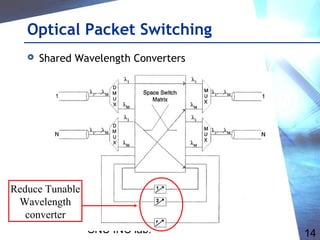
Optical Packet Switching
 Shared Wavelength Converters
Reduce Tunable
Wavelength
converter
SNU INC lab. 15
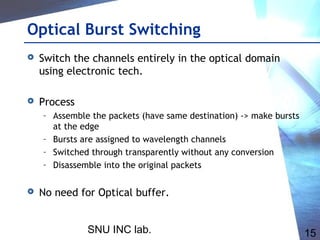
Optical Burst Switching
 Switch the channels entirely in the optical domain
using electronic tech.
 Process
– Assemble the packets (have same destination) -> make bursts
at the edge
– Bursts are assigned to wavelength channels
– Switched through transparently without any conversion
– Disassemble into the original packets
 No need for Optical buffer.
SNU INC lab. 16
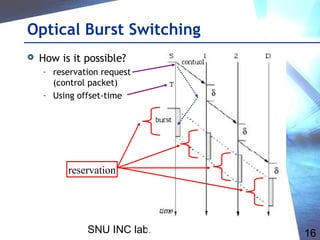
Optical Burst Switching
 How is it possible?
– reservation request
(control packet)
– Using offset-time
reservation
SNU INC lab. 17
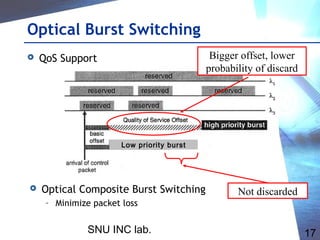
Optical Burst Switching
 QoS Support Bigger offset, lower
probability of discard
 Optical Composite Burst Switching
– Minimize packet loss
Low priority burst
Not discarded
SNU INC lab. 18
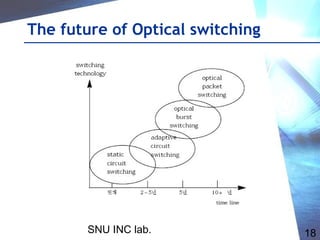
The future of Optical switching
SNU INC lab. 19
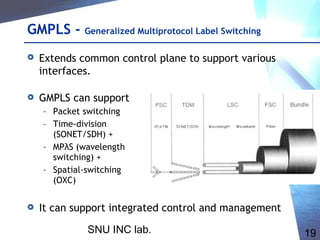
GMPLS - Generalized Multiprotocol Label Switching
 Extends common control plane to support various
interfaces.
 GMPLS can support
– Packet switching
– Time-division
(SONET/SDH) +
– MPλS (wavelength
switching) +
– Spatial-switching
(OXC)
 It can support integrated control and management
SNU INC lab. 20
Conclusion
 Optical fiber is not fully exploited
 Switching functions must be executed optically
 Two obstacles
– The lack of optical memory
– processing capabilities in optical domain
 In the future, breakthroughs may counteract
the fundamental limitations of optics
 Then, current network is completely changed

34. optical switch

  • 1.
    Optical SwitchingOptical Switching SwitchFabrics, Techniques and ArchitecturesSwitch Fabrics, Techniques and Architectures 원종호 (INC lab) Oct 30, 2006
  • 2.
    SNU INC lab.2 Outline  Introduction  Optical Switch  Optical Packet Switch  Optical Burst Switch  GMPLS  Conclusion
  • 3.
    SNU INC lab.3 Introduction  Internet traffic has doubled per year  New services like VOD, IPTV  DWDM (Dense Wavelength Division Multiplexing) is developed – Can transport tens to hundreds of wavelengths per fiber  Then, What is problem? – Slow O/E/O conversion. – Electronic equipment is dependent on the data rate & protocol. (non-transparent)  Goal? – All optical!
  • 4.
    SNU INC lab.4 Optical switch - OXC  What is Optical Cross-Connect (OXC)? – Set up light paths  Electrical XC, All-optical XC, Opaque XC Switch Fabric Electrical XC All-optical XC Process O/E/O (slow) O/O/O (fast) Data rate & format Transparent? No Yes Implementation Easy Hard  Major difficulties of All-optical XC – The lack of processing at bit level in optical domain – The lack of efficient buffering in optical domain
  • 5.
    SNU INC lab.5 Optical switch - Optical Switch Fabrics  Optical Switch Fabrics – Allow switching directly in the optical domain (All-optical)  Important parameters – Switching time ( )↓ – Insertion loss ( and loss uniformity at all input-output↓ connections) – Crosstalk ( )↓ – Extinction ratio (ratio of ON-OFF power) ( )↑ – Polarization-dependent loss ( )↓ – Reliability, energy usage, scalability, temperature resistance
  • 6.
    SNU INC lab.6 Optical switch - Optical Switch Fabrics  Main optical switching technologies – Opto-mechanical Switch • Use prisms, mirrors, directional couplers. • Lack of scalability – Micro-electro-mechanical System Device (MEMS) • Use tiny reflective surfaces to redirect the light • 2D-MEMS(on-off mirror) • 3D-MEMS(movable mirror) • Scalability • low loss • short switching time • Low power consumption • Low crosstalk • Low polarization effect
  • 7.
    SNU INC lab.7 Optical switch - Optical Switch Fabrics – Electro-optic Switch • Use a directional coupler • Its coupling ratio is changed by varying the refractive index – Thermo-optic Switch – Liquid-Crystal Switch – Bubble Switch – Acousto-optic Switch
  • 8.
    SNU INC lab.8 Optical switch - Optical Switch Fabrics Optomechanical Switch MEMS Electro-optic Switching time Milliseconds Milliseconds Nanoseconds Insertion loss Low Low High PDL Low Low high Scalability Bad Good Bad
  • 9.
    SNU INC lab.9 Optical switch – large switches  Main considerations in building Large switch – Number of small switches required – Loss uniformity – Number of crossovers • cause power loss, crosstalk – Blocking Characteristics • Blocking vs. non-blocking
  • 10.
    SNU INC lab.10 Optical Packet Switching  Optical Circuit Switching – Limited circuit – Low efficiency (due to fixed bandwidth)  Optical Packet Switching – Using Packet ( = Header (for routing) + Data )  If Optical Packet Switching is realized, it can – allocate WDM channels on demand (microsecond) – share network resource efficiently – support burst traffic efficiently – offer high-speed data rate/format transparency & configurability
  • 11.
    SNU INC lab.11 Optical Packet Switching  What is the problem in implementing OPS? – Long Switching time – Buffer is needed  Long switching time is due to – Extracting the routing information from the header – Controlling switching matrix electronically – Performing the switching and buffering functions  Buffer at Optical domain is needed – Data should be buffered while header is processed – When a contention is occurred – When the bandwidth is not sufficient  We don’t have perfect solutions yet.
  • 12.
    SNU INC lab.12 Optical Packet Switching  Contention Resolution – Buffering • Using FDL (Fiber Delay Line) – bulky, expensive, indefinite, Quality degradation • Solutions to reduce the number of FDLs, – synchronous manner – Use TOWC (Tunable optical wavelength converter) – Deflection routing • Only one packet – desired link, others – longer links • There can be the looping of packets
  • 13.
    SNU INC lab.13 Optical Packet Switching  Architecture Output Input O/E interface: extract the header info. FDL
  • 14.
    SNU INC lab.14 Optical Packet Switching  Shared Wavelength Converters Reduce Tunable Wavelength converter
  • 15.
    SNU INC lab.15 Optical Burst Switching  Switch the channels entirely in the optical domain using electronic tech.  Process – Assemble the packets (have same destination) -> make bursts at the edge – Bursts are assigned to wavelength channels – Switched through transparently without any conversion – Disassemble into the original packets  No need for Optical buffer.
  • 16.
    SNU INC lab.16 Optical Burst Switching  How is it possible? – reservation request (control packet) – Using offset-time reservation
  • 17.
    SNU INC lab.17 Optical Burst Switching  QoS Support Bigger offset, lower probability of discard  Optical Composite Burst Switching – Minimize packet loss Low priority burst Not discarded
  • 18.
    SNU INC lab.18 The future of Optical switching
  • 19.
    SNU INC lab.19 GMPLS - Generalized Multiprotocol Label Switching  Extends common control plane to support various interfaces.  GMPLS can support – Packet switching – Time-division (SONET/SDH) + – MPλS (wavelength switching) + – Spatial-switching (OXC)  It can support integrated control and management
  • 20.
    SNU INC lab.20 Conclusion  Optical fiber is not fully exploited  Switching functions must be executed optically  Two obstacles – The lack of optical memory – processing capabilities in optical domain  In the future, breakthroughs may counteract the fundamental limitations of optics  Then, current network is completely changed

Editor's Notes

  • #3 처음 introduction으로 시작하여 optical switch의 기본적인 것들을 살펴보고 Optical packet switch의 구성 및 특징, 문제점에 대해 알아보겠습니다. 이런 문제점을 해결하기 위해 고안된 optical burst switch에 대해 살펴보고 마지막으로 GMPLS에 대해 살펴보겠습니다.
  • #4 그럼 현재 옵티컬 기술이 안고 있는 문제는 무엇일까요? 첫째는 광 전 광으로 변환되는 부분에서 병목 현상이 발생한다는 점입니다. 두번째는 전자 기기로 변환되는 과정에서 data의 rate과 protocol이 정해진다는 점입니다. 이것은 다양한 미래에 생길 지도 모르는 새로운 data rate과 protocol을 지원할 수 없다는 뜻입니다.
  • #5 스위치 구조에 따라 Electrical XC, All-optical XC, Opaque XC로 나뉨
  • #6 그럼 all optical 구현을 위한 optical switch fabric에 대해 살펴보겠습니다.
  • #7 MEMS 공간적인 움직임이 가능한 Si 기판 등을 사용한 미소 거울의 각도를 변경시켜 광로 변경
  • #20 GMPLS는 기존의 PSC inf, TDM inf. LSC, FSC 에서도 적용 가능하도록 제어평면을 확장하는 기술이다. 이런 다양한 인터페이스를 지원하기 위해 LSP를 계층화 한다. PSC는 TDM inf.에 다중화 되어 들어갈 수 있다. 다양한 스위칭 타입에 공통적인 제어 평면을 구현하기 위해 GMPLS에서는 MPLS signaling 및 routing protocol을 확장