1
MOEMS simulation
Presented
By
Ramesh Kumar
Professor, BIT, Durg
2
 
 
MOEMS microstructures are manufactured in
batch methodologies similar to computer
microchips. The photolithographic techniques
that mass-produce millions of complex
microchips can also be used simultaneously to
develop and produce mechanical sensors and
actuators integrated with electronic circuitry.
Most MOEMS devices are built on wafers of
silicon, adopting micromachining technologies
from integrated circuit (IC) manufacturing and
batch fabrication techniques.
MOEMS and ICs
3
MEMS Introduction
•Physical actions require mechanical by 
actuation of electrical actions.
•Automation and technological competence are 
the basic goals of development
•Integration of Electrical & Mechanical system 
result in complete system:Both Electrical and 
Mechanical components embedded on same 
substrate 
4
            MEMS Introduction                 Contd.
The basic approaches are
•Miniaturization
•Multiplicity
•Microelectronics
•The dimension of Electrical devices is in milli   
    to micro meter & some times nano mt.
•The dimension of mechanical devices is 3 to 6 
times that of electronics devices
5
Micro-Optical-Electro-Mechanical-Systems 
(MOEMS)
If in the MEMS technology, optical components is 
combined with mechanisms to allow motion with 
electrical structures to provide actuation then the 
system developed is termed as MOEMS
6
Input Signal Microsensing Element Transduction 
Unit
Output 
signal
Power supply
MOEMS as Microsensor
7
•Acoustic Wave sensor
•Humidity sensor
•Displacement sensor
•Biomedical sensor
•Biosensor
•Chemical Sensor
•Optical Sensor
•Pressure Sensor
•Thermal Sensor
Types of Microsensors
8
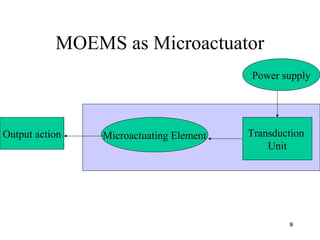
Output action Microactuating Element Transduction 
Unit
Power supply
MOEMS as Microactuator
9
•Actuation Using Thermal Forces
•Actuation using shape memory alloys
•Actuation Using Piezoelectric Crystals
•Actuation Using Electrostatic Forces
Microactuation
10
Advantages
•To provide general solution
•To make cost effective approach
•For teaching & Demonstration
•Analyze & verify theoretical model
•Research tool
•Complexity of problems easily understood
•Lowers time & cost in designing
11
•Light weight, Small size
• No induce impulse
•No effect in explosive environments
•Immunity to adverse temp. and moisture
•Low cost
•No additional protection
•No problem in space radiation
•No electromagnetic interference
•No crosstalk interference
Benefits of Optics
12
Need of SimulationDifferent level of Abstraction
Alternative solution
Practical feedback at time of designing
Real life solution
Trade offs between accurate modeling
Cost
Teaching & demonstration
Time
Large data handling
Debugging and tuning in Design
Visualize data
Virtual prototype
13
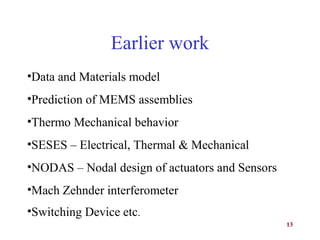
Earlier work
•Data and Materials model
•Prediction of MEMS assemblies
•Thermo Mechanical behavior
•SESES – Electrical, Thermal & Mechanical
•NODAS – Nodal design of actuators and Sensors
•Mach Zehnder interferometer
•Switching Device etc.
14
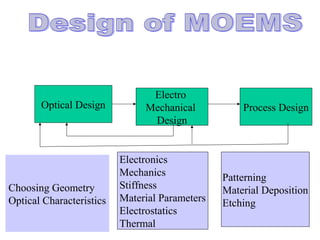
Optical Design
Electro
Mechanical
Design
Process Design
Choosing Geometry
Optical Characteristics
Electronics
Mechanics
Stiffness
Material Parameters
Electrostatics
Thermal
Patterning
Material Deposition
Etching
15
Design
Parameters
16
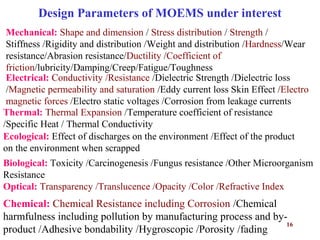
Design Parameters of MOEMS under interest
Mechanical: Shape and dimension / Stress distribution / Strength /
Stiffness /Rigidity and distribution /Weight and distribution /Hardness/Wear
resistance/Abrasion resistance/Ductility /Coefficient of
friction/lubricity/Damping/Creep/Fatigue/Toughness
Electrical: Conductivity /Resistance /Dielectric Strength /Dielectric loss
/Magnetic permeability and saturation /Eddy current loss Skin Effect /Electro
magnetic forces /Electro static voltages /Corrosion from leakage currents
Thermal: Thermal Expansion /Temperature coefficient of resistance
/Specific Heat / Thermal Conductivity
Ecological: Effect of discharges on the environment /Effect of the product
on the environment when scrapped
Biological: Toxicity /Carcinogenesis /Fungus resistance /Other Microorganism
Resistance
Optical: Transparency /Translucence /Opacity /Color /Refractive Index
Chemical: Chemical Resistance including Corrosion /Chemical
harmfulness including pollution by manufacturing process and by-
product /Adhesive bondability /Hygroscopic /Porosity /fading
17
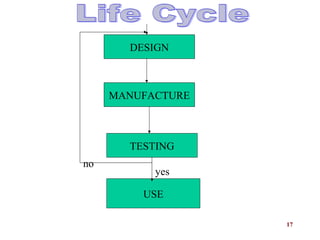
DESIGN
MANUFACTURE
TESTING
USE
no
yes
18
Methodology
19
Methodology
•Modeling of MOEMS as Sensor
•Modeling based on different substrates
•Modeling of MOEMS as Actuator
•Beam Propagation Technique
•Computational OptoElectroMechanics ( High
Fidelity Modeling )
•High Fidelity Modeling of Electromagnetic Field
20
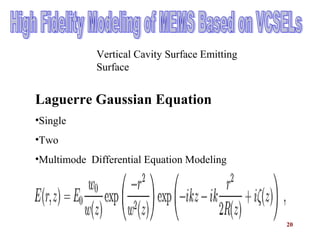
Laguerre Gaussian Equation
•Single
•Two
•Multimode Differential Equation Modeling
Vertical Cavity Surface Emitting
Surface
21
Maxwell’s Equation
•Boundary Conditions
•Fast Fourier Transformation
(1) div D = ρ, (2) div B = 0, (3) curl E = -dB/dt,
and (4) curl H = dD/dt + J.
rho, ρ, is charge density, J is current density,
E is the electric field, and B is the magnetic
field; here, D and H are field quantities that
are proportional to E and B, respectively.
22
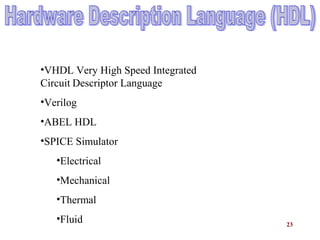
Helmholtz Equation
•Free Space
•Guided wave propagation
•FD-BMP
•FFT-BMP
Helmholtz (time-independent
diffusion) equation
23
•VHDL Very High Speed Integrated
Circuit Descriptor Language
•Verilog
•ABEL HDL
•SPICE Simulator
•Electrical
•Mechanical
•Thermal
•Fluid
24
Simulation outcome
•Modeling and Analysis based on different parameter.
•Parameters effect
•Variations of refractive index
Modeling & Simulation for the optical & electro-
mechanical parts is usually done separately, But here
it is tried to integrate in one.
25
•Accuracy in distance measurements
•EMI insensitivity in harsh environments
•Security in exploding fields
•Selectivity in chemical detection
•Miniaturization
•Reliability
•Mass and size reduction
•Mass production capability
•Low manufacturing costs
Benefits of using MOEMS
26
•Sand-sized machines
•chip to think, act, and communicate
•intelligent Microsystems
•systems-on-a-chip
•Sensing and acting
•potentially quite inexpensive
•millimeters to a dozen microns
•miniature parts
•use little power, occupy a small volume
Advantages
27
•Limited Options
•Packaging
•Fabrication Knowledge Required
•Expermintal data
•Technological barrier
• Acceptence
• Less Fabrication center
Limitation
28
smart dust
Smart roads
sensors in automobile airbags
Medical
 aviation
Defense
Wireless communication
and optical communications systems.
automobile-mounted global positioning systems
Today & Future
29
Outstanding industrial applications of MOEMS are
•Peripherals and Telecom
•Biomedical
•Automotive
•Industrial maintenance and control
•Demotic
•Space and astronomy
•Environmental monitoring
MOEMS applications
30
Applications
31
•Inertial Measurements - Accelerometers, gyroscopes, rate
sensors, vibration sensors.
•Pressure Measurements - TPMS (Tire Pressure Monitoring
System) , disposable blood pressure sensors and various
industrial applications.
•Display Technology - Optical MEMS in projectors, plasma
displays.
•RF Technology - Tunable filters, RF switches, antennas,
phase shifters, passive components (capacitors,
inductors).
• Chemical Measurements - Microfluidics: Lab-On-Chip
devices, DNA test structures, micro-dispensing pumps,
hazardous chemical and biological agent detectors
Typical Device Applications
32
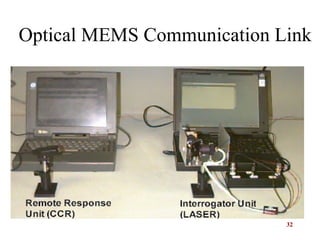
Optical MEMS Communication Link
33
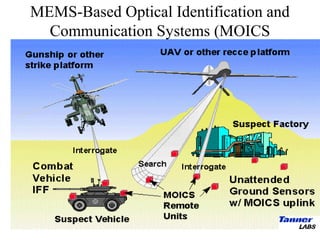
MEMS-Based Optical Identification and
Communication Systems (MOICS
34
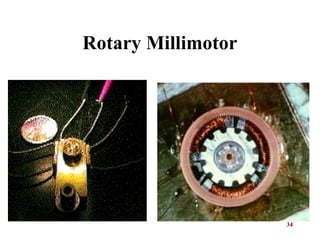
Rotary Millimotor
35
Thanks

Moems.ppt