MEMS
Introduction
Contents:
1. Definition
2. Interdisciplinary Technology
3. MEMS Process Block Diagram
4. MEMS Characteristics
5. MEMS Device Size
6. MEMS Switching Types
7. Advantages of MEMS
8. Disadvantages of MEMS
9. MEMS Applications
10. Basic Fabrication Steps of MEMS
Micro-Electro Mechanical Systems 2
MEMS Introduction – Definition:
 MEMS stands for Micro-Electro Mechanical Systems.
 Definition - A technological process to design and develop miniature integrated devices that
comprise both mechanical and electrical-electronic components.
 MEMS consists - Central Processing Unit (CPU), and static and moving components interacting
with the surrounding environment, i.e. micro-sensors.
 Called as MEMS in USA, Micro-Machines (MM) in Japan and Microsystem Technology (MST)
in Europe.
 Umbrella term for a wide range of micro-fabrication designs, methods and mechanisms that
involve realizing moving mechanical parts at microscopic scale.
Micro-Electro Mechanical Systems 3
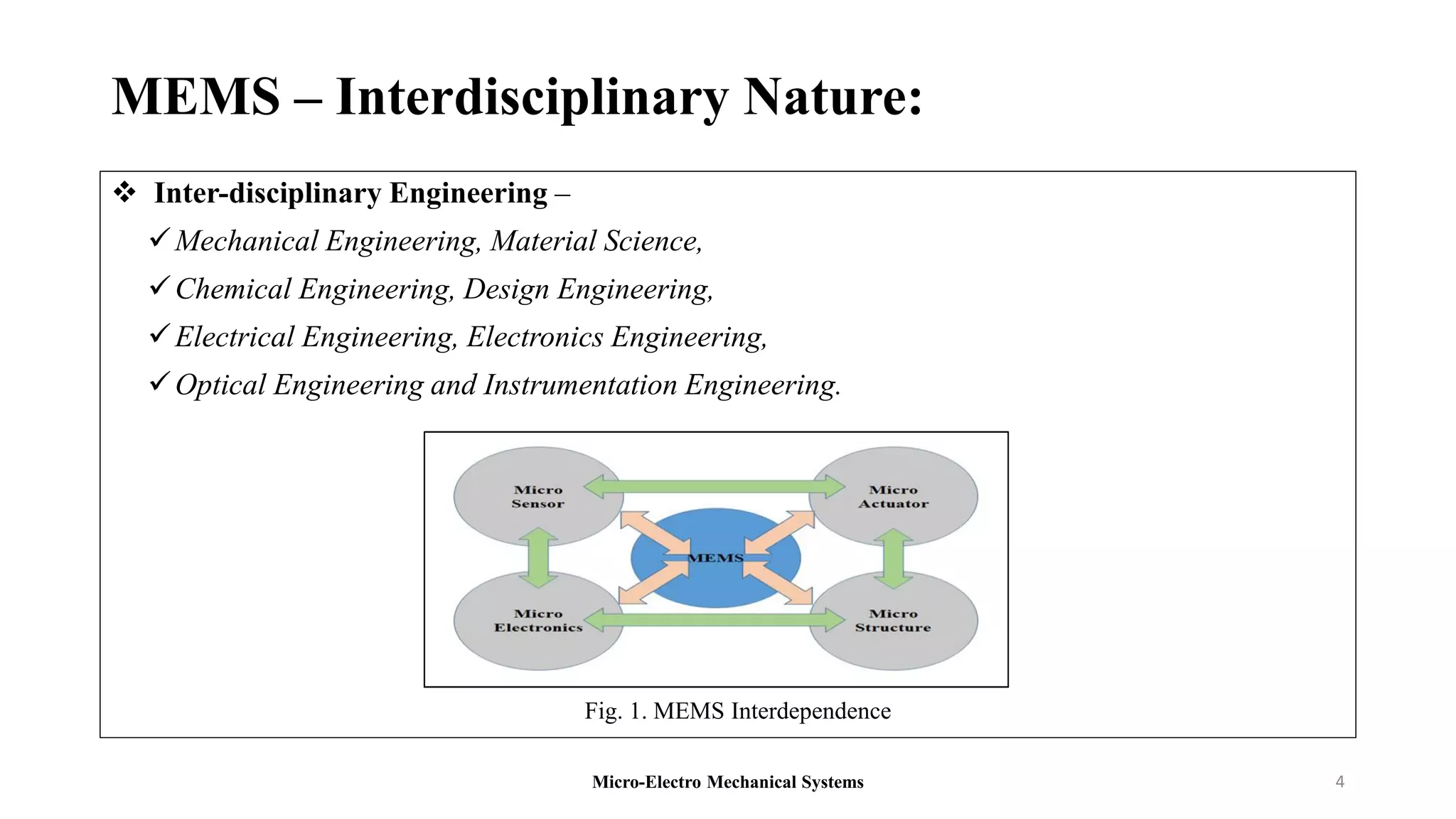
MEMS – Interdisciplinary Nature:
 Inter-disciplinary Engineering –
Mechanical Engineering, Material Science,
Chemical Engineering, Design Engineering,
Electrical Engineering, Electronics Engineering,
Optical Engineering and Instrumentation Engineering.
Micro-Electro Mechanical Systems 4
Fig. 1. MEMS Interdependence
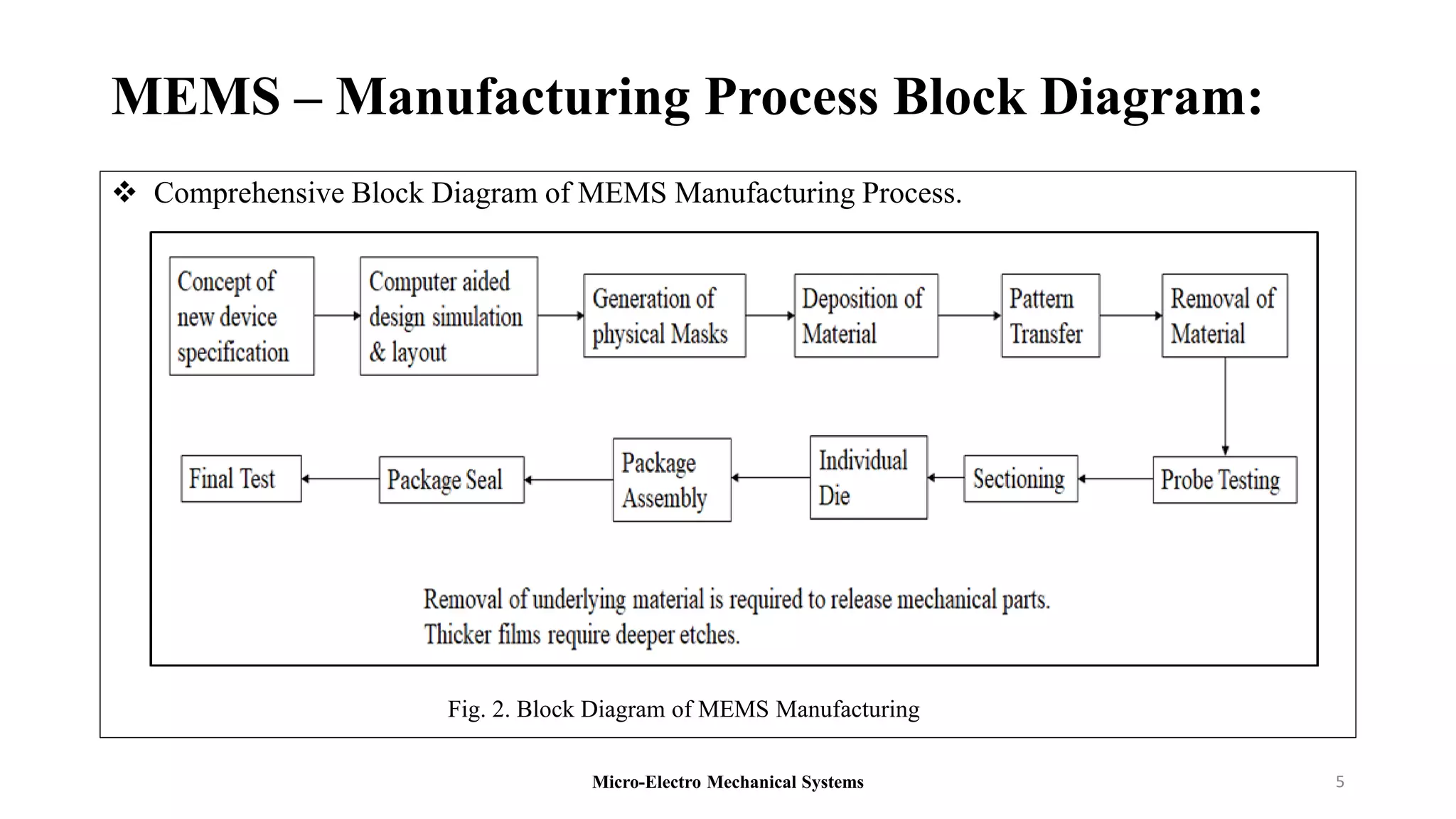
MEMS – Manufacturing Process Block Diagram:
 Comprehensive Block Diagram of MEMS Manufacturing Process.
Micro-Electro Mechanical Systems 5
Fig. 2. Block Diagram of MEMS Manufacturing
MEMS – Characteristics:
 The intrinsic characteristics of MEMS-based devices are:
1. Miniaturization (1 μm to 1 cm)
2. Electronic Integration
3. Precision Control of Physical Dimensions.
4. Parallel Fabrication
5. Cost Effective Batch Fabrication.
Micro-Electro Mechanical Systems 6
MEMS – Characteristics:
 Miniaturization leads to:
1. High resonance frequency (ranging from Hz to MHz).
2. Enhanced sensitivity (output at 5 psi / 34 kPa / 345 mbar at 100 millivolts (mV)).
3. Good Stability (greater accuracy with marginal drift).)
4. Low thermal mass and thermal hysteresis (thermal hysteresis offset of <0.05% FSO).
 Electronic Integration leads to:
1. Seamless integration of mechanical sensors and actuator with electronic processors.
2. Monolithic integration (complete circuit on a single piece of silicon).
3. Improved signal quality due to reduced noise.
 Parallel Fabrication leads to:
1. High aspect ratio (ratio of width to height).
2. High uniformity across wafer.
3. High precision and multidimensional features.
Micro-Electro Mechanical Systems 7
MEMS – Device Size:
 Fabricated by using IC batch process manufacturing techniques.
 Miniaturized size leads to consumes low power, and maintaining of very high isolation.
 Comprises – simple static to complex structures multi-moving parts.
 Size – Few micro-meters to millimetres.
 Influence – Macro-scale control elements and devices.
 Built of components - 1 and 100 μm in size (i.e., 0.001 to 0.1 mm).
 MEMS device range - 20 μm to 1 millimetre (i.e., 0.02 to 1.0 mm).
 Although components arranged in arrays (e.g., digital micro-mirror devices) can be more than
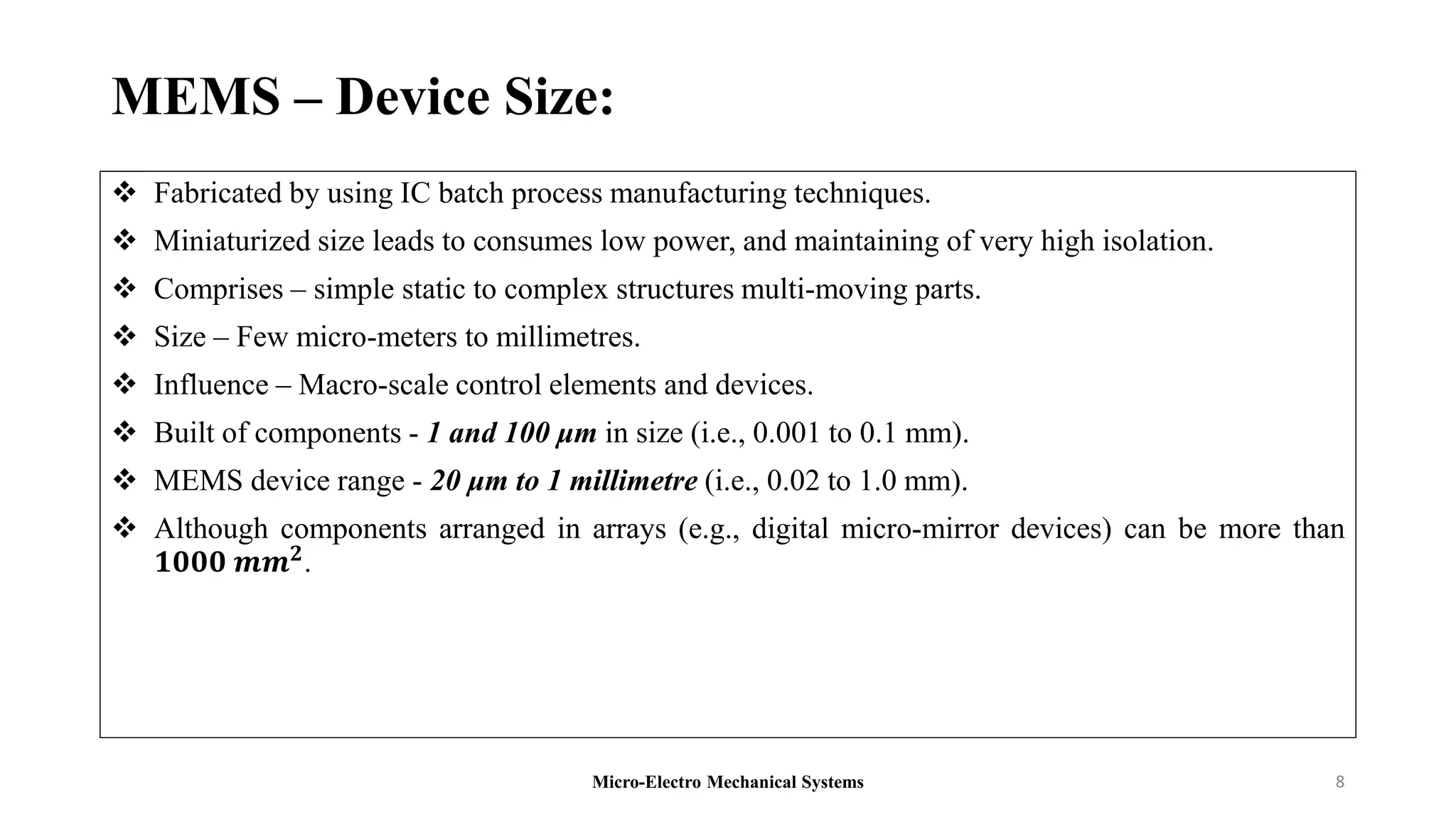
𝟏𝟎𝟎𝟎 𝒎𝒎𝟐.
Micro-Electro Mechanical Systems 8
MEMS – Switch Types:
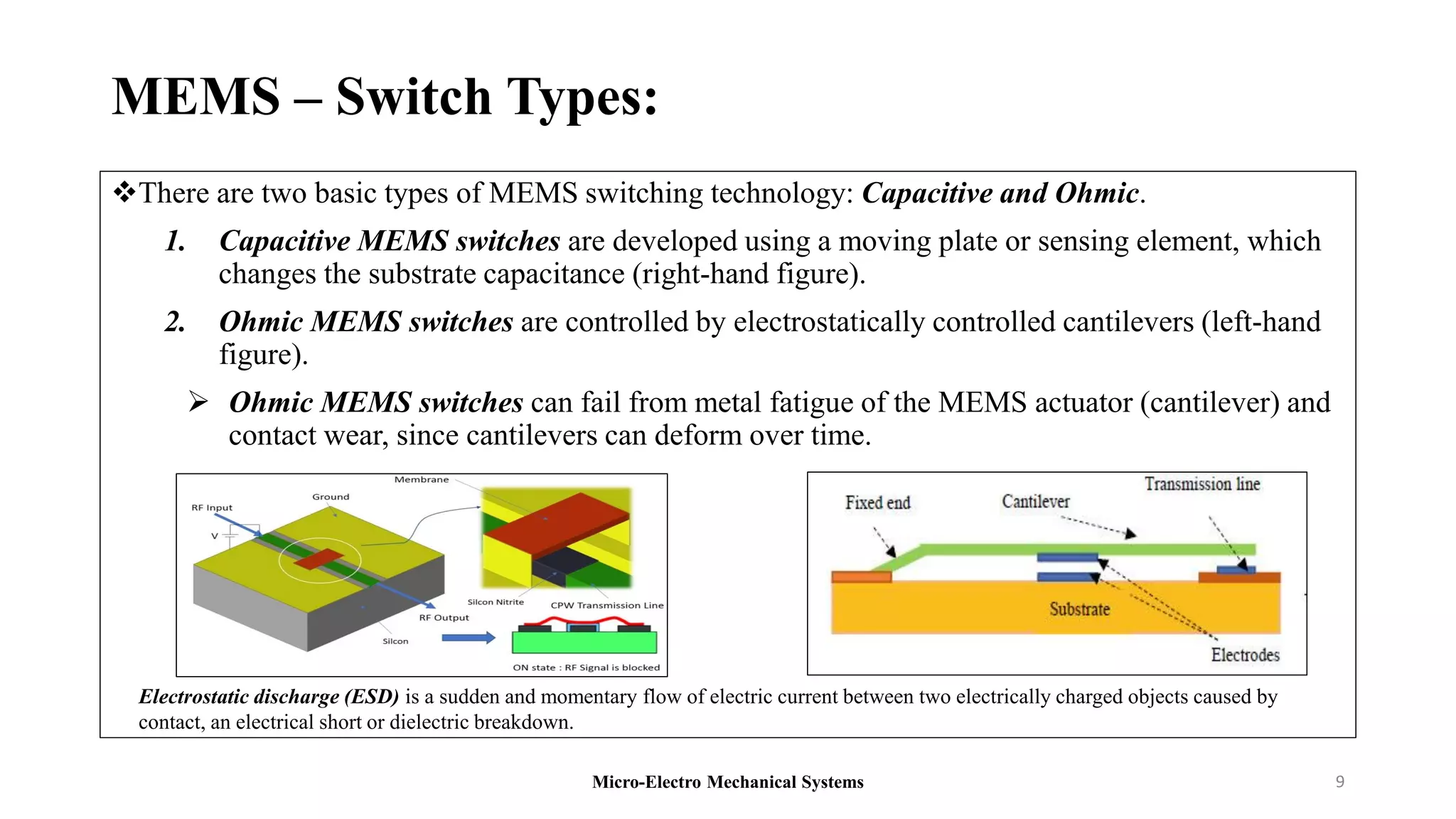
There are two basic types of MEMS switching technology: Capacitive and Ohmic.
1. Capacitive MEMS switches are developed using a moving plate or sensing element, which
changes the substrate capacitance (right-hand figure).
2. Ohmic MEMS switches are controlled by electrostatically controlled cantilevers (left-hand
figure).
 Ohmic MEMS switches can fail from metal fatigue of the MEMS actuator (cantilever) and
contact wear, since cantilevers can deform over time.
Micro-Electro Mechanical Systems 9
Electrostatic discharge (ESD) is a sudden and momentary flow of electric current between two electrically charged objects caused by
contact, an electrical short or dielectric breakdown.
MEMS – Advantages:
 Advantages of MEMS:
1. Small size, dimension & weight.
2. Consumption of very low power.
3. High productivity (Batch fabricated in large arrays).
4. Superior performance & Wide range compatibility.
5. Low cost.
6. Easy to integrate and modify into systems.
7. Small thermal constant, & Improved thermal expansion tolerance
8. Negligible thermal hysteresis.
9. Resistant to shock, vibration and radiation.
Micro-Electro Mechanical Systems 10
MEMS – Disadvantages:
 Drawbacks in MEMS:
1. Significant power transfer is challenging due to their excessive miniaturized size.
2. The wafer material cannot be exposed to large loads as that might damage the wafer.
3. High cost involvement in the Research & Development stages.
4. It is still a developing field, and therefore reliability at times is a concern.
Micro-Electro Mechanical Systems 11
MEMS – Applications:
 MEMS - capable to sense, control and actuate on micro scales.
 MEMS - applications in electronic control and bio-sensing applications.
 MEMS devices find widespread applications in:
1. Navigation field.
1) Marine environment and Geo-mapping.
2) Natural Resource Identification like Oil and Gas exploration.
2. Environmental Studies.
1) MEMS barometer.
2) Weather predictions.
3) Water quality monitor.
4) Aquatic and ocean ecology studies.
Micro-Electro Mechanical Systems 12
MEMS – Applications:
3. Bio medical applications.
1) Bio-cavity Laser to distinguish between cancerous and non-cancerous cells.
2) Smart Pill – body implantation and automatic drug delivery.
3) Synthetic Eyesight – MEMS based array inserted in retina to instil partial vision.
4) Lab-On-Chip, Micro Total Analyser, embedded medical devices, viz. stents.
4. Security and surveillance.
1) MEMS gyroscope in drones.
2) Inertial Navigation System (INS) to facilitate auto-pilot.
5. Military Operation.
1) Pressure sensing for anti-torpedo weaponry.
2) Submarine Detection.
Micro-Electro Mechanical Systems 13
MEMS – Applications:
6. High frequency circuit designs.
1) Micro-actuation in micro-scale devices.
2) MEMS switches.
3) Micro-pumps.
4) Micro-levers.
5) Micro-grippers
7. Micro scale Energy Harvester
1) Micro-piezoelectric crystals.
2) Electrostatic energy harvesters.
3) Electromagnetic energy harvesters.
8. Microscopy
1) Scanning probe microscope.
2) Atomic Force microscope.
Micro-Electro Mechanical Systems 14
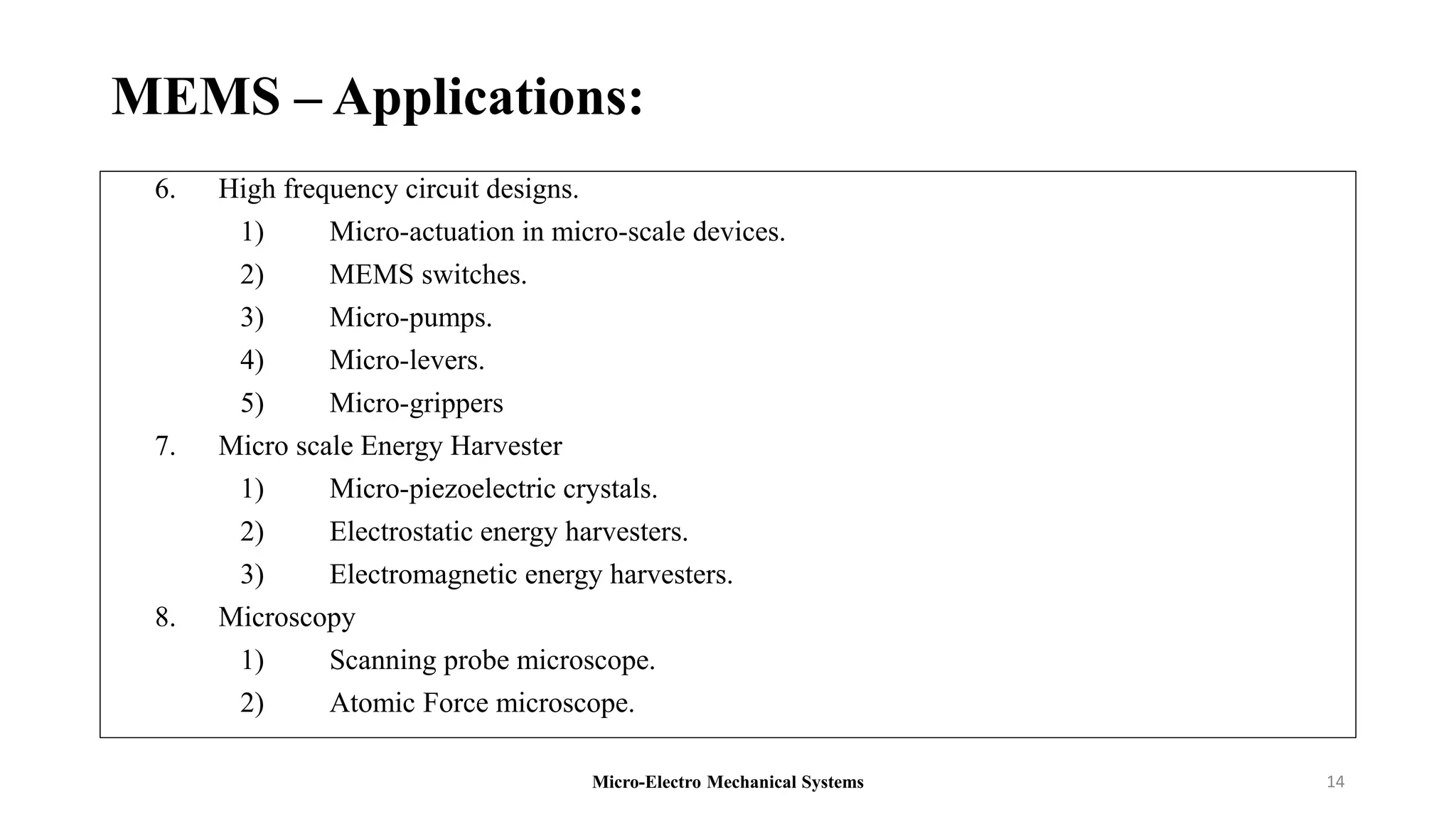
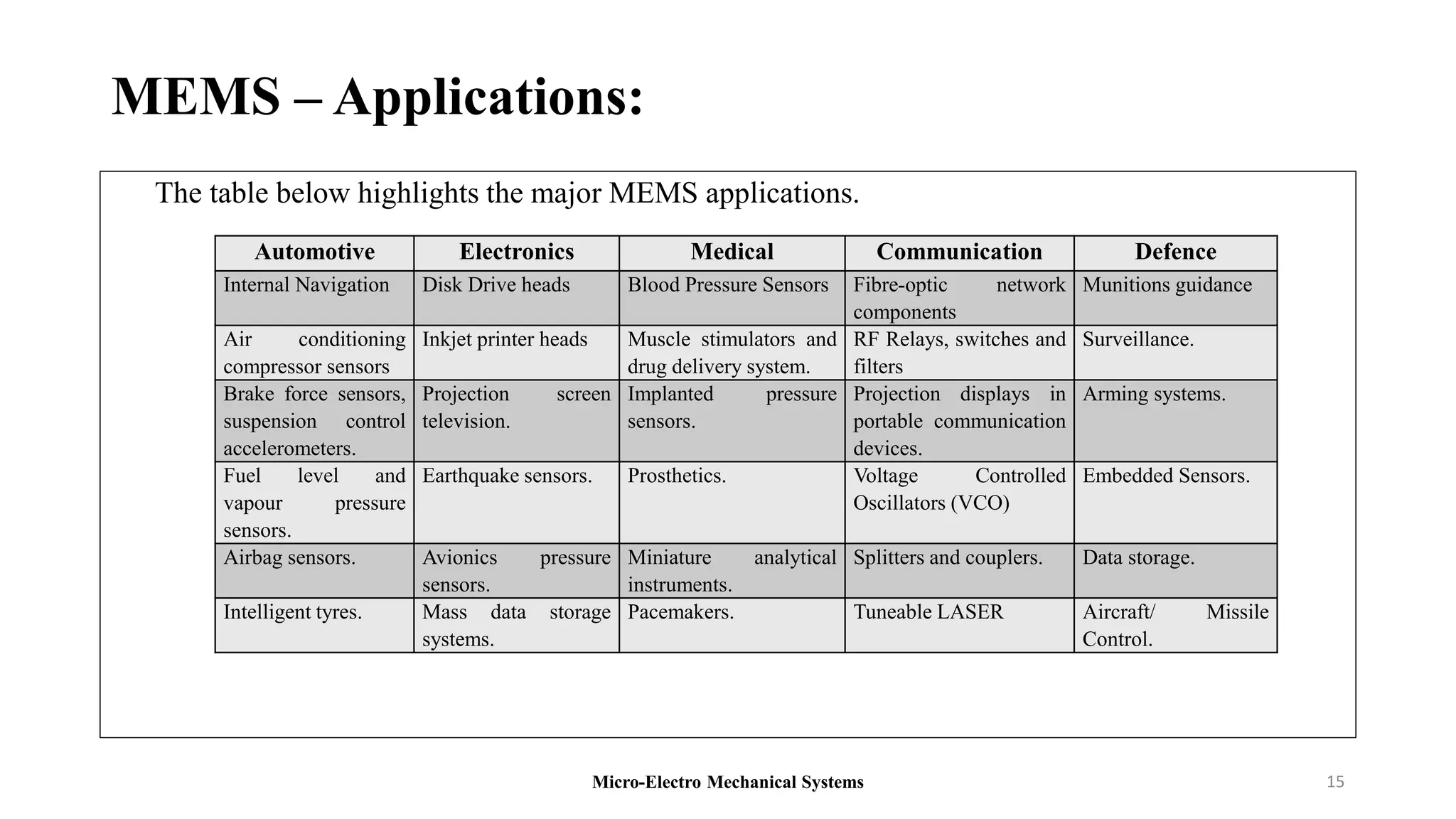
MEMS – Applications:
The table below highlights the major MEMS applications.
Micro-Electro Mechanical Systems 15
Automotive Electronics Medical Communication Defence
Internal Navigation Disk Drive heads Blood Pressure Sensors Fibre-optic network
components
Munitions guidance
Air conditioning
compressor sensors
Inkjet printer heads Muscle stimulators and
drug delivery system.
RF Relays, switches and
filters
Surveillance.
Brake force sensors,
suspension control
accelerometers.
Projection screen
television.
Implanted pressure
sensors.
Projection displays in
portable communication
devices.
Arming systems.
Fuel level and
vapour pressure
sensors.
Earthquake sensors. Prosthetics. Voltage Controlled
Oscillators (VCO)
Embedded Sensors.
Airbag sensors. Avionics pressure
sensors.
Miniature analytical
instruments.
Splitters and couplers. Data storage.
Intelligent tyres. Mass data storage
systems.
Pacemakers. Tuneable LASER Aircraft/ Missile
Control.
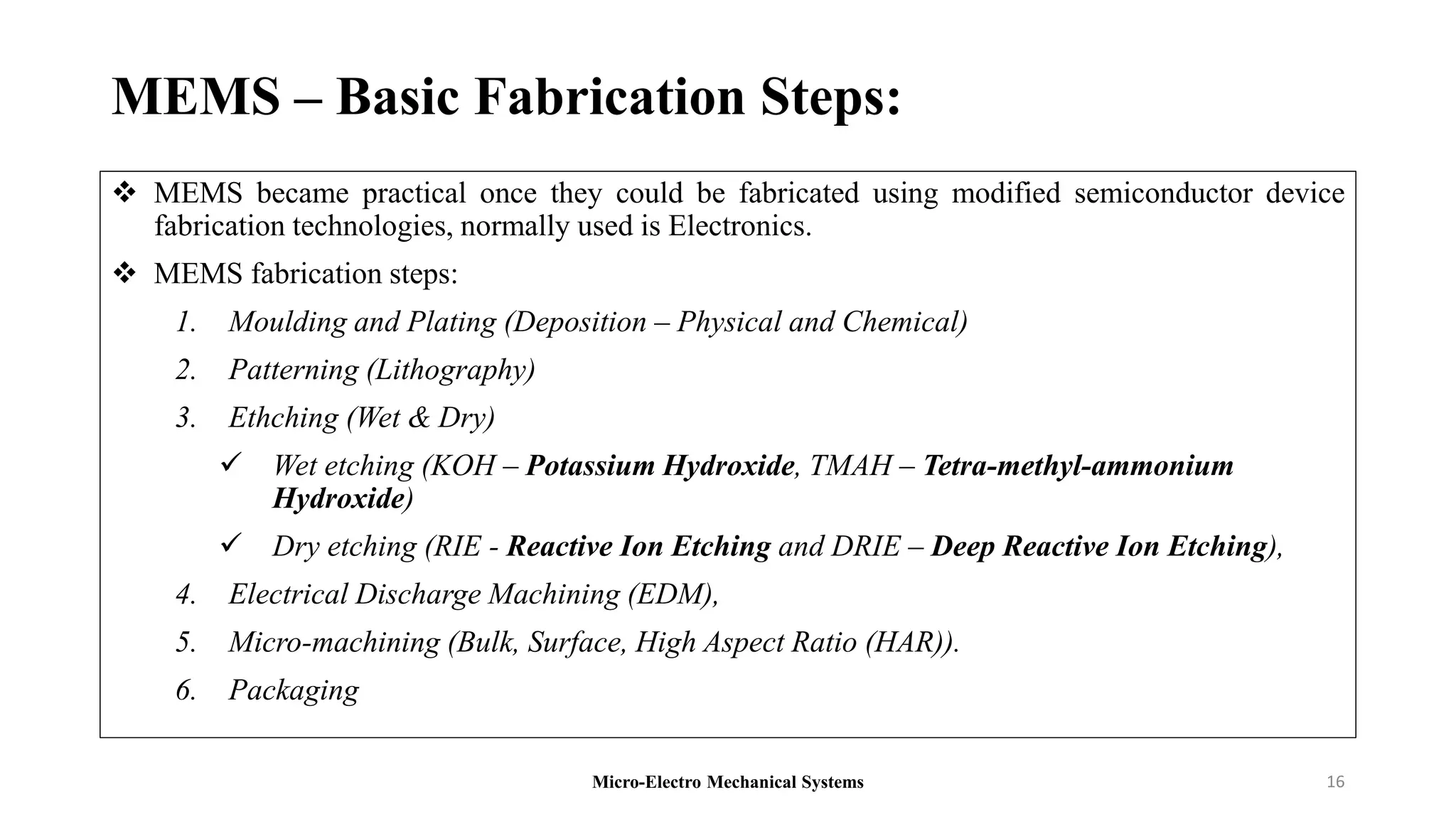
MEMS – Basic Fabrication Steps:
 MEMS became practical once they could be fabricated using modified semiconductor device
fabrication technologies, normally used is Electronics.
 MEMS fabrication steps:
1. Moulding and Plating (Deposition – Physical and Chemical)
2. Patterning (Lithography)
3. Ethching (Wet & Dry)
 Wet etching (KOH – Potassium Hydroxide, TMAH – Tetra-methyl-ammonium
Hydroxide)
 Dry etching (RIE - Reactive Ion Etching and DRIE – Deep Reactive Ion Etching),
4. Electrical Discharge Machining (EDM),
5. Micro-machining (Bulk, Surface, High Aspect Ratio (HAR)).
6. Packaging
Micro-Electro Mechanical Systems 16
References:
1. P.C https://www.mems-exchange.org/MEMS/what-is.html
2. P.C https://www.bosch-sensortec.com/about-us/our-company/mems-expertise/
3. P.C https://wpo-altertechnology.com/mems-packaging/
4. Gabriel K, Jarvis J, Trimmer W (1988). Small Machines, Large Opportunities: A Report on the Emerging
Field of Microdynamics: Report of the Workshop on Microelectromechanical Systems Research. National
Science Foundation (sponsor). AT&T Bell Laboratories.
5. Waldner JB (2008). Nanocomputers and Swarm Intelligence. London: ISTE John Wiley & Sons.
p. 205. ISBN 9781848210097.
6. Angell JB, Terry SC, Barth PW (1983). "Silicon Micromechanical Devices".
7. Sci. Am. 248 (4): 44–55
8. Bibcode:1983SciAm.248d..44A. doi:10.1038/scientificamerican0483-44.
9. Dirk K. de Vries (2005). "Investigation of gross die per wafer formulas". IEEE Transactions on
Semiconductor Manufacturing. 18 (February 2005): 136–139.
10. https://en.wikipedia.org/wiki/Flexural_strength
Micro-Electro Mechanical Systems 17

1_MEMS - Introduction.pdf

  • 1.
  • 2.
    Contents: 1. Definition 2. InterdisciplinaryTechnology 3. MEMS Process Block Diagram 4. MEMS Characteristics 5. MEMS Device Size 6. MEMS Switching Types 7. Advantages of MEMS 8. Disadvantages of MEMS 9. MEMS Applications 10. Basic Fabrication Steps of MEMS Micro-Electro Mechanical Systems 2
  • 3.
    MEMS Introduction –Definition:  MEMS stands for Micro-Electro Mechanical Systems.  Definition - A technological process to design and develop miniature integrated devices that comprise both mechanical and electrical-electronic components.  MEMS consists - Central Processing Unit (CPU), and static and moving components interacting with the surrounding environment, i.e. micro-sensors.  Called as MEMS in USA, Micro-Machines (MM) in Japan and Microsystem Technology (MST) in Europe.  Umbrella term for a wide range of micro-fabrication designs, methods and mechanisms that involve realizing moving mechanical parts at microscopic scale. Micro-Electro Mechanical Systems 3
  • 4.
    MEMS – InterdisciplinaryNature:  Inter-disciplinary Engineering – Mechanical Engineering, Material Science, Chemical Engineering, Design Engineering, Electrical Engineering, Electronics Engineering, Optical Engineering and Instrumentation Engineering. Micro-Electro Mechanical Systems 4 Fig. 1. MEMS Interdependence
  • 5.
    MEMS – ManufacturingProcess Block Diagram:  Comprehensive Block Diagram of MEMS Manufacturing Process. Micro-Electro Mechanical Systems 5 Fig. 2. Block Diagram of MEMS Manufacturing
  • 6.
    MEMS – Characteristics: The intrinsic characteristics of MEMS-based devices are: 1. Miniaturization (1 μm to 1 cm) 2. Electronic Integration 3. Precision Control of Physical Dimensions. 4. Parallel Fabrication 5. Cost Effective Batch Fabrication. Micro-Electro Mechanical Systems 6
  • 7.
    MEMS – Characteristics: Miniaturization leads to: 1. High resonance frequency (ranging from Hz to MHz). 2. Enhanced sensitivity (output at 5 psi / 34 kPa / 345 mbar at 100 millivolts (mV)). 3. Good Stability (greater accuracy with marginal drift).) 4. Low thermal mass and thermal hysteresis (thermal hysteresis offset of <0.05% FSO).  Electronic Integration leads to: 1. Seamless integration of mechanical sensors and actuator with electronic processors. 2. Monolithic integration (complete circuit on a single piece of silicon). 3. Improved signal quality due to reduced noise.  Parallel Fabrication leads to: 1. High aspect ratio (ratio of width to height). 2. High uniformity across wafer. 3. High precision and multidimensional features. Micro-Electro Mechanical Systems 7
  • 8.
    MEMS – DeviceSize:  Fabricated by using IC batch process manufacturing techniques.  Miniaturized size leads to consumes low power, and maintaining of very high isolation.  Comprises – simple static to complex structures multi-moving parts.  Size – Few micro-meters to millimetres.  Influence – Macro-scale control elements and devices.  Built of components - 1 and 100 μm in size (i.e., 0.001 to 0.1 mm).  MEMS device range - 20 μm to 1 millimetre (i.e., 0.02 to 1.0 mm).  Although components arranged in arrays (e.g., digital micro-mirror devices) can be more than 𝟏𝟎𝟎𝟎 𝒎𝒎𝟐. Micro-Electro Mechanical Systems 8
  • 9.
    MEMS – SwitchTypes: There are two basic types of MEMS switching technology: Capacitive and Ohmic. 1. Capacitive MEMS switches are developed using a moving plate or sensing element, which changes the substrate capacitance (right-hand figure). 2. Ohmic MEMS switches are controlled by electrostatically controlled cantilevers (left-hand figure).  Ohmic MEMS switches can fail from metal fatigue of the MEMS actuator (cantilever) and contact wear, since cantilevers can deform over time. Micro-Electro Mechanical Systems 9 Electrostatic discharge (ESD) is a sudden and momentary flow of electric current between two electrically charged objects caused by contact, an electrical short or dielectric breakdown.
  • 10.
    MEMS – Advantages: Advantages of MEMS: 1. Small size, dimension & weight. 2. Consumption of very low power. 3. High productivity (Batch fabricated in large arrays). 4. Superior performance & Wide range compatibility. 5. Low cost. 6. Easy to integrate and modify into systems. 7. Small thermal constant, & Improved thermal expansion tolerance 8. Negligible thermal hysteresis. 9. Resistant to shock, vibration and radiation. Micro-Electro Mechanical Systems 10
  • 11.
    MEMS – Disadvantages: Drawbacks in MEMS: 1. Significant power transfer is challenging due to their excessive miniaturized size. 2. The wafer material cannot be exposed to large loads as that might damage the wafer. 3. High cost involvement in the Research & Development stages. 4. It is still a developing field, and therefore reliability at times is a concern. Micro-Electro Mechanical Systems 11
  • 12.
    MEMS – Applications: MEMS - capable to sense, control and actuate on micro scales.  MEMS - applications in electronic control and bio-sensing applications.  MEMS devices find widespread applications in: 1. Navigation field. 1) Marine environment and Geo-mapping. 2) Natural Resource Identification like Oil and Gas exploration. 2. Environmental Studies. 1) MEMS barometer. 2) Weather predictions. 3) Water quality monitor. 4) Aquatic and ocean ecology studies. Micro-Electro Mechanical Systems 12
  • 13.
    MEMS – Applications: 3.Bio medical applications. 1) Bio-cavity Laser to distinguish between cancerous and non-cancerous cells. 2) Smart Pill – body implantation and automatic drug delivery. 3) Synthetic Eyesight – MEMS based array inserted in retina to instil partial vision. 4) Lab-On-Chip, Micro Total Analyser, embedded medical devices, viz. stents. 4. Security and surveillance. 1) MEMS gyroscope in drones. 2) Inertial Navigation System (INS) to facilitate auto-pilot. 5. Military Operation. 1) Pressure sensing for anti-torpedo weaponry. 2) Submarine Detection. Micro-Electro Mechanical Systems 13
  • 14.
    MEMS – Applications: 6.High frequency circuit designs. 1) Micro-actuation in micro-scale devices. 2) MEMS switches. 3) Micro-pumps. 4) Micro-levers. 5) Micro-grippers 7. Micro scale Energy Harvester 1) Micro-piezoelectric crystals. 2) Electrostatic energy harvesters. 3) Electromagnetic energy harvesters. 8. Microscopy 1) Scanning probe microscope. 2) Atomic Force microscope. Micro-Electro Mechanical Systems 14
  • 15.
    MEMS – Applications: Thetable below highlights the major MEMS applications. Micro-Electro Mechanical Systems 15 Automotive Electronics Medical Communication Defence Internal Navigation Disk Drive heads Blood Pressure Sensors Fibre-optic network components Munitions guidance Air conditioning compressor sensors Inkjet printer heads Muscle stimulators and drug delivery system. RF Relays, switches and filters Surveillance. Brake force sensors, suspension control accelerometers. Projection screen television. Implanted pressure sensors. Projection displays in portable communication devices. Arming systems. Fuel level and vapour pressure sensors. Earthquake sensors. Prosthetics. Voltage Controlled Oscillators (VCO) Embedded Sensors. Airbag sensors. Avionics pressure sensors. Miniature analytical instruments. Splitters and couplers. Data storage. Intelligent tyres. Mass data storage systems. Pacemakers. Tuneable LASER Aircraft/ Missile Control.
  • 16.
    MEMS – BasicFabrication Steps:  MEMS became practical once they could be fabricated using modified semiconductor device fabrication technologies, normally used is Electronics.  MEMS fabrication steps: 1. Moulding and Plating (Deposition – Physical and Chemical) 2. Patterning (Lithography) 3. Ethching (Wet & Dry)  Wet etching (KOH – Potassium Hydroxide, TMAH – Tetra-methyl-ammonium Hydroxide)  Dry etching (RIE - Reactive Ion Etching and DRIE – Deep Reactive Ion Etching), 4. Electrical Discharge Machining (EDM), 5. Micro-machining (Bulk, Surface, High Aspect Ratio (HAR)). 6. Packaging Micro-Electro Mechanical Systems 16
  • 17.
    References: 1. P.C https://www.mems-exchange.org/MEMS/what-is.html 2.P.C https://www.bosch-sensortec.com/about-us/our-company/mems-expertise/ 3. P.C https://wpo-altertechnology.com/mems-packaging/ 4. Gabriel K, Jarvis J, Trimmer W (1988). Small Machines, Large Opportunities: A Report on the Emerging Field of Microdynamics: Report of the Workshop on Microelectromechanical Systems Research. National Science Foundation (sponsor). AT&T Bell Laboratories. 5. Waldner JB (2008). Nanocomputers and Swarm Intelligence. London: ISTE John Wiley & Sons. p. 205. ISBN 9781848210097. 6. Angell JB, Terry SC, Barth PW (1983). "Silicon Micromechanical Devices". 7. Sci. Am. 248 (4): 44–55 8. Bibcode:1983SciAm.248d..44A. doi:10.1038/scientificamerican0483-44. 9. Dirk K. de Vries (2005). "Investigation of gross die per wafer formulas". IEEE Transactions on Semiconductor Manufacturing. 18 (February 2005): 136–139. 10. https://en.wikipedia.org/wiki/Flexural_strength Micro-Electro Mechanical Systems 17