FORCED COMUTATED
CYCLOCONVERTER
Presented by:
Rohit kumar
(M.E student)
Submitted to:
Er.Shimi S.L
(Assistant Professor)
INTRODUCTION
Cycloconverters directly convert ac power
of one frequency to ac power of different
frequency.
CYCLOCONVERTERAC (ONE FREQ.) AC(DIFFERENT FREQ.)
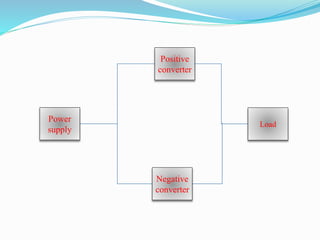
BLOCK DIAGRAM
OF
CYCLOCONVERTER
Power
supply
Negative
converter
Load
Positive
converter
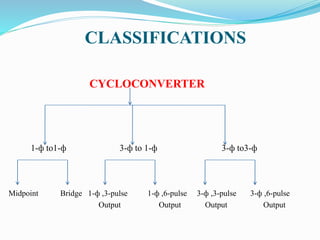
CLASSIFICATIONS
CYCLOCONVERTER
1-ф to1-ф 3-ф to 1-ф 3-ф to3-ф
Midpoint Bridge 1-ф ,3-pulse 1-ф ,6-pulse 3-ф ,3-pulse 3-ф ,6-pulse
Output Output Output Output
SINGLE PHASE TO
SINGLE PHASE
CYCLOCONVERTER
F O/PF I/P
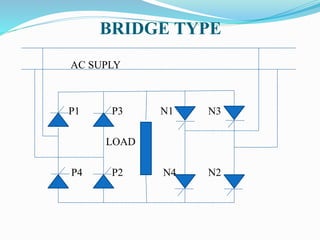
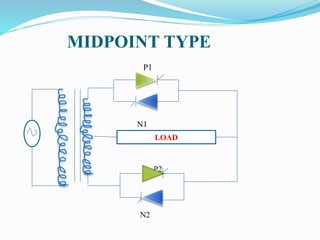
CIRCUIT DIAGRAM
BRIDGE TYPE
AC SUPLY
P1 P3 N1 N3
LOAD
P4 P2 N4 N2
MIDPOINT TYPE
P1
N1
P2
N2
LOAD
WORKING OF STEP DOWN
CYCLOCONVERTER WITH
SIMULINK MODEL
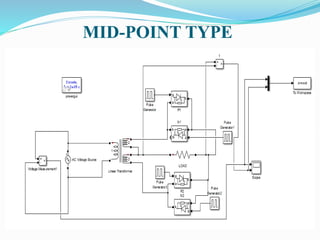
MID-POINT TYPE
OUTPUT OF SIMULINK MODEL
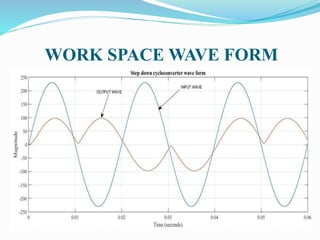
OTPUT FREQ.=(INPUT FREQ)/2
SIMULINK OUTPUT
WORK SPACE WAVE FORM
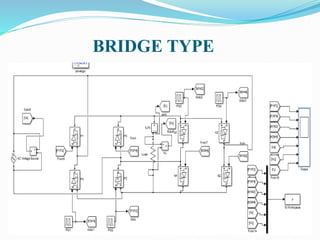
BRIDGE TYPE
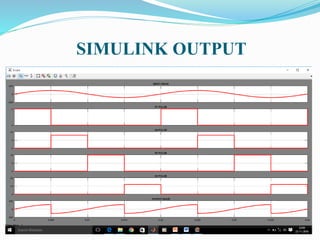
SIMULINK OUTPUT
WORK SPACE WAVE FORM
WORKING OF STEP -UP
CYCLOCONVERTER
OUTPUT OF SIMULINK MODEL
OTPUT FREQ.=2*(INPUT FREQ.)
MID-POINT TYPE
SIMULINK OUTPUT
WORK SPACE WAVE FORM
BRIDGE TYPE
SIMULINK OUTPUT
WORK SPACE WAVE FORM
3-PHASE
CYCLOCONVERTER
THREE PHASE TO
SINGLE PHASE
CYCLOCONVERTER
F O/PF I/P
SCHEMATIC DIAGRAM
Positive group Negative group
Load
Neutral
CIRCUIT CONFIGRATION
+GROUP - GROUP
LOAD
NEUTRAL
An output phase wave is achieved by
sinusoidal modulation of the thyristor
firing angles
Advantages of cycloconverters:
 Direct frequency conversion without any intermediate stage.
 Power transfer in either directions.
 Operates in any power factor
 Capable of regeneration over the complete speed range, down to
standstill.
 Commutation failure leads only to blown-off of individual fuses
only.
 Delivers a high quality sinusoidal waveform at low output
frequencies since it is fabricated from a large number of segments
of the supply waveform.
 This is often preferable for very low speed applications.
Applications
 Rolling mill main drives
 Mine hoist drives
 Ship propulsion
 Cement mill drives
 Scherbius drives
 Ore grinding mills
 Mine winders
Disadvantages of cycloconverters
 Complex control circuitry.
 Large number of thyristors are required in a Cyclo
converter.
 The power factor is low, particularly at reduced output
voltages.
RESEARCH PAPER
Cycloconverter-Based Double-Ended Microinverter
Topologies for Solar Photovoltaic AC Module
Ravi Kiran Surapaneni, Student Member, IEEE, Dorai
Babu Yelaverthi , and Akshay Kumar Rathore, Senior
Member, IEEE
IEEE JOURNAL OF EMERGING AND SELECTED
TOPICS IN POWER ELECTRONICS, VOL. 4, NO. 4,
DECEMBER 2016
 Abstract—This paper investigates a novel half-bridge
cycloconverter configuration on load side with devices operating
at line frequency, thus providing direct high-frequency ac to line
frequency ac conversion with transformer isolation. This paper
also presents a detailed comparative study and evaluation of
double-ended converters, viz., full-bridge, half-bridge, and push–
pull-based microinverter topologies for solar photovoltaic ac
module. Double-ended converters offer merits of no transformer
saturation, reduced transformer, and filter size. Simple sinusoidal
pulse width modulation for standalone mode and current control
for grid-tied mode are implemented for front-end devices.
Comparative study reveals that half-bridge topology is cheaper
than the other two topologies and has comparable efficiency with
full bridge. A 250-W laboratory prototype of half bridge
microinverter is developed, and experimental results are
demonstrated to show its performance under various conditions,
i.e., standalone, grid-tied, and change of current references.
REFERENCES
1. Mohammed Abdul Khader Aziz Biabani, Md Akheel Pasha
“Performance Analysis of Step up and Step down Cyclo
converter” , (ICEEOT) - 2016
2. Dogga Raveendhra , “Simulation based Study of FPGA
Controlled Single-Phase Matrix Converter with Different Types
of Loads”,ACEEE
3. Burak Ozpineci, Leon M. Tolbert ,“CYCLOCONVERTERS”,
University of Tennessee-Knoxville
4. Power Electronics , Dr.P.S.Bimbhra, Khanna Publishers
CONTINUE….
5. Cycloconverter-Based Double-Ended Microinverter Topologies
for Solar Photovoltaic AC Module, Ravi Kiran Surapaneni, Student
Member, IEEE, Dorai Babu Yelaverthi , and Akshay Kumar
Rathore, Senior Member, IEEE, IEEE JOURNAL OF EMERGING
AND SELECTED TOPICS IN POWER ELECTRONICS, VOL. 4,
NO. 4, DECEMBER 2016
Cycloconverter

Cycloconverter