UNDER THE SUPERVISION OF:- MR. SATYENDRA VISHWAKARMA
PRESENTED BY:-
MANSHI BAJPAI
SAUMYA RAJ
AYUSH TRIPATHI
RAJEEV KUMAR
ABHAY KUMAR
PRATIBHA BANAUDHA
DFIG-Based Wind Power Conversion
System Connected To Grid
Outline of Presentation
⚫ Objective
⚫ Introduction
⚫ Literature Review
⚫ Control Schemes
⚫ Simulation Results
⚫ Conclusions
⚫ Future scope of the work
OBJECTIVE
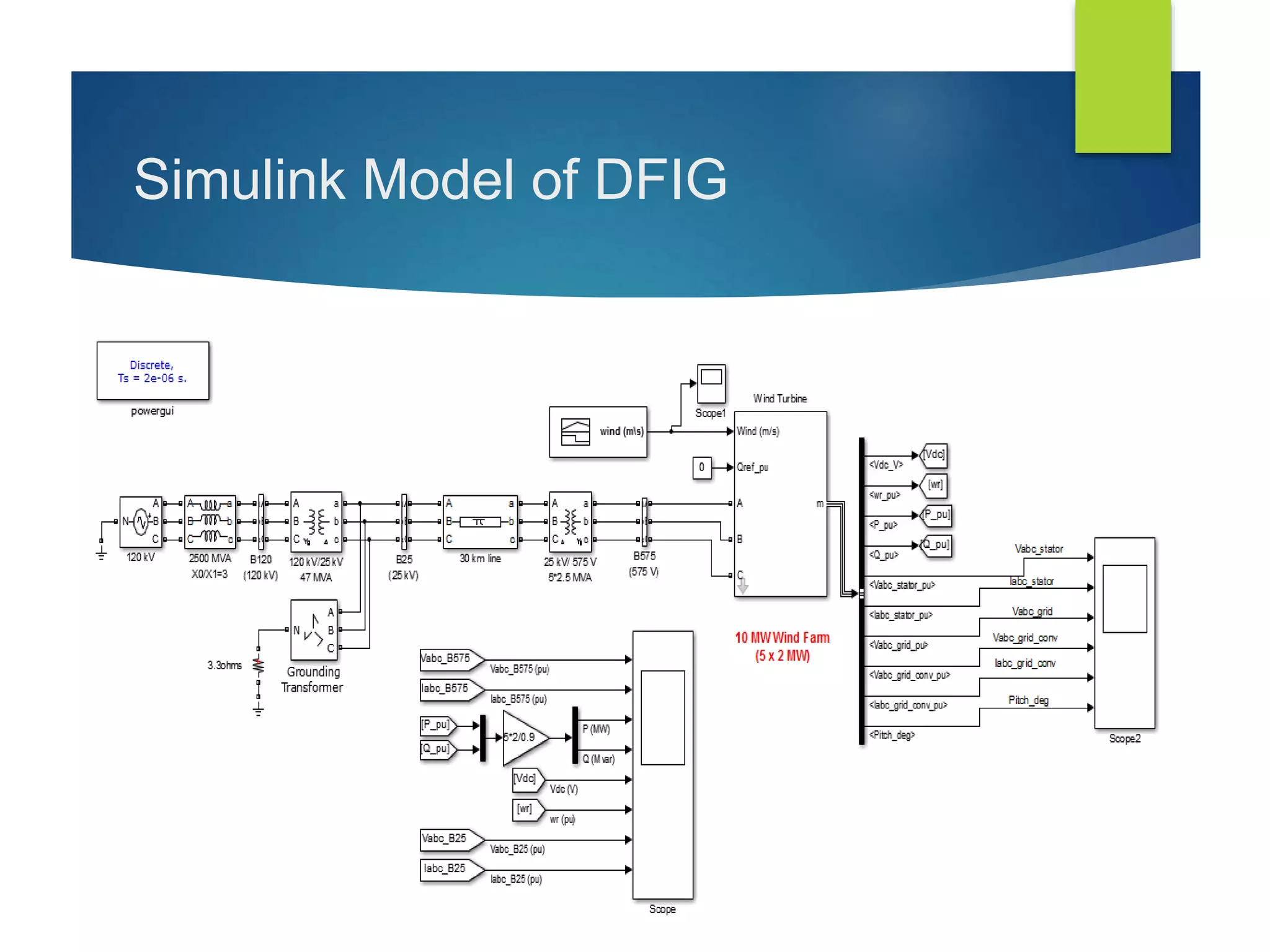
A detailed electromechanical model of a DFIG-based wind
turbine connected to power grid is studied.
Aim of thesis is to :
► Regulate Pitch Angle at variable wind speed
► Maintain DC-link Voltage
► Fault analysis of PMSG based Wind Energy Conversion
System
INTRODUCTION
► Wind generation has become the most important alternate
energy source and has experienced increased progress in
INDIA during the past decade.
► Wind energy conversion system suffer from the fact that their
real power generation is closely dependent on the local
environmental conditions.
Contd…
► DFIG based wind turbine with variable-speed, variable-pitch
control scheme is the most popular wind power generation.
► This machine can be operated either in grid connected or
standalone mode.
► In this thesis, DFIG is operated with different sub-systems in
the MATLAB/SIMULINK environment. Steady state behavior
of the wind turbine system is presented and analyzed.
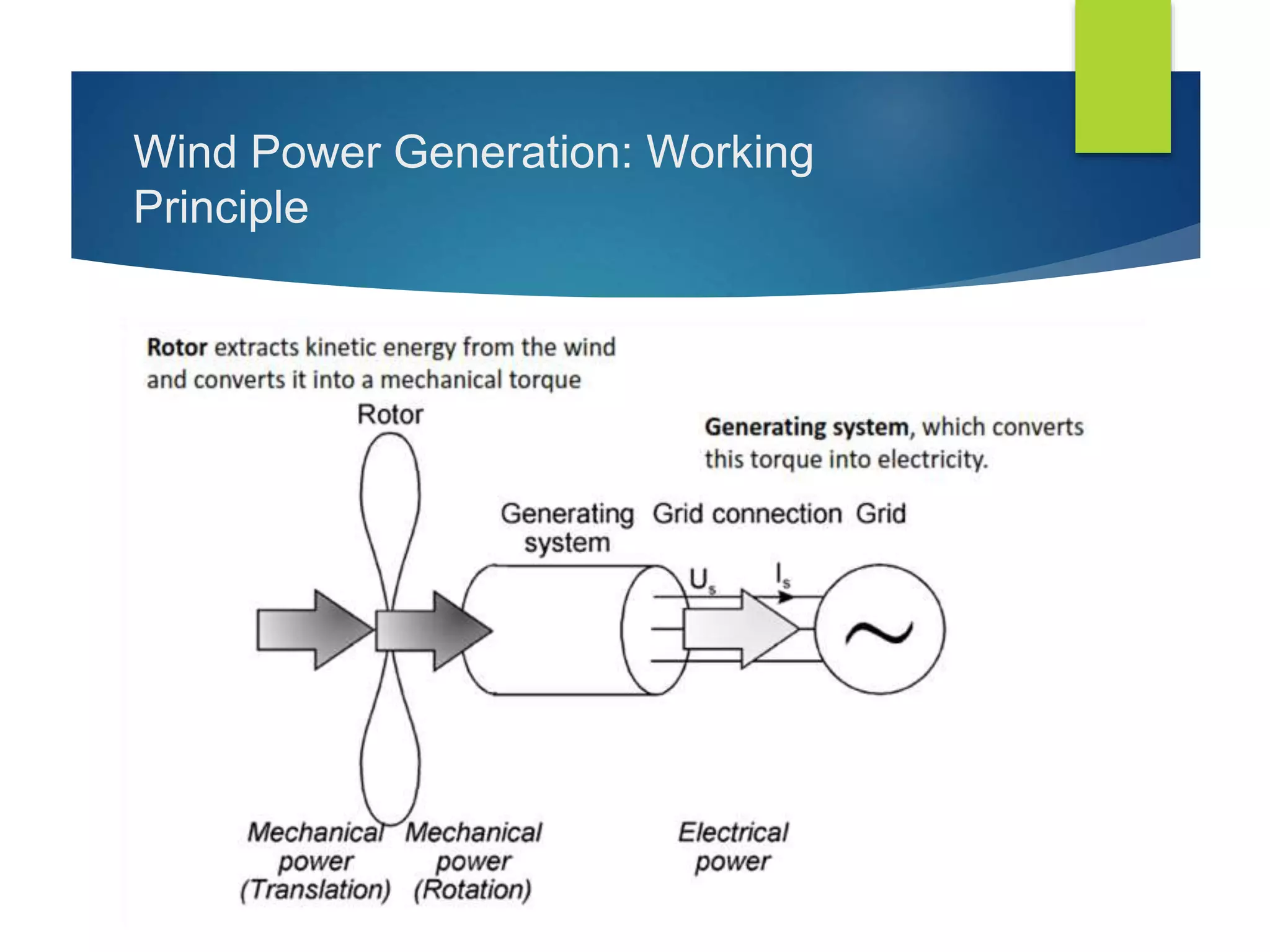
Wind Power Generation: Working
Principle
VARIABLE SPEED DIRECT DRIVE
WIND ENERGY CONVERSION
SYSTEM
► In variable speed systems, the turbines rotor absorbs the
mechanical power fluctuations by changing its speed.
► To allow variable speed operation, the mechanical rotor
speed and the electrical frequency of the grid must be decoupled.
► So the output power curve is smoother which greatly enhances the
quality of power.
► However, since variable speed operation produces a variable
frequency voltage, a power electronic converter must be used to
connect to the constant frequency grid
Types of Generators
► Induction generators
► Synchronous generators
► Doubly fed induction generators
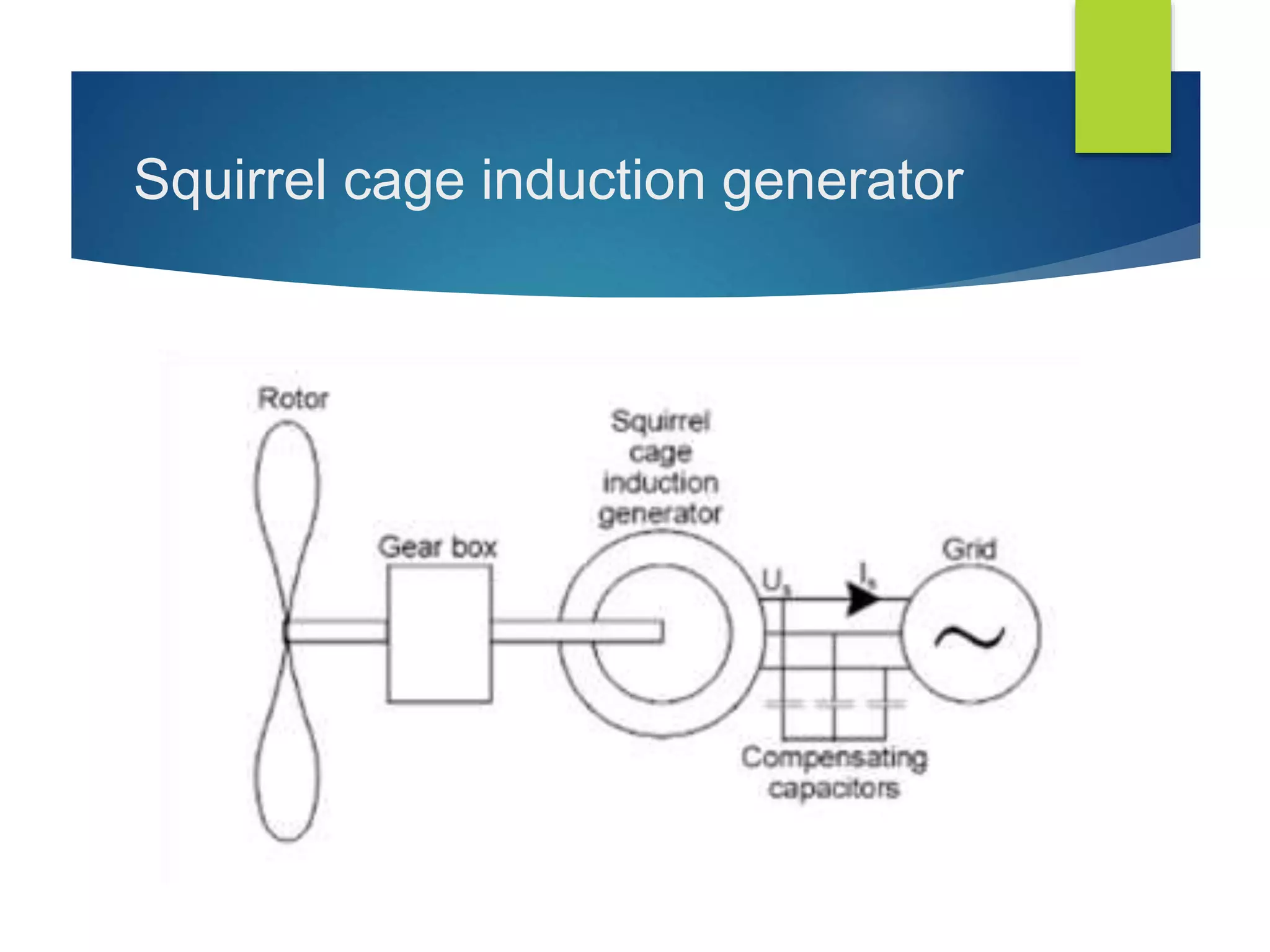
Squirrel cage induction generator
► Conventional, directly grid coupled squirrel cage induction
generator.
► This wind turbine is normally referred to as a constant
speed or fixed speed wind turbine
► A SCIG always consumes reactive power. In most cases, t
his is undesirable, particularly in case of large turbines a
nd weak grids.
► Reactive power consumption of the SCIG is nearly always
partly or fully compensated by capacitors in order to achiev
e a power factor close to one.
Squirrel cage induction generator
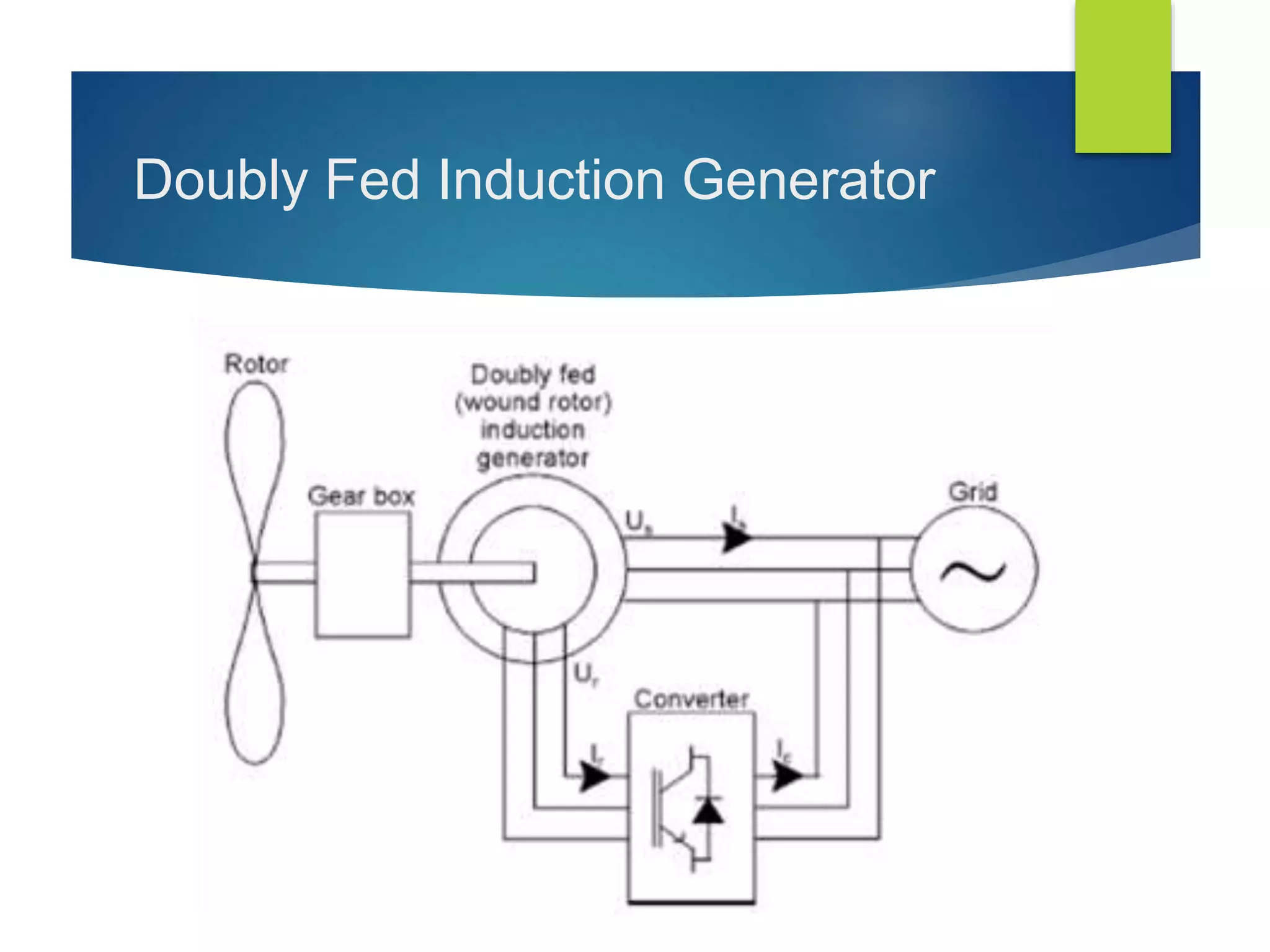
Doubly Fed Induction Generator
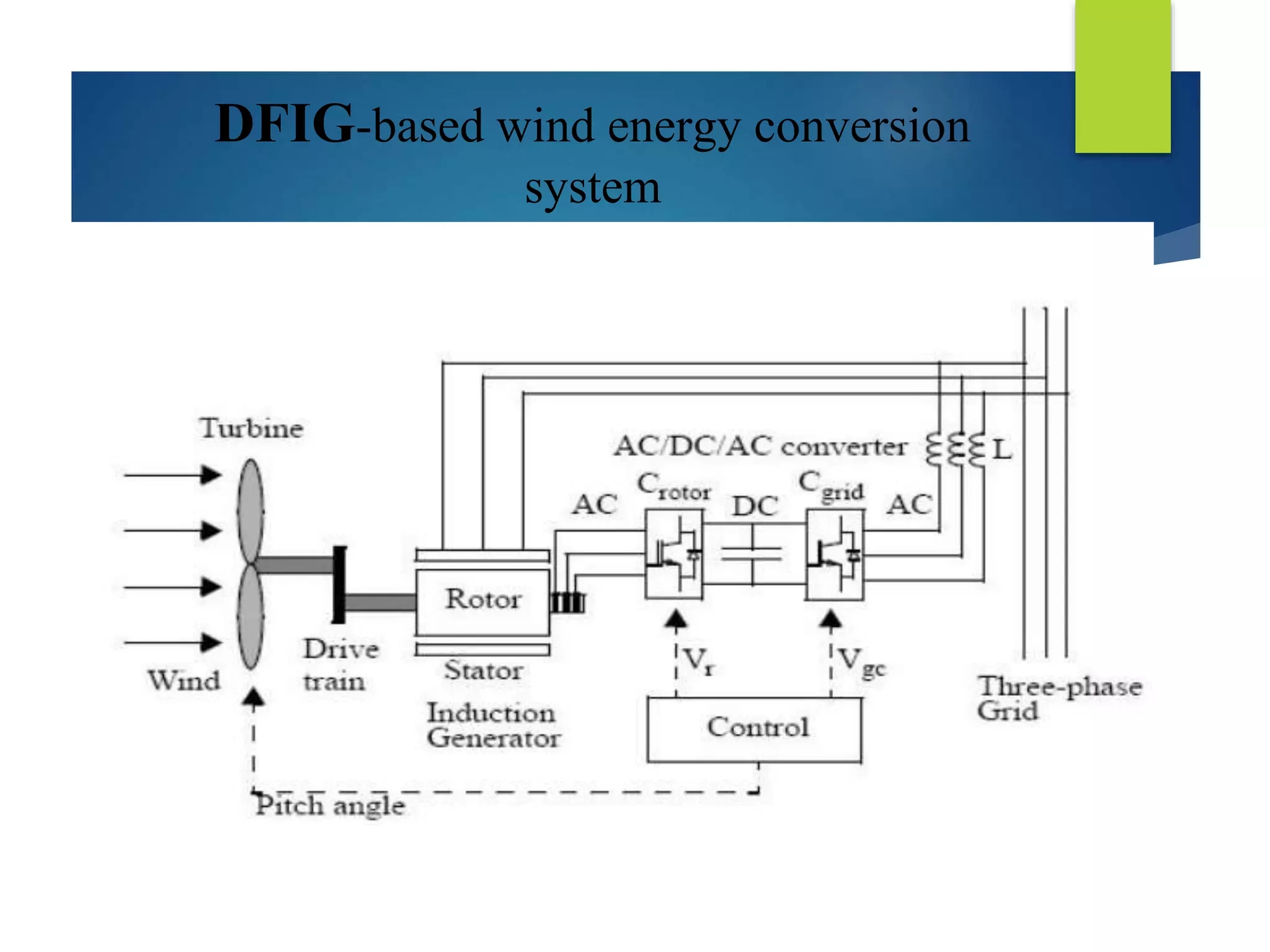
► The stator is directly connected to the grid, and the rotor
is connected to the grid through a partial scale power
electronic converter.
► High torque peaks in the machine and large stator peak
currents under grid fault conditions depending on control
► Regular maintenance of the brush-slip ring set to bring
power to the rotor
► External synchronization circuit required between the
stator and the grid to limit the start-up current
► In the case of grid disturbances, ride-through capability of
DFIG is required so that the control strategies may be
very complex.
Doubly Fed Induction Generator
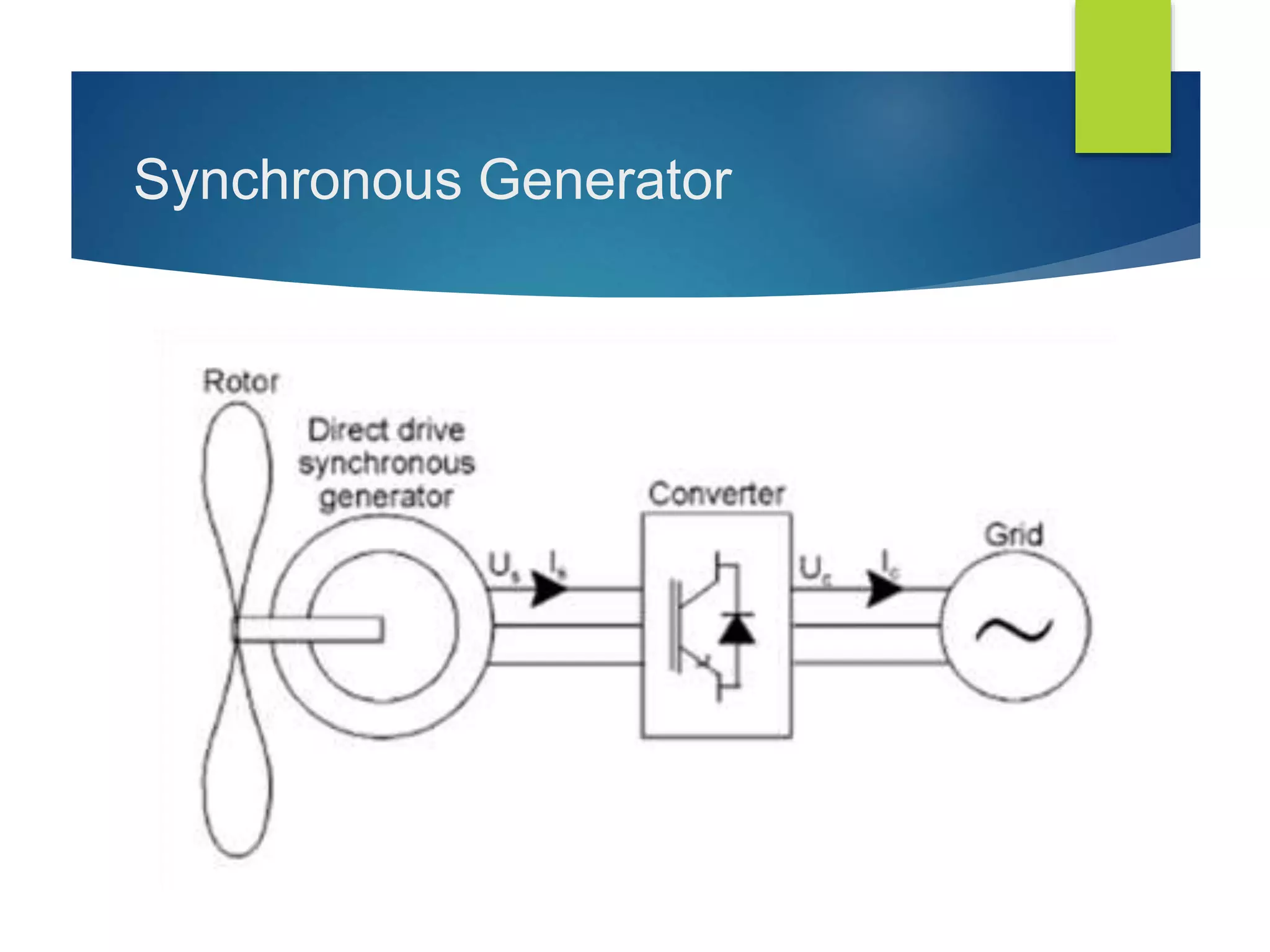
Synchronous Generator
► The permanent magnet synchronous generator (PMSG)
is excited by a permanent magnet.
► The PMSG is connected to the grid through a full-scale
power electronic converter.
Synchronous Generator
Literature Review
► In Holdsworth et al [18], the modeling and control strategies
of fixed speed and doubly-fed asynchronous generator wind
turbines have been described and their performance were
compared during power system disturbances
► In Pena et al [19], the DFIG working with a Scherbius
scheme, consisting of two back-to-back PWM converters,
has been presented. An experimental transputer controlled
system has been described, and the fundamental
operational advantages have been verified.
Contd..
► Yuanye Xia et al [2011], presented a technique for maximum power
point tracking by using Perturbation and observation to eliminate the
effect of fluctuation wind conditions.
► Ribeiro et al [17], presented energy storage system for advanced
power application. The potential performance benefits produced by
advanced energy storage applications are improved system reliability,
dynamic stability, enhanced power quality, transmission capacity
enhancement, and area protection. An energy storage device can also
have a positive cost and environmental impact by reducing fuel
consumption and emissions through reduced line losses and reduced
generation availability for frequency stabilization.
Contd..
► Morel et al [25], presented a new system for variable speed using
a doubly-fed induction machine. In this case, power can reach
only 20% of the maximum mechanical power as compared with
classical one.
► In Datta and Ranganathan [27], in this paper, a method of
tracking the peak power in a wind energy conversion system
(WECS) is proposed, which is independent of the turbine
parameters and air density. The criteria for selecting the critical
control parameters are described. The algorithm is implemented
on a laboratory setup using a grid-connected wound rotor
induction generator controlled from the rotor side
DFIG-based wind energy conversion
system
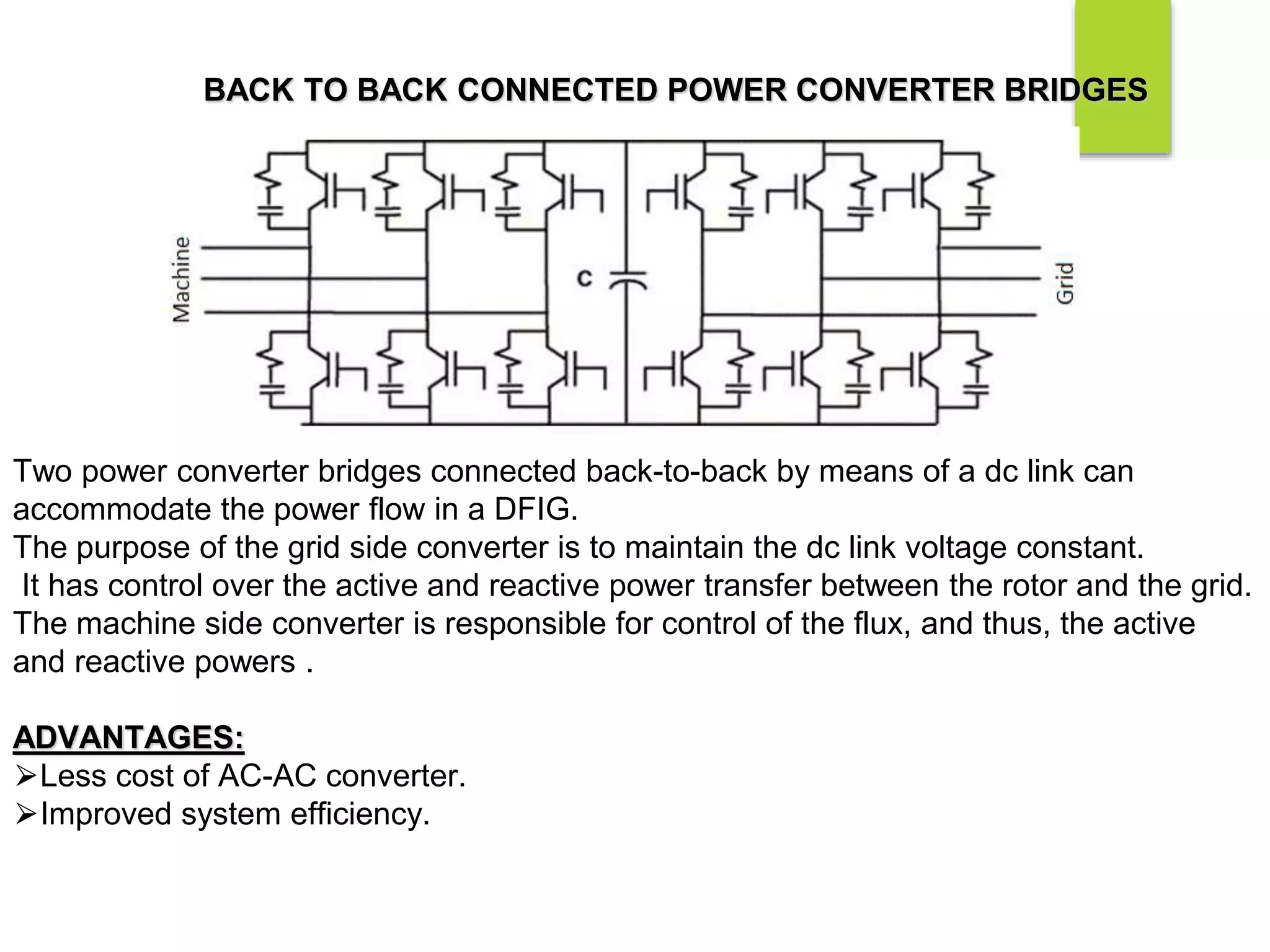
BACK TO BACK CONNECTED POWER CONVERTER BRIDGES
Two power converter bridges connected back-to-back by means of a dc link can
accommodate the power flow in a DFIG.
The purpose of the grid side converter is to maintain the dc link voltage constant.
It has control over the active and reactive power transfer between the rotor and the grid.
The machine side converter is responsible for control of the flux, and thus, the active
and reactive powers .
ADVANTAGES:
⮚Less cost of AC-AC converter.
⮚Improved system efficiency.
Power Converter Controls
The control sequences are as follows:
a) Measurement of all required quantities including machine voltage, machine
and grid currents, and machine angle.
b) Extraction of the voltage angle using a phase-locked loop (PLL)
c) To perform the appropriate transformations to express all voltage and
current quantities on the synchronously rotating frame
d) Calculation of active power and reactive power.
e) To generate the machine Current references using the output of the PI
compensator
f) Machine Current control using PI compensators for d and q axes
components
g) Transforming the machine voltage back to abc quantities
h) Modulation of the machine voltages for generation of the gating signals
Control
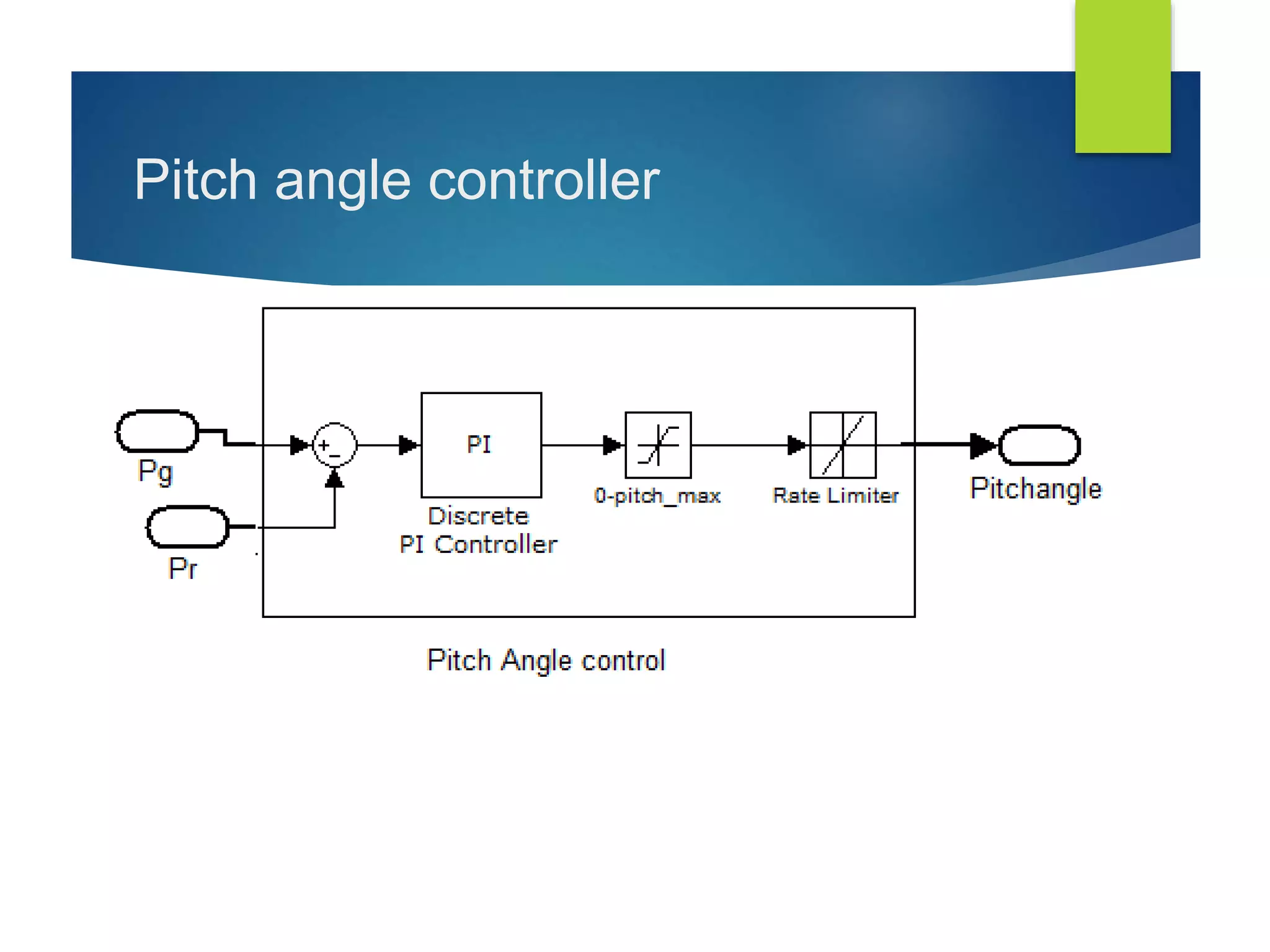
► Pitch control requires active control systems to turn the blades
► Nowadays stall control is mainly used in constant speed turbines, whereas
► Pitch control is used in variable speed turbines.
Pitch angle controller
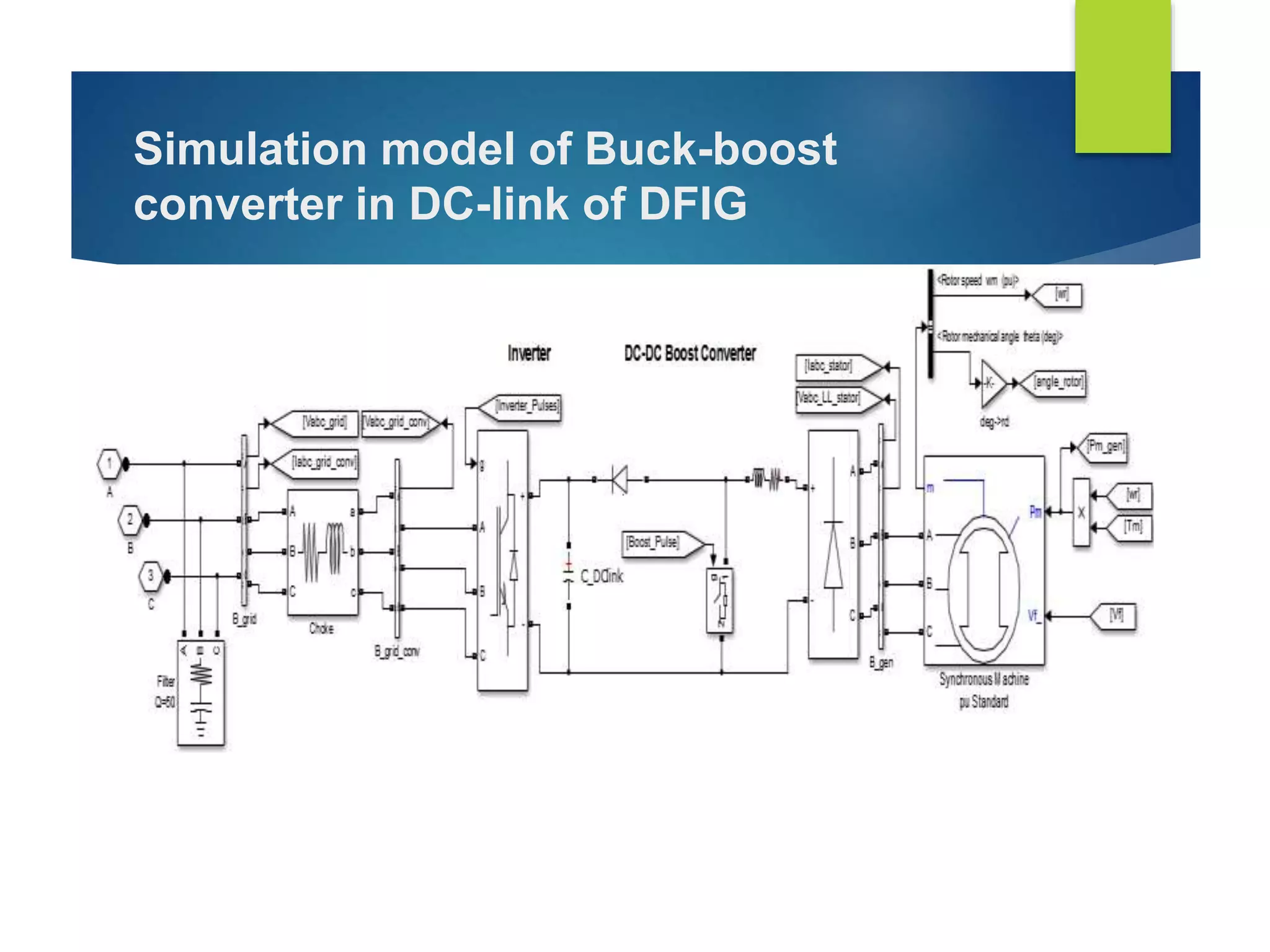
Simulation model of Buck-boost
converter in DC-link of DFIG
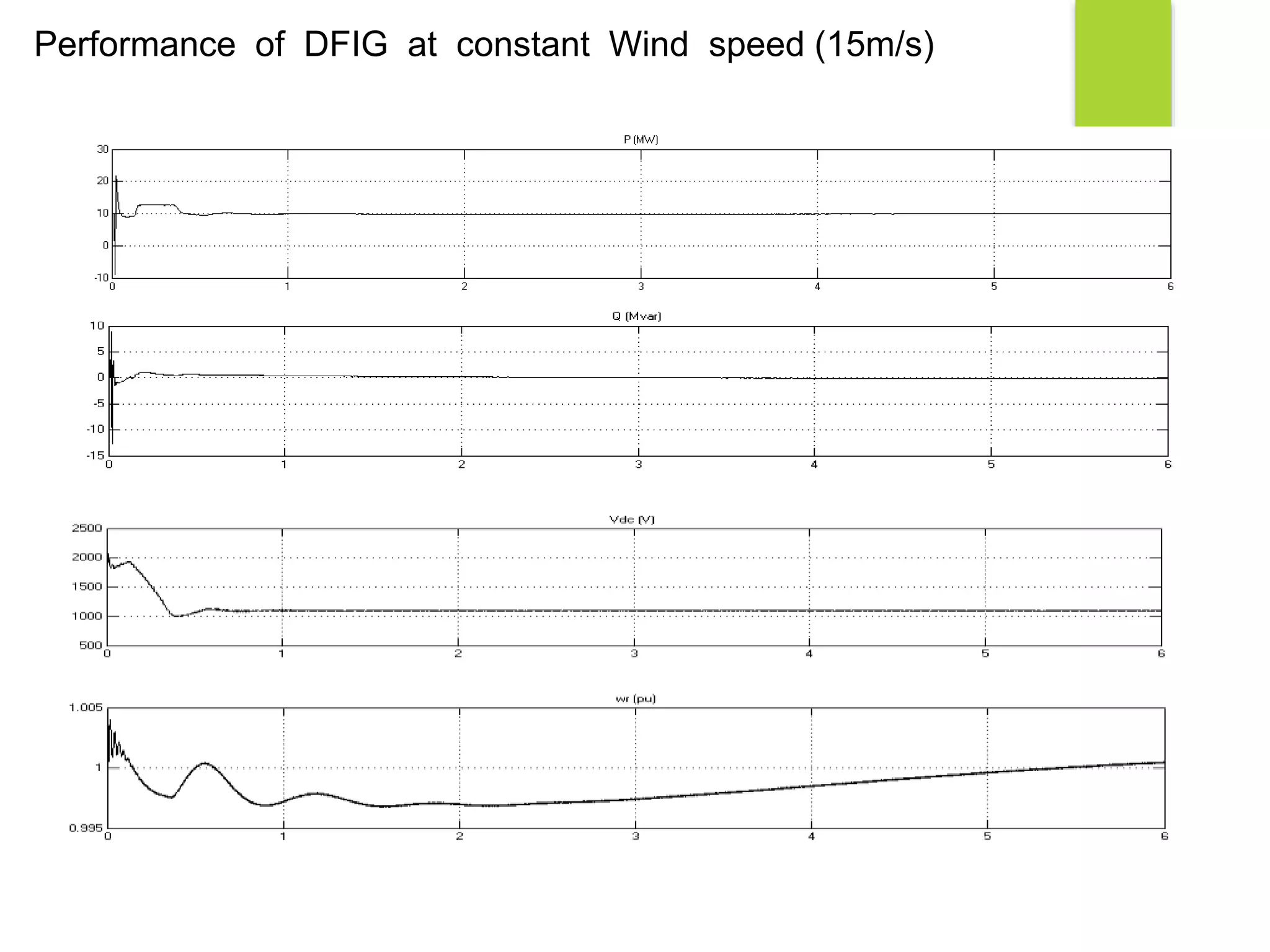
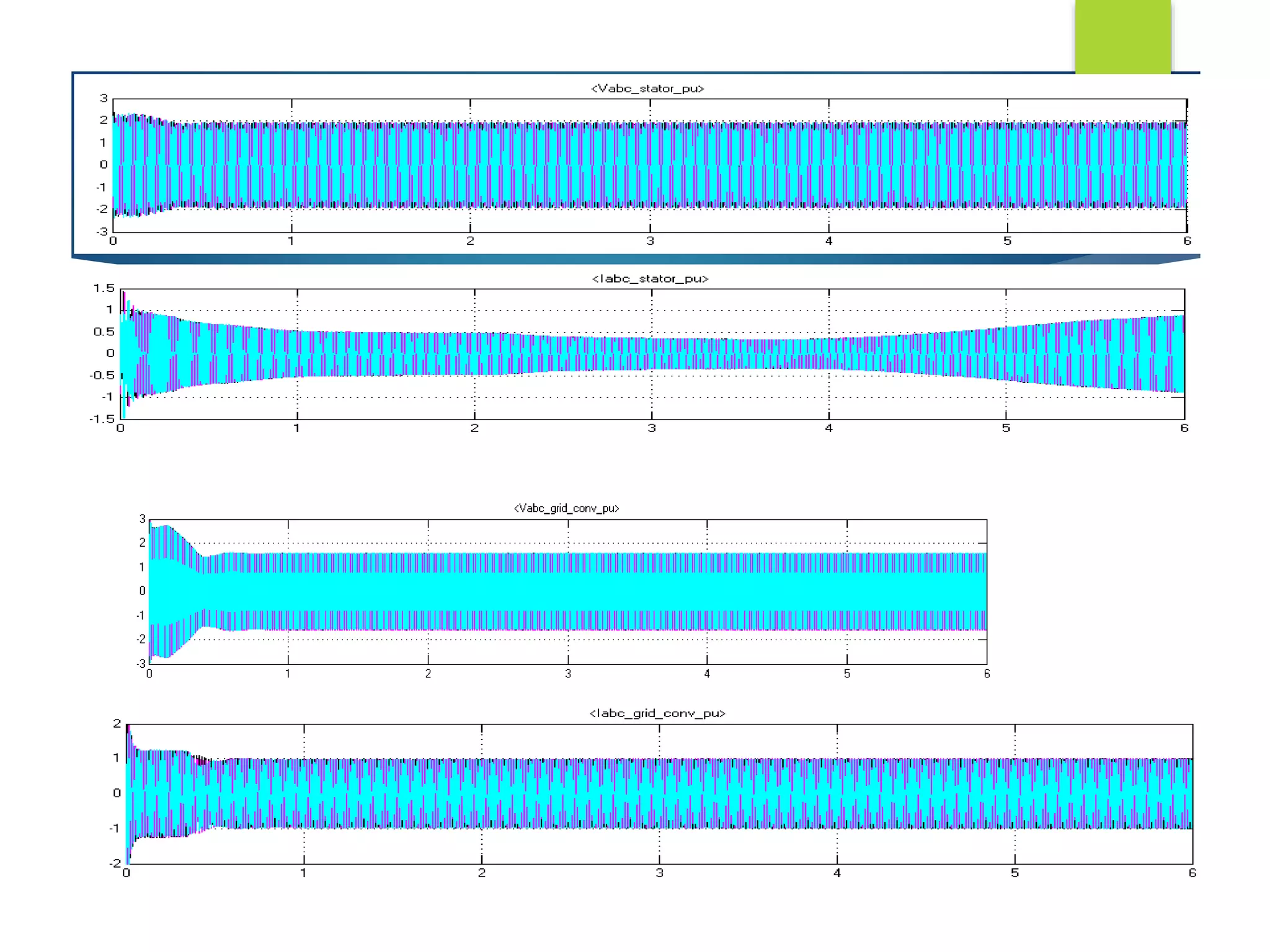
Performance of DFIG at constant Wind speed (15m/s)
Simulink Model of DFIG
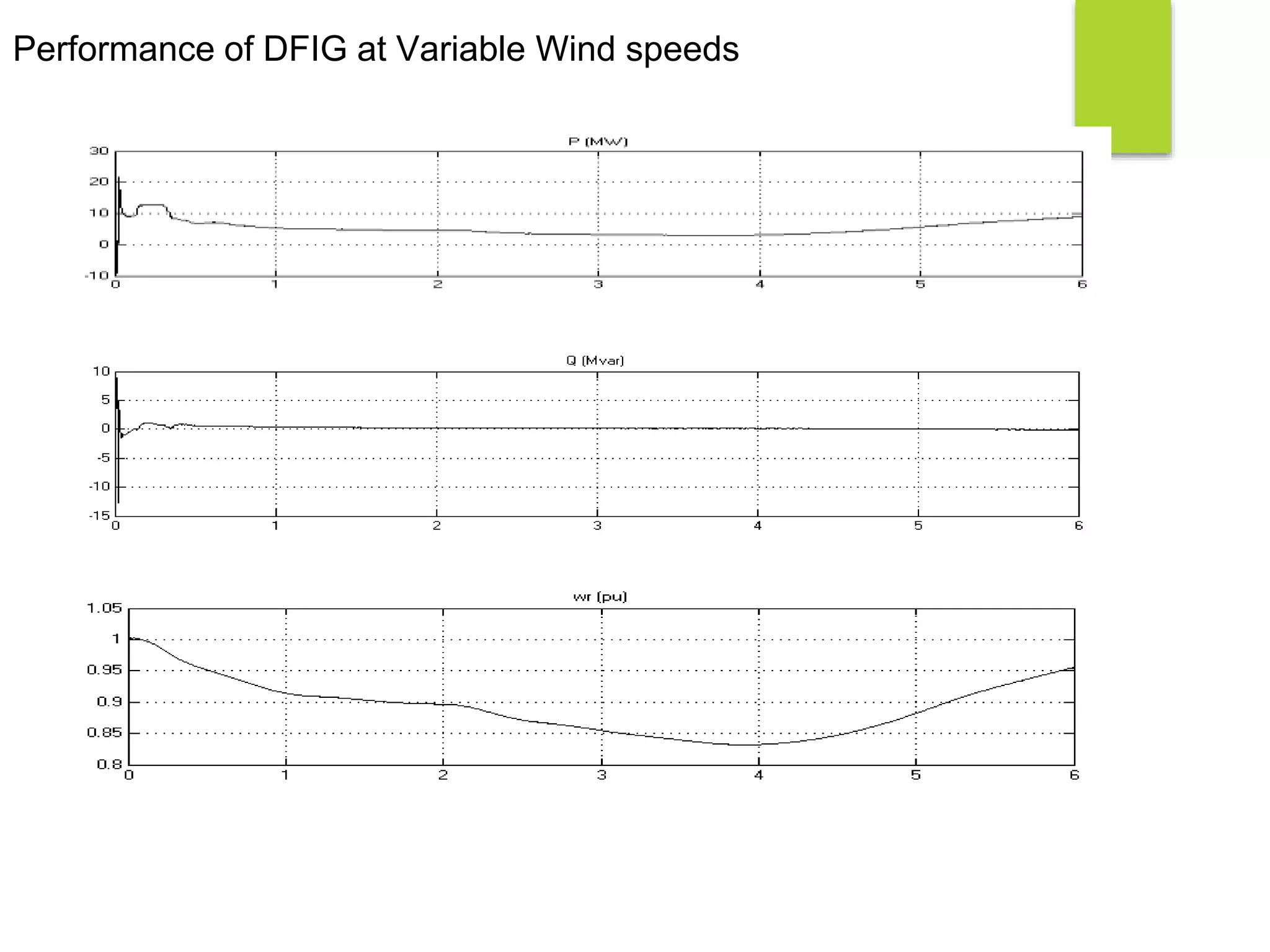
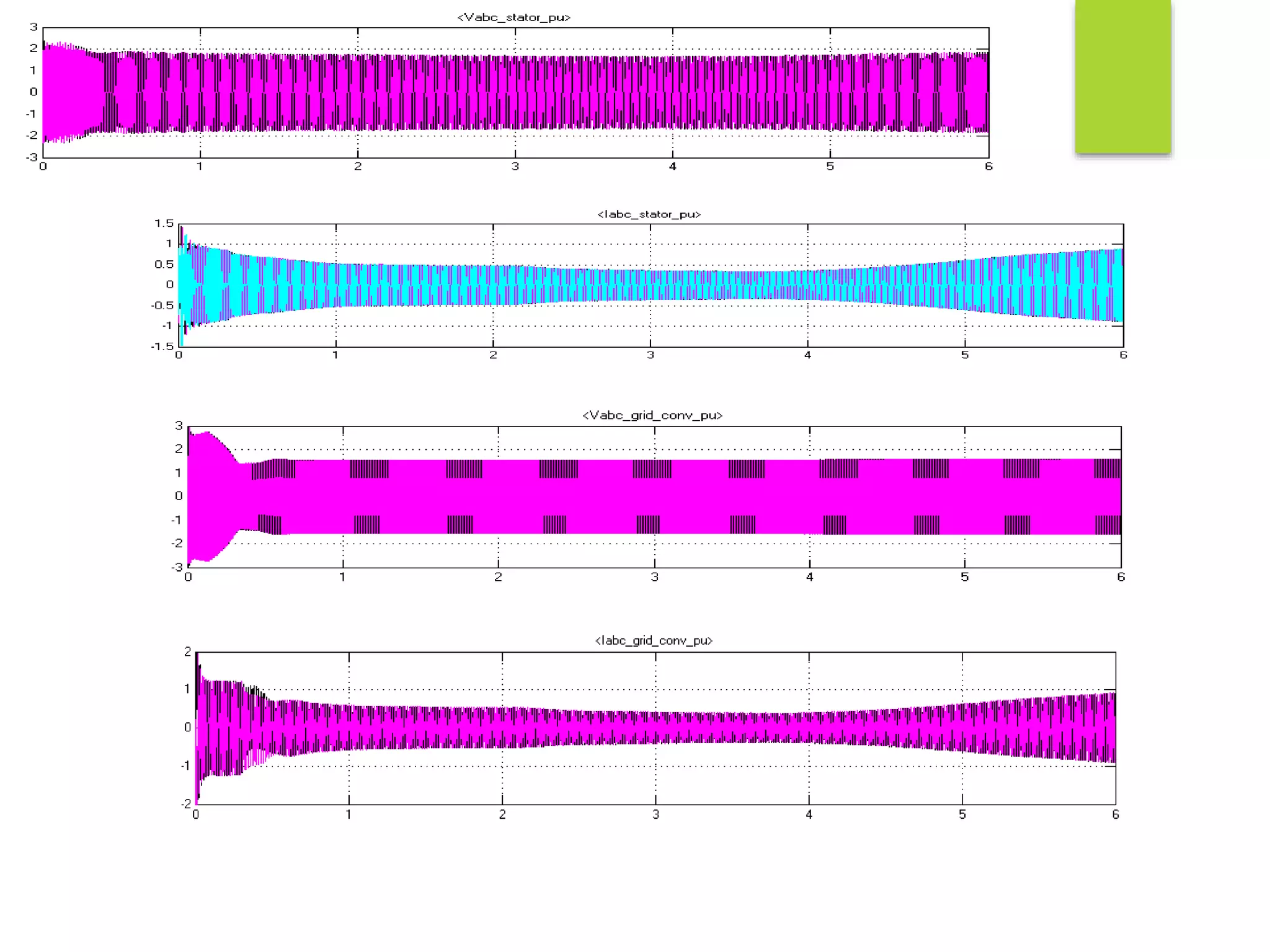
Performance of DFIG at Variable Wind speeds
PARAMETERS OF DFIG
Rated Power 10[MW]
Rated Voltage 575[kv]
No. of Phases 3
Configuration Sinusoidal
Flux linkage 1.48 [V.s]
Frequency 50[hz]
No. of pole pairs 3
Stator Resistance 0.00706 [pu]
Stator Inductance [Ld] 1.9e-3[pu]
Stator Inductance [Lq] 1.6e-3[pu]
CONCLUSION
► Following results are achieved in this project:
► DFIG is able to control the power at variable wind
► DC link voltage was regulated
► MPPT using Pitch angle control at variable wind is achieved
Future Scope
The following problems can be taken in future:
►To improve the existing control for controlling the DFIG for
voltage regulation.
►To reduce the cost of this machine whether by reducing the
numbers of switching devise, or other devices.
►Also reducing the size of wind energy conversion system.
References
[1] http://en.wikipedia.org/wiki/Wind_energy
[2] http://www.windfinder.com/windstats/windstatistic_delhi_indira_gandhi_airport.htm
[3] Swisher, R., C. Real de Azua, and J. Clendenin, "Strong winds on the horizon:
wind power comes of age," IEEE PROC., VOL. 89, NO. 12, DEC. 2001.
[4] "Non dispatchable production in the Nordel System," Annual Meeting of Nordel's
Grid Group, May 2000.
[5] CIGRE TF38.01.10 "Modeling of new forms of generation and storage," Nov. 2000.
[6] Blaabjerg, F., G. Joos, and K. Rajashekara, "Distributed power generation
technology, application and interconnection issues," IEEE lAS Tutorial, Salt Lake
City, Oct. 2003.
[7] IEEE Standard for Distributed Resources Interconnected With Electric Power
Systems, IEEE CC21, IEEE P1547 Std Draft 06, 2000.
[8] Kanellos, F.D., and N.D. Hatziargyriou, "The effect of variable-speed wind
turbines on the operation of weak distribution networks," IEEE TRANSACTIONS
ON ENERGY CONVERSION VOL. 17, NO. 4, DEC. 2002.
[9] Slootweg, J. G. "Wind power: Modelling and impact on power system
dynamics,"PH. D THESIS, DEPARTMENT OF COMPUTER AND ELECTRICAL
ENGINEERING, TECHNISCHE UNIVERSITEIT DELFT, DEC. 2003.
[10] Henk Polinder, Frank F. A. Vander Pijl, Gert-Jan de Vilder, and Peter J. Tavner,
"Comparison of Direct-Drive and Geared Generator Concepts for Wind
Turbines”, IEEE TRANSACTIONS ON ENERGY CONVERSION, VOLUME: 21,
NO. 3, SEPTEMBER 2006, PAGE(S): 725 -733
[11] Lu, Weixing and B.T. Ooi, "Multiterminal LVDC system for optimal acquisition of
power in wind-farm using induction generators", IEEE TRANSACTIONS
POWER ELEC., VOL. 17, NO. 4, JULY 2002.
[12] Rodriguez-Amenedo, J.L., S. Amalte, and J.C. Burgos, "Automatic generation
control of a wind farm with variable speed wind turbines", IEEE
TRANSACTIONS ON ENERGY CONVERSION, VOL. 17, NO. 2, JUNE 2002.
[13] B. G. Rawn, P. W. Lehn, and M. Maggiore, “Control methodology to mitigate
the grid impact of wind turbines,” IEEE TRANS. ENERGY CONVERS., VOL. 22,
NO. 2, PP. 431–438, JUN. 2007.
[14] Wind Energy Conversion System from Electrical Perspective —A
Survey Hyong Sik Kim, Dylan Dah-Chuan Lu Smart Grid and
Renewable Energy, 2010, 1, 119-131 doi:10.4236/sgre.2010.13017
Published Online November 2010 (http://www.SciRP.org/journal/sgre)
[15] Monica Chinchilla, Santiago Arnaltes, Juan Carlos Burgos, “Control of
Permanent Magnet Generators Applied to variable speed wind energy
systems connected to the grid”, IEEE TRANS. ENERGY
CONVERSION, VOL. 21, NO. 1, PP. 130–135, MARCH 2006.
[16] Doek-Je Bang. “Design of Transverse Flux Permanent Magnet
Machines for Large Direct-Drive Wind Turbines,” PH. D THESIS,
TECHNISCHE UNIVERSITEIT DELFT, OCTOBER 2010.
[17] Shuhui Li, Timothy A. Haslew, Richard P. Swatloski, William
Gathings, “Optimal and Direct-Current Vector Control of Direct-Driven
PMSG Wind Turbines”, IEEE TRANS. POWER ELECTRONICS, VOL.
27, NO. 5, PP. 2325–2337, MAY 2012.
[18] Kelvin Tan, Syed Islam, “Optimum control strategies in Energy
Conversion of PMSG Wind Turbine System Without Mechanical
Sensors”, TRANS. ENERGY CONVERSION, VOL. 19, NO. 2, PP. 392–
399, JUNE 2004.
[19] N. A. Sachinas, N. A. Vovos, G. B. Giannakopoulus, “ An Autonomous System
supplied only by a Pitch-Controlled Variable-Speed WindTurbine”, IEEE TRANS.
ENERGY CONVERSION, VOL. 22, NO. 2, PP. 325–331, JUNE 2007
[20] Akie Uehara, Alok Pratap, Tomonori Goya, Tomonobu Senjyu, Atsushi Yona,
Naomitsu Urasaki, and Toshihisa Funabashi, “A Coordinated Control Method to
Smooth Wind Power Fluctuations of a PMSG-Based WECS” IEEE
TRANSACTIONS ON ENERGY CONVERSION, VOL. 26, NO. 2, pp. 550–558
JUNE 2011.
[21] Neris, A.S, N.A. Vovos, and G.B. Giannakopoulos, "A variable speed wind
energy conversion scheme for connection to weak ac systems," IEEE
TRANSACTIONS ON ENERGY CONVERSION, VOL. 14, NO. 1, MARCH 1999.
[22] P.C. Krause, "Analysis of Electric Machinery", MCGRAW-HILL BOOK
COMPANY, 1986.
[23] Chen. Z., and E. Spooner, "Grid power quality with variable speed wind
turbines," IEEE TRANSACTIONS ON ENERGY CONVERSION, VOL. 16, NO. 2,
JUNE 2001.
[24] Hua Geng, Dewei Xu, “Stability analysis and Improvements for Variable-Speed
Multipole Permanent Magnet Synchronous Generator-Based wind Energy
Conversion System”, IEEE TRANSACTIONS ON SUSTAINABLE ENERGY, VOL.
2, NO. 4, OCTOBER 2011.
[25] M. Jahangir Hossain, Hemanshu R. Pota, Valeri A. Ugrinovskii, and Rodrigo A.
Ramos, “Simultaneous STATCOM and Pitch Angle Control for Improved LVRT
Capability of Fixed Speed Wind Turbine”, IEEE TRANSACTIONS ON
SUSTAINABLE ENERGY, VOL. 1, NO.34, OCTOBER 2010.
[26] Zhe Chen, Joseph M. Guerrero, Frede Blaabjerg, “A Review of the State of Art of
Power Electronics for Wind Turbines”, IEEE TRANSACTIONS ON POWER
ELECTRONICS, VOL. 24, NO. 8, AUGUST 2009.
[27] Datta, R. and V.T. Ranganathan, "A method of tracking the peak power points for a
variable speed wind energy conversion system," IEEE TRANSACTIONS POWER
ELEC., VOL. 16, NO. 3, MAY 2001.
[28] Gyugyi, L.: "Dynamic compensation of AC transmission lines by solid-state
synchronous voltage sources", IEEE TRANS. POWER DELIVERY, 1994, VOL 9,
NO. 2, PP.904-911.
[29] Yuanye Xia, Khaled H. Ahmed, and Barry W. Williams, “ A New Maximum Power
Point Tracking Technique for Permanent Magnet Synchronous Generator Based
Wind Energy Conversion System”, IEEE TRANSACTIONS ON POWER
ELECTRONICS, VOL. 26, NO. 12, DECEMBER 2011.
[30] Jiacheng Wang, Dewei Xu, and Zhenhan Luo, “A Low-Cost Rectifier Topology for
Variable-Speed High-Power PMSG Wind Turbines”, IEEE TRANSACTIONS ON
POWER ELECTRONICS, VOL. 26, NO. 8, AUGUST 2011.
► [31] Nishad Mendis, Kashem M. Muttaqi, Saad Sayeef and Sarath Perera,"Standalone
Operation of Wind Turbine-Based Variable Speed Generators with Maximum Power
Extraction Capability", IEEE TRANSACTIONS ON ENERGY CONVERSION, VOL. 27,
NO. 4, DECEMBER 2012.
► [32] Maurizio Cirrincione, Marcello Pucci, and Gianpaolo Vitale, “Neural MPPT of Variable
– Pitch Wind Generators with Induction Machines in a Wide Wind Speed Range”, IEEE
TRANSACTIONS ON INDUSTRY APPLICATIONS, VOL. 49, NO. 2, MARCH/APRIL 2013.
► [33] Tomonobu Senjyu, Ryosei Sakamoto, Naomitsu Urasaki, Toshihisa Funabashi,
Hideki Fujita, and Hideomi Sekine, “Output Power Leveling of Wind Turbine Generator for
all Operating Regions by Pitch Angle Control”, IEEE TRANSACTIONS ON ENERGY
CONVERSION, VOL. 21, NO. 2, JUNE 2006.
► [34] Maria Letizia, Corradini, Gianluca Ippoliti, and Giuseppe Orlando, “Robust Control of
Variable –Speed Wind Turbines Based on an Aerodynamic Torque Observer”, IEEE
TRANSACTIONS ON CONTROL SYSTEMS TECHNOLOGY, VOL. 21, NO. 4, JULY
2013.
► [35] M. G. Molina, A. G. Sanchez, and A. M. Rizzato Lede, “Dynamic Modelling of Wind
Farms with Variable –Speed Direct –Driven PMSG Wind Turbines”, ARGENTINEAN
NATIONAL AGENCY FOR THE PROMOTION OF SCIENCE AND
TECHNOLOGY.POWER ELEC., VOL. 16, NO. 3, MAY 2001.
Thank You !!!

DFIG ppt.pptx

  • 1.
    UNDER THE SUPERVISIONOF:- MR. SATYENDRA VISHWAKARMA PRESENTED BY:- MANSHI BAJPAI SAUMYA RAJ AYUSH TRIPATHI RAJEEV KUMAR ABHAY KUMAR PRATIBHA BANAUDHA DFIG-Based Wind Power Conversion System Connected To Grid
  • 2.
    Outline of Presentation ⚫Objective ⚫ Introduction ⚫ Literature Review ⚫ Control Schemes ⚫ Simulation Results ⚫ Conclusions ⚫ Future scope of the work
  • 3.
    OBJECTIVE A detailed electromechanicalmodel of a DFIG-based wind turbine connected to power grid is studied. Aim of thesis is to : ► Regulate Pitch Angle at variable wind speed ► Maintain DC-link Voltage ► Fault analysis of PMSG based Wind Energy Conversion System
  • 4.
    INTRODUCTION ► Wind generationhas become the most important alternate energy source and has experienced increased progress in INDIA during the past decade. ► Wind energy conversion system suffer from the fact that their real power generation is closely dependent on the local environmental conditions.
  • 5.
    Contd… ► DFIG basedwind turbine with variable-speed, variable-pitch control scheme is the most popular wind power generation. ► This machine can be operated either in grid connected or standalone mode. ► In this thesis, DFIG is operated with different sub-systems in the MATLAB/SIMULINK environment. Steady state behavior of the wind turbine system is presented and analyzed.
  • 6.
    Wind Power Generation:Working Principle
  • 7.
    VARIABLE SPEED DIRECTDRIVE WIND ENERGY CONVERSION SYSTEM ► In variable speed systems, the turbines rotor absorbs the mechanical power fluctuations by changing its speed. ► To allow variable speed operation, the mechanical rotor speed and the electrical frequency of the grid must be decoupled. ► So the output power curve is smoother which greatly enhances the quality of power. ► However, since variable speed operation produces a variable frequency voltage, a power electronic converter must be used to connect to the constant frequency grid
  • 8.
    Types of Generators ►Induction generators ► Synchronous generators ► Doubly fed induction generators
  • 9.
    Squirrel cage inductiongenerator ► Conventional, directly grid coupled squirrel cage induction generator. ► This wind turbine is normally referred to as a constant speed or fixed speed wind turbine ► A SCIG always consumes reactive power. In most cases, t his is undesirable, particularly in case of large turbines a nd weak grids. ► Reactive power consumption of the SCIG is nearly always partly or fully compensated by capacitors in order to achiev e a power factor close to one.
  • 10.
  • 11.
    Doubly Fed InductionGenerator ► The stator is directly connected to the grid, and the rotor is connected to the grid through a partial scale power electronic converter. ► High torque peaks in the machine and large stator peak currents under grid fault conditions depending on control ► Regular maintenance of the brush-slip ring set to bring power to the rotor ► External synchronization circuit required between the stator and the grid to limit the start-up current ► In the case of grid disturbances, ride-through capability of DFIG is required so that the control strategies may be very complex.
  • 12.
  • 13.
    Synchronous Generator ► Thepermanent magnet synchronous generator (PMSG) is excited by a permanent magnet. ► The PMSG is connected to the grid through a full-scale power electronic converter.
  • 14.
  • 15.
    Literature Review ► InHoldsworth et al [18], the modeling and control strategies of fixed speed and doubly-fed asynchronous generator wind turbines have been described and their performance were compared during power system disturbances ► In Pena et al [19], the DFIG working with a Scherbius scheme, consisting of two back-to-back PWM converters, has been presented. An experimental transputer controlled system has been described, and the fundamental operational advantages have been verified.
  • 16.
    Contd.. ► Yuanye Xiaet al [2011], presented a technique for maximum power point tracking by using Perturbation and observation to eliminate the effect of fluctuation wind conditions. ► Ribeiro et al [17], presented energy storage system for advanced power application. The potential performance benefits produced by advanced energy storage applications are improved system reliability, dynamic stability, enhanced power quality, transmission capacity enhancement, and area protection. An energy storage device can also have a positive cost and environmental impact by reducing fuel consumption and emissions through reduced line losses and reduced generation availability for frequency stabilization.
  • 17.
    Contd.. ► Morel etal [25], presented a new system for variable speed using a doubly-fed induction machine. In this case, power can reach only 20% of the maximum mechanical power as compared with classical one. ► In Datta and Ranganathan [27], in this paper, a method of tracking the peak power in a wind energy conversion system (WECS) is proposed, which is independent of the turbine parameters and air density. The criteria for selecting the critical control parameters are described. The algorithm is implemented on a laboratory setup using a grid-connected wound rotor induction generator controlled from the rotor side
  • 18.
    DFIG-based wind energyconversion system
  • 19.
    BACK TO BACKCONNECTED POWER CONVERTER BRIDGES Two power converter bridges connected back-to-back by means of a dc link can accommodate the power flow in a DFIG. The purpose of the grid side converter is to maintain the dc link voltage constant. It has control over the active and reactive power transfer between the rotor and the grid. The machine side converter is responsible for control of the flux, and thus, the active and reactive powers . ADVANTAGES: ⮚Less cost of AC-AC converter. ⮚Improved system efficiency.
  • 20.
    Power Converter Controls Thecontrol sequences are as follows: a) Measurement of all required quantities including machine voltage, machine and grid currents, and machine angle. b) Extraction of the voltage angle using a phase-locked loop (PLL) c) To perform the appropriate transformations to express all voltage and current quantities on the synchronously rotating frame d) Calculation of active power and reactive power. e) To generate the machine Current references using the output of the PI compensator f) Machine Current control using PI compensators for d and q axes components g) Transforming the machine voltage back to abc quantities h) Modulation of the machine voltages for generation of the gating signals
  • 21.
    Control ► Pitch controlrequires active control systems to turn the blades ► Nowadays stall control is mainly used in constant speed turbines, whereas ► Pitch control is used in variable speed turbines.
  • 22.
  • 23.
    Simulation model ofBuck-boost converter in DC-link of DFIG
  • 24.
    Performance of DFIGat constant Wind speed (15m/s)
  • 26.
  • 27.
    Performance of DFIGat Variable Wind speeds
  • 29.
    PARAMETERS OF DFIG RatedPower 10[MW] Rated Voltage 575[kv] No. of Phases 3 Configuration Sinusoidal Flux linkage 1.48 [V.s] Frequency 50[hz] No. of pole pairs 3 Stator Resistance 0.00706 [pu] Stator Inductance [Ld] 1.9e-3[pu] Stator Inductance [Lq] 1.6e-3[pu]
  • 30.
    CONCLUSION ► Following resultsare achieved in this project: ► DFIG is able to control the power at variable wind ► DC link voltage was regulated ► MPPT using Pitch angle control at variable wind is achieved
  • 31.
    Future Scope The followingproblems can be taken in future: ►To improve the existing control for controlling the DFIG for voltage regulation. ►To reduce the cost of this machine whether by reducing the numbers of switching devise, or other devices. ►Also reducing the size of wind energy conversion system.
  • 32.
    References [1] http://en.wikipedia.org/wiki/Wind_energy [2] http://www.windfinder.com/windstats/windstatistic_delhi_indira_gandhi_airport.htm [3]Swisher, R., C. Real de Azua, and J. Clendenin, "Strong winds on the horizon: wind power comes of age," IEEE PROC., VOL. 89, NO. 12, DEC. 2001. [4] "Non dispatchable production in the Nordel System," Annual Meeting of Nordel's Grid Group, May 2000. [5] CIGRE TF38.01.10 "Modeling of new forms of generation and storage," Nov. 2000. [6] Blaabjerg, F., G. Joos, and K. Rajashekara, "Distributed power generation technology, application and interconnection issues," IEEE lAS Tutorial, Salt Lake City, Oct. 2003. [7] IEEE Standard for Distributed Resources Interconnected With Electric Power Systems, IEEE CC21, IEEE P1547 Std Draft 06, 2000.
  • 33.
    [8] Kanellos, F.D.,and N.D. Hatziargyriou, "The effect of variable-speed wind turbines on the operation of weak distribution networks," IEEE TRANSACTIONS ON ENERGY CONVERSION VOL. 17, NO. 4, DEC. 2002. [9] Slootweg, J. G. "Wind power: Modelling and impact on power system dynamics,"PH. D THESIS, DEPARTMENT OF COMPUTER AND ELECTRICAL ENGINEERING, TECHNISCHE UNIVERSITEIT DELFT, DEC. 2003. [10] Henk Polinder, Frank F. A. Vander Pijl, Gert-Jan de Vilder, and Peter J. Tavner, "Comparison of Direct-Drive and Geared Generator Concepts for Wind Turbines”, IEEE TRANSACTIONS ON ENERGY CONVERSION, VOLUME: 21, NO. 3, SEPTEMBER 2006, PAGE(S): 725 -733 [11] Lu, Weixing and B.T. Ooi, "Multiterminal LVDC system for optimal acquisition of power in wind-farm using induction generators", IEEE TRANSACTIONS POWER ELEC., VOL. 17, NO. 4, JULY 2002. [12] Rodriguez-Amenedo, J.L., S. Amalte, and J.C. Burgos, "Automatic generation control of a wind farm with variable speed wind turbines", IEEE TRANSACTIONS ON ENERGY CONVERSION, VOL. 17, NO. 2, JUNE 2002. [13] B. G. Rawn, P. W. Lehn, and M. Maggiore, “Control methodology to mitigate the grid impact of wind turbines,” IEEE TRANS. ENERGY CONVERS., VOL. 22, NO. 2, PP. 431–438, JUN. 2007.
  • 34.
    [14] Wind EnergyConversion System from Electrical Perspective —A Survey Hyong Sik Kim, Dylan Dah-Chuan Lu Smart Grid and Renewable Energy, 2010, 1, 119-131 doi:10.4236/sgre.2010.13017 Published Online November 2010 (http://www.SciRP.org/journal/sgre) [15] Monica Chinchilla, Santiago Arnaltes, Juan Carlos Burgos, “Control of Permanent Magnet Generators Applied to variable speed wind energy systems connected to the grid”, IEEE TRANS. ENERGY CONVERSION, VOL. 21, NO. 1, PP. 130–135, MARCH 2006. [16] Doek-Je Bang. “Design of Transverse Flux Permanent Magnet Machines for Large Direct-Drive Wind Turbines,” PH. D THESIS, TECHNISCHE UNIVERSITEIT DELFT, OCTOBER 2010. [17] Shuhui Li, Timothy A. Haslew, Richard P. Swatloski, William Gathings, “Optimal and Direct-Current Vector Control of Direct-Driven PMSG Wind Turbines”, IEEE TRANS. POWER ELECTRONICS, VOL. 27, NO. 5, PP. 2325–2337, MAY 2012. [18] Kelvin Tan, Syed Islam, “Optimum control strategies in Energy Conversion of PMSG Wind Turbine System Without Mechanical Sensors”, TRANS. ENERGY CONVERSION, VOL. 19, NO. 2, PP. 392– 399, JUNE 2004.
  • 35.
    [19] N. A.Sachinas, N. A. Vovos, G. B. Giannakopoulus, “ An Autonomous System supplied only by a Pitch-Controlled Variable-Speed WindTurbine”, IEEE TRANS. ENERGY CONVERSION, VOL. 22, NO. 2, PP. 325–331, JUNE 2007 [20] Akie Uehara, Alok Pratap, Tomonori Goya, Tomonobu Senjyu, Atsushi Yona, Naomitsu Urasaki, and Toshihisa Funabashi, “A Coordinated Control Method to Smooth Wind Power Fluctuations of a PMSG-Based WECS” IEEE TRANSACTIONS ON ENERGY CONVERSION, VOL. 26, NO. 2, pp. 550–558 JUNE 2011. [21] Neris, A.S, N.A. Vovos, and G.B. Giannakopoulos, "A variable speed wind energy conversion scheme for connection to weak ac systems," IEEE TRANSACTIONS ON ENERGY CONVERSION, VOL. 14, NO. 1, MARCH 1999. [22] P.C. Krause, "Analysis of Electric Machinery", MCGRAW-HILL BOOK COMPANY, 1986. [23] Chen. Z., and E. Spooner, "Grid power quality with variable speed wind turbines," IEEE TRANSACTIONS ON ENERGY CONVERSION, VOL. 16, NO. 2, JUNE 2001. [24] Hua Geng, Dewei Xu, “Stability analysis and Improvements for Variable-Speed Multipole Permanent Magnet Synchronous Generator-Based wind Energy Conversion System”, IEEE TRANSACTIONS ON SUSTAINABLE ENERGY, VOL. 2, NO. 4, OCTOBER 2011.
  • 36.
    [25] M. JahangirHossain, Hemanshu R. Pota, Valeri A. Ugrinovskii, and Rodrigo A. Ramos, “Simultaneous STATCOM and Pitch Angle Control for Improved LVRT Capability of Fixed Speed Wind Turbine”, IEEE TRANSACTIONS ON SUSTAINABLE ENERGY, VOL. 1, NO.34, OCTOBER 2010. [26] Zhe Chen, Joseph M. Guerrero, Frede Blaabjerg, “A Review of the State of Art of Power Electronics for Wind Turbines”, IEEE TRANSACTIONS ON POWER ELECTRONICS, VOL. 24, NO. 8, AUGUST 2009. [27] Datta, R. and V.T. Ranganathan, "A method of tracking the peak power points for a variable speed wind energy conversion system," IEEE TRANSACTIONS POWER ELEC., VOL. 16, NO. 3, MAY 2001. [28] Gyugyi, L.: "Dynamic compensation of AC transmission lines by solid-state synchronous voltage sources", IEEE TRANS. POWER DELIVERY, 1994, VOL 9, NO. 2, PP.904-911. [29] Yuanye Xia, Khaled H. Ahmed, and Barry W. Williams, “ A New Maximum Power Point Tracking Technique for Permanent Magnet Synchronous Generator Based Wind Energy Conversion System”, IEEE TRANSACTIONS ON POWER ELECTRONICS, VOL. 26, NO. 12, DECEMBER 2011. [30] Jiacheng Wang, Dewei Xu, and Zhenhan Luo, “A Low-Cost Rectifier Topology for Variable-Speed High-Power PMSG Wind Turbines”, IEEE TRANSACTIONS ON POWER ELECTRONICS, VOL. 26, NO. 8, AUGUST 2011.
  • 37.
    ► [31] NishadMendis, Kashem M. Muttaqi, Saad Sayeef and Sarath Perera,"Standalone Operation of Wind Turbine-Based Variable Speed Generators with Maximum Power Extraction Capability", IEEE TRANSACTIONS ON ENERGY CONVERSION, VOL. 27, NO. 4, DECEMBER 2012. ► [32] Maurizio Cirrincione, Marcello Pucci, and Gianpaolo Vitale, “Neural MPPT of Variable – Pitch Wind Generators with Induction Machines in a Wide Wind Speed Range”, IEEE TRANSACTIONS ON INDUSTRY APPLICATIONS, VOL. 49, NO. 2, MARCH/APRIL 2013. ► [33] Tomonobu Senjyu, Ryosei Sakamoto, Naomitsu Urasaki, Toshihisa Funabashi, Hideki Fujita, and Hideomi Sekine, “Output Power Leveling of Wind Turbine Generator for all Operating Regions by Pitch Angle Control”, IEEE TRANSACTIONS ON ENERGY CONVERSION, VOL. 21, NO. 2, JUNE 2006. ► [34] Maria Letizia, Corradini, Gianluca Ippoliti, and Giuseppe Orlando, “Robust Control of Variable –Speed Wind Turbines Based on an Aerodynamic Torque Observer”, IEEE TRANSACTIONS ON CONTROL SYSTEMS TECHNOLOGY, VOL. 21, NO. 4, JULY 2013. ► [35] M. G. Molina, A. G. Sanchez, and A. M. Rizzato Lede, “Dynamic Modelling of Wind Farms with Variable –Speed Direct –Driven PMSG Wind Turbines”, ARGENTINEAN NATIONAL AGENCY FOR THE PROMOTION OF SCIENCE AND TECHNOLOGY.POWER ELEC., VOL. 16, NO. 3, MAY 2001.
  • 38.