1
Multi Level Inverter
Dr. A. Ravi
Professor/EEE
FRANCIS XAVIER ENGINEERING COLLEGE
TIRUNELVELI- India
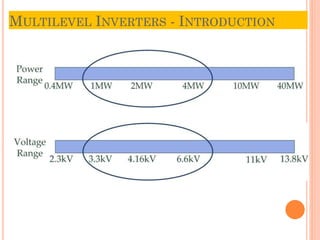
MULTILEVEL INVERTERS - INTRODUCTION
2
MULTILEVEL INVERTERS - INTRODUCTION
3
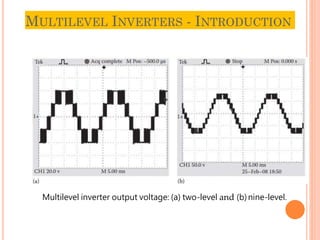
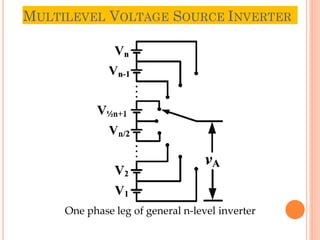
Drawbacks of two-level VSIs for MV Drives
 High dv/dt in the inverter output voltage – as high as
10,000V/µs
 Motor harmonic losses
This can be solved by adding properly tuned LC filter.
It has some disadvantages
 Increased manufacturing cost
 Fundamental voltage drop
 Circulating current between the filter and DC circuit
Multilevel inverter output voltage: (a) two-level and (b) nine-level.
4
MULTILEVEL INVERTERS - INTRODUCTION
MULTILEVEL VOLTAGE SOURCE INVERTER
One phase leg of general n-level inverter
5
MULTILEVEL VOLTAGE SOURCE INVERTER
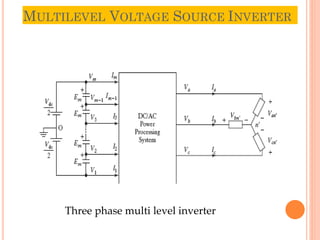
Three phase multi level inverter
6
MULTILEVEL VOLTAGE SOURCE INVERTER
7
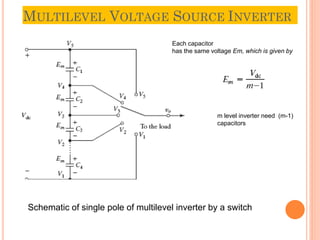
Schematic of single pole of multilevel inverter by a switch
Each capacitor
has the same voltage Em, which is given by
m level inverter need (m-1)
capacitors
MULTILEVEL VOLTAGE SOURCE INVERTER
8
The actual realization of the switch requires
bidirectional switching devices
for each node. The topological structure of
multilevel inverter must
(1) have less switching devices as far as possible,
(2) be capable of withstanding very high input
voltage for high-power applications,
(3) have lower switching frequency for each
switching device.
MULTILEVEL VOLTAGE SOURCE INVERTER
9
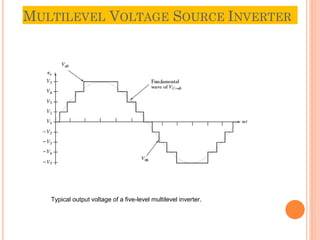
Typical output voltage of a five-level multilevel inverter.
MULTILEVEL VOLTAGE SOURCE INVERTER
10
The general structure of the multilevel converter is to synthesize a
near sinusoidal voltage from several levels of dc voltages, typically
obtained from capacitor voltage sources.
As the number of levels increases, the synthesized output waveform
has
more steps, which produce a staircase wave that approaches a
desired waveform.
Also, as more steps are added to the waveform, the harmonic
distortion of the output wave decreases, approaching zero as the
number of levels increases.
As the number of levels increases, the voltage that can be spanned
by summing multiple voltage levels also increases.
MULTILEVEL VOLTAGE SOURCE INVERTER
11
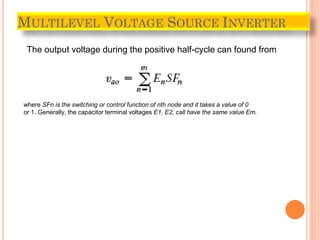
The output voltage during the positive half-cycle can found from
where SFn is the switching or control function of nth node and it takes a value of 0
or 1. Generally, the capacitor terminal voltages E1, E2, call have the same value Em.
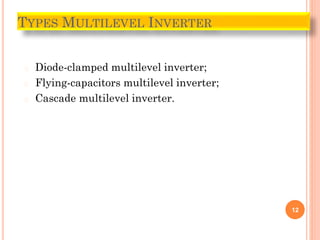
� Diode-clamped multilevel inverter;
� Flying-capacitors multilevel inverter;
� Cascade multilevel inverter.
12
TYPES MULTILEVEL INVERTER
MULTILEVEL VOLTAGE SOURCE INVERTER
13
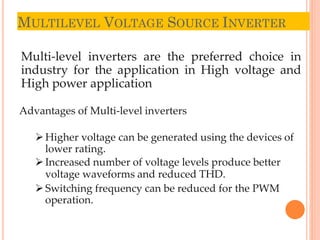
Multi-level inverters are the preferred choice in
industry for the application in High voltage and
High power application
Advantages of Multi-level inverters
Higher voltage can be generated using the devices of
lower rating.
Increased number of voltage levels produce better
voltage waveforms and reduced THD.
Switching frequency can be reduced for the PWM
operation.
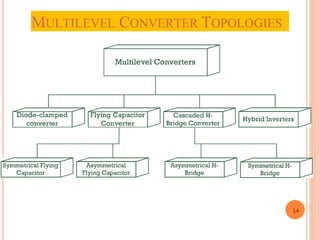
MULTILEVEL CONVERTER TOPOLOGIES
14
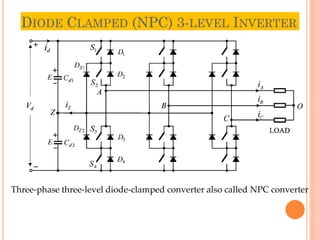
DIODE CLAMPED (NPC) 3-LEVEL INVERTER
Three-phase three-level diode-clamped converter also called NPC converter
16
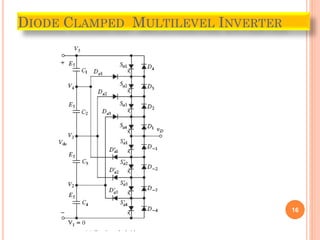
DIODE CLAMPED MULTILEVEL INVERTER
17
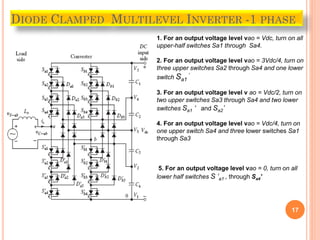
DIODE CLAMPED MULTILEVEL INVERTER -1 PHASE
1. For an output voltage level vao = Vdc, turn on all
upper-half switches Sa1 through Sa4.
2. For an output voltage level vao = 3Vdc/4, turn on
three upper switches Sa2 through Sa4 and one lower
switch Sa1
‘
3. For an output voltage level v ao = Vdc/2, turn on
two upper switches Sa3 through Sa4 and two lower
switches Sa1 ‘ and Sa2’
4. For an output voltage level vao = Vdc/4, turn on
one upper switch Sa4 and three lower switches Sa1
through Sa3
5. For an output voltage level vao = 0, turn on all
lower half switches S ‘a1 , through Sa4’
18
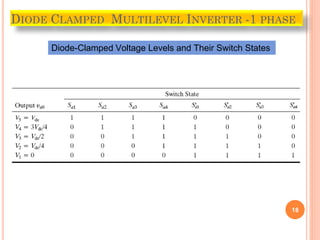
DIODE CLAMPED MULTILEVEL INVERTER -1 PHASE
Diode-Clamped Voltage Levels and Their Switch States
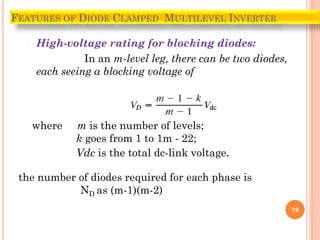
� High-voltage rating for blocking diodes:
In an m-level leg, there can be two diodes,
each seeing a blocking voltage of
19
FEATURES OF DIODE CLAMPED MULTILEVEL INVERTER
where m is the number of levels;
k goes from 1 to 1m - 22;
Vdc is the total dc-link voltage.
the number of diodes required for each phase is
ND as (m-1)(m-2)
� High-voltage rating for blocking diodes:
� Capacitor voltage unbalance:
20
FEATURES OF DIODE CLAMPED MULTILEVEL INVERTER
Major advantages of the diode-clamped inverter
•When the number of levels is high enough, the
harmonic content is low enough to avoid the
need for filters.
• Inverter efficiency is high because all devices
are switched at the fundamental frequency.
• The control method is simple.
Major Disadvantages of the diode-clamped inverter
• Excessive clamping diodes are required when
the number of levels is high.
• It is difficult to control the real power flow of the
individual converter in multi converter systems.
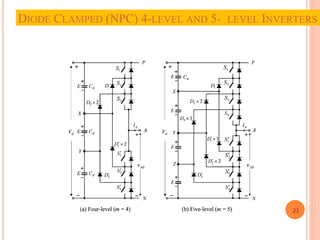
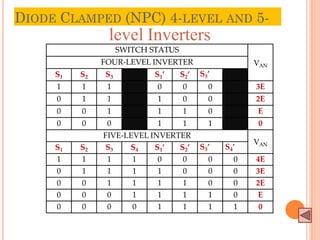
DIODE CLAMPED (NPC) 4-LEVEL AND 5- LEVEL INVERTERS
23
DIODE CLAMPED (NPC) 4-LEVEL AND 5-
level Inverters
SWITCH STATUS
VAN
FOUR-LEVEL INVERTER
S1 S2 S3 S1’ S2’ S3’
1 1 1 0 0 0 3E
0 1 1 1 0 0 2E
0 0 1 1 1 0 E
0 0 0 1 1 1 0
FIVE-LEVEL INVERTER
VAN
S1 S2 S3 S4 S1’ S2’ S3’ S4’
1 1 1 1 0 0 0 0 4E
0 1 1 1 1 0 0 0 3E
0 0 1 1 1 1 0 0 2E
0 0 0 1 1 1 1 0 E
0 0 0 0 1 1 1 1 0
24
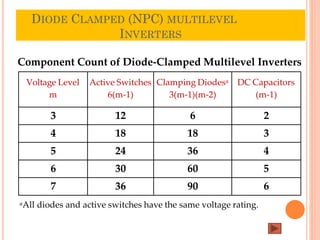
DIODE CLAMPED (NPC) MULTILEVEL
INVERTERS
Component Count of Diode-Clamped Multilevel Inverters
Voltage Level
m
Active Switches
6(m-1)
Clamping Diodesa
3(m-1)(m-2)
DC Capacitors
(m-1)
3 12 6 2
4 18 18 3
5 24 36 4
6 30 60 5
7 36 90 6
aAll diodes and active switches have the same voltage rating.
25
DIODE CLAMPED (NPC) MULTILEVEL
INVERTERS
26
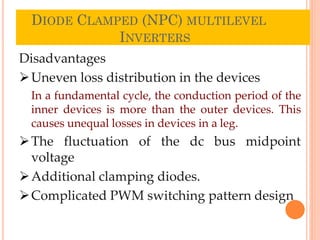
Disadvantages
Uneven loss distribution in the devices
In a fundamental cycle, the conduction period of the
inner devices is more than the outer devices. This
causes unequal losses in devices in a leg.
The fluctuation of the dc bus midpoint
voltage
Additional clamping diodes.
Complicated PWM switching pattern design
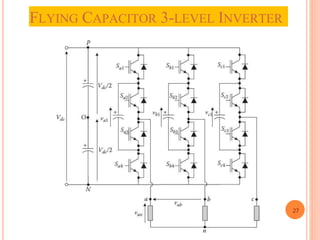
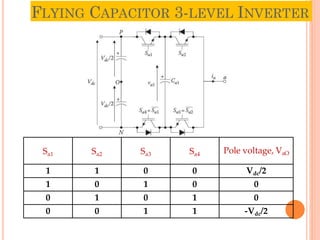
FLYING CAPACITOR 3-LEVEL INVERTER
27
FLYING CAPACITOR 3-LEVEL INVERTER
Sa1 Sa2 Sa3 Sa4 Pole voltage, VaO
1 1 0 0 Vdc/2
1 0 1 0 0
0 1 0 1 0
0 0 1 1 -Vdc/2
28
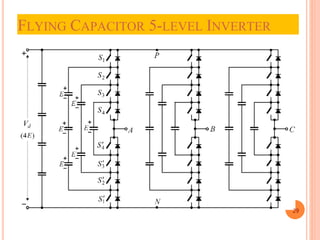
29
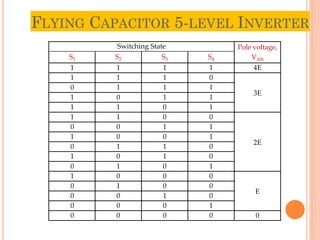
FLYING CAPACITOR 5-LEVEL INVERTER
30
Switching State Pole voltage,
VAN
S1 S2 S3 S4
1 1 1 1 4E
1 1 1 0
3E
0 1 1 1
1 0 1 1
1 1 0 1
1 1 0 0
2E
0 0 1 1
1 0 0 1
0 1 1 0
1 0 1 0
0 1 0 1
1 0 0 0
E
0 1 0 0
0 0 1 0
0 0 0 1
0 0 0 0 0
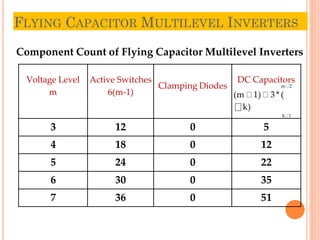
FLYING CAPACITOR MULTILEVEL INVERTERS
Component Count of Flying Capacitor Multilevel Inverters
Voltage Level
m
Active Switches
6(m-1)
Clamping Diodes
DC Capacitors
m 2
(m 1) 3 * (
k)
k 1
3 12 0 5
4 18 0 12
5 24 0 22
6 30 0 35
7 36 0 51
FEATURES OF FLYING-CAPACITORS INVERTER
32
Large number of capacitors:
Balancing capacitor voltages:
THE MAJOR ADVANTAGES OF THE FLYING-CAPACITORS
INVERTER CAN BE SUMMARIZED AS FOLLOWS
� Large amounts of storage capacitors can provide
capabilities during power outages.
� These inverters provide switch combination
redundancy for balancing different voltage levels.
� Like the diode-clamp inverter with more levels, the
harmonic content is low enough to avoid the need for
filters.
� Both real and reactive power flow can be controlled.
33
THE MAJOR DISADVANTAGES OF THE FLYING-CAPACITORS
INVERTER CAN BE SUMMARIZED AS FOLLOWS:
� An excessive number of storage capacitors is required
when the number of levels is high. High-level
inverters are more difficult to package with the bulky
power capacitors and are more expensive too.
� The inverter control can be very complicated, and the
switching frequency and switching losses are high for
real power transmission.
34
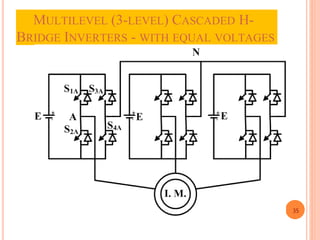
MULTILEVEL (3-LEVEL) CASCADED H-
BRIDGE INVERTERS - WITH EQUAL VOLTAGES
35
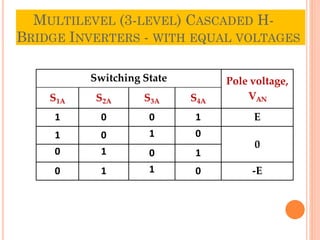
MULTILEVEL (3-LEVEL) CASCADED H-
BRIDGE INVERTERS - WITH EQUAL VOLTAGES
36
Switching State Pole voltage,
VAN
S1A S2A S3A S4A
1 0 0 1 E
1 0 1 0
0
0 1 0 1
0 1 1 0 -E
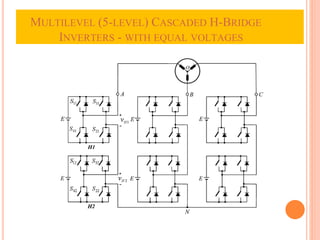
MULTILEVEL (5-LEVEL) CASCADED H-BRIDGE
INVERTERS - WITH EQUAL VOLTAGES
MULTILEVEL (5-LEVEL) CASCADED H-BRIDGE
INVERTERS - WITH EQUAL VOLTAGES
PEGCRES
2015
38
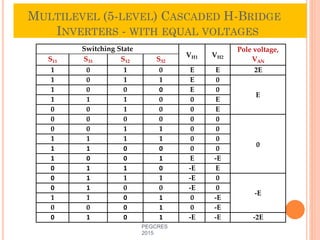
Switching State
VH1 VH2
Pole voltage,
VAN
S11 S31 S12 S32
1 0 1 0 E E 2E
1 0 1 1 E 0
E
1 0 0 0 E 0
1 1 1 0 0 E
0 0 1 0 0 E
0 0 0 0 0 0
0
0 0 1 1 0 0
1 1 1 1 0 0
1 1 0 0 0 0
1 0 0 1 E -E
0 1 1 0 -E E
0 1 1 1 -E 0
-E
0 1 0 0 -E 0
1 1 0 1 0 -E
0 0 0 1 0 -E
0 1 0 1 -E -E -2E
MULTILEVEL CASCADED H-BRIDGE
INVERTERS – WITH EQUAL VOLTAGES
39
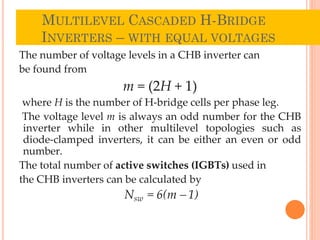
The number of voltage levels in a CHB inverter can
be found from
m = (2H + 1)
where H is the number of H-bridge cells per phase leg.
The voltage level m is always an odd number for the CHB
inverter while in other multilevel topologies such as
diode-clamped inverters, it can be either an even or odd
number.
The total number of active switches (IGBTs) used in
the CHB inverters can be calculated by
Nsw = 6(m – 1)
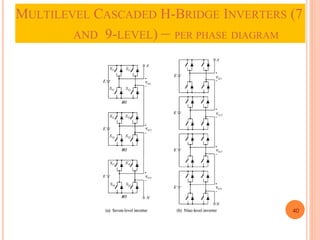
MULTILEVEL CASCADED H-BRIDGE INVERTERS (7
AND 9-LEVEL) – PER PHASE DIAGRAM
40
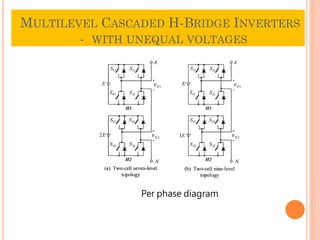
MULTILEVEL CASCADED H-BRIDGE INVERTERS
- WITH UNEQUAL VOLTAGES
Per phase diagram
41
MULTILEVEL CASCADED H-BRIDGE INVERTERS -
WITH UNEQUAL VOLTAGES
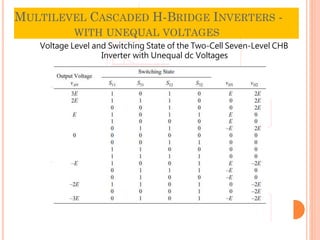
Voltage Level and Switching State of the Two-Cell Seven-Level CHB
Inverter with Unequal dc Voltages
42
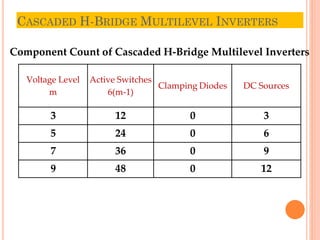
CASCADED H-BRIDGE MULTILEVEL INVERTERS
Component Count of Cascaded H-Bridge Multilevel Inverters
Voltage Level
m
Active Switches
6(m-1)
Clamping Diodes DC Sources
3 12 0 3
5 24 0 6
7 36 0 9
9 48 0 12
43
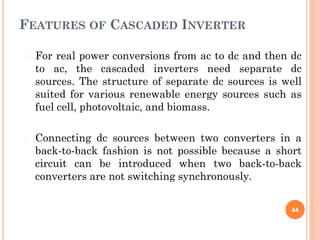
FEATURES OF CASCADED INVERTER
� For real power conversions from ac to dc and then dc
to ac, the cascaded inverters need separate dc
sources. The structure of separate dc sources is well
suited for various renewable energy sources such as
fuel cell, photovoltaic, and biomass.
� Connecting dc sources between two converters in a
back-to-back fashion is not possible because a short
circuit can be introduced when two back-to-back
converters are not switching synchronously.
44
45
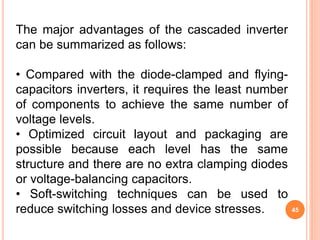
The major advantages of the cascaded inverter
can be summarized as follows:
• Compared with the diode-clamped and flying-
capacitors inverters, it requires the least number
of components to achieve the same number of
voltage levels.
• Optimized circuit layout and packaging are
possible because each level has the same
structure and there are no extra clamping diodes
or voltage-balancing capacitors.
• Soft-switching techniques can be used to
reduce switching losses and device stresses.
46
The major disadvantage of the
cascaded inverter is as follows:
• It needs separate dc sources for
real power conversions, thereby
limiting its applications.
KEY FEATURES OF A MULTILEVEL STRUCTURE
� The output voltage and power increase with number of
levels. Adding a voltage level involves adding a main
switching device to each phase.
� The harmonic content decreases as the number of levels
increases and filtering requirements are reduced.
� With additional voltage levels, the voltage waveform has
more free-switching angles, which can be preselected for
harmonic elimination.
� In the absence of any PWM techniques, the switching
losses can be avoided.
� Increasing output voltage and power does not require an
increase in rating of individual device.
47
48
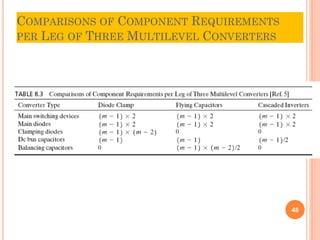
COMPARISONS OF COMPONENT REQUIREMENTS
PER LEG OF THREE MULTILEVEL CONVERTERS
REFERENCES
49
 B. Wu, High-Power Converters and AC Drives, Wiley-IEEE
Press, Piscataway, NJ, 2006.
 J. Rodriguez, J. S. Lai, and F. Z. Peng, Multilevel inverters: A
survey of topologies, controls, and applications, IEEE
Transactions on Industrial Electronics, 49(4), 724–738, August
2002.
 N. Mohan,
Electronics:
T. M. Undeland, and W. P. Robbins, Power
Converters, Applications, and Design, 3 edn,
Wiley, Hoboken, NJ, October 10, 2002.
 Rodriguez, S. Bernet, B. Wu, J. O. Pontt, and S. Kouro,
Multilevel voltage-source-converter topologies for industrial
medium-voltage drives, IEEE Transactions on Industrial
Electronics, 54(6), 2930–2945, December 2007.
50

Multi level inverter

  • 1.
    1 Multi Level Inverter Dr.A. Ravi Professor/EEE FRANCIS XAVIER ENGINEERING COLLEGE TIRUNELVELI- India
  • 2.
    MULTILEVEL INVERTERS -INTRODUCTION 2
  • 3.
    MULTILEVEL INVERTERS -INTRODUCTION 3 Drawbacks of two-level VSIs for MV Drives  High dv/dt in the inverter output voltage – as high as 10,000V/µs  Motor harmonic losses This can be solved by adding properly tuned LC filter. It has some disadvantages  Increased manufacturing cost  Fundamental voltage drop  Circulating current between the filter and DC circuit
  • 4.
    Multilevel inverter outputvoltage: (a) two-level and (b) nine-level. 4 MULTILEVEL INVERTERS - INTRODUCTION
  • 5.
    MULTILEVEL VOLTAGE SOURCEINVERTER One phase leg of general n-level inverter 5
  • 6.
    MULTILEVEL VOLTAGE SOURCEINVERTER Three phase multi level inverter 6
  • 7.
    MULTILEVEL VOLTAGE SOURCEINVERTER 7 Schematic of single pole of multilevel inverter by a switch Each capacitor has the same voltage Em, which is given by m level inverter need (m-1) capacitors
  • 8.
    MULTILEVEL VOLTAGE SOURCEINVERTER 8 The actual realization of the switch requires bidirectional switching devices for each node. The topological structure of multilevel inverter must (1) have less switching devices as far as possible, (2) be capable of withstanding very high input voltage for high-power applications, (3) have lower switching frequency for each switching device.
  • 9.
    MULTILEVEL VOLTAGE SOURCEINVERTER 9 Typical output voltage of a five-level multilevel inverter.
  • 10.
    MULTILEVEL VOLTAGE SOURCEINVERTER 10 The general structure of the multilevel converter is to synthesize a near sinusoidal voltage from several levels of dc voltages, typically obtained from capacitor voltage sources. As the number of levels increases, the synthesized output waveform has more steps, which produce a staircase wave that approaches a desired waveform. Also, as more steps are added to the waveform, the harmonic distortion of the output wave decreases, approaching zero as the number of levels increases. As the number of levels increases, the voltage that can be spanned by summing multiple voltage levels also increases.
  • 11.
    MULTILEVEL VOLTAGE SOURCEINVERTER 11 The output voltage during the positive half-cycle can found from where SFn is the switching or control function of nth node and it takes a value of 0 or 1. Generally, the capacitor terminal voltages E1, E2, call have the same value Em.
  • 12.
    � Diode-clamped multilevelinverter; � Flying-capacitors multilevel inverter; � Cascade multilevel inverter. 12 TYPES MULTILEVEL INVERTER
  • 13.
    MULTILEVEL VOLTAGE SOURCEINVERTER 13 Multi-level inverters are the preferred choice in industry for the application in High voltage and High power application Advantages of Multi-level inverters Higher voltage can be generated using the devices of lower rating. Increased number of voltage levels produce better voltage waveforms and reduced THD. Switching frequency can be reduced for the PWM operation.
  • 14.
  • 15.
    DIODE CLAMPED (NPC)3-LEVEL INVERTER Three-phase three-level diode-clamped converter also called NPC converter
  • 16.
  • 17.
    17 DIODE CLAMPED MULTILEVELINVERTER -1 PHASE 1. For an output voltage level vao = Vdc, turn on all upper-half switches Sa1 through Sa4. 2. For an output voltage level vao = 3Vdc/4, turn on three upper switches Sa2 through Sa4 and one lower switch Sa1 ‘ 3. For an output voltage level v ao = Vdc/2, turn on two upper switches Sa3 through Sa4 and two lower switches Sa1 ‘ and Sa2’ 4. For an output voltage level vao = Vdc/4, turn on one upper switch Sa4 and three lower switches Sa1 through Sa3 5. For an output voltage level vao = 0, turn on all lower half switches S ‘a1 , through Sa4’
  • 18.
    18 DIODE CLAMPED MULTILEVELINVERTER -1 PHASE Diode-Clamped Voltage Levels and Their Switch States
  • 19.
    � High-voltage ratingfor blocking diodes: In an m-level leg, there can be two diodes, each seeing a blocking voltage of 19 FEATURES OF DIODE CLAMPED MULTILEVEL INVERTER where m is the number of levels; k goes from 1 to 1m - 22; Vdc is the total dc-link voltage. the number of diodes required for each phase is ND as (m-1)(m-2)
  • 20.
    � High-voltage ratingfor blocking diodes: � Capacitor voltage unbalance: 20 FEATURES OF DIODE CLAMPED MULTILEVEL INVERTER
  • 21.
    Major advantages ofthe diode-clamped inverter •When the number of levels is high enough, the harmonic content is low enough to avoid the need for filters. • Inverter efficiency is high because all devices are switched at the fundamental frequency. • The control method is simple.
  • 22.
    Major Disadvantages ofthe diode-clamped inverter • Excessive clamping diodes are required when the number of levels is high. • It is difficult to control the real power flow of the individual converter in multi converter systems.
  • 23.
    DIODE CLAMPED (NPC)4-LEVEL AND 5- LEVEL INVERTERS 23
  • 24.
    DIODE CLAMPED (NPC)4-LEVEL AND 5- level Inverters SWITCH STATUS VAN FOUR-LEVEL INVERTER S1 S2 S3 S1’ S2’ S3’ 1 1 1 0 0 0 3E 0 1 1 1 0 0 2E 0 0 1 1 1 0 E 0 0 0 1 1 1 0 FIVE-LEVEL INVERTER VAN S1 S2 S3 S4 S1’ S2’ S3’ S4’ 1 1 1 1 0 0 0 0 4E 0 1 1 1 1 0 0 0 3E 0 0 1 1 1 1 0 0 2E 0 0 0 1 1 1 1 0 E 0 0 0 0 1 1 1 1 0 24
  • 25.
    DIODE CLAMPED (NPC)MULTILEVEL INVERTERS Component Count of Diode-Clamped Multilevel Inverters Voltage Level m Active Switches 6(m-1) Clamping Diodesa 3(m-1)(m-2) DC Capacitors (m-1) 3 12 6 2 4 18 18 3 5 24 36 4 6 30 60 5 7 36 90 6 aAll diodes and active switches have the same voltage rating. 25
  • 26.
    DIODE CLAMPED (NPC)MULTILEVEL INVERTERS 26 Disadvantages Uneven loss distribution in the devices In a fundamental cycle, the conduction period of the inner devices is more than the outer devices. This causes unequal losses in devices in a leg. The fluctuation of the dc bus midpoint voltage Additional clamping diodes. Complicated PWM switching pattern design
  • 27.
  • 28.
    FLYING CAPACITOR 3-LEVELINVERTER Sa1 Sa2 Sa3 Sa4 Pole voltage, VaO 1 1 0 0 Vdc/2 1 0 1 0 0 0 1 0 1 0 0 0 1 1 -Vdc/2 28
  • 29.
  • 30.
    FLYING CAPACITOR 5-LEVELINVERTER 30 Switching State Pole voltage, VAN S1 S2 S3 S4 1 1 1 1 4E 1 1 1 0 3E 0 1 1 1 1 0 1 1 1 1 0 1 1 1 0 0 2E 0 0 1 1 1 0 0 1 0 1 1 0 1 0 1 0 0 1 0 1 1 0 0 0 E 0 1 0 0 0 0 1 0 0 0 0 1 0 0 0 0 0
  • 31.
    FLYING CAPACITOR MULTILEVELINVERTERS Component Count of Flying Capacitor Multilevel Inverters Voltage Level m Active Switches 6(m-1) Clamping Diodes DC Capacitors m 2 (m 1) 3 * ( k) k 1 3 12 0 5 4 18 0 12 5 24 0 22 6 30 0 35 7 36 0 51
  • 32.
    FEATURES OF FLYING-CAPACITORSINVERTER 32 Large number of capacitors: Balancing capacitor voltages:
  • 33.
    THE MAJOR ADVANTAGESOF THE FLYING-CAPACITORS INVERTER CAN BE SUMMARIZED AS FOLLOWS � Large amounts of storage capacitors can provide capabilities during power outages. � These inverters provide switch combination redundancy for balancing different voltage levels. � Like the diode-clamp inverter with more levels, the harmonic content is low enough to avoid the need for filters. � Both real and reactive power flow can be controlled. 33
  • 34.
    THE MAJOR DISADVANTAGESOF THE FLYING-CAPACITORS INVERTER CAN BE SUMMARIZED AS FOLLOWS: � An excessive number of storage capacitors is required when the number of levels is high. High-level inverters are more difficult to package with the bulky power capacitors and are more expensive too. � The inverter control can be very complicated, and the switching frequency and switching losses are high for real power transmission. 34
  • 35.
    MULTILEVEL (3-LEVEL) CASCADEDH- BRIDGE INVERTERS - WITH EQUAL VOLTAGES 35
  • 36.
    MULTILEVEL (3-LEVEL) CASCADEDH- BRIDGE INVERTERS - WITH EQUAL VOLTAGES 36 Switching State Pole voltage, VAN S1A S2A S3A S4A 1 0 0 1 E 1 0 1 0 0 0 1 0 1 0 1 1 0 -E
  • 37.
    MULTILEVEL (5-LEVEL) CASCADEDH-BRIDGE INVERTERS - WITH EQUAL VOLTAGES
  • 38.
    MULTILEVEL (5-LEVEL) CASCADEDH-BRIDGE INVERTERS - WITH EQUAL VOLTAGES PEGCRES 2015 38 Switching State VH1 VH2 Pole voltage, VAN S11 S31 S12 S32 1 0 1 0 E E 2E 1 0 1 1 E 0 E 1 0 0 0 E 0 1 1 1 0 0 E 0 0 1 0 0 E 0 0 0 0 0 0 0 0 0 1 1 0 0 1 1 1 1 0 0 1 1 0 0 0 0 1 0 0 1 E -E 0 1 1 0 -E E 0 1 1 1 -E 0 -E 0 1 0 0 -E 0 1 1 0 1 0 -E 0 0 0 1 0 -E 0 1 0 1 -E -E -2E
  • 39.
    MULTILEVEL CASCADED H-BRIDGE INVERTERS– WITH EQUAL VOLTAGES 39 The number of voltage levels in a CHB inverter can be found from m = (2H + 1) where H is the number of H-bridge cells per phase leg. The voltage level m is always an odd number for the CHB inverter while in other multilevel topologies such as diode-clamped inverters, it can be either an even or odd number. The total number of active switches (IGBTs) used in the CHB inverters can be calculated by Nsw = 6(m – 1)
  • 40.
    MULTILEVEL CASCADED H-BRIDGEINVERTERS (7 AND 9-LEVEL) – PER PHASE DIAGRAM 40
  • 41.
    MULTILEVEL CASCADED H-BRIDGEINVERTERS - WITH UNEQUAL VOLTAGES Per phase diagram 41
  • 42.
    MULTILEVEL CASCADED H-BRIDGEINVERTERS - WITH UNEQUAL VOLTAGES Voltage Level and Switching State of the Two-Cell Seven-Level CHB Inverter with Unequal dc Voltages 42
  • 43.
    CASCADED H-BRIDGE MULTILEVELINVERTERS Component Count of Cascaded H-Bridge Multilevel Inverters Voltage Level m Active Switches 6(m-1) Clamping Diodes DC Sources 3 12 0 3 5 24 0 6 7 36 0 9 9 48 0 12 43
  • 44.
    FEATURES OF CASCADEDINVERTER � For real power conversions from ac to dc and then dc to ac, the cascaded inverters need separate dc sources. The structure of separate dc sources is well suited for various renewable energy sources such as fuel cell, photovoltaic, and biomass. � Connecting dc sources between two converters in a back-to-back fashion is not possible because a short circuit can be introduced when two back-to-back converters are not switching synchronously. 44
  • 45.
    45 The major advantagesof the cascaded inverter can be summarized as follows: • Compared with the diode-clamped and flying- capacitors inverters, it requires the least number of components to achieve the same number of voltage levels. • Optimized circuit layout and packaging are possible because each level has the same structure and there are no extra clamping diodes or voltage-balancing capacitors. • Soft-switching techniques can be used to reduce switching losses and device stresses.
  • 46.
    46 The major disadvantageof the cascaded inverter is as follows: • It needs separate dc sources for real power conversions, thereby limiting its applications.
  • 47.
    KEY FEATURES OFA MULTILEVEL STRUCTURE � The output voltage and power increase with number of levels. Adding a voltage level involves adding a main switching device to each phase. � The harmonic content decreases as the number of levels increases and filtering requirements are reduced. � With additional voltage levels, the voltage waveform has more free-switching angles, which can be preselected for harmonic elimination. � In the absence of any PWM techniques, the switching losses can be avoided. � Increasing output voltage and power does not require an increase in rating of individual device. 47
  • 48.
    48 COMPARISONS OF COMPONENTREQUIREMENTS PER LEG OF THREE MULTILEVEL CONVERTERS
  • 49.
    REFERENCES 49  B. Wu,High-Power Converters and AC Drives, Wiley-IEEE Press, Piscataway, NJ, 2006.  J. Rodriguez, J. S. Lai, and F. Z. Peng, Multilevel inverters: A survey of topologies, controls, and applications, IEEE Transactions on Industrial Electronics, 49(4), 724–738, August 2002.  N. Mohan, Electronics: T. M. Undeland, and W. P. Robbins, Power Converters, Applications, and Design, 3 edn, Wiley, Hoboken, NJ, October 10, 2002.  Rodriguez, S. Bernet, B. Wu, J. O. Pontt, and S. Kouro, Multilevel voltage-source-converter topologies for industrial medium-voltage drives, IEEE Transactions on Industrial Electronics, 54(6), 2930–2945, December 2007.
  • 50.