Vasculitis
Vasculitis
DEFINITION
Vasculitis are a heterogeneous group of diseases characterized by
Inflammation , necrosis and damage to blood vessel walls , often with
associated organ involvement.

 The vessel lumen is usually compromised, and this is associated with
ischemia of the tissue supplied by the involved vessel.

Any type, size, and location of blood vessel may be involved.

Vasculitis may be primary ( sole manifestation of a disease)
or may be secondary( component of another primary disease)

Vasculitis may be confined to a single organ, such as the skin,
or it may simultaneously involve several organ systems
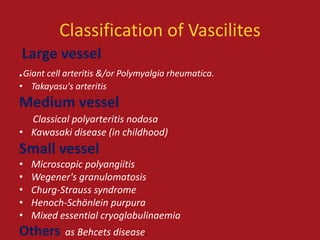
Classification of Vascilites
Large vessel
.Giant cell arteritis &/or Polymyalgia rheumatica.
• Takayasu's arteritis
Medium vessel
  Classical polyarteritis nodosa
• Kawasaki disease (in childhood)
Small vessel
•   Microscopic polyangiitis
•   Wegener's granulomatosis
•   Churg-Strauss syndrome
•   Henoch-Schönlein purpura
•   Mixed essential cryoglobulinaemia
Others     as Behcets disease.
PATHOPHYSIOLOGY AND
         PATHOGENESIS of Vasculitis
• Generally, most of the vasculitic syndromes are assumed to be
  mediated at least in part by immunopathogenic mechanisms
  that occur in response to certain antigenic stimuli

• it is unknown why some individuals might develop vasculitis
  in response to certain antigenic stimuli,whereas others do not.

• It is likely that a number of factors are involved in the
  ultimate expression of a vasculitic syndrome. These include
  the genetic predisposition, environmental exposures, and the
  regulatory mechanisms associated with immune response to
  certain antigens.
deposition of immune complexes in vessel walls is the most
  widely accepted pathogenic mechanism of vasculitis.

• The actual antigen contained in the immune complex has only
  rarely been identified in vasculitic syndromes.

• In this regard, hepatitis B antigen has been identified in some
  patients with systemic vasculitis, most notably in polyarteritis
  nodosa .
• The syndrome of essential mixed cryoglobulinemiais strongly
  associated with hepatitis C virus infection
• . The mechanisms of tissue damage in
  immune complex–mediated vasculitis
•    antigen-antibody complexes are formed and are deposited in
    vessel walls .
•   The deposition of complexes results in activation of
    complement components, particularly C5a, which is strongly
    chemotactic for neutrophils.
•   These cells then infiltrate the vessel wall, phagocytose the
    immune complexes, and release their intracytoplasmic
    enzymes, which damage the vessel wall.
•   As the process becomes subacute or chronic,mononuclear
    cells infiltrate the vessel wall.
•   This will compromise of the vessel lumen with ischemic
    changes in the tissues supplied by the involved vessel.
Clinical features of Vasculitis
• The clinical features of vasculitis are due to a combination of
  local tissue ischaemia (caused by vessel inflammation and
  narrowing) and the systemic effects of widespread
  inflammation.

• Systemic vasculitis should be considered in any patient with
  fever, weight loss, fatigue, evidence of multisystem
  involvement, rashes, raised inflammatory markers and
  abnormal urinalysis.

• Early diagnosis and management are essential to prevent
  irreversible organ damage.
• .
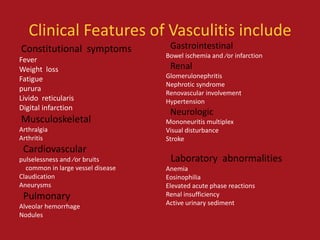
Clinical Features of Vasculitis include
Constitutional symptoms             Gastrointestinal
                                   Bowel ischemia and ⁄or infarction
Fever
Weight loss                         Renal
Fatigue                            Glomerulonephritis
                                   Nephrotic syndrome
purura
                                   Renovascular involvement
Livido reticularis                 Hypertension
Digital infarction
                                    Neurologic
Musculoskeletal                    Mononeuritis multiplex
Arthralgia                         Visual disturbance
Arthritis                          Stroke
 Cardiovascular
pulselessness and ⁄or bruits        Laboratory abnormalities
  common in large vessel disease   Anemia
Claudication                       Eosinophilia
Aneurysms                          Elevated acute phase reactions
 Pulmonary                         Renal insufficiency
Alveolar hemorrhage                Active urinary sediment
Nodules
• Vasculitis may be difficult to distinguish from

    - widespread malignancy.

   - occult sepsis (particularly subacute bacterial endocarditis &
  meningococcal septicaemia).

   - cholesterol emboli.
   - atrial myxoma .
   -antiphospholipid syndrome.

 The key to recognition is the presence of multisystem
involvement
Conditions That Can Mimic Vasculitis

•   Infectious diseases
•   Bacterial endocarditis
•   Disseminated gonococcal infection
•   Pulmonary histoplasmosis
•   Coccidioidomycosis
•   Syphilis
•   Lyme disease
•   Rocky Mountain spotted fever

• Coagulopathies/thrombotic
  microangiopathies
• Antiphospholipid antibody syndrome
• Thrombotic thrombocytopenic purpura
• Neoplasms                  Emboli
•   Atrial myxoma             cardiac emboli
•   Lymphoma                  cholestrol emboli
•   Carcinomatosis
• Drug toxicity
•   Cocaine
•   Amphetamines
•   Ergot alkaloids
•   Methysergide

• Others
•   Sarcoidosis
•   Goodpasture’s syndrome
•   Amyloidosis
•   Migraine
•   Cryofibrinogenemia
Investigations in Vasculitis
• If vasculitis is suspected, the diagnosis should ideally be
  confirmed by tissue biopsy.
• Skin biopsies are easily obtained.
• Nasal septal tissue can be taken from areas of ulceration or
  granulation.
• Muscle biopsy is positive in about 50% of patients with muscle
  pain.

. The most important bedside test is the urine dip test for protein
  and blood, and subsequent microscopy, since the prognosis of
  vasculitis is often determined by the degree of renal
  involvement. In patients with abnormal renal function and active
  urinary sediment, renal biopsy should be considered.
• Visceral angiography
  to detect microaneurysms (e.g. classical polyarteritis nodosa)
  is most useful where involved tissue is not available to biopsy.


• ESR usually elevated in vasculitis
• CRP
• C-ANCA & p-ANCA
• Antineutrophil cytoplasmic antibodies (ANCA)
• are directed against enzymes present in neutrophil granules.
• Two main patterns of immunofluorescence are distinguished:
  cytoplasmic (c-ANCA) and perinuclear (p-ANCA).

•   c-ANCA are usually directed against proteinase 3 and are
    particularly associated with Wegener's granulomatosis and Churg-
    Strauss syndrome.
• p-ANCA are usually directed against myeloperoxidase and
    associate with microscopic polyangiitis.

•   However, positive ANCAs occur in many other diseases, including
    malignancy, infection (bacterial and HIV), inflammatory bowel
    disease, RA, lupus and pulmonary fibrosis. Therefore, the diagnosis
    of these conditions cannot be made or refuted on the ANCA test
    alone.
Large Vessel Vasculitis

1- Giant cell arteritis
2- Polymyalgia rheumatica
3-Takayasu's arteritis
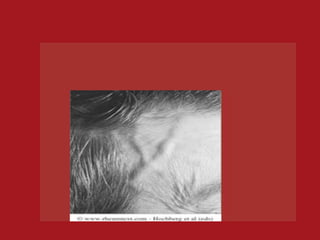
GIANT CELL ARTERITIS (GCA)
            (Temporal Arteritis)

• GCA also known as temporal arteritis or cranial arteritis

• is a large vessel vasculitis predominately affecting branches of
  the temporal and ophthalmic arteries.

• The mean age of onset is 70 years .

• 4:1 female:male ratio.
Clinical features of Giant cell arteritis
• The onset of symptoms may be abrupt but is often
  insidious over the course of several weeks or months.

• The most important clinical features are:
 1- Headache. This is usually the first symptom and is often
   localised to the temporal or occipital region, with scalp
   tenderness.
2- Jaw pain. This is brought on by chewing or talking and is
   due to ischaemia of the masseters.
3-Visual disturbance.
The most important complication of GCA is monocular blindness
  which is almost never reversible
  The optic nerve head is supplied by the posterior ciliary artery,
  vasculitis of which leads to occlusion and acute anterior
  ischaemic optic neuropathy.
Damage to the optic nerve results in loss of visual acuity and field,
  reduced colour perception and pupillary defects.
Sudden visual symptoms in one eye, leading rapidly to blindness,
  constitute the most common pattern.
On fundoscopy the optic disc may appear pale and swollen with
  haemorrhages, but these changes may take 24-36 hours to
  develop.
Once blindness has occurred corticosteroids have a negligible
  effect but are indicated to prevent blindness in the other eye.
4- There may be associated constitutional
  symptoms of anorexia, fatigue, weight
  loss, fever, depression and general malaise.

5- Occasionally presentation is with
  neurological complications that include
  transient ischaemic attacks, brain-stem
  infarcts and hemiparesis.
Investigations
• The ESR usually elevated above 50 mm/hour in 90% of cases. ( in
  some cases the ESR may be normal mainly in those with acute
  presentationis , in the this situation the CRP may be more helpful ,&
  usually elevated ).

•    Temporal artery biopsy should be obtained.
    corticosteroid treatment should not be delayed whilst the biopsy is
    organised.
    Characteristic biopsy findings are fragmentation of the internal
    elastic lamina with necrosis of the media in combination with a
    mixed inflammatory cell infiltrate (lymphocytes, plasma cells and
    eosinophils).
    However, 'skip' lesions are common and a negative biopsy does not
    exclude the diagnosis.
Management of GCA
• If GCA is suspected, systemic corticosteroid (prednisolone 60
  mg daily) should be started immediately to prevent visual loss.
• Steroid reduction should be guided by symptoms and ESR,
  aiming for approximately 10 mg daily by 6 weeks. Thereafter,
  doses should be reduced by 1 mg per month
• Maintenance therapy is required for at least 1 year, and
  occasionally for the rest of the patient's life.

• Relapse occurs in 30%, and is an indication to restart high-
  dose steroids with additional immunosuppressive agents,
  typically azathioprine or methotrexate
• . Patients with known GCA should be advised to take
  60 mg prednisolone and seek prompt medical advice
  should they experience any recurrence of headache
  or visual disturbance.
meidicine.Vasculitis 1.(dr.kawa)

meidicine.Vasculitis 1.(dr.kawa)

  • 1.
  • 2.
    Vasculitis DEFINITION Vasculitis are aheterogeneous group of diseases characterized by Inflammation , necrosis and damage to blood vessel walls , often with associated organ involvement. The vessel lumen is usually compromised, and this is associated with ischemia of the tissue supplied by the involved vessel. Any type, size, and location of blood vessel may be involved. Vasculitis may be primary ( sole manifestation of a disease) or may be secondary( component of another primary disease) Vasculitis may be confined to a single organ, such as the skin, or it may simultaneously involve several organ systems
  • 3.
    Classification of Vascilites Largevessel .Giant cell arteritis &/or Polymyalgia rheumatica. • Takayasu's arteritis Medium vessel Classical polyarteritis nodosa • Kawasaki disease (in childhood) Small vessel • Microscopic polyangiitis • Wegener's granulomatosis • Churg-Strauss syndrome • Henoch-Schönlein purpura • Mixed essential cryoglobulinaemia Others as Behcets disease.
  • 4.
    PATHOPHYSIOLOGY AND PATHOGENESIS of Vasculitis • Generally, most of the vasculitic syndromes are assumed to be mediated at least in part by immunopathogenic mechanisms that occur in response to certain antigenic stimuli • it is unknown why some individuals might develop vasculitis in response to certain antigenic stimuli,whereas others do not. • It is likely that a number of factors are involved in the ultimate expression of a vasculitic syndrome. These include the genetic predisposition, environmental exposures, and the regulatory mechanisms associated with immune response to certain antigens.
  • 5.
    deposition of immunecomplexes in vessel walls is the most widely accepted pathogenic mechanism of vasculitis. • The actual antigen contained in the immune complex has only rarely been identified in vasculitic syndromes. • In this regard, hepatitis B antigen has been identified in some patients with systemic vasculitis, most notably in polyarteritis nodosa . • The syndrome of essential mixed cryoglobulinemiais strongly associated with hepatitis C virus infection
  • 6.
    • . Themechanisms of tissue damage in immune complex–mediated vasculitis • antigen-antibody complexes are formed and are deposited in vessel walls . • The deposition of complexes results in activation of complement components, particularly C5a, which is strongly chemotactic for neutrophils. • These cells then infiltrate the vessel wall, phagocytose the immune complexes, and release their intracytoplasmic enzymes, which damage the vessel wall. • As the process becomes subacute or chronic,mononuclear cells infiltrate the vessel wall. • This will compromise of the vessel lumen with ischemic changes in the tissues supplied by the involved vessel.
  • 7.
    Clinical features ofVasculitis • The clinical features of vasculitis are due to a combination of local tissue ischaemia (caused by vessel inflammation and narrowing) and the systemic effects of widespread inflammation. • Systemic vasculitis should be considered in any patient with fever, weight loss, fatigue, evidence of multisystem involvement, rashes, raised inflammatory markers and abnormal urinalysis. • Early diagnosis and management are essential to prevent irreversible organ damage. • .
  • 8.
    Clinical Features ofVasculitis include Constitutional symptoms Gastrointestinal Bowel ischemia and ⁄or infarction Fever Weight loss Renal Fatigue Glomerulonephritis Nephrotic syndrome purura Renovascular involvement Livido reticularis Hypertension Digital infarction Neurologic Musculoskeletal Mononeuritis multiplex Arthralgia Visual disturbance Arthritis Stroke Cardiovascular pulselessness and ⁄or bruits Laboratory abnormalities common in large vessel disease Anemia Claudication Eosinophilia Aneurysms Elevated acute phase reactions Pulmonary Renal insufficiency Alveolar hemorrhage Active urinary sediment Nodules
  • 9.
    • Vasculitis maybe difficult to distinguish from - widespread malignancy. - occult sepsis (particularly subacute bacterial endocarditis & meningococcal septicaemia). - cholesterol emboli. - atrial myxoma . -antiphospholipid syndrome. The key to recognition is the presence of multisystem involvement
  • 10.
    Conditions That CanMimic Vasculitis • Infectious diseases • Bacterial endocarditis • Disseminated gonococcal infection • Pulmonary histoplasmosis • Coccidioidomycosis • Syphilis • Lyme disease • Rocky Mountain spotted fever • Coagulopathies/thrombotic microangiopathies • Antiphospholipid antibody syndrome • Thrombotic thrombocytopenic purpura
  • 11.
    • Neoplasms Emboli • Atrial myxoma cardiac emboli • Lymphoma cholestrol emboli • Carcinomatosis • Drug toxicity • Cocaine • Amphetamines • Ergot alkaloids • Methysergide • Others • Sarcoidosis • Goodpasture’s syndrome • Amyloidosis • Migraine • Cryofibrinogenemia
  • 12.
    Investigations in Vasculitis •If vasculitis is suspected, the diagnosis should ideally be confirmed by tissue biopsy. • Skin biopsies are easily obtained. • Nasal septal tissue can be taken from areas of ulceration or granulation. • Muscle biopsy is positive in about 50% of patients with muscle pain. . The most important bedside test is the urine dip test for protein and blood, and subsequent microscopy, since the prognosis of vasculitis is often determined by the degree of renal involvement. In patients with abnormal renal function and active urinary sediment, renal biopsy should be considered.
  • 13.
    • Visceral angiography to detect microaneurysms (e.g. classical polyarteritis nodosa) is most useful where involved tissue is not available to biopsy. • ESR usually elevated in vasculitis • CRP • C-ANCA & p-ANCA
  • 14.
    • Antineutrophil cytoplasmicantibodies (ANCA) • are directed against enzymes present in neutrophil granules. • Two main patterns of immunofluorescence are distinguished: cytoplasmic (c-ANCA) and perinuclear (p-ANCA). • c-ANCA are usually directed against proteinase 3 and are particularly associated with Wegener's granulomatosis and Churg- Strauss syndrome. • p-ANCA are usually directed against myeloperoxidase and associate with microscopic polyangiitis. • However, positive ANCAs occur in many other diseases, including malignancy, infection (bacterial and HIV), inflammatory bowel disease, RA, lupus and pulmonary fibrosis. Therefore, the diagnosis of these conditions cannot be made or refuted on the ANCA test alone.
  • 15.
    Large Vessel Vasculitis 1-Giant cell arteritis 2- Polymyalgia rheumatica 3-Takayasu's arteritis
  • 16.
    GIANT CELL ARTERITIS(GCA) (Temporal Arteritis) • GCA also known as temporal arteritis or cranial arteritis • is a large vessel vasculitis predominately affecting branches of the temporal and ophthalmic arteries. • The mean age of onset is 70 years . • 4:1 female:male ratio.
  • 17.
    Clinical features ofGiant cell arteritis • The onset of symptoms may be abrupt but is often insidious over the course of several weeks or months. • The most important clinical features are: 1- Headache. This is usually the first symptom and is often localised to the temporal or occipital region, with scalp tenderness. 2- Jaw pain. This is brought on by chewing or talking and is due to ischaemia of the masseters.
  • 18.
    3-Visual disturbance. The mostimportant complication of GCA is monocular blindness which is almost never reversible The optic nerve head is supplied by the posterior ciliary artery, vasculitis of which leads to occlusion and acute anterior ischaemic optic neuropathy. Damage to the optic nerve results in loss of visual acuity and field, reduced colour perception and pupillary defects. Sudden visual symptoms in one eye, leading rapidly to blindness, constitute the most common pattern. On fundoscopy the optic disc may appear pale and swollen with haemorrhages, but these changes may take 24-36 hours to develop. Once blindness has occurred corticosteroids have a negligible effect but are indicated to prevent blindness in the other eye.
  • 19.
    4- There maybe associated constitutional symptoms of anorexia, fatigue, weight loss, fever, depression and general malaise. 5- Occasionally presentation is with neurological complications that include transient ischaemic attacks, brain-stem infarcts and hemiparesis.
  • 20.
    Investigations • The ESRusually elevated above 50 mm/hour in 90% of cases. ( in some cases the ESR may be normal mainly in those with acute presentationis , in the this situation the CRP may be more helpful ,& usually elevated ). • Temporal artery biopsy should be obtained. corticosteroid treatment should not be delayed whilst the biopsy is organised. Characteristic biopsy findings are fragmentation of the internal elastic lamina with necrosis of the media in combination with a mixed inflammatory cell infiltrate (lymphocytes, plasma cells and eosinophils). However, 'skip' lesions are common and a negative biopsy does not exclude the diagnosis.
  • 21.
    Management of GCA •If GCA is suspected, systemic corticosteroid (prednisolone 60 mg daily) should be started immediately to prevent visual loss. • Steroid reduction should be guided by symptoms and ESR, aiming for approximately 10 mg daily by 6 weeks. Thereafter, doses should be reduced by 1 mg per month • Maintenance therapy is required for at least 1 year, and occasionally for the rest of the patient's life. • Relapse occurs in 30%, and is an indication to restart high- dose steroids with additional immunosuppressive agents, typically azathioprine or methotrexate
  • 22.
    • . Patientswith known GCA should be advised to take 60 mg prednisolone and seek prompt medical advice should they experience any recurrence of headache or visual disturbance.