Blood Vessel DiseasesPathology-B LabRavi A Patel
M++Hemangioma-LiverCoronary Artery AtherosclerosisAtherosclerosis with thrombus- Aortic aneurysmAtheromatous aortaTumour emboli in LungMonckeberg’s Sclerosis
Hemangioma-Liver***Hemangiomas are very common tumours characterized by increased number of Normal or abnormal blood vessels filled with blood.There are 2 typesCapillary Hemangioma- occurs in skin, subcutaneous tissue and mucous membranes of lips as well as liver,spleen and kidneys. Cavernous Hemangioma (shown in lab for liver) - Characterized by large dilated vascular channels. Compared to capillary  type, these are less well circumscribed and mostly involve deep structures.Gross:- Red-Blue soft spongy massMicroscopic:- Well defined but not encapsulated large cavernous blood filled vascular spaces.
What is the cell of origin of this tumour ?Ans- Endothelial cellsCavernous hemangiomas arise from the endothelial cells that line the blood vessels and consist of multiple, large vascular channels lined by a single layer of endothelial cells and supported by collagenous walls.How will the tumour give rise to clinical manifestations ?Ans- Abdominal pain & vomitingPresentation	The vast majority of hemangiomas (as many as 85%) are asymptomatic; however, hemangiomas may cause symptoms because of the compression of adjacent structures, rupture, acute thrombosis, or consumptive coagulopathy (ie,KasabachMeritt syndrome).Pressure on the stomach and duodenum caused by large pedunculatedhemangioma lesions may cause vague abdominal pain, early satiety, nausea, and vomiting. Pedunculatedhemangiomas may twist and cause acute abdominal pain.Compression of the inferior vena cava may result in Budd chiarisyndrome.Acute thrombosis may result in acute inflammatory changes that cause fever, abdominal pain, and abnormal results in liver function tests.Spontaneous or posttraumatic rupture is a catastrophic complication that occurs in about 1-4% of hemangiomas; this condition has a considerable mortality rate, as high as 60%.
Why is it called cavernous(hollow) ?Ans- Because there are large blood filled spaces found compared to capillary type where in there are no spaces found.Is it capable of spreading ?Ans- No (Malignant transformation occurs rarely)What examination would you request to show this tumour ?Ans- MRI, CT and US	Most hemangiomas are incidentally detected on imaging studies. Ultrasonography is a cost-effective imaging modality for the diagnosis of a hemangioma. However, computed tomography (CT) scanning and/or MRI may be required to specifically diagnose a hemangioma
Identification of organ involved in low power Less circumscribed  mass Fat vacuoles in liver LPO
Description of the mass at the pointer* well defined* Less circumscribed * Not encapsulated * Large blood filled vascular spacesLPO
If it is a cirrhotic liver then the tumour will ultimately shrink as the fibroblast Wont allow the tumour to growLots ofNeutrophilsAt the pointerSignificant AmountOf fibroblastIn this slideHPO
Blood filledVascular Space  at The pointerHPO
Mild to moderate Amount of Connective Tissue inStromaBetween The vascularspacesHPO
Intravascular thrombosisHPO
NeutrophilsAt the pointerIn HPOHPO
Magnified HepatocytesWith some Fat vacuolesIn HemangiomaslideHPO
Coronary Artery AtherosclerosisComponents of Atherosclerotic plaqueFibrous cap – Smooth muscle cells, macrophages, lymphocytes, collagen, elastinproteoglycans.Necrotic center- cell debris, foam cells,Cholesterolclefts,calcium.Intact media
Complication expected with progression of Coronary artery atherosclerosisRupture/Ulceration/erosion of luminal surface of the plaque exposes the blood stream to highly thrombogenic substances  and induces thrombus formation. Such thrombi partially or completely occludes the lumen of the arteryThis will lead to Ischemic heart disease(IHD)And indeed Myocardial infarction(MI)
Examination request for CAAPrimary Angioplasty2)  Echocardiogram
F – Fibrous capC – Necrotic center regionL – Lumen Plaque rupturesiteLPOFLCCF
Identification of Plaque components at the pointerLPO
MagnifiedRupture siteHPO
ScatteredInflammatoryCells inThe fibrouscapHPO
Aortic aneurysm with thrombus & AtherosclerosisThrombus:- Thrombi can develop anywhere in the cardiovascular system. A thrombus is focally attached to the underlying vascular surface. Propagating portion of the thrombus tends to be poorly attached and there for is prone to fragmentation generating an EmbolusEmboli:- Embolus is a detached intravascular solid, liquid or gaseous mass that is carried by the blood to a site distant from the site of its origin.
AneurysmIt is a localized abnormal dilation of blood vessel or the heart.
Types of Aneurysms based on Morphological pathologyTrue – If it involves all three layers of arterial wall or the wall of the heart.----- True(Saccular)- spherical pouching involving only a portion of the vessel wall.. Varying from 5-20 cm in diameter often containing thrombi.----- True(Fusiform)- Involves diffuse, circumferential dilation of a long vascular segment. Diameter (</= 20cm) and in length can involve extensive portions of the aortic arch, abdominal aorta, or even the iliacs.False(Pseudoaneurysm) –A Breach in the vascular wall leading to the extravascular hematoma.(Usually involves the endothelial layer)
Types of Aortic AneurysmsAortic route     aneurysmB) Thoracic aortic aneurysmC) Abdominal aorticaneurysm
Other AneurysmsBrain AneurysmsPeripheral Aneurysms
Site of vesselWall thinningRepresenting Aneurysm LPO
Thrombus attached to The vascular wall
ThrombusLPO
LPO
LPO
LPO
Atheromatous aortaComponents of Atherosclerotic plaqueFibrous cap – Smooth muscle cells, macrophages, lymphocytes, collagen, elastinproteoglycans.Necrotic center- cell debris, foam cells, Cholesterol clefts, calcium deposits.Intact media
What will be the effect of this Clinically ?Ans. Most common is Hypertension and patient might have angina along with HPNWhat laboratory tests would be associated ?Ans. Lipid profile, CBC ,Coagulation studies, serum electrolytes, Glucose & liver function tests.What are the acute plaque changes ?Ans. Rupture,ulceration or erosion
Plaque formationInvolvingIntima & subintimaF- Fibrous capC-Necrotic centerL- Lumen Tunica adventitiaTunica MediaLPOCFL
F- Fibrous capC-Necrotic centerCFLPO
Plaque component identificationLPO
Cholesterol cleftsLPO
Cholesterol clefts in HPO
Foam cellsHPO
Foam cells HPO
Gross specimen of Atheromatous Aorta
Tumour emboli in LungThrombus:- 	Thrombi can develop anywhere in the cardiovascular system. A thrombus is focally attached to the underlying vascular surface. Propagating portion of the thrombus tends to be poorly attached and there for is prone to fragmentation generating an EmbolusEmboli:-	 Embolus is a detached intravascular solid, liquid or gaseous mass that is carried by the blood to a site distant from the site of its origin.
What abnormal cellular features are seen ?Ans. PleiomorphismWhat will be the effect of this lesion on lungs ?Ans. Pulmonary hypertension as common one due to the tumour compressing the surrounding alveolar region.How will this manifest clinically ?Ans. DyspneaWhere do emboli like this usually arise ?Ans. There emboli are mostly intra cardial mural thrombi
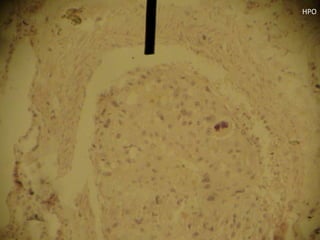
HPO
HPO
LPO
Alveoli surrounding The tumourLPO
Monkeberg’s Sclerosis/Medial calcificationIt is characterized by calcific deposits in muscular arteries(Medium sized) in Tunica media.More frequent in patients over 50 yrs of age and Diabetics.
Grossly it is rigid , there is loss of distensibility and there are palpable calcification.How does it differ from Psammoma bodies ?Ans. Psammoma bodies are characterized by concentrically laminated  calcified concretions , most commonly found in malignant conditions(Meningioma,Pappilary carcinoma)   and not necessarily found in Blood vessel wall..Will it give rise to systemic hypertension ?Ans. Yes This lesion usually occur in Medium sized arteries..
LPO
LPO
HPO
Thanking to the entire Universe

Blood Vessel Diseases

  • 1.
  • 2.
    M++Hemangioma-LiverCoronary Artery AtherosclerosisAtherosclerosiswith thrombus- Aortic aneurysmAtheromatous aortaTumour emboli in LungMonckeberg’s Sclerosis
  • 3.
    Hemangioma-Liver***Hemangiomas are verycommon tumours characterized by increased number of Normal or abnormal blood vessels filled with blood.There are 2 typesCapillary Hemangioma- occurs in skin, subcutaneous tissue and mucous membranes of lips as well as liver,spleen and kidneys. Cavernous Hemangioma (shown in lab for liver) - Characterized by large dilated vascular channels. Compared to capillary type, these are less well circumscribed and mostly involve deep structures.Gross:- Red-Blue soft spongy massMicroscopic:- Well defined but not encapsulated large cavernous blood filled vascular spaces.
  • 4.
    What is thecell of origin of this tumour ?Ans- Endothelial cellsCavernous hemangiomas arise from the endothelial cells that line the blood vessels and consist of multiple, large vascular channels lined by a single layer of endothelial cells and supported by collagenous walls.How will the tumour give rise to clinical manifestations ?Ans- Abdominal pain & vomitingPresentation The vast majority of hemangiomas (as many as 85%) are asymptomatic; however, hemangiomas may cause symptoms because of the compression of adjacent structures, rupture, acute thrombosis, or consumptive coagulopathy (ie,KasabachMeritt syndrome).Pressure on the stomach and duodenum caused by large pedunculatedhemangioma lesions may cause vague abdominal pain, early satiety, nausea, and vomiting. Pedunculatedhemangiomas may twist and cause acute abdominal pain.Compression of the inferior vena cava may result in Budd chiarisyndrome.Acute thrombosis may result in acute inflammatory changes that cause fever, abdominal pain, and abnormal results in liver function tests.Spontaneous or posttraumatic rupture is a catastrophic complication that occurs in about 1-4% of hemangiomas; this condition has a considerable mortality rate, as high as 60%.
  • 5.
    Why is itcalled cavernous(hollow) ?Ans- Because there are large blood filled spaces found compared to capillary type where in there are no spaces found.Is it capable of spreading ?Ans- No (Malignant transformation occurs rarely)What examination would you request to show this tumour ?Ans- MRI, CT and US Most hemangiomas are incidentally detected on imaging studies. Ultrasonography is a cost-effective imaging modality for the diagnosis of a hemangioma. However, computed tomography (CT) scanning and/or MRI may be required to specifically diagnose a hemangioma
  • 6.
    Identification of organinvolved in low power Less circumscribed mass Fat vacuoles in liver LPO
  • 7.
    Description of themass at the pointer* well defined* Less circumscribed * Not encapsulated * Large blood filled vascular spacesLPO
  • 8.
    Description of themass at the pointer* well defined* Less circumscribed * Not encapsulated * Large blood filled vascular spacesLPO
  • 9.
    If it isa cirrhotic liver then the tumour will ultimately shrink as the fibroblast Wont allow the tumour to growLots ofNeutrophilsAt the pointerSignificant AmountOf fibroblastIn this slideHPO
  • 10.
    Blood filledVascular Space at The pointerHPO
  • 11.
    Mild to moderateAmount of Connective Tissue inStromaBetween The vascularspacesHPO
  • 12.
    Mild to moderateAmount of Connective Tissue inStromaBetween The vascularspacesHPO
  • 13.
  • 14.
  • 15.
    Magnified HepatocytesWith someFat vacuolesIn HemangiomaslideHPO
  • 16.
    Coronary Artery AtherosclerosisComponentsof Atherosclerotic plaqueFibrous cap – Smooth muscle cells, macrophages, lymphocytes, collagen, elastinproteoglycans.Necrotic center- cell debris, foam cells,Cholesterolclefts,calcium.Intact media
  • 17.
    Complication expected withprogression of Coronary artery atherosclerosisRupture/Ulceration/erosion of luminal surface of the plaque exposes the blood stream to highly thrombogenic substances and induces thrombus formation. Such thrombi partially or completely occludes the lumen of the arteryThis will lead to Ischemic heart disease(IHD)And indeed Myocardial infarction(MI)
  • 18.
    Examination request forCAAPrimary Angioplasty2) Echocardiogram
  • 19.
    F – FibrouscapC – Necrotic center regionL – Lumen Plaque rupturesiteLPOFLCCF
  • 20.
    Identification of Plaquecomponents at the pointerLPO
  • 21.
  • 22.
  • 23.
    Aortic aneurysm withthrombus & AtherosclerosisThrombus:- Thrombi can develop anywhere in the cardiovascular system. A thrombus is focally attached to the underlying vascular surface. Propagating portion of the thrombus tends to be poorly attached and there for is prone to fragmentation generating an EmbolusEmboli:- Embolus is a detached intravascular solid, liquid or gaseous mass that is carried by the blood to a site distant from the site of its origin.
  • 24.
    AneurysmIt is alocalized abnormal dilation of blood vessel or the heart.
  • 25.
    Types of Aneurysmsbased on Morphological pathologyTrue – If it involves all three layers of arterial wall or the wall of the heart.----- True(Saccular)- spherical pouching involving only a portion of the vessel wall.. Varying from 5-20 cm in diameter often containing thrombi.----- True(Fusiform)- Involves diffuse, circumferential dilation of a long vascular segment. Diameter (</= 20cm) and in length can involve extensive portions of the aortic arch, abdominal aorta, or even the iliacs.False(Pseudoaneurysm) –A Breach in the vascular wall leading to the extravascular hematoma.(Usually involves the endothelial layer)
  • 26.
    Types of AorticAneurysmsAortic route aneurysmB) Thoracic aortic aneurysmC) Abdominal aorticaneurysm
  • 27.
  • 28.
    Site of vesselWallthinningRepresenting Aneurysm LPO
  • 29.
    Thrombus attached toThe vascular wall
  • 30.
  • 31.
  • 32.
  • 33.
  • 34.
    Atheromatous aortaComponents ofAtherosclerotic plaqueFibrous cap – Smooth muscle cells, macrophages, lymphocytes, collagen, elastinproteoglycans.Necrotic center- cell debris, foam cells, Cholesterol clefts, calcium deposits.Intact media
  • 35.
    What will bethe effect of this Clinically ?Ans. Most common is Hypertension and patient might have angina along with HPNWhat laboratory tests would be associated ?Ans. Lipid profile, CBC ,Coagulation studies, serum electrolytes, Glucose & liver function tests.What are the acute plaque changes ?Ans. Rupture,ulceration or erosion
  • 36.
    Plaque formationInvolvingIntima &subintimaF- Fibrous capC-Necrotic centerL- Lumen Tunica adventitiaTunica MediaLPOCFL
  • 37.
  • 38.
  • 39.
  • 40.
  • 41.
  • 42.
  • 43.
    Gross specimen ofAtheromatous Aorta
  • 44.
    Tumour emboli inLungThrombus:- Thrombi can develop anywhere in the cardiovascular system. A thrombus is focally attached to the underlying vascular surface. Propagating portion of the thrombus tends to be poorly attached and there for is prone to fragmentation generating an EmbolusEmboli:- Embolus is a detached intravascular solid, liquid or gaseous mass that is carried by the blood to a site distant from the site of its origin.
  • 45.
    What abnormal cellularfeatures are seen ?Ans. PleiomorphismWhat will be the effect of this lesion on lungs ?Ans. Pulmonary hypertension as common one due to the tumour compressing the surrounding alveolar region.How will this manifest clinically ?Ans. DyspneaWhere do emboli like this usually arise ?Ans. There emboli are mostly intra cardial mural thrombi
  • 46.
  • 47.
  • 48.
  • 49.
  • 50.
    Monkeberg’s Sclerosis/Medial calcificationItis characterized by calcific deposits in muscular arteries(Medium sized) in Tunica media.More frequent in patients over 50 yrs of age and Diabetics.
  • 51.
    Grossly it isrigid , there is loss of distensibility and there are palpable calcification.How does it differ from Psammoma bodies ?Ans. Psammoma bodies are characterized by concentrically laminated calcified concretions , most commonly found in malignant conditions(Meningioma,Pappilary carcinoma) and not necessarily found in Blood vessel wall..Will it give rise to systemic hypertension ?Ans. Yes This lesion usually occur in Medium sized arteries..
  • 52.
  • 53.
  • 54.
  • 55.
    Thanking to theentire Universe