Seminar-Vasculitis 
Abdul 
Waris Khan
Definition 
• Vasculitis is a histological term describing inflammation of the 
vessel wall. 
• Characterized by widespread vasculitis leading to systemic 
symptoms and signs, generally requiring treatment with 
corticosteroids and/ or immunosuppressive drugs. 
• Two main features are helpful in classifying these 
vasculitides:- 
– The size of the blood vessels involved 
– The presence or absence of anti-neutrophil cytoplasmic antibodies (ANCA) in 
the blood
Types
Clinical features
PMR & GCA 
• Polymyalgia rheumatica (PMR) and giant cell 
(temporal) arteritis are systemic illnesses of the 
elderly. 
• Both are associated with the finding of a giant cell 
arteritis on temporal artery biopsy.
Polymyalgia rheumatica (PMR) 
 PMR causes a sudden onset of severe pain and stiffness of the 
shoulders and neck, and of the hips and lumbar spine. 
 These symptoms are worse in the morning, lasting from 30 
minutes to several hours. 
 Clinical history is usually diagnostic and the patient is always 
over 50 years old. 
 Approximately one-third of patients develop systemic features 
of tiredness, fever, weight loss, depression and occasionally 
nocturnal sweats.
Investigation of PMR 
 A raised ESR and/or CRP is a hallmark of this condition. 
 Serum alkaline phosphatase and γ-glutamyltranspeptidase 
may be raised as markers of the acute inflammation. 
 Anaemia often present. 
 Temporal artery biopsy shows giant cell arteritis in 10–30% of 
cases, but is rarely performed unless GCA is also suspected.
Giant cell arteritis 
 GCA is inflammatory granulomatous arteritis of large 
cerebral arteries which occurs in association with 
PMR. 
 The patient may have current PMR, a history of 
recent PMR, or be on treatment for PMR.
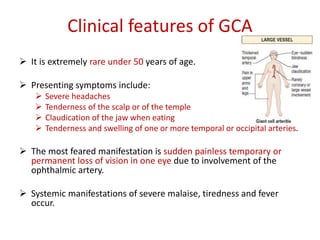
Clinical features of GCA 
 It is extremely rare under 50 years of age. 
 Presenting symptoms include: 
 Severe headaches 
 Tenderness of the scalp or of the temple 
 Claudication of the jaw when eating 
 Tenderness and swelling of one or more temporal or occipital arteries. 
 The most feared manifestation is sudden painless temporary or 
permanent loss of vision in one eye due to involvement of the 
ophthalmic artery. 
 Systemic manifestations of severe malaise, tiredness and fever 
occur.
Investigation of GCA 
• A temporal artery biopsy from the affected side is the 
definitive diagnostic test. This should be taken before, or 
within 7 days of starting, high doses of corticosteroids. 
• Anemia may be present 
• ESR is usually raised and the CRP very high. 
• Liver biochemistry: Abnormalities occur, as in PMR
Histological features of GCA 
 The histological features of GCA are: 
 Cellular infiltrates of CD4+ T lymphocytes, macrophages and giant cells 
in the vessel wall. 
 Granulomatous inflammation of the intima and media 
 Breaking up of the internal elastic lamina 
 Giant cells, lymphocytes and plasma cells in the internal elastic lamina.
Treatment of PMR or GCA 
 Corticosteroids produce a dramatic reduction of symptoms of 
PMR within 24–48 hours of starting treatment, provided the 
dose is adequate. 
 This treatment should reduce the risk of patients who have 
PMR developing GCA. 
 In GCA, corticosteroids are obligatory because they 
significantly reduce the risk of irreversible visual loss and 
other focal ischaemic lesions, but much higher doses are 
needed than in PMR.
 Sometimes biopsy is not obtainable, so the treatment should 
not be delayed, especially if there have already been episodes 
of visual loss or stroke. 
 PMR: 10–15 mg prednisolone as a single dose in the morning. 
 GCA: 60–100 mg prednisolone, usually in divided doses. 
 Most patients will eventually be able to stop corticosteroids 
after 12–18 months. 
 Calcium and vitamin D supplements and sometimes 
bisphosphonates are necessary to prevent osteoporosis while 
high-dose steroids are being used
Takayasu’s disease 
 This is rare, except in Japan. 
 It is of unknown aetiology and occurs in females. 
 There is a vasculitis involving the aortic arch as well as other major arteries. 
 There is also a systemic illness, with pain and tenderness over the affected 
arteries. 
 Absent peripheral pulses and hypertension are common. 
 Corticosteroids help relieve symptoms. 
 Treatment may require a surgical bypass to improve perfusion of the affected 
areas. 
 Eventually heart failure and strokes may occur but most patients survive for at 
least 5 years
Medium-sized vessel 
vasculitis
Polyarteritis nodosa (PAN) 
 Classical PAN is a rare condition which usually occurs in 
middle-aged men. 
 its occasional association with hepatitis B antigenaemia 
suggests a vasculitis secondary to the deposition of immune 
complexes. 
 Pathologically, there is fibrinoid necrosis of vessel walls with 
microaneurysm formation, thrombosis and infarction.
Clinical features 
 These include fever, malaise, weight loss and myalgia. 
These initial symptoms are followed by dramatic acute 
features that are due to organ infarction. 
 Neurological: mononeuritis multiplex is due to 
arteritis of the vasa nervorum. 
 Abdominal: pain due to arterial involvement of the 
abdominal viscera, mimicking acute cholecystitis, 
pancreatitis or appendicitis. Gastrointestinal 
haemorrhage occurs because of mucosal ulceration.
Renal: presents with haematuria and proteinuria. 
Hypertension and acute/chronic kidney disease 
occur. 
Cardiac: coronary arteritis causes myocardial 
infarction and heart failure. Pericarditis also 
occurs. 
Skin: subcutaneous haemorrhage and gangrene 
occur. A persistent livedo reticularis is seen in 
chronic cases. Cutaneous and subcutaneous 
palpable nodules occur, but are uncommon. 
Lung: involvement is rare.
Investigations 
 Blood count: Anaemia, leucocytosis and a raised ESR 
occur. 
 Angiography: Demonstration of microaneurysms in 
hepatic, intestinal or renal vessels if necessary. 
 Other investigations: as appropriate (e.g. ECG and 
abdominal ultrasound), depending on the clinical 
problem. ANCA is positive only rarely in classic PAN.
Treatment 
Is with corticosteroids, usually in combination 
with immunosuppressive drugs such as 
azathioprine.
Kawasaki’s disease 
• This is an acute systemic vasculitis involving medium-sized 
vessels, affecting mainly children under 5 years of age. 
• It is very frequent in Japan, and an infective trigger is 
suspected. 
• It occurs worldwide and is also seen in adults.
Clinical features 
 Fever lasting 5 days or more 
 Bilateral conjunctival congestion 2–4 days after onset 
 Dryness and redness of the lips and oral cavity 3 days after onset 
 Acute cervical lymphadenopathy accompanying the fever 
 Polymorphic rash involving any part of the body 
 Redness and oedema of the palms and soles 2–5 days after onset
Diagnosis 
 The persistent fever plus at least 4/5 features should be present to make 
the diagnosis, or < 4 if coronary aneurysms can be seen on two 
dimensional echocardiography, MRI or angiography. 
 Cardiovascular changes in the acute stage include pancarditis and 
coronary arteritis leading to aneurysms or dilatation. 
 Anti-endothelial cell autoantibodies are often detectable. 
 Other features include diarrhoea, albuminuria, aseptic meningitis and 
arthralgia and, in most, there is a leucocytosis, thrombocytosis and a 
raised CRP.
Treatment 
• Is with a single dose of high-dose intravenous 
immunoglobulin (2 g/kg), which prevents the 
coronary artery disease, followed after the acute 
phase by aspirin 200–300 mg daily. 
• There is no evidence that steroid treatment improves 
the outcome.
Small vessel vasculitis
This can be separated into 
those that are positive or 
negative for anti-neutrophil 
cytoplasmic antibody (ANCA)
ANCA-positive small vessel 
vasculitis 
 Wegener’s granulomatosis 
 Churg–Strauss 
granulomatosis 
 Microscopic polyangiitis 
ANCA-negative small vessel 
vasculitis 
 Henoch–Schönlein purpura 
 Cryoglobulinaemic 
vasculitis 
 Cutaneous leucocytoclastic 
vasculitis
ANCA-positive small vessel vasculitis
Wegener’s granulomatosis 
 It is characterized by lesions involving the upper respiratory tract, lungs and kidneys. 
 It often starts with severe rhinorrhoea, with subsequent nasal mucosal ulceration 
followed by cough, haemoptysis and pleuritic pain. 
 Etiology is unknown 
 Single or multiple nodular masses or pneumonic infiltrates with cavitation are seen 
on chest X-ray. 
 The typical histological changes are usually best seen on renal biopsy, which shows 
necrotizing microvascular glomerulonephritis. 
 This disease responds well to treatment with cyclophosphamide 150–200 mg daily. 
 Rituximab is also being used. 
 A variant of Wegener’s granulomatosis called ‘midline granuloma’ affects the nose 
and paranasal sinuses and is particularly mutilating; it has a poor prognosis.
Churg–Strauss syndrome 
 This condition classically occurs in males in their 4th decade, who present 
with rhinitis and asthma, eosinophilia and systemic vasculitis. 
 The aetiology is uncertain. 
 Typically, it involves the lungs, peripheral nerves and skin, but renal 
involvement is uncommon. 
 Transient patchy pneumonia-like shadows may occur. 
 Skin lesions include tender subcutaneous nodules as well as petechial or 
purpuric lesions. 
 ANCA is usually positive. 
 The disease responds well to corticosteroids.
Microscopic vasculitis (polyangiitis) 
This involves the kidneys and the lungs where 
it results in recurrent haemoptysis. 
ANCA is usually positive.
ANCA-negative small vessel vasculitis
Henoch–Schönlein Purpura 
• This clinical syndrome comprises a characteristic skin rash, abdominal 
colic, joint pain and glomerulonephritis. 
• Approximately 30–70% have clinical evidence of renal disease with 
haematuria and/or proteinuria 
• The renal lesion is a focal segmental proliferative glomerulonephritis, 
sometimes with mesangial hypercellularity. 
• In more severe cases, epithelial crescents may be present. 
• Immunoglobulin deposition is mainly IgA in the glomerular mesangium 
distribution, similar to IgA nephropathy. 
• There is no treatment of proven benefit; steroid therapy is ineffective. 
• Treatment is usually supportive but with crescentic GN aggressive 
immunosuppression has been tried with variable outcome.
Leucocytoclastic vasculitis 
• (LCV) is the most common cutaneous vasculitis affecting small vessels. 
• This usually appears on the lower legs as a symmetrical palpable purpura. 
• It can be caused by drugs (15%), infection (15%), inflammatory disease 
(10%) or malignant disease (<5%) but often no cause is found (55–60%). 
• Investigations are only necessary with persistent lesions or associated 
signs and symptoms. 
• LCV often settles spontaneously, treatment with analgesia, support 
stockings, dapsone or prednisolone may be needed to control the pain 
and to heal up any ulceration.
References 
• Kumar & Clark's clinical medicine 8th edition

vasculitis

  • 2.
  • 3.
    Definition • Vasculitisis a histological term describing inflammation of the vessel wall. • Characterized by widespread vasculitis leading to systemic symptoms and signs, generally requiring treatment with corticosteroids and/ or immunosuppressive drugs. • Two main features are helpful in classifying these vasculitides:- – The size of the blood vessels involved – The presence or absence of anti-neutrophil cytoplasmic antibodies (ANCA) in the blood
  • 4.
  • 5.
  • 6.
    PMR & GCA • Polymyalgia rheumatica (PMR) and giant cell (temporal) arteritis are systemic illnesses of the elderly. • Both are associated with the finding of a giant cell arteritis on temporal artery biopsy.
  • 7.
    Polymyalgia rheumatica (PMR)  PMR causes a sudden onset of severe pain and stiffness of the shoulders and neck, and of the hips and lumbar spine.  These symptoms are worse in the morning, lasting from 30 minutes to several hours.  Clinical history is usually diagnostic and the patient is always over 50 years old.  Approximately one-third of patients develop systemic features of tiredness, fever, weight loss, depression and occasionally nocturnal sweats.
  • 8.
    Investigation of PMR  A raised ESR and/or CRP is a hallmark of this condition.  Serum alkaline phosphatase and γ-glutamyltranspeptidase may be raised as markers of the acute inflammation.  Anaemia often present.  Temporal artery biopsy shows giant cell arteritis in 10–30% of cases, but is rarely performed unless GCA is also suspected.
  • 9.
    Giant cell arteritis  GCA is inflammatory granulomatous arteritis of large cerebral arteries which occurs in association with PMR.  The patient may have current PMR, a history of recent PMR, or be on treatment for PMR.
  • 10.
    Clinical features ofGCA  It is extremely rare under 50 years of age.  Presenting symptoms include:  Severe headaches  Tenderness of the scalp or of the temple  Claudication of the jaw when eating  Tenderness and swelling of one or more temporal or occipital arteries.  The most feared manifestation is sudden painless temporary or permanent loss of vision in one eye due to involvement of the ophthalmic artery.  Systemic manifestations of severe malaise, tiredness and fever occur.
  • 11.
    Investigation of GCA • A temporal artery biopsy from the affected side is the definitive diagnostic test. This should be taken before, or within 7 days of starting, high doses of corticosteroids. • Anemia may be present • ESR is usually raised and the CRP very high. • Liver biochemistry: Abnormalities occur, as in PMR
  • 12.
    Histological features ofGCA  The histological features of GCA are:  Cellular infiltrates of CD4+ T lymphocytes, macrophages and giant cells in the vessel wall.  Granulomatous inflammation of the intima and media  Breaking up of the internal elastic lamina  Giant cells, lymphocytes and plasma cells in the internal elastic lamina.
  • 13.
    Treatment of PMRor GCA  Corticosteroids produce a dramatic reduction of symptoms of PMR within 24–48 hours of starting treatment, provided the dose is adequate.  This treatment should reduce the risk of patients who have PMR developing GCA.  In GCA, corticosteroids are obligatory because they significantly reduce the risk of irreversible visual loss and other focal ischaemic lesions, but much higher doses are needed than in PMR.
  • 14.
     Sometimes biopsyis not obtainable, so the treatment should not be delayed, especially if there have already been episodes of visual loss or stroke.  PMR: 10–15 mg prednisolone as a single dose in the morning.  GCA: 60–100 mg prednisolone, usually in divided doses.  Most patients will eventually be able to stop corticosteroids after 12–18 months.  Calcium and vitamin D supplements and sometimes bisphosphonates are necessary to prevent osteoporosis while high-dose steroids are being used
  • 15.
    Takayasu’s disease This is rare, except in Japan.  It is of unknown aetiology and occurs in females.  There is a vasculitis involving the aortic arch as well as other major arteries.  There is also a systemic illness, with pain and tenderness over the affected arteries.  Absent peripheral pulses and hypertension are common.  Corticosteroids help relieve symptoms.  Treatment may require a surgical bypass to improve perfusion of the affected areas.  Eventually heart failure and strokes may occur but most patients survive for at least 5 years
  • 16.
  • 17.
    Polyarteritis nodosa (PAN)  Classical PAN is a rare condition which usually occurs in middle-aged men.  its occasional association with hepatitis B antigenaemia suggests a vasculitis secondary to the deposition of immune complexes.  Pathologically, there is fibrinoid necrosis of vessel walls with microaneurysm formation, thrombosis and infarction.
  • 18.
    Clinical features These include fever, malaise, weight loss and myalgia. These initial symptoms are followed by dramatic acute features that are due to organ infarction.  Neurological: mononeuritis multiplex is due to arteritis of the vasa nervorum.  Abdominal: pain due to arterial involvement of the abdominal viscera, mimicking acute cholecystitis, pancreatitis or appendicitis. Gastrointestinal haemorrhage occurs because of mucosal ulceration.
  • 19.
    Renal: presents withhaematuria and proteinuria. Hypertension and acute/chronic kidney disease occur. Cardiac: coronary arteritis causes myocardial infarction and heart failure. Pericarditis also occurs. Skin: subcutaneous haemorrhage and gangrene occur. A persistent livedo reticularis is seen in chronic cases. Cutaneous and subcutaneous palpable nodules occur, but are uncommon. Lung: involvement is rare.
  • 20.
    Investigations  Bloodcount: Anaemia, leucocytosis and a raised ESR occur.  Angiography: Demonstration of microaneurysms in hepatic, intestinal or renal vessels if necessary.  Other investigations: as appropriate (e.g. ECG and abdominal ultrasound), depending on the clinical problem. ANCA is positive only rarely in classic PAN.
  • 21.
    Treatment Is withcorticosteroids, usually in combination with immunosuppressive drugs such as azathioprine.
  • 22.
    Kawasaki’s disease •This is an acute systemic vasculitis involving medium-sized vessels, affecting mainly children under 5 years of age. • It is very frequent in Japan, and an infective trigger is suspected. • It occurs worldwide and is also seen in adults.
  • 23.
    Clinical features Fever lasting 5 days or more  Bilateral conjunctival congestion 2–4 days after onset  Dryness and redness of the lips and oral cavity 3 days after onset  Acute cervical lymphadenopathy accompanying the fever  Polymorphic rash involving any part of the body  Redness and oedema of the palms and soles 2–5 days after onset
  • 25.
    Diagnosis  Thepersistent fever plus at least 4/5 features should be present to make the diagnosis, or < 4 if coronary aneurysms can be seen on two dimensional echocardiography, MRI or angiography.  Cardiovascular changes in the acute stage include pancarditis and coronary arteritis leading to aneurysms or dilatation.  Anti-endothelial cell autoantibodies are often detectable.  Other features include diarrhoea, albuminuria, aseptic meningitis and arthralgia and, in most, there is a leucocytosis, thrombocytosis and a raised CRP.
  • 26.
    Treatment • Iswith a single dose of high-dose intravenous immunoglobulin (2 g/kg), which prevents the coronary artery disease, followed after the acute phase by aspirin 200–300 mg daily. • There is no evidence that steroid treatment improves the outcome.
  • 27.
  • 28.
    This can beseparated into those that are positive or negative for anti-neutrophil cytoplasmic antibody (ANCA)
  • 29.
    ANCA-positive small vessel vasculitis  Wegener’s granulomatosis  Churg–Strauss granulomatosis  Microscopic polyangiitis ANCA-negative small vessel vasculitis  Henoch–Schönlein purpura  Cryoglobulinaemic vasculitis  Cutaneous leucocytoclastic vasculitis
  • 30.
  • 31.
    Wegener’s granulomatosis It is characterized by lesions involving the upper respiratory tract, lungs and kidneys.  It often starts with severe rhinorrhoea, with subsequent nasal mucosal ulceration followed by cough, haemoptysis and pleuritic pain.  Etiology is unknown  Single or multiple nodular masses or pneumonic infiltrates with cavitation are seen on chest X-ray.  The typical histological changes are usually best seen on renal biopsy, which shows necrotizing microvascular glomerulonephritis.  This disease responds well to treatment with cyclophosphamide 150–200 mg daily.  Rituximab is also being used.  A variant of Wegener’s granulomatosis called ‘midline granuloma’ affects the nose and paranasal sinuses and is particularly mutilating; it has a poor prognosis.
  • 32.
    Churg–Strauss syndrome This condition classically occurs in males in their 4th decade, who present with rhinitis and asthma, eosinophilia and systemic vasculitis.  The aetiology is uncertain.  Typically, it involves the lungs, peripheral nerves and skin, but renal involvement is uncommon.  Transient patchy pneumonia-like shadows may occur.  Skin lesions include tender subcutaneous nodules as well as petechial or purpuric lesions.  ANCA is usually positive.  The disease responds well to corticosteroids.
  • 33.
    Microscopic vasculitis (polyangiitis) This involves the kidneys and the lungs where it results in recurrent haemoptysis. ANCA is usually positive.
  • 34.
  • 35.
    Henoch–Schönlein Purpura •This clinical syndrome comprises a characteristic skin rash, abdominal colic, joint pain and glomerulonephritis. • Approximately 30–70% have clinical evidence of renal disease with haematuria and/or proteinuria • The renal lesion is a focal segmental proliferative glomerulonephritis, sometimes with mesangial hypercellularity. • In more severe cases, epithelial crescents may be present. • Immunoglobulin deposition is mainly IgA in the glomerular mesangium distribution, similar to IgA nephropathy. • There is no treatment of proven benefit; steroid therapy is ineffective. • Treatment is usually supportive but with crescentic GN aggressive immunosuppression has been tried with variable outcome.
  • 37.
    Leucocytoclastic vasculitis •(LCV) is the most common cutaneous vasculitis affecting small vessels. • This usually appears on the lower legs as a symmetrical palpable purpura. • It can be caused by drugs (15%), infection (15%), inflammatory disease (10%) or malignant disease (<5%) but often no cause is found (55–60%). • Investigations are only necessary with persistent lesions or associated signs and symptoms. • LCV often settles spontaneously, treatment with analgesia, support stockings, dapsone or prednisolone may be needed to control the pain and to heal up any ulceration.
  • 39.
    References • Kumar& Clark's clinical medicine 8th edition