1/20/2017
GOOD MORNING
GREETINGS FROM
SHARJAH
SYSTEMIC VASCULITIS
AN OVERVIEW
DR.K.V.RISHIKESAN MD,Dip.NB
SPECIALIST PHYSICIAN
1/20/2017
LEARNING OBJECTIVES
• DEFINE VASCULITIS
• DEFINE TYPICAL FEATURES S/o VASCULITIS
• DESCRIBE THE MODERN CLASSIFICATION SYSTEM
• IDENTIFY A PROBABLE VASCULITIS IN A PATIENT WITH
A TYPICAL PRESENTATION
• TREATMENT OVERVIEW and finally
• TAKE HOME MESSAGE
1/20/2017
VASCULITIS
A heterogeneous group of clinical syndromes
characterized by inflammation and necrosis of
blood vessels
Normal Artery
Artery: WBC in media and
adventitia
1/20/2017
WHAT IS VASCULITIS?
VASCULITIS IS A DIVERSE CATEGORY OF INFLAMMATORY
DISEASES OF BLOOD VESSELS.
• RANGE IN SEVERITY FROM SELF LIMITED DERMATOLOGIC
CONDITIONS TO ACUTE AND RAPIDLY FATAL MULTISYSTEM
DISEASES.
• ALL FORMS OF VASCULITIS ARE CHARECTERISED BY
ENDOTHELIAL DAMAGE, INTIMAL PROLIFERATION,
THROMBOSIS AND EVENTUAL VASCULAR OCCLUSION.
• VASCULITIS CAN AFFECT EVERY ORGAN SYSTEM.
1/20/2017
WHAT IS VASCULITIS?
VASCULITIS IS A DIVERSE CATEGORY OF
INFLAMMATORY DISEASES OF BLOOD
VESSELS.
• RANGE IN SEVERITY FROM SELF LIMITED
DERMATOLOGIC CONDITIONS TO ACUTE
AND RAPIDLY FATAL MULTISYSTEM
DISEASES.
• ALL FORMS OF VASCULITIS ARE
CHARECTERISED BY ENDOTHELIAL
DAMAGE, INTIMAL PROLIFERATION,
THROMBOSIS AND EVENTUAL VASCULAR
OCCLUSION.
• VASCULITIS CAN AFFECT EVERY ORGAN
SYSTEM.
1/20/2017
Can be difficult to
diagnose and may
be life-threatening
1/20/2017
1/20/2017
FIBRINOID
NECROSIS
Fibrinoid necrosis is a
form of necrosis, or
tissue death, in which
there is accumulation
of amorphous, basic,
proteinaceous material
in the tissue matrix
with a staining pattern
reminiscent of fibrin.
1/20/2017
1/20/2017
Systemic
Fever, sweats,
weight loss
Skin
Palpable
Purpura
Neurologic
Mononeuritis
Multiplex
Musculoskeletal
Arthralgia /
arthritis
Muscle pain /
claudication
Respiratory
Sinusitis /
Epistaxis
Pulmonary
infiltrates
Gastrointestinal
Abdominal
Pain
Bloody stools
Renal
Glomerulo-
nephritis
Hypertension
WHEN SHOULD VASCULITIS BE SUSPECTED?
• MULTISYSTEM inflammatory
disease
• Sign. CONSTITUTIONAL
SYMPTOMS
• RAPIDLY PROGRESSIVE
organ dysfunction
• HIGH ESR
SEVERE anemia
PLATELETS > 500K
• Low serum ALBUMIN
CLINICAL FEATURES
PARTICULARLY S/O
of small vessel inflammation:
• SKIN: palpable purpura
• LUNGS: pulmonary infiltrates /
hemoptysis
• KIDNEY: active urinary sediment
• NEURO: foot drop
1/20/2017
TAKE THESE CLUES…..
• Palpable purpura =
small vessel leukocytoclastic
vasculitis
• Hepatitis B PAN
• Wrist/foot drop= PAN
• Hepatitis C =
cryoglobulinemia
• Oral & genital ulcers =
Behcet’s
Upper/lower airway disease and
glomerulonephritis =
Wegener’s
• Septal perforation,
epistaxis
• Recurrent sinus infections
Asthma and eosinophilia=
CSV
• Young female with arm/leg
fatigue and HTN =
Takayasu’s
1/20/2017
1/20/2017
Unexplained ischemia,
such as claudication,
limb ischemia,
angina, transient
ischemic attack, stroke,
mesenteric ischemia
and cutaneous
ischemia, particularly in
a young patient or a
patient without risk
factors for
atherosclerosis
When should
vasculitis be
suspected?
CLINICAL FEATURES HIGHLY S/o VASCULITIS
1/20/2017
CUTANEOUS MANIFESTATION
Palpable
Purpura
Caused by
extravasation of RBCs
from small vessels that
have been occluded by
immunecomplexes.
They are heavy and tend
to occur in the most
gravity dependent area
of the body
1/20/2017
LIVEDO RETICULARIS
All of us develop this
“lacy” vascular pattern
when we are cold.
However livedo
reticularis is caused by
relative ischemia of the
capillary beds.
Vasculitis is one of the
causes of livedo.
1/20/2017
SPLINTER HEMORRHAGES
Splinter hemorrhages can be found in the distal nail
bed and/or in the periungual area.
1/20/2017
NEUROLOGIC
Mononeuritis multiplex:
check for FOOT DROP
Sural n. biopsy showing vasculitis
Note that the nerve tissue is seen at the
bottom of the picture. The vessel infiltration
with white blood cells occurs in the vasa
nervorum.
nerve tissue
vasa nervorum
1/20/2017
RESPIRATORY: UPPER/LOWER
• SINUSITIS
• EPISTAXIS
Or……..
.Pulmonary infiltrates
• Nodules
• Cavities
1/20/2017
GENITOURINARY
• Glomerulonephritis
• Hypertension
• Hematuria
• RBC casts
• Testicular pain
(especially PAN)
Cellular and Fibrous Crescent Formation in
glomerulonephritis. Testicular pain is
uncommon in systemic vasculitis, but when it
occurs, it is relatively specific for PAN.
1/20/2017
OCULAR
http://www.uveitis.org/images/sa
rcoid6.jpg
Retinal Vasculitis
http://webmedia.unmc.edu/eye/iritis.jpg
Iritis
Scleritis
eyelearn.med.utoronto.ca/.../RedE
ye/10Sclera.htm
1/20/2017
GASTROINTESTINAL
• Mesenteric ischemia which
may result in :
• pain 30 minutes after
eating
• bloody diarrhea
• bowel perforation
• hepatitis
• pancreatitis
• cholecystitis
1/20/2017
CLASSIFICATION
CONFUSING and UNSATISFYING DUE TO
1.OVERLAPPING PRESENTATIONS
2.MIX OF PRIMARY AND SECONDARY FORMS
3.EVOLVING UNDERSTANDING OF PATHOPHYSIOLOGY
4.EVOLVING CONSENSUS REGARDING USE OF EPONYMS
5.VARIED OPINION ON WHETHER CLASSIFCATION SHOULD BE BASED
PRIMARILY ON SIZE OF AFFECTED VESSELS,OR ON UNDERLYING
PATHOLOGIC PROCESS.
6.DIFFERENT SOURCES MAY PRESENT SLIGHTLY DIFFERENT
CLASSIFICATION SCHEMES
1/20/2017
CLASSIFICATION
No universally accepted
classification system.
• Vessel size
• Histopathology
• Dominant organ involvement.
The clinical features of primary
vasculitis syndromes often
OVERLAP, and many patients
do not fit neatly into a well-
defined type of vasculitis
1/20/2017
CHAPEL HILL
CLASSIFICATION
Large vessels : Aorta and its
major branches and the
analogous veins.
Medium vessels: The main
visceral arteries , veins and
their initial branches.
Small vessels :
Intraparenchymal arteries,
arterioles, capillaries, venules,
and veins.
The kidney is used to
exemplify medium and small
vessels.
1/20/2017
CLASSIFICATION BASED ON Vs.SIZE
• LARGE Vs: GIANT CELL ARTERITIS,
TAKAYASU ARTERITIS.
• MEDIUM Vs: PAN, KAWASAKI DISEASE
• SMALL Vs: ANCA POSITIVE
MICROSCOPIC POLYANGIITIS
WEGENERS, CHURG STRAUSS
ANCA NEGATIVE
HENOCH SCHONLEIN
PURPURA , MIXED ESSENTIAL
CRYOGLOBULINAMIA
1/20/2017
CLASSIFICATION
SOME TYPES PREVIOUSLY HAD DIFFERENT
EPONYM BASED NAMES
OLD NAME
• WEGENER’S GRANULOMATOSIS
(WG)
• CHURG STRAUSS VASCULITIS
(CSV)
• HENOCH SCHOENLEIN PURPURA
NEW NAME
GRANULOMATOUS POLYANGIITIS
(GPA)
EOSINOPHILIC GRANULOMATOSIS
WITH POLY ANGIITIS
(EGPA)
IgA VASCULITIS
1/20/2017
GENERAL APPROACH TO VASCULITIS
HISTORY: PATIENT’S
STORY
PHYSICAL EXAM: BODY’S
STORY
LABORATORY: BEHIND
THE-SCENES STORY
Basic CBC, CHEMS, LFTs,
UA/micro, CXR
……..MORE PROBLEMS
CREATE PROBLEM LIST………
LIST EVERYTHING [split
don’t lump]
PRIORITIZE PROBLEM
LIST………
WORK the PROBLEM LIST
1/20/2017
LABS
• Determine organ involvement
• Exclude other diseases
• Routine labs: CBC, BMP, UA,
ESR, CRP, LFTs
• Infection : cultures, viral
serologies (HBV, HCV, HIV)
• Autoimmune serologies:
ANA, RF, ANCAs, ENA,
ds- DNA, C3/C4
• Misc: CK, anti-GBM, SPEP,
Cryoglobulins
1/20/2017
VASCULITIS MIMICS
•Systemic illness – must
exclude alternative
diagnoses:
•Sepsis
•Drug toxicity
•Malignancy
•Coagulopathy
• INFECTIOUS DISEASES
• Endocarditis
• HIV
• DRUGS
• Cocaine
• Methamphetamine
• CHOLESTEROL EMBOLI
• ANTIPHOSPHOLIPID
ANTIBODY SYNDROME
1/20/2017
APPROACH TO DIAGNOSIS: ANCAs
• Antibodies directed against neutrophil granule
constituents
• c-ANCA
• Stains cytoplasm (hence “c”)
• Main target antigen: proteinase-3
• Highly specific (>90%) for Wegener’s
• p-ANCA
• Stains perinuclear (hence “p”)
• Main target antigen: myeloperoxidase
• A/w MPA and Churg-Strauss
1/20/2017
VASCULITIS: ADDITIONAL TESTING
Imaging studies
Sinus CT scan
Chest CT scan
Mesenteric
angiogram
Tissue biopsy
Temporal artery
Sural nerve
Muscle
Lung
Renal
1/20/2017
TISSUE BIOPSY “GO WHERE THE MONEY IS”
Blind biopsy generally low
yield of < 20%.
Vasculitic lesions tend to be
focal and segmental.
If a patient is over age 50 Y.
and presents with a new,
unexplained headache and
elevated ESR, with or without a
tender or abnormal temporal
artery, a temporal artery
biopsy would be indicated.
Similarly, in a patient who
presents with a multisystem
illness and testicular pain and
swelling,
a testicular biopsy should be
considered.
Sural nerve biopsy may be
indicated in a patient with
numbness and tingling in a
lower extremity.
If the urine sediment is
abnormal, a renal biopsy might
be obtained.
1/20/2017
ANGIOGRAM
• If biopsy is impractical
• Important in large vessel
vasculitis
• Patient with abdominal
pain
• Renal or mesenteric
vasculitis
If visceral involvement is suspected (and in the absence of a surgical abdomen), a visceral angiogram
to include the celiac, mesenteric, renal and, perhaps, hepatic arteries should be performed .
1/20/2017
TEMPORAL ARTERITIS(GCA)
Anaemia of chronic disease.
Blindness (ischemic optic
neuropathy) .
Claudication jaw/tongue
Dramatic response to
steroids
ESR high
Fever, wt. loss
Head ache new onset.
Scalp tenderness
PMR symptoms (proximal
muscle pain)
10% with large vessel
involvement (e.g. subclavian
artery)
1/20/2017
GIANT CELL ARTERITIS
ACR CRITERIA (3 OF 5)
• Age > 50
• New onset headache
• ESR (Westergren)  50
• Abnormal artery biopsy
(mononuclear cell infiltrate,
granulomatous inflammation,
usually multinucleated giant cells)
• Temporal artery abnormality
(tender or decreased pulse)
1/20/2017
GCA: THERAPY
• Corticosteroids mainstay
of therapy (~1 mg/kg)
• Calcium and vitamin D
• Consider bisphosphonate
• Try to prevent visual loss
with therapy:
Treat, then biopsy!
Necrosis of Intima and media
with disruption of Internal
Elastic Lamina
1/20/2017
QUESTIONS
• In the ACR diagnostic criteria
for Giant Cell Arteritis
(Temporal Arteritis), a patient
needs to be greater than what
age?
A. > 40 years
B. > 50 years
C. > 60 years
D. > 70 years
E. > 80 years
B. > 50 YEARS
Almost all are > 60
Average age is 70
1/20/2017
TAKAYASU’S
• Large vessel
• Unknown etiology
• Aorta/branches
• “Pulseless Disease”
• Women in reproductive years
• 10X more than men
• Asia, Eastern Europe, Latin America
• Granulomatous Panarteritis: 98%
have stenotic lesions, 27%
aneurysms
• Subclavian & aortic arch most
common, 93%
• 40- 80% renal artery stenosis
1/20/2017
TAKAYASU’S
• Arterial stenoses/organ ischemia
• Claudication
• Transient cerebral ischemia/ stroke
• Renal artery hypertension
• CHF
• Angina
• MI
• Mesenteric vascular insufficiency
• In the absence of complications
(retinopathy, HTN, aortic v. insuff), 15 yr
survival 95%
• Most respond to steroids alone
• 40% will need cytotoxics
1/20/2017
Aortogram of a 15-year-old girl with Takayasu
arteritis. Note large aneurysms of descending
aorta and dilatation of innominate artery.
POLY ARTERITIS NODOSA
• Necrotizing vasculitis of
medium & small arteries
• Age ~ 40s; M > F
• Constitutional symptoms are
common
• fever 50%
• weight loss 50%
• Vasculitis can be variable in
distribution making diagnosis
difficult
• Mononeuritis multiplex:50%
• Renal involvement: 60%
(renal arteries, interlobular arteries)
• Hypertension (more common)
• Glomerulonephritis (uncommon)
• Abdominal involvement 45%
• Arthralgias/ Myalgias / Myositis 64%
• Testicular pain 25%
• Pulmonary involvement
rare
1/20/2017
CASE
• A 29yo woman presents with a 4yr
h/o skin ulcers on her lower
extremities. A previous punch
biopsy showed thrombotic lesions
in small blood vessels of the
dermis. Treatment has mostly
focused on wound care.
• On exam the ulcers are noted, as
is livedo reticularis, a decreased
right hand grip, and a right foot
drop.
• Which of the following is the most
likely diagnosis:
A. LYMPHOMA WITH A PARANEOPLASTIC
SYNDROME
B. TAKAYASU’S ARTERITIS
C. SLE
D. PAN
E. KAWASAKI DISEASE
1/20/2017
PAN : CLINICAL FEATURES
MYALGIA, ARTHRALGIA
FEVER , WT LOSS
PALPABLE PURPURIC RASH,
ULCERATION, INFARCTION AND
LIVEDO RETICULARIS
ARTERITIS OF VASA NERVORUM
LEADS TO A SYMMETRICAL
SENSORY AND MOTOR
NEUROPATHY.
RENAL INFARCTIONS MAY LEAD
TO SEVERE HTN AND RENAL
IMPAIRMENT.
1/20/2017
POLY ARTERITIS NODOSA
Hepatitis B (surface
antigen) is risk factor for
PAN.
Classic PAN
is NOT associated with
ANCA
ANCA
1/20/2017
KAWASAKI DISEASE
1/20/2017
KD : THE MUCOCUTANEOUS LYMPH NODE
SYNDROME
1/20/2017
KAWASAKI DISEASE
1/20/2017
KAWASAKI DISEASE : F E B Ri L E
Kawasaki disease (KD) is an
acute febrile vasculitic
syndrome of early
childhood that, (although it
has a good prognosis with
treatment) can lead to
death from coronary artery
aneurysm (CAA) in a very
small percentage of
patients.
CRITERIA
• Fever
• Enanthem
• Bulbar conjunctivitis
• Rash
• Internal organ involvement (not
part of the criteria)
• Lymphadenopathy
• Extremity changes
1/20/2017
ANCA ASSOCIATED VASCULITIS
• They have been classified together in the recent 2012 Chapel
Hill classification system.
• GPA and MPA have been considered together in clinical and
treatment studies because they share many clinical features.
• Renal involvement is identical in both diseases with a pauci
immune FSGN. Granulomatous involvement, of the upper
respiratory tract, is a characteristic feature of GPA, but not of
MPA
• Eosinophilia, asthma and atopy typically occur in EGPA
1/20/2017
TYPES OF ANCA ASSOCIATED VASCULITIDES
There are 3 forms of ANCA-
associated vasculitis.
• Granulomatosis with polyangiitis
(GPA)
• Formerly known as Wegener's
granulomatosis
• Microscopic polyangiitis (MPA)
• Eosinophilic granulomatosis with
polyangiitis (EGPA)
• Formerly known as Churg-
Strauss syndrome
1/20/2017
WEGENER’S GRANULOMATOSIS (GPA)
• Necrotizing vasculitis that affects the
small vessels of the respiratory tract
and renal system : PULMONARY-
RENAL SYNDROME
• Age ~ 40s: M > F 2:1
• Sinusitis
• Nasal septal ulceration
• Pneumonitis
• few symptoms until late
• usually no mediastinal
lymphadenopathy
• nodules that can cavitate
ACR CRITERIA (3 OUT OF 5)
1.Nasal or oral inflammation
(oral ulcers or bloody nasal drainage)
2.Abnormal chest radiograph (nodules,
fixed infiltrates, cavities)
3.Urinary sediment
(> 5 RBC/ hpf or casts)
4.Abnormal Biopsy:
showing vasculitis
5.Proteinase-3 antibodies
1/20/2017
1/20/2017
WEGENER’S GRANULOMATOSIS (GPA)
A 65yo. woman c/o 6 months of
malaise, 9 lb weight loss, recurrent
sinusitis, and a persistent cough.
On exam, she is afebrile, the mid-
portion of the nasal bridge has a
flattened appearance, and both
sides of the nasal septum are
ulcerated.
RF is positive and ESR is 66.
• Which of the following tests
would be most helpful in
determining the diagnosis:
A. Nasal septum biopsy
B. Chest radiograph
C. Measurement of ANCA
antibodies
D. Sputum culture
E. Measurement of anti-GBM
antibodies
1/20/2017
GRANULOMATOUS POLYANGIITIS
WEGENER’S : ANCA
• AntiNeutrophil Cytoplasmic Antibody
• C (cytoplasmic staining) ANCA
• Proteinase 3 (C is the 3rd letter)
• Pulmonary-renal disease
• sensitivity of 95%
• specificity of 95%
• Limited disease…
• lower sensitivity and specificity
1/20/2017
GRANULOMATOUS POLYANGIITIS
(GPA) : RX
• Prior to cyclophosphamide, 80-90% mortality at 5 years
• With cyclophosphamide, 5-10% mortality
• Concern about long-term toxicity of PO cyclophosphamide
(bladder especially)
• IV CYTOXAN no significant bladder risk
• Rituximab: very effective for induction & maintenance
• Azathioprine for maintenance
1/20/2017
WEGENER’S GRANULOMATOSIS: OUTCOMES
INTERVENTION SURVIVAL
NONE 50% AT 5 MONTHS
GLUCOCORTICOIDS 50% AT 1 YEAR
GCS+CYTOXAN 80% AT 8 YEARS
1/20/2017
CHURG-STRAUSS VASCULITIS (EGPA)
• Necrotizing, granulomatous
vasculitis of small arteries and
venules
• Prior asthma
• Allergic rhinitis
• Eosinophilia
• Pulmonary infiltrates.
Classical presentation as a triad
of skin nodules, mononeuritis
multiplex and eosinophilia
• Intra/extravascular
granulomas
• Confusion with Wegener’s
• Nasal/sinus DZ is NON-
destructive
• Pulmonary nodules less
common
• p-ANCA (MPO): 70%
• More responsive to steroids
alone
1/20/2017
CHURG STRAUSS
THE BASTARD CHILD
OF WEGENER’S AND
POLYARTERITIS
NODOSA.
CSS SHARES FEATURES
OF BOTH WEGENER’S
AND PAN.
PATIENT WITH CSS
ALWAYS HAS ASTHMA
1/20/2017
1/20/2017
CHURG STRAUSS VASCULITIS(EGPA) WEGENERS(WG)
ASTHMA +++ UNCOMMON
EOSINOPHILS +++ OCCASIONAL/MODEST
ATOPY +++ UNCOMMON
UPPER AIRWAY DESTRUCTION :
UNCOMMON
+
PULMONARY NODULES: OCCASIONAL ++
RENAL FAILURE : + ++
ANCA + +
1/20/2017
MICROSCOPIC
POLYANGIITIS (MPA)
• CLASSICALLY PRESENTS WITH
RAPIDLY PROGRESSIVE
GLOMERULONEPHRITIS OFTEN
ASSOCIATED WITH
PULMONARY ALVEOLAR
HAEMORRHAGE.
• CUTANEOUS INVOLVEMENT
SIMILAR TO PAN IS COMMON
• PATIENTS ARE USUALLY
p-ANCA POSITIVE
1/20/2017
CASE: WHAT IS THE MOST LIKELY CAUSE OF
RENAL DISEASE IN THIS PATIENT ?
• A previously healthy 22yo. male
college student had an URI 2 weeks
ago, RX with PCN
• He develops abdominal pain,
bilateral ankle pain & swelling with
raised purpuric lesions over lower
extremities
• Labs:
• creatinine 3.0 mg/d L, BUN 46 mg/dL
• Urinalysis: 4+ proteinuria, 2+ RBC’s,
• sev. RBC casts/ hpf
1/20/2017
HSP MANIFESTATIONS
Renal involvement (10-50%)
• Renal disease more
severe in adults
• Determines prognosis
• Many recover with no
therapy
• Asymptomatic hematuria
 proteinuria & renal
insufficiency (cresentic
GN)
• < 0.5% progress to ESRD
Small vessels, post capillary venules
Palpable purpura, Arthralgias,
GI INVOLVEMENT IN 85%
Abdominal pain, N&V,hemorrhage
Intussusception in children as the major
life threatening complication
Males=females
Mean age 5 yrs.
Preceding URI in 2/3 (1-3 weeks)
Tissue deposition of IgA-containing
immune complexes (skin, kidneys,
bowel)
1/20/2017
HSP: IgA VASCULITIS
Usually single episodes
< 4 weeks duration.
Glomerulonephritis
indistinguishable from IgA
nephropathy may occur.
Uncommon:
#Testicular involvement
#Pulmonary hemorrhage
#CNS complications
40% recurrence rate after
period of wellness
Treatment
• Supportive measures
• Corticosteroids for GI
vasculitis and
hemorrhage
• ? CS early in nephritis
1/20/2017
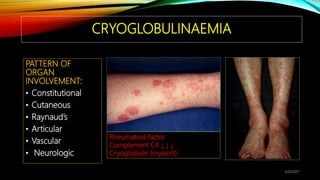
CRYOGLOBULINAEMIA
PATTERN OF
ORGAN
INVOLVEMENT:
• Constitutional
• Cutaneous
• Raynaud’s
• Articular
• Vascular
• Neurologic
1/20/2017
Rheumatoid factor
Complement C4 ↓ ↓ ↓
Cryoglobulin (cryocrit)
CRYOGLOBULINAEMIA
An immune-complex-mediated
small vessels Vasculitis.
A causative role of hepatitis C
virus in over 80% patients .
Cryoprecipitate Hep C Ag – Ab
Complement fixing:
C4 consumption
C4 levels VERY low
Therapeutic strategies
include
Aetiologic (antiviral),
Pathogenetic
(cyclophosfamide,
rituximab), or
Symptomatic (steroids,
plasmapheresis)
1/20/2017
BEHCET DISEASE
Behçet disease:
A rare vasculitic disorder.
Characterized by a triple-symptom
complex of recurrent oral aphthous ulcers,
genital ulcers, and uveitis
AUTOIMMUNE DISEASE.
The pathergy test is helpful but is not
sensitive or specific for the diagnosis of
Behcet disease.
1/20/2017
Oral aphthous ulcers secondary
to Behçet disease.
1/20/2017
RARE VASCULITIS WHICH TARGETS
VENULES.
TREATMENT: CORTICOSTEROIDS,
THALIDOMIDE,
IMMUNOSUPPRESSIVE
VASCULITIS: PRINCIPLES OF TREATMENT
ORAL GLUCOCORTICOIDS
IV METHYL PREDNISOLONE
METHOTREXATE
AZATHIOPRINE
CYCLOSPORINE
RITUXIMAB-ANTI CD20Abs
ANTI TNF THERAPIES
INFLIXIMAB
ADALIMUMAB
ETANERCEPT
CERTULIZUMAB
1/20/2017
CHOICE OF THERAPY…….
DEPENDS ON :
SEVERITY OF ORGAN DAMAGE
EXTEND OF MULTISYSTEM INVOLVEMENT
THE VASCULAR BED INVOLVED:
(RENAL, OCCULAR,CORONARY.)
GLUCOCORTICOIDS + CYCLOPHOSPHAMIDE PREFERRED
FOR SERIOUS AND SEVERE COMPLICATIONS.
GLUCOCORTICOIDS ALONE WILL SUFFICE FOR ISOLATED MILD
VASCULITIS LIKE IDIOPATHIC CUTANEOUS VASCULITIS
1/20/2017
TREATMENT OVERVIEW
LIMITED CUTANEOUS
VASCULITIS
OBSERVATION…
ANTIHISTAMINE….
SHORT COURSE
PREDNISONE.
MILD SYSTEMIC
VASCULITIS
PREDNISONE
RAPIDLY PROGRESSIVE
VASCULITIS
PREDNISONE+
CYTOTOXIC
(CYCLOPHOSPHAMIDE).
CYC. TRANSITIONED TO
LESS TOXIC AGENTS
(AZA, METHOTREXATE)
AFTER REMISSION IS
ACHIEVED.
1/20/2017
VASCULITIS: ACTIVITY Vs. DAMAGES
Disease Activity
Disease Damage
1/20/2017
Even after achieving disease remission, patients will
continue to suffer from the chronic, irreversible
consequences of both the disease and its therapies
TAKE HOME MESSAGE
• The systemic vasculitides are chronic diseases, usually
autoimmune , characterized by relapse and remission
• Ultimate diagnosis is almost always biopsy
• Achieving remission requires intense monitoring by an expert
multidisciplinary team
• Therapy of choice usually involves corticosteroids and
sometimes an adjunctive cytotoxic
• Pain and fatigue are common consequences independent of
disease activity and generally fail to respond to
immunosuppression
1/20/2017
Questions?
1/20/2017

Systemic vasculitis 2016 shj

  • 1.
  • 2.
    SYSTEMIC VASCULITIS AN OVERVIEW DR.K.V.RISHIKESANMD,Dip.NB SPECIALIST PHYSICIAN 1/20/2017
  • 3.
    LEARNING OBJECTIVES • DEFINEVASCULITIS • DEFINE TYPICAL FEATURES S/o VASCULITIS • DESCRIBE THE MODERN CLASSIFICATION SYSTEM • IDENTIFY A PROBABLE VASCULITIS IN A PATIENT WITH A TYPICAL PRESENTATION • TREATMENT OVERVIEW and finally • TAKE HOME MESSAGE 1/20/2017
  • 4.
    VASCULITIS A heterogeneous groupof clinical syndromes characterized by inflammation and necrosis of blood vessels Normal Artery Artery: WBC in media and adventitia 1/20/2017
  • 5.
    WHAT IS VASCULITIS? VASCULITISIS A DIVERSE CATEGORY OF INFLAMMATORY DISEASES OF BLOOD VESSELS. • RANGE IN SEVERITY FROM SELF LIMITED DERMATOLOGIC CONDITIONS TO ACUTE AND RAPIDLY FATAL MULTISYSTEM DISEASES. • ALL FORMS OF VASCULITIS ARE CHARECTERISED BY ENDOTHELIAL DAMAGE, INTIMAL PROLIFERATION, THROMBOSIS AND EVENTUAL VASCULAR OCCLUSION. • VASCULITIS CAN AFFECT EVERY ORGAN SYSTEM. 1/20/2017
  • 6.
    WHAT IS VASCULITIS? VASCULITISIS A DIVERSE CATEGORY OF INFLAMMATORY DISEASES OF BLOOD VESSELS. • RANGE IN SEVERITY FROM SELF LIMITED DERMATOLOGIC CONDITIONS TO ACUTE AND RAPIDLY FATAL MULTISYSTEM DISEASES. • ALL FORMS OF VASCULITIS ARE CHARECTERISED BY ENDOTHELIAL DAMAGE, INTIMAL PROLIFERATION, THROMBOSIS AND EVENTUAL VASCULAR OCCLUSION. • VASCULITIS CAN AFFECT EVERY ORGAN SYSTEM. 1/20/2017 Can be difficult to diagnose and may be life-threatening
  • 7.
  • 8.
  • 9.
    FIBRINOID NECROSIS Fibrinoid necrosis isa form of necrosis, or tissue death, in which there is accumulation of amorphous, basic, proteinaceous material in the tissue matrix with a staining pattern reminiscent of fibrin. 1/20/2017
  • 10.
    1/20/2017 Systemic Fever, sweats, weight loss Skin Palpable Purpura Neurologic Mononeuritis Multiplex Musculoskeletal Arthralgia/ arthritis Muscle pain / claudication Respiratory Sinusitis / Epistaxis Pulmonary infiltrates Gastrointestinal Abdominal Pain Bloody stools Renal Glomerulo- nephritis Hypertension
  • 11.
    WHEN SHOULD VASCULITISBE SUSPECTED? • MULTISYSTEM inflammatory disease • Sign. CONSTITUTIONAL SYMPTOMS • RAPIDLY PROGRESSIVE organ dysfunction • HIGH ESR SEVERE anemia PLATELETS > 500K • Low serum ALBUMIN CLINICAL FEATURES PARTICULARLY S/O of small vessel inflammation: • SKIN: palpable purpura • LUNGS: pulmonary infiltrates / hemoptysis • KIDNEY: active urinary sediment • NEURO: foot drop 1/20/2017
  • 12.
    TAKE THESE CLUES….. •Palpable purpura = small vessel leukocytoclastic vasculitis • Hepatitis B PAN • Wrist/foot drop= PAN • Hepatitis C = cryoglobulinemia • Oral & genital ulcers = Behcet’s Upper/lower airway disease and glomerulonephritis = Wegener’s • Septal perforation, epistaxis • Recurrent sinus infections Asthma and eosinophilia= CSV • Young female with arm/leg fatigue and HTN = Takayasu’s 1/20/2017
  • 13.
    1/20/2017 Unexplained ischemia, such asclaudication, limb ischemia, angina, transient ischemic attack, stroke, mesenteric ischemia and cutaneous ischemia, particularly in a young patient or a patient without risk factors for atherosclerosis When should vasculitis be suspected?
  • 14.
    CLINICAL FEATURES HIGHLYS/o VASCULITIS 1/20/2017
  • 15.
    CUTANEOUS MANIFESTATION Palpable Purpura Caused by extravasationof RBCs from small vessels that have been occluded by immunecomplexes. They are heavy and tend to occur in the most gravity dependent area of the body 1/20/2017
  • 16.
    LIVEDO RETICULARIS All ofus develop this “lacy” vascular pattern when we are cold. However livedo reticularis is caused by relative ischemia of the capillary beds. Vasculitis is one of the causes of livedo. 1/20/2017
  • 17.
    SPLINTER HEMORRHAGES Splinter hemorrhagescan be found in the distal nail bed and/or in the periungual area. 1/20/2017
  • 18.
    NEUROLOGIC Mononeuritis multiplex: check forFOOT DROP Sural n. biopsy showing vasculitis Note that the nerve tissue is seen at the bottom of the picture. The vessel infiltration with white blood cells occurs in the vasa nervorum. nerve tissue vasa nervorum 1/20/2017
  • 19.
    RESPIRATORY: UPPER/LOWER • SINUSITIS •EPISTAXIS Or…….. .Pulmonary infiltrates • Nodules • Cavities 1/20/2017
  • 20.
    GENITOURINARY • Glomerulonephritis • Hypertension •Hematuria • RBC casts • Testicular pain (especially PAN) Cellular and Fibrous Crescent Formation in glomerulonephritis. Testicular pain is uncommon in systemic vasculitis, but when it occurs, it is relatively specific for PAN. 1/20/2017
  • 21.
  • 22.
    GASTROINTESTINAL • Mesenteric ischemiawhich may result in : • pain 30 minutes after eating • bloody diarrhea • bowel perforation • hepatitis • pancreatitis • cholecystitis 1/20/2017
  • 23.
    CLASSIFICATION CONFUSING and UNSATISFYINGDUE TO 1.OVERLAPPING PRESENTATIONS 2.MIX OF PRIMARY AND SECONDARY FORMS 3.EVOLVING UNDERSTANDING OF PATHOPHYSIOLOGY 4.EVOLVING CONSENSUS REGARDING USE OF EPONYMS 5.VARIED OPINION ON WHETHER CLASSIFCATION SHOULD BE BASED PRIMARILY ON SIZE OF AFFECTED VESSELS,OR ON UNDERLYING PATHOLOGIC PROCESS. 6.DIFFERENT SOURCES MAY PRESENT SLIGHTLY DIFFERENT CLASSIFICATION SCHEMES 1/20/2017
  • 24.
    CLASSIFICATION No universally accepted classificationsystem. • Vessel size • Histopathology • Dominant organ involvement. The clinical features of primary vasculitis syndromes often OVERLAP, and many patients do not fit neatly into a well- defined type of vasculitis 1/20/2017
  • 25.
    CHAPEL HILL CLASSIFICATION Large vessels: Aorta and its major branches and the analogous veins. Medium vessels: The main visceral arteries , veins and their initial branches. Small vessels : Intraparenchymal arteries, arterioles, capillaries, venules, and veins. The kidney is used to exemplify medium and small vessels. 1/20/2017
  • 26.
    CLASSIFICATION BASED ONVs.SIZE • LARGE Vs: GIANT CELL ARTERITIS, TAKAYASU ARTERITIS. • MEDIUM Vs: PAN, KAWASAKI DISEASE • SMALL Vs: ANCA POSITIVE MICROSCOPIC POLYANGIITIS WEGENERS, CHURG STRAUSS ANCA NEGATIVE HENOCH SCHONLEIN PURPURA , MIXED ESSENTIAL CRYOGLOBULINAMIA 1/20/2017
  • 27.
    CLASSIFICATION SOME TYPES PREVIOUSLYHAD DIFFERENT EPONYM BASED NAMES OLD NAME • WEGENER’S GRANULOMATOSIS (WG) • CHURG STRAUSS VASCULITIS (CSV) • HENOCH SCHOENLEIN PURPURA NEW NAME GRANULOMATOUS POLYANGIITIS (GPA) EOSINOPHILIC GRANULOMATOSIS WITH POLY ANGIITIS (EGPA) IgA VASCULITIS 1/20/2017
  • 28.
    GENERAL APPROACH TOVASCULITIS HISTORY: PATIENT’S STORY PHYSICAL EXAM: BODY’S STORY LABORATORY: BEHIND THE-SCENES STORY Basic CBC, CHEMS, LFTs, UA/micro, CXR ……..MORE PROBLEMS CREATE PROBLEM LIST……… LIST EVERYTHING [split don’t lump] PRIORITIZE PROBLEM LIST……… WORK the PROBLEM LIST 1/20/2017
  • 29.
    LABS • Determine organinvolvement • Exclude other diseases • Routine labs: CBC, BMP, UA, ESR, CRP, LFTs • Infection : cultures, viral serologies (HBV, HCV, HIV) • Autoimmune serologies: ANA, RF, ANCAs, ENA, ds- DNA, C3/C4 • Misc: CK, anti-GBM, SPEP, Cryoglobulins 1/20/2017
  • 30.
    VASCULITIS MIMICS •Systemic illness– must exclude alternative diagnoses: •Sepsis •Drug toxicity •Malignancy •Coagulopathy • INFECTIOUS DISEASES • Endocarditis • HIV • DRUGS • Cocaine • Methamphetamine • CHOLESTEROL EMBOLI • ANTIPHOSPHOLIPID ANTIBODY SYNDROME 1/20/2017
  • 31.
    APPROACH TO DIAGNOSIS:ANCAs • Antibodies directed against neutrophil granule constituents • c-ANCA • Stains cytoplasm (hence “c”) • Main target antigen: proteinase-3 • Highly specific (>90%) for Wegener’s • p-ANCA • Stains perinuclear (hence “p”) • Main target antigen: myeloperoxidase • A/w MPA and Churg-Strauss 1/20/2017
  • 32.
    VASCULITIS: ADDITIONAL TESTING Imagingstudies Sinus CT scan Chest CT scan Mesenteric angiogram Tissue biopsy Temporal artery Sural nerve Muscle Lung Renal 1/20/2017
  • 33.
    TISSUE BIOPSY “GOWHERE THE MONEY IS” Blind biopsy generally low yield of < 20%. Vasculitic lesions tend to be focal and segmental. If a patient is over age 50 Y. and presents with a new, unexplained headache and elevated ESR, with or without a tender or abnormal temporal artery, a temporal artery biopsy would be indicated. Similarly, in a patient who presents with a multisystem illness and testicular pain and swelling, a testicular biopsy should be considered. Sural nerve biopsy may be indicated in a patient with numbness and tingling in a lower extremity. If the urine sediment is abnormal, a renal biopsy might be obtained. 1/20/2017
  • 34.
    ANGIOGRAM • If biopsyis impractical • Important in large vessel vasculitis • Patient with abdominal pain • Renal or mesenteric vasculitis If visceral involvement is suspected (and in the absence of a surgical abdomen), a visceral angiogram to include the celiac, mesenteric, renal and, perhaps, hepatic arteries should be performed . 1/20/2017
  • 35.
    TEMPORAL ARTERITIS(GCA) Anaemia ofchronic disease. Blindness (ischemic optic neuropathy) . Claudication jaw/tongue Dramatic response to steroids ESR high Fever, wt. loss Head ache new onset. Scalp tenderness PMR symptoms (proximal muscle pain) 10% with large vessel involvement (e.g. subclavian artery) 1/20/2017
  • 36.
    GIANT CELL ARTERITIS ACRCRITERIA (3 OF 5) • Age > 50 • New onset headache • ESR (Westergren)  50 • Abnormal artery biopsy (mononuclear cell infiltrate, granulomatous inflammation, usually multinucleated giant cells) • Temporal artery abnormality (tender or decreased pulse) 1/20/2017
  • 37.
    GCA: THERAPY • Corticosteroidsmainstay of therapy (~1 mg/kg) • Calcium and vitamin D • Consider bisphosphonate • Try to prevent visual loss with therapy: Treat, then biopsy! Necrosis of Intima and media with disruption of Internal Elastic Lamina 1/20/2017
  • 38.
    QUESTIONS • In theACR diagnostic criteria for Giant Cell Arteritis (Temporal Arteritis), a patient needs to be greater than what age? A. > 40 years B. > 50 years C. > 60 years D. > 70 years E. > 80 years B. > 50 YEARS Almost all are > 60 Average age is 70 1/20/2017
  • 39.
    TAKAYASU’S • Large vessel •Unknown etiology • Aorta/branches • “Pulseless Disease” • Women in reproductive years • 10X more than men • Asia, Eastern Europe, Latin America • Granulomatous Panarteritis: 98% have stenotic lesions, 27% aneurysms • Subclavian & aortic arch most common, 93% • 40- 80% renal artery stenosis 1/20/2017
  • 40.
    TAKAYASU’S • Arterial stenoses/organischemia • Claudication • Transient cerebral ischemia/ stroke • Renal artery hypertension • CHF • Angina • MI • Mesenteric vascular insufficiency • In the absence of complications (retinopathy, HTN, aortic v. insuff), 15 yr survival 95% • Most respond to steroids alone • 40% will need cytotoxics 1/20/2017 Aortogram of a 15-year-old girl with Takayasu arteritis. Note large aneurysms of descending aorta and dilatation of innominate artery.
  • 41.
    POLY ARTERITIS NODOSA •Necrotizing vasculitis of medium & small arteries • Age ~ 40s; M > F • Constitutional symptoms are common • fever 50% • weight loss 50% • Vasculitis can be variable in distribution making diagnosis difficult • Mononeuritis multiplex:50% • Renal involvement: 60% (renal arteries, interlobular arteries) • Hypertension (more common) • Glomerulonephritis (uncommon) • Abdominal involvement 45% • Arthralgias/ Myalgias / Myositis 64% • Testicular pain 25% • Pulmonary involvement rare 1/20/2017
  • 42.
    CASE • A 29yowoman presents with a 4yr h/o skin ulcers on her lower extremities. A previous punch biopsy showed thrombotic lesions in small blood vessels of the dermis. Treatment has mostly focused on wound care. • On exam the ulcers are noted, as is livedo reticularis, a decreased right hand grip, and a right foot drop. • Which of the following is the most likely diagnosis: A. LYMPHOMA WITH A PARANEOPLASTIC SYNDROME B. TAKAYASU’S ARTERITIS C. SLE D. PAN E. KAWASAKI DISEASE 1/20/2017
  • 43.
    PAN : CLINICALFEATURES MYALGIA, ARTHRALGIA FEVER , WT LOSS PALPABLE PURPURIC RASH, ULCERATION, INFARCTION AND LIVEDO RETICULARIS ARTERITIS OF VASA NERVORUM LEADS TO A SYMMETRICAL SENSORY AND MOTOR NEUROPATHY. RENAL INFARCTIONS MAY LEAD TO SEVERE HTN AND RENAL IMPAIRMENT. 1/20/2017
  • 44.
    POLY ARTERITIS NODOSA HepatitisB (surface antigen) is risk factor for PAN. Classic PAN is NOT associated with ANCA ANCA 1/20/2017
  • 45.
  • 46.
    KD : THEMUCOCUTANEOUS LYMPH NODE SYNDROME 1/20/2017
  • 47.
  • 48.
    KAWASAKI DISEASE :F E B Ri L E Kawasaki disease (KD) is an acute febrile vasculitic syndrome of early childhood that, (although it has a good prognosis with treatment) can lead to death from coronary artery aneurysm (CAA) in a very small percentage of patients. CRITERIA • Fever • Enanthem • Bulbar conjunctivitis • Rash • Internal organ involvement (not part of the criteria) • Lymphadenopathy • Extremity changes 1/20/2017
  • 49.
    ANCA ASSOCIATED VASCULITIS •They have been classified together in the recent 2012 Chapel Hill classification system. • GPA and MPA have been considered together in clinical and treatment studies because they share many clinical features. • Renal involvement is identical in both diseases with a pauci immune FSGN. Granulomatous involvement, of the upper respiratory tract, is a characteristic feature of GPA, but not of MPA • Eosinophilia, asthma and atopy typically occur in EGPA 1/20/2017
  • 50.
    TYPES OF ANCAASSOCIATED VASCULITIDES There are 3 forms of ANCA- associated vasculitis. • Granulomatosis with polyangiitis (GPA) • Formerly known as Wegener's granulomatosis • Microscopic polyangiitis (MPA) • Eosinophilic granulomatosis with polyangiitis (EGPA) • Formerly known as Churg- Strauss syndrome 1/20/2017
  • 51.
    WEGENER’S GRANULOMATOSIS (GPA) •Necrotizing vasculitis that affects the small vessels of the respiratory tract and renal system : PULMONARY- RENAL SYNDROME • Age ~ 40s: M > F 2:1 • Sinusitis • Nasal septal ulceration • Pneumonitis • few symptoms until late • usually no mediastinal lymphadenopathy • nodules that can cavitate ACR CRITERIA (3 OUT OF 5) 1.Nasal or oral inflammation (oral ulcers or bloody nasal drainage) 2.Abnormal chest radiograph (nodules, fixed infiltrates, cavities) 3.Urinary sediment (> 5 RBC/ hpf or casts) 4.Abnormal Biopsy: showing vasculitis 5.Proteinase-3 antibodies 1/20/2017
  • 52.
  • 53.
    WEGENER’S GRANULOMATOSIS (GPA) A65yo. woman c/o 6 months of malaise, 9 lb weight loss, recurrent sinusitis, and a persistent cough. On exam, she is afebrile, the mid- portion of the nasal bridge has a flattened appearance, and both sides of the nasal septum are ulcerated. RF is positive and ESR is 66. • Which of the following tests would be most helpful in determining the diagnosis: A. Nasal septum biopsy B. Chest radiograph C. Measurement of ANCA antibodies D. Sputum culture E. Measurement of anti-GBM antibodies 1/20/2017
  • 54.
    GRANULOMATOUS POLYANGIITIS WEGENER’S :ANCA • AntiNeutrophil Cytoplasmic Antibody • C (cytoplasmic staining) ANCA • Proteinase 3 (C is the 3rd letter) • Pulmonary-renal disease • sensitivity of 95% • specificity of 95% • Limited disease… • lower sensitivity and specificity 1/20/2017
  • 55.
    GRANULOMATOUS POLYANGIITIS (GPA) :RX • Prior to cyclophosphamide, 80-90% mortality at 5 years • With cyclophosphamide, 5-10% mortality • Concern about long-term toxicity of PO cyclophosphamide (bladder especially) • IV CYTOXAN no significant bladder risk • Rituximab: very effective for induction & maintenance • Azathioprine for maintenance 1/20/2017
  • 56.
    WEGENER’S GRANULOMATOSIS: OUTCOMES INTERVENTIONSURVIVAL NONE 50% AT 5 MONTHS GLUCOCORTICOIDS 50% AT 1 YEAR GCS+CYTOXAN 80% AT 8 YEARS 1/20/2017
  • 57.
    CHURG-STRAUSS VASCULITIS (EGPA) •Necrotizing, granulomatous vasculitis of small arteries and venules • Prior asthma • Allergic rhinitis • Eosinophilia • Pulmonary infiltrates. Classical presentation as a triad of skin nodules, mononeuritis multiplex and eosinophilia • Intra/extravascular granulomas • Confusion with Wegener’s • Nasal/sinus DZ is NON- destructive • Pulmonary nodules less common • p-ANCA (MPO): 70% • More responsive to steroids alone 1/20/2017
  • 58.
    CHURG STRAUSS THE BASTARDCHILD OF WEGENER’S AND POLYARTERITIS NODOSA. CSS SHARES FEATURES OF BOTH WEGENER’S AND PAN. PATIENT WITH CSS ALWAYS HAS ASTHMA 1/20/2017
  • 59.
  • 60.
    CHURG STRAUSS VASCULITIS(EGPA)WEGENERS(WG) ASTHMA +++ UNCOMMON EOSINOPHILS +++ OCCASIONAL/MODEST ATOPY +++ UNCOMMON UPPER AIRWAY DESTRUCTION : UNCOMMON + PULMONARY NODULES: OCCASIONAL ++ RENAL FAILURE : + ++ ANCA + + 1/20/2017
  • 61.
    MICROSCOPIC POLYANGIITIS (MPA) • CLASSICALLYPRESENTS WITH RAPIDLY PROGRESSIVE GLOMERULONEPHRITIS OFTEN ASSOCIATED WITH PULMONARY ALVEOLAR HAEMORRHAGE. • CUTANEOUS INVOLVEMENT SIMILAR TO PAN IS COMMON • PATIENTS ARE USUALLY p-ANCA POSITIVE 1/20/2017
  • 62.
    CASE: WHAT ISTHE MOST LIKELY CAUSE OF RENAL DISEASE IN THIS PATIENT ? • A previously healthy 22yo. male college student had an URI 2 weeks ago, RX with PCN • He develops abdominal pain, bilateral ankle pain & swelling with raised purpuric lesions over lower extremities • Labs: • creatinine 3.0 mg/d L, BUN 46 mg/dL • Urinalysis: 4+ proteinuria, 2+ RBC’s, • sev. RBC casts/ hpf 1/20/2017
  • 63.
    HSP MANIFESTATIONS Renal involvement(10-50%) • Renal disease more severe in adults • Determines prognosis • Many recover with no therapy • Asymptomatic hematuria  proteinuria & renal insufficiency (cresentic GN) • < 0.5% progress to ESRD Small vessels, post capillary venules Palpable purpura, Arthralgias, GI INVOLVEMENT IN 85% Abdominal pain, N&V,hemorrhage Intussusception in children as the major life threatening complication Males=females Mean age 5 yrs. Preceding URI in 2/3 (1-3 weeks) Tissue deposition of IgA-containing immune complexes (skin, kidneys, bowel) 1/20/2017
  • 64.
    HSP: IgA VASCULITIS Usuallysingle episodes < 4 weeks duration. Glomerulonephritis indistinguishable from IgA nephropathy may occur. Uncommon: #Testicular involvement #Pulmonary hemorrhage #CNS complications 40% recurrence rate after period of wellness Treatment • Supportive measures • Corticosteroids for GI vasculitis and hemorrhage • ? CS early in nephritis 1/20/2017
  • 65.
    CRYOGLOBULINAEMIA PATTERN OF ORGAN INVOLVEMENT: • Constitutional •Cutaneous • Raynaud’s • Articular • Vascular • Neurologic 1/20/2017 Rheumatoid factor Complement C4 ↓ ↓ ↓ Cryoglobulin (cryocrit)
  • 66.
    CRYOGLOBULINAEMIA An immune-complex-mediated small vesselsVasculitis. A causative role of hepatitis C virus in over 80% patients . Cryoprecipitate Hep C Ag – Ab Complement fixing: C4 consumption C4 levels VERY low Therapeutic strategies include Aetiologic (antiviral), Pathogenetic (cyclophosfamide, rituximab), or Symptomatic (steroids, plasmapheresis) 1/20/2017
  • 67.
    BEHCET DISEASE Behçet disease: Arare vasculitic disorder. Characterized by a triple-symptom complex of recurrent oral aphthous ulcers, genital ulcers, and uveitis AUTOIMMUNE DISEASE. The pathergy test is helpful but is not sensitive or specific for the diagnosis of Behcet disease. 1/20/2017 Oral aphthous ulcers secondary to Behçet disease.
  • 68.
    1/20/2017 RARE VASCULITIS WHICHTARGETS VENULES. TREATMENT: CORTICOSTEROIDS, THALIDOMIDE, IMMUNOSUPPRESSIVE
  • 69.
    VASCULITIS: PRINCIPLES OFTREATMENT ORAL GLUCOCORTICOIDS IV METHYL PREDNISOLONE METHOTREXATE AZATHIOPRINE CYCLOSPORINE RITUXIMAB-ANTI CD20Abs ANTI TNF THERAPIES INFLIXIMAB ADALIMUMAB ETANERCEPT CERTULIZUMAB 1/20/2017
  • 70.
    CHOICE OF THERAPY……. DEPENDSON : SEVERITY OF ORGAN DAMAGE EXTEND OF MULTISYSTEM INVOLVEMENT THE VASCULAR BED INVOLVED: (RENAL, OCCULAR,CORONARY.) GLUCOCORTICOIDS + CYCLOPHOSPHAMIDE PREFERRED FOR SERIOUS AND SEVERE COMPLICATIONS. GLUCOCORTICOIDS ALONE WILL SUFFICE FOR ISOLATED MILD VASCULITIS LIKE IDIOPATHIC CUTANEOUS VASCULITIS 1/20/2017
  • 71.
    TREATMENT OVERVIEW LIMITED CUTANEOUS VASCULITIS OBSERVATION… ANTIHISTAMINE…. SHORTCOURSE PREDNISONE. MILD SYSTEMIC VASCULITIS PREDNISONE RAPIDLY PROGRESSIVE VASCULITIS PREDNISONE+ CYTOTOXIC (CYCLOPHOSPHAMIDE). CYC. TRANSITIONED TO LESS TOXIC AGENTS (AZA, METHOTREXATE) AFTER REMISSION IS ACHIEVED. 1/20/2017
  • 72.
    VASCULITIS: ACTIVITY Vs.DAMAGES Disease Activity Disease Damage 1/20/2017 Even after achieving disease remission, patients will continue to suffer from the chronic, irreversible consequences of both the disease and its therapies
  • 73.
    TAKE HOME MESSAGE •The systemic vasculitides are chronic diseases, usually autoimmune , characterized by relapse and remission • Ultimate diagnosis is almost always biopsy • Achieving remission requires intense monitoring by an expert multidisciplinary team • Therapy of choice usually involves corticosteroids and sometimes an adjunctive cytotoxic • Pain and fatigue are common consequences independent of disease activity and generally fail to respond to immunosuppression 1/20/2017
  • 74.