
Dr Joshua Ho
SCGH Emergency Medicine Registrar
May 18, 2017 CME

 Definitions and pathophysiology
 Classification
 Clinical overview
 Systems commonly involved
 Emergency presentations
 Management in the ED
 Management upstairs
Overview

Definitions &
Pathogenesis
Vasculitis (plural: vasculitides) is a group of disorders that destroy
blood vessels by inflammation.

 Vasculitis: vessel wall inflammation
 Heterogenous group of diseases
 Common histopathologic features of inflammation
and necrosis of blood vessel walls
 Different sized vessels
 Different vessel beds
 Different aetiologies
What is it?

 Immune-mediated inflammation (non-infectious)
 Direct vascular wall invasion (infectious)
 Physical/chemical injuries
Pathogenesis

 Immune complex deposition
 Anti-neutrophil cytoplasmic antibodies
 Anti-endothelial cell antibodies
Immunologically Mediated

 Typically seen with systemic autoimmune diseases
 Also with drug hypersensitivity reactions
 Viral antigen-antibody complexes (Hep B)
 Antibody and complement detected
 Exact antigens responsible not always clear
 Circulating antigen-antibody complexes may be seen
Immune Complex Deposition

 Circulating antibodies directed against neutrophil
granules, monocyte lysosomes and endothelial cells
 Cytoplasmic or perinuclear
 Myeloperoxidase or Proteinase-3
 MPO is a lysosomal granule constituent normally
involved in generating oxygen free radicals
 PR3 is a neutrophil azurophilic granule constituent
 Direct injury to endothelial cells
 Degranulation causes release of ROS
ANCAs

 Unclear role
 May have direct cytotoxic effects
 Association with Kawasaki disease
Anti-endothelial cell antibodies

Chapel Hill
Classification
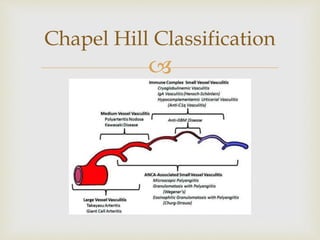
In 2012, the Chapel Hill Consensus Conference notably replaced
most of the eponymously named diseases with names that
reflected the understanding of the diseases’ pathophysiology.

Chapel Hill Classification
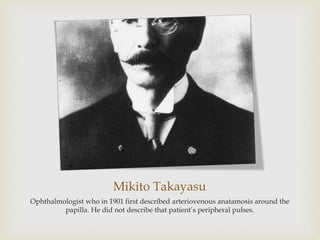
Mikito Takayasu
Ophthalmologist who in 1901 first described arteriovenous anatamosis around the
papilla. He did not describe that patient’s peripheral pulses.

 Giant Cell Arteritis
 Typically those over 50
 Temporal arteries often affected
 Associated with polymyalgia rheumatica
 Aorta and major branches with predilection for
branches of carotids and vertebrals
 Takayasu Arteritis
 Typically those under 50
 Aorta and major branches
Large Vessel Vasculitis
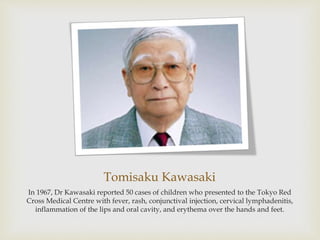
Tomisaku Kawasaki
In 1967, Dr Kawasaki reported 50 cases of children who presented to the Tokyo Red
Cross Medical Centre with fever, rash, conjunctival injection, cervical lymphadenitis,
inflammation of the lips and oral cavity, and erythema over the hands and feet.

 Polyarteritis nodosa
 Necrotising arteritis of medium or small arteries
 No ANCA, doesn’t affect small vessels
 Kawasaki disease
 Arteritis associated with mucocutaneous syndrome
 Coronary arteries often involved
 Affects infants and young children
Medium Vessel Vasculitis
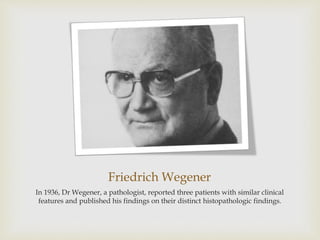
Friedrich Wegener
In 1936, Dr Wegener, a pathologist, reported three patients with similar clinical
features and published his findings on their distinct histopathologic findings.
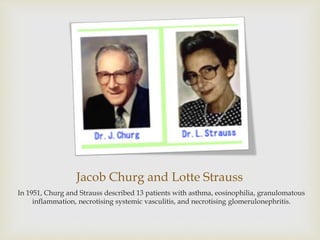
Jacob Churg and Lotte Strauss
In 1951, Churg and Strauss described 13 patients with asthma, eosinophilia, granulomatous
inflammation, necrotising systemic vasculitis, and necrotising glomerulonephritis.
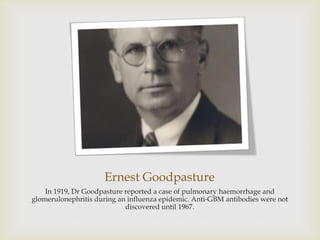
Ernest Goodpasture
In 1919, Dr Goodpasture reported a case of pulmonary haemorrhage and
glomerulonephritis during an influenza epidemic. Anti-GBM antibodies were not
discovered until 1967.

 ANCA associated
 Microscopic polyangiitis
 Granulomatosis with polyangiitis
 Eosinophilic granulomatosis with polyangiitis
 Immune complex mediated
 Anti-GBM vasculitis
 Cryoglobulinaemic vasculitis
 IgA vasculitis
 Hypocomplementemic urticarial vasculitis
Small vessel vasculitis

Organs involved
Almost any system can be involved.

 Airway
 Pulmonary
 Cardiovascular
 Renal
 Neurological
 Gastrointestinal
 Cutaneous
Organ Involvement

 Cricoarytenoid oedema
 Subglottic stenosis in Wegener’s
 Can be anatomically difficult intubations
Airway

 Subclinical alveolitis
 Interstitial lung fibrosis
 Pulmonary hypertension
 Diffuse alveolar haemorrhage
Pulmonary
Diffuse Alveolar Haemorrhage

 Accelerated atherosclerosis
 Acute heart failure
 Hypertensive emergencies
 Signs of arterial insufficiency
 Stroke
 Claudication
 ACS
Cardiovascular

 Blindness
 TIA/Stroke
 Peripheral neuropathies
 Seizures
 Psychiatric Disorders
Neurological

 Renal artery aneurysms
 Nephrotic syndrome
 Nephritic syndrome
Renal

 Ischaemic bowel
 Mesenteric ischaemia
 Gastrointestinal haemorrhage
Gastrointestinal

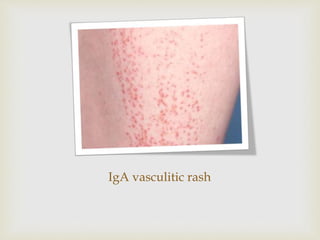
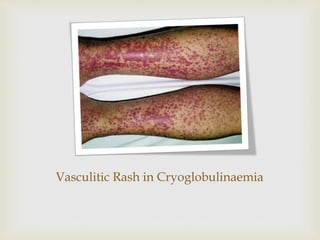
 Palpable purpura
 Oral and genital ulcers
Cutaneous
IgA vasculitic rash
Vasculitic Rash in Cryoglobulinaemia

 Predisposition to opportunistic infections
 Hyperviscosity syndrome
 Subglottic stenosis in Wegener’s
 Most have constitutional symptoms
Miscellaneous

The emergencies
Emergency (google’s defintion): a serious, unexpected, and often
dangerous situation requiring immediate action.
Emergency room (urbandictionary.com): A place you go when you
think you are going to die, but want somebody else to pay for it.

 Constitutional symptoms of: fatigue, malaise, diffuse
pain, arthralgia or arthritis, weight loss
 Clinical signs of rheumatologic disease such as:
arthritis, red eyes, Raynaud phenomenon
 Young patients or those without typical risk factors
presenting with neurological deficits
 Recurrent episodes of erythema nodosum
 High inflammatory markers without obvious source
of infection clinically
Red Flags

 Older than 50 years old, female > male
 Diffuse headache that is new in character
 Focal tenderness on direct palpation
 Scalp tenderness with combing hair or wearing hat
 Jaw claudication with firm foods/long speeches
 Visual changes: transient, unilateral, painless visual
blurring or loss and occasionally diplopia
 Previous diagnosis of PMR or complaint of neck, torso,
shoulder, pelvic girdle pain
 The emergency: undiagnosed, patient goes blind.
Giant Cell Arteritis
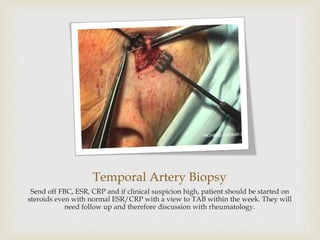
Temporal Artery Biopsy
Send off FBC, ESR, CRP and if clinical suspicion high, patient should be started on
steroids even with normal ESR/CRP with a view to TAB within the week. They will
need follow up and therefore discussion with rheumatology.

 Classical triad of: haemoptysis, drop in haemoglobin and
pulmonary infiltrates on imaging (<50%)
 Should have high index of suspicion for patients with
known vasculitic disorders and other autoimmune
diseases though can be ‘bland’
 Clinically: dyspnoea, cough, fever
 May present with type 1 respiratory failure
 The emergency: can rapidly deteriorate, requiring
intubation for adequate oxygenation. Can be mistakenly
treated as pneumonia/sepsis.
Diffuse Alveolar Haemorrhage
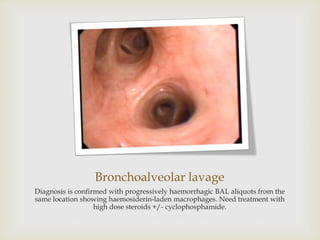
Bronchoalveolar lavage
Diagnosis is confirmed with progressively haemorrhagic BAL aliquots from the
same location showing haemosiderin-laden macrophages. Need treatment with
high dose steroids +/- cyclophosphamide.

 Patients with first episode psychoses that may have
other constitutional symptoms of SLE
 Consider in young patients with ischaemic stroke
 Headache and altered mental status most common
 Extremely rare, and even other rarer causes are
significantly more common
 The importance: first episode psychosis or delirium
should prompt consideration of an organic cause for
the presentation before being labeled psychiatric.
Cerebral Vasculitis
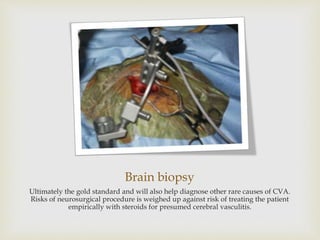
Brain biopsy
Ultimately the gold standard and will also help diagnose other rare causes of CVA.
Risks of neurosurgical procedure is weighed up against risk of treating the patient
empirically with steroids for presumed cerebral vasculitis.

 Vasculitis is rare but it should be considered when
patients present with atypical symptoms
 Remember the red flags
 Remember the emergencies
Conclusions

 https://www.ncbi.nlm.nih.gov/pmc/articles/PMC1798473/
 http://www.medscape.com/viewarticle/407580_1
 http://emedicine.medscape.com/article/329255-overview
 http://link.springer.com/article/10.1186/2110-5820-2-31
 http://www.emdocs.net/the-emergency-medicine-approach-to-vasculitides/
 https://emergency.unboundmedicine.com/emergency/view/5-
Minute_Emergency_Consult/307249/all/Vasculitis
 https://www.ncbi.nlm.nih.gov/pmc/articles/PMC4029362/
 http://emedicine.medscape.com/article/332483-treatment
 http://www.medscape.com/viewarticle/740972_8
 http://ard.bmj.com/content/64/5/784
 Kawasaki T. [Acute febrile mucocutaneous syndrome with lymphoid
involvement with specific desquamation of the fingers and toes in children].
Arerugi. 1967 Mar. 16(3):178-222. [Medline].
References

Vasculitides Emergency Presentations

  • 1.
    Dr Joshua Ho SCGHEmergency Medicine Registrar May 18, 2017 CME
  • 2.
      Definitions andpathophysiology  Classification  Clinical overview  Systems commonly involved  Emergency presentations  Management in the ED  Management upstairs Overview
  • 3.
     Definitions & Pathogenesis Vasculitis (plural:vasculitides) is a group of disorders that destroy blood vessels by inflammation.
  • 4.
      Vasculitis: vesselwall inflammation  Heterogenous group of diseases  Common histopathologic features of inflammation and necrosis of blood vessel walls  Different sized vessels  Different vessel beds  Different aetiologies What is it?
  • 5.
      Immune-mediated inflammation(non-infectious)  Direct vascular wall invasion (infectious)  Physical/chemical injuries Pathogenesis
  • 6.
      Immune complexdeposition  Anti-neutrophil cytoplasmic antibodies  Anti-endothelial cell antibodies Immunologically Mediated
  • 7.
      Typically seenwith systemic autoimmune diseases  Also with drug hypersensitivity reactions  Viral antigen-antibody complexes (Hep B)  Antibody and complement detected  Exact antigens responsible not always clear  Circulating antigen-antibody complexes may be seen Immune Complex Deposition
  • 8.
      Circulating antibodiesdirected against neutrophil granules, monocyte lysosomes and endothelial cells  Cytoplasmic or perinuclear  Myeloperoxidase or Proteinase-3  MPO is a lysosomal granule constituent normally involved in generating oxygen free radicals  PR3 is a neutrophil azurophilic granule constituent  Direct injury to endothelial cells  Degranulation causes release of ROS ANCAs
  • 9.
      Unclear role May have direct cytotoxic effects  Association with Kawasaki disease Anti-endothelial cell antibodies
  • 10.
     Chapel Hill Classification In 2012,the Chapel Hill Consensus Conference notably replaced most of the eponymously named diseases with names that reflected the understanding of the diseases’ pathophysiology.
  • 11.
  • 12.
    Mikito Takayasu Ophthalmologist whoin 1901 first described arteriovenous anatamosis around the papilla. He did not describe that patient’s peripheral pulses.
  • 13.
      Giant CellArteritis  Typically those over 50  Temporal arteries often affected  Associated with polymyalgia rheumatica  Aorta and major branches with predilection for branches of carotids and vertebrals  Takayasu Arteritis  Typically those under 50  Aorta and major branches Large Vessel Vasculitis
  • 14.
    Tomisaku Kawasaki In 1967,Dr Kawasaki reported 50 cases of children who presented to the Tokyo Red Cross Medical Centre with fever, rash, conjunctival injection, cervical lymphadenitis, inflammation of the lips and oral cavity, and erythema over the hands and feet.
  • 15.
      Polyarteritis nodosa Necrotising arteritis of medium or small arteries  No ANCA, doesn’t affect small vessels  Kawasaki disease  Arteritis associated with mucocutaneous syndrome  Coronary arteries often involved  Affects infants and young children Medium Vessel Vasculitis
  • 16.
    Friedrich Wegener In 1936,Dr Wegener, a pathologist, reported three patients with similar clinical features and published his findings on their distinct histopathologic findings.
  • 17.
    Jacob Churg andLotte Strauss In 1951, Churg and Strauss described 13 patients with asthma, eosinophilia, granulomatous inflammation, necrotising systemic vasculitis, and necrotising glomerulonephritis.
  • 18.
    Ernest Goodpasture In 1919,Dr Goodpasture reported a case of pulmonary haemorrhage and glomerulonephritis during an influenza epidemic. Anti-GBM antibodies were not discovered until 1967.
  • 19.
      ANCA associated Microscopic polyangiitis  Granulomatosis with polyangiitis  Eosinophilic granulomatosis with polyangiitis  Immune complex mediated  Anti-GBM vasculitis  Cryoglobulinaemic vasculitis  IgA vasculitis  Hypocomplementemic urticarial vasculitis Small vessel vasculitis
  • 20.
     Organs involved Almost anysystem can be involved.
  • 21.
      Airway  Pulmonary Cardiovascular  Renal  Neurological  Gastrointestinal  Cutaneous Organ Involvement
  • 22.
      Cricoarytenoid oedema Subglottic stenosis in Wegener’s  Can be anatomically difficult intubations Airway
  • 23.
      Subclinical alveolitis Interstitial lung fibrosis  Pulmonary hypertension  Diffuse alveolar haemorrhage Pulmonary
  • 24.
  • 25.
      Accelerated atherosclerosis Acute heart failure  Hypertensive emergencies  Signs of arterial insufficiency  Stroke  Claudication  ACS Cardiovascular
  • 26.
      Blindness  TIA/Stroke Peripheral neuropathies  Seizures  Psychiatric Disorders Neurological
  • 27.
      Renal arteryaneurysms  Nephrotic syndrome  Nephritic syndrome Renal
  • 28.
      Ischaemic bowel Mesenteric ischaemia  Gastrointestinal haemorrhage Gastrointestinal
  • 29.
      Palpable purpura Oral and genital ulcers Cutaneous
  • 30.
  • 31.
    Vasculitic Rash inCryoglobulinaemia
  • 32.
      Predisposition toopportunistic infections  Hyperviscosity syndrome  Subglottic stenosis in Wegener’s  Most have constitutional symptoms Miscellaneous
  • 33.
     The emergencies Emergency (google’sdefintion): a serious, unexpected, and often dangerous situation requiring immediate action. Emergency room (urbandictionary.com): A place you go when you think you are going to die, but want somebody else to pay for it.
  • 34.
      Constitutional symptomsof: fatigue, malaise, diffuse pain, arthralgia or arthritis, weight loss  Clinical signs of rheumatologic disease such as: arthritis, red eyes, Raynaud phenomenon  Young patients or those without typical risk factors presenting with neurological deficits  Recurrent episodes of erythema nodosum  High inflammatory markers without obvious source of infection clinically Red Flags
  • 35.
      Older than50 years old, female > male  Diffuse headache that is new in character  Focal tenderness on direct palpation  Scalp tenderness with combing hair or wearing hat  Jaw claudication with firm foods/long speeches  Visual changes: transient, unilateral, painless visual blurring or loss and occasionally diplopia  Previous diagnosis of PMR or complaint of neck, torso, shoulder, pelvic girdle pain  The emergency: undiagnosed, patient goes blind. Giant Cell Arteritis
  • 36.
    Temporal Artery Biopsy Sendoff FBC, ESR, CRP and if clinical suspicion high, patient should be started on steroids even with normal ESR/CRP with a view to TAB within the week. They will need follow up and therefore discussion with rheumatology.
  • 37.
      Classical triadof: haemoptysis, drop in haemoglobin and pulmonary infiltrates on imaging (<50%)  Should have high index of suspicion for patients with known vasculitic disorders and other autoimmune diseases though can be ‘bland’  Clinically: dyspnoea, cough, fever  May present with type 1 respiratory failure  The emergency: can rapidly deteriorate, requiring intubation for adequate oxygenation. Can be mistakenly treated as pneumonia/sepsis. Diffuse Alveolar Haemorrhage
  • 38.
    Bronchoalveolar lavage Diagnosis isconfirmed with progressively haemorrhagic BAL aliquots from the same location showing haemosiderin-laden macrophages. Need treatment with high dose steroids +/- cyclophosphamide.
  • 39.
      Patients withfirst episode psychoses that may have other constitutional symptoms of SLE  Consider in young patients with ischaemic stroke  Headache and altered mental status most common  Extremely rare, and even other rarer causes are significantly more common  The importance: first episode psychosis or delirium should prompt consideration of an organic cause for the presentation before being labeled psychiatric. Cerebral Vasculitis
  • 40.
    Brain biopsy Ultimately thegold standard and will also help diagnose other rare causes of CVA. Risks of neurosurgical procedure is weighed up against risk of treating the patient empirically with steroids for presumed cerebral vasculitis.
  • 41.
      Vasculitis israre but it should be considered when patients present with atypical symptoms  Remember the red flags  Remember the emergencies Conclusions
  • 42.
      https://www.ncbi.nlm.nih.gov/pmc/articles/PMC1798473/  http://www.medscape.com/viewarticle/407580_1 http://emedicine.medscape.com/article/329255-overview  http://link.springer.com/article/10.1186/2110-5820-2-31  http://www.emdocs.net/the-emergency-medicine-approach-to-vasculitides/  https://emergency.unboundmedicine.com/emergency/view/5- Minute_Emergency_Consult/307249/all/Vasculitis  https://www.ncbi.nlm.nih.gov/pmc/articles/PMC4029362/  http://emedicine.medscape.com/article/332483-treatment  http://www.medscape.com/viewarticle/740972_8  http://ard.bmj.com/content/64/5/784  Kawasaki T. [Acute febrile mucocutaneous syndrome with lymphoid involvement with specific desquamation of the fingers and toes in children]. Arerugi. 1967 Mar. 16(3):178-222. [Medline]. References

Editor's Notes

  • #5 Large, medium, small Arterioles, capillaries, venules
  • #6 Chemical injuries – irradiation, mechanical trauma, toxins
  • #7 Each one in turn
  • #8 Lupus, PAN – anti DNAse Antibodies against drug modified proteins (penicillin) or foreign molecules – in drug hypersensitivity reactions Hepatitis B and PAN (30% of patients have hep B and have complexes of Hep B surface antigen and antibody) Complexes can form elsewhere then deposit or antigen in vessel wall then antibody binding Sometimes no complexes seen – late diagnosis or pauci-immune vasculitis
  • #9 ANCA (anti-neutrophil cytoplasmic antibodies) P-ANCA is MPO (microscopic polyangiitis and churg strauss) C-ANCA is PR3 (wegener) Drugs or microbes may have cross reactivity and incite ANCA formation in susceptible hosts- PTU can do this with p-anca Infections or endotoxin exposure elicit cytokines that induce surface expression of MPO or PR3 ANCA react with antigen and cause vessel injury Useful as diagnostic markers and rise with recurrent disease
  • #12 Schematic showing large vessel, medium vessel and small vessel vaculitides – those associated with ANCA and those associated with other immune complex deposition
  • #14 Both are granulomatous disease Main distinguishing feature is age TA – pulseless disease, transmural fibrous thickening of aorta, luminal narrowing of major branch vessels – strokes, aortic dissections
  • #16 PAN typically spares lung, associated with hep B 80% younger than 4 years old with kawasaki, triggered by infection, auto-antibodies to endothelial cells, T/B cell hypersensitivity reaction Fever for 5 days or more plus: 1. polymorphous rash 2. bilateral non-purulent conjunctival injection 3. mucous membrane changes 4. desquamative rash, palmar erythema 5. cervical lymphadenopathy CREAM mnemonic – conjunctivitis, rash, edema, adenitis, mucosal involvement Need ECHOs and IVIG as treatment
  • #20 Granulomatosis with polyangiitis (GPA) – wegener  recurrent RTIs in adults, with ophthalmic/sinusitis/pulmonary infiltrate/renal involvement (complex diagnosis) Eosinophilic granulomatosis with polyangiitis (EGPA) – churg strauss  severe asthma, blood and tissue eosinophilia, sinusitis, pulmonary infiltrate, mononeuritis multiplex/polyneuropathy Anti GBM – goodpastures (acute GN, haemoptysis) IgA vasculitis – HSP  children, palpable purpura, arthirtis, abdominal pain, haemoproteinuria Hypocomplementemic urticarial vasculitis – anti-C1q antibodies Others: thromboangiitis obliterans (buerger’s disease), rheumatoid, SLE, cancer, APLs, systemic sclerosis
  • #23 Wegener (GPA)
  • #25 Diagnosis made with CXR, CT and usually need BAL to show red cells Triage of haemoptysis, anaemia and type 1 resp failure Most commonly wegener’s, (30%), but also goodpastures, microscopic polyangiitis, idiopathic pulmonary haemosiderosis, collagen vascular disorders
  • #27 Be hesitant to diagnose a new psychiatric disorder in a patient who has any autoimmune disease
  • #28 Membranoproliferative GN most common manifestation of renal disease
  • #33 Opportunitic infections – steroids and other immunosupresive therapy Hyperviscosity syndrome (mucosal bleeding, visual changes, neurologic symptoms) in those with cryoglobulinaemia – CCF, ischaemic ATN, pulmonary oedema Subglottic stenosis
  • #37 Up to 20% patients have normal ESR/CRP TAB results remain positive for characteristic GCA pathology at least 2 weeks after treatment is started British guidelines 40 – 60mg for 4 weeks at least then taper dose down
  • #39 Wegener, SLE, Goodpasture Other causes – HIV, idiopathic pulmonary haemosiderosis, drugs/toxins, mitral stenosis
  • #40 Reversible cerebral vasoconstriction syndrome, CNS lymphoma, neuro sarcoid, MS, fibromuscular dysplasia , CNS infections, amyloid angiopathy all more frequent.