‫بسم ال الرحمن الرحيم‬

   Antepartum
(haemorrhage(APH
     By Dr. sallama kamel
:Definition
APH is defined as bleeding in the third-
trimester of pregnancy, after 24weeks and
.before the delivery of the fetus
.It complicates 4 percent of all pregnancies-
It is an obstetric emergency because it-
endanger the life of both the mother and
.fetus
Hemorrhage remain the most frequent cause-
.of maternal deaths
:Etiology
:Placental causes
 (.Placenta previa (30%.1
(.Abruptio placenta (34%.2
(.Vasa previa (1%.3
(:Local causes (5%
.Cervicitis.1
.Cervical erosion.2
.Cervical carcinoma.3
.Vaginal infection.4
.Vaginal trauma.5
.In 30% of cases no cause can be found
Placenta previa and abruptio placenta represents the
main causes of APH and will be discusses in details
.(.Placenta previa (P.P
.Means implantation of the placenta in the lower uterine segment

:Incidence
(.It complicate 0.5% of pregnancies(1 in 200 pregnancies ♠
Bleeding from placenta previa account for about 30% of all cases of♠
.APH

:Predisposing factors
.Multiparity.1
.Previous C/S scar.2
.Increasing maternal age.3
.Multiple gestation.4
:Prior placenta previa.5
 patient with a placenta previa has a 4% - 8% risk of having p.p. in
.subsequent pregnancy
.Congenital anomaly of the uterus e.g. septate uterus.6
:What is the lower uterine segment

The lower segment can be defined as that part of
:the uterine wall which
Does not contract in labour but is stretched in •
.response to contractions
.Used to be the isthmus before pregnancy•
Underlies the loose fold of peritoneum that •
.reflects from the bladder
.Is covered by a full bladder anteriorly•
.Is within 8 cm of the internal cervical os at term •
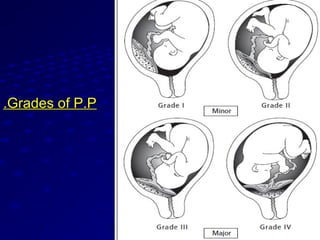
Grading of placenta previa
.(Grade .1 (lateral placenta
The placenta implanted in the lower uterine segment
.but does not reach the internal os
(.Grade .2.(marginal placenta
The edge of the placenta reaches the internal os but
.not covering it
(.Grade.3.(partial placenta previa
.The placenta partially covering the internal os
(.Grade.4.(complete placenta previa
.The placenta cover the internal os completely
.Grade 1&2 called minor P.P. grade 3&4 major P.P
.Grades of P.P
:Clinical presentation

Painless, recurrent unprovoked vaginal.1
:bleeding
Placenta previa characteristically present with -
.unprovoked painless bleeding
Bleeding occurs as a result of disruption of the-
placental attachment secondary to the development
.and thinning of the lower uterine segment
 In general those with complete previa bleeds earlier -
         and more heavily than those with a partial or
.The bleeding is usually recurrent-
The mean gestational age at the onset of the first -
bleeding is 30 weeks with one third presenting
.before 30 weeks
:malpresentation. 2
On abdominal examination it is common to find-
malpresentation in association with placenta previa
(which are either breech or transverse lie in about
(.35%
Slight but inconsistent deviation of the presenting part -
from the midline and difficulty with palpating the
.presenting part
The abdomen is usually soft and the fetal heart is -
.normal
:Diagnosis of placenta previa
  Placenta previa is almost exclusively diagnosed nowadays by
. ultrasound
An ultrasound scan will show the position of the-
. placenta clearly within the uterus
If the placenta lies in the anterior part of the uterus and-
reaches into the area covered by the bladder, it is
 known as a low-lying placenta (before 24 weeks( and placenta
praevia after 24 weeks

 About 5%of patients have some degree of placenta previa on
ultrasonic examination before 20 week’s gestation.

 With the development of the lower uterine segment, a relative
upward placental migration occurs, with 90% of these resolves by
the 3rd trimester.
Clinical diagnosis of placenta previa.
 Clinical diagnosis of placenta previa can be
  made by palpating the placenta through the
  cervical os .

 However this examination can precipitate
 profuse vaginal bleeding and it is only
 indicated when U/S is not available and the
 patient in labour with non-life-threatening
 vaginal bleeding.
Such examination should always be done
in the theatre with every thing is prepared
for caesarian section with a complete
operating team ready to operate should
vaginal examination precipitate substantial
 bleeding
the procedure called examination in the)
(.theatre or double set examination
:Management

ASYMPTOMATIC LOW-LYING PLACENTA
All women with a low-lying placenta diagnosed •
in early pregnancy should be rescanned at 34
.weeks’ gestation
There is no need to restrict work activities or•
sexual intercourse in women with a low-lying
.placenta on ultrasound unless they bleed
’If the placenta praevia is still present at 34 weeks•
gestation and is Grade I or II, the woman should be
rescanned on a fortnightly basis but need not be
.admitted unless they bleed
Management of patient with bleeding
:As with any 3rd trimester bleeding
. The patient condition should initially be stabilized
. Fetal monitoring instituted
. Blood studies ordered
. Blood products made available. • Admit to hospital

Insert a broad-bore i.v. cannula and start an infusion of normal saline—if •
.the woman is shocked start with a colloid infusion, e.g. Haemaccel
.Take blood for cross-matching and haemoglobin estimation •

Once the diagnosis of placenta previa is established, management
: decision will depend on
.Gestational age. 1
Severity of bleeding.2
When the pregnancy is preterm.1

The aim is to obtain fetal maturation without
.compromising the mother’s health
:if the bleeding is excessive.1
Delivery must be accomplished by caesarian
.section regardless the gestational age

:When the bleeding is not profuse. 2
The patient is managed expectantly in
hospital on bed rest and blood transfusion if
.the woman is anaemic
After several days without bleeding, she may be
.ambulate and even discharged if she lives nearby

 Instruct the patient to return at the first sign of
.further bleeding

 Her haematocrite should be followed her
.haemoglobin should be not less than 11gm

. Blood should always be available for the patient
At 36–37 weeks’ presentation, a final ultrasound •
:should be performed and acted upon
a) Grades III and IV placenta praevia should)
have a Caesarean section between 37 and 38
weeks’ gestation by an experienced obstetrician
particularly if the placenta is on the anterior wall
.of the uterus
b) If the presenting part is below the lower edge )
of the placenta in Grade I, then it is safe to wait
until labour and these women can be expected to
.deliver vaginally
When the patient present in labour with.2
vaginal bleeding
the patient should be delivered by caesarean
section if placenta previa is documented by
.ultrasound

if the ultrasound diagnosis is uncertain,
.examination in the theatre can be done

 In rare cases a patient with marginal placenta
previa can be delivered vaginally provided that
the fetal head compress the site of bleeding
.during labour
In patient with grade one placenta previa
(the placenta implanted in the lower
 ( segment but not reaching the cervical os

vaginal delivery is usually
accomplished, although it should be
done in a well controlled manner and
.setting
If the woman is Rh-negative.3
There is increased risk of feto-maternal
.transfusion and immunization

.So anti-D immunoglobulin should be given

A kleihauer-Betke test should be done on
maternal blood to determine the extent of the
feto-maternal transfusion so that an
.appropriate larger dose of anti-D may be given
:Maternal risks of placenta previa
. There is increased maternal mortality and morbidity
  Antepartum and intrapartum haemorrhage carry a constant
.threat to the life of patient with placenta previa
: Bleeding may be due to
.Placenta previa itself.1
major cause of death in women with placenta. 2
).praevia now is postpartum haemorrhage )PPH
PPH is common because the lower segment does not contract
 and
retract as in the upper segment, and therefore maternal vessels of
 the placental bed may continue to bleed after delivery. This may
lead to an emergency hysterectomy if the bleeding
.cannot be stopped
.Associated placenta accreta.3
:Fetal risks of placenta previa
The perinatal mortality of patients with placenta previa
is higher than the general population and this is
:related to
(.Prematurity (which is the main cause.1
Higher incidence of IUGR (about 20% of pregnancies.2
(.with placenta previa develops IUGR
(.Malpresentation (in 30% of cases.3
Higher risk of preterm premature rupture of.4
.membranes
The presence of vasa previa which carry a perinatal.5
.mortality of 75%
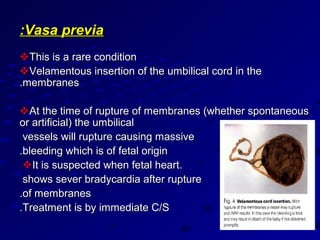
:Vasa previa
This is a rare condition
Velamentous insertion of the umbilical cord in the
.membranes

At the time of rupture of membranes (whether spontaneous
or artificial) the umbilical
 vessels will rupture causing massive
.bleeding which is of fetal origin
 It is suspected when fetal heart.
 shows sever bradycardia after rupture
.of membranes
.Treatment is by immediate C/S
:Placenta accreta

Abnormal attachment of the placenta through
the myometrium as a result of defective decidua
.formation
It may be superficial ------ placenta accreta.1
The placental villi may invade partially through .2
.the myometrium------ placenta increta
The villi may invade the serosa----- placenta.3
.percreta
.Risk factors for placenta accreta
.Previous uterine surgery.1
.Placenta previa.2
.Congenital anomalies of the uterus.3

There will be difficulty in delivering the placenta
.with massive bleeding
Two third of patients will require hysterectomy to
.save their life
بسم الله الرحمن الرحيمAph

بسم الله الرحمن الرحيمAph

  • 1.
    ‫بسم ال الرحمنالرحيم‬ Antepartum (haemorrhage(APH By Dr. sallama kamel
  • 2.
    :Definition APH is definedas bleeding in the third- trimester of pregnancy, after 24weeks and .before the delivery of the fetus .It complicates 4 percent of all pregnancies- It is an obstetric emergency because it- endanger the life of both the mother and .fetus Hemorrhage remain the most frequent cause- .of maternal deaths
  • 3.
    :Etiology :Placental causes (.Placentaprevia (30%.1 (.Abruptio placenta (34%.2 (.Vasa previa (1%.3 (:Local causes (5% .Cervicitis.1 .Cervical erosion.2 .Cervical carcinoma.3 .Vaginal infection.4 .Vaginal trauma.5 .In 30% of cases no cause can be found Placenta previa and abruptio placenta represents the main causes of APH and will be discusses in details
  • 4.
    .(.Placenta previa (P.P .Meansimplantation of the placenta in the lower uterine segment :Incidence (.It complicate 0.5% of pregnancies(1 in 200 pregnancies ♠ Bleeding from placenta previa account for about 30% of all cases of♠ .APH :Predisposing factors .Multiparity.1 .Previous C/S scar.2 .Increasing maternal age.3 .Multiple gestation.4 :Prior placenta previa.5 patient with a placenta previa has a 4% - 8% risk of having p.p. in .subsequent pregnancy .Congenital anomaly of the uterus e.g. septate uterus.6
  • 5.
    :What is thelower uterine segment The lower segment can be defined as that part of :the uterine wall which Does not contract in labour but is stretched in • .response to contractions .Used to be the isthmus before pregnancy• Underlies the loose fold of peritoneum that • .reflects from the bladder .Is covered by a full bladder anteriorly• .Is within 8 cm of the internal cervical os at term •
  • 6.
    Grading of placentaprevia .(Grade .1 (lateral placenta The placenta implanted in the lower uterine segment .but does not reach the internal os (.Grade .2.(marginal placenta The edge of the placenta reaches the internal os but .not covering it (.Grade.3.(partial placenta previa .The placenta partially covering the internal os (.Grade.4.(complete placenta previa .The placenta cover the internal os completely .Grade 1&2 called minor P.P. grade 3&4 major P.P
  • 7.
  • 8.
    :Clinical presentation Painless, recurrentunprovoked vaginal.1 :bleeding Placenta previa characteristically present with - .unprovoked painless bleeding Bleeding occurs as a result of disruption of the- placental attachment secondary to the development .and thinning of the lower uterine segment In general those with complete previa bleeds earlier - and more heavily than those with a partial or
  • 9.
    .The bleeding isusually recurrent- The mean gestational age at the onset of the first - bleeding is 30 weeks with one third presenting .before 30 weeks :malpresentation. 2 On abdominal examination it is common to find- malpresentation in association with placenta previa (which are either breech or transverse lie in about (.35% Slight but inconsistent deviation of the presenting part - from the midline and difficulty with palpating the .presenting part The abdomen is usually soft and the fetal heart is - .normal
  • 10.
    :Diagnosis of placentaprevia  Placenta previa is almost exclusively diagnosed nowadays by . ultrasound An ultrasound scan will show the position of the- . placenta clearly within the uterus If the placenta lies in the anterior part of the uterus and- reaches into the area covered by the bladder, it is known as a low-lying placenta (before 24 weeks( and placenta praevia after 24 weeks  About 5%of patients have some degree of placenta previa on ultrasonic examination before 20 week’s gestation.  With the development of the lower uterine segment, a relative upward placental migration occurs, with 90% of these resolves by the 3rd trimester.
  • 11.
    Clinical diagnosis ofplacenta previa.  Clinical diagnosis of placenta previa can be made by palpating the placenta through the cervical os .  However this examination can precipitate profuse vaginal bleeding and it is only indicated when U/S is not available and the patient in labour with non-life-threatening vaginal bleeding.
  • 12.
    Such examination shouldalways be done in the theatre with every thing is prepared for caesarian section with a complete operating team ready to operate should vaginal examination precipitate substantial bleeding the procedure called examination in the) (.theatre or double set examination
  • 13.
    :Management ASYMPTOMATIC LOW-LYING PLACENTA Allwomen with a low-lying placenta diagnosed • in early pregnancy should be rescanned at 34 .weeks’ gestation There is no need to restrict work activities or• sexual intercourse in women with a low-lying .placenta on ultrasound unless they bleed ’If the placenta praevia is still present at 34 weeks• gestation and is Grade I or II, the woman should be rescanned on a fortnightly basis but need not be .admitted unless they bleed
  • 14.
    Management of patientwith bleeding :As with any 3rd trimester bleeding . The patient condition should initially be stabilized . Fetal monitoring instituted . Blood studies ordered . Blood products made available. • Admit to hospital Insert a broad-bore i.v. cannula and start an infusion of normal saline—if • .the woman is shocked start with a colloid infusion, e.g. Haemaccel .Take blood for cross-matching and haemoglobin estimation • Once the diagnosis of placenta previa is established, management : decision will depend on .Gestational age. 1 Severity of bleeding.2
  • 15.
    When the pregnancyis preterm.1 The aim is to obtain fetal maturation without .compromising the mother’s health :if the bleeding is excessive.1 Delivery must be accomplished by caesarian .section regardless the gestational age :When the bleeding is not profuse. 2 The patient is managed expectantly in hospital on bed rest and blood transfusion if .the woman is anaemic
  • 16.
    After several dayswithout bleeding, she may be .ambulate and even discharged if she lives nearby  Instruct the patient to return at the first sign of .further bleeding  Her haematocrite should be followed her .haemoglobin should be not less than 11gm . Blood should always be available for the patient
  • 17.
    At 36–37 weeks’presentation, a final ultrasound • :should be performed and acted upon a) Grades III and IV placenta praevia should) have a Caesarean section between 37 and 38 weeks’ gestation by an experienced obstetrician particularly if the placenta is on the anterior wall .of the uterus b) If the presenting part is below the lower edge ) of the placenta in Grade I, then it is safe to wait until labour and these women can be expected to .deliver vaginally
  • 18.
    When the patientpresent in labour with.2 vaginal bleeding the patient should be delivered by caesarean section if placenta previa is documented by .ultrasound if the ultrasound diagnosis is uncertain, .examination in the theatre can be done  In rare cases a patient with marginal placenta previa can be delivered vaginally provided that the fetal head compress the site of bleeding .during labour
  • 19.
    In patient withgrade one placenta previa (the placenta implanted in the lower ( segment but not reaching the cervical os vaginal delivery is usually accomplished, although it should be done in a well controlled manner and .setting
  • 20.
    If the womanis Rh-negative.3 There is increased risk of feto-maternal .transfusion and immunization .So anti-D immunoglobulin should be given A kleihauer-Betke test should be done on maternal blood to determine the extent of the feto-maternal transfusion so that an .appropriate larger dose of anti-D may be given
  • 21.
    :Maternal risks ofplacenta previa . There is increased maternal mortality and morbidity  Antepartum and intrapartum haemorrhage carry a constant .threat to the life of patient with placenta previa : Bleeding may be due to .Placenta previa itself.1 major cause of death in women with placenta. 2 ).praevia now is postpartum haemorrhage )PPH PPH is common because the lower segment does not contract and retract as in the upper segment, and therefore maternal vessels of the placental bed may continue to bleed after delivery. This may lead to an emergency hysterectomy if the bleeding .cannot be stopped .Associated placenta accreta.3
  • 22.
    :Fetal risks ofplacenta previa The perinatal mortality of patients with placenta previa is higher than the general population and this is :related to (.Prematurity (which is the main cause.1 Higher incidence of IUGR (about 20% of pregnancies.2 (.with placenta previa develops IUGR (.Malpresentation (in 30% of cases.3 Higher risk of preterm premature rupture of.4 .membranes The presence of vasa previa which carry a perinatal.5 .mortality of 75%
  • 23.
    :Vasa previa This isa rare condition Velamentous insertion of the umbilical cord in the .membranes At the time of rupture of membranes (whether spontaneous or artificial) the umbilical vessels will rupture causing massive .bleeding which is of fetal origin It is suspected when fetal heart. shows sever bradycardia after rupture .of membranes .Treatment is by immediate C/S
  • 24.
    :Placenta accreta Abnormal attachmentof the placenta through the myometrium as a result of defective decidua .formation It may be superficial ------ placenta accreta.1 The placental villi may invade partially through .2 .the myometrium------ placenta increta The villi may invade the serosa----- placenta.3 .percreta
  • 25.
    .Risk factors forplacenta accreta .Previous uterine surgery.1 .Placenta previa.2 .Congenital anomalies of the uterus.3 There will be difficulty in delivering the placenta .with massive bleeding Two third of patients will require hysterectomy to .save their life