VASCULITIS
SUPERVISED BY
DR.EKHLAS ALOTHMAN
PRESENTED BY
SARAA AHMAD
OVERVIEW
The term vasculitis refers to the inflammation of vessel walls. It may range in
severity from a self-limited disorder in one single organ to a life-threatening
disease due to multiple organ failure.
Vasculitides encompass a large group of heterogeneous diseases
characterized by inflammatory reaction localized in the vascular wall and
perivascular tissues. To the concern of etiology, it is defined as a complex
syndrome because several types of vasculitides can be elicited by different
stimulus, although most of them are classified as idiopathic.
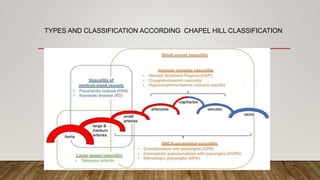
TYPES AND CLASSIFICATION ACCORDING CHAPEL HILL CLASSIFICATION
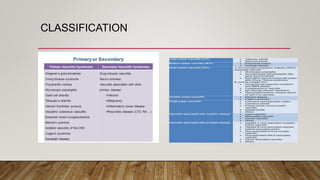
CLASSIFICATION
• However, an overlap of vessel sizes affected within the diseases is noted, and the
phenotype and pattern of organ involvement in vasculitis seems to be
independent of vessel size. For example, Kawasaki disease is characterized by a
mucocutaneous syndrome and coronary artery inflammation, whereas
polyarteritis nodosa (PAN), another medium-vessel vasculitis, manifests with
nodular skin lesions, neuropathy, and hypertension.
• As such, the most recent classification of childhood vasculitides incorporates both
vessel size and organ manifestations
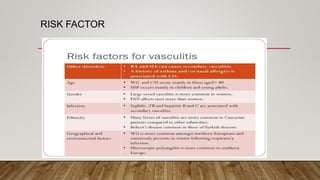
RISK FACTOR
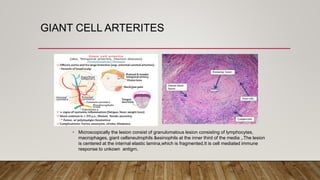
GIANT CELL ARTERITES
• Microscopically the lesion consist of granulomatous lesion consisting of lymphocytes,
macrophages, giant cellsneutrophils &esinophils at the inner third of the media ,.The lesion
is centered at the internal elastic lamina,which is fragmented.It is cell mediated immune
response to unkown antigrn.
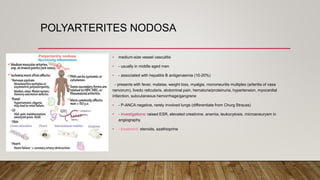
POLYARTERITES NODOSA
• medium-size vessel vasculitis
• - usually in middle aged men
• - associated with hepatitis B antigenaemia (10-20%)
- presents with fever, malaise, weight loss, myalgia, mononeuritis multiplex (arteritis of vasa
nervorum), livedo reticularis, abdominal pain, hematuria/proteinuria, hypertension, myocardial
infarction, subcutaneous hemorrhage/gangrene
• - P-ANCA negative, rarely involved lungs (differentiate from Churg Strauss)
• - investigations: raised ESR, elevated creatinine, anemia, leukocytosis, microaneurysm in
angiography
• - treatment: steroids, azathioprine
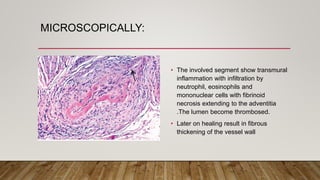
MICROSCOPICALLY:
• The involved segment show transmural
inflammation with infiltration by
neutrophil, eosinophils and
mononuclear cells with fibrinoid
necrosis extending to the adventitia
.The lumen become thrombosed.
• Later on healing result in fibrous
thickening of the vessel wall
THROMBOANGITIS OBLITERANS
(BUERGER DISEASE )
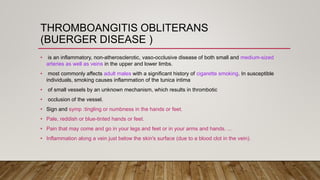
• is an inflammatory, non-atherosclerotic, vaso-occlusive disease of both small and medium-sized
arteries as well as veins in the upper and lower limbs.
• most commonly affects adult males with a significant history of cigarette smoking. In susceptible
individuals, smoking causes inflammation of the tunica intima
• of small vessels by an unknown mechanism, which results in thrombotic
• occlusion of the vessel.
• Sign and symp :tingling or numbness in the hands or feet.
• Pale, reddish or blue-tinted hands or feet.
• Pain that may come and go in your legs and feet or in your arms and hands. ...
• Inflammation along a vein just below the skin's surface (due to a blood clot in the vein).
BURGER DISEASE(
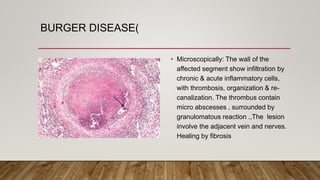
• Microscopically: The wall of the
affected segment show infiltration by
chronic & acute inflammatory cells,
with thrombosis, organization & re-
canalization. The thrombus contain
micro abscesses , surrounded by
granulomatous reaction .,The lesion
involve the adjacent vein and nerves.
Healing by fibrosis
RAYNAUD'S DISEASE
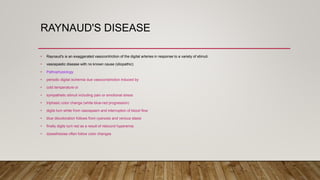
• Raynaud's is an exaggerated vasocontriction of the digital arteries in response to a variety of stimuli.
• vasospastic disease with no known cause (idiopathic)
• Pathophysiology
• periodic digital ischemia due vasoconstriction induced by
• cold temperature or
• sympathetic stimuli including pain or emotional stress
• triphasic color change (white-blue-red progression)
• digits turn white from vasospasm and interruption of blood flow
• blue discoloration follows from cyanosis and venous stasis
• finally digits turn red as a result of rebound hyperemia
• dysesthesias often follow color changes
WEGENERS GRAULOMATOSIS
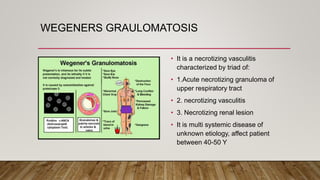
• It is a necrotizing vasculitis
characterized by triad of:
• 1.Acute necrotizing granuloma of
upper respiratory tract
• 2. necrotizing vasculitis
• 3. Necrotizing renal lesion
• It is multi systemic disease of
unknown etiology, affect patient
between 40-50 Y
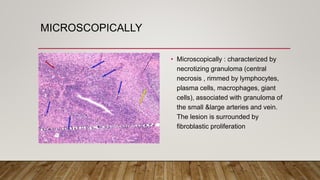
MICROSCOPICALLY
• Microscopically : characterized by
necrotizing granuloma (central
necrosis , rimmed by lymphocytes,
plasma cells, macrophages, giant
cells), associated with granuloma of
the small &large arteries and vein.
The lesion is surrounded by
fibroblastic proliferation
PATHOGENESIS
• Many data study demonstrae the pathogenesis of vasculitis by various inflammatory
pathway either ; Cell mediated inflammation, ic. Immune complex mediated infl., Anca
mediated infl.
• Secondary vasculitides, frequently associated with infections or systemic autoimmune
diseases, are, in most cases, characterized by immune deposits in the vessel wall,
which probably underlies the development of lesions.
• In the primary vasculitides, immune deposits are generally absent. A group of primary
vasculitides is, however, strongly associated with anti-neutrophil cytoplasmic
autoantibodies (ANCA). Various in vitro and in vivo experimental data suggest that
those ANCA are involved in the pathogenesis of lesions in the associated disorders.
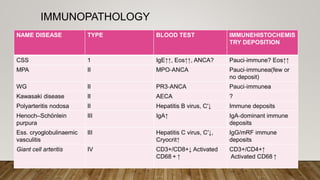
IMMUNOPATHOLOGY
NAME DISEASE TYPE BLOOD TEST IMMUNEHISTOCHEMIS
TRY DEPOSITION
CSS 1 IgE↑↑, Eos↑↑, ANCA? Pauci‐immune? Eos↑↑
MPA II MPO‐ANCA Pauci‐immunea(few or
no deposit)
WG II PR3‐ANCA Pauci‐immunea
Kawasaki disease II AECA ?
Polyarteritis nodosa II Hepatitis B virus, C′↓ Immune deposits
Henoch–Schönlein
purpura
III IgA↑ IgA‐dominant immune
deposits
Ess. cryoglobulinaemic
vasculitis
III Hepatitis C virus, C′↓,
Cryocrit↑
IgG/mRF immune
deposits
Giant cell arteritis IV CD3+/CD8+↓ Activated
CD68 + ↑
CD3+/CD4+↑
Activated CD68 ↑
DIAGNOSIS
• Blood test
• and other studies may suggest the diagnosis of vasculitis like serological test ,anti
body indicator as c reactive protein
• , but often the only way to clinch the diagnosis is to biopsy involved tissue,
examine the tissue under the microscope in consultation with a pathologist.
BIOPSY
• Skin Biopsy: One of the least invasive ways of making the
diagnosis. A minor procedure performed under local
anesthesia. The wound is closed with 1–2 stitches that are
removed 7–10 days later.
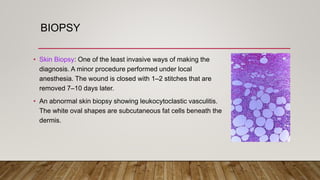
• An abnormal skin biopsy showing leukocytoclastic vasculitis.
The white oval shapes are subcutaneous fat cells beneath the
dermis.
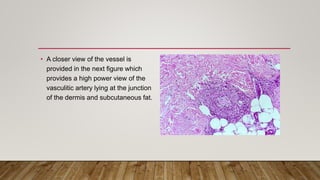
• A closer view of the vessel is
provided in the next figure which
provides a high power view of the
vasculitic artery lying at the junction
of the dermis and subcutaneous fat.
KIDNEY BIOPSY
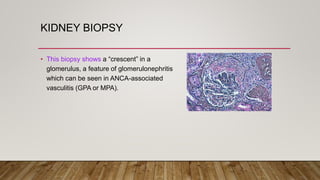
• This biopsy shows a “crescent” in a
glomerulus, a feature of glomerulonephritis
which can be seen in ANCA-associated
vasculitis (GPA or MPA).
• Sural Nerve Biopsy:
• Temporal Artery Biopsy: Performed to diagnose Giant Cell Arteritis, also known as
Temporal Arteritis, because the temporal artery is often involved. The temporal artery
courses up the temples, just in front of the ears. The biopsy, done under local
anesthesia, is performed by making a small incision just above the hairline
(sometimes shaving a small area of hair is required).
• The procedure is extremely well–tolerated by patients. Within several weeks, there is
usually little or no sign that a biopsy was done.
• Complications of temporal artery biopsies are extremely rare. Sometimes, to
increase the diagnostic yield, both temporal arteries (i.e., the ones on each side of the
head) are biopsied
• Lung Biopsy : Often the best way to make a diagnosis of vasculitis that involves
the lungs, such as granulomatosis with polyangiitis (Wegener’s).
• Brain Biopsy: Often necessary to confirm the diagnosis of Central Nervous
System (CNS) Vasculitis. This is usually performed on the non–dominant side of
the patient’s.
• Biopsy of the brain’s covering, the meninges, is usually performed at the same
time..
OTHER TEST
• Angiogram / angiography: Angiography is helpful in the diagnosis of Polyarteritis
Nodosa (PAN).
• Other useful test:
• Erythrocyte sedimentation rate (ESR)
• C–reactive protein (CRP)
• Urinalysis
• CT Scan
• ANCA tests.
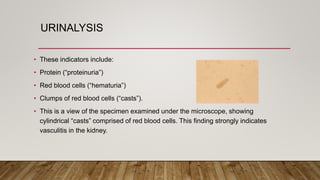
URINALYSIS
• These indicators include:
• Protein (“proteinuria”)
• Red blood cells (“hematuria”)
• Clumps of red blood cells (“casts”).
• This is a view of the specimen examined under the microscope, showing
cylindrical “casts” comprised of red blood cells. This finding strongly indicates
vasculitis in the kidney.
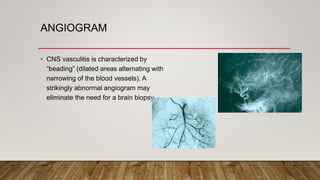
ANGIOGRAM
• CNS vasculitis is characterized by
“beading” (dilated areas alternating with
narrowing of the blood vessels). A
strikingly abnormal angiogram may
eliminate the need for a brain biopsy.
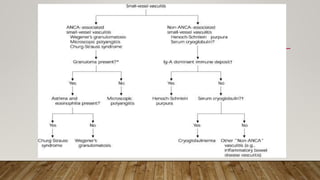
ANCA ASSOCITED DS.
• ANCA tests — ANCA is an abbreviation (acronym) for anti–neutrophil cytoplasmic
antibodies. These antibodies are found in the blood of patients with several different
types of vasculitis, including Wegener’s Granulomatosis, Microscopic Polyangiitis,
and the Churg–Strauss Syndrome.
• ANCAs are detected by a simple blood test. These antibodies are directed against the
cytoplasm (the non–nucleus part) of white blood cells.
• ANCAs come in two primary forms:
• 1) the C–ANCA [C stands for cytoplasmic].
• 2) the P–ANCA [P stands for perinuclear].
• –ANCAs have a particularly strong connection to Wegener’s Granulomatosis (up
to 80% of patients – and possibly more of those with active disease – have these
antibodies). When C–ANCAs are present in the blood of a patient with symptoms
or signs suggesting Wegener’s, the likelihood of the diagnosis increases
considerably. Because of the long list of other conditions that are sometimes
associated with ANCAs,
• however, in most cases it is still VERY IMPORTANT to biopsy an organ involved
by vasculitis to verify the diagnosis.
• Atypical” ANCA patterns are uncommon and often comprise a mix of cytoplasmic
and perinuclear fluorescence with multiple antigen specificities.
• . They occur with propylthiouracil and other drugs, even if there is no vasculitis,
and are also observed in inflammatory bowel disease and rheumatoid arthritis.
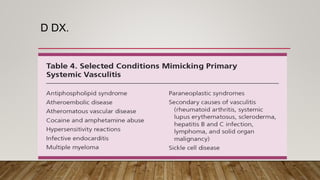
D DX.
KEY MESSAGE ABOUT ANCA ASSOCIATES
VASCULITIS
• The ANCA-associated vasculitides (AAV) are rare multisystem autoimmune diseases, more
common in older people and in men.
• Induction treatment for most patients with AAV should be with cyclophosphamide or rituximab
and glucocorticoids.
• AAV should be considered to be a chronic disease needing long-term immunosuppressive
therapy.
• Rituximab should be considered as an alternative induction agent for those at high risk of
infertility and infection
• The mortality remains high, and late death is due to cardiovascular disease, infection
(secondary to treatment) and malignancy
• Vasculitis can sometimes be triggered by medications such as hydralazine,
allopurinol, minocycline and propylthiouracil. Infections. Having hepatitis B or C
can increase your risk of
MEDICATION
• Corticosteroids, such as prednisone. These can reduce inflammation but can have long-term
serious side effects, such as diabetes, high blood pressure, glaucoma, osteoporosis or greater
susceptibility to infection
• Immune suppressants including cyclophosphamide or methotrexate (for milder cases). These
have less serious side effects than steroids, but can put patients at risk of infection.
• Newer drugs that treat autoimmune and inflammatory diseases such as rituximab
• IV immunoglobulin (IVIg), which may be given to people with sever vasculitis
PROGNOSIS
• Prognosis is related to the degree of end-organ involvement. Generally, ANCA-
associated vasculitis is associated with a poorer prognosis.
• Recurrence rate in Kawasaki disease is approximately 2%.
• Patients with Kawasaki disease and large coronary aneurysms are at risk for
multiple complications, including stenosis and obstruction, myocardial infarction,
and dysrhythmias. Some experience with bypass grafting for revascularization
has been reported very good success.
COVID 19 AND VASCULITIS
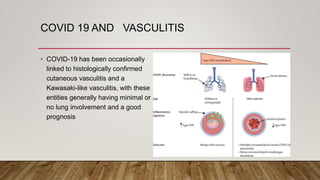
• COVID-19 has been occasionally
linked to histologically confirmed
cutaneous vasculitis and a
Kawasaki-like vasculitis, with these
entities generally having minimal or
no lung involvement and a good
prognosis
• Unlike these vasculitis types, patients with severe COVID-19 pneumonia can develop
cutaneous vasculitis-like lesions and systemic arterial and venous thromboemboli,
including cryptogenic strokes and other vasculopathy features.
• Proposed underlying mechanisms for these severe manifestations have encompassed
immune dysregulation, including an anti-phospholipid syndrome-like state, complement
activation, viral dissemination with direct systemic endothelial infection, viral RNAaemia
with immunothrombosis, clotting pathway activation mediated by hypoxaemia, and
immobility.
• In this Viewpoint, we highlight how imaging and post-mortem findings from patients with
COVID-19 indicate a novel thrombosis in the pulmonary venous territory distal to the
alveolar capillary bed, a territory that normally acts as a clot filtration system, which might
represent an unappreciated nidus for systemic microembolism.
.
CONT.
• Additionally, we suggest that this mechanism represents a novel vasculitis mimic
related to COVID-19 that might lead to cryptogenic strokes across multivessel
territories, acute kidney injury with haematuria, a skin vasculitis mimic, intestinal
ischaemia, and other organ ischaemic manifestations.
• This finding is supported by pathological reports of extensive pulmonary venular
thrombosis and peripheral organ thrombosis with pauci-immune cellular infiltrates.
Therefore, severe COVID-19 pneumonia with extensive pulmonary intravascular
coagulopathy might help to explain the numerous systemic complications of
COVID-19, in which the demonstration of direct organ infection has not
adequately explained the pathology
REFRENCES
• RESEARCH GATE .EDU.COM
• ACADEMIC.OUP.COM
• JOHN HOPKIN CENTER OF VASCULITIS
• NCBI.COM
• SAGE JOURNALS .COM
Vasculitis

Vasculitis

  • 1.
  • 2.
    OVERVIEW The term vasculitisrefers to the inflammation of vessel walls. It may range in severity from a self-limited disorder in one single organ to a life-threatening disease due to multiple organ failure. Vasculitides encompass a large group of heterogeneous diseases characterized by inflammatory reaction localized in the vascular wall and perivascular tissues. To the concern of etiology, it is defined as a complex syndrome because several types of vasculitides can be elicited by different stimulus, although most of them are classified as idiopathic.
  • 3.
    TYPES AND CLASSIFICATIONACCORDING CHAPEL HILL CLASSIFICATION
  • 4.
  • 5.
    • However, anoverlap of vessel sizes affected within the diseases is noted, and the phenotype and pattern of organ involvement in vasculitis seems to be independent of vessel size. For example, Kawasaki disease is characterized by a mucocutaneous syndrome and coronary artery inflammation, whereas polyarteritis nodosa (PAN), another medium-vessel vasculitis, manifests with nodular skin lesions, neuropathy, and hypertension. • As such, the most recent classification of childhood vasculitides incorporates both vessel size and organ manifestations
  • 6.
  • 7.
    GIANT CELL ARTERITES •Microscopically the lesion consist of granulomatous lesion consisting of lymphocytes, macrophages, giant cellsneutrophils &esinophils at the inner third of the media ,.The lesion is centered at the internal elastic lamina,which is fragmented.It is cell mediated immune response to unkown antigrn.
  • 8.
    POLYARTERITES NODOSA • medium-sizevessel vasculitis • - usually in middle aged men • - associated with hepatitis B antigenaemia (10-20%) - presents with fever, malaise, weight loss, myalgia, mononeuritis multiplex (arteritis of vasa nervorum), livedo reticularis, abdominal pain, hematuria/proteinuria, hypertension, myocardial infarction, subcutaneous hemorrhage/gangrene • - P-ANCA negative, rarely involved lungs (differentiate from Churg Strauss) • - investigations: raised ESR, elevated creatinine, anemia, leukocytosis, microaneurysm in angiography • - treatment: steroids, azathioprine
  • 9.
    MICROSCOPICALLY: • The involvedsegment show transmural inflammation with infiltration by neutrophil, eosinophils and mononuclear cells with fibrinoid necrosis extending to the adventitia .The lumen become thrombosed. • Later on healing result in fibrous thickening of the vessel wall
  • 10.
    THROMBOANGITIS OBLITERANS (BUERGER DISEASE) • is an inflammatory, non-atherosclerotic, vaso-occlusive disease of both small and medium-sized arteries as well as veins in the upper and lower limbs. • most commonly affects adult males with a significant history of cigarette smoking. In susceptible individuals, smoking causes inflammation of the tunica intima • of small vessels by an unknown mechanism, which results in thrombotic • occlusion of the vessel. • Sign and symp :tingling or numbness in the hands or feet. • Pale, reddish or blue-tinted hands or feet. • Pain that may come and go in your legs and feet or in your arms and hands. ... • Inflammation along a vein just below the skin's surface (due to a blood clot in the vein).
  • 11.
    BURGER DISEASE( • Microscopically:The wall of the affected segment show infiltration by chronic & acute inflammatory cells, with thrombosis, organization & re- canalization. The thrombus contain micro abscesses , surrounded by granulomatous reaction .,The lesion involve the adjacent vein and nerves. Healing by fibrosis
  • 12.
    RAYNAUD'S DISEASE • Raynaud'sis an exaggerated vasocontriction of the digital arteries in response to a variety of stimuli. • vasospastic disease with no known cause (idiopathic) • Pathophysiology • periodic digital ischemia due vasoconstriction induced by • cold temperature or • sympathetic stimuli including pain or emotional stress • triphasic color change (white-blue-red progression) • digits turn white from vasospasm and interruption of blood flow • blue discoloration follows from cyanosis and venous stasis • finally digits turn red as a result of rebound hyperemia • dysesthesias often follow color changes
  • 13.
    WEGENERS GRAULOMATOSIS • Itis a necrotizing vasculitis characterized by triad of: • 1.Acute necrotizing granuloma of upper respiratory tract • 2. necrotizing vasculitis • 3. Necrotizing renal lesion • It is multi systemic disease of unknown etiology, affect patient between 40-50 Y
  • 14.
    MICROSCOPICALLY • Microscopically :characterized by necrotizing granuloma (central necrosis , rimmed by lymphocytes, plasma cells, macrophages, giant cells), associated with granuloma of the small &large arteries and vein. The lesion is surrounded by fibroblastic proliferation
  • 15.
    PATHOGENESIS • Many datastudy demonstrae the pathogenesis of vasculitis by various inflammatory pathway either ; Cell mediated inflammation, ic. Immune complex mediated infl., Anca mediated infl. • Secondary vasculitides, frequently associated with infections or systemic autoimmune diseases, are, in most cases, characterized by immune deposits in the vessel wall, which probably underlies the development of lesions. • In the primary vasculitides, immune deposits are generally absent. A group of primary vasculitides is, however, strongly associated with anti-neutrophil cytoplasmic autoantibodies (ANCA). Various in vitro and in vivo experimental data suggest that those ANCA are involved in the pathogenesis of lesions in the associated disorders.
  • 16.
    IMMUNOPATHOLOGY NAME DISEASE TYPEBLOOD TEST IMMUNEHISTOCHEMIS TRY DEPOSITION CSS 1 IgE↑↑, Eos↑↑, ANCA? Pauci‐immune? Eos↑↑ MPA II MPO‐ANCA Pauci‐immunea(few or no deposit) WG II PR3‐ANCA Pauci‐immunea Kawasaki disease II AECA ? Polyarteritis nodosa II Hepatitis B virus, C′↓ Immune deposits Henoch–Schönlein purpura III IgA↑ IgA‐dominant immune deposits Ess. cryoglobulinaemic vasculitis III Hepatitis C virus, C′↓, Cryocrit↑ IgG/mRF immune deposits Giant cell arteritis IV CD3+/CD8+↓ Activated CD68 + ↑ CD3+/CD4+↑ Activated CD68 ↑
  • 17.
    DIAGNOSIS • Blood test •and other studies may suggest the diagnosis of vasculitis like serological test ,anti body indicator as c reactive protein • , but often the only way to clinch the diagnosis is to biopsy involved tissue, examine the tissue under the microscope in consultation with a pathologist.
  • 18.
    BIOPSY • Skin Biopsy:One of the least invasive ways of making the diagnosis. A minor procedure performed under local anesthesia. The wound is closed with 1–2 stitches that are removed 7–10 days later. • An abnormal skin biopsy showing leukocytoclastic vasculitis. The white oval shapes are subcutaneous fat cells beneath the dermis.
  • 19.
    • A closerview of the vessel is provided in the next figure which provides a high power view of the vasculitic artery lying at the junction of the dermis and subcutaneous fat.
  • 20.
    KIDNEY BIOPSY • Thisbiopsy shows a “crescent” in a glomerulus, a feature of glomerulonephritis which can be seen in ANCA-associated vasculitis (GPA or MPA).
  • 21.
    • Sural NerveBiopsy: • Temporal Artery Biopsy: Performed to diagnose Giant Cell Arteritis, also known as Temporal Arteritis, because the temporal artery is often involved. The temporal artery courses up the temples, just in front of the ears. The biopsy, done under local anesthesia, is performed by making a small incision just above the hairline (sometimes shaving a small area of hair is required). • The procedure is extremely well–tolerated by patients. Within several weeks, there is usually little or no sign that a biopsy was done. • Complications of temporal artery biopsies are extremely rare. Sometimes, to increase the diagnostic yield, both temporal arteries (i.e., the ones on each side of the head) are biopsied
  • 22.
    • Lung Biopsy: Often the best way to make a diagnosis of vasculitis that involves the lungs, such as granulomatosis with polyangiitis (Wegener’s). • Brain Biopsy: Often necessary to confirm the diagnosis of Central Nervous System (CNS) Vasculitis. This is usually performed on the non–dominant side of the patient’s. • Biopsy of the brain’s covering, the meninges, is usually performed at the same time..
  • 23.
    OTHER TEST • Angiogram/ angiography: Angiography is helpful in the diagnosis of Polyarteritis Nodosa (PAN). • Other useful test: • Erythrocyte sedimentation rate (ESR) • C–reactive protein (CRP) • Urinalysis • CT Scan • ANCA tests.
  • 24.
    URINALYSIS • These indicatorsinclude: • Protein (“proteinuria”) • Red blood cells (“hematuria”) • Clumps of red blood cells (“casts”). • This is a view of the specimen examined under the microscope, showing cylindrical “casts” comprised of red blood cells. This finding strongly indicates vasculitis in the kidney.
  • 25.
    ANGIOGRAM • CNS vasculitisis characterized by “beading” (dilated areas alternating with narrowing of the blood vessels). A strikingly abnormal angiogram may eliminate the need for a brain biopsy.
  • 26.
    ANCA ASSOCITED DS. •ANCA tests — ANCA is an abbreviation (acronym) for anti–neutrophil cytoplasmic antibodies. These antibodies are found in the blood of patients with several different types of vasculitis, including Wegener’s Granulomatosis, Microscopic Polyangiitis, and the Churg–Strauss Syndrome. • ANCAs are detected by a simple blood test. These antibodies are directed against the cytoplasm (the non–nucleus part) of white blood cells. • ANCAs come in two primary forms: • 1) the C–ANCA [C stands for cytoplasmic]. • 2) the P–ANCA [P stands for perinuclear].
  • 27.
    • –ANCAs havea particularly strong connection to Wegener’s Granulomatosis (up to 80% of patients – and possibly more of those with active disease – have these antibodies). When C–ANCAs are present in the blood of a patient with symptoms or signs suggesting Wegener’s, the likelihood of the diagnosis increases considerably. Because of the long list of other conditions that are sometimes associated with ANCAs, • however, in most cases it is still VERY IMPORTANT to biopsy an organ involved by vasculitis to verify the diagnosis.
  • 28.
    • Atypical” ANCApatterns are uncommon and often comprise a mix of cytoplasmic and perinuclear fluorescence with multiple antigen specificities. • . They occur with propylthiouracil and other drugs, even if there is no vasculitis, and are also observed in inflammatory bowel disease and rheumatoid arthritis.
  • 30.
  • 31.
    KEY MESSAGE ABOUTANCA ASSOCIATES VASCULITIS • The ANCA-associated vasculitides (AAV) are rare multisystem autoimmune diseases, more common in older people and in men. • Induction treatment for most patients with AAV should be with cyclophosphamide or rituximab and glucocorticoids. • AAV should be considered to be a chronic disease needing long-term immunosuppressive therapy. • Rituximab should be considered as an alternative induction agent for those at high risk of infertility and infection • The mortality remains high, and late death is due to cardiovascular disease, infection (secondary to treatment) and malignancy
  • 32.
    • Vasculitis cansometimes be triggered by medications such as hydralazine, allopurinol, minocycline and propylthiouracil. Infections. Having hepatitis B or C can increase your risk of
  • 33.
    MEDICATION • Corticosteroids, suchas prednisone. These can reduce inflammation but can have long-term serious side effects, such as diabetes, high blood pressure, glaucoma, osteoporosis or greater susceptibility to infection • Immune suppressants including cyclophosphamide or methotrexate (for milder cases). These have less serious side effects than steroids, but can put patients at risk of infection. • Newer drugs that treat autoimmune and inflammatory diseases such as rituximab • IV immunoglobulin (IVIg), which may be given to people with sever vasculitis
  • 34.
    PROGNOSIS • Prognosis isrelated to the degree of end-organ involvement. Generally, ANCA- associated vasculitis is associated with a poorer prognosis. • Recurrence rate in Kawasaki disease is approximately 2%. • Patients with Kawasaki disease and large coronary aneurysms are at risk for multiple complications, including stenosis and obstruction, myocardial infarction, and dysrhythmias. Some experience with bypass grafting for revascularization has been reported very good success.
  • 35.
    COVID 19 ANDVASCULITIS • COVID-19 has been occasionally linked to histologically confirmed cutaneous vasculitis and a Kawasaki-like vasculitis, with these entities generally having minimal or no lung involvement and a good prognosis
  • 36.
    • Unlike thesevasculitis types, patients with severe COVID-19 pneumonia can develop cutaneous vasculitis-like lesions and systemic arterial and venous thromboemboli, including cryptogenic strokes and other vasculopathy features. • Proposed underlying mechanisms for these severe manifestations have encompassed immune dysregulation, including an anti-phospholipid syndrome-like state, complement activation, viral dissemination with direct systemic endothelial infection, viral RNAaemia with immunothrombosis, clotting pathway activation mediated by hypoxaemia, and immobility. • In this Viewpoint, we highlight how imaging and post-mortem findings from patients with COVID-19 indicate a novel thrombosis in the pulmonary venous territory distal to the alveolar capillary bed, a territory that normally acts as a clot filtration system, which might represent an unappreciated nidus for systemic microembolism. .
  • 37.
    CONT. • Additionally, wesuggest that this mechanism represents a novel vasculitis mimic related to COVID-19 that might lead to cryptogenic strokes across multivessel territories, acute kidney injury with haematuria, a skin vasculitis mimic, intestinal ischaemia, and other organ ischaemic manifestations. • This finding is supported by pathological reports of extensive pulmonary venular thrombosis and peripheral organ thrombosis with pauci-immune cellular infiltrates. Therefore, severe COVID-19 pneumonia with extensive pulmonary intravascular coagulopathy might help to explain the numerous systemic complications of COVID-19, in which the demonstration of direct organ infection has not adequately explained the pathology
  • 38.
    REFRENCES • RESEARCH GATE.EDU.COM • ACADEMIC.OUP.COM • JOHN HOPKIN CENTER OF VASCULITIS • NCBI.COM • SAGE JOURNALS .COM