VASCULITIS George R. Mount, CPT USA MC Rheumatology Fellow Walter Reed AMC
Goals Overview Clinical patterns Diagnostic aids Treatment paradigms Cases and questions
Introduction Inflammation and necrosis of blood vessels Occlusion and ischemia Immunologic mechanisms Multi-system disease with constitutional symptoms and inflammatory laboratory indices
Vasculitis: Primary or Secondary? Primary : Vasculitis is the  principal feature  of the disease Secondary :   Vasculitis is a complication of another disease or toxin (e.g. RA, infection, malignancy)
Classification of Vasculitis No universally accepted classification system Vessel size Histopathology Dominant organ involvement Overlap
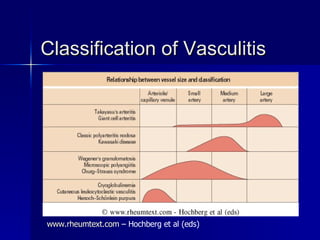
Classification of Vasculitis Large Vessel Giant cell arteritis Takayasu’s Medium Vessel Polyarteritis Nodosa Kawasaki’s Small Vessel Wegener’s, Microscopic polyangitis, Henoch-Scholein purpura, Cryoglobulemic, hypersensitivity
Classification of Vasculitis www.rheumtext.com  – Hochberg et al (eds)
When to Suspect a Vasculitis Unexplained ischemia: Claudication, limb ischemia, angina, TIA, stroke, mesenteric ischemia, cutaneous ischemia Especially in a young individual Multiorgan dysfunction: Systemically ill patient Other suggestive features
When to Suspect a Vasculitis Other suggestive features: Glomerulonephritis Palpable purpura Peripheral neuropathy Established autoimmune disease
When to Suspect a Vasculitis Systemic illness – must exclude alternative diagnoses: Sepsis Drug toxicity Malignancy Coagulopathy
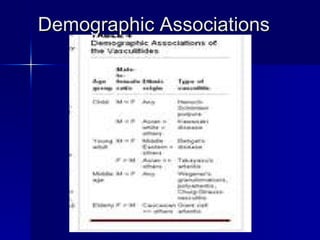
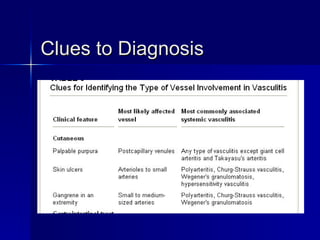
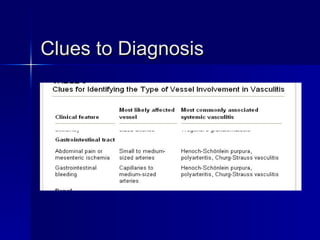
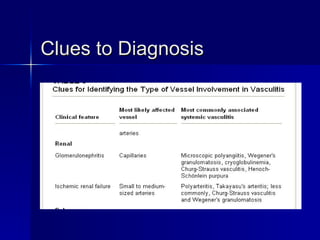
General Approach to Diagnosis Attempt to exclude other processes Consider the age, gender, ethnicity of the patient Determine which organ systems are involved Estimate the size of the vessels involved
Demographic Associations
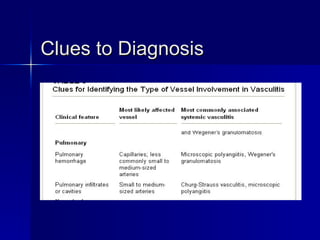
Clues to Diagnosis
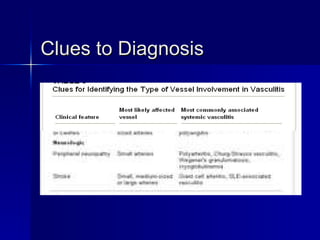
Clues to Diagnosis
Clues to Diagnosis
Clues to Diagnosis
Clues to Diagnosis
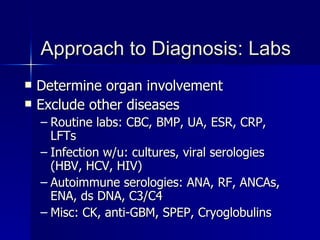
Approach to Diagnosis: Labs Determine organ involvement Exclude other diseases Routine labs: CBC, BMP, UA, ESR, CRP, LFTs Infection w/u: cultures, viral serologies (HBV, HCV, HIV) Autoimmune serologies: ANA, RF, ANCAs, ENA, ds DNA, C3/C4 Misc: CK, anti-GBM, SPEP, Cryoglobulins
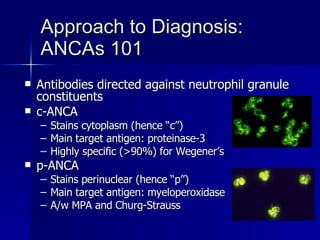
Approach to Diagnosis: ANCAs 101 Antibodies directed against neutrophil granule constituents c-ANCA Stains cytoplasm (hence “c”) Main target antigen: proteinase-3 Highly specific (>90%) for Wegener’s p-ANCA Stains perinuclear (hence “p”) Main target antigen: myeloperoxidase A/w MPA and Churg-Strauss
Approach to Diagnosis: Biopsy Blind biopsy generally low yield Less than 20% “ Go where the money is.” Approx. 66% success in symptomatic organs Examples: Temporal artery biopsy, kidney biopsy, sural nerve biopsy, testicular biopsy Vasculitic lesions tend to be focal and segmental
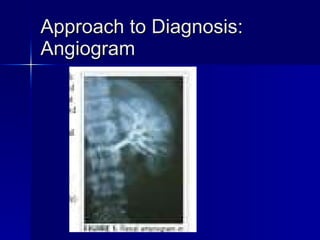
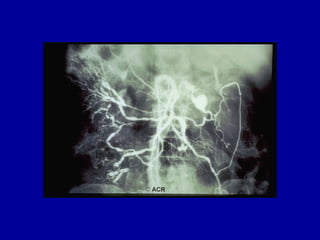
Approach to Diagnosis: Angiogram If biopsy is impractical Important in large vessel vasculitis Patient with abdominal pain Renal or mesenteric vasculitis
Approach to Diagnosis: Angiogram
Prognosis Untreated is a rapidly progressive, usually fatal, disease The prognosis is determined by the extent and number of organs involved  Morbidity and mortality can be prevented if recognized and treated early
Treatment Determined by: Type and severity of organ involvement Rate of disease progression  Corticosteroids Usually 1mg/kg initially Pulse dose corticosteroids Immunosuppressive therapy Cytoxan, Methotrexate, Imuran
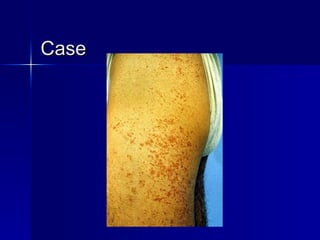
Case A previously healthy 22yo male college student had an URI 2 weeks ago, RX with PCN He develops abdominal pain, bilateral ankle pain & swelling with raised purpuric lesions over lower extremities Labs: creatinine 3.0 mg/dL, BUN 46 mg/dL Urinalysis: 4+ proteinuria, 2+ RBC’s, sev. RBC casts/ hpf
Case
Case What is the most likely cause of renal disease in this patient: A. Lupus nephritis B. Acute post-streptococcal glomerulonephritis C. Henoch-Schonlein purpura D. Allergic interstitial nephritis E. Goodpasture’s syndrome
Case What is the most likely cause of renal disease in this patient: A. Lupus nephritis B. Acute post-streptococcal glomerulonephritis C.  Henoch-Schonlein purpura D. Allergic interstitial nephritis E. Goodpasture’s syndrome
Henoch-Schonlein Purpura Small vessels, post capillary venules  Palpable purpura, arthralgias, abdominal pain, renal disease Males=females Mean age 5 yrs. Preceding URI in 2/3 (1-3 weeks) Tissue deposition of  IgA -containing  immune complexes  (skin, kidneys, bowel)
Henoch-Schonlein Purpura GI involvement in 85% Severe cramping, pain, nausea, vomiting, bleeding Major hemorrage or intussuseption is an uncommon but life-threatening complication in children
Henoch-Schonlein Purpura Renal involvement (10-50%) Renal disease more severe in adults Determines prognosis Many recover with no therapy Asymptomatic hematuria    proteinuria & renal insufficiency (cresentic GN) < 0.5% progress to ESRD
Henoch-Schonlein Purpura Uncommon Testicular involvement Pulmonary hemorrhage CNS complications
Henoch-Schonlein Purpura Usually single episodes < 4 weeks duration 40% recurrence rate after period of wellness Treatment Supportive measures Corticosteroids for GI vasculitis and hemorrhage ? CS early in nephritis
Case 50yo woman  presents with 1 week of fever, chills, chest pain, cough, dyspnea and paresthesias in LE   PMHx: bronchial asthma (7 yrs), allergic rhinitis   PE: 100 F, HR 98, BP 120/70, RR 16/min wheezes/ rhonchi bilaterally mild peripheral weakness in LE sensory dysesthesia in stocking distribution bilaterally
Case Lab: WBC 12.8 (N 30%, L 25%, Eos 40%) Blood/sputum cultures: negative ANA neg, p-ANCA + 1:20 CXR: patchy bilateral infiltrates
Case
Case She is treated with empiric antibiotics over 3 days with no improvement in symptoms. What is the most likely diagnosis: A. Eosinophilic bronchitis B. Idiopathic hypereosinophilic syndromes C. Churg-Strauss syndrome D. Wegener’s granulomatosis E. Polyarteritis nodosa
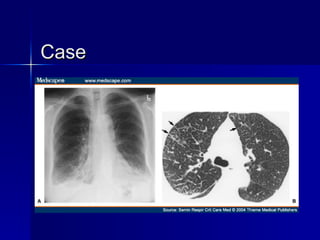
Case She is treated with empiric antibiotics over 3 days with no improvement in symptoms. What is the most likely diagnosis: A. Eosinophilic bronchitis B. Idiopathic hypereosinophilic syndromes C.  Churg-Strauss syndrome D. Wegener’s granulomatosis E. Polyarteritis nodosa
Churg-Strauss Vasculitis Necrotizing, granulomatous vasculitis of small arteries and venules Prior asthma Started on leukotriene inhibitors and weaned off steroids Allergic rhinitis Eosinophilia Pulmonary infiltrates Intra/extravascular granulomas
Churg-Strauss: Criteria- 4/6 Asthma Eosinophilia (>10%) Mono/ Polyneuropathy Pulmonary Infiltrates – Non-fixed Paranasal sinus abnormality Extravascular eosinophils
Churg-Strauss Vasculitis Asthma precedes vasculitis Confusion with Wegener’s Nasal/sinus DZ is NON-destructive Pulmonary nodules less common
Churg-Strauss Vasculitis p-ANCA (MPO): 70% More responsive to steroids alone
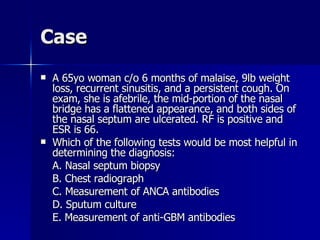
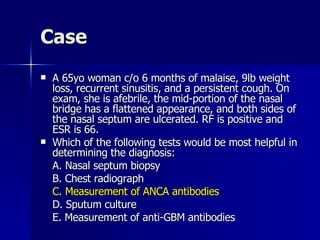
Case A 65yo woman c/o 6 months of malaise, 9lb weight loss, recurrent sinusitis, and a persistent cough. On exam, she is afebrile, the mid-portion of the nasal bridge has a flattened appearance, and both sides of the nasal septum are ulcerated. RF is positive and ESR is 66. Which of the following tests would be most helpful in determining the diagnosis: A. Nasal septum biopsy B. Chest radiograph C. Measurement of ANCA antibodies D. Sputum culture E. Measurement of anti-GBM antibodies
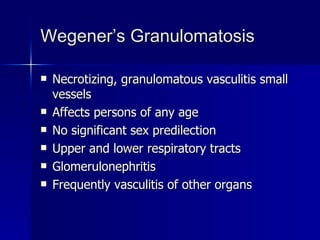
Wegener’s Granulomatosis Necrotizing, granulomatous vasculitis small vessels Affects persons of any age No significant sex predilection Upper and lower respiratory tracts Glomerulonephritis  Frequently vasculitis of other organs
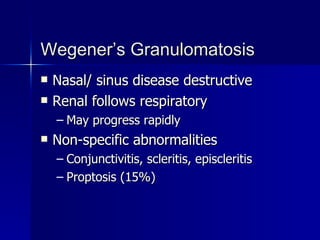
Wegener’s Granulomatosis Nasal/ sinus disease destructive Renal follows respiratory May progress rapidly Non-specific abnormalities Conjunctivitis, scleritis, episcleritis Proptosis (15%)
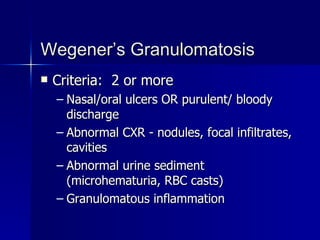
Wegener’s Granulomatosis Criteria:  2 or more Nasal/oral ulcers OR purulent/ bloody discharge Abnormal CXR - nodules, focal infiltrates, cavities Abnormal urine sediment (microhematuria, RBC casts) Granulomatous inflammation
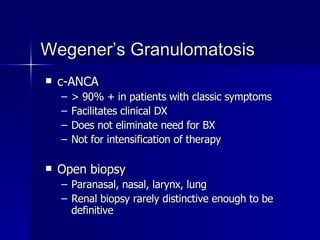
Wegener’s Granulomatosis c-ANCA > 90% + in patients with classic symptoms Facilitates clinical DX Does not eliminate need for BX Not for intensification of therapy Open biopsy Paranasal, nasal, larynx, lung Renal biopsy rarely distinctive enough to be definitive
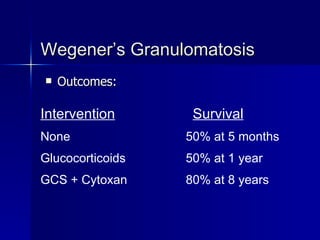
Wegener’s Granulomatosis Outcomes: Intervention   Survival None   50% at 5 months Glucocorticoids   50% at 1 year GCS + Cytoxan   80% at 8 years
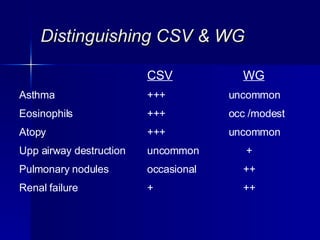
Distinguishing CSV & WG CSV WG Asthma +++   uncommon Eosinophils +++   occ /modest Atopy +++   uncommon Upp airway destruction uncommon  + Pulmonary nodules occasional ++ Renal failure + ++
Case A 29yo woman presents with a 4yr h/o skin ulcers on her lower extremities. A previous punch biopsy showed thrombotic lesions in small blood vessels of the dermis. Treatment has mostly focused on wound care. On exam the ulcers are noted, as is livedo reticularis, a decreased right hand grip, and a right foot drop. Which of the following is the most likely diagnosis: Lymphoma, with a paraneoplastic syndrome Takayasu’s arteritis Systemic lupus erythematosus Polyarteritis nodosa Kawasaki’s disease
Polyarteritis Nodosa  Primary systemic necrotizing vasculitis Small/ medium sized arteries Very rarely veins Never large elastic arteries May be a manifestation of other disease RA, Sjogren’s, Hepatitis B or C Limited    progressive/ fulminant
Polyarteritis Nodosa Any age Peak years: 30-60 M:F Ratio  2:1
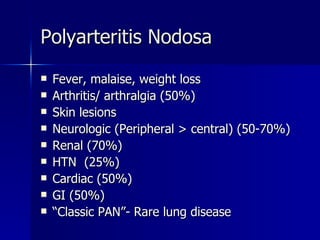
Fever, malaise, weight loss Arthritis/ arthralgia (50%) Skin lesions  Neurologic (Peripheral > central) (50-70%) Renal (70%) HTN  (25%) Cardiac (50%) GI (50%) “ Classic PAN”- Rare lung disease Polyarteritis Nodosa
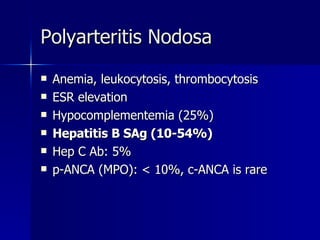
Anemia, leukocytosis, thrombocytosis ESR elevation Hypocomplementemia (25%) Hepatitis B SAg (10-54%) Hep C Ab: 5% p-ANCA (MPO): < 10%, c-ANCA is rare Polyarteritis Nodosa
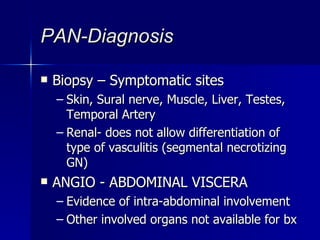
PAN-Diagnosis Biopsy – Symptomatic sites Skin, Sural nerve, Muscle, Liver, Testes, Temporal Artery Renal- does not allow differentiation of type of vasculitis (segmental necrotizing GN) ANGIO - ABDOMINAL VISCERA  Evidence of intra-abdominal involvement Other involved organs not available for bx
 
PAN- Prognosis &Treatment Untreated - 85% mortality at 5 years Treatment - 80% survival at 5 years Corticosteroids Cytotoxics 40% relapse (median 33 months)
Case A 32yo Korean woman presents with a 30lb weight loss, low-grade fevers and arthralgias. She notes back pain between her shoulder blades. She notes pain in her arms with any prolonged activity. Recent labs are notable for a platelet count of 800K and an ESR of 130. On exam, her HR is 100bpm and her BP is 60/40 in both arms. What is the next step in her management: Hospitalize for further evaluation Order blood cultures, get an ANA and RF Perform a careful exam, listen for subclavian bruits Administer IV saline Advise the patient to begin Fe supplementation
Takayasu’s Arteritis Large vessel Unknown etiology Aorta/branches “ Pulseless Disease”
Takayasu’s Arteritis Women in reproductive years 10X more than men Asia, Eastern Europe, Latin America Granulomatous Panarteritis
Takayasu’s Arteritis 98% have stenotic lesions, 27% aneurysms Subclavian & aortic arch most common, 93% 40- 80% renal artery stenosis
Arterial stenoses/organ ischemia Claudication Transient cerebral ischemia/ stroke Renal artery hypertension CHF Angina MI Mesenteric vascular insufficiency Takayasu’s Arteritis
In the absence of complications (retinopathy, HTN, aortic v. insuff), 15 yr survival 95% Most respond to steroids alone 40% will need cytotoxics Takayasu’s Arteritis
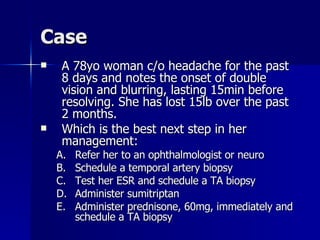
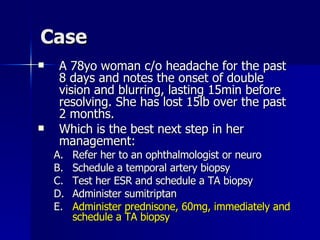
Case A 78yo woman c/o headache for the past 8 days and notes the onset of double vision and blurring, lasting 15min before resolving. She has lost 15lb over the past 2 months. Which is the best next step in her management: Refer her to an ophthalmologist or neuro Schedule a temporal artery biopsy Test her ESR and schedule a TA biopsy Administer sumitriptan Administer prednisone, 60mg, immediately and schedule a TA biopsy
 
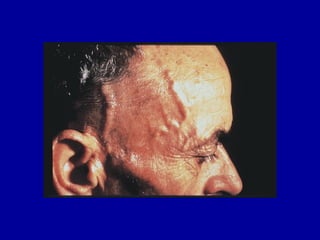
Giant Cell Arteritis “ Temporal arteritis” & “Cranial arteritis” Large vessel, granulomatous arteritis Extracranial vessels (arteries) >>> intracranial Aortic arch vessels (10-15%) Unknown etiology Persons over age 50 (mean 70) 2-3x more common in women
Segmental vessel inflammation Multinucleate giant cell, lymphocytic predominance…PMN’s rare Thrombosis Giant cells not  required  for diagnosis Giant Cell Arteritis
Nonspecific constitutional symptoms- fever,malaise, fatigue Headache (> 2/3) Scalp tenderness +/- nodules Temporal artery tenderness Visual symptoms (blindness 15%) Intermittent claudication (jaw, tongue, extremities) Neuropathies/TIA/Stroke (30%) Respiratory Tract  (10%) PMR (40-60%) Giant Cell Arteritis
Giant Cell Arteritis Lab ESR – Marked elevation CRP elevation Anemia Thrombocytosis Increased LAE Increased Alkaline phosphotase
Biopsy Vascular involvement not uniform Length ?: If normal TA exam, obtain 3-5 cm sample and examine at multiple levels Negative biopsy  Consider contralateral bx if first bx normal When ?  .….ASAP Giant Cell Arteritis
Prednisone 1mg/kg/d Taper 10%/month after Sx/lab resolved Slow taper at 15 mg/d Lab and Sx Long term steroids Steroid sparing with MTX Giant Cell Arteritis
30% - relapse with steroid taper, esp prednisone < 20 mg/d 25% - vertebral compression fractures 50% - other serious steroid toxicities, e.g. HTN, diabetes, CHF, cataracts….. Giant Cell Arteritis
Common Vaculitis Presentations (aka Board Buzz Words…) Oral & genital ulcers = Behcet’s Upper/lower airway disease and glomerulonephritis = Wegener’s Septal perforation, epistaxis Recurrent sinus infections Young female with arm/leg fatigue and HTN = Takayasu’s
Common Vaculitis Presentations (aka Board Buzz Words…) Palpable purpura = small vessel leukocytoclastic vasculitis Hepatitis B = PAN Hepatitis C = cryoglobulinemia
Questions?

Vasculitis Overview

  • 1.
    VASCULITIS George R.Mount, CPT USA MC Rheumatology Fellow Walter Reed AMC
  • 2.
    Goals Overview Clinicalpatterns Diagnostic aids Treatment paradigms Cases and questions
  • 3.
    Introduction Inflammation andnecrosis of blood vessels Occlusion and ischemia Immunologic mechanisms Multi-system disease with constitutional symptoms and inflammatory laboratory indices
  • 4.
    Vasculitis: Primary orSecondary? Primary : Vasculitis is the principal feature of the disease Secondary : Vasculitis is a complication of another disease or toxin (e.g. RA, infection, malignancy)
  • 5.
    Classification of VasculitisNo universally accepted classification system Vessel size Histopathology Dominant organ involvement Overlap
  • 6.
    Classification of VasculitisLarge Vessel Giant cell arteritis Takayasu’s Medium Vessel Polyarteritis Nodosa Kawasaki’s Small Vessel Wegener’s, Microscopic polyangitis, Henoch-Scholein purpura, Cryoglobulemic, hypersensitivity
  • 7.
    Classification of Vasculitiswww.rheumtext.com – Hochberg et al (eds)
  • 8.
    When to Suspecta Vasculitis Unexplained ischemia: Claudication, limb ischemia, angina, TIA, stroke, mesenteric ischemia, cutaneous ischemia Especially in a young individual Multiorgan dysfunction: Systemically ill patient Other suggestive features
  • 9.
    When to Suspecta Vasculitis Other suggestive features: Glomerulonephritis Palpable purpura Peripheral neuropathy Established autoimmune disease
  • 10.
    When to Suspecta Vasculitis Systemic illness – must exclude alternative diagnoses: Sepsis Drug toxicity Malignancy Coagulopathy
  • 11.
    General Approach toDiagnosis Attempt to exclude other processes Consider the age, gender, ethnicity of the patient Determine which organ systems are involved Estimate the size of the vessels involved
  • 12.
  • 13.
  • 14.
  • 15.
  • 16.
  • 17.
  • 18.
    Approach to Diagnosis:Labs Determine organ involvement Exclude other diseases Routine labs: CBC, BMP, UA, ESR, CRP, LFTs Infection w/u: cultures, viral serologies (HBV, HCV, HIV) Autoimmune serologies: ANA, RF, ANCAs, ENA, ds DNA, C3/C4 Misc: CK, anti-GBM, SPEP, Cryoglobulins
  • 19.
    Approach to Diagnosis:ANCAs 101 Antibodies directed against neutrophil granule constituents c-ANCA Stains cytoplasm (hence “c”) Main target antigen: proteinase-3 Highly specific (>90%) for Wegener’s p-ANCA Stains perinuclear (hence “p”) Main target antigen: myeloperoxidase A/w MPA and Churg-Strauss
  • 20.
    Approach to Diagnosis:Biopsy Blind biopsy generally low yield Less than 20% “ Go where the money is.” Approx. 66% success in symptomatic organs Examples: Temporal artery biopsy, kidney biopsy, sural nerve biopsy, testicular biopsy Vasculitic lesions tend to be focal and segmental
  • 21.
    Approach to Diagnosis:Angiogram If biopsy is impractical Important in large vessel vasculitis Patient with abdominal pain Renal or mesenteric vasculitis
  • 22.
  • 23.
    Prognosis Untreated isa rapidly progressive, usually fatal, disease The prognosis is determined by the extent and number of organs involved Morbidity and mortality can be prevented if recognized and treated early
  • 24.
    Treatment Determined by:Type and severity of organ involvement Rate of disease progression Corticosteroids Usually 1mg/kg initially Pulse dose corticosteroids Immunosuppressive therapy Cytoxan, Methotrexate, Imuran
  • 25.
    Case A previouslyhealthy 22yo male college student had an URI 2 weeks ago, RX with PCN He develops abdominal pain, bilateral ankle pain & swelling with raised purpuric lesions over lower extremities Labs: creatinine 3.0 mg/dL, BUN 46 mg/dL Urinalysis: 4+ proteinuria, 2+ RBC’s, sev. RBC casts/ hpf
  • 26.
  • 27.
    Case What isthe most likely cause of renal disease in this patient: A. Lupus nephritis B. Acute post-streptococcal glomerulonephritis C. Henoch-Schonlein purpura D. Allergic interstitial nephritis E. Goodpasture’s syndrome
  • 28.
    Case What isthe most likely cause of renal disease in this patient: A. Lupus nephritis B. Acute post-streptococcal glomerulonephritis C. Henoch-Schonlein purpura D. Allergic interstitial nephritis E. Goodpasture’s syndrome
  • 29.
    Henoch-Schonlein Purpura Smallvessels, post capillary venules Palpable purpura, arthralgias, abdominal pain, renal disease Males=females Mean age 5 yrs. Preceding URI in 2/3 (1-3 weeks) Tissue deposition of IgA -containing immune complexes (skin, kidneys, bowel)
  • 30.
    Henoch-Schonlein Purpura GIinvolvement in 85% Severe cramping, pain, nausea, vomiting, bleeding Major hemorrage or intussuseption is an uncommon but life-threatening complication in children
  • 31.
    Henoch-Schonlein Purpura Renalinvolvement (10-50%) Renal disease more severe in adults Determines prognosis Many recover with no therapy Asymptomatic hematuria  proteinuria & renal insufficiency (cresentic GN) < 0.5% progress to ESRD
  • 32.
    Henoch-Schonlein Purpura UncommonTesticular involvement Pulmonary hemorrhage CNS complications
  • 33.
    Henoch-Schonlein Purpura Usuallysingle episodes < 4 weeks duration 40% recurrence rate after period of wellness Treatment Supportive measures Corticosteroids for GI vasculitis and hemorrhage ? CS early in nephritis
  • 34.
    Case 50yo woman presents with 1 week of fever, chills, chest pain, cough, dyspnea and paresthesias in LE PMHx: bronchial asthma (7 yrs), allergic rhinitis PE: 100 F, HR 98, BP 120/70, RR 16/min wheezes/ rhonchi bilaterally mild peripheral weakness in LE sensory dysesthesia in stocking distribution bilaterally
  • 35.
    Case Lab: WBC12.8 (N 30%, L 25%, Eos 40%) Blood/sputum cultures: negative ANA neg, p-ANCA + 1:20 CXR: patchy bilateral infiltrates
  • 36.
  • 37.
    Case She istreated with empiric antibiotics over 3 days with no improvement in symptoms. What is the most likely diagnosis: A. Eosinophilic bronchitis B. Idiopathic hypereosinophilic syndromes C. Churg-Strauss syndrome D. Wegener’s granulomatosis E. Polyarteritis nodosa
  • 38.
    Case She istreated with empiric antibiotics over 3 days with no improvement in symptoms. What is the most likely diagnosis: A. Eosinophilic bronchitis B. Idiopathic hypereosinophilic syndromes C. Churg-Strauss syndrome D. Wegener’s granulomatosis E. Polyarteritis nodosa
  • 39.
    Churg-Strauss Vasculitis Necrotizing,granulomatous vasculitis of small arteries and venules Prior asthma Started on leukotriene inhibitors and weaned off steroids Allergic rhinitis Eosinophilia Pulmonary infiltrates Intra/extravascular granulomas
  • 40.
    Churg-Strauss: Criteria- 4/6Asthma Eosinophilia (>10%) Mono/ Polyneuropathy Pulmonary Infiltrates – Non-fixed Paranasal sinus abnormality Extravascular eosinophils
  • 41.
    Churg-Strauss Vasculitis Asthmaprecedes vasculitis Confusion with Wegener’s Nasal/sinus DZ is NON-destructive Pulmonary nodules less common
  • 42.
    Churg-Strauss Vasculitis p-ANCA(MPO): 70% More responsive to steroids alone
  • 43.
    Case A 65yowoman c/o 6 months of malaise, 9lb weight loss, recurrent sinusitis, and a persistent cough. On exam, she is afebrile, the mid-portion of the nasal bridge has a flattened appearance, and both sides of the nasal septum are ulcerated. RF is positive and ESR is 66. Which of the following tests would be most helpful in determining the diagnosis: A. Nasal septum biopsy B. Chest radiograph C. Measurement of ANCA antibodies D. Sputum culture E. Measurement of anti-GBM antibodies
  • 44.
    Case A 65yowoman c/o 6 months of malaise, 9lb weight loss, recurrent sinusitis, and a persistent cough. On exam, she is afebrile, the mid-portion of the nasal bridge has a flattened appearance, and both sides of the nasal septum are ulcerated. RF is positive and ESR is 66. Which of the following tests would be most helpful in determining the diagnosis: A. Nasal septum biopsy B. Chest radiograph C. Measurement of ANCA antibodies D. Sputum culture E. Measurement of anti-GBM antibodies
  • 45.
    Wegener’s Granulomatosis Necrotizing,granulomatous vasculitis small vessels Affects persons of any age No significant sex predilection Upper and lower respiratory tracts Glomerulonephritis Frequently vasculitis of other organs
  • 46.
    Wegener’s Granulomatosis Nasal/sinus disease destructive Renal follows respiratory May progress rapidly Non-specific abnormalities Conjunctivitis, scleritis, episcleritis Proptosis (15%)
  • 47.
    Wegener’s Granulomatosis Criteria: 2 or more Nasal/oral ulcers OR purulent/ bloody discharge Abnormal CXR - nodules, focal infiltrates, cavities Abnormal urine sediment (microhematuria, RBC casts) Granulomatous inflammation
  • 48.
    Wegener’s Granulomatosis c-ANCA> 90% + in patients with classic symptoms Facilitates clinical DX Does not eliminate need for BX Not for intensification of therapy Open biopsy Paranasal, nasal, larynx, lung Renal biopsy rarely distinctive enough to be definitive
  • 49.
    Wegener’s Granulomatosis Outcomes:Intervention Survival None 50% at 5 months Glucocorticoids 50% at 1 year GCS + Cytoxan 80% at 8 years
  • 50.
    Distinguishing CSV &WG CSV WG Asthma +++ uncommon Eosinophils +++ occ /modest Atopy +++ uncommon Upp airway destruction uncommon + Pulmonary nodules occasional ++ Renal failure + ++
  • 51.
    Case A 29yowoman presents with a 4yr h/o skin ulcers on her lower extremities. A previous punch biopsy showed thrombotic lesions in small blood vessels of the dermis. Treatment has mostly focused on wound care. On exam the ulcers are noted, as is livedo reticularis, a decreased right hand grip, and a right foot drop. Which of the following is the most likely diagnosis: Lymphoma, with a paraneoplastic syndrome Takayasu’s arteritis Systemic lupus erythematosus Polyarteritis nodosa Kawasaki’s disease
  • 52.
    Case A 29yowoman presents with a 4yr h/o skin ulcers on her lower extremities. A previous punch biopsy showed thrombotic lesions in small blood vessels of the dermis. Treatment has mostly focused on wound care. On exam the ulcers are noted, as is livedo reticularis, a decreased right hand grip, and a right foot drop. Which of the following is the most likely diagnosis: Lymphoma, with a paraneoplastic syndrome Takayasu’s arteritis Systemic lupus erythematosus Polyarteritis nodosa Kawasaki’s disease
  • 53.
    Polyarteritis Nodosa Primary systemic necrotizing vasculitis Small/ medium sized arteries Very rarely veins Never large elastic arteries May be a manifestation of other disease RA, Sjogren’s, Hepatitis B or C Limited  progressive/ fulminant
  • 54.
    Polyarteritis Nodosa Anyage Peak years: 30-60 M:F Ratio 2:1
  • 55.
    Fever, malaise, weightloss Arthritis/ arthralgia (50%) Skin lesions Neurologic (Peripheral > central) (50-70%) Renal (70%) HTN (25%) Cardiac (50%) GI (50%) “ Classic PAN”- Rare lung disease Polyarteritis Nodosa
  • 56.
    Anemia, leukocytosis, thrombocytosisESR elevation Hypocomplementemia (25%) Hepatitis B SAg (10-54%) Hep C Ab: 5% p-ANCA (MPO): < 10%, c-ANCA is rare Polyarteritis Nodosa
  • 57.
    PAN-Diagnosis Biopsy –Symptomatic sites Skin, Sural nerve, Muscle, Liver, Testes, Temporal Artery Renal- does not allow differentiation of type of vasculitis (segmental necrotizing GN) ANGIO - ABDOMINAL VISCERA Evidence of intra-abdominal involvement Other involved organs not available for bx
  • 58.
  • 59.
    PAN- Prognosis &TreatmentUntreated - 85% mortality at 5 years Treatment - 80% survival at 5 years Corticosteroids Cytotoxics 40% relapse (median 33 months)
  • 60.
    Case A 32yoKorean woman presents with a 30lb weight loss, low-grade fevers and arthralgias. She notes back pain between her shoulder blades. She notes pain in her arms with any prolonged activity. Recent labs are notable for a platelet count of 800K and an ESR of 130. On exam, her HR is 100bpm and her BP is 60/40 in both arms. What is the next step in her management: Hospitalize for further evaluation Order blood cultures, get an ANA and RF Perform a careful exam, listen for subclavian bruits Administer IV saline Advise the patient to begin Fe supplementation
  • 61.
    Case A 32yoKorean woman presents with a 30lb weight loss, low-grade fevers and arthralgias. She notes back pain between her shoulder blades. She notes pain in her arms with any prolonged activity. Recent labs are notable for a platelet count of 800K and an ESR of 130. On exam, her HR is 100bpm and her BP is 60/40 in both arms. What is the next step in her management: Hospitalize for further evaluation Order blood cultures, get an ANA and RF Perform a careful exam, listen for subclavian bruits Administer IV saline Advise the patient to begin Fe supplementation
  • 62.
    Takayasu’s Arteritis Largevessel Unknown etiology Aorta/branches “ Pulseless Disease”
  • 63.
    Takayasu’s Arteritis Womenin reproductive years 10X more than men Asia, Eastern Europe, Latin America Granulomatous Panarteritis
  • 64.
    Takayasu’s Arteritis 98%have stenotic lesions, 27% aneurysms Subclavian & aortic arch most common, 93% 40- 80% renal artery stenosis
  • 65.
    Arterial stenoses/organ ischemiaClaudication Transient cerebral ischemia/ stroke Renal artery hypertension CHF Angina MI Mesenteric vascular insufficiency Takayasu’s Arteritis
  • 66.
    In the absenceof complications (retinopathy, HTN, aortic v. insuff), 15 yr survival 95% Most respond to steroids alone 40% will need cytotoxics Takayasu’s Arteritis
  • 67.
    Case A 78yowoman c/o headache for the past 8 days and notes the onset of double vision and blurring, lasting 15min before resolving. She has lost 15lb over the past 2 months. Which is the best next step in her management: Refer her to an ophthalmologist or neuro Schedule a temporal artery biopsy Test her ESR and schedule a TA biopsy Administer sumitriptan Administer prednisone, 60mg, immediately and schedule a TA biopsy
  • 68.
    Case A 78yowoman c/o headache for the past 8 days and notes the onset of double vision and blurring, lasting 15min before resolving. She has lost 15lb over the past 2 months. Which is the best next step in her management: Refer her to an ophthalmologist or neuro Schedule a temporal artery biopsy Test her ESR and schedule a TA biopsy Administer sumitriptan Administer prednisone, 60mg, immediately and schedule a TA biopsy
  • 69.
  • 70.
    Giant Cell Arteritis“ Temporal arteritis” & “Cranial arteritis” Large vessel, granulomatous arteritis Extracranial vessels (arteries) >>> intracranial Aortic arch vessels (10-15%) Unknown etiology Persons over age 50 (mean 70) 2-3x more common in women
  • 71.
    Segmental vessel inflammationMultinucleate giant cell, lymphocytic predominance…PMN’s rare Thrombosis Giant cells not required for diagnosis Giant Cell Arteritis
  • 72.
    Nonspecific constitutional symptoms-fever,malaise, fatigue Headache (> 2/3) Scalp tenderness +/- nodules Temporal artery tenderness Visual symptoms (blindness 15%) Intermittent claudication (jaw, tongue, extremities) Neuropathies/TIA/Stroke (30%) Respiratory Tract (10%) PMR (40-60%) Giant Cell Arteritis
  • 73.
    Giant Cell ArteritisLab ESR – Marked elevation CRP elevation Anemia Thrombocytosis Increased LAE Increased Alkaline phosphotase
  • 74.
    Biopsy Vascular involvementnot uniform Length ?: If normal TA exam, obtain 3-5 cm sample and examine at multiple levels Negative biopsy Consider contralateral bx if first bx normal When ? .….ASAP Giant Cell Arteritis
  • 75.
    Prednisone 1mg/kg/d Taper10%/month after Sx/lab resolved Slow taper at 15 mg/d Lab and Sx Long term steroids Steroid sparing with MTX Giant Cell Arteritis
  • 76.
    30% - relapsewith steroid taper, esp prednisone < 20 mg/d 25% - vertebral compression fractures 50% - other serious steroid toxicities, e.g. HTN, diabetes, CHF, cataracts….. Giant Cell Arteritis
  • 77.
    Common Vaculitis Presentations(aka Board Buzz Words…) Oral & genital ulcers = Behcet’s Upper/lower airway disease and glomerulonephritis = Wegener’s Septal perforation, epistaxis Recurrent sinus infections Young female with arm/leg fatigue and HTN = Takayasu’s
  • 78.
    Common Vaculitis Presentations(aka Board Buzz Words…) Palpable purpura = small vessel leukocytoclastic vasculitis Hepatitis B = PAN Hepatitis C = cryoglobulinemia
  • 79.