VASCULITIS SYNDROMES
Dr.Sarath Menon.R
DIVISION OF RHEUMATOLOGY
DEPT. OF MEDICINE
MGM MEDICAL COLLEGE,INDORE
OUTLINE
 Definition
 Classification
 Diagnosis
 Clinical syndromes
 Laboratory evaluation
 Management
WHAT IS VASCULITIS?
 Vasculitis is a clinicopathologic process
characterized by inflammation and damage to
blood vessels,leading to compromise of the
vascular lumen resulting in ischemia of the
tissues supplied by the involved vessels.
CLASSIFICATION
CLASSIFICATION
PRIMARY VASCULITIS SYNDROMES
PREDOMINANTLY LARGE VESSEL
VASCULITIS
GIANT CELL VASCULITIS
TAKAYASUS ARTERITIS
PREDOMINANTLY MEDIUM VESSEL
VASCULITIS
PAN
KAWASAKIS DISEASE
PREDOMINANTLY SMALL VESSEL
VASCULITIS
ANCA +VE---
c-ANCA +VE-
WEGENERS GRANULOMATOSIS
p-ANCA +VE
MICROSCOPIC POLYANGITIS
CHURG – STRAUSS SYNDROME
ANCA -VE
ESSENTIAL MIXED CRYOGLOBULINEMIA
HENOCH SCHONLEIN PURPURA
IDIOPATHIC CUTANEOUS VASCULITIS
BECHETS SYNDROME
SECONDARY VASCULITIS SYNDROMES
DRUG INDUCED VASCULITIS
HYDRALAZINE
PROPYLTHIOURACIL
ALLOPURINOL
THIAZIDES
SERUM SICKNESS
INFECTIONS
RICKETTSIAS
SABE
EBV
HIV
MALIGNANCIES
LYMPHOMAS
CTDs
SLE
RA
SJOGRENS SYNDROME
INFLAMMATORY MYOSITIS
OTHER
PRIMARY BILIARY CIRRHOSIS
ULCERATIVE COLITIS
ALPHA 1 ANTIITRYPSIN DEFICIENCY
RETROPERITPNEAL FIBROSIS
PATHOGENESIS
 Immune complex production & deposition
 Production of ANCA
 T-Lymphocyte response and granuloma
formation
APPROACH TO A CASE OF VASCULITIS
 Suspect diagnosis & exclude secondary causes
 History,clinical exam,lab.evaluation
 Syndrome recognition
 Confirmation of diagnosis
 Treatment
WHEN TO SUSPECT VASCULITIS?
Nonspecific systemic symptoms
Fatigue
Malaise
Weakness
Fever
Anorexia
Weight loss
Skin involvement: palpable purpura, nodules, ulcers, cutaneous or nailfold infarctions
Musculoskeletal: range from full–blown arthritis to aches in the joints without obvious swelling
(arthralgias)
GI: abdominal pain, bleeding
Pulmonary symptoms: cough, dyspnea, hemoptysis
Ocular symptoms: pain, redness, diplopia, visual loss
Cardiac: chest pain, dyspnea
Peripheral nerve symptoms: numbness, weakness, pain consistent with mononeuritis multiplex
CNS symptoms: stroke, transient ischemic attack (TIA)
Renal ds – HTN , hematuria
MEDICAL HISTORY
Connective tissue disease (SLE,
Sjogren’ssyndrome, RA, Scleroderma,
Dermatomyositis )
Malignancy ( Lymphoma, leukemia)
TTP
Bronchial asthma
HIV ds
DRUG HISTORY
 Hydralazine
 Propylthiouracil
 Allopurinol
 Thiazides
 Gold
 Sulphonamides
 Phenytoin
 penicillin
GENERAL EXAMINATION
 Pallor
 Lymph nodes
 Pulses
 Blood pressure
 Skin
 Eyes
 Nasal cavity
 Oral cavity
SYSTEMIC EXAMINATION
 Respiratory system
- cavitatory lesion
- fleeting infiltrates
 CVS
- CHF
 GIT
- abdominal tenderness
- malaena
 CNS
- mononeuritis multiplex
- visual loss
- TIA,stroke
SYSTEMIC EXAMINATION
 Renal
- hematuria
- oliguria
- hypertension
LABORATORY EVALUATION
 Routine blood counts
 S.electrolytes
 RFT
 LFT
 Urinalysis
 Rheumatoid factor
 Blood culture
 ESR,CRP
 ANA, C3,C4
 HIV,HBsAg, anti- HCV
LAB.TESTS
 ANCA
 CXR
 USG abdomen
 2D Echo
 Angiography/MRA
 Biopsy
CLUES TO CLASSIFY TYPE OF VASCULITIS
 Small vessel vasculitis
- palpable purpura,ulcers
- glomerulonephritis
- GI bleeding
- pulmonary hemorrhage,infiltrates,
cavities
- peripheral neuropathy
 Medium vessel vasculitis
- nodules,livedo reticularis,
- digital ischemia,infarcts,gangrene
- mesentric ischemia
- ischemic renal failure
- testicular pain,tenderness
 Large vessel vasculitis
- stroke
- jaw claudication
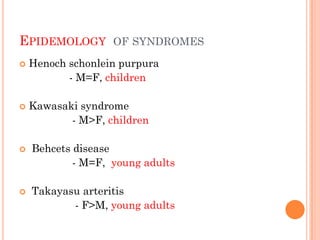
EPIDEMOLOGY OF SYNDROMES
 Henoch schonlein purpura
- M=F, children
 Kawasaki syndrome
- M>F, children
 Behcets disease
- M=F, young adults
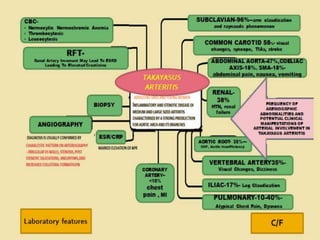
 Takayasu arteritis
- F>M, young adults
 Wegeners granulomatosis,CSS,PAN
M >F, Middle age
 Giant cell arteritis
F>M , Elderly
SYNDROME RECOGNITION
WEGENERS
GRANULOMATO
SIS
Laboratory
features
C/F
Age- 40 yrs
M:F = 1:1
CHURG
STRAUSS
SYNDROME
MEAN AGE OF ONSET – 48
YRS
F:M= 1.2:1
Laboratory
features
C/F
C/F
Laboratory
features
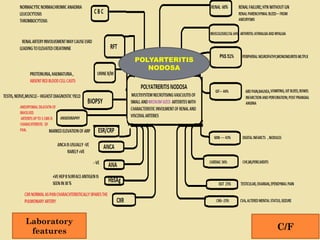
POLYARTERITIS
NODOSA
GIANT CELL
ARTERITIS
FEMALE
PREPONDERANCE
AGE>50 YRS
Laboratory
features
C/F
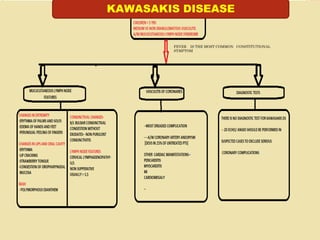
FEVER IS THE MOST COMMON CONSTITUTIONAL
SYMPTOM
KAWASAKIS DISEASE
HENOCH SCHONLEIN PRUPURA
 Children
 Small vessel vasculitis
 Palpable purpura
 athralgia
 Git symptoms- pain,malena,intussusception
 Renal-glomerulonephitis
 Myocardial involvement – rare- adults
 Skin biopsy- leukocytoclastic venulitis with
IgA & C3 deposition
TREATMENT
SPECIFIC THERAPY-IMMUNOMODULATORS
 Cyclophosphomide
 Indication:
- ANCA + vasculitis- multisystem inv. &
life threatening condition
- steroid non responsive CSS,PAN
 Dosage:
- 2mg/kg/d- Rx of choice
- IV cyclophosp. Intermittent bolus
- 15mg/kg thrice infusion every 2 wks, then
every 3 wks
 S/e-
- BM suppression
- cystitis
- bladder cancer
- infertility, GI intolerance
- pulmonary fibrosis
- myelodysplasia
 Methotroxate
 Indication :
- limited WG- non- life threatening
- cyclophosphomide toxicity
- maintaining remission
 Dosage
- start -0.3mg/kg/week ,inc . by 2.5mg/wk
- max.dose- 20-25mg/wk
- maintain remission level
- 2 yr post remission ,taper down by
2.5 mg /mnt and discontinue
 S/E-
- GI intolerance,
- hepatotoxicity
- stomatitis
- BM suppression
- teratogenicity
 Azathioprine & mycophenolate mofetil
 Indication :
- alternative to MTx.
- maintaining remission
Dosage
- azathioprine-2mg/kg/d
- mycophenolate- 1gm bd
ROLE OF STEROIDS
 Indication for first line therapy
-severe ulcerative,necrotic cutaneous lesion
- GI bleeding
- a./c glomerulonephritis
- peripheral neuropathy with impending
palsy
- primary Rx in CSS,GCA,TA
 Dosage
-1mg/kg/d x 1 mnth, then alternate days
- taper down & discontinue in 6-9 mnths
ROLE OF IVIG
 Indications:
Kawasaki disease-
- Rx of choice
- 2 g/kg single dose infusion over
10 hr with high dose aspirin
- prevents aneurysmal formation
 Henoch schonlein purpura
- cutaneous
- renal
- git involvement
ROLE OF ASPIRIN
 Kawasaki disease
- high dose 10mg/kg/d X 14 d,then
- 3-5mg/kg/d for several weeks
- reduce coronary abnormalities
 Giant cell arteritis
- reduce cerebral ischemic
complication
ROLE OF ANTIVIRAL THERAPY
 Hep .C related cryoglobulinemia
- IFN –alpha preffered drug
- 3 million IU thrice weekly X 12-18 Months
- 60-80% improvement renal,cutaneous,joint
- relapse 90%- ribavarin can be added
 Hep .B related PAN
-IFN a + vidarabine + lamivudine in
combination with plasma exchange
ROLE OF SURGERY
 Takayasu arteritis
- surgical/angioplasty for stenosis
- reduce risk of stroke
- correct HTN due to renal artery
stenosis
- improves blood flow to viscera & limbs
QUIZ
Q1
 20 yr old woman presented with bilateral
conductive deafness,palpable purpura on
legs,hemoptysis.for duration of 1 month
 Lab-
TLC- 12000/mm3
S.Creat- 3mg/dl
CXR-
DIAGNOSIS
 Henoch-schonlein purpura
 Polyateritis nodosa
 Wegeners granulomatosis
 Disseminated TB
Q2 A
 45 yr old male presented to opd c/o dyspnoea
athralgia for 2 week.
The patient has h/o asthma for 5 yrs on Rx.
o/e-
P- 82/mt BP- 122/82 mmHg Rt.arm
pallor+,no icterus,LN,jvp
nasal polyposis +
Urinalysis- rbc casts+++,protein++
CXR
DIAGNOSIS
 Churg strauss syndrome
 Allergic broncho pulmonary aspergillosis
 Wegeners granulomatosis
 SLE
Q2 B-WHICH MARKER WILL BE POSITIVE
 P –ANCA
 RA factor
 ds – DNA
 C-ANCA
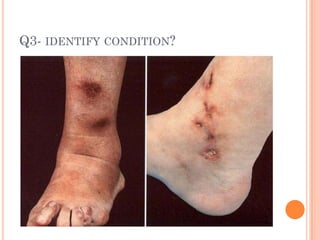
Q3- IDENTIFY CONDITION?
 HSP
 SLE
 PAN
 Cryoglobulinemia
THANK U….

Vasculitis syndromes

  • 1.
    VASCULITIS SYNDROMES Dr.Sarath Menon.R DIVISIONOF RHEUMATOLOGY DEPT. OF MEDICINE MGM MEDICAL COLLEGE,INDORE
  • 2.
    OUTLINE  Definition  Classification Diagnosis  Clinical syndromes  Laboratory evaluation  Management
  • 3.
    WHAT IS VASCULITIS? Vasculitis is a clinicopathologic process characterized by inflammation and damage to blood vessels,leading to compromise of the vascular lumen resulting in ischemia of the tissues supplied by the involved vessels.
  • 5.
  • 6.
    CLASSIFICATION PRIMARY VASCULITIS SYNDROMES PREDOMINANTLYLARGE VESSEL VASCULITIS GIANT CELL VASCULITIS TAKAYASUS ARTERITIS PREDOMINANTLY MEDIUM VESSEL VASCULITIS PAN KAWASAKIS DISEASE PREDOMINANTLY SMALL VESSEL VASCULITIS ANCA +VE--- c-ANCA +VE- WEGENERS GRANULOMATOSIS p-ANCA +VE MICROSCOPIC POLYANGITIS CHURG – STRAUSS SYNDROME ANCA -VE ESSENTIAL MIXED CRYOGLOBULINEMIA HENOCH SCHONLEIN PURPURA IDIOPATHIC CUTANEOUS VASCULITIS BECHETS SYNDROME SECONDARY VASCULITIS SYNDROMES DRUG INDUCED VASCULITIS HYDRALAZINE PROPYLTHIOURACIL ALLOPURINOL THIAZIDES SERUM SICKNESS INFECTIONS RICKETTSIAS SABE EBV HIV MALIGNANCIES LYMPHOMAS CTDs SLE RA SJOGRENS SYNDROME INFLAMMATORY MYOSITIS OTHER PRIMARY BILIARY CIRRHOSIS ULCERATIVE COLITIS ALPHA 1 ANTIITRYPSIN DEFICIENCY RETROPERITPNEAL FIBROSIS
  • 7.
    PATHOGENESIS  Immune complexproduction & deposition  Production of ANCA  T-Lymphocyte response and granuloma formation
  • 8.
    APPROACH TO ACASE OF VASCULITIS  Suspect diagnosis & exclude secondary causes  History,clinical exam,lab.evaluation  Syndrome recognition  Confirmation of diagnosis  Treatment
  • 9.
    WHEN TO SUSPECTVASCULITIS?
  • 10.
    Nonspecific systemic symptoms Fatigue Malaise Weakness Fever Anorexia Weightloss Skin involvement: palpable purpura, nodules, ulcers, cutaneous or nailfold infarctions Musculoskeletal: range from full–blown arthritis to aches in the joints without obvious swelling (arthralgias) GI: abdominal pain, bleeding Pulmonary symptoms: cough, dyspnea, hemoptysis Ocular symptoms: pain, redness, diplopia, visual loss Cardiac: chest pain, dyspnea Peripheral nerve symptoms: numbness, weakness, pain consistent with mononeuritis multiplex CNS symptoms: stroke, transient ischemic attack (TIA) Renal ds – HTN , hematuria
  • 11.
    MEDICAL HISTORY Connective tissuedisease (SLE, Sjogren’ssyndrome, RA, Scleroderma, Dermatomyositis ) Malignancy ( Lymphoma, leukemia) TTP Bronchial asthma HIV ds
  • 12.
    DRUG HISTORY  Hydralazine Propylthiouracil  Allopurinol  Thiazides  Gold  Sulphonamides  Phenytoin  penicillin
  • 13.
    GENERAL EXAMINATION  Pallor Lymph nodes  Pulses  Blood pressure  Skin  Eyes  Nasal cavity  Oral cavity
  • 14.
    SYSTEMIC EXAMINATION  Respiratorysystem - cavitatory lesion - fleeting infiltrates  CVS - CHF  GIT - abdominal tenderness - malaena  CNS - mononeuritis multiplex - visual loss - TIA,stroke
  • 15.
    SYSTEMIC EXAMINATION  Renal -hematuria - oliguria - hypertension
  • 16.
    LABORATORY EVALUATION  Routineblood counts  S.electrolytes  RFT  LFT  Urinalysis  Rheumatoid factor  Blood culture  ESR,CRP  ANA, C3,C4  HIV,HBsAg, anti- HCV
  • 17.
    LAB.TESTS  ANCA  CXR USG abdomen  2D Echo  Angiography/MRA  Biopsy
  • 18.
    CLUES TO CLASSIFYTYPE OF VASCULITIS  Small vessel vasculitis - palpable purpura,ulcers - glomerulonephritis - GI bleeding - pulmonary hemorrhage,infiltrates, cavities - peripheral neuropathy
  • 19.
     Medium vesselvasculitis - nodules,livedo reticularis, - digital ischemia,infarcts,gangrene - mesentric ischemia - ischemic renal failure - testicular pain,tenderness  Large vessel vasculitis - stroke - jaw claudication
  • 20.
    EPIDEMOLOGY OF SYNDROMES Henoch schonlein purpura - M=F, children  Kawasaki syndrome - M>F, children  Behcets disease - M=F, young adults  Takayasu arteritis - F>M, young adults
  • 21.
     Wegeners granulomatosis,CSS,PAN M>F, Middle age  Giant cell arteritis F>M , Elderly
  • 22.
  • 23.
  • 26.
    CHURG STRAUSS SYNDROME MEAN AGE OFONSET – 48 YRS F:M= 1.2:1 Laboratory features C/F
  • 27.
  • 28.
  • 30.
    FEVER IS THEMOST COMMON CONSTITUTIONAL SYMPTOM KAWASAKIS DISEASE
  • 31.
    HENOCH SCHONLEIN PRUPURA Children  Small vessel vasculitis  Palpable purpura  athralgia  Git symptoms- pain,malena,intussusception  Renal-glomerulonephitis  Myocardial involvement – rare- adults  Skin biopsy- leukocytoclastic venulitis with IgA & C3 deposition
  • 35.
  • 36.
    SPECIFIC THERAPY-IMMUNOMODULATORS  Cyclophosphomide Indication: - ANCA + vasculitis- multisystem inv. & life threatening condition - steroid non responsive CSS,PAN  Dosage: - 2mg/kg/d- Rx of choice - IV cyclophosp. Intermittent bolus - 15mg/kg thrice infusion every 2 wks, then every 3 wks
  • 37.
     S/e- - BMsuppression - cystitis - bladder cancer - infertility, GI intolerance - pulmonary fibrosis - myelodysplasia
  • 38.
     Methotroxate  Indication: - limited WG- non- life threatening - cyclophosphomide toxicity - maintaining remission  Dosage - start -0.3mg/kg/week ,inc . by 2.5mg/wk - max.dose- 20-25mg/wk - maintain remission level - 2 yr post remission ,taper down by 2.5 mg /mnt and discontinue
  • 39.
     S/E- - GIintolerance, - hepatotoxicity - stomatitis - BM suppression - teratogenicity
  • 40.
     Azathioprine &mycophenolate mofetil  Indication : - alternative to MTx. - maintaining remission Dosage - azathioprine-2mg/kg/d - mycophenolate- 1gm bd
  • 41.
    ROLE OF STEROIDS Indication for first line therapy -severe ulcerative,necrotic cutaneous lesion - GI bleeding - a./c glomerulonephritis - peripheral neuropathy with impending palsy - primary Rx in CSS,GCA,TA  Dosage -1mg/kg/d x 1 mnth, then alternate days - taper down & discontinue in 6-9 mnths
  • 42.
    ROLE OF IVIG Indications: Kawasaki disease- - Rx of choice - 2 g/kg single dose infusion over 10 hr with high dose aspirin - prevents aneurysmal formation  Henoch schonlein purpura - cutaneous - renal - git involvement
  • 43.
    ROLE OF ASPIRIN Kawasaki disease - high dose 10mg/kg/d X 14 d,then - 3-5mg/kg/d for several weeks - reduce coronary abnormalities  Giant cell arteritis - reduce cerebral ischemic complication
  • 44.
    ROLE OF ANTIVIRALTHERAPY  Hep .C related cryoglobulinemia - IFN –alpha preffered drug - 3 million IU thrice weekly X 12-18 Months - 60-80% improvement renal,cutaneous,joint - relapse 90%- ribavarin can be added  Hep .B related PAN -IFN a + vidarabine + lamivudine in combination with plasma exchange
  • 45.
    ROLE OF SURGERY Takayasu arteritis - surgical/angioplasty for stenosis - reduce risk of stroke - correct HTN due to renal artery stenosis - improves blood flow to viscera & limbs
  • 46.
  • 47.
    Q1  20 yrold woman presented with bilateral conductive deafness,palpable purpura on legs,hemoptysis.for duration of 1 month  Lab- TLC- 12000/mm3 S.Creat- 3mg/dl CXR-
  • 49.
    DIAGNOSIS  Henoch-schonlein purpura Polyateritis nodosa  Wegeners granulomatosis  Disseminated TB
  • 50.
    Q2 A  45yr old male presented to opd c/o dyspnoea athralgia for 2 week. The patient has h/o asthma for 5 yrs on Rx. o/e- P- 82/mt BP- 122/82 mmHg Rt.arm pallor+,no icterus,LN,jvp nasal polyposis + Urinalysis- rbc casts+++,protein++
  • 51.
  • 52.
    DIAGNOSIS  Churg strausssyndrome  Allergic broncho pulmonary aspergillosis  Wegeners granulomatosis  SLE
  • 53.
    Q2 B-WHICH MARKERWILL BE POSITIVE  P –ANCA  RA factor  ds – DNA  C-ANCA
  • 54.
  • 55.
     HSP  SLE PAN  Cryoglobulinemia
  • 56.