Meeting Management
Kevin R. Thomas
Manager, Training & Development
x3542
kevin.r.thomas@williams.edu
Objectives
• Recognise the
characteristics of a
good meeting.
• Learn how to prepare
for, structure and
facilitate effective
meetings.
• Devise an action plan
to improve your ability
to run good face to
face meetings.
Agenda
1
• Introduction and Warm Up
2
• Meetings Step by Step
• Meeting objectives
• Writing Effective Agendas
• Structure and Facilitate
• Summarize and Record
3
• Action Planning
Meetings Bloody Meetings
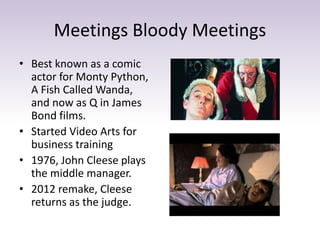
• Best known as a comic
actor for Monty Python,
A Fish Called Wanda,
and now as Q in James
Bond films.
• Started Video Arts for
business training
• 1976, John Cleese plays
the middle manager.
• 2012 remake, Cleese
returns as the judge.
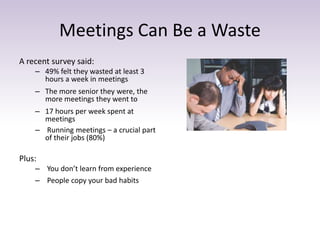
Meetings Can Be a Waste
A recent survey said:
– 49% felt they wasted at least 3
hours a week in meetings
– The more senior they were, the
more meetings they went to
– 17 hours per week spent at
meetings
– Running meetings – a crucial part
of their jobs (80%)
Plus:
– You don’t learn from experience
– People copy your bad habits
Monster Meetings and
Miracle Meetings
• Pair up
• Share stories of
meeting disasters
• What went wrong?
• Now share stories of
successful meetings
• What made them
successful?
Agenda
1
• Introduction and Warm Up
2
• Meetings Step by Step
• Meeting objectives
• Writing Effective Agendas
• Structure and Facilitate
• Summarize and Record
3
• Action Planning
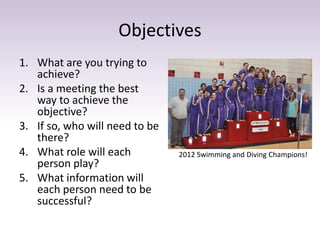
Objectives
1. What are you trying to
achieve?
2. Is a meeting the best
way to achieve the
objective?
3. If so, who will need to be
there?
4. What role will each
person play?
5. What information will
each person need to be
successful?
2012 Swimming and Diving Champions!
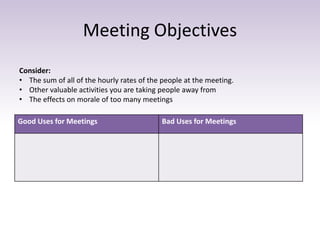
Meeting Objectives
Good Uses for Meetings Bad Uses for Meetings
Consider:
• The sum of all of the hourly rates of the people at the meeting.
• Other valuable activities you are taking people away from
• The effects on morale of too many meetings
Agenda
1
• Introduction and Warm Up
2
• Meetings Step by Step
• Meeting objectives
• Writing Effective Agendas
• Structure and Facilitate
• Summarize and Record
3
• Action Planning
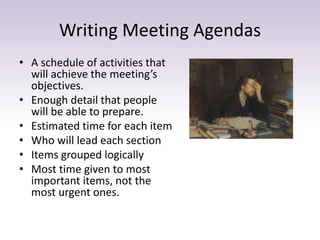
Writing Meeting Agendas
• A schedule of activities that
will achieve the meeting’s
objectives.
• Enough detail that people
will be able to prepare.
• Estimated time for each item
• Who will lead each section
• Items grouped logically
• Most time given to most
important items, not the
most urgent ones.
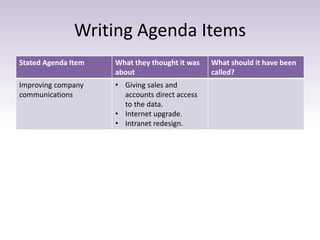
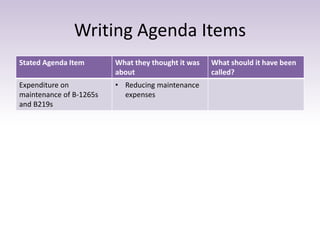
Writing Agenda Items
Stated Agenda Item What they thought it was
about
What should it have been
called?
Improving company
communications
• Giving sales and
accounts direct access
to the data.
• Internet upgrade.
• Intranet redesign.
Writing Agenda Items
Stated Agenda Item What they thought it was
about
What should it have been
called?
Expenditure on
maintenance of B-1265s
and B219s
• Reducing maintenance
expenses
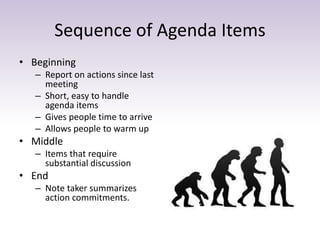
Sequence of Agenda Items
• Beginning
– Report on actions since last
meeting
– Short, easy to handle
agenda items
– Gives people time to arrive
– Allows people to warm up
• Middle
– Items that require
substantial discussion
• End
– Note taker summarizes
action commitments.
Supporting Materials
• What do you want
people to do to
prepare for the
meeting?
• What documents, data,
or other media will be
needed to successfully
accomplish the
objectives?
Agenda Writing Exercise
• Form groups of 3-4
• Read the Agenda Writing Case Study
• Step 1: List all of the agenda items and give
them appropriate titles
• Step 2: Prioritize them by importance
• Step 3: Assign time intervals to them
• Step 4: Put them in a logical sequence
• Write your group’s agenda on a flip chart
Agenda
1
• Introduction and Warm Up
2
• Meetings Step by Step
• Meeting objectives
• Writing Effective Agendas
• Structure and Facilitate
• Summarize and Record
3
• Action Planning
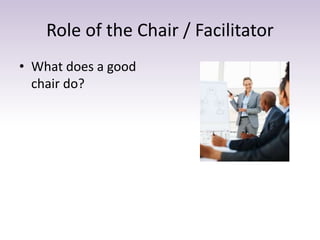
Role of the Chair / Facilitator
• What does a good
chair do?
Facilitating Meetings: Case Study
• Read the case study
• Pair up
• Put yourself in the role of advice
columnist; what advice would
you give?
Norms
• Rules that a group uses to
distinguish appropriate
from inappropriate
behavior.
• Examples:
– Preparation
– Confidentiality
– Participation
– Listening
– Use of devices
– Start and end on time
• Facilitator makes norms
explicit and enforces them
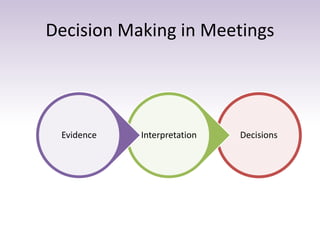
Decision Making in Meetings
DecisionsInterpretationEvidence
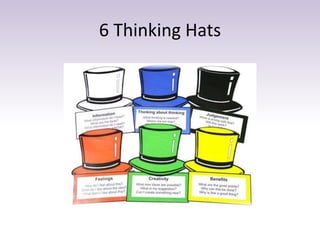
6 Thinking Hats
Special Case:
Scrum-style Project Meetings
• Each team member reports on:
– What has been done since last meeting
– Any obstacles that have prevented progress
– What each team member commits to do by the
next meeting
Agenda
1
• Introduction and Warm Up
2
• Meetings Step by Step
• Meeting objectives
• Writing Effective Agendas
• Structure and Facilitate
• Summarize and Record
3
• Action Planning
Role of the Secretary / Note Taker
– Having a separate
note taker frees the
facilitator to attend
to his/her role
– Records progress
and action items
– Summarizes and
checks for
consensus at the
end.
Tracking Action Items
• Sample meeting notes template
• Save time for note taker to review at end,
make sure everyone is clear and in agreement
about next steps.
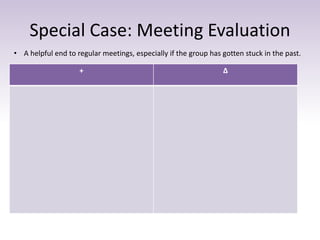
Special Case: Meeting Evaluation
+ ∆
• A helpful end to regular meetings, especially if the group has gotten stuck in the past.
Agenda
1
• Introduction and Warm Up
2
• Meetings Step by Step
• Meeting objectives
• Writing Effective Agendas
• Structure and Facilitate
• Summarize and Record
3
• Action Planning
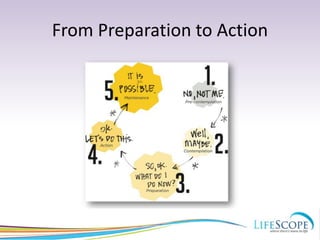
From Preparation to Action
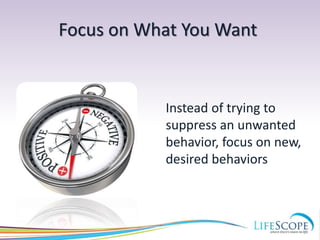
Focus on What You Want
Instead of trying to
suppress an unwanted
behavior, focus on new,
desired behaviors
WOOP It Up
Wish, Outcome, Obstacle, Plan
• Wish – What you hope will come from this
session.
• Outcome – the best outcome you can imagine
for your meetings
• Obstacle – what might get in the way?
• Plan – make a plan to make it happen
Kevin R. Thomas
Manager, Training & Development
x3542
Kevin.R.Thomas@williams.edu
• Program evaluation link will be sent by email.
• You’ll get a link to a course page with all the materials.

Meeting Management

  • 1.
    Meeting Management Kevin R.Thomas Manager, Training & Development x3542 kevin.r.thomas@williams.edu
  • 2.
    Objectives • Recognise the characteristicsof a good meeting. • Learn how to prepare for, structure and facilitate effective meetings. • Devise an action plan to improve your ability to run good face to face meetings.
  • 3.
    Agenda 1 • Introduction andWarm Up 2 • Meetings Step by Step • Meeting objectives • Writing Effective Agendas • Structure and Facilitate • Summarize and Record 3 • Action Planning
  • 4.
    Meetings Bloody Meetings •Best known as a comic actor for Monty Python, A Fish Called Wanda, and now as Q in James Bond films. • Started Video Arts for business training • 1976, John Cleese plays the middle manager. • 2012 remake, Cleese returns as the judge.
  • 5.
    Meetings Can Bea Waste A recent survey said: – 49% felt they wasted at least 3 hours a week in meetings – The more senior they were, the more meetings they went to – 17 hours per week spent at meetings – Running meetings – a crucial part of their jobs (80%) Plus: – You don’t learn from experience – People copy your bad habits
  • 6.
    Monster Meetings and MiracleMeetings • Pair up • Share stories of meeting disasters • What went wrong? • Now share stories of successful meetings • What made them successful?
  • 7.
    Agenda 1 • Introduction andWarm Up 2 • Meetings Step by Step • Meeting objectives • Writing Effective Agendas • Structure and Facilitate • Summarize and Record 3 • Action Planning
  • 8.
    Objectives 1. What areyou trying to achieve? 2. Is a meeting the best way to achieve the objective? 3. If so, who will need to be there? 4. What role will each person play? 5. What information will each person need to be successful? 2012 Swimming and Diving Champions!
  • 9.
    Meeting Objectives Good Usesfor Meetings Bad Uses for Meetings Consider: • The sum of all of the hourly rates of the people at the meeting. • Other valuable activities you are taking people away from • The effects on morale of too many meetings
  • 10.
    Agenda 1 • Introduction andWarm Up 2 • Meetings Step by Step • Meeting objectives • Writing Effective Agendas • Structure and Facilitate • Summarize and Record 3 • Action Planning
  • 11.
    Writing Meeting Agendas •A schedule of activities that will achieve the meeting’s objectives. • Enough detail that people will be able to prepare. • Estimated time for each item • Who will lead each section • Items grouped logically • Most time given to most important items, not the most urgent ones.
  • 12.
    Writing Agenda Items StatedAgenda Item What they thought it was about What should it have been called? Improving company communications • Giving sales and accounts direct access to the data. • Internet upgrade. • Intranet redesign.
  • 13.
    Writing Agenda Items StatedAgenda Item What they thought it was about What should it have been called? Expenditure on maintenance of B-1265s and B219s • Reducing maintenance expenses
  • 14.
    Sequence of AgendaItems • Beginning – Report on actions since last meeting – Short, easy to handle agenda items – Gives people time to arrive – Allows people to warm up • Middle – Items that require substantial discussion • End – Note taker summarizes action commitments.
  • 15.
    Supporting Materials • Whatdo you want people to do to prepare for the meeting? • What documents, data, or other media will be needed to successfully accomplish the objectives?
  • 16.
    Agenda Writing Exercise •Form groups of 3-4 • Read the Agenda Writing Case Study • Step 1: List all of the agenda items and give them appropriate titles • Step 2: Prioritize them by importance • Step 3: Assign time intervals to them • Step 4: Put them in a logical sequence • Write your group’s agenda on a flip chart
  • 17.
    Agenda 1 • Introduction andWarm Up 2 • Meetings Step by Step • Meeting objectives • Writing Effective Agendas • Structure and Facilitate • Summarize and Record 3 • Action Planning
  • 18.
    Role of theChair / Facilitator • What does a good chair do?
  • 19.
    Facilitating Meetings: CaseStudy • Read the case study • Pair up • Put yourself in the role of advice columnist; what advice would you give?
  • 20.
    Norms • Rules thata group uses to distinguish appropriate from inappropriate behavior. • Examples: – Preparation – Confidentiality – Participation – Listening – Use of devices – Start and end on time • Facilitator makes norms explicit and enforces them
  • 21.
    Decision Making inMeetings DecisionsInterpretationEvidence
  • 22.
  • 23.
    Special Case: Scrum-style ProjectMeetings • Each team member reports on: – What has been done since last meeting – Any obstacles that have prevented progress – What each team member commits to do by the next meeting
  • 24.
    Agenda 1 • Introduction andWarm Up 2 • Meetings Step by Step • Meeting objectives • Writing Effective Agendas • Structure and Facilitate • Summarize and Record 3 • Action Planning
  • 25.
    Role of theSecretary / Note Taker – Having a separate note taker frees the facilitator to attend to his/her role – Records progress and action items – Summarizes and checks for consensus at the end.
  • 26.
    Tracking Action Items •Sample meeting notes template • Save time for note taker to review at end, make sure everyone is clear and in agreement about next steps.
  • 27.
    Special Case: MeetingEvaluation + ∆ • A helpful end to regular meetings, especially if the group has gotten stuck in the past.
  • 28.
    Agenda 1 • Introduction andWarm Up 2 • Meetings Step by Step • Meeting objectives • Writing Effective Agendas • Structure and Facilitate • Summarize and Record 3 • Action Planning
  • 29.
  • 30.
    Focus on WhatYou Want Instead of trying to suppress an unwanted behavior, focus on new, desired behaviors
  • 31.
    WOOP It Up Wish,Outcome, Obstacle, Plan • Wish – What you hope will come from this session. • Outcome – the best outcome you can imagine for your meetings • Obstacle – what might get in the way? • Plan – make a plan to make it happen
  • 32.
    Kevin R. Thomas Manager,Training & Development x3542 Kevin.R.Thomas@williams.edu • Program evaluation link will be sent by email. • You’ll get a link to a course page with all the materials.

Editor's Notes

  • #5 Play 0:00 – 2:20
  • #8 2:05 – 8:53
  • #10 Good Objectives Generating ideas for solutions Making informed decisions that affect team members. Determining next steps. Get feedback on a proposal Finding out more about a stakeholder group Developing connections between team members Not-so-good Uses for Meetings Meetings are routine but there are no agenda items. Wordsmithing Informing people of something where no action or discussion is required (although there are exceptions). Problem solving between 2 people when a group of people have been called together.
  • #12 8:53 -13:00
  • #13 13:00 – 14:32
  • #14 14:32 – 18:40
  • #18 24:30 - 26:35
  • #19 Organizing Agenda Items Managing time Enforcing norms Listening Empowering members Making conflict productive Appreciation
  • #22 26:35 – 28:40
  • #25 28:40 – 30:45
  • #29 30:51 - END
  • #31 Combine the breaking of a habit with the making of a new habit. This is a very effective approach for smokers. If a smoker normally wakes up and lights a cigarette before their feet hit the floor, they will instead head straight to the shower. They will slowing transform their habit and redirect every last one of their triggers to other non-smoking related behaviors. Who can share a story about a habit you broke by replacing it with a new habit? Here’s some more good advice from Joyce Meyer… Focus on the good habit you want to do, not the bad habit you don’t want to do. Overcome the bad with good. This is so key because it allows you to celebrate your success in forming the new habit, rather than focus on failing to suppress the old habit.