Types of Speech
According to
Delivery
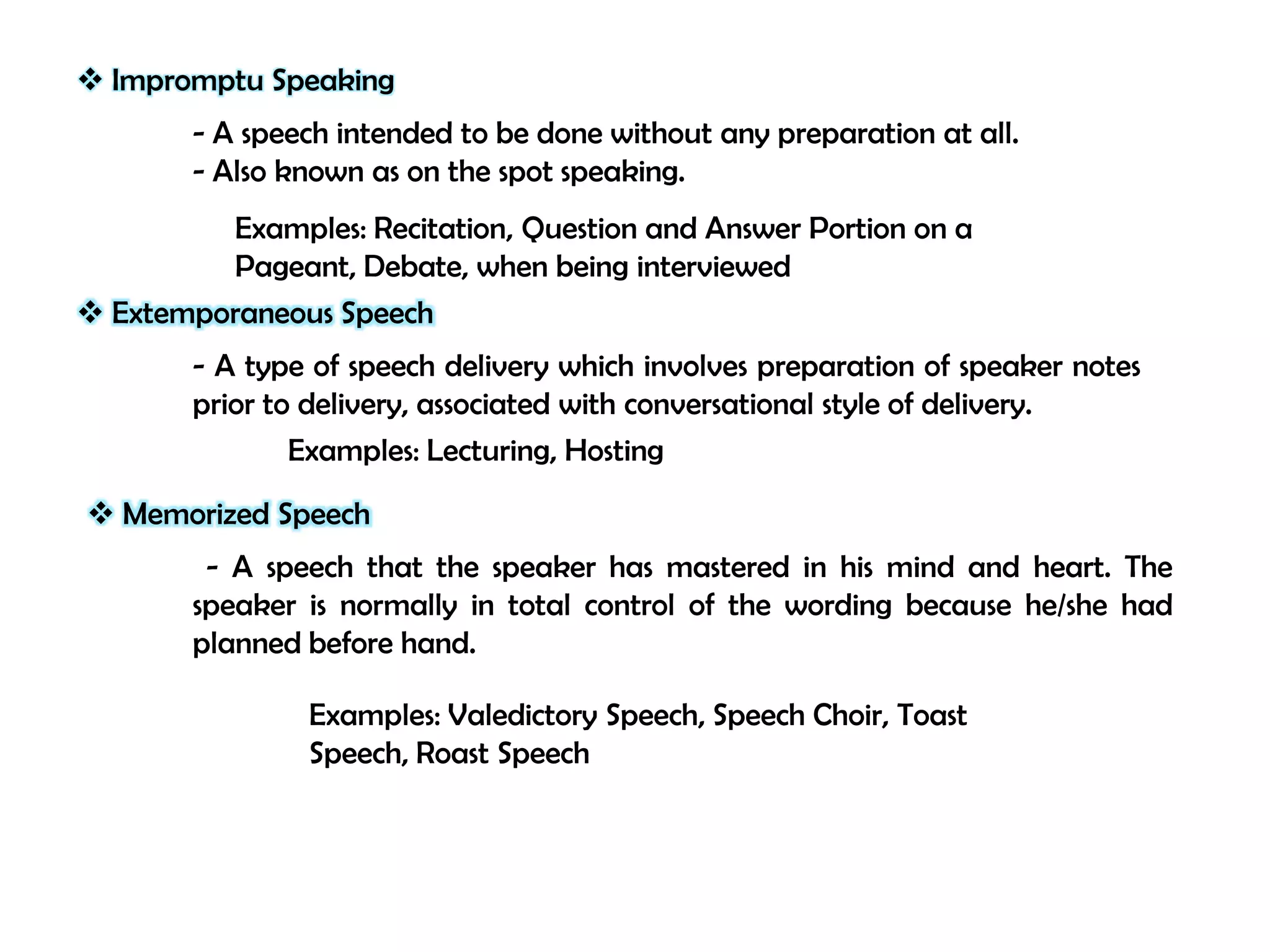
 Impromptu Speaking
- A speech intended to be done without any preparation at all.
- Also known as on the spot speaking.
Examples: Recitation, Question and Answer Portion on a
Pageant, Debate, when being interviewed
 Extemporaneous Speech
- A type of speech delivery which involves preparation of speaker notes
prior to delivery, associated with conversational style of delivery.
Examples: Lecturing, Hosting
 Memorized Speech
- A speech that the speaker has mastered in his mind and heart. The
speaker is normally in total control of the wording because he/she had
planned before hand.
Examples: Valedictory Speech, Speech Choir, Toast
Speech, Roast Speech
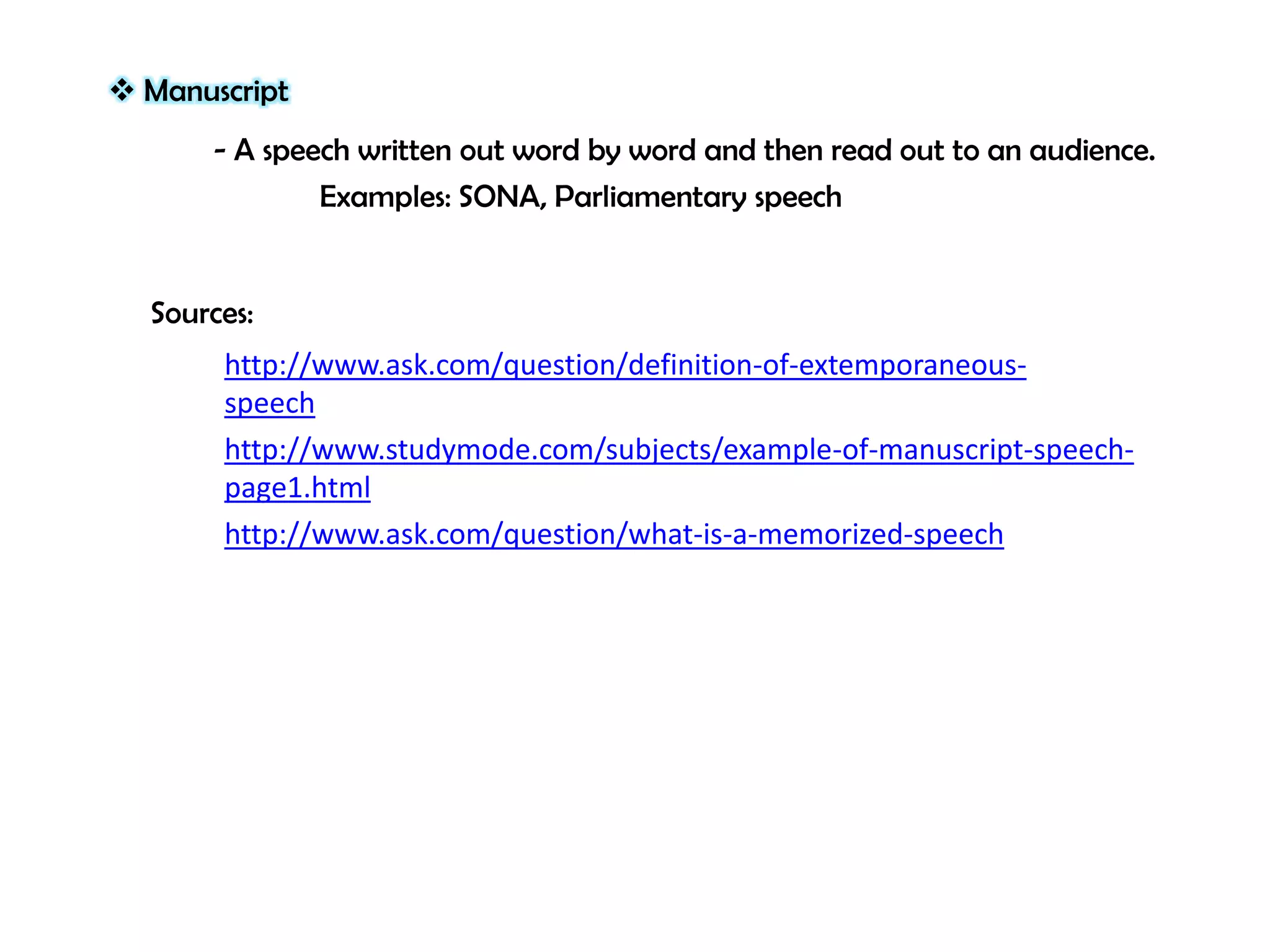
 Manuscript
- A speech written out word by word and then read out to an audience.
Examples: SONA, Parliamentary speech

Sources:
http://www.ask.com/question/definition-of-extemporaneousspeech
http://www.studymode.com/subjects/example-of-manuscript-speechpage1.html
http://www.ask.com/question/what-is-a-memorized-speech
Types of Speech
According to
Purpose
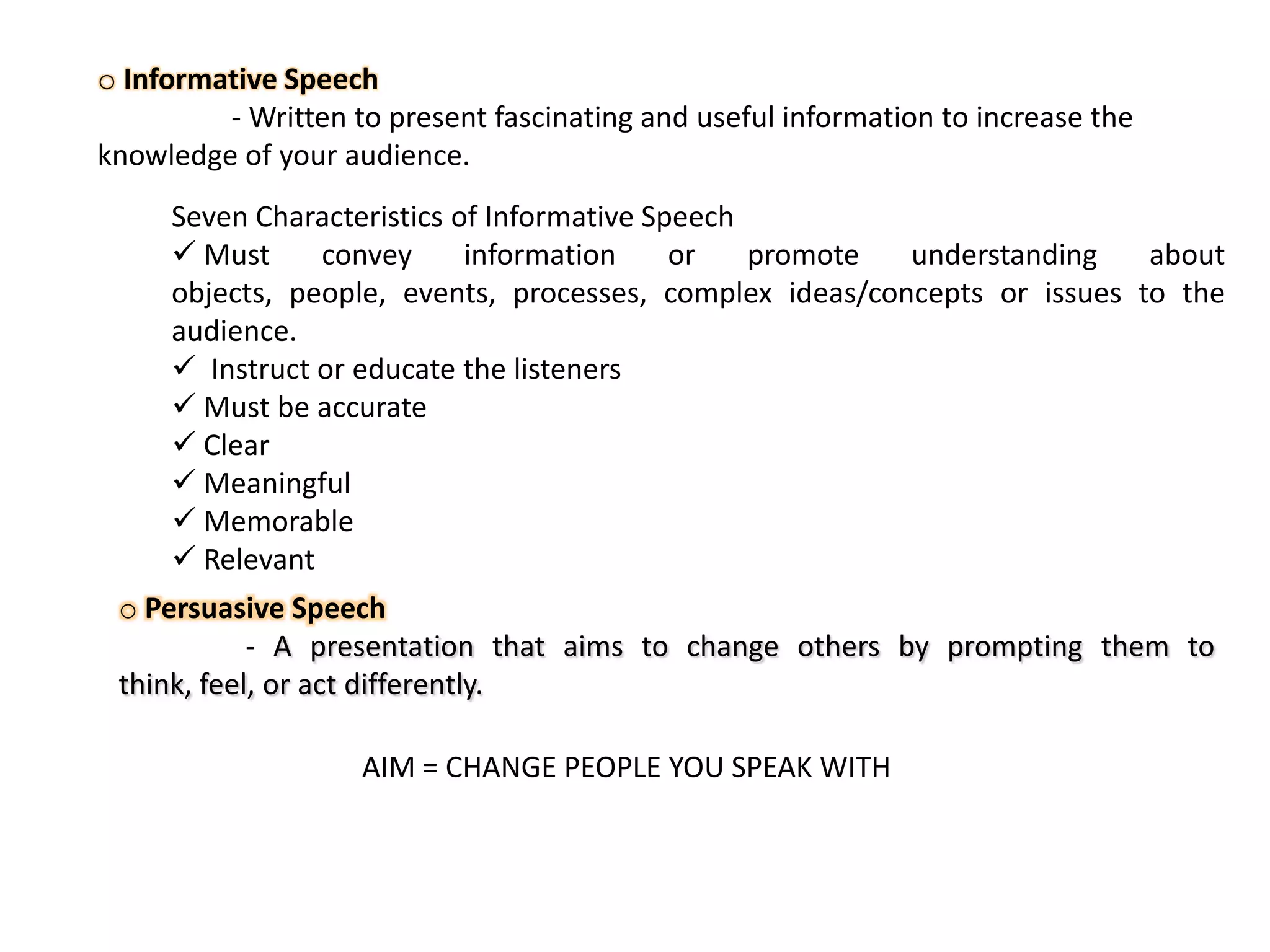
o Informative Speech
- Written to present fascinating and useful information to increase the
knowledge of your audience.
Seven Characteristics of Informative Speech
 Must
convey
information
or
promote
understanding
about
objects, people, events, processes, complex ideas/concepts or issues to the
audience.
 Instruct or educate the listeners
 Must be accurate
 Clear
 Meaningful
 Memorable
 Relevant
o Persuasive Speech
- A presentation that aims to change others by prompting them to
think, feel, or act differently.

AIM = CHANGE PEOPLE YOU SPEAK WITH
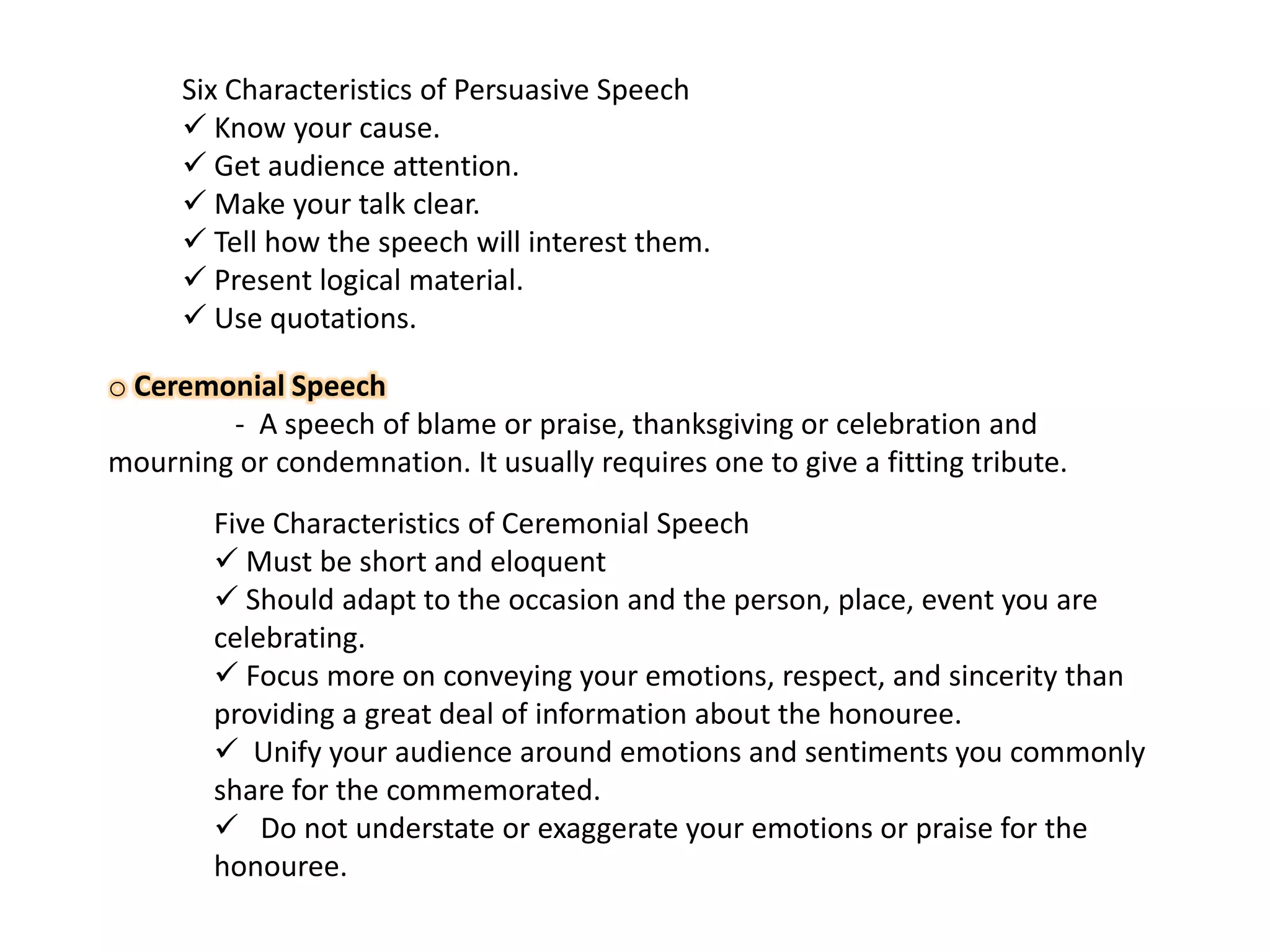
Six Characteristics of Persuasive Speech
 Know your cause.
 Get audience attention.
 Make your talk clear.
 Tell how the speech will interest them.
 Present logical material.
 Use quotations.
o Ceremonial Speech
- A speech of blame or praise, thanksgiving or celebration and
mourning or condemnation. It usually requires one to give a fitting tribute.
Five Characteristics of Ceremonial Speech
 Must be short and eloquent
 Should adapt to the occasion and the person, place, event you are
celebrating.
 Focus more on conveying your emotions, respect, and sincerity than
providing a great deal of information about the honouree.
 Unify your audience around emotions and sentiments you commonly
share for the commemorated.
 Do not understate or exaggerate your emotions or praise for the
honouree.
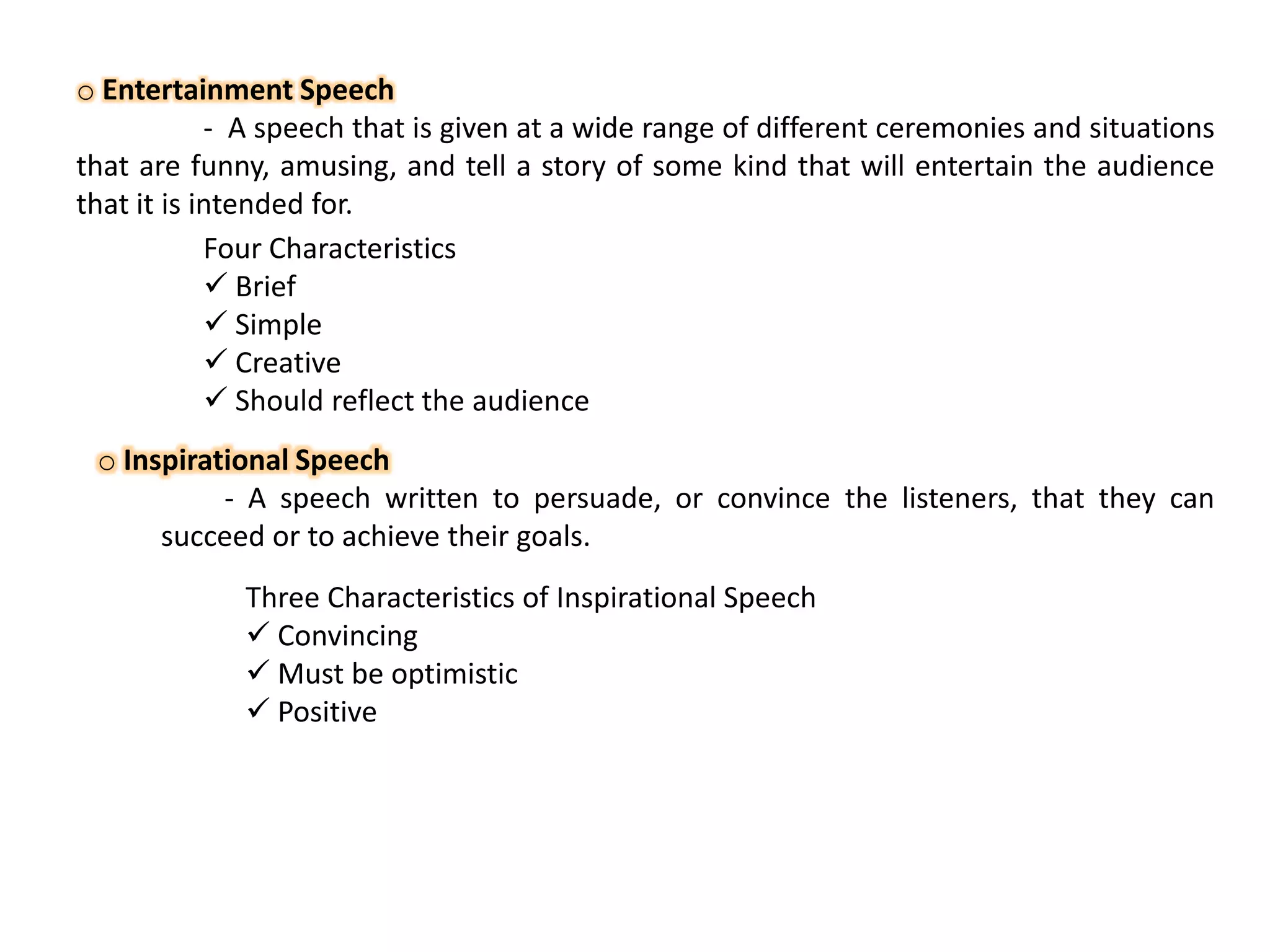
o Entertainment Speech
- A speech that is given at a wide range of different ceremonies and situations
that are funny, amusing, and tell a story of some kind that will entertain the audience
that it is intended for.
Four Characteristics
 Brief
 Simple
 Creative
 Should reflect the audience
o Inspirational Speech
- A speech written to persuade, or convince the listeners, that they can
succeed or to achieve their goals.
Three Characteristics of Inspirational Speech
 Convincing
 Must be optimistic
 Positive
Sources:
http://ramiahbu.net/attachments/article/75/UNIT%204.pdf
http://www.ask.com/question/what-is-a-ceremonial-speech
http://spot.pcc.edu/~dwerkman/lecture3.html

http://www.hawaii.edu/mauispeech/html/commemorative_speech.html
http://www.chacha.com/question/what-are-ten-major-characteristics-ofa-persuasive-speech
http://thenationonlineng.net/new/entertaining-speech/
http://www.famous-speeches-and-speech-topics.info/speechtopics/inspirational-speech.htm
Types of
Informative
Speech
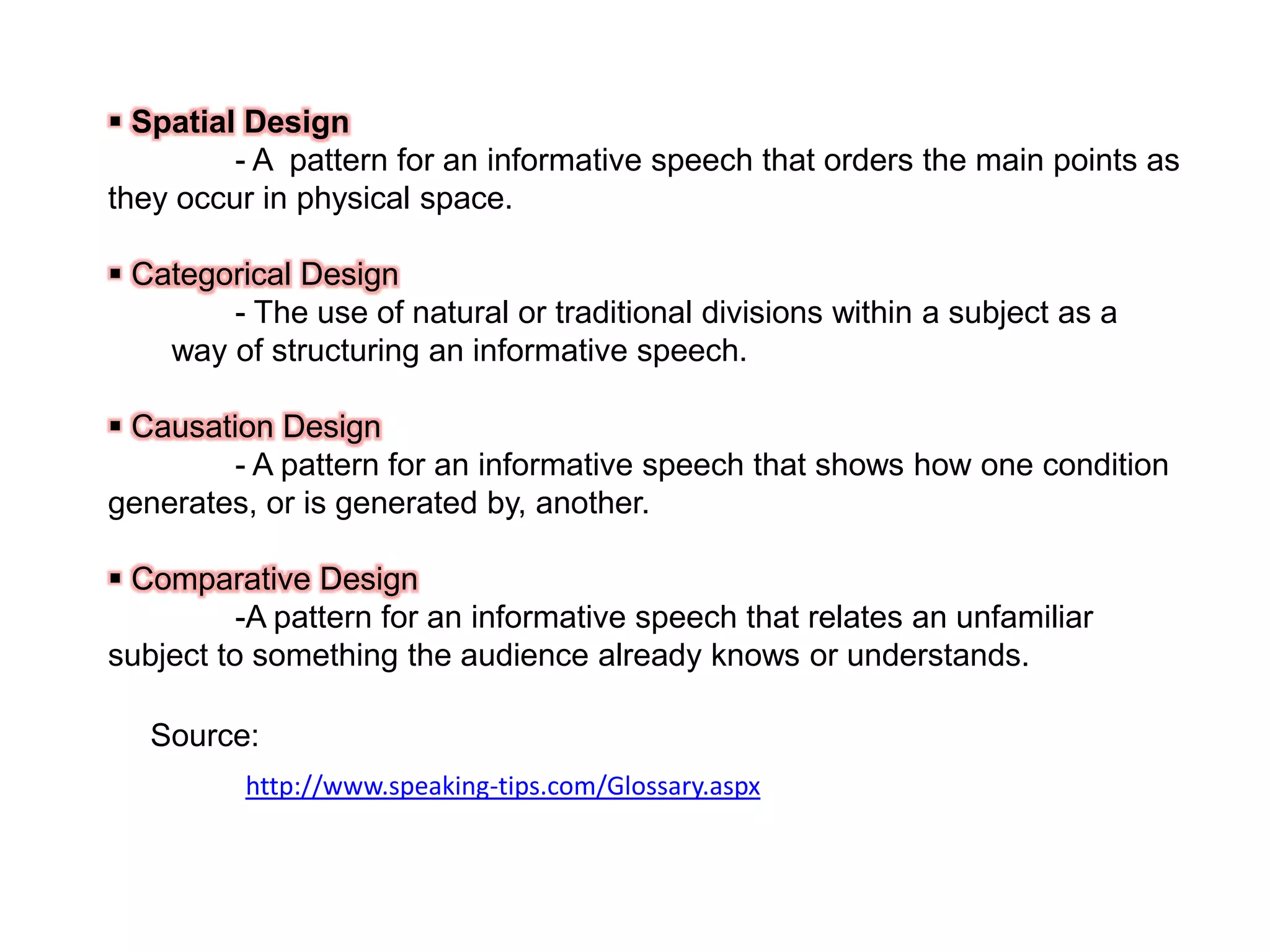
 Spatial Design
- A pattern for an informative speech that orders the main points as
they occur in physical space.
 Categorical Design
- The use of natural or traditional divisions within a subject as a
way of structuring an informative speech.
 Causation Design
- A pattern for an informative speech that shows how one condition
generates, or is generated by, another.
 Comparative Design
-A pattern for an informative speech that relates an unfamiliar
subject to something the audience already knows or understands.
Source:
http://www.speaking-tips.com/Glossary.aspx
Types of
Persuasive
Speech
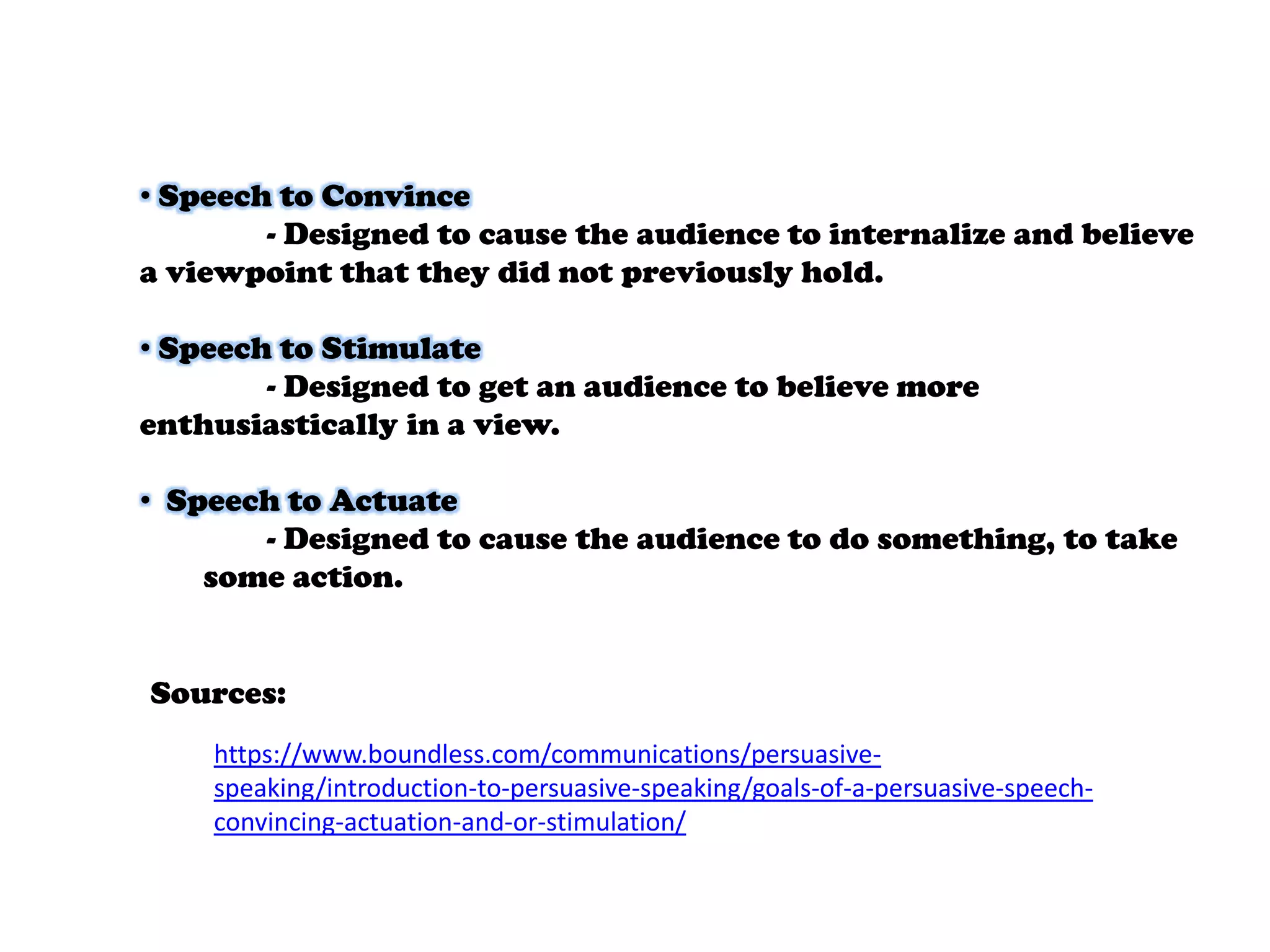
• Speech to Convince
- Designed to cause the audience to internalize and believe
a viewpoint that they did not previously hold.
• Speech to Stimulate
- Designed to get an audience to believe more
enthusiastically in a view.
• Speech to Actuate
- Designed to cause the audience to do something, to take
some action.

Sources:
https://www.boundless.com/communications/persuasivespeaking/introduction-to-persuasive-speaking/goals-of-a-persuasive-speechconvincing-actuation-and-or-stimulation/
Types of
Persuasion
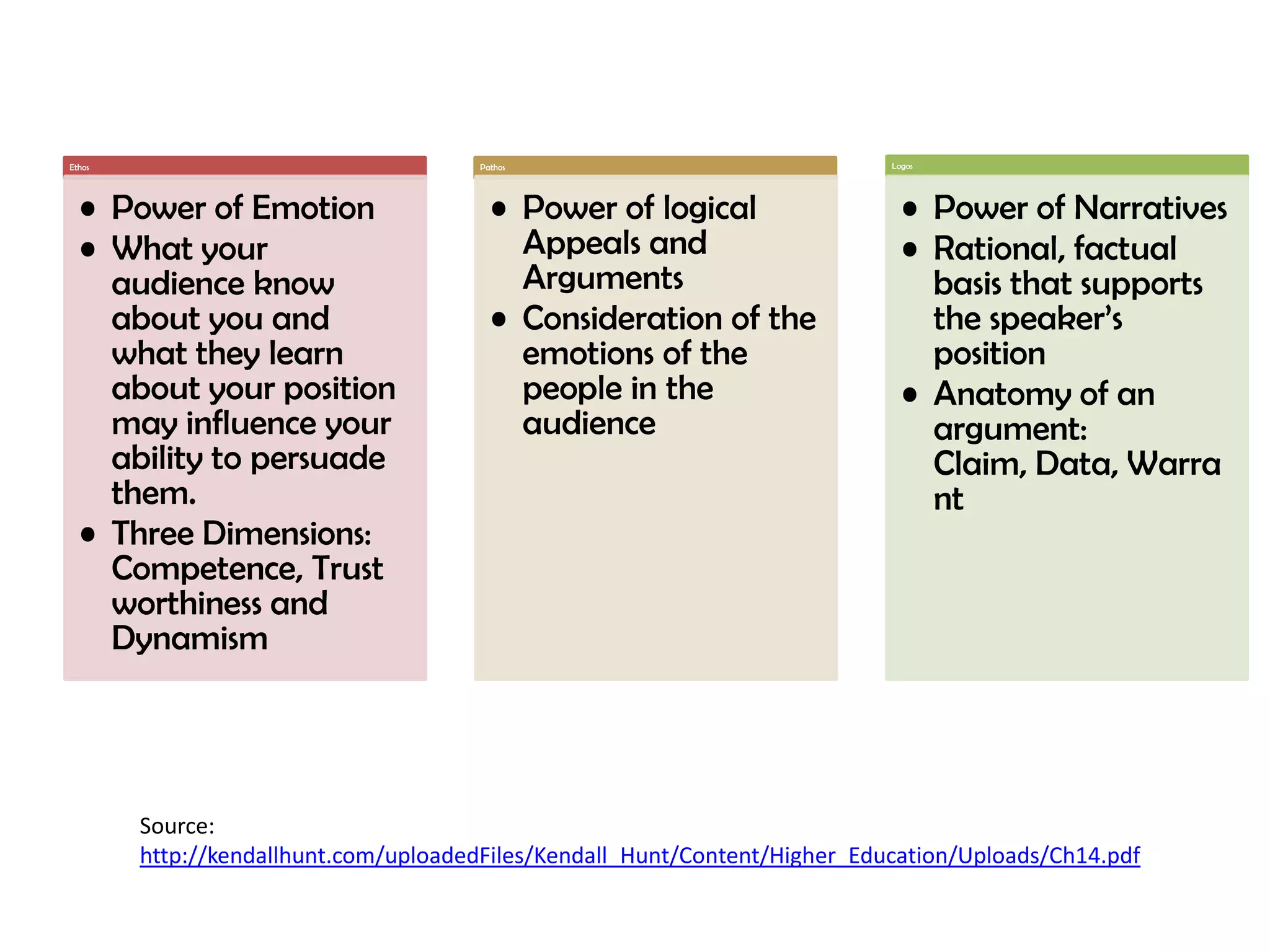
Ethos

Pathos

• Power of Emotion
• What your
audience know
about you and
what they learn
about your position
may influence your
ability to persuade
them.
• Three Dimensions:
Competence, Trust
worthiness and
Dynamism

• Power of logical
Appeals and
Arguments
• Consideration of the
emotions of the
people in the
audience

Logos

• Power of Narratives
• Rational, factual
basis that supports
the speaker’s
position
• Anatomy of an
argument:
Claim, Data, Warra
nt

Source:
http://kendallhunt.com/uploadedFiles/Kendall_Hunt/Content/Higher_Education/Uploads/Ch14.pdf
Types of
Proposition
 Proposition of Value
- A persuasive speech that espouses the worth of an idea,
person, or object.
- The speaker’s goal is to prove the worth of an evaluative
statement .
 Proposition of Policy
- A persuasive speech which proposes a course of action.
-The speaker, usually, is arguing that something should or
should not be done.
- Proposition of policy is easily recognizable with their use
of “ought to”, “should”, “have to” and/or “must”.
 Proposition of Fact

-A persuasive speech with the goal of settling what is
or is not so.
-Suggests the existence of something.
- Proves or disapproves something
- You need to convince you audience that your
evaluation is based on widely accepted standards.

Source:
http://kendallhunt.com/uploadedFiles/Kendall_Hunt/Content/Higher_Education/Uploads/
Ch14.pdf
Types of Speeches
 Valedictory Address
- Etymology: “Valedictory” & “Valedictorian” comes
from the Latin word valedicere, which means or
pertain to a formal farewell.
- An oration which conveys farewell delivered by a
valedictorian during graduation.
- Its aim is to inspire the audience or the graduates
and to thank everyone responsible for their
excellence.
Do’s:
 Include stories
 Should come from the heart
 Be emotional
 Keep it short as possible and be
mindful of the time consumed
 Practice before your actual speech
 Organize the content
 Relate your speech/ stories to your
audience
 Keep eye-contact with your
audience
 Be confident and smile

Don’ts:
×Do not read your speech
× Do not keep a dull
moment
× Do not crack unnecessary
jokes
× Don’t be negative
× Refrain form saying
“sorry” whenever you
missed out something
 Acceptance Speech
- A speech done when accepting a prize, award or an honor to express
the gratitude of the receiver.
Do’s:
 Say “thank you” in the beginning
of the speech
 Talk about the organization or
the award
 Be brief and spontaneous
 Allow humility
 Make it short and memorable

Don’ts:
× Read your speech
× Don’t force tears
× Don’t talk about yourself

 Toast Speech
- A ritual speech done during a wedding to express honor or goodwill
while holding a glass of wine.
Do’s:
Keep it short
 Maintain the appropriate level
of emotion
 Keep it personal
 Introduce yourself to the crowd

Don’ts:
× Do not share embarrassing
stories
× Do not tell too many inside
jokes
 Roast Speech
- A speech told to poke fun at the honoree/ celebrant. It is usually done
during birthday parties, retirement parties, farewell parties and
other occasions where someone with sense of humor is being honored.
Do’s:
Don’ts:
Be respectful
× Don’t be too negative
 Be organized
× Refrain form saying jokes
 Be funny
that are too personal
 Avoid inside jokes

 Privilege Speech
- Also known as parliamentary speech enjoyed by a member of a legislature.
Do’s:
 Exercise freedom of speech
 Defend your part

Don’ts:
× Play safe

 Invocation
- Given to ask for cooperation, assistance or help.
Do’s:
Impart words of wisdom
 Should be from the heart
 Should be delivered
naturally

Don’ts:
× Do not change from one tone to
another
× Do not entreat
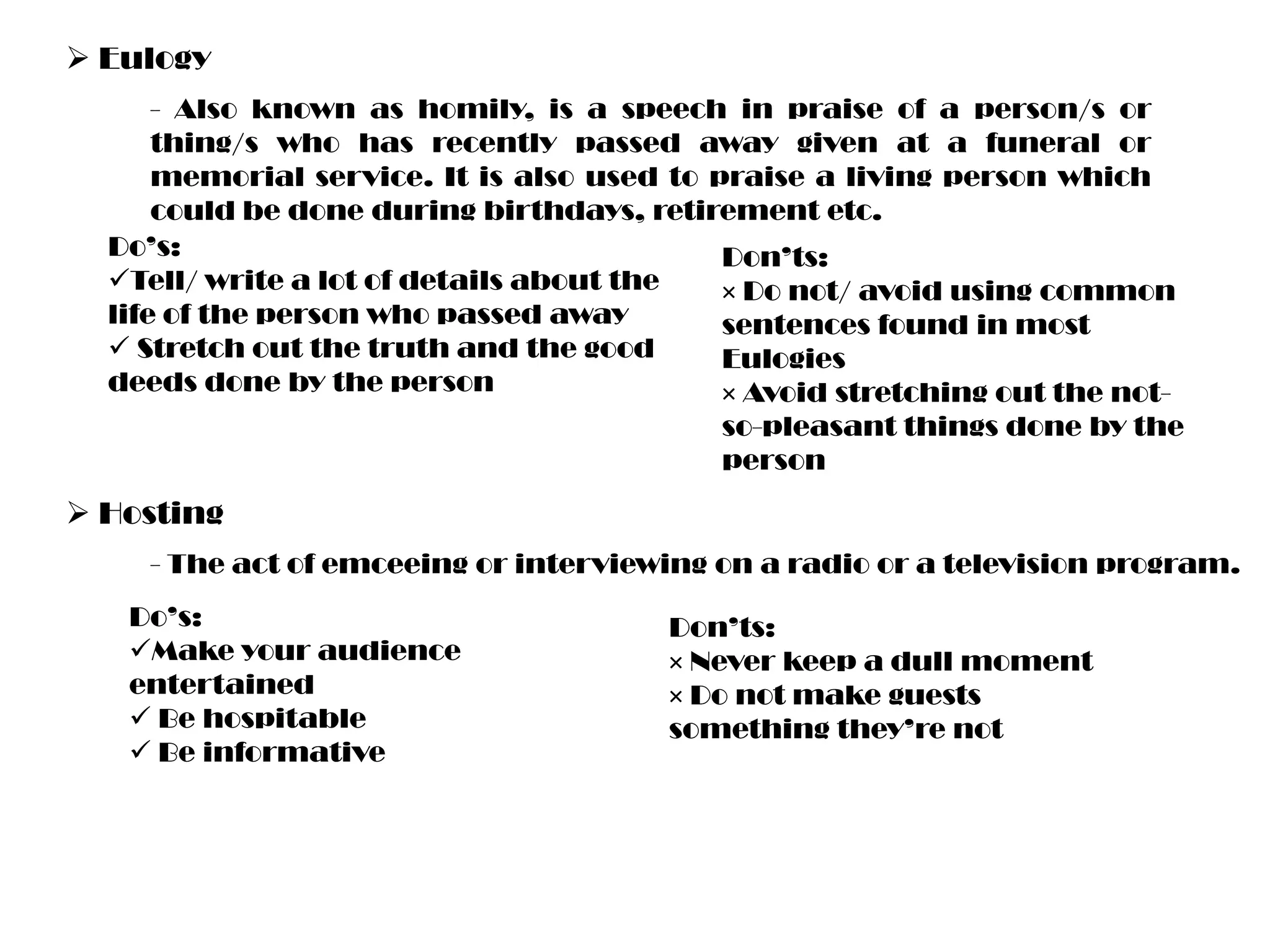
 Eulogy
- Also known as homily, is a speech in praise of a person/s or
thing/s who has recently passed away given at a funeral or
memorial service. It is also used to praise a living person which
could be done during birthdays, retirement etc.
Do’s:
Don’ts:
Tell/ write a lot of details about the
× Do not/ avoid using common
life of the person who passed away
sentences found in most
 Stretch out the truth and the good
Eulogies
deeds done by the person
× Avoid stretching out the notso-pleasant things done by the
person

 Hosting
- The act of emceeing or interviewing on a radio or a television program.
Do’s:
Make your audience
entertained
 Be hospitable
 Be informative

Don’ts:
× Never keep a dull moment
× Do not make guests
something they’re not
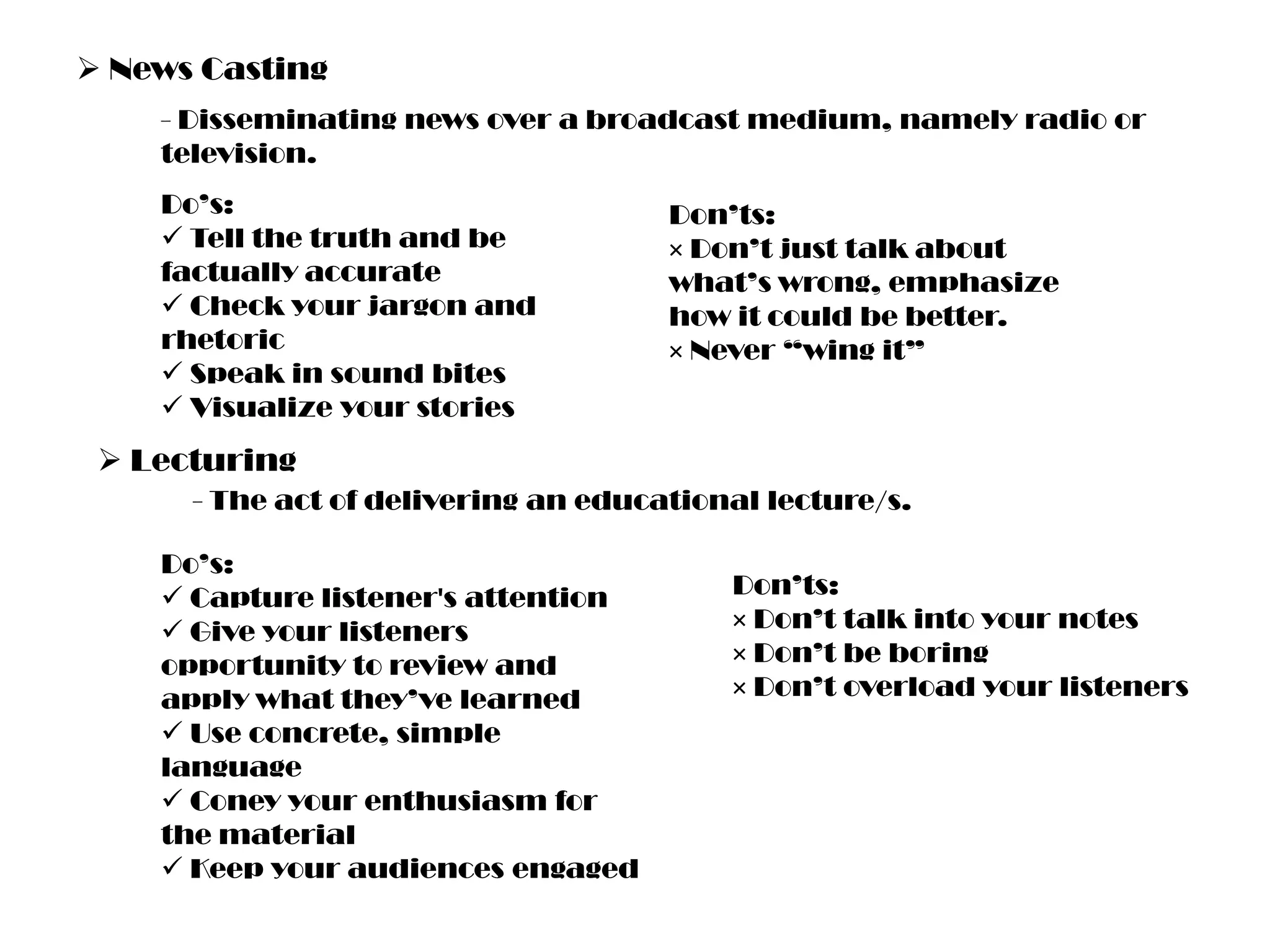
 News Casting
- Disseminating news over a broadcast medium, namely radio or
television.
Do’s:
 Tell the truth and be
factually accurate
 Check your jargon and
rhetoric
 Speak in sound bites
 Visualize your stories

Don’ts:
× Don’t just talk about
what’s wrong, emphasize
how it could be better.
× Never “wing it”

 Lecturing
- The act of delivering an educational lecture/s.
Do’s:
 Capture listener's attention
 Give your listeners
opportunity to review and
apply what they’ve learned
 Use concrete, simple
language
 Coney your enthusiasm for
the material
 Keep your audiences engaged

Don’ts:
× Don’t talk into your notes
× Don’t be boring
× Don’t overload your listeners
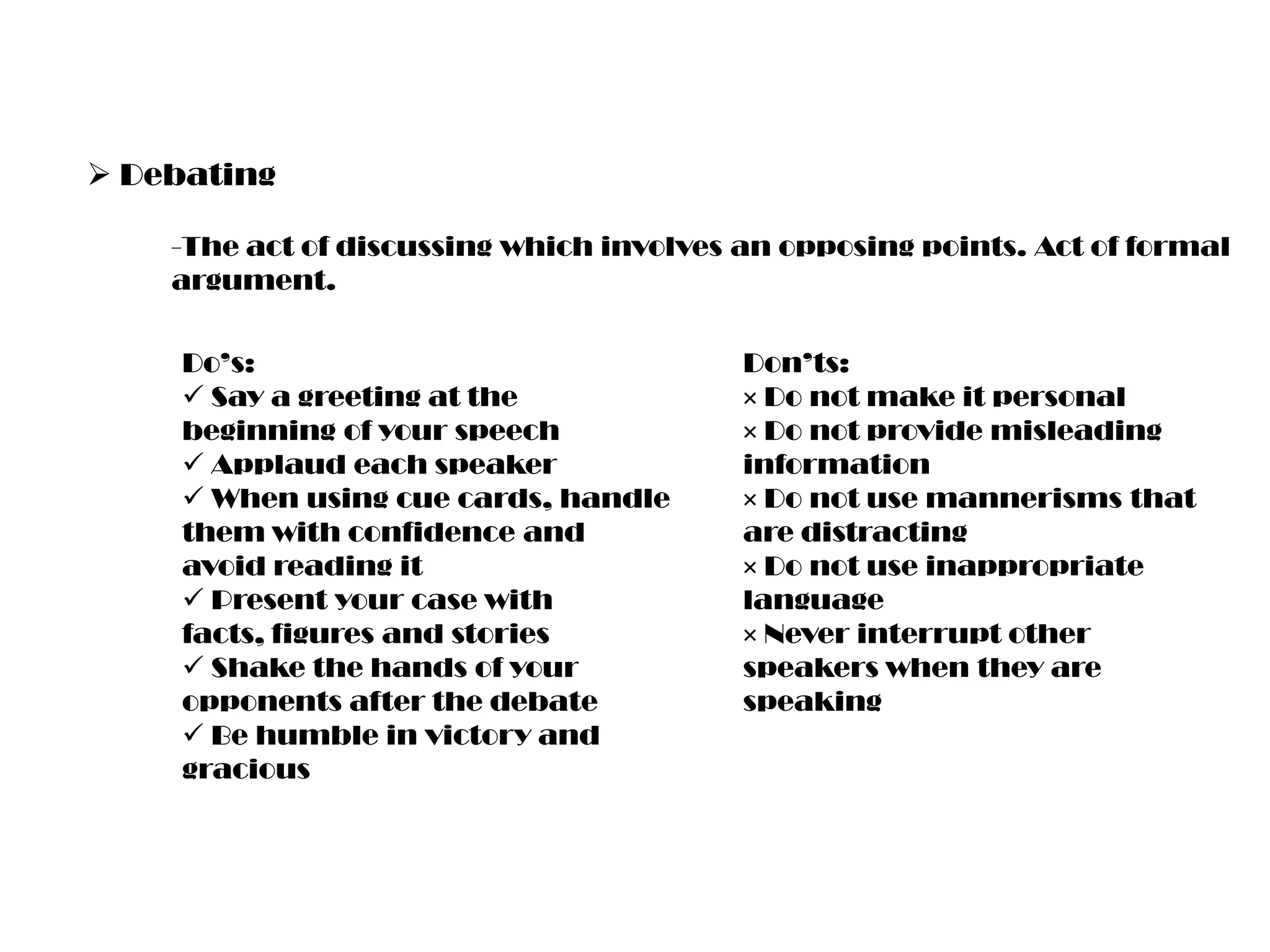
 Debating
-The act of discussing which involves an opposing points. Act of formal
argument.
Do’s:
 Say a greeting at the
beginning of your speech
 Applaud each speaker
 When using cue cards, handle
them with confidence and
avoid reading it
 Present your case with
facts, figures and stories
 Shake the hands of your
opponents after the debate
 Be humble in victory and
gracious

Don’ts:
× Do not make it personal
× Do not provide misleading
information
× Do not use mannerisms that
are distracting
× Do not use inappropriate
language
× Never interrupt other
speakers when they are
speaking
Sources:
http://www.ask.com/question/privileged-speech
http://www.columbia.edu/cu/tat/pdfs/lectures.pdf

http://dying.about.com/od/glossary/g/eulogy.htm
http://www.campusactivism.org/server-new/uploads/section3.pdf
https://www.debatingsa.com.au/Resources/Documents/Debating-Dos-AndDonts.pdf

Speech RP#2

  • 1.
  • 2.
     Impromptu Speaking -A speech intended to be done without any preparation at all. - Also known as on the spot speaking. Examples: Recitation, Question and Answer Portion on a Pageant, Debate, when being interviewed  Extemporaneous Speech - A type of speech delivery which involves preparation of speaker notes prior to delivery, associated with conversational style of delivery. Examples: Lecturing, Hosting  Memorized Speech - A speech that the speaker has mastered in his mind and heart. The speaker is normally in total control of the wording because he/she had planned before hand. Examples: Valedictory Speech, Speech Choir, Toast Speech, Roast Speech
  • 3.
     Manuscript - Aspeech written out word by word and then read out to an audience. Examples: SONA, Parliamentary speech Sources: http://www.ask.com/question/definition-of-extemporaneousspeech http://www.studymode.com/subjects/example-of-manuscript-speechpage1.html http://www.ask.com/question/what-is-a-memorized-speech
  • 4.
  • 5.
    o Informative Speech -Written to present fascinating and useful information to increase the knowledge of your audience. Seven Characteristics of Informative Speech  Must convey information or promote understanding about objects, people, events, processes, complex ideas/concepts or issues to the audience.  Instruct or educate the listeners  Must be accurate  Clear  Meaningful  Memorable  Relevant o Persuasive Speech - A presentation that aims to change others by prompting them to think, feel, or act differently. AIM = CHANGE PEOPLE YOU SPEAK WITH
  • 6.
    Six Characteristics ofPersuasive Speech  Know your cause.  Get audience attention.  Make your talk clear.  Tell how the speech will interest them.  Present logical material.  Use quotations. o Ceremonial Speech - A speech of blame or praise, thanksgiving or celebration and mourning or condemnation. It usually requires one to give a fitting tribute. Five Characteristics of Ceremonial Speech  Must be short and eloquent  Should adapt to the occasion and the person, place, event you are celebrating.  Focus more on conveying your emotions, respect, and sincerity than providing a great deal of information about the honouree.  Unify your audience around emotions and sentiments you commonly share for the commemorated.  Do not understate or exaggerate your emotions or praise for the honouree.
  • 7.
    o Entertainment Speech -A speech that is given at a wide range of different ceremonies and situations that are funny, amusing, and tell a story of some kind that will entertain the audience that it is intended for. Four Characteristics  Brief  Simple  Creative  Should reflect the audience o Inspirational Speech - A speech written to persuade, or convince the listeners, that they can succeed or to achieve their goals. Three Characteristics of Inspirational Speech  Convincing  Must be optimistic  Positive
  • 8.
  • 9.
  • 10.
     Spatial Design -A pattern for an informative speech that orders the main points as they occur in physical space.  Categorical Design - The use of natural or traditional divisions within a subject as a way of structuring an informative speech.  Causation Design - A pattern for an informative speech that shows how one condition generates, or is generated by, another.  Comparative Design -A pattern for an informative speech that relates an unfamiliar subject to something the audience already knows or understands. Source: http://www.speaking-tips.com/Glossary.aspx
  • 11.
  • 12.
    • Speech toConvince - Designed to cause the audience to internalize and believe a viewpoint that they did not previously hold. • Speech to Stimulate - Designed to get an audience to believe more enthusiastically in a view. • Speech to Actuate - Designed to cause the audience to do something, to take some action. Sources: https://www.boundless.com/communications/persuasivespeaking/introduction-to-persuasive-speaking/goals-of-a-persuasive-speechconvincing-actuation-and-or-stimulation/
  • 13.
  • 14.
    Ethos Pathos • Power ofEmotion • What your audience know about you and what they learn about your position may influence your ability to persuade them. • Three Dimensions: Competence, Trust worthiness and Dynamism • Power of logical Appeals and Arguments • Consideration of the emotions of the people in the audience Logos • Power of Narratives • Rational, factual basis that supports the speaker’s position • Anatomy of an argument: Claim, Data, Warra nt Source: http://kendallhunt.com/uploadedFiles/Kendall_Hunt/Content/Higher_Education/Uploads/Ch14.pdf
  • 15.
  • 16.
     Proposition ofValue - A persuasive speech that espouses the worth of an idea, person, or object. - The speaker’s goal is to prove the worth of an evaluative statement .  Proposition of Policy - A persuasive speech which proposes a course of action. -The speaker, usually, is arguing that something should or should not be done. - Proposition of policy is easily recognizable with their use of “ought to”, “should”, “have to” and/or “must”.
  • 17.
     Proposition ofFact -A persuasive speech with the goal of settling what is or is not so. -Suggests the existence of something. - Proves or disapproves something - You need to convince you audience that your evaluation is based on widely accepted standards. Source: http://kendallhunt.com/uploadedFiles/Kendall_Hunt/Content/Higher_Education/Uploads/ Ch14.pdf
  • 18.
    Types of Speeches Valedictory Address - Etymology: “Valedictory” & “Valedictorian” comes from the Latin word valedicere, which means or pertain to a formal farewell. - An oration which conveys farewell delivered by a valedictorian during graduation. - Its aim is to inspire the audience or the graduates and to thank everyone responsible for their excellence. Do’s:  Include stories  Should come from the heart  Be emotional  Keep it short as possible and be mindful of the time consumed  Practice before your actual speech  Organize the content  Relate your speech/ stories to your audience  Keep eye-contact with your audience  Be confident and smile Don’ts: ×Do not read your speech × Do not keep a dull moment × Do not crack unnecessary jokes × Don’t be negative × Refrain form saying “sorry” whenever you missed out something
  • 19.
     Acceptance Speech -A speech done when accepting a prize, award or an honor to express the gratitude of the receiver. Do’s:  Say “thank you” in the beginning of the speech  Talk about the organization or the award  Be brief and spontaneous  Allow humility  Make it short and memorable Don’ts: × Read your speech × Don’t force tears × Don’t talk about yourself  Toast Speech - A ritual speech done during a wedding to express honor or goodwill while holding a glass of wine. Do’s: Keep it short  Maintain the appropriate level of emotion  Keep it personal  Introduce yourself to the crowd Don’ts: × Do not share embarrassing stories × Do not tell too many inside jokes
  • 20.
     Roast Speech -A speech told to poke fun at the honoree/ celebrant. It is usually done during birthday parties, retirement parties, farewell parties and other occasions where someone with sense of humor is being honored. Do’s: Don’ts: Be respectful × Don’t be too negative  Be organized × Refrain form saying jokes  Be funny that are too personal  Avoid inside jokes  Privilege Speech - Also known as parliamentary speech enjoyed by a member of a legislature. Do’s:  Exercise freedom of speech  Defend your part Don’ts: × Play safe  Invocation - Given to ask for cooperation, assistance or help. Do’s: Impart words of wisdom  Should be from the heart  Should be delivered naturally Don’ts: × Do not change from one tone to another × Do not entreat
  • 21.
     Eulogy - Alsoknown as homily, is a speech in praise of a person/s or thing/s who has recently passed away given at a funeral or memorial service. It is also used to praise a living person which could be done during birthdays, retirement etc. Do’s: Don’ts: Tell/ write a lot of details about the × Do not/ avoid using common life of the person who passed away sentences found in most  Stretch out the truth and the good Eulogies deeds done by the person × Avoid stretching out the notso-pleasant things done by the person  Hosting - The act of emceeing or interviewing on a radio or a television program. Do’s: Make your audience entertained  Be hospitable  Be informative Don’ts: × Never keep a dull moment × Do not make guests something they’re not
  • 22.
     News Casting -Disseminating news over a broadcast medium, namely radio or television. Do’s:  Tell the truth and be factually accurate  Check your jargon and rhetoric  Speak in sound bites  Visualize your stories Don’ts: × Don’t just talk about what’s wrong, emphasize how it could be better. × Never “wing it”  Lecturing - The act of delivering an educational lecture/s. Do’s:  Capture listener's attention  Give your listeners opportunity to review and apply what they’ve learned  Use concrete, simple language  Coney your enthusiasm for the material  Keep your audiences engaged Don’ts: × Don’t talk into your notes × Don’t be boring × Don’t overload your listeners
  • 23.
     Debating -The actof discussing which involves an opposing points. Act of formal argument. Do’s:  Say a greeting at the beginning of your speech  Applaud each speaker  When using cue cards, handle them with confidence and avoid reading it  Present your case with facts, figures and stories  Shake the hands of your opponents after the debate  Be humble in victory and gracious Don’ts: × Do not make it personal × Do not provide misleading information × Do not use mannerisms that are distracting × Do not use inappropriate language × Never interrupt other speakers when they are speaking
  • 24.

Editor's Notes