MEETING…!
HOW TO ORGANIZE FOR A
MEETING…?
AIR ACTIVE CLUB
HOW TO ORGANISE AND RUN
EFFECTIVE MEETINGS
Meetings are necessary to coordinate individual efforts
Collaborate on joint projects
Garner support for ideas
Sell ideas
Solve problems collectively, and
Make consensus-based decisions.
MEETING
Essentially, meetings are a gathering of two or more persons to collectively
accomplish what one person cannot.
However, not all meetings are really necessary.
FIRST DECIDE IF YOU NEED
TO HAVE A MEETING
Many meetings don't need to be held, and often they are attended by more
people than necessary.
Often times there are more efficient ways to "meet" your objectives without
holding a meeting.
Some of these alternatives include: phone calls, conference calls,
memos/letters, postal mail, e-mails, teleconferencing, and listserves.
First, one needs to decide if a meeting is necessary.
DEFINE THE OBJECTIVES
Before scheduling or attending your next meeting, clearly define the
objectives for yourself or the group if you are the person responsible for the
meeting.
To help you think through your objectives, ask yourself the following four
questions:
Why am I scheduling or attending this meeting?
What do I want to accomplish or gain?
What information will be exchanged or decisions made?
Who will be attending that I need to meet or gain their support?
IS A MEETING THE BEST WAY
TO REACH THEM?
To ensure that meeting is the best way to reach them, Meeting must be usefull for
following reasons:
To convey information to a group
To solicit information from a group
To answers questions
To participate in group decision making
To brainstorm ideas
To solve problems
To network
To sell an idea, product, or service
To show or provide support for others
ORGANISE A MEETING ONLY
IF…
If you have determined
a meeting is the best avenue
..to carry out your team's objective
…then you should begin to organize
….for an effective meeting
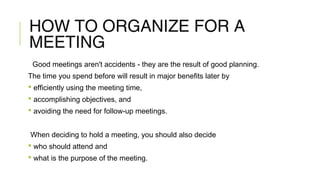
HOW TO ORGANIZE FOR A
MEETING
Good meetings aren't accidents - they are the result of good planning.
The time you spend before will result in major benefits later by
 efficiently using the meeting time,
 accomplishing objectives, and
 avoiding the need for follow-up meetings.
When deciding to hold a meeting, you should also decide
 who should attend and
 what is the purpose of the meeting.
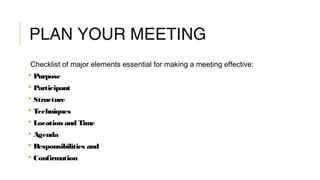
PLAN YOUR MEETING
Checklist of major elements essential for making a meeting effective:
 Purpose
 Participant
 Structure
 Techniques
 Location and Time
 Agenda
 Responsibilities and
 Confirmation
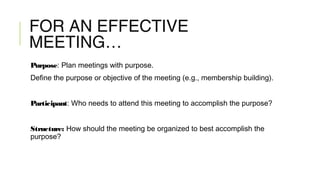
FOR AN EFFECTIVE
MEETING…
Purpose: Plan meetings with purpose.
Define the purpose or objective of the meeting (e.g., membership building).
Participant: Who needs to attend this meeting to accomplish the purpose?
Structure: How should the meeting be organized to best accomplish the
purpose?
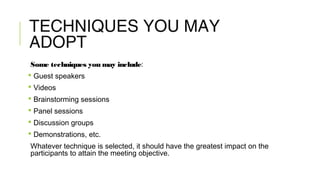
TECHNIQUES YOU MAY
ADOPT
Some techniques you may include:
 Guest speakers
 Videos
 Brainstorming sessions
 Panel sessions
 Discussion groups
 Demonstrations, etc.
Whatever technique is selected, it should have the greatest impact on the
participants to attain the meeting objective.
WHERE AND WHEN : STICK TO
THE SCHEDULED PROGRAM
Location and Time:
 Select a meeting place that best matches the participant's needs, the
objective, and the meeting structure.
 For venue, give consideration to size, comfort, accessibility, adequate
parking, room acoustics, equipment needs, etc.
 Choosing a meeting time depends on the availability of participants and
meeting facilities.
 The anticipated length of the meeting should also be a factor in deciding
when to schedule the meeting
AGENDA
A meeting agenda should be prepared and distributed to participants at least
three days prior to the meeting day.
An agenda is crucial to meeting success in three ways:
 it clarifies the objectives so people understand the meeting purpose and
tasks
 distributing the agenda prior to the meeting helps participants plan and
prepare to make an effective contribution and
 during the meeting, the agenda provides direction and focus for the
discussion
AGENDA STYLE
There are a variety of agenda styles but essentially they should contain at
least the following elements:
 title (e.g., membership drive followup meeting),
 time (e.g. 8:00-10:00 a.m.)
 date
 location
 discussion items and
 names of persons responsible for covering each item.
SHOULDERING
RESPONSIBILITIES
Responsibilities:
 There should be a mutual understanding of not only the meeting purpose,
but also individual assignments and how they fit into the total program.
 Those meetings that are more focused on brainstorming or creativity may
require little or no individual assignments.
 In task-oriented or policy deciding meetings, it is best to prepare a written
summary of assigned duties so individuals know what their responsibility is
for the meeting.
GET CONFIRMATION
Confirmation:
 If it is a first meeting or if the meeting is on a new day or time, individually
contact all participants a week to three days before the meeting day
 Contact can be as simple by a friendly reminder through office e-mail,
phone calls etc
If you are responsible for conducting the meeting and you chose to delegate
the tasks of organizing the meeting, make sure you are familiar with the
agenda, objectives, and any relevant background information before the
meeting begins.
EFFECTIVE MEETING
HOWTORUN EFFECTIVE MEETINGS:
 The meeting leader or facilitator is responsible for setting the meeting tone,
keeping the discussion on track, and making sure everyone has a fair
chance of being heard.
 The leader or facilitator should also summarize relevant points and tie
things together when the discussion jumps around between interrelated
topics.
 Filling the role of leader or facilitator is no easy task, especially when
personal agendas clash or misunderstandings occur.
GUIDELINES FOR EFFECTIVE
MEETING
ESSENCE OF TIME
Some guidelines on how to run effective meetings:
 Begin on time and end on time
 If you begin a meeting five to seven minutes after it was scheduled, you are
starting late. Starting a meeting late sends the message that it's okay to be
late and it shows a lack of respect and appreciation for those who make the
effort to arrive on time.
 Some people may have back-to-back meetings.
 Ending on time shows respect for participants valuable time.
 However, no one ever complains if you are fortunate enough to end early.
IMPORTANCE OF AGENDA
Use the Agenda
 Review the agenda with participants at the beginning of the meeting and
ask them if any changes need to be made on time allocations or discussion
content.
 Continually refer back to the agenda throughout the meeting to keep
discussion centered on the stated purpose and specified agenda items.
 Display the agenda at a prominent place so that everyone can refer to the
agenda when discussion seems to be getting off track.
IDEAS “BIN”
Use an Ideas “Bin” - A "bin" consists of blank sheets of paper (one or two) placed at
a point of easy access
 Any idea that is unrelated to the current topic is written on the paper (i.e., placed in
the bin).
The bin serves two valuable purposes:
1) it stores valuable ideas for consideration at an appropriate and convenient time,
and
2) it allows discussion to stay focused on the agenda topic.
 Using the bin will help to avoid members being disruptive to the meeting.
Explain the use of the bin at the beginning of the meeting.
 During the meeting the team leader or the facilitator should record bin items as they
come up.
USE GROUND RULES
Establish and Use Ground Rules
 Ground rules are explicit rules agreed by the group and convey "the way
things should be done at meetings"
 Ground rules are used to facilitate group interaction, not to restrict it
 All members should reach consensus on following the ground rules
 The ground rules should be written down on a paper and displayed for
everyone to see
GROUND RULES
The group can change the ground rules or add new ones based on group needs.
Examples of some typically used ground rules :
arrive and start on time
stick to the agenda
everyone participates
be realistic when accepting follow-up tasks
focus on interests, not positions
separate people from the problem
respect different viewpoints
share responsibility for following the ground rules
CHECK DOMINATION
Control dominating individuals
 Make sure each individual has a fair chance of expressing ideas and
opinions.
 Do not let one person dominate the discussion.
 Of equal importance is to ensure that quiet participants are expressing their
ideas and opinions.
 This may require the leader or facilitator to directly call on the quiet member
and ask them for their opinion or for any ideas they would like to share.
ENERGISE!
Bring Food
 Food energizes and motivates people more effectively than any other
meeting tactic.
 Although many people still prefer the standard coffee and samosas,
alternatives such as fruit, juice, and buiscuits can be provided.
 For afternoon meetings, cookies, hard candy, fruit, and sandwitches are
some suggestions
MOST IMPORTANT :
CONCLUDE
Summarize
 Conclude the meeting by summarizing the discussion, decisions made,
tasks delegated, deadlines, and any action required by participants
 Depending on the time available, either address bin items or place them on
the agenda for the next meeting
 Include in the summary any review plans for follow-up or the need to
schedule any succeeding meetings
 It is far easier to schedule the next meeting while everyone is at the table
than it is to wait and contact each participant individually
 The responsibility for the success and effectiveness of the meeting
ultimately rests equally with everyone in the group
MEETINGS CAN BE FUN AND
PRODUCTIVE
 It's easy to get caught up in the pressure of the meeting and lose sight of
perspectives.
 Stress diminishes creativity and spontaneity and generally lowers the quality
of results achieved by the group.
 So relax and remember that the best results come from groups who are
able to laugh together, discuss their mistakes, and take pride in their efforts.
A WELL-PLANNED AGENDA
POSTED GROUND RULES
USING A BIN
ARE THE THREE MOST IMPORTANT KEYS TO
RUNNING EFFECTIVE MEETINGS
THANK YOU
FROM AIR ACTIVE
CLUB

Meeting

  • 1.
    MEETING…! HOW TO ORGANIZEFOR A MEETING…? AIR ACTIVE CLUB
  • 2.
    HOW TO ORGANISEAND RUN EFFECTIVE MEETINGS Meetings are necessary to coordinate individual efforts Collaborate on joint projects Garner support for ideas Sell ideas Solve problems collectively, and Make consensus-based decisions.
  • 3.
    MEETING Essentially, meetings area gathering of two or more persons to collectively accomplish what one person cannot. However, not all meetings are really necessary.
  • 4.
    FIRST DECIDE IFYOU NEED TO HAVE A MEETING Many meetings don't need to be held, and often they are attended by more people than necessary. Often times there are more efficient ways to "meet" your objectives without holding a meeting. Some of these alternatives include: phone calls, conference calls, memos/letters, postal mail, e-mails, teleconferencing, and listserves. First, one needs to decide if a meeting is necessary.
  • 5.
    DEFINE THE OBJECTIVES Beforescheduling or attending your next meeting, clearly define the objectives for yourself or the group if you are the person responsible for the meeting. To help you think through your objectives, ask yourself the following four questions: Why am I scheduling or attending this meeting? What do I want to accomplish or gain? What information will be exchanged or decisions made? Who will be attending that I need to meet or gain their support?
  • 6.
    IS A MEETINGTHE BEST WAY TO REACH THEM? To ensure that meeting is the best way to reach them, Meeting must be usefull for following reasons: To convey information to a group To solicit information from a group To answers questions To participate in group decision making To brainstorm ideas To solve problems To network To sell an idea, product, or service To show or provide support for others
  • 7.
    ORGANISE A MEETINGONLY IF… If you have determined a meeting is the best avenue ..to carry out your team's objective …then you should begin to organize ….for an effective meeting
  • 8.
    HOW TO ORGANIZEFOR A MEETING Good meetings aren't accidents - they are the result of good planning. The time you spend before will result in major benefits later by  efficiently using the meeting time,  accomplishing objectives, and  avoiding the need for follow-up meetings. When deciding to hold a meeting, you should also decide  who should attend and  what is the purpose of the meeting.
  • 9.
    PLAN YOUR MEETING Checklistof major elements essential for making a meeting effective:  Purpose  Participant  Structure  Techniques  Location and Time  Agenda  Responsibilities and  Confirmation
  • 10.
    FOR AN EFFECTIVE MEETING… Purpose:Plan meetings with purpose. Define the purpose or objective of the meeting (e.g., membership building). Participant: Who needs to attend this meeting to accomplish the purpose? Structure: How should the meeting be organized to best accomplish the purpose?
  • 11.
    TECHNIQUES YOU MAY ADOPT Sometechniques you may include:  Guest speakers  Videos  Brainstorming sessions  Panel sessions  Discussion groups  Demonstrations, etc. Whatever technique is selected, it should have the greatest impact on the participants to attain the meeting objective.
  • 12.
    WHERE AND WHEN: STICK TO THE SCHEDULED PROGRAM Location and Time:  Select a meeting place that best matches the participant's needs, the objective, and the meeting structure.  For venue, give consideration to size, comfort, accessibility, adequate parking, room acoustics, equipment needs, etc.  Choosing a meeting time depends on the availability of participants and meeting facilities.  The anticipated length of the meeting should also be a factor in deciding when to schedule the meeting
  • 13.
    AGENDA A meeting agendashould be prepared and distributed to participants at least three days prior to the meeting day. An agenda is crucial to meeting success in three ways:  it clarifies the objectives so people understand the meeting purpose and tasks  distributing the agenda prior to the meeting helps participants plan and prepare to make an effective contribution and  during the meeting, the agenda provides direction and focus for the discussion
  • 14.
    AGENDA STYLE There area variety of agenda styles but essentially they should contain at least the following elements:  title (e.g., membership drive followup meeting),  time (e.g. 8:00-10:00 a.m.)  date  location  discussion items and  names of persons responsible for covering each item.
  • 15.
    SHOULDERING RESPONSIBILITIES Responsibilities:  There shouldbe a mutual understanding of not only the meeting purpose, but also individual assignments and how they fit into the total program.  Those meetings that are more focused on brainstorming or creativity may require little or no individual assignments.  In task-oriented or policy deciding meetings, it is best to prepare a written summary of assigned duties so individuals know what their responsibility is for the meeting.
  • 16.
    GET CONFIRMATION Confirmation:  Ifit is a first meeting or if the meeting is on a new day or time, individually contact all participants a week to three days before the meeting day  Contact can be as simple by a friendly reminder through office e-mail, phone calls etc If you are responsible for conducting the meeting and you chose to delegate the tasks of organizing the meeting, make sure you are familiar with the agenda, objectives, and any relevant background information before the meeting begins.
  • 17.
    EFFECTIVE MEETING HOWTORUN EFFECTIVEMEETINGS:  The meeting leader or facilitator is responsible for setting the meeting tone, keeping the discussion on track, and making sure everyone has a fair chance of being heard.  The leader or facilitator should also summarize relevant points and tie things together when the discussion jumps around between interrelated topics.  Filling the role of leader or facilitator is no easy task, especially when personal agendas clash or misunderstandings occur.
  • 18.
    GUIDELINES FOR EFFECTIVE MEETING ESSENCEOF TIME Some guidelines on how to run effective meetings:  Begin on time and end on time  If you begin a meeting five to seven minutes after it was scheduled, you are starting late. Starting a meeting late sends the message that it's okay to be late and it shows a lack of respect and appreciation for those who make the effort to arrive on time.  Some people may have back-to-back meetings.  Ending on time shows respect for participants valuable time.  However, no one ever complains if you are fortunate enough to end early.
  • 19.
    IMPORTANCE OF AGENDA Usethe Agenda  Review the agenda with participants at the beginning of the meeting and ask them if any changes need to be made on time allocations or discussion content.  Continually refer back to the agenda throughout the meeting to keep discussion centered on the stated purpose and specified agenda items.  Display the agenda at a prominent place so that everyone can refer to the agenda when discussion seems to be getting off track.
  • 20.
    IDEAS “BIN” Use anIdeas “Bin” - A "bin" consists of blank sheets of paper (one or two) placed at a point of easy access  Any idea that is unrelated to the current topic is written on the paper (i.e., placed in the bin). The bin serves two valuable purposes: 1) it stores valuable ideas for consideration at an appropriate and convenient time, and 2) it allows discussion to stay focused on the agenda topic.  Using the bin will help to avoid members being disruptive to the meeting. Explain the use of the bin at the beginning of the meeting.  During the meeting the team leader or the facilitator should record bin items as they come up.
  • 21.
    USE GROUND RULES Establishand Use Ground Rules  Ground rules are explicit rules agreed by the group and convey "the way things should be done at meetings"  Ground rules are used to facilitate group interaction, not to restrict it  All members should reach consensus on following the ground rules  The ground rules should be written down on a paper and displayed for everyone to see
  • 22.
    GROUND RULES The groupcan change the ground rules or add new ones based on group needs. Examples of some typically used ground rules : arrive and start on time stick to the agenda everyone participates be realistic when accepting follow-up tasks focus on interests, not positions separate people from the problem respect different viewpoints share responsibility for following the ground rules
  • 23.
    CHECK DOMINATION Control dominatingindividuals  Make sure each individual has a fair chance of expressing ideas and opinions.  Do not let one person dominate the discussion.  Of equal importance is to ensure that quiet participants are expressing their ideas and opinions.  This may require the leader or facilitator to directly call on the quiet member and ask them for their opinion or for any ideas they would like to share.
  • 24.
    ENERGISE! Bring Food  Foodenergizes and motivates people more effectively than any other meeting tactic.  Although many people still prefer the standard coffee and samosas, alternatives such as fruit, juice, and buiscuits can be provided.  For afternoon meetings, cookies, hard candy, fruit, and sandwitches are some suggestions
  • 25.
    MOST IMPORTANT : CONCLUDE Summarize Conclude the meeting by summarizing the discussion, decisions made, tasks delegated, deadlines, and any action required by participants  Depending on the time available, either address bin items or place them on the agenda for the next meeting  Include in the summary any review plans for follow-up or the need to schedule any succeeding meetings  It is far easier to schedule the next meeting while everyone is at the table than it is to wait and contact each participant individually  The responsibility for the success and effectiveness of the meeting ultimately rests equally with everyone in the group
  • 26.
    MEETINGS CAN BEFUN AND PRODUCTIVE  It's easy to get caught up in the pressure of the meeting and lose sight of perspectives.  Stress diminishes creativity and spontaneity and generally lowers the quality of results achieved by the group.  So relax and remember that the best results come from groups who are able to laugh together, discuss their mistakes, and take pride in their efforts.
  • 27.
    A WELL-PLANNED AGENDA POSTEDGROUND RULES USING A BIN ARE THE THREE MOST IMPORTANT KEYS TO RUNNING EFFECTIVE MEETINGS THANK YOU FROM AIR ACTIVE CLUB