Running Effective Meetings
APAC September 2017
Lynn Valenter, Vice Chancellor of Finance and Operations
Impact of Effective Meetings
(Why do I care?)
• Professional Development &
Career impacts
• Use of precious resources
• Higher Ed and Collaboration
Learning Outcomes
Understand meeting purposes; why do we need
them and what are common expected outcomes?
Be able to describe resource impacts of meetings.
What are the key phases of a successful meeting?
What are some common causes of failure?
Why have a meeting?
Collaborative culture and
Complex organization
 For the wonks (Parallel v sequential)
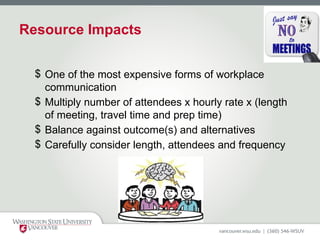
Resource Impacts
$ One of the most expensive forms of workplace
communication
$ Multiply number of attendees x hourly rate x (length
of meeting, travel time and prep time)
$ Balance against outcome(s) and alternatives
$ Carefully consider length, attendees and frequency
Overview of an Effective Meeting
• Clear purpose, pre-planning
• Conducted well
• Conclusions and follow up
• Elements to avoid
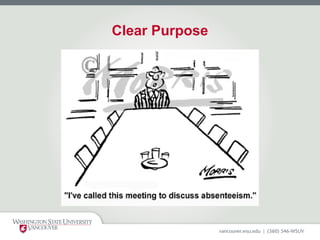
Clear Purpose
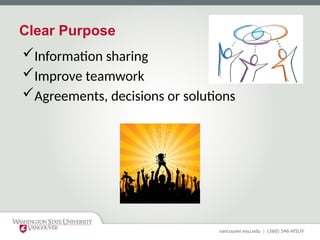
Clear Purpose
Information sharing
Improve teamwork
Agreements, decisions or solutions
Do’s and Don’t s of Effective Meetings
• Do’s • Don’ts
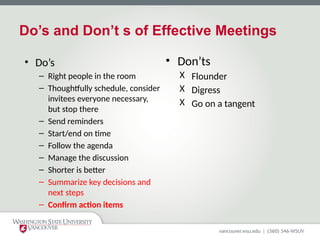
Do’s and Don’t s of Effective Meetings
• Do’s
– Right people in the room
– Thoughtfully schedule, consider
invitees everyone necessary,
but stop there
– Send reminders
– Start/end on time
– Follow the agenda
– Manage the discussion
– Shorter is better
– Summarize key decisions and
next steps
– Confirm action items
• Don’ts
X Flounder
X Digress
X Go on a tangent
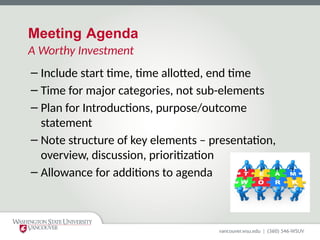
Meeting Agenda
A Worthy Investment
– Include start time, time allotted, end time
– Time for major categories, not sub-elements
– Plan for Introductions, purpose/outcome
statement
– Note structure of key elements – presentation,
overview, discussion, prioritization
– Allowance for additions to agenda
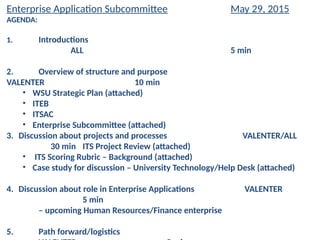
Enterprise Application Subcommittee May 29, 2015
AGENDA:
1. Introductions
ALL 5 min
2. Overview of structure and purpose
VALENTER 10 min
• WSU Strategic Plan (attached)
• ITEB
• ITSAC
• Enterprise Subcommittee (attached)
3. Discussion about projects and processes VALENTER/ALL
30 min ITS Project Review (attached)
• ITS Scoring Rubric – Background (attached)
• Case study for discussion – University Technology/Help Desk (attached)
4. Discussion about role in Enterprise Applications VALENTER
5 min
– upcoming Human Resources/Finance enterprise
5. Path forward/logistics
Facilitation
• Formal training (Meeting Management &
Facilitation)
• Ground rules
• Over/under contributors
• Keep on track, parking lot, timing facilitation
(one/two more comments)
Facilitation Skills
• Idea generation
– List/flip chart
– Contrast/color with pen
– Brainstorming
– Group individual, list until no new (nominal)
– Sticky notes
– Electronic submission in advance or in meeting
– Facilitator/scribe if you’re running the meeting
Facilitation Skills
• Group decision-making
• What criteria will be used?
• Consider methodology
–Size of group
–Relative knowledge
–Compatibility, trust, group dynamics
–Complexity, anonymity
Facilitation Skills
• Elimination
• Consensus
• Vote
• Commonalities
• Matrix
• Rank
• Initial H,M,L
• Dots
– Color?
– Multiple dots or no?
– Must use all dots?
– Rank/prioritize
Conclusions and Follow Up
Protect the investment
Decide who will follow up, by when
Record/memorialize decisions
Communicate results
Effectiveness encourages future
commitment
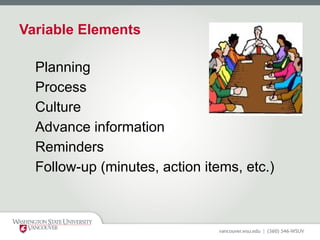
Variable Elements
Planning
Process
Culture
Advance information
Reminders
Follow-up (minutes, action items, etc.)
Summary
1. Meetings matter. Necessary and cost-effective done well.
2. Pre-planning is an investment.
3. Conducting a meeting includes tending to culture,
discussion, agenda, timing and outcomes. Experience
helps.
4. Conclusion/follow-up is good stewardship of the
investment. Minutes, summary, action items with
time/person accountability and scheduling next steps
protect the investment.
5. Know what can make a meeting ineffective and avoid.
6. Facilitation training valuable.
Active Learning
 Need to generate budget reductions within your
department/division. How would you structure an initial
meeting? Who would you invite? What would the
agenda look like?
 You’ve heard rumblings of unrest within a department.
How might you structure a meeting to begin to address?
 You are chairing a committee that selects employee of
the year. You have 15 nominations. How would you
structure a meeting (or meetings) to determine your
recommendation to the decision-maker?
 You need to conduct a mandatory safety or awareness
training. What would an agenda look like?

running-effective-meetings for AAFDRMC.pptx

  • 1.
    Running Effective Meetings APACSeptember 2017 Lynn Valenter, Vice Chancellor of Finance and Operations
  • 2.
    Impact of EffectiveMeetings (Why do I care?) • Professional Development & Career impacts • Use of precious resources • Higher Ed and Collaboration
  • 3.
    Learning Outcomes Understand meetingpurposes; why do we need them and what are common expected outcomes? Be able to describe resource impacts of meetings. What are the key phases of a successful meeting? What are some common causes of failure?
  • 4.
    Why have ameeting? Collaborative culture and Complex organization  For the wonks (Parallel v sequential)
  • 5.
    Resource Impacts $ Oneof the most expensive forms of workplace communication $ Multiply number of attendees x hourly rate x (length of meeting, travel time and prep time) $ Balance against outcome(s) and alternatives $ Carefully consider length, attendees and frequency
  • 6.
    Overview of anEffective Meeting • Clear purpose, pre-planning • Conducted well • Conclusions and follow up • Elements to avoid
  • 7.
  • 8.
    Clear Purpose Information sharing Improveteamwork Agreements, decisions or solutions
  • 9.
    Do’s and Don’ts of Effective Meetings • Do’s • Don’ts
  • 10.
    Do’s and Don’ts of Effective Meetings • Do’s – Right people in the room – Thoughtfully schedule, consider invitees everyone necessary, but stop there – Send reminders – Start/end on time – Follow the agenda – Manage the discussion – Shorter is better – Summarize key decisions and next steps – Confirm action items • Don’ts X Flounder X Digress X Go on a tangent
  • 11.
    Meeting Agenda A WorthyInvestment – Include start time, time allotted, end time – Time for major categories, not sub-elements – Plan for Introductions, purpose/outcome statement – Note structure of key elements – presentation, overview, discussion, prioritization – Allowance for additions to agenda
  • 12.
    Enterprise Application SubcommitteeMay 29, 2015 AGENDA: 1. Introductions ALL 5 min 2. Overview of structure and purpose VALENTER 10 min • WSU Strategic Plan (attached) • ITEB • ITSAC • Enterprise Subcommittee (attached) 3. Discussion about projects and processes VALENTER/ALL 30 min ITS Project Review (attached) • ITS Scoring Rubric – Background (attached) • Case study for discussion – University Technology/Help Desk (attached) 4. Discussion about role in Enterprise Applications VALENTER 5 min – upcoming Human Resources/Finance enterprise 5. Path forward/logistics
  • 13.
    Facilitation • Formal training(Meeting Management & Facilitation) • Ground rules • Over/under contributors • Keep on track, parking lot, timing facilitation (one/two more comments)
  • 14.
    Facilitation Skills • Ideageneration – List/flip chart – Contrast/color with pen – Brainstorming – Group individual, list until no new (nominal) – Sticky notes – Electronic submission in advance or in meeting – Facilitator/scribe if you’re running the meeting
  • 15.
    Facilitation Skills • Groupdecision-making • What criteria will be used? • Consider methodology –Size of group –Relative knowledge –Compatibility, trust, group dynamics –Complexity, anonymity
  • 16.
    Facilitation Skills • Elimination •Consensus • Vote • Commonalities • Matrix • Rank • Initial H,M,L • Dots – Color? – Multiple dots or no? – Must use all dots? – Rank/prioritize
  • 17.
    Conclusions and FollowUp Protect the investment Decide who will follow up, by when Record/memorialize decisions Communicate results Effectiveness encourages future commitment
  • 18.
  • 19.
    Summary 1. Meetings matter.Necessary and cost-effective done well. 2. Pre-planning is an investment. 3. Conducting a meeting includes tending to culture, discussion, agenda, timing and outcomes. Experience helps. 4. Conclusion/follow-up is good stewardship of the investment. Minutes, summary, action items with time/person accountability and scheduling next steps protect the investment. 5. Know what can make a meeting ineffective and avoid. 6. Facilitation training valuable.
  • 20.
    Active Learning  Needto generate budget reductions within your department/division. How would you structure an initial meeting? Who would you invite? What would the agenda look like?  You’ve heard rumblings of unrest within a department. How might you structure a meeting to begin to address?  You are chairing a committee that selects employee of the year. You have 15 nominations. How would you structure a meeting (or meetings) to determine your recommendation to the decision-maker?  You need to conduct a mandatory safety or awareness training. What would an agenda look like?