MANAGING
MEETINGS
TOYOTA
PUERTO PRINCESA
2016
YOUR MEETING EXPERIENCES
1. What types of meeting do you usually conduct?
2. What is effective about your meetings?
3. What is ineffective about your meeting?
4. What are the causes of the ineffectiveness?
5. What is the one thing you gain from this program?
MANAGING MEETINGS
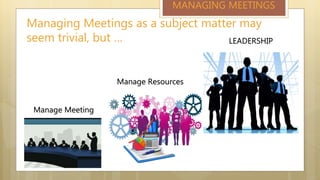
Managing Meetings as a subject matter may
seem trivial, but …
Manage Meeting
Manage Resources
LEADERSHIP
MANAGING MEETINGS
How to LEAD meetings.
Focus Topic
MANAGING MEETINGS
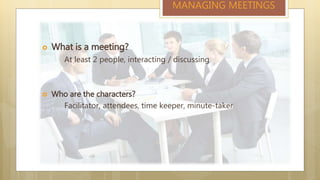
 What is a meeting?
At least 2 people, interacting / discussing
 Who are the characters?
Facilitator, attendees, time keeper, minute-taker
MANAGING MEETINGS
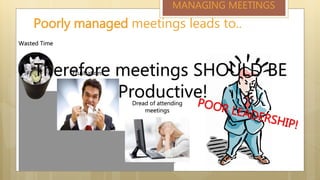
Poorly managed meetings leads to..
MANAGING MEETINGS
Wasted Time
Frustrations
Dread of attending
meetings
Therefore meetings SHOULD BE
Productive!
 To give Team Members an opportunity to learn how to
plan and lead productive meetings
TASK
MANAGING MEETINGS
Program Overview
Participants will have the following opportunities:
 To learn how to plan and conduct meetings to maximize participation
and achieve desired outcomes;
 To increase understanding of the differences between task and
interpersonal issues in a group;
 To build confidence in the use of effective meeting leadership
practices.
DESIRED OUTCOME
MANAGING MEETINGS
Program Overview
The TASK is the purpose of the meeting or the reason why the
meeting is being held.
The DESIRED OUTCOME is the product or what it is that people
will take away from the meeting.
Difference between Task and Desired Outcome
MANAGING MEETINGS
TASK
and
DESIRED OUTCOME
EXERCISE:
MANAGING MEETINGS
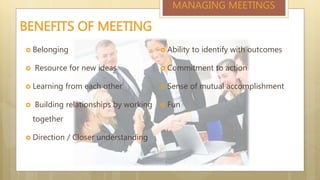
 Belonging
 Resource for new ideas
 Learning from each other
 Building relationships by working
together
 Direction / Closer understanding
BENEFITS OF MEETING
MANAGING MEETINGS
 Ability to identify with outcomes
 Commitment to action
 Sense of mutual accomplishment
 Fun
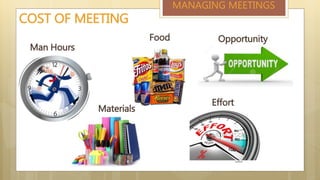
Man Hours
COST OF MEETING
MANAGING MEETINGS
Materials
Effort
Food Opportunity
CONTENT and PROCESS
Content refers to what is talked about at the meeting, the agenda topics,
information, opinions, decisions, action, plans, and the task of the meeting
Process refers to how the meeting proceeds, how the group works together to
accomplish the task and to build and maintain cohesiveness.
MANAGING MEETINGS
1. Planning is all of the things that must be done to prepare
for the meeting.
2. Starting refers to how you set the tone and create the
climate for the meeting.
3. Focusing means keeping the meeting on track.
5 KEYS TO LEADING A MEETING
MANAGING MEETINGS
4. Facilitating refers to the many things a leader can do to involve
participants, be supportive, resolve conflict, and manage
differences.
5. Concluding is the way in which the leader ends the meeting to
assure that participants feel satisfied with the outcome and that
follow-up action will be carried out
5 KEYS TO LEADING A MEETING
MANAGING MEETINGS
1. Clarify the task of the meeting.
2. Define the desired outcome.
3. Design the sequence of meeting activities.
4. Determine who should attend, roles, and ground rules.
5. Decide when to meet, when to end.
6. Determine logistics, equipment, and administrative matters and notify
participants.
7. Complete the agenda.
8. Communicate the agenda to participants.
9. Set up the meeting room.
9 Steps to Planning a Meeting
MANAGING MEETINGS
Checkpoints in Planning a Meeting
MANAGING MEETINGS
1. Task statements.
2. Desired outcomes.
3. Agenda
4. Ground rules.
5. Roles
Starting a meeting..
MANAGING MEETINGS
Minutes are…
MANAGING MEETINGS
Permanent record of discussions
and progress
 Record of next action and PIC
Official record of proceedings of a meeting
Minute taker
MANAGING MEETINGS
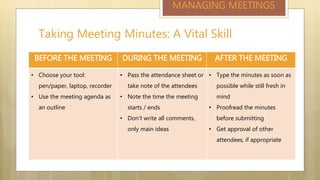
Taking Meeting Minutes: A Vital Skill
MANAGING MEETINGS
BEFORE THE MEETING DURING THE MEETING AFTER THE MEETING
• Choose your tool:
pen/paper, laptop, recorder
• Use the meeting agenda as
an outline
• Pass the attendance sheet or
take note of the attendees
• Note the time the meeting
starts / ends
• Don’t write all comments,
only main ideas
• Type the minutes as soon as
possible while still fresh in
mind
• Proofread the minutes
before submitting
• Get approval of other
attendees, if appropriate
Key Point for Focusing
MANAGING MEETINGS
FOCUSING ON THE TASK
1. Lead the meeting through the agenda. Take charge. It is your
meeting.
2. Introduce each agenda item. Cover time and desired results.
3. Keep the discussion on track by referring to the following
structures:
A. Task
B. Desired Outcome
C. Agenda Items
D. Ground Rules
E. Roles
F. Time Limits
Key Point for Focusing
MANAGING MEETINGS
4. To focus attention, use a chart pad or easel or
other visual aids.
5. Maintain a bin list of important items not
relevant to the present discussion.
6. At the end of each agenda item, briefly:
 Summarize what was accomplished/decided
 Identify unfinished business and what to do
 Check for clarity of agreement
Key Point for Focusing
MANAGING MEETINGS
A meeting leader must:
1. Facilitate participant involvement
2. Deal with conflicts
3. Manage differences
4. Make sure that everyone is heard
5. Keep communications open; and
6. Carry out many other tasks that will help participants to feel as if they
can make a contribution to the meeting and that the meeting was
worthwhile.
Dealing with difficult meeting attendees
MANAGING MEETINGS
1. The Heckler
 Probably insecure, gets satisfaction by needling, aggressive and argumentative
What to do:
 Never get upset
 Find merit, express agreement, move on
 Wait for the misstatement of fact and then throw it out to
the group for correction
Dealing with difficult meeting attendees
MANAGING MEETINGS
2. The Talker / Know All
 An “eager beaver” / chatterbox
 A show-off
 Well-informed and anxious to show it
What to do:
 Wait until he/she takes a breath, thank, refocus and move on
 Slow him/her down with a tough question
 jump in and ask for group comment
Dealing with difficult meeting attendees
MANAGING MEETINGS
Long-windedness has bad effects:
 monopolized meeting time
 turn-off meeting participants
TIPS:
1. Non-verbal STOP sign
2. Non-verbal “A-HA” sign
3. Stronger Stance (“Kiss-Kick-Kiss” method)
Dealing with difficult meeting attendees
MANAGING MEETINGS
3. The Whisperers
 Don’t understand what’s going on – clarifying or translating
 Bored, mischievous or hypercritical
What to do:
 Stop talking, wait for them to look up and “non-verbally” ask for
their permission to continue.
Dealing with difficult meeting attendees
MANAGING MEETINGS
4. The Silent One
 Timid, insecure, shy
 Bored, indifferent
What to do:
 Timid? Ask easy questions; boost his/her ego in discussing answer
 Bored? Ask tough questions; use as helper in exercises
Communication Tips
MANAGING MEETINGS
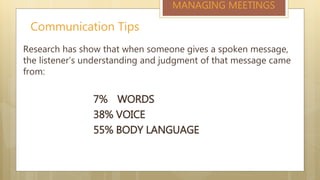
Research has show that when someone gives a spoken message,
the listener’s understanding and judgment of that message came
from:
7% WORDS
38% VOICE
55% BODY LANGUAGE
Concluding a Meeting
MANAGING MEETINGS
1. Summarize what has been accomplished.
2. Compared the accomplishments with the desired
outcomes.
3. Identify unfinished business and suggest ways to address
these issues.
4. Complete the action plan: who will do, what and when
5. Ask for feedback
Q and A
MANAGING MEETINGS
THANK YOU LEADERS!
MANAGING MEETINGS
QUIZ
MANAGING MEETINGS
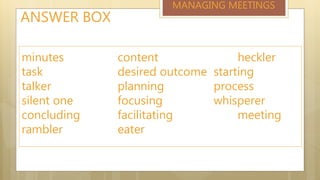
ANSWER BOX
MANAGING MEETINGS
minutes content heckler
task desired outcome starting
talker planning process
silent one focusing whisperer
concluding facilitating meeting
rambler eater

Effective Meeting Management

  • 1.
  • 2.
    YOUR MEETING EXPERIENCES 1.What types of meeting do you usually conduct? 2. What is effective about your meetings? 3. What is ineffective about your meeting? 4. What are the causes of the ineffectiveness? 5. What is the one thing you gain from this program? MANAGING MEETINGS
  • 3.
    Managing Meetings asa subject matter may seem trivial, but … Manage Meeting Manage Resources LEADERSHIP MANAGING MEETINGS
  • 4.
    How to LEADmeetings. Focus Topic MANAGING MEETINGS
  • 5.
     What isa meeting? At least 2 people, interacting / discussing  Who are the characters? Facilitator, attendees, time keeper, minute-taker MANAGING MEETINGS
  • 6.
    Poorly managed meetingsleads to.. MANAGING MEETINGS Wasted Time Frustrations Dread of attending meetings Therefore meetings SHOULD BE Productive!
  • 7.
     To giveTeam Members an opportunity to learn how to plan and lead productive meetings TASK MANAGING MEETINGS Program Overview
  • 8.
    Participants will havethe following opportunities:  To learn how to plan and conduct meetings to maximize participation and achieve desired outcomes;  To increase understanding of the differences between task and interpersonal issues in a group;  To build confidence in the use of effective meeting leadership practices. DESIRED OUTCOME MANAGING MEETINGS Program Overview
  • 9.
    The TASK isthe purpose of the meeting or the reason why the meeting is being held. The DESIRED OUTCOME is the product or what it is that people will take away from the meeting. Difference between Task and Desired Outcome MANAGING MEETINGS
  • 10.
  • 11.
     Belonging  Resourcefor new ideas  Learning from each other  Building relationships by working together  Direction / Closer understanding BENEFITS OF MEETING MANAGING MEETINGS  Ability to identify with outcomes  Commitment to action  Sense of mutual accomplishment  Fun
  • 12.
    Man Hours COST OFMEETING MANAGING MEETINGS Materials Effort Food Opportunity
  • 13.
    CONTENT and PROCESS Contentrefers to what is talked about at the meeting, the agenda topics, information, opinions, decisions, action, plans, and the task of the meeting Process refers to how the meeting proceeds, how the group works together to accomplish the task and to build and maintain cohesiveness. MANAGING MEETINGS
  • 14.
    1. Planning isall of the things that must be done to prepare for the meeting. 2. Starting refers to how you set the tone and create the climate for the meeting. 3. Focusing means keeping the meeting on track. 5 KEYS TO LEADING A MEETING MANAGING MEETINGS
  • 15.
    4. Facilitating refersto the many things a leader can do to involve participants, be supportive, resolve conflict, and manage differences. 5. Concluding is the way in which the leader ends the meeting to assure that participants feel satisfied with the outcome and that follow-up action will be carried out 5 KEYS TO LEADING A MEETING MANAGING MEETINGS
  • 16.
    1. Clarify thetask of the meeting. 2. Define the desired outcome. 3. Design the sequence of meeting activities. 4. Determine who should attend, roles, and ground rules. 5. Decide when to meet, when to end. 6. Determine logistics, equipment, and administrative matters and notify participants. 7. Complete the agenda. 8. Communicate the agenda to participants. 9. Set up the meeting room. 9 Steps to Planning a Meeting MANAGING MEETINGS
  • 17.
    Checkpoints in Planninga Meeting MANAGING MEETINGS
  • 18.
    1. Task statements. 2.Desired outcomes. 3. Agenda 4. Ground rules. 5. Roles Starting a meeting.. MANAGING MEETINGS
  • 19.
    Minutes are… MANAGING MEETINGS Permanentrecord of discussions and progress  Record of next action and PIC Official record of proceedings of a meeting
  • 20.
  • 21.
    Taking Meeting Minutes:A Vital Skill MANAGING MEETINGS BEFORE THE MEETING DURING THE MEETING AFTER THE MEETING • Choose your tool: pen/paper, laptop, recorder • Use the meeting agenda as an outline • Pass the attendance sheet or take note of the attendees • Note the time the meeting starts / ends • Don’t write all comments, only main ideas • Type the minutes as soon as possible while still fresh in mind • Proofread the minutes before submitting • Get approval of other attendees, if appropriate
  • 22.
    Key Point forFocusing MANAGING MEETINGS FOCUSING ON THE TASK 1. Lead the meeting through the agenda. Take charge. It is your meeting. 2. Introduce each agenda item. Cover time and desired results. 3. Keep the discussion on track by referring to the following structures: A. Task B. Desired Outcome C. Agenda Items D. Ground Rules E. Roles F. Time Limits
  • 23.
    Key Point forFocusing MANAGING MEETINGS 4. To focus attention, use a chart pad or easel or other visual aids. 5. Maintain a bin list of important items not relevant to the present discussion. 6. At the end of each agenda item, briefly:  Summarize what was accomplished/decided  Identify unfinished business and what to do  Check for clarity of agreement
  • 24.
    Key Point forFocusing MANAGING MEETINGS A meeting leader must: 1. Facilitate participant involvement 2. Deal with conflicts 3. Manage differences 4. Make sure that everyone is heard 5. Keep communications open; and 6. Carry out many other tasks that will help participants to feel as if they can make a contribution to the meeting and that the meeting was worthwhile.
  • 25.
    Dealing with difficultmeeting attendees MANAGING MEETINGS 1. The Heckler  Probably insecure, gets satisfaction by needling, aggressive and argumentative What to do:  Never get upset  Find merit, express agreement, move on  Wait for the misstatement of fact and then throw it out to the group for correction
  • 26.
    Dealing with difficultmeeting attendees MANAGING MEETINGS 2. The Talker / Know All  An “eager beaver” / chatterbox  A show-off  Well-informed and anxious to show it What to do:  Wait until he/she takes a breath, thank, refocus and move on  Slow him/her down with a tough question  jump in and ask for group comment
  • 27.
    Dealing with difficultmeeting attendees MANAGING MEETINGS Long-windedness has bad effects:  monopolized meeting time  turn-off meeting participants TIPS: 1. Non-verbal STOP sign 2. Non-verbal “A-HA” sign 3. Stronger Stance (“Kiss-Kick-Kiss” method)
  • 28.
    Dealing with difficultmeeting attendees MANAGING MEETINGS 3. The Whisperers  Don’t understand what’s going on – clarifying or translating  Bored, mischievous or hypercritical What to do:  Stop talking, wait for them to look up and “non-verbally” ask for their permission to continue.
  • 29.
    Dealing with difficultmeeting attendees MANAGING MEETINGS 4. The Silent One  Timid, insecure, shy  Bored, indifferent What to do:  Timid? Ask easy questions; boost his/her ego in discussing answer  Bored? Ask tough questions; use as helper in exercises
  • 30.
    Communication Tips MANAGING MEETINGS Researchhas show that when someone gives a spoken message, the listener’s understanding and judgment of that message came from: 7% WORDS 38% VOICE 55% BODY LANGUAGE
  • 31.
    Concluding a Meeting MANAGINGMEETINGS 1. Summarize what has been accomplished. 2. Compared the accomplishments with the desired outcomes. 3. Identify unfinished business and suggest ways to address these issues. 4. Complete the action plan: who will do, what and when 5. Ask for feedback
  • 32.
  • 33.
  • 34.
  • 35.
    ANSWER BOX MANAGING MEETINGS minutescontent heckler task desired outcome starting talker planning process silent one focusing whisperer concluding facilitating meeting rambler eater

Editor's Notes

  • #2 Good morning/afternoon everyone! Thank you for attending todays training about how to manage meetings effectively. Most of the attendees always conduct meetings. What is the importance of having a meeting for you?
  • #3 To start the training, let us first answer the following questions regarding meetings.
  • #4 Managing meetings may be trivial but if we are able to manage meetings effectively, we can also manage resources which can lead to effective leadership.
  • #5 How do we LEAD meetings?
  • #6 A meeting is a gathering of two or more people that has been convened for the purpose of achieving a common goal through verbal interaction, such as sharing information or reaching agreement
  • #8 To give you an overview, this is the task of managing meetings training.
  • #10 Now, let us differentiate task and desired outcome.
  • #11 As PCO/SO As Admins As GRM’s As Customer Relation Officer
  • #12 The following are the benefits of meeting
  • #19 Samples of task statements: to identify the knowledge, skills and attributes the new set of kaizen champions need to have or develop to carry out their functions effectively. Desired outcome: List of KSA’s for the new kaizen champions / development plan Agenda: Define functions and roles of kaizen champions / Possible development method / Preparation of development plan Ground rules: Roles;
  • #20 Decisions are not forgotten when lights are turned off.
  • #25 Also, one of the key point in facilitating an effective meeting can be attributed to the meeting leader.
  • #26 Meetings sometimes become dreadful because of difficult attendees. Let us identify the following attendees. We might know, maybe one of them is you. A heckler is a person who harasses and tries to disconcert others with questions, challenges, or gibes.Hecklers are often known to shout disparaging comments at a performance or event, or to interrupt set-piece speeches, with the intent of disturbing performers and/or participants • Keep your cool- you will never win the argument. Try to win this person over by finding some good reasons to agree with some points.
  • #27 The Talker or Know-It-All has opinions on every subject and states them in a very authoritative manner. Other participants and the trainer find it hard to disagree with or to give help to this person. What to do: Thank the person for his participation and indicate it is time to hear from others. • Tactfully ask the person to give someone else a chance. Acknowledge the person’s expertise or experience and ask permission to call on them for specific examples
  • #28 Take actions when the meeting is being monopolized by the talker.
  • #30 The Silent one is non-participative and passive in the group. This individual does not make an effort to become part of the discussion. They can be also shy, depressed, afraid, tired, or have a negative attitude towards the group, instructor, or the process. Subtly incorporate the person into the group by using her name in hypothetical examples or stories. • Have participants pair off rather than working immediately in large or small groups. This will be more comfortable for the shy person.