






















TIME MANAGEMENT
FORMULAS FOR SUCCESS: USING TIME WISELY
Overview Develop a more clear understanding of strategies for effective time management Develop a greater self-awareness of how you currently use your time
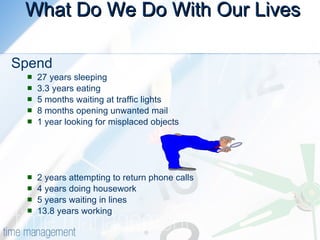
What Do We Do With Our Lives Spend  27 years sleeping 3.3 years eating 5 months waiting at traffic lights 8 months opening unwanted mail 1 year looking for misplaced objects 2 years attempting to return phone calls 4 years doing housework 5 years waiting in lines 13.8 years working
Why aren’t we organized?
Why aren’t we organized? It takes too much time. We don’t know how. We want to do it “perfectly.”
What is the price of  not being organized?
The price of not being organized? Missed goals. Overlooked opportunities. Wasted time. Wasted money.
A Shift In Focus Concentrate on results, not on being busy!
The Rule Many people spend their days in a frenzy of activity that produces few results because they are not concentrating on the right things. The 80:20 Rule 80% of unfocussed effort generates only 20% of results.  The remaining 80% of results are achieved with only 20% of the effort.
Ten Myths about Time
Ten Myths about Time Myth:  Time can be managed.  Myth:  The longer or harder you work the more you  accomplish.  Myth:  If you want something done right, do it yourself.  Myth:  You aren’t supposed to enjoy work.  Myth:  We should take pride in working hard.
Ten Myths about Time Myth:  You should try to do the most in the least amount of time.  Myth:  Technology will help you do it better, faster.  Myth:  Doing one thing at a time will help you succeed.  Myth:  Pay attention to any paperwork that crosses your desk.  Myth:  Get more done and you’ll be happier.
TIME MANAGEMENT,PLANNING,  AND  PRIORITIZATION
The "Three Ps" of Effective  Time Management  Planning.  Priorities.  Procrastination.
PLANNING OR NOT? “ If you don’t know where you’re going, will  any road will get you there?” “ If you don’t know where you’re going, how will you know when you get there?”  Strategic planning solves these problems.
PLANNING
Why Plan? It focuses your thinking on the future  It clarifies your goals and objectives.  It will save time in the long run.
Why Plan? What are some other reasons why you feel you should plan?
How Do I Plan? Beckwith’s Three Cornerstones of Planning - Plus 1 “ Selling the Invisible: A Field Guide to Modern Marketing”  1. Predicting the future.  2. Decide what you want your future to look like. 3. Analyze the results. 4. Implement the plan.
Predicting the future This is hard What results did you expect last year? What does your manager want?  What do your agents want?
2. Decide what you want your future to look like  What will this years result look like? Share your expected result with your team.  Remember to plan for alternative futures.
3. Analyze the results Figure out ways to make sure your future comes out the way you want.
4. Implement the plan The planning process is important, maybe as important as the result. BUT… the object of a plan is to change something—so it MUST be implemented.
PRIORITIZATION Just because you  can  do something doesn’t mean you  should.
You Can— and Should, Say “No”  People take advantage of you only with your permission.
“ it MUST be implemented”
“ it MUST be implemented” What tool can you use to “implement” your plan?
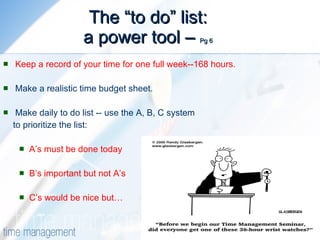
The “to do” list: a power tool –  Pg 6 Keep a record of your time for one full week--168 hours. Make a realistic time budget sheet. Make daily to do list -- use the A, B, C system  to prioritize the list: A’s must be done today B’s important but not A’s C’s would be nice but…
Annual “to do” list  Pg 6 Your annual list should include: Major recurring events/projects Example:  Agency Manager Meetings  Major new projects – major/minor subtasks Example:  Opening new areas, new markets Minor new projects – major/minor subtasks Example: Competitive advantage information
Monthly “to do” list Pg 6 Your monthly list should include: Regular reporting deadlines Example:  monthly production report Important standing meetings Example:  Weekly sales meetings Long-term follow-up ticklers Example:  Performance review for agents
Daily “to do” list Pg 7 Your daily list should include: Meetings Example:  Monday 9:30 a.m. phone clinic Appointments Example:  5:30 p.m. dentist Follow-up phone/email Example:  Return call from Terry W in a.m. Short-term follow-up ticklers Example: Check on pending business
The Roadblock To Time Management Procrastination
Why Do We Procrastinate?
Why Do We Procrastinate? Poor Time Management Difficulty Concentrating Fear and Anxiety Negative Self-beliefs Unrealistic Expectations & Perfectionism
How to Beat Procrastination Recognize when you are procrastinating – become aware of your favorite procrastination tactics and learn to catch yourself as soon as you start to wander off. Break Inertia – do small things to get  yourself started (e.g., make the first phone call, get out of the office, etc)
How to Beat Procrastination 3. Divide activity into small manageable pieces – take one step at a time. Make use of small chunks of time. Making recruiting calls a little may inspire you to do more later. 4. Set reachable sub-goals that are specific –  Making 10 calls now is better than saying I’ll make some calls later.
How to Beat Procrastination 5. Don’t sabotage yourself – set up your environment with as few distractions as possible. Arrange your work day when you have your peak energy and keep going. 6. Reward non-procrastinating behavior – You’ve finally made a dent in that paper work. Give yourself a little reward. 7. Enjoy Your  FREEDOM  – when you complete an unpleasant task, take time and feel how nice it is to have it over and done with.
Hear me Now, Believe me Later Being successful doesn’t make you manage your time well. Managing your time well makes you successful.
Give Yourself Permission to Fail  Failure is okay, if... If you have not failed, it means you have not risked, not challenged yourself.
Be both efficient and effective Efficiency is… Effectiveness is… Too many managers spend lots of time making sure they are doing things right and not enough time determining if they are doing the right things.
The 80/20 Rule Good judgment comes from experience Experience comes from bad judgment
Inspiration “ If you can dream it, you can do it” Walt Disney Disneyland was built in 366 days, from ground-breaking to first day open to the public.
A New Tool to Manage Your Time Agency Desk Calendar
Using Your Calendar
Using Your Calendar Monday – Agent Sales Meeting Phone Techniques Training Scrub/FedEx business Recruiting Calls Agent Reports
Agent Sales Meeting
Sales Meetings   Monday  meeting  Have your turn in prior to meeting starting  Target train, one topic/subject, with the end in mind  Engage others in training
Sales Meetings  Monday  meeting  Purpose: Train for Results
Sales Meetings   Sample Agenda – Introduce new people Recognition – Top 10/5/$ amount Top District – only their producers News & Notes Training – District managers conduct End on a high note - contest
Phone Technique
Phone Technique Training Tell them how to make phone calls: Have necessary tools available Purpose of phone call Schedule the week
Scrub/Fax
Scrubbing New Business   How to ensure your agency submitted business is “clean” - Application All questions initialed by the client when required  Details provided on all YES answers  Complete information is provided for Doctors, Hospitals such as complete address, city, zip code and phone number  Contact information for applicants including alternative contact numbers if needed  Signatures and dates are obtained from applicants and agents
Scrubbing New Business   Forms  Required HIPPA form completed and signed (This is Required in all States)  All State Specific required forms obtained, completed, and signed by applicant, other proposed insured when required and agent (if applicable (ex. BGO (Business Group of One) form completed and signed by Colorado only).
Scrubbing New Business   Premium check payable to American Republic Insurance Company  App signed and completed, copy of voided check or deposit slip attached (if Automatic Payment mode selected)  Credit cards - check with customer and make sure they have enough open credit so the card is not declined when the Home Office runs the amount through
Scrubbing New Business   By checking these items you ensure the smooth submission of your business and the best chance of business being processed and issued.
Recruiting Calls
Recruiting  What are some keys to taking Recruiting?
Recruiting  Ad Calls/Resumes Take calls personally Make the call conversational You are the cookie jar Have them read directions back
Agent Reports
Agent Reports Require agents to call you each  Monday  Evening – This enables you to have a way of holding them accountable Helps you determine if their activity plan is achievable Provides an expected time to coach them about their activity plans
Agent Reports Mondays  5:00 p.m. – 9 p.m. Talk to the agent personally Don’t just let them leave a message Direct communication is preferred Have them report the number of appointments set for the week
Using Your Calendar Tuesday  – Recruiting/Orientation Set Personal Appointments Second Interviews
Recruiting/Orientation
Group Recruiting
Group Recruiting Follow Recruiting Training Manual Give corporate brochure, preliminary interview form out Chair giveaway Collect Preliminary Interview Form at end of Recruiting Schedule second interview  Send Recruiting DVD home
Set Personal Appointments
Set Personal Appointments Make concentrated calls Schedule with training in mind Accept fewer excuses from your agents
Second Interviews
Second Interview Second Interview Schedule after Group Interview Schedule all on same day if possible Use Second Interview Form
Second Interview What happens after the Second Interview?
Second Interview Complete Final Evaluation Checklist for all candidates from second interview Make the job offer Put all paperwork in Personal Folder for hired agents Recruit Referral Bonus for agent
Using Your Calendar Wednesday –  Second Interviews Field Training and Selling Agent Reports
Field Training and Selling
Field Training   Always take agent out on your appointments  Demonstrate different prospecting methods: walk & talk, take one placement, etc  Let them carry the ball  Establish a program for continual follow-through
Keys to Role Playing during Field Training  Teach Agents to:  1. Solve their own problems  2. Be accountable  3. Set goals
Agent Reports -  Wednesday
Agent Reports –  Wednesday Wednesday  5 p.m. – 9 p.m. Number of presentations Number of sales Amount of written business Number of remaining appointments Don’t let them leave a message Direct communication is most effective
Agent Reports –  Wednesday You can help them re-establish/recommit to their goal Use this opportunity to role play and improve their sales skills Catch them doing something right
Using Your Calendar Thursday  - Personal Selling/Field Training – every other week Agent Classroom Training every other week Prepare/place newspaper ad
Agent Classroom Training
Agent Classroom Training  Purpose Teach Agents to:  1. Solve their own problems  2. Be accountable  3. Set goals
Agent Classroom Training Important points  Have material ready in advance Have classroom set up when they arrive Stick to a schedule Plan breaks, snacks, lunch and ending
Agent Classroom Training Stress Key Points Do not try to teach too much at one time Give the agent no more than she or he can handle Set a “High Standard” as you teach and  demonstrate
Newspaper Ad
Recruiting   Recruiting activity: Thursday Place ad in Sunday paper Coverage area Give a time frame for calling Ask for a “tear sheet” Read ad when it comes out Call other ad’s in paper
Using Your Calendar Friday  –  Recruiting Follow-up Agent classroom training – every other week Prepare agent leads Prepare expense reports Final prep for Monday Sales Meeting
Prepare agent leads
Prepare agent leads Review sales potential – share with agent Suggest techniques to work leads – zip code, routing number, phone approach, etc Suggest product/referral options Help new agents put together their activity plan
Prep For Sales Meeting
Sales Meetings  Principles of a good meeting:  Planned, handouts Active participation End on a high note
Sales Meetings  Structure your training presentation into three sections  Tell them what you are going to say, the Opening - 10% of time  Say it - the Body - 80% of time  Tell them what you said - Closing - 10% of time
Sales Meetings  Sample Agenda – Introduce new people Recognition – Top 10/5/$ amount Top District – only their producers News & Notes Training – District managers conduct End on a high note - contest
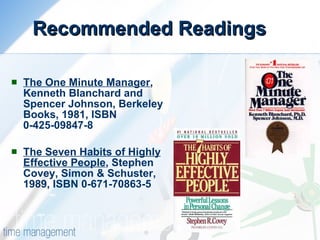
Recommended Readings The One Minute Manager , Kenneth Blanchard and Spencer Johnson, Berkeley Books, 1981, ISBN 0-425-09847-8 The Seven Habits of Highly Effective People , Stephen Covey, Simon & Schuster, 1989, ISBN 0-671-70863-5
The Seven Habits
The Seven Habits  From “The Seven Habits of Highly Effective People:  Restoring the Character Ethic” by Stephen R. Covey, Simon and Schuster, 1989 BE PROACTIVE:  B etween stimulus and response in human beings lies the power to choose .  P roductivity, then, means that we are solely responsible for what happens in our lives .  No fair blaming anyone or anything else.  BEGIN WITH THE END IN MIND:  I magine your funeral and listen to what you would like the eulogist to say about you .  T his should reveal exactly what matters most to you in your life .  U se this frame of reference to make all your day-to-day decisions so that you are working toward your most meaningful life goals .
The Seven Habits 3.  PUT FIRST THINGS FIRST: T o manage our lives effectively, we must keep our mission in mind, understand what’s important as well as urgent, and maintain a balance between what we produce each day and our ability to produce in the future .  Think of the former as putting out fires and the latter as personal development .  4.  THINK WIN/WIN: A greements or solutions among people can be mutually beneficial if all parties cooperate and begin with a belief in the “third alternative”:   a better way that hasn’t been thought of yet.
The Seven Habits SEEK FIRST TO BE UNDERSTANDING, THEN TO BE UNDERSTOOD: Most  people don’t listen .  Not really .  T hey listen long enough to devise a solution to the speaker’s problem or a rejoinder to what’s being said .  Then they dive into the conversation .  Y ou’ll be more effective in your relationships with people if you sincerely try to understand them fully before you try to make them understand your point of view
Seven Habits SYNERGIZE: Just what it sound like . T he whole is greater than the sum of its parts.  In practice, this means you must use “creative cooperation” in social interactions .  Value differences because it is often the clash between them that leads to creative solutions .
Seven Habits SHARPEN THE SAW: T his is the habit of self-renewal, which has four elements .  1.  The first is mental , which includes reading, visualizing, planning and writing.  2.  The second is spiritual , which means value clarification and commitment, study and meditation.  3.  Third is social/emotional , which stress management includes service, empathy, synergy and intrinsic security.  4.  Finally, the physical  includes exercise, nutrition and stress management.
You are always free to change your mind  and choose a different future or a different past. Richard Bach
Argue for your limitations and sure enough they’re yours. Richard Bach

Time Management For Managers

  • 1.
  • 2.
    FORMULAS FOR SUCCESS:USING TIME WISELY
  • 3.
    Overview Develop amore clear understanding of strategies for effective time management Develop a greater self-awareness of how you currently use your time
  • 4.
    What Do WeDo With Our Lives Spend 27 years sleeping 3.3 years eating 5 months waiting at traffic lights 8 months opening unwanted mail 1 year looking for misplaced objects 2 years attempting to return phone calls 4 years doing housework 5 years waiting in lines 13.8 years working
  • 5.
    Why aren’t weorganized?
  • 6.
    Why aren’t weorganized? It takes too much time. We don’t know how. We want to do it “perfectly.”
  • 7.
    What is theprice of not being organized?
  • 8.
    The price ofnot being organized? Missed goals. Overlooked opportunities. Wasted time. Wasted money.
  • 9.
    A Shift InFocus Concentrate on results, not on being busy!
  • 10.
    The Rule Manypeople spend their days in a frenzy of activity that produces few results because they are not concentrating on the right things. The 80:20 Rule 80% of unfocussed effort generates only 20% of results. The remaining 80% of results are achieved with only 20% of the effort.
  • 11.
  • 12.
    Ten Myths aboutTime Myth: Time can be managed. Myth: The longer or harder you work the more you accomplish. Myth: If you want something done right, do it yourself. Myth: You aren’t supposed to enjoy work. Myth: We should take pride in working hard.
  • 13.
    Ten Myths aboutTime Myth: You should try to do the most in the least amount of time. Myth: Technology will help you do it better, faster. Myth: Doing one thing at a time will help you succeed. Myth: Pay attention to any paperwork that crosses your desk. Myth: Get more done and you’ll be happier.
  • 14.
    TIME MANAGEMENT,PLANNING, AND PRIORITIZATION
  • 15.
    The "Three Ps"of Effective Time Management Planning. Priorities. Procrastination.
  • 16.
    PLANNING OR NOT?“ If you don’t know where you’re going, will any road will get you there?” “ If you don’t know where you’re going, how will you know when you get there?” Strategic planning solves these problems.
  • 17.
  • 18.
    Why Plan? Itfocuses your thinking on the future It clarifies your goals and objectives. It will save time in the long run.
  • 19.
    Why Plan? Whatare some other reasons why you feel you should plan?
  • 20.
    How Do IPlan? Beckwith’s Three Cornerstones of Planning - Plus 1 “ Selling the Invisible: A Field Guide to Modern Marketing” 1. Predicting the future. 2. Decide what you want your future to look like. 3. Analyze the results. 4. Implement the plan.
  • 21.
    Predicting the futureThis is hard What results did you expect last year? What does your manager want? What do your agents want?
  • 22.
    2. Decide whatyou want your future to look like What will this years result look like? Share your expected result with your team. Remember to plan for alternative futures.
  • 23.
    3. Analyze theresults Figure out ways to make sure your future comes out the way you want.
  • 24.
    4. Implement theplan The planning process is important, maybe as important as the result. BUT… the object of a plan is to change something—so it MUST be implemented.
  • 25.
    PRIORITIZATION Just becauseyou can do something doesn’t mean you should.
  • 26.
    You Can— andShould, Say “No” People take advantage of you only with your permission.
  • 27.
    “ it MUSTbe implemented”
  • 28.
    “ it MUSTbe implemented” What tool can you use to “implement” your plan?
  • 29.
    The “to do”list: a power tool – Pg 6 Keep a record of your time for one full week--168 hours. Make a realistic time budget sheet. Make daily to do list -- use the A, B, C system to prioritize the list: A’s must be done today B’s important but not A’s C’s would be nice but…
  • 30.
    Annual “to do”list Pg 6 Your annual list should include: Major recurring events/projects Example: Agency Manager Meetings Major new projects – major/minor subtasks Example: Opening new areas, new markets Minor new projects – major/minor subtasks Example: Competitive advantage information
  • 31.
    Monthly “to do”list Pg 6 Your monthly list should include: Regular reporting deadlines Example: monthly production report Important standing meetings Example: Weekly sales meetings Long-term follow-up ticklers Example: Performance review for agents
  • 32.
    Daily “to do”list Pg 7 Your daily list should include: Meetings Example: Monday 9:30 a.m. phone clinic Appointments Example: 5:30 p.m. dentist Follow-up phone/email Example: Return call from Terry W in a.m. Short-term follow-up ticklers Example: Check on pending business
  • 33.
    The Roadblock ToTime Management Procrastination
  • 34.
    Why Do WeProcrastinate?
  • 35.
    Why Do WeProcrastinate? Poor Time Management Difficulty Concentrating Fear and Anxiety Negative Self-beliefs Unrealistic Expectations & Perfectionism
  • 36.
    How to BeatProcrastination Recognize when you are procrastinating – become aware of your favorite procrastination tactics and learn to catch yourself as soon as you start to wander off. Break Inertia – do small things to get yourself started (e.g., make the first phone call, get out of the office, etc)
  • 37.
    How to BeatProcrastination 3. Divide activity into small manageable pieces – take one step at a time. Make use of small chunks of time. Making recruiting calls a little may inspire you to do more later. 4. Set reachable sub-goals that are specific – Making 10 calls now is better than saying I’ll make some calls later.
  • 38.
    How to BeatProcrastination 5. Don’t sabotage yourself – set up your environment with as few distractions as possible. Arrange your work day when you have your peak energy and keep going. 6. Reward non-procrastinating behavior – You’ve finally made a dent in that paper work. Give yourself a little reward. 7. Enjoy Your FREEDOM – when you complete an unpleasant task, take time and feel how nice it is to have it over and done with.
  • 39.
    Hear me Now,Believe me Later Being successful doesn’t make you manage your time well. Managing your time well makes you successful.
  • 40.
    Give Yourself Permissionto Fail Failure is okay, if... If you have not failed, it means you have not risked, not challenged yourself.
  • 41.
    Be both efficientand effective Efficiency is… Effectiveness is… Too many managers spend lots of time making sure they are doing things right and not enough time determining if they are doing the right things.
  • 42.
    The 80/20 RuleGood judgment comes from experience Experience comes from bad judgment
  • 43.
    Inspiration “ Ifyou can dream it, you can do it” Walt Disney Disneyland was built in 366 days, from ground-breaking to first day open to the public.
  • 44.
    A New Toolto Manage Your Time Agency Desk Calendar
  • 45.
  • 46.
    Using Your CalendarMonday – Agent Sales Meeting Phone Techniques Training Scrub/FedEx business Recruiting Calls Agent Reports
  • 47.
  • 48.
    Sales Meetings Monday meeting Have your turn in prior to meeting starting Target train, one topic/subject, with the end in mind Engage others in training
  • 49.
    Sales Meetings Monday meeting Purpose: Train for Results
  • 50.
    Sales Meetings Sample Agenda – Introduce new people Recognition – Top 10/5/$ amount Top District – only their producers News & Notes Training – District managers conduct End on a high note - contest
  • 51.
  • 52.
    Phone Technique TrainingTell them how to make phone calls: Have necessary tools available Purpose of phone call Schedule the week
  • 53.
  • 54.
    Scrubbing New Business How to ensure your agency submitted business is “clean” - Application All questions initialed by the client when required Details provided on all YES answers Complete information is provided for Doctors, Hospitals such as complete address, city, zip code and phone number Contact information for applicants including alternative contact numbers if needed Signatures and dates are obtained from applicants and agents
  • 55.
    Scrubbing New Business Forms Required HIPPA form completed and signed (This is Required in all States) All State Specific required forms obtained, completed, and signed by applicant, other proposed insured when required and agent (if applicable (ex. BGO (Business Group of One) form completed and signed by Colorado only).
  • 56.
    Scrubbing New Business Premium check payable to American Republic Insurance Company App signed and completed, copy of voided check or deposit slip attached (if Automatic Payment mode selected) Credit cards - check with customer and make sure they have enough open credit so the card is not declined when the Home Office runs the amount through
  • 57.
    Scrubbing New Business By checking these items you ensure the smooth submission of your business and the best chance of business being processed and issued.
  • 58.
  • 59.
    Recruiting Whatare some keys to taking Recruiting?
  • 60.
    Recruiting AdCalls/Resumes Take calls personally Make the call conversational You are the cookie jar Have them read directions back
  • 61.
  • 62.
    Agent Reports Requireagents to call you each Monday Evening – This enables you to have a way of holding them accountable Helps you determine if their activity plan is achievable Provides an expected time to coach them about their activity plans
  • 63.
    Agent Reports Mondays 5:00 p.m. – 9 p.m. Talk to the agent personally Don’t just let them leave a message Direct communication is preferred Have them report the number of appointments set for the week
  • 64.
    Using Your CalendarTuesday – Recruiting/Orientation Set Personal Appointments Second Interviews
  • 65.
  • 66.
  • 67.
    Group Recruiting FollowRecruiting Training Manual Give corporate brochure, preliminary interview form out Chair giveaway Collect Preliminary Interview Form at end of Recruiting Schedule second interview Send Recruiting DVD home
  • 68.
  • 69.
    Set Personal AppointmentsMake concentrated calls Schedule with training in mind Accept fewer excuses from your agents
  • 70.
  • 71.
    Second Interview SecondInterview Schedule after Group Interview Schedule all on same day if possible Use Second Interview Form
  • 72.
    Second Interview Whathappens after the Second Interview?
  • 73.
    Second Interview CompleteFinal Evaluation Checklist for all candidates from second interview Make the job offer Put all paperwork in Personal Folder for hired agents Recruit Referral Bonus for agent
  • 74.
    Using Your CalendarWednesday – Second Interviews Field Training and Selling Agent Reports
  • 75.
  • 76.
    Field Training Always take agent out on your appointments Demonstrate different prospecting methods: walk & talk, take one placement, etc Let them carry the ball Establish a program for continual follow-through
  • 77.
    Keys to RolePlaying during Field Training Teach Agents to: 1. Solve their own problems 2. Be accountable 3. Set goals
  • 78.
    Agent Reports - Wednesday
  • 79.
    Agent Reports – Wednesday Wednesday 5 p.m. – 9 p.m. Number of presentations Number of sales Amount of written business Number of remaining appointments Don’t let them leave a message Direct communication is most effective
  • 80.
    Agent Reports – Wednesday You can help them re-establish/recommit to their goal Use this opportunity to role play and improve their sales skills Catch them doing something right
  • 81.
    Using Your CalendarThursday - Personal Selling/Field Training – every other week Agent Classroom Training every other week Prepare/place newspaper ad
  • 82.
  • 83.
    Agent Classroom Training Purpose Teach Agents to: 1. Solve their own problems 2. Be accountable 3. Set goals
  • 84.
    Agent Classroom TrainingImportant points Have material ready in advance Have classroom set up when they arrive Stick to a schedule Plan breaks, snacks, lunch and ending
  • 85.
    Agent Classroom TrainingStress Key Points Do not try to teach too much at one time Give the agent no more than she or he can handle Set a “High Standard” as you teach and demonstrate
  • 86.
  • 87.
    Recruiting Recruiting activity: Thursday Place ad in Sunday paper Coverage area Give a time frame for calling Ask for a “tear sheet” Read ad when it comes out Call other ad’s in paper
  • 88.
    Using Your CalendarFriday – Recruiting Follow-up Agent classroom training – every other week Prepare agent leads Prepare expense reports Final prep for Monday Sales Meeting
  • 89.
  • 90.
    Prepare agent leadsReview sales potential – share with agent Suggest techniques to work leads – zip code, routing number, phone approach, etc Suggest product/referral options Help new agents put together their activity plan
  • 91.
  • 92.
    Sales Meetings Principles of a good meeting: Planned, handouts Active participation End on a high note
  • 93.
    Sales Meetings Structure your training presentation into three sections Tell them what you are going to say, the Opening - 10% of time Say it - the Body - 80% of time Tell them what you said - Closing - 10% of time
  • 94.
    Sales Meetings Sample Agenda – Introduce new people Recognition – Top 10/5/$ amount Top District – only their producers News & Notes Training – District managers conduct End on a high note - contest
  • 95.
    Recommended Readings TheOne Minute Manager , Kenneth Blanchard and Spencer Johnson, Berkeley Books, 1981, ISBN 0-425-09847-8 The Seven Habits of Highly Effective People , Stephen Covey, Simon & Schuster, 1989, ISBN 0-671-70863-5
  • 96.
  • 97.
    The Seven Habits From “The Seven Habits of Highly Effective People: Restoring the Character Ethic” by Stephen R. Covey, Simon and Schuster, 1989 BE PROACTIVE: B etween stimulus and response in human beings lies the power to choose . P roductivity, then, means that we are solely responsible for what happens in our lives . No fair blaming anyone or anything else. BEGIN WITH THE END IN MIND: I magine your funeral and listen to what you would like the eulogist to say about you . T his should reveal exactly what matters most to you in your life . U se this frame of reference to make all your day-to-day decisions so that you are working toward your most meaningful life goals .
  • 98.
    The Seven Habits3. PUT FIRST THINGS FIRST: T o manage our lives effectively, we must keep our mission in mind, understand what’s important as well as urgent, and maintain a balance between what we produce each day and our ability to produce in the future . Think of the former as putting out fires and the latter as personal development . 4. THINK WIN/WIN: A greements or solutions among people can be mutually beneficial if all parties cooperate and begin with a belief in the “third alternative”: a better way that hasn’t been thought of yet.
  • 99.
    The Seven HabitsSEEK FIRST TO BE UNDERSTANDING, THEN TO BE UNDERSTOOD: Most people don’t listen . Not really . T hey listen long enough to devise a solution to the speaker’s problem or a rejoinder to what’s being said . Then they dive into the conversation . Y ou’ll be more effective in your relationships with people if you sincerely try to understand them fully before you try to make them understand your point of view
  • 100.
    Seven Habits SYNERGIZE:Just what it sound like . T he whole is greater than the sum of its parts. In practice, this means you must use “creative cooperation” in social interactions . Value differences because it is often the clash between them that leads to creative solutions .
  • 101.
    Seven Habits SHARPENTHE SAW: T his is the habit of self-renewal, which has four elements . 1. The first is mental , which includes reading, visualizing, planning and writing. 2. The second is spiritual , which means value clarification and commitment, study and meditation. 3. Third is social/emotional , which stress management includes service, empathy, synergy and intrinsic security. 4. Finally, the physical includes exercise, nutrition and stress management.
  • 102.
    You are alwaysfree to change your mind and choose a different future or a different past. Richard Bach
  • 103.
    Argue for yourlimitations and sure enough they’re yours. Richard Bach

Editor's Notes

  • #7 Time: being disorganized takes even more time. Know how: learn how or hire someone. Sometimes, good enough is good enough. Perfect is seldom justified.
  • #13 Only tasks can be managed. It’s better to work efficiently. You have to delegate. You can’t do it all. If you don’t enjoy it, find something else to do. We should take pride in working smart.
  • #14 6. Do things right. 7.It may, but also encourages us to do things that don’t need doing. 8.Multitask. 9. Never pick up a piece of paper without doing something to get it off your desk. 10. No, you’ll only get more done.
  • #16 Planning: If you don’t have time for planning, you’d better find the time. Priorities: Not everything you do is of equal importance. Priorities are not constant, they must e re-evaluated. Procrastination: The anti-Nike – just don’t do it.
  • #19 It focuses your thinking on the future. It clarifies your goals and objectives. It will save time in the long run. It helps you avoid doing things that are not in your best interest. It helps you justify (to others) where you spend your time. It provides a framework for policy formulation and decision-making. It can help support your case for funding. It identifies critical issues and constraints. It can help keep you on course.
  • #22 This is hard Look at the environment. Corporate culture. Competitors. Information needs of users. Mandates from the community (management, accrediting). Unmet market niches. What did last year’s strategic plan say? What does your boss or organization want? What do your users want?
  • #41 you learn from it. you failed because a higher priority task came up. you did not get the resources you needed (such as cooperation from someone else).
  • #42 Efficiency: is completing a task with the least possible amount of wasted labor, cash, or time. Effectiveness is doing what will make the most difference. Too many businesses spend lots of time making sure they are doing things right and not enough determining if they are doing the right things. Doing the wrong things right is the epitome of wasted time.. Doing the right things right is the epitome of time management.
  • #47 Pencil meetings in, you can always erase them. Followup: such as, call Mr. Jones re search. Write dates for filing, etc. You can have satellite calendars, but one must be the master.