May 17th, 2016
Less Pain More Gain:
Best Practices for More
Effective Meetings
2
Meeting Best Practices
3
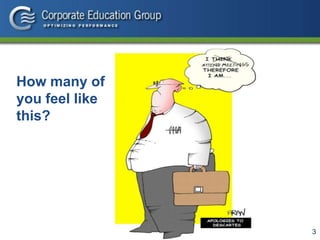
How many of
you feel like
this?
4
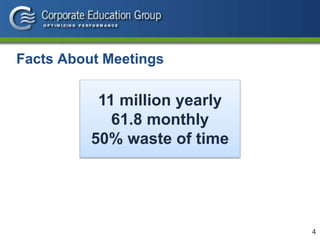
11 million yearly
61.8 monthly
50% waste of time
Facts About Meetings
5
Facts About Meetings
6
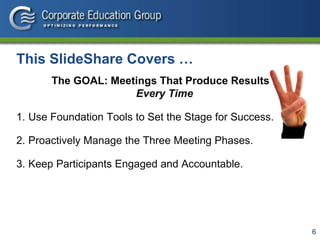
This SlideShare Covers …
The GOAL: Meetings That Produce Results
Every Time
1. Use Foundation Tools to Set the Stage for Success.
2. Proactively Manage the Three Meeting Phases.
3. Keep Participants Engaged and Accountable.
7
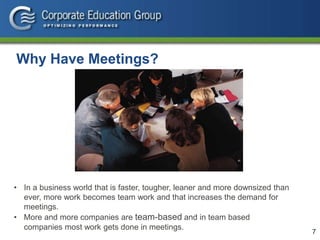
Why Have Meetings?
• In a business world that is faster, tougher, leaner and more downsized than
ever, more work becomes team work and that increases the demand for
meetings.
• More and more companies are team-based and in team based
companies most work gets done in meetings.
8
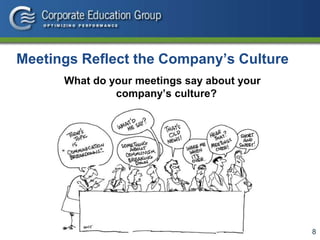
Meetings Reflect the Company’s Culture
What do your meetings say about your
company’s culture?
9
How do meetings impact your company?
• Meetings are the most universal and – and universally despised
part of business life.
• William R. Daniel, senior consultant at American Consulting and
Training of Mill Valley, California is adamant about the real
stakes: bad meetings make bad companies.
• “Meetings matter because that’s where an organization’s
culture perpetuates Itself,” he says. “Meetings are how an
organization says, ‘You are a member,’ Bad meetings are a
source of negative messages about our company and
ourselves.”
10
Seven Sins of Deadly Meetings
Identified by Fast Company:
#1: People don’t take meetings seriously.
Solution: Adopt Intel’s mind-set that meetings are real work.
#2: Meetings are too long.
Solution: Time is money. Track the cost of your meetings.
Meetings should last no longer than 90 minutes.
#3: People wander off the topic.
Solution: Get serious about agendas and store distractions in a
“parking lot.”
11
Seven Sins of Deadly Meetings
#4: Nothing happens once the meeting ends.
Solution: Convert from “meeting” to “doing.”
#5: People don’t tell the truth.
Solution: Embrace anonymity. Work on building trust.
#6: Missing information that is important for decision
making.
Solution: Get data into meeting rooms. Plan and prepare.
12
Seven Sins of Deadly Meetings
#7: Meetings never get better.
Solution: Practice makes perfect. Monitor what works and what
doesn’t. Take feedback seriously.
Tip: Good meetings aren’t just about work,
they are about fun – keeping people charged up.
13
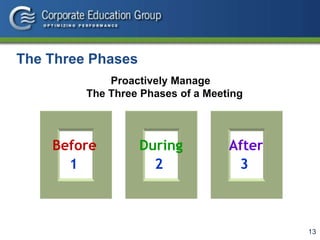
The Three Phases
Proactively Manage
The Three Phases of a Meeting
Before During After
1 2 3
14
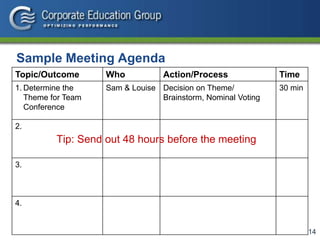
Sample Meeting Agenda
Topic/Outcome Who Action/Process Time
1. Determine the
Theme for Team
Conference
Sam & Louise Decision on Theme/
Brainstorm, Nominal Voting
30 min
2.
3.
4.
Tip: Send out 48 hours before the meeting
15
Manage the Three Phases
Conducting the Meeting
During
2
16
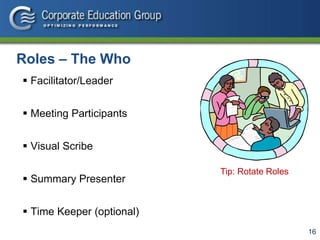
Roles – The Who
 Facilitator/Leader
 Meeting Participants
 Visual Scribe
 Summary Presenter
 Time Keeper (optional)
Tip: Rotate Roles
17
Roles – The Who
 Having clearly defined and assigned roles in meetings
contribute to its effectiveness. When roles are not
clarified and there is confusion about roles things do not
get done or they risk getting done poorly.
 There is the tendency for some project managers to do it
all – let people share the ownership of meeting it is great
for engagement and eliciting participation.
18
Set the Stage for Success
Use Foundation Tools
19
The Three Foundation Tools
1. Goals, Roles and Process
2. Agenda with Time Frames
3. Ground Rules
20
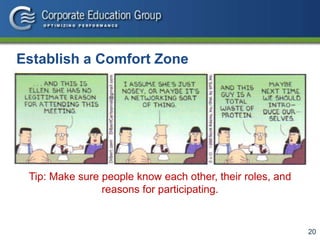
Tip: Make sure people know each other, their roles, and
reasons for participating.
Establish a Comfort Zone
21
Closing the Meeting
 Recap and clarify actions to be taken (what, who, when).
 Summarize results of meeting, including agreements
and decisions made.
 Thank people and reinforce positive contributions.
22
Manage the Three Phases
After the Meeting
After
3
23
After the Meeting
 Prepare and distribute meeting notes.
 Take actions agreed to.
 Monitor results, follow up as needed.
 Use feedback/evaluation to improve next meeting.
24
After the Meeting
Template for meeting notes:
 Date, time, location of the meeting
 Names of members and guests
 List of key outcomes
 List of key outcomes and decisions
 Action items: what, who, when
 Links to or attachments of relevant documents
 Next meeting date, time, and location
Tip: Send out within 24 hrs.
25
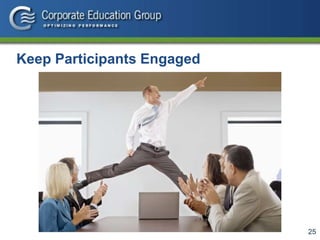
Keep Participants Engaged
26
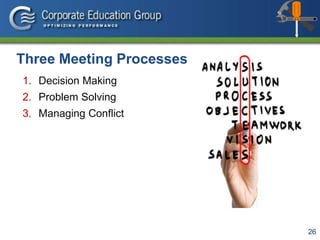
Three Meeting Processes
1. Decision Making
2. Problem Solving
3. Managing Conflict
27
Facilitation Skills and Behaviors
What works?
28
Prevention techniques are used before or during
team meetings which prevent the team from
getting off track with respect to either content or
process.
Prevention Techniques
29
Prevention Techniques
 GRP
 Agenda
 Ground Rules
30
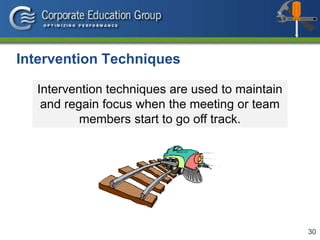
Intervention techniques are used to maintain
and regain focus when the meeting or team
members start to go off track.
Intervention Techniques
31
Intervention Techniques
Types of intervention:
 Boomerang
 Say what’s going on
 Enforce process agreements
 Accept/legitimize/deal with or defer
 Use body language
 Use humor
32
How would you rate your meetings on a scale
of 1-10? (10 being the best).
1……2……3……4……5……6……7……8……9……10
What will you do to improve the quality of
your meetings?
Meeting Quality Evaluation
33
Keep Participants Engaged and Accountable
Purpose, Direction and Meaning
– People need from their leaders a sense of purpose, direction, and meaning.
– They need to understand the connection between their individual and team
contribution and their organization’s vision, purpose and goals.
Trust
– People need to trust their leaders, their capacity to do their job, their competence.
– They need to believe that their leaders will stand by them when the going gets
tough.
– They need to feel their leaders care about them and empathize with them.
Optimism
– People need optimism and hope from their leaders, a belief that through their
combined efforts they can create new realities and overcome any obstacle.
Action and Results
– People need leaders who share their knowledge and expertise, are willing to make
difficult decisions, have a bias toward action, and the ability to get results.
34
The Goal
Meetings That Produce Results
Every Time
1. Use Foundation Tools to Set the Stage for Success.
2. Proactively Manage the Three Meeting Phases.
3. Keep Participants Engaged and Accountable.

Best Practices for Running More Effective Meetings

  • 1.
    May 17th, 2016 LessPain More Gain: Best Practices for More Effective Meetings
  • 2.
  • 3.
    3 How many of youfeel like this?
  • 4.
    4 11 million yearly 61.8monthly 50% waste of time Facts About Meetings
  • 5.
  • 6.
    6 This SlideShare Covers… The GOAL: Meetings That Produce Results Every Time 1. Use Foundation Tools to Set the Stage for Success. 2. Proactively Manage the Three Meeting Phases. 3. Keep Participants Engaged and Accountable.
  • 7.
    7 Why Have Meetings? •In a business world that is faster, tougher, leaner and more downsized than ever, more work becomes team work and that increases the demand for meetings. • More and more companies are team-based and in team based companies most work gets done in meetings.
  • 8.
    8 Meetings Reflect theCompany’s Culture What do your meetings say about your company’s culture?
  • 9.
    9 How do meetingsimpact your company? • Meetings are the most universal and – and universally despised part of business life. • William R. Daniel, senior consultant at American Consulting and Training of Mill Valley, California is adamant about the real stakes: bad meetings make bad companies. • “Meetings matter because that’s where an organization’s culture perpetuates Itself,” he says. “Meetings are how an organization says, ‘You are a member,’ Bad meetings are a source of negative messages about our company and ourselves.”
  • 10.
    10 Seven Sins ofDeadly Meetings Identified by Fast Company: #1: People don’t take meetings seriously. Solution: Adopt Intel’s mind-set that meetings are real work. #2: Meetings are too long. Solution: Time is money. Track the cost of your meetings. Meetings should last no longer than 90 minutes. #3: People wander off the topic. Solution: Get serious about agendas and store distractions in a “parking lot.”
  • 11.
    11 Seven Sins ofDeadly Meetings #4: Nothing happens once the meeting ends. Solution: Convert from “meeting” to “doing.” #5: People don’t tell the truth. Solution: Embrace anonymity. Work on building trust. #6: Missing information that is important for decision making. Solution: Get data into meeting rooms. Plan and prepare.
  • 12.
    12 Seven Sins ofDeadly Meetings #7: Meetings never get better. Solution: Practice makes perfect. Monitor what works and what doesn’t. Take feedback seriously. Tip: Good meetings aren’t just about work, they are about fun – keeping people charged up.
  • 13.
    13 The Three Phases ProactivelyManage The Three Phases of a Meeting Before During After 1 2 3
  • 14.
    14 Sample Meeting Agenda Topic/OutcomeWho Action/Process Time 1. Determine the Theme for Team Conference Sam & Louise Decision on Theme/ Brainstorm, Nominal Voting 30 min 2. 3. 4. Tip: Send out 48 hours before the meeting
  • 15.
    15 Manage the ThreePhases Conducting the Meeting During 2
  • 16.
    16 Roles – TheWho  Facilitator/Leader  Meeting Participants  Visual Scribe  Summary Presenter  Time Keeper (optional) Tip: Rotate Roles
  • 17.
    17 Roles – TheWho  Having clearly defined and assigned roles in meetings contribute to its effectiveness. When roles are not clarified and there is confusion about roles things do not get done or they risk getting done poorly.  There is the tendency for some project managers to do it all – let people share the ownership of meeting it is great for engagement and eliciting participation.
  • 18.
    18 Set the Stagefor Success Use Foundation Tools
  • 19.
    19 The Three FoundationTools 1. Goals, Roles and Process 2. Agenda with Time Frames 3. Ground Rules
  • 20.
    20 Tip: Make surepeople know each other, their roles, and reasons for participating. Establish a Comfort Zone
  • 21.
    21 Closing the Meeting Recap and clarify actions to be taken (what, who, when).  Summarize results of meeting, including agreements and decisions made.  Thank people and reinforce positive contributions.
  • 22.
    22 Manage the ThreePhases After the Meeting After 3
  • 23.
    23 After the Meeting Prepare and distribute meeting notes.  Take actions agreed to.  Monitor results, follow up as needed.  Use feedback/evaluation to improve next meeting.
  • 24.
    24 After the Meeting Templatefor meeting notes:  Date, time, location of the meeting  Names of members and guests  List of key outcomes  List of key outcomes and decisions  Action items: what, who, when  Links to or attachments of relevant documents  Next meeting date, time, and location Tip: Send out within 24 hrs.
  • 25.
  • 26.
    26 Three Meeting Processes 1.Decision Making 2. Problem Solving 3. Managing Conflict
  • 27.
    27 Facilitation Skills andBehaviors What works?
  • 28.
    28 Prevention techniques areused before or during team meetings which prevent the team from getting off track with respect to either content or process. Prevention Techniques
  • 29.
    29 Prevention Techniques  GRP Agenda  Ground Rules
  • 30.
    30 Intervention techniques areused to maintain and regain focus when the meeting or team members start to go off track. Intervention Techniques
  • 31.
    31 Intervention Techniques Types ofintervention:  Boomerang  Say what’s going on  Enforce process agreements  Accept/legitimize/deal with or defer  Use body language  Use humor
  • 32.
    32 How would yourate your meetings on a scale of 1-10? (10 being the best). 1……2……3……4……5……6……7……8……9……10 What will you do to improve the quality of your meetings? Meeting Quality Evaluation
  • 33.
    33 Keep Participants Engagedand Accountable Purpose, Direction and Meaning – People need from their leaders a sense of purpose, direction, and meaning. – They need to understand the connection between their individual and team contribution and their organization’s vision, purpose and goals. Trust – People need to trust their leaders, their capacity to do their job, their competence. – They need to believe that their leaders will stand by them when the going gets tough. – They need to feel their leaders care about them and empathize with them. Optimism – People need optimism and hope from their leaders, a belief that through their combined efforts they can create new realities and overcome any obstacle. Action and Results – People need leaders who share their knowledge and expertise, are willing to make difficult decisions, have a bias toward action, and the ability to get results.
  • 34.
    34 The Goal Meetings ThatProduce Results Every Time 1. Use Foundation Tools to Set the Stage for Success. 2. Proactively Manage the Three Meeting Phases. 3. Keep Participants Engaged and Accountable.

Editor's Notes

  • #4 Richard Collard, senior manager of network operations at Federal Express is simply exasperated: “We just meet and meet and meet and we never seem to do anything.” Meetings are the most universal – and universally despised – part of business life. 11 million meetings occur in the US daily. Most professionals attend 61.8 meetings monthly and 50% of meetings are considered a waste of time.
  • #8 In a business world that is faster, tougher, leaner and more downsized than ever, more work becomes team work and that increases the demand for meetings. More and more companies are team-based and in team based Companies most work gets done in meetings.
  • #9 Meetings are the most universal and – and universally despised part of Business life. William R. Daniesl , senior consultant at American Consulting and Training of Mill Valley, California is adamant about the real stakes: bad meetings make Bad companies. “Meetings matter because that’s where an organization’s culture perpetuates Itself,” he says. “Meetings are how an organization says, ‘You are a member,’ Bad meetings are a source of negative messages about our company and ourselves.”
  • #10 In a business world that is faster, tougher, leaner and more downsized than ever, more work becomes team work and that increases the demand for meetings. More and more companies are team-based and in team based Companies most work gets done in meetings.
  • #14 What if we can change this ? We need to – meetings matter because that is where an organization’s culture perpetuates itself, meetings are the vehicle we Use to really connect and collaborate. Today the business world is faster, tougher , leaner and more downsized than ever, the sheer demands of competition , not to mention the impact of e-mail and groupware) the need for meetings is not decreasing it is increasing. As more work becomes team work and fewer People remain to do the work that exists, the number of meetings are increasing rather than decreasing. More and more companies are team- based and as team-based companies most work gets done in meetings.
  • #17 Having clearly defined and assigned roles in meetings contribute to its effectiveness. When roles are not clarified and there is confusion about role sometimes things do not get done or done poorly. How many of you clearly define roles ? One way of developing accountability and participation is to rotate role, There is the tendency for some project managers to do it all – let people share the ownership of meeting it is great for engagement and eliciting participation.
  • #18 Having clearly defined and assigned roles in meetings contribute to its effectiveness. When roles are not clarified and there is confusion about role sometimes things do not get done or done poorly. How many of you clearly define roles ? One way of developing accountability and participation is to rotate role, There is the tendency for some project managers to do it all – let people share the ownership of meeting it is great for engagement and eliciting participation.
  • #19 We are going to start with the best practice of using foundation tools – the foundation you set is critical to the success of your meeting.
  • #33  Purpose, Direction and Meaning People need from their leaders a sense of purpose, direction, and meaning. They need to understand the connection between their individual and team contribution and their organization’s vision, purpose and goals. Trust People need to trust their leaders, their capacity to do their job, their competence. They need to believe that their leaders will stand by them when the going gets tough. They need to feel their leaders care about them and empathize with them. Optimism People need optimism and hope from their leaders, a belief that through their combined efforts they can create new realities and overcome any obstacle. Action and Results People need leaders who share their knowledge and expertise, are willing to make difficult decisions, have a bias toward action, and the ability to get results.