Why do we meet?
 Meeting is a necessary evil ?
 What are some of your opinions for why do
we have meetings?
 Create a list of all the meetings that you take
part in (or that you know of)
 Create a list of what you believe is right or
wrong with those meetings
Impact of Effective Meetings
(Why do I care?)
 Professional Development &
Career impacts
 Use of precious resources
 Higher Ed and Collaboration
Resource Impacts
$ One of the most expensive forms of workplace
communication
$ Multiply number of attendees x hourly rate x (length
of meeting, travel time and prep time)
$ Balance against outcome(s) and alternatives
$ Carefully consider length, attendees and frequency
How to conduct effective meetings
 Meeting types
 Information exchange
 Collaboration session
 Planning
 Decisions
 More….
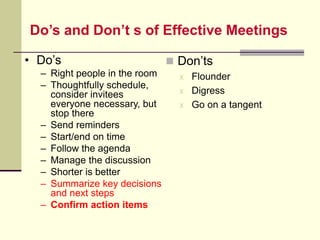
Do’s and Don’t s of Effective Meetings
• Do’s
– Right people in the room
– Thoughtfully schedule,
consider invitees
everyone necessary, but
stop there
– Send reminders
– Start/end on time
– Follow the agenda
– Manage the discussion
– Shorter is better
– Summarize key decisions
and next steps
– Confirm action items
 Don’ts
X Flounder
X Digress
X Go on a tangent
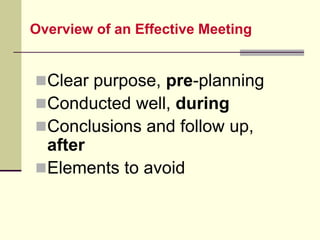
Overview of an Effective Meeting
Clear purpose, pre-planning
Conducted well, during
Conclusions and follow up,
after
Elements to avoid
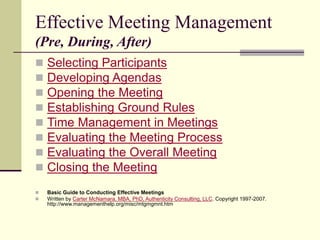
Effective Meeting Management
(Pre, During, After)
 Selecting Participants
 Developing Agendas
 Opening the Meeting
 Establishing Ground Rules
 Time Management in Meetings
 Evaluating the Meeting Process
 Evaluating the Overall Meeting
 Closing the Meeting
 Basic Guide to Conducting Effective Meetings
 Written by Carter McNamara, MBA, PhD, Authenticity Consulting, LLC. Copyright 1997-2007.
http://www.managementhelp.org/misc/mtgmgmnt.htm
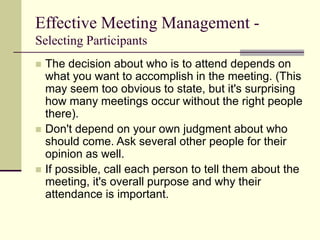
Effective Meeting Management -
Selecting Participants
 The decision about who is to attend depends on
what you want to accomplish in the meeting. (This
may seem too obvious to state, but it's surprising
how many meetings occur without the right people
there).
 Don't depend on your own judgment about who
should come. Ask several other people for their
opinion as well.
 If possible, call each person to tell them about the
meeting, it's overall purpose and why their
attendance is important.
Effective Meeting Management –
Selecting Participants
 Follow-up your call with a meeting notice, including
the purpose of the meeting, where it will be held
and when, the list of participants and whom to
contact if they have questions.
 Send out a copy of the proposed agenda along
with the meeting notice.
 Have someone designated to record important
actions, assignments and due dates during the
meeting. Distribute the notes to all participants
shortly after the meeting.
Effective Meeting Management -
Developing Agendas
 Develop the agenda together with key participants
in the meeting.
 Think of what overall outcome you want from the meeting
and what activities need to occur to reach that outcome.
 The agenda should be organized so that these
activities are conducted during the meeting.
 In the agenda, state the overall outcome that you
want from the meeting
 Design the agenda so that participants get involved
early by having something for them to do right
away and so they come on time.
Effective Meeting Management -
Developing Agendas
 Next to each major topic,
 include the type of action needed,
 the type of output expected (decision, vote, action
assigned to someone)
 time estimates for addressing each topic
 Ask participants if they'll commit to the agenda.
 Keep the agenda posted at all times.
 Don't overly design meetings; be willing to adapt
the meeting agenda
 Think about how you label an event, so people
come in with that mindset;.
Effective Meeting Management -
Opening Meetings
 Always start on time; this respects those who showed up on
time and reminds late-comers that the scheduling is serious.
 Welcome attendees and thank them for their time.
 Review the agenda at the beginning of each meeting, giving
participants a chance to understand all proposed major
topics, change them and accept them.
 Note that a meeting recorder if used will take minutes and
provide them back to each participant shortly after the
meeting.
 Model the kind of energy and contribution needed by
meeting participants.
 Clarify your role(s) in the meeting.
Effective Meeting Management -
Establishing Ground Rules for Meetings
 It pays to have a few basic ground rules that can be used for
most of your meetings. These ground rules cultivate the
basic ingredients needed for a successful meeting.
 Four powerful ground rules are:
 participate, get focus, maintain momentum and reach
closure. (You may want a ground rule about confidentiality.)
 List your primary ground rules on the agenda.
 If you have new attendees who are not used to your
meetings, you might review each ground rule.
 Keep the ground rules posted at all times.
Effective Meeting Management –
Time Management
 One of the most difficult facilitation tasks is time
management
 Time seems to run out before tasks are completed.
Therefore, the biggest challenge is keeping momentum to
keep the process moving.
 You might ask attendees to help you keep track of the time.
 If the planned time on the agenda is getting out of hand,
present it to the group and ask for their input as to a
resolution. .
Effective Meeting Management -
Evaluations of Meeting Process
 People will often complain about a meeting being a complete
waste of time -- but they only say so after the meeting.
 Get their feedback during the meeting when you can
improve the meeting process right away. Evaluating a
meeting only at the end of the meeting is usually too late to
do anything about participants' feedback.
 Every couple of hours, conduct 5-10 minutes "satisfaction
checks".
 In a round-table approach, quickly have each participant
indicate how they think the meeting is going.
Effective Meeting Management -
Evaluating the Overall Meeting
 Leave 5-10 minutes at the end of the meeting to
evaluate the meeting; don't skip this portion of the
meeting.
 Have each member rank the meeting from 1-5,
with 5 as the highest, and have each member
explain their ranking
 Have the chief executive rank the meeting last.
Effective Meeting Management –
Closing meetings
 Always end meetings on time and attempt to end
on a positive note.
· At the end of a meeting, review actions and
assignments, and set the time for the next meeting
and ask each person if they can make it or not (to
get their commitment)
· Clarify that meeting minutes and/or actions will be
reported back to members in at most a week (this
helps to keep momentum going).
Why do have problems with meetings?
 Meetings have different time duration
 30 minutes
 1 hour
 3 hour
 Full day
 How come we can enjoy a TV show or a
movie but think meeting is a drag ?
Death by a meeting
 Patrick M. Lencioni , makes the point that
having a meeting to simply gain consensus or
worst--give status--can be deadly.
 But just like a good movie, having conflict and
tension and resolution can make everyone
more engaged and interested.
Death by a meeting
 Is it Daily Check-In?
 Weekly Tactical?
 Monthly Strategic?
 OR Quarterly Off-site Review?
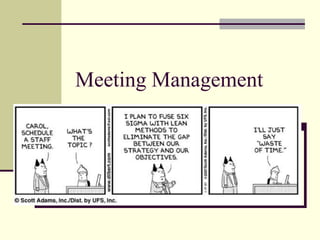
Meeting Management
Summary
1. Meetings matter. Necessary and cost-effective done
well.
2. Pre-planning is an investment.
3. Conducting a meeting includes tending to culture,
discussion, agenda, facilitation, environment, timing
and outcomes. Experience helps.
4. Conclusion/follow-up is good stewardship of the
investment. Minutes, summary, action items with
time/person accountability and scheduling next steps
protect the investment.
5. Know what can make a meeting ineffective and
avoid.
6. Facilitation training valuable.

Meeting management

  • 1.
    Why do wemeet?  Meeting is a necessary evil ?  What are some of your opinions for why do we have meetings?  Create a list of all the meetings that you take part in (or that you know of)  Create a list of what you believe is right or wrong with those meetings
  • 2.
    Impact of EffectiveMeetings (Why do I care?)  Professional Development & Career impacts  Use of precious resources  Higher Ed and Collaboration
  • 3.
    Resource Impacts $ Oneof the most expensive forms of workplace communication $ Multiply number of attendees x hourly rate x (length of meeting, travel time and prep time) $ Balance against outcome(s) and alternatives $ Carefully consider length, attendees and frequency
  • 4.
    How to conducteffective meetings  Meeting types  Information exchange  Collaboration session  Planning  Decisions  More….
  • 5.
    Do’s and Don’ts of Effective Meetings • Do’s – Right people in the room – Thoughtfully schedule, consider invitees everyone necessary, but stop there – Send reminders – Start/end on time – Follow the agenda – Manage the discussion – Shorter is better – Summarize key decisions and next steps – Confirm action items  Don’ts X Flounder X Digress X Go on a tangent
  • 6.
    Overview of anEffective Meeting Clear purpose, pre-planning Conducted well, during Conclusions and follow up, after Elements to avoid
  • 7.
    Effective Meeting Management (Pre,During, After)  Selecting Participants  Developing Agendas  Opening the Meeting  Establishing Ground Rules  Time Management in Meetings  Evaluating the Meeting Process  Evaluating the Overall Meeting  Closing the Meeting  Basic Guide to Conducting Effective Meetings  Written by Carter McNamara, MBA, PhD, Authenticity Consulting, LLC. Copyright 1997-2007. http://www.managementhelp.org/misc/mtgmgmnt.htm
  • 8.
    Effective Meeting Management- Selecting Participants  The decision about who is to attend depends on what you want to accomplish in the meeting. (This may seem too obvious to state, but it's surprising how many meetings occur without the right people there).  Don't depend on your own judgment about who should come. Ask several other people for their opinion as well.  If possible, call each person to tell them about the meeting, it's overall purpose and why their attendance is important.
  • 9.
    Effective Meeting Management– Selecting Participants  Follow-up your call with a meeting notice, including the purpose of the meeting, where it will be held and when, the list of participants and whom to contact if they have questions.  Send out a copy of the proposed agenda along with the meeting notice.  Have someone designated to record important actions, assignments and due dates during the meeting. Distribute the notes to all participants shortly after the meeting.
  • 10.
    Effective Meeting Management- Developing Agendas  Develop the agenda together with key participants in the meeting.  Think of what overall outcome you want from the meeting and what activities need to occur to reach that outcome.  The agenda should be organized so that these activities are conducted during the meeting.  In the agenda, state the overall outcome that you want from the meeting  Design the agenda so that participants get involved early by having something for them to do right away and so they come on time.
  • 11.
    Effective Meeting Management- Developing Agendas  Next to each major topic,  include the type of action needed,  the type of output expected (decision, vote, action assigned to someone)  time estimates for addressing each topic  Ask participants if they'll commit to the agenda.  Keep the agenda posted at all times.  Don't overly design meetings; be willing to adapt the meeting agenda  Think about how you label an event, so people come in with that mindset;.
  • 12.
    Effective Meeting Management- Opening Meetings  Always start on time; this respects those who showed up on time and reminds late-comers that the scheduling is serious.  Welcome attendees and thank them for their time.  Review the agenda at the beginning of each meeting, giving participants a chance to understand all proposed major topics, change them and accept them.  Note that a meeting recorder if used will take minutes and provide them back to each participant shortly after the meeting.  Model the kind of energy and contribution needed by meeting participants.  Clarify your role(s) in the meeting.
  • 13.
    Effective Meeting Management- Establishing Ground Rules for Meetings  It pays to have a few basic ground rules that can be used for most of your meetings. These ground rules cultivate the basic ingredients needed for a successful meeting.  Four powerful ground rules are:  participate, get focus, maintain momentum and reach closure. (You may want a ground rule about confidentiality.)  List your primary ground rules on the agenda.  If you have new attendees who are not used to your meetings, you might review each ground rule.  Keep the ground rules posted at all times.
  • 14.
    Effective Meeting Management– Time Management  One of the most difficult facilitation tasks is time management  Time seems to run out before tasks are completed. Therefore, the biggest challenge is keeping momentum to keep the process moving.  You might ask attendees to help you keep track of the time.  If the planned time on the agenda is getting out of hand, present it to the group and ask for their input as to a resolution. .
  • 15.
    Effective Meeting Management- Evaluations of Meeting Process  People will often complain about a meeting being a complete waste of time -- but they only say so after the meeting.  Get their feedback during the meeting when you can improve the meeting process right away. Evaluating a meeting only at the end of the meeting is usually too late to do anything about participants' feedback.  Every couple of hours, conduct 5-10 minutes "satisfaction checks".  In a round-table approach, quickly have each participant indicate how they think the meeting is going.
  • 16.
    Effective Meeting Management- Evaluating the Overall Meeting  Leave 5-10 minutes at the end of the meeting to evaluate the meeting; don't skip this portion of the meeting.  Have each member rank the meeting from 1-5, with 5 as the highest, and have each member explain their ranking  Have the chief executive rank the meeting last.
  • 17.
    Effective Meeting Management– Closing meetings  Always end meetings on time and attempt to end on a positive note. · At the end of a meeting, review actions and assignments, and set the time for the next meeting and ask each person if they can make it or not (to get their commitment) · Clarify that meeting minutes and/or actions will be reported back to members in at most a week (this helps to keep momentum going).
  • 18.
    Why do haveproblems with meetings?  Meetings have different time duration  30 minutes  1 hour  3 hour  Full day  How come we can enjoy a TV show or a movie but think meeting is a drag ?
  • 19.
    Death by ameeting  Patrick M. Lencioni , makes the point that having a meeting to simply gain consensus or worst--give status--can be deadly.  But just like a good movie, having conflict and tension and resolution can make everyone more engaged and interested.
  • 20.
    Death by ameeting  Is it Daily Check-In?  Weekly Tactical?  Monthly Strategic?  OR Quarterly Off-site Review?
  • 21.
  • 22.
    Summary 1. Meetings matter.Necessary and cost-effective done well. 2. Pre-planning is an investment. 3. Conducting a meeting includes tending to culture, discussion, agenda, facilitation, environment, timing and outcomes. Experience helps. 4. Conclusion/follow-up is good stewardship of the investment. Minutes, summary, action items with time/person accountability and scheduling next steps protect the investment. 5. Know what can make a meeting ineffective and avoid. 6. Facilitation training valuable.