TIME MANAGEMENT
What About it Causes Stress &
     Strategies to Fix It
                 PRESENTED BY:
            Cara Grassie, President
      Cara A. Grassie Communications, Inc.
Be a Difference Maker
http://www.youtube.com/watch?v=eqX7pShNrt0&feature=BF&list=U
                   Lv7aWEKn_RKk&index=18
Introduction
 • Service driven offices often have
   challenging demands on staffs’ time
 • Do you have days when you are
   overwhelmed by your daily to-do list &
   can’t complete the necessary tasks?
 • How often does this happen?
 • By managing time wisely you can reduce
   your general stress level and positively
   impact your health
Agenda
• Define areas where time stressors build
• Share strategies to avoid these stressors
• Open discussion
• Tips to reduce the stress of time
  management
Vocabulary
• Stress (noun)
   − the physical pressure, pull, or other force exerted on one
     thing by another; strain
   − physical, mental, or emotional strain or tension

• Time (noun)
   − the system of those sequential relations that any event has to
     any other, as past, present, or future; indefinite and
     continuous duration regarded as that in which events succeed
     one another
   − a limited period or interval, as between two successive events

• Manage (verb)
   − to handle, direct, govern, or control in action or use
                                        Reference: http://dictionary.reference.com/
Time is Fixed – How We Use it Is Not
• There are seven days in a week
• 28-31 days in a month, depending on the year
  and month, and
• Approximately 365.24 days in a year.
                   http://wiki.answers.com/Q/How_many_days_in_a_week_month_and_year#ixzz1IPdrrlho


• 1 day= 86,400 seconds
• 1 week=604,800 seconds
• 1month=2,629,743.83 seconds
• 1 year=31,556,926 seconds
  http://wiki.answers.com/Q/How_many_seconds_are_in_a_day_a_week_a_month_and_a_year#ixzz1IPdaq9br
Exercise – Part 1
• Take a moment to think about ALL your tasks
  during your day
• Write down on a sheet of paper:
  − things you do on a daily basis aside from tasks you
    are supposed to carry out as part of your job
  − i.e. classes, tea/coffee breaks, social media, etc.

• Scribble on different parts of the sheet rather
  than making a list
Exercise – Part II
• Now start tearing off bits of paper each
  containing one “time waster”
• What is left of the paper after tearing
  off all the “time wasters” is the actual
  time to carry out your tasks
Exercise – Part III
• How does that make you feel?
• Which of the slips of paper on the table
  are your worst time bandits?
• Why?
• What are some possible solutions?
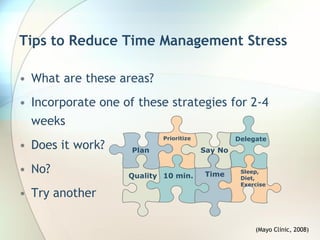
Tips to Reduce Time Management Stress

• What are these areas?
• Incorporate one of these strategies for 2-4
  weeks
                           Prioritize            Delegate
• Does it work?     Plan                Say No

• No?              Quality 10 min.      Time      Sleep,
                                                  Diet,
                                                  Exercise
• Try another

                                                      (Mayo Clinic, 2008)
Simple Stress Test

• Hand out
• Stress Test Scores
  1.   you could be stressed
  2.   you are probably stressed
  3.   you are almost certainly stressed
  4.   or more - you are definitely stressed

  NOTE:   If you score high in this simple test you should seek help. It's a simple
          test which for some people will be a bit of fun. If it's not fun for you
          do something about it.
Effective Time Management
• By managing your time more wisely, you
  can minimize stress and improve your
  quality of life.
• How do you stay on track when
  organizational skills don't come
  naturally?
PLAN each day
• Accomplish more, feel more control of
  your life
• Write a to-do list, putting the most
  important tasks at the top
• Keep a schedule of daily activities
• One project on your desk at a time

                                        (Mayo Clinic, 2008)
PRIORITIZE your tasks
• Spend time on what’s important
• Time-consuming, but relatively
  unimportant, tasks can consume your
  day
• Block out time on your calendar for big
  projects
• Close your door, turn off your phone,
  pager and e-mail                   (Mayo Clinic, 2008)
Say NO to nonessential tasks.
• Consider your goals and schedule before
  agreeing to take on additional work
• DELEGATE
  − Take a look at your to-do list and consider
    what you can pass on to someone else
  − Be thoughtful in what you delegate and who
    you delegate it to

                                          (Mayo Clinic, 2008)
QUALITY over Quantity
• Take the time needed to do a quality job
• There’s never time to do it right – But
  there’s always time to do it over
• Break large, time-consuming tasks into
  smaller tasks


                                     (Mayo Clinic, 2008)
10 MINUTE Rule
• Commit to giving 10 minutes to the
  projects you don’t want to start
• That’s usually enough to get interested
  in a project
• You may find you can finish it


                                    (Mayo Clinic, 2008)
Where is your TIME spent?

• Log everything you do for three days to
  determine how you're spending your
  time
• Look for time that can be used more
  wisely and free up time to exercise or
  spend with family or friends

                                     (Mayo Clinic, 2008)
Pay Attention to Your Health
• Simple steps lead to great strides
  − Get plenty of sleep, have a healthy diet and
    exercise regularly
  − A healthy lifestyle helps improve your
    efficiency
• When you need a break, take one.
  − Take your lunch away from your desk
  − Take a walk
  − Do some quick stretches at your
    workstation.                          (Mayo Clinic, 2008)
Summary
• Know where your “time bandits” are
  lurking
• Once identified apply one or more of the
  strategies to take the knock them out of
  your day
• Be assertive and mindful of your
  personal needs
STAY FOCUSED
http://www.youtube.com/watch?v=8-
     EpuP8p870&feature=related
References
Answers.com. (2011). How many days in a week month and year? Retrieved from:
    http://wiki.answers.com/Q/How_many_days_in_a_week_month_and_year#ixzz1IPfyfAn6
Answers.com. (2011). How many seconds are in a day a week a month and a year? Retrieved from:
    http://wiki.answers.com/Q/How_many_seconds_are_in_a_day_a_week_a_month_and_a_year#ixzz1I
    PgFShrs
Be a Difference Maker. YouTube. 12 Jan. 2011.
    http://www.youtube.com/watch?v=eqX7pShNrt0&feature=BF&list=ULv7aWEKn_RKk&index=18
Chapman, A. (2006). The “Poor Workplace Health”. Retrieved from
    http://www.businessballs.com/stressmanagement.htm#stress%20test%20questions

Dictionary.com, LLC. (2011). Retrieved from http://dictionary.reference.com/

Hicks, T., & Miller, E. (2006). College Life Styles, Life Stressors and Health Status: Differences along
    Gender Lines. Journal of College Admission, (192), 22-29. Retrieved from http://www.nacacnet.org

Mayo Clinic. (2009). Being assertive: Reduce stress, communicate better. Retrieved from
    http://www.mayoclinic.com/health/assertive/SR00042/METHOD=print#

Mayo Clinic. (2008). Time management: Tips to reduce stress and improve productivity. Retrieved from
    http://www.mayoclinic.com/health/time-management/WL00048/METHOD=print

Slater, R. (2006). Time Bandits. Retrieved from http://www.trainingzone.co.uk/item/149676

Stay Focused. YouTube. 26 Aug. 2007. http://www.youtube.com/watch?v=8-EpuP8p870&feature=related

Training Presentation Time Management

  • 1.
    TIME MANAGEMENT What Aboutit Causes Stress & Strategies to Fix It PRESENTED BY: Cara Grassie, President Cara A. Grassie Communications, Inc.
  • 2.
    Be a DifferenceMaker http://www.youtube.com/watch?v=eqX7pShNrt0&feature=BF&list=U Lv7aWEKn_RKk&index=18
  • 3.
    Introduction • Servicedriven offices often have challenging demands on staffs’ time • Do you have days when you are overwhelmed by your daily to-do list & can’t complete the necessary tasks? • How often does this happen? • By managing time wisely you can reduce your general stress level and positively impact your health
  • 4.
    Agenda • Define areaswhere time stressors build • Share strategies to avoid these stressors • Open discussion • Tips to reduce the stress of time management
  • 5.
    Vocabulary • Stress (noun) − the physical pressure, pull, or other force exerted on one thing by another; strain − physical, mental, or emotional strain or tension • Time (noun) − the system of those sequential relations that any event has to any other, as past, present, or future; indefinite and continuous duration regarded as that in which events succeed one another − a limited period or interval, as between two successive events • Manage (verb) − to handle, direct, govern, or control in action or use Reference: http://dictionary.reference.com/
  • 6.
    Time is Fixed– How We Use it Is Not • There are seven days in a week • 28-31 days in a month, depending on the year and month, and • Approximately 365.24 days in a year. http://wiki.answers.com/Q/How_many_days_in_a_week_month_and_year#ixzz1IPdrrlho • 1 day= 86,400 seconds • 1 week=604,800 seconds • 1month=2,629,743.83 seconds • 1 year=31,556,926 seconds http://wiki.answers.com/Q/How_many_seconds_are_in_a_day_a_week_a_month_and_a_year#ixzz1IPdaq9br
  • 7.
    Exercise – Part1 • Take a moment to think about ALL your tasks during your day • Write down on a sheet of paper: − things you do on a daily basis aside from tasks you are supposed to carry out as part of your job − i.e. classes, tea/coffee breaks, social media, etc. • Scribble on different parts of the sheet rather than making a list
  • 8.
    Exercise – PartII • Now start tearing off bits of paper each containing one “time waster” • What is left of the paper after tearing off all the “time wasters” is the actual time to carry out your tasks
  • 9.
    Exercise – PartIII • How does that make you feel? • Which of the slips of paper on the table are your worst time bandits? • Why? • What are some possible solutions?
  • 10.
    Tips to ReduceTime Management Stress • What are these areas? • Incorporate one of these strategies for 2-4 weeks Prioritize Delegate • Does it work? Plan Say No • No? Quality 10 min. Time Sleep, Diet, Exercise • Try another (Mayo Clinic, 2008)
  • 11.
    Simple Stress Test •Hand out • Stress Test Scores 1. you could be stressed 2. you are probably stressed 3. you are almost certainly stressed 4. or more - you are definitely stressed NOTE: If you score high in this simple test you should seek help. It's a simple test which for some people will be a bit of fun. If it's not fun for you do something about it.
  • 12.
    Effective Time Management •By managing your time more wisely, you can minimize stress and improve your quality of life. • How do you stay on track when organizational skills don't come naturally?
  • 13.
    PLAN each day •Accomplish more, feel more control of your life • Write a to-do list, putting the most important tasks at the top • Keep a schedule of daily activities • One project on your desk at a time (Mayo Clinic, 2008)
  • 14.
    PRIORITIZE your tasks •Spend time on what’s important • Time-consuming, but relatively unimportant, tasks can consume your day • Block out time on your calendar for big projects • Close your door, turn off your phone, pager and e-mail (Mayo Clinic, 2008)
  • 15.
    Say NO tononessential tasks. • Consider your goals and schedule before agreeing to take on additional work • DELEGATE − Take a look at your to-do list and consider what you can pass on to someone else − Be thoughtful in what you delegate and who you delegate it to (Mayo Clinic, 2008)
  • 16.
    QUALITY over Quantity •Take the time needed to do a quality job • There’s never time to do it right – But there’s always time to do it over • Break large, time-consuming tasks into smaller tasks (Mayo Clinic, 2008)
  • 17.
    10 MINUTE Rule •Commit to giving 10 minutes to the projects you don’t want to start • That’s usually enough to get interested in a project • You may find you can finish it (Mayo Clinic, 2008)
  • 18.
    Where is yourTIME spent? • Log everything you do for three days to determine how you're spending your time • Look for time that can be used more wisely and free up time to exercise or spend with family or friends (Mayo Clinic, 2008)
  • 19.
    Pay Attention toYour Health • Simple steps lead to great strides − Get plenty of sleep, have a healthy diet and exercise regularly − A healthy lifestyle helps improve your efficiency • When you need a break, take one. − Take your lunch away from your desk − Take a walk − Do some quick stretches at your workstation. (Mayo Clinic, 2008)
  • 20.
    Summary • Know whereyour “time bandits” are lurking • Once identified apply one or more of the strategies to take the knock them out of your day • Be assertive and mindful of your personal needs
  • 21.
  • 22.
    References Answers.com. (2011). Howmany days in a week month and year? Retrieved from: http://wiki.answers.com/Q/How_many_days_in_a_week_month_and_year#ixzz1IPfyfAn6 Answers.com. (2011). How many seconds are in a day a week a month and a year? Retrieved from: http://wiki.answers.com/Q/How_many_seconds_are_in_a_day_a_week_a_month_and_a_year#ixzz1I PgFShrs Be a Difference Maker. YouTube. 12 Jan. 2011. http://www.youtube.com/watch?v=eqX7pShNrt0&feature=BF&list=ULv7aWEKn_RKk&index=18 Chapman, A. (2006). The “Poor Workplace Health”. Retrieved from http://www.businessballs.com/stressmanagement.htm#stress%20test%20questions Dictionary.com, LLC. (2011). Retrieved from http://dictionary.reference.com/ Hicks, T., & Miller, E. (2006). College Life Styles, Life Stressors and Health Status: Differences along Gender Lines. Journal of College Admission, (192), 22-29. Retrieved from http://www.nacacnet.org Mayo Clinic. (2009). Being assertive: Reduce stress, communicate better. Retrieved from http://www.mayoclinic.com/health/assertive/SR00042/METHOD=print# Mayo Clinic. (2008). Time management: Tips to reduce stress and improve productivity. Retrieved from http://www.mayoclinic.com/health/time-management/WL00048/METHOD=print Slater, R. (2006). Time Bandits. Retrieved from http://www.trainingzone.co.uk/item/149676 Stay Focused. YouTube. 26 Aug. 2007. http://www.youtube.com/watch?v=8-EpuP8p870&feature=related