TIME MANAGEMENT
What would have
been a scenario, if
we could have a
control on time !
HOW TO ACHIEVE MORE
WITH YOUR TIME
• INTRODUCTION
• HOW MUCH IS YOUR TIME WORTH?
• HOW DO YOU SPEND YOUR TIME NOW?
• HOW SHOULD YOU USE YOUR TIME?
• USING TIME MORE EFFECTIVELY
• CREATING MORE TIME
• AVOIDING DISTRACTIONS
INTRODUCTION
• WHY TIME MANAGEMENT?
• WHAT WILL WE GAIN BY
ADOPTING TIME
MANAGEMENT SKILLS?
• WHAT ROLE DOES ATTITUDE
PLAY IN MANAGING TIME?
• WHY DON’T PEOPLE MANAGE
THEIR TIME?
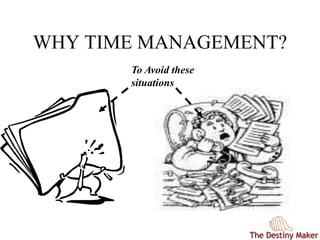
WHY TIME MANAGEMENT?
To Avoid these
situations
GAIN BY LEARNING TIME
MANAGEMENT SKILLS
You will learn to:
• Make effective use of your time.
• Complete 8 hrs job in 6hrs.
• Control distractions that waste your time.
• Increase Productivity.
• Reduce Stress.
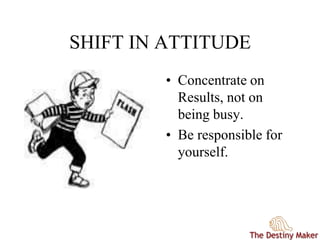
SHIFT IN ATTITUDE
• Concentrate on
Results, not on
being busy.
• Be responsible for
yourself.
WHY DON’T PEOPLE
MANAGE THEIR TIME?
• They don’t know
about it.
• They are too lazy to
plan.
• They enjoy crisis
management.
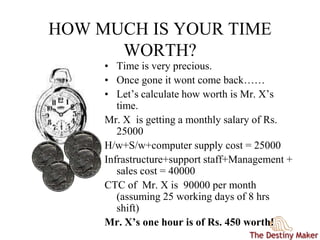
HOW MUCH IS YOUR TIME
WORTH?
• Time is very precious.
• Once gone it wont come back……
• Let’s calculate how worth is Mr. X’s
time.
Mr. X is getting a monthly salary of Rs.
25000
H/w+S/w+computer supply cost = 25000
Infrastructure+support staff+Management +
sales cost = 40000
CTC of Mr. X is 90000 per month
(assuming 25 working days of 8 hrs
shift)
Mr. X’s one hour is of Rs. 450 worth!
HOW DO YOU SPEND YOUR
TIME NOW?
• How to use an
activity log to find
out?
• What is activity log
and how to prepare
it?
• Analyzing your log.
ANALYSING YOUR LOG
OBSERVATION
25% of his time is unproductive.
Confused about priority of his job.
Confused about which job to be taken when.
HOW SHOULD YOU USE
YOUR TIME ?
• Planning:
 Personal Planning
 Project Planning
 Informal Planning
To Do Lists
• Prioritizing Jobs
• Scheduling Jobs
TO DO LISTS
What are To Do Lists?
• To Do Lists are lists of tasks to be carried out to
achieve goals.
How to use To Do Lists?
• List down all the jobs to be done.
• Break them down into their components.
• Allocate priorities.
• Scheduling jobs (Which job to be done when)
USING TIME MORE
EFFECTIVELY !
Eating Patterns, rest
and energy.
• Have good breakfast with
plenty of Carbohydrates
and proteins.
• Don’t take heavy lunch.
• Take rest breaks in
between.
USING TIME MORE
EFFECTIVELY!
Getting the most out of
meetings:
Holding Meetings
• Hold Meeting Only when trigger
events occur.
• Use the agenda effectively.
• Setting the time of meeting.
Attending Meetings
• On time and present only if needed.
• Well prepared and briefed on your
contribution.
• Attentive to the discussion.
• Brief, relevant, focused and courteous
in your interventions
USING TIME MORE EFFECTIVELY!
Using Waiting time
effectively
• Confirm the appointment
the day before.
• Try not to arrive at the
site of the meeting more
than 5 minutes early.
• While you are waiting
keep busy.
USING TIME MORE EFFECTIVELY !
Dropping Task That don’t
benefit you
“If you are carrying out tasks
that are neither cost nor
goal effective, it will
probably be worth trying
to either drop them or
delegate them if possible.”
CREATING MORE TIME
Delegation Skills
Delegation is useful for following reasons:
• Save time.
• Cost effective.
• Develop your colleagues, subordinates.
• Better utilization of skills.
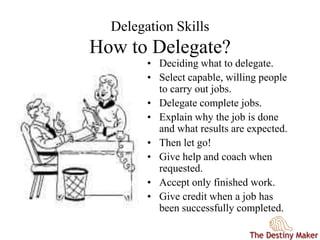
Delegation Skills
How to Delegate?
• Deciding what to delegate.
• Select capable, willing people
to carry out jobs.
• Delegate complete jobs.
• Explain why the job is done
and what results are expected.
• Then let go!
• Give help and coach when
requested.
• Accept only finished work.
• Give credit when a job has
been successfully completed.
Creating extra hours
“If you get up one
hour early for a
year, you have
effectively created
around 10
additional working
weeks”
Avoiding Distractions
• Distraction by casual visitors.
 You do not always need to be
welcoming.
 Letting people know not to distract you.
• Avoiding unnecessary phone calls.
Phone skills
How to be effective on the phone?
• Have an aim.
• Tailor your style to that of the person you are
talking to.
• Limit social conversation.
• Give concise answers to questions.
• If you don’t know an answer, say so.
• At the end of a call, summarize the points made.
• Don’t talk to anyone else when on the phone.
Phone skills
Making phone calls
 Club phone calls.
 Don’t make a call very early or very late.
 If calls are administrative, delegate them..
Taking incoming calls
 The phone should not ring more than 3 times before being
answered.
 Everyone in the organization should have responsibility for
answering phones.
 Always ring back.
SUMMARY
• We started looking at your time management by:
Using an activity log to evaluate your use of time
& your energy levels at different times of the day.
• Knowing how much your time is worth.
• Plan and schedule your job for working
effectively.
• Ways in which you could use your time
effectively.
• We saw how we could create more time
• We looked at controlling distractions that interfere
with effective work.
BY EFFECTIVE USE OF
THESE BASIC SKILLS, YOU
CAN ENSURE THAT:
• You are successful in your job.
• You are productive and therefore secure in
your job.
• You can avoid staying late at work, giving
yourself more quality time to relax and
enjoy life outside work.
www.thedestinymaker.com
Arvind
RaiAstrology & Vastu Expert
+91 7709240111

Time management

  • 1.
    TIME MANAGEMENT What wouldhave been a scenario, if we could have a control on time !
  • 2.
    HOW TO ACHIEVEMORE WITH YOUR TIME • INTRODUCTION • HOW MUCH IS YOUR TIME WORTH? • HOW DO YOU SPEND YOUR TIME NOW? • HOW SHOULD YOU USE YOUR TIME? • USING TIME MORE EFFECTIVELY • CREATING MORE TIME • AVOIDING DISTRACTIONS
  • 3.
    INTRODUCTION • WHY TIMEMANAGEMENT? • WHAT WILL WE GAIN BY ADOPTING TIME MANAGEMENT SKILLS? • WHAT ROLE DOES ATTITUDE PLAY IN MANAGING TIME? • WHY DON’T PEOPLE MANAGE THEIR TIME?
  • 4.
    WHY TIME MANAGEMENT? ToAvoid these situations
  • 5.
    GAIN BY LEARNINGTIME MANAGEMENT SKILLS You will learn to: • Make effective use of your time. • Complete 8 hrs job in 6hrs. • Control distractions that waste your time. • Increase Productivity. • Reduce Stress.
  • 6.
    SHIFT IN ATTITUDE •Concentrate on Results, not on being busy. • Be responsible for yourself.
  • 7.
    WHY DON’T PEOPLE MANAGETHEIR TIME? • They don’t know about it. • They are too lazy to plan. • They enjoy crisis management.
  • 8.
    HOW MUCH ISYOUR TIME WORTH? • Time is very precious. • Once gone it wont come back…… • Let’s calculate how worth is Mr. X’s time. Mr. X is getting a monthly salary of Rs. 25000 H/w+S/w+computer supply cost = 25000 Infrastructure+support staff+Management + sales cost = 40000 CTC of Mr. X is 90000 per month (assuming 25 working days of 8 hrs shift) Mr. X’s one hour is of Rs. 450 worth!
  • 9.
    HOW DO YOUSPEND YOUR TIME NOW? • How to use an activity log to find out? • What is activity log and how to prepare it? • Analyzing your log.
  • 10.
    ANALYSING YOUR LOG OBSERVATION 25%of his time is unproductive. Confused about priority of his job. Confused about which job to be taken when.
  • 11.
    HOW SHOULD YOUUSE YOUR TIME ? • Planning:  Personal Planning  Project Planning  Informal Planning To Do Lists • Prioritizing Jobs • Scheduling Jobs
  • 12.
    TO DO LISTS Whatare To Do Lists? • To Do Lists are lists of tasks to be carried out to achieve goals. How to use To Do Lists? • List down all the jobs to be done. • Break them down into their components. • Allocate priorities. • Scheduling jobs (Which job to be done when)
  • 13.
    USING TIME MORE EFFECTIVELY! Eating Patterns, rest and energy. • Have good breakfast with plenty of Carbohydrates and proteins. • Don’t take heavy lunch. • Take rest breaks in between.
  • 14.
    USING TIME MORE EFFECTIVELY! Gettingthe most out of meetings: Holding Meetings • Hold Meeting Only when trigger events occur. • Use the agenda effectively. • Setting the time of meeting. Attending Meetings • On time and present only if needed. • Well prepared and briefed on your contribution. • Attentive to the discussion. • Brief, relevant, focused and courteous in your interventions
  • 15.
    USING TIME MOREEFFECTIVELY! Using Waiting time effectively • Confirm the appointment the day before. • Try not to arrive at the site of the meeting more than 5 minutes early. • While you are waiting keep busy.
  • 16.
    USING TIME MOREEFFECTIVELY ! Dropping Task That don’t benefit you “If you are carrying out tasks that are neither cost nor goal effective, it will probably be worth trying to either drop them or delegate them if possible.”
  • 17.
    CREATING MORE TIME DelegationSkills Delegation is useful for following reasons: • Save time. • Cost effective. • Develop your colleagues, subordinates. • Better utilization of skills.
  • 18.
    Delegation Skills How toDelegate? • Deciding what to delegate. • Select capable, willing people to carry out jobs. • Delegate complete jobs. • Explain why the job is done and what results are expected. • Then let go! • Give help and coach when requested. • Accept only finished work. • Give credit when a job has been successfully completed.
  • 19.
    Creating extra hours “Ifyou get up one hour early for a year, you have effectively created around 10 additional working weeks”
  • 20.
    Avoiding Distractions • Distractionby casual visitors.  You do not always need to be welcoming.  Letting people know not to distract you. • Avoiding unnecessary phone calls.
  • 21.
    Phone skills How tobe effective on the phone? • Have an aim. • Tailor your style to that of the person you are talking to. • Limit social conversation. • Give concise answers to questions. • If you don’t know an answer, say so. • At the end of a call, summarize the points made. • Don’t talk to anyone else when on the phone.
  • 22.
    Phone skills Making phonecalls  Club phone calls.  Don’t make a call very early or very late.  If calls are administrative, delegate them.. Taking incoming calls  The phone should not ring more than 3 times before being answered.  Everyone in the organization should have responsibility for answering phones.  Always ring back.
  • 23.
    SUMMARY • We startedlooking at your time management by: Using an activity log to evaluate your use of time & your energy levels at different times of the day. • Knowing how much your time is worth. • Plan and schedule your job for working effectively. • Ways in which you could use your time effectively. • We saw how we could create more time • We looked at controlling distractions that interfere with effective work.
  • 24.
    BY EFFECTIVE USEOF THESE BASIC SKILLS, YOU CAN ENSURE THAT: • You are successful in your job. • You are productive and therefore secure in your job. • You can avoid staying late at work, giving yourself more quality time to relax and enjoy life outside work.
  • 25.