How to run effective
meetings
Abdulla Aziz
International University of Erbil
http://ue.edu.krd/
abdulla.aziz@ue.edu.krd
objectives
After completing this section, students are expected to:
• Know the functions of a meeting
• Be able to prepare for a meeting
• Be familiar with the dos and don’ts
• Learn how to write after meeting reports and follow ups
Facts about meetings
• Over a billion meetings per year in the US
• Not everyone likes meetings
• Meetings are expensive at $338 salary cost per meeting on average
• 63% of the meetings are done without in-advance planning
• 11:00 am is the most frequent meeting start time
What are the functions of a meeting?
1. A meeting defines the team and strengthens the sense of
belonging to it
2. A meeting is the place where the group revises, updates, and adds
to what it knows as a group.
3. It helps every individual understand both the collective aim of the
group and everyone’s contribution
4. A meeting creates a commitment to the decisions it makes and the
objectives it pursues.
5. It is very often the only occasion where the team or group actually
exists and works as a group
6. A meeting is a good place where a member can compare their
performance and status against other group members
Preparing for a meeting
• DEFINE MEETING’S OBJECTIVES
• Unless you have a very clear requirement from the meeting, there is a
grave danger that it will be a waste of everyone’ s time
• Meeting’s objectives define what is this meeting intended to achieve
and what would be the likely consequences of not holding it. It is the
bases according to which you can judge the success or a failure of the
meeting.
Categories of meeting’s objectives
Informative- digestive meetings
• A meeting introducing an item that requires no conclusion, decision,
or action from the meeting, it is enough, simply , that the meeting
should receive and discuss a report
• It is a waste of time for the meeting to give out purely factual
information that would be better circulated in a document, unless the
information should be heard from a particular person, needs some
clarification, or if it has deep implications for the members of the
meeting
Categories of meeting’s objectives
Constructive-originative
• This “What shall we do?” function embraces all items that require
something new to be devised, such as a new policy , a new strategy , a
new sales target and so forth.
• This sort of discussion asks people to contribute their knowledge,
experience, judgment, and ideas.
Categories of meeting’s objectives
Executive responsibilities
• This is the “How shall we do it?” function of a meeting
Preparing for meetings
SELECT PARTICIPANTS FOR THE MEETING
• Th e rule here is simple: Invite everyone who really needs to be
involved
• Between 4 and 7 is generally ideal, 10 is tolerable, and 12 is the
outside limit
If the leader sees no way of getting the meeting down to a manageable
size, he can try the following
(a) analyze the agenda to see whether everyone has to be present for
every item (you might be able to structure the agenda so that some
people can leave at half time and others can arrive)
(b) Ask yourself whether you don’t really need two separate, smaller
meetings rather than one big one; and
(c) Determine whether one or two groups can be asked to resolve their
topics out in advance so that only one of them needs to come in
with its proposals.
Preparing for a meeting
• PREPARE THE TIME AND VENUE
Make sure all the required facilities are available and in a working order
Activity
• Thill and Bovee believe that you should hold your meetings in the
morning. People are generally more alert and not yet engaged with
the work of the day, they say.
• Templar says: hold all meetings at the end of the day rather than at the
beginning. Everyone’s anxious to go home, and it keeps meetings
shorter
• With who do you agree and why?
Preparing for meetings
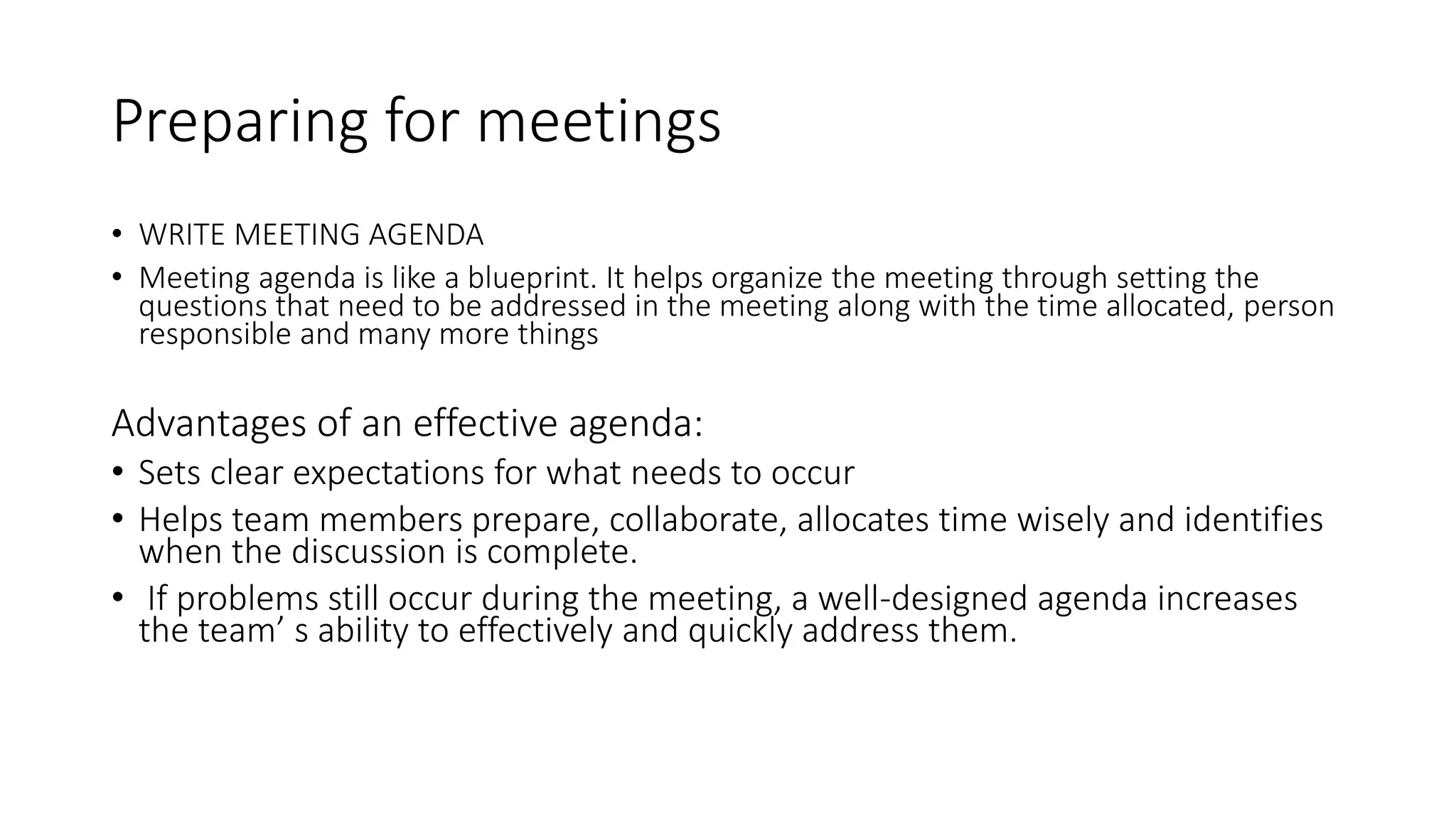
• WRITE MEETING AGENDA
• Meeting agenda is like a blueprint. It helps organize the meeting through setting the
questions that need to be addressed in the meeting along with the time allocated, person
responsible and many more things
Advantages of an effective agenda:
• Sets clear expectations for what needs to occur
• Helps team members prepare, collaborate, allocates time wisely and identifies
when the discussion is complete.
• If problems still occur during the meeting, a well-designed agenda increases
the team’ s ability to effectively and quickly address them.
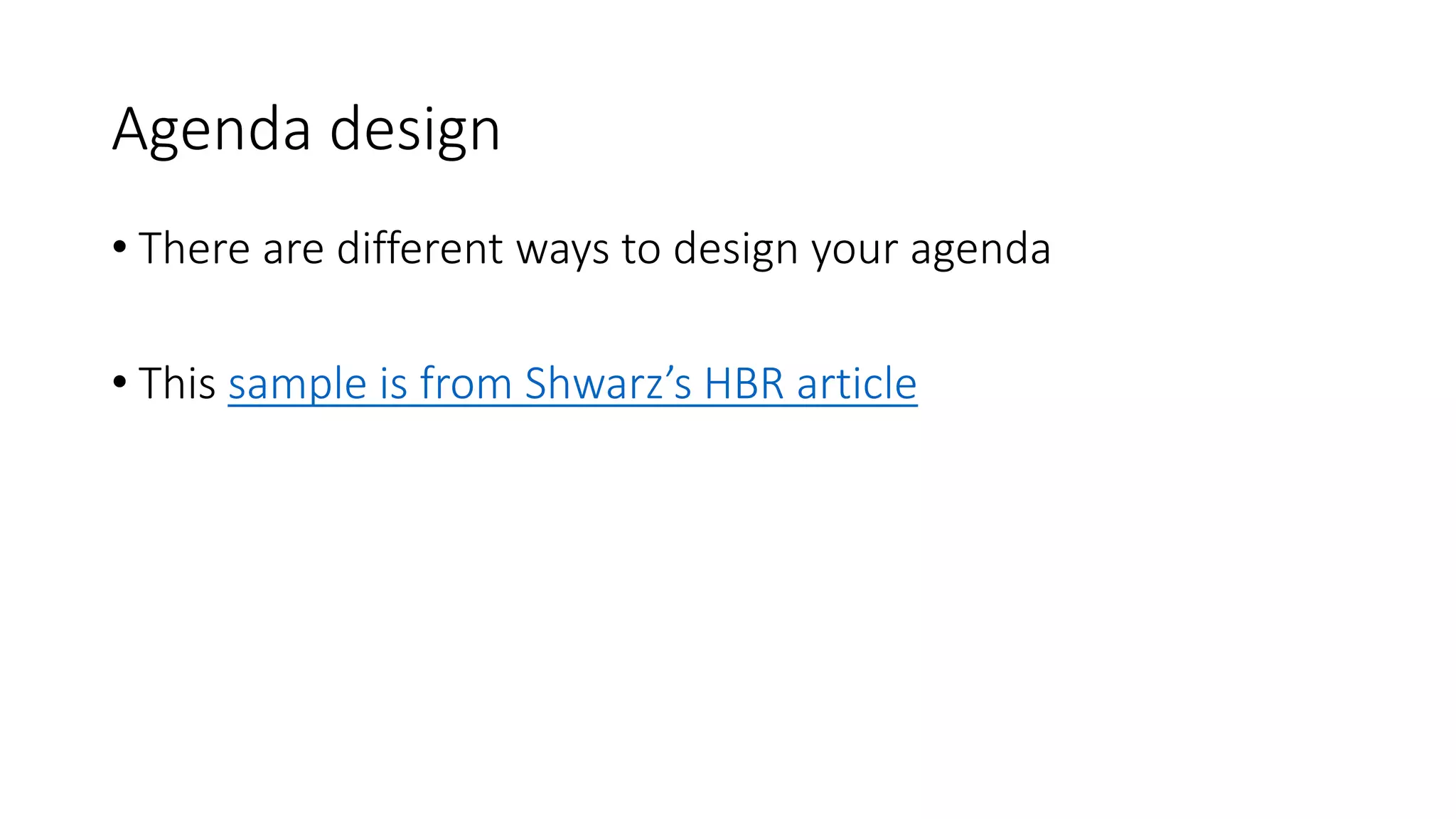
Agenda design
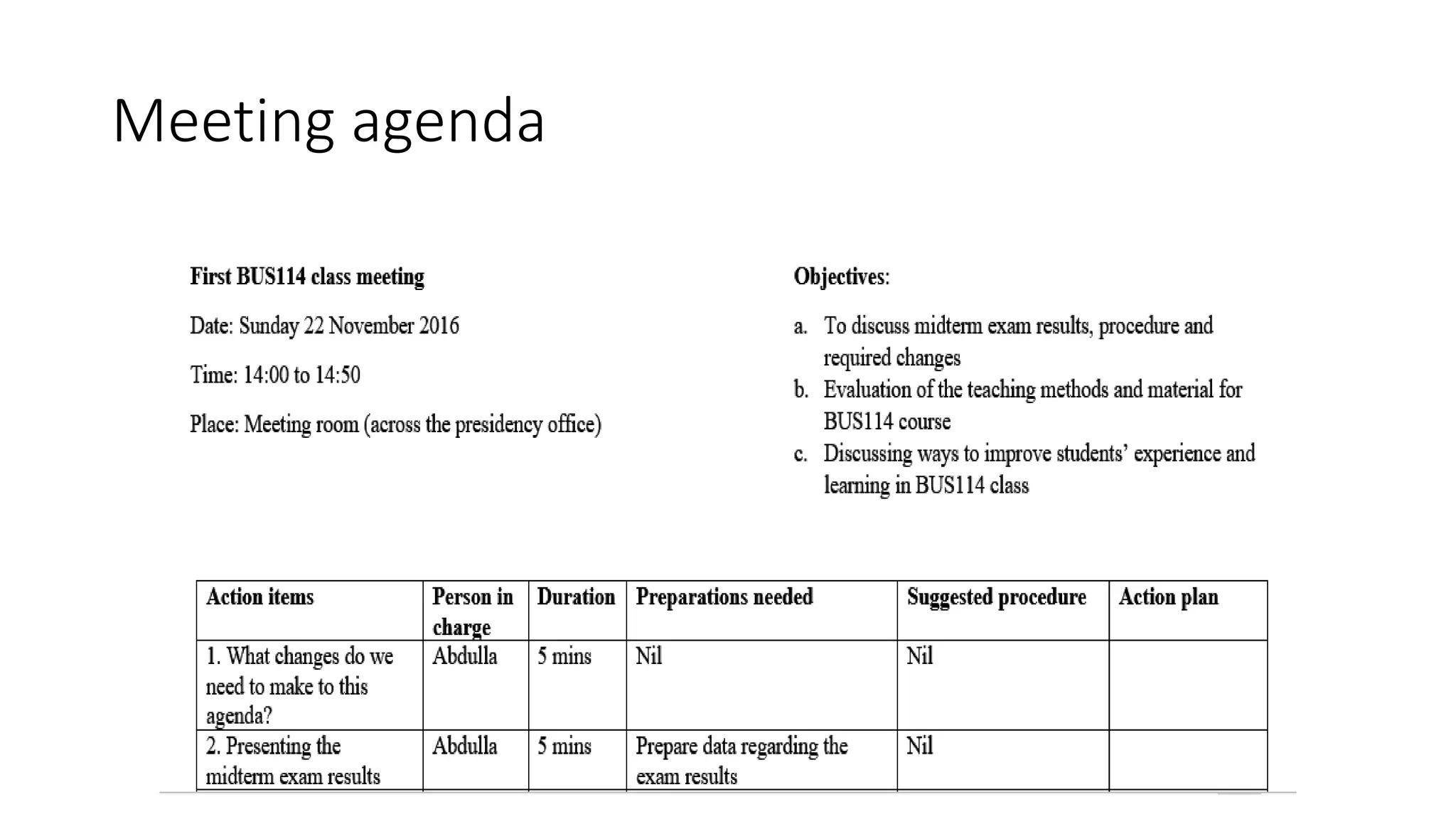
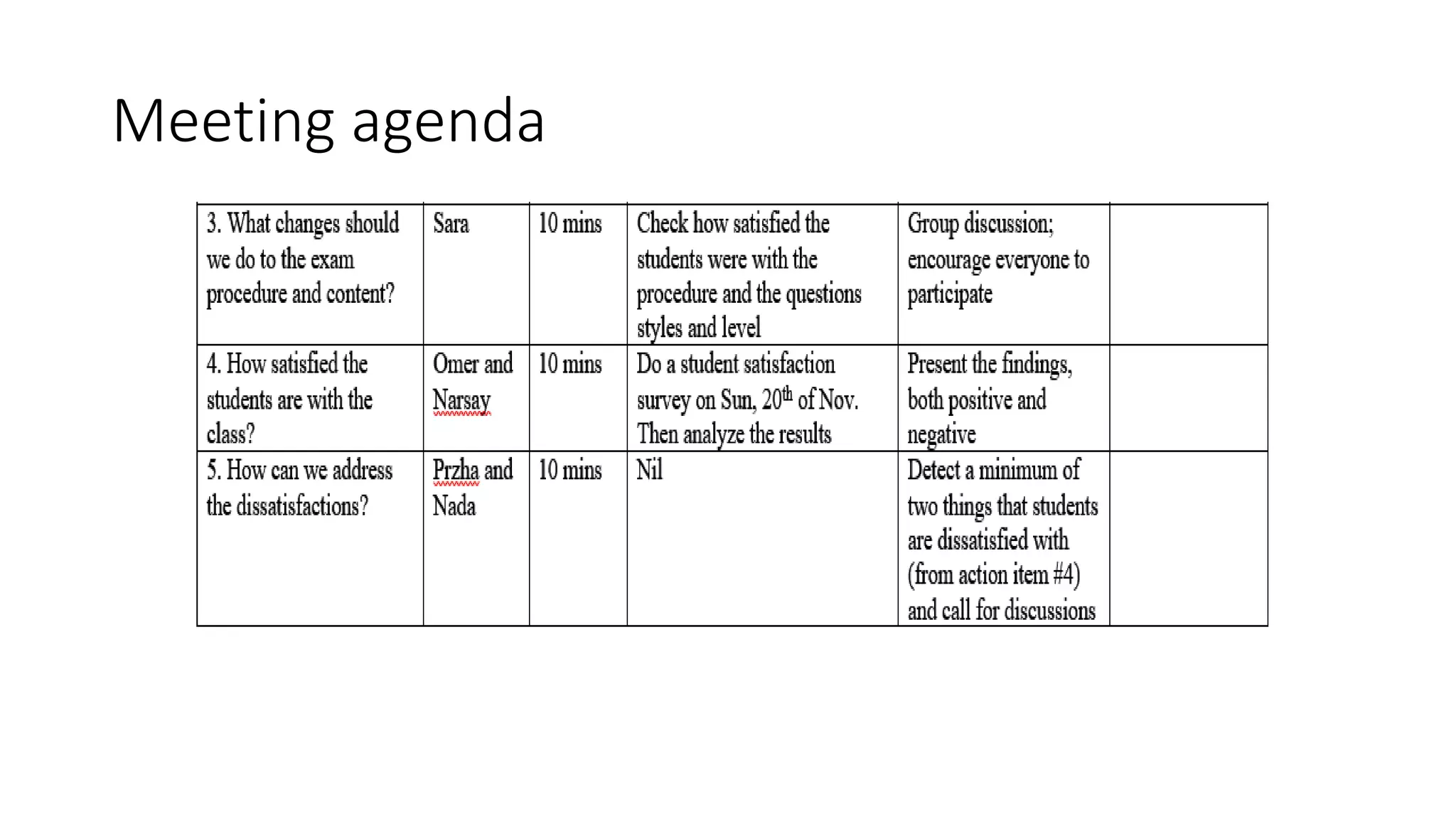
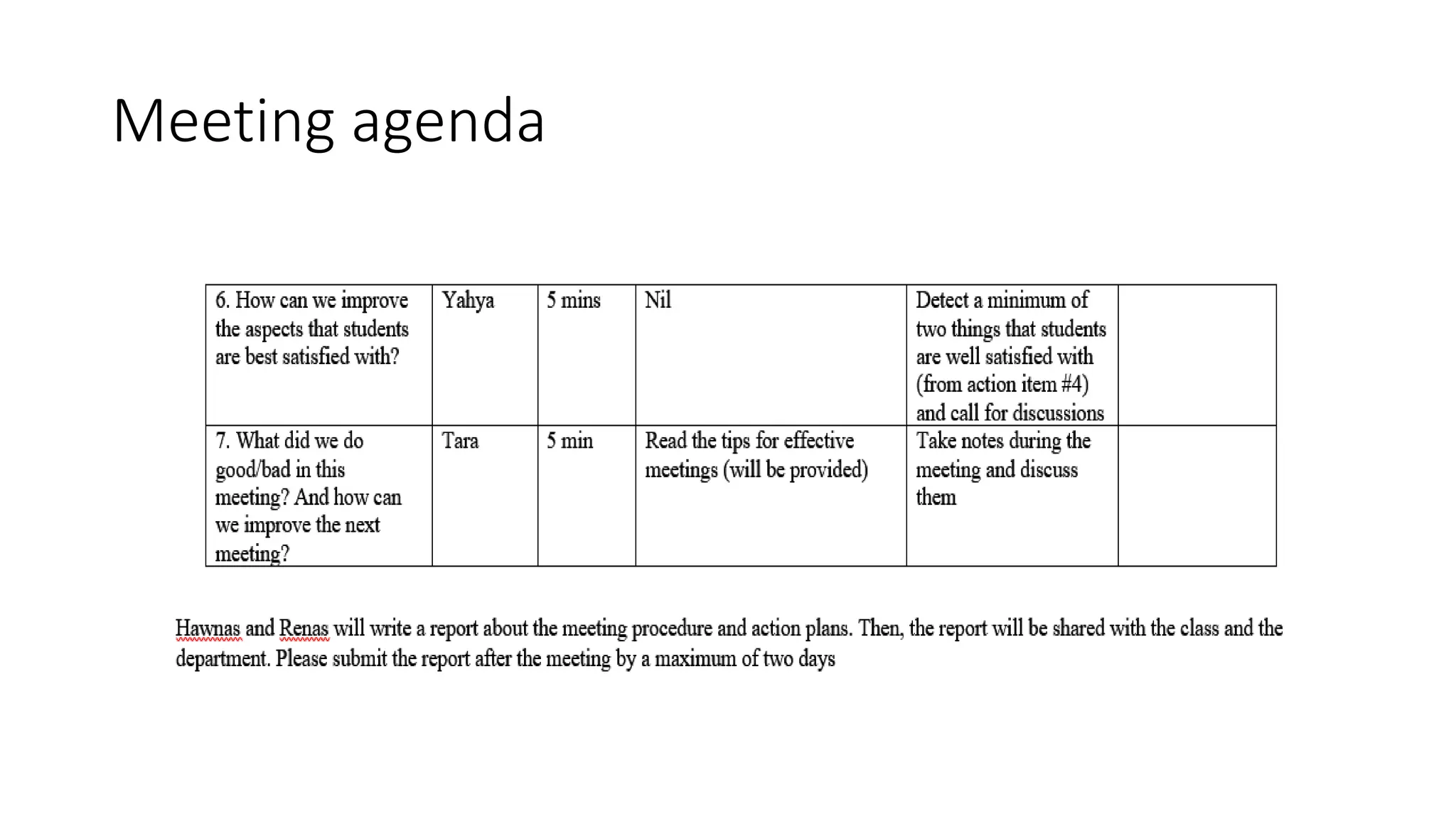
• There are different ways to design your agenda
• This sample is from Shwarz’s HBR article
Meeting agenda
Meeting agenda
Meeting agenda
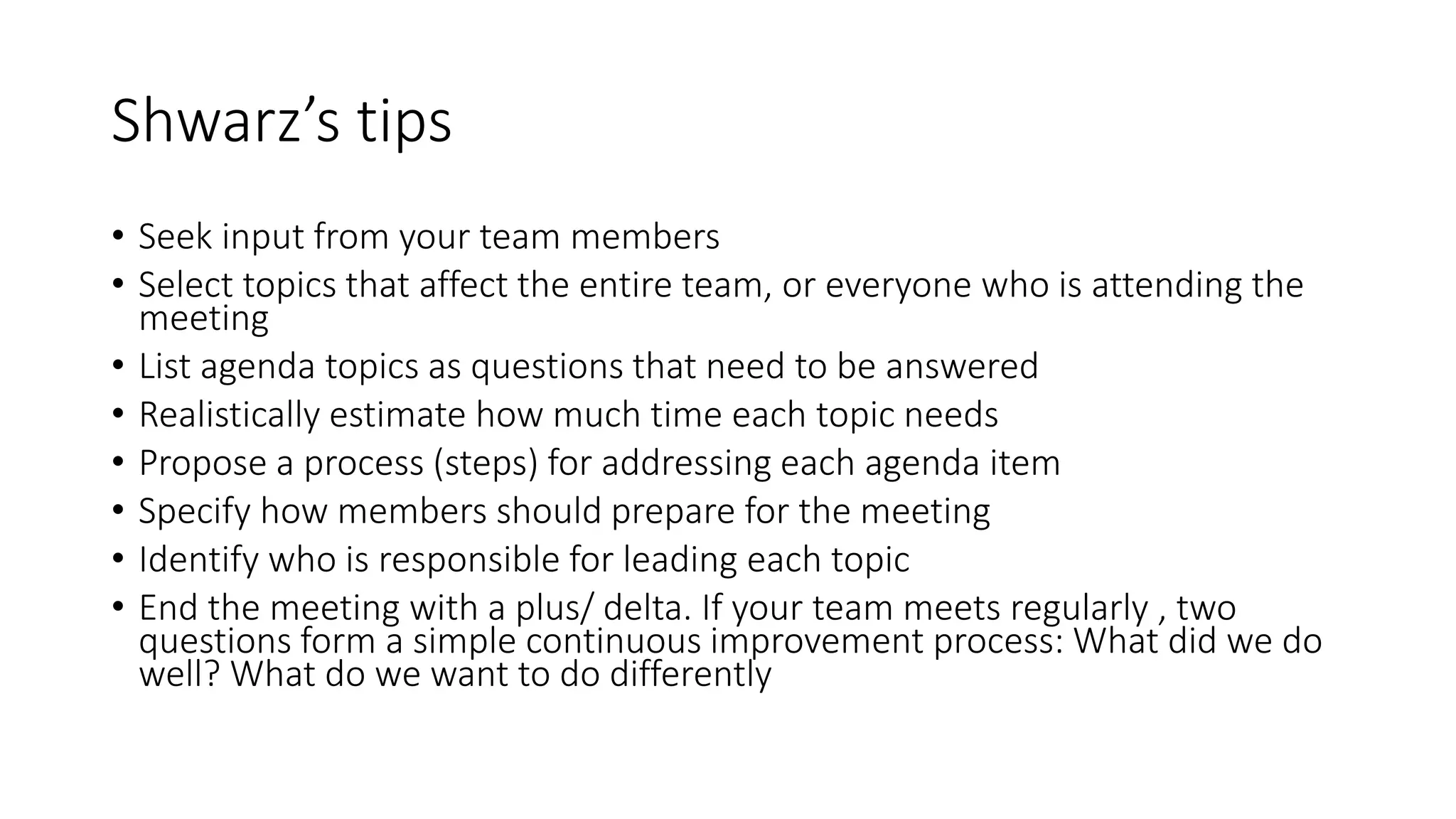
Shwarz’s tips
• Seek input from your team members
• Select topics that affect the entire team, or everyone who is attending the
meeting
• List agenda topics as questions that need to be answered
• Realistically estimate how much time each topic needs
• Propose a process (steps) for addressing each agenda item
• Specify how members should prepare for the meeting
• Identify who is responsible for leading each topic
• End the meeting with a plus/ delta. If your team meets regularly , two
questions form a simple continuous improvement process: What did we do
well? What do we want to do differently
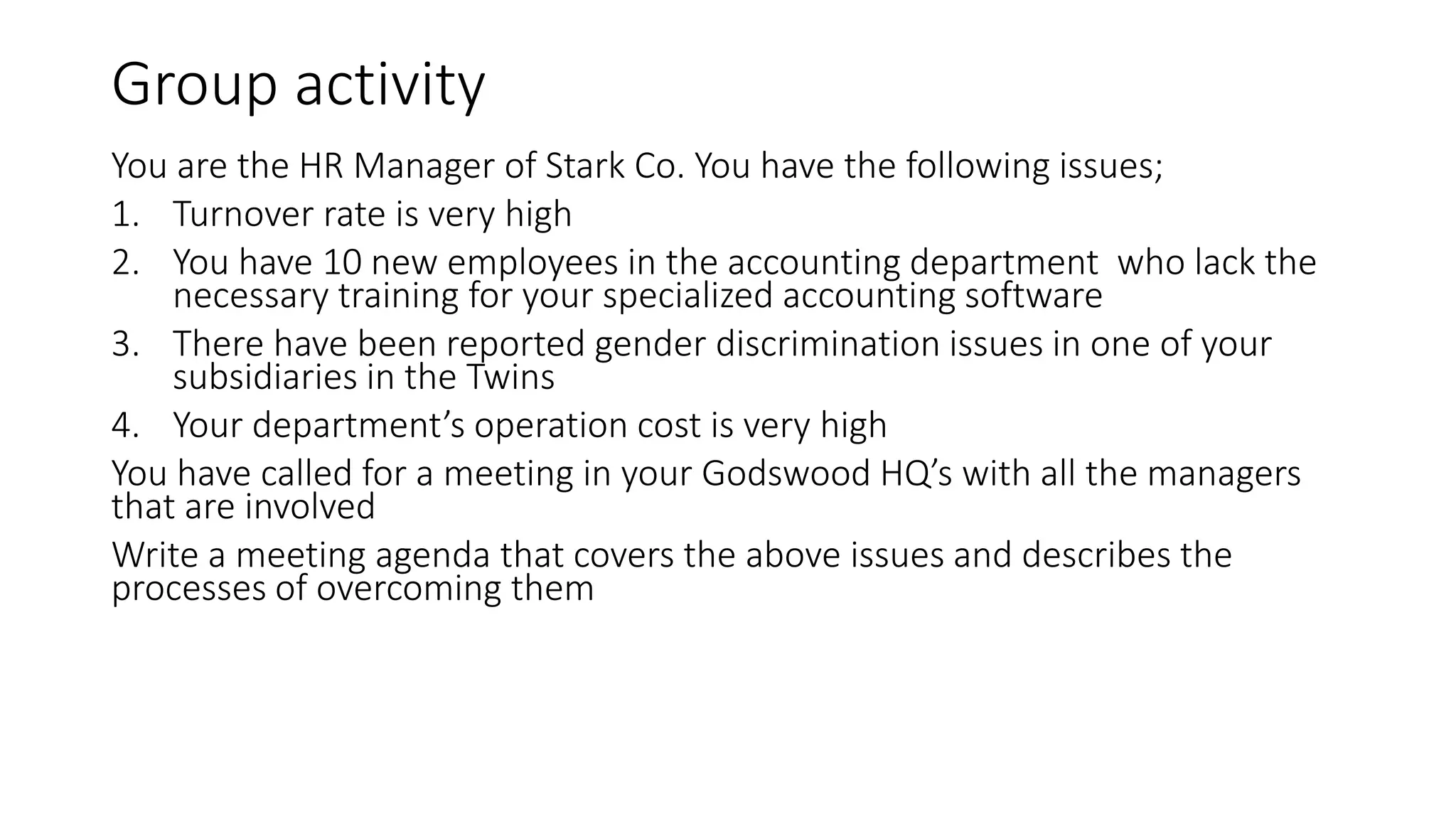
Group activity
You are the HR Manager of Stark Co. You have the following issues;
1. Turnover rate is very high
2. You have 10 new employees in the accounting department who lack the
necessary training for your specialized accounting software
3. There have been reported gender discrimination issues in one of your
subsidiaries in the Twins
4. Your department’s operation cost is very high
You have called for a meeting in your Godswood HQ’s with all the managers
that are involved
Write a meeting agenda that covers the above issues and describes the
processes of overcoming them
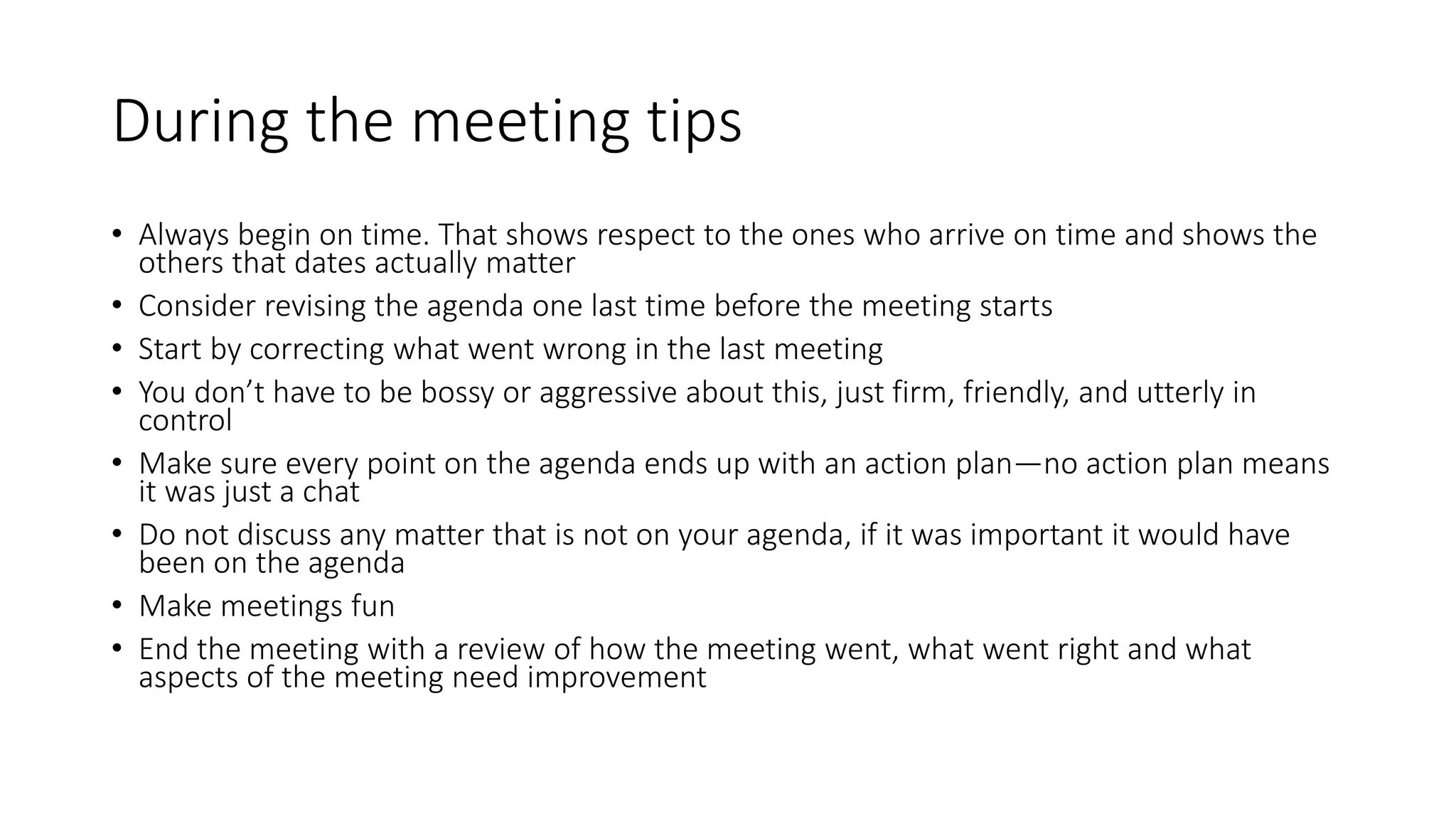
During the meeting tips
• Always begin on time. That shows respect to the ones who arrive on time and shows the
others that dates actually matter
• Consider revising the agenda one last time before the meeting starts
• Start by correcting what went wrong in the last meeting
• You don’t have to be bossy or aggressive about this, just firm, friendly, and utterly in
control
• Make sure every point on the agenda ends up with an action plan—no action plan means
it was just a chat
• Do not discuss any matter that is not on your agenda, if it was important it would have
been on the agenda
• Make meetings fun
• End the meeting with a review of how the meeting went, what went right and what
aspects of the meeting need improvement
After the meeting
• Write a report (meeting protocol or minutes) about the meeting and
summarize the action plans
• Make the report as clear as possible
• Share the report with everyone who is involved
• Make sure you control the execution of the action plans
How to write a meeting minutes
A good meeting minutes includes:
• Basic information: meeting title, objectives, date, location and etc.
• Summarize the meeting’s content: Using the meeting agenda as an outline,
write a summary of each discussion took place
• Include action plans decided upon at the meeting; Identify the person
responsible for each task and state the deadline
• If the meeting is a regular occurrence, mention the date of the next
gathering. Include the time and location
References
• Bovee, C. and Thill, J. (2013). Business communication essentials (1st
ed.). [Place of publication not identified]: Prentice Hall.
• Jay, A. (2016). How To Run a Meeting. Harvard Business Review.
Retrieved 23 November 2016, from https://hbr.org/1976/03/how-to-
run-a-meeting
• Schwarz, R. (2016). How to Design an Agenda for an Effective
Meeting. Harvard Business Review. Retrieved 23 November 2016,
from https://hbr.org/2015/03/how-to-design-an-agenda-for-an-
effective-meeting

How to run effective meetings

  • 1.
    How to runeffective meetings Abdulla Aziz International University of Erbil http://ue.edu.krd/ abdulla.aziz@ue.edu.krd
  • 2.
    objectives After completing thissection, students are expected to: • Know the functions of a meeting • Be able to prepare for a meeting • Be familiar with the dos and don’ts • Learn how to write after meeting reports and follow ups
  • 3.
    Facts about meetings •Over a billion meetings per year in the US • Not everyone likes meetings • Meetings are expensive at $338 salary cost per meeting on average • 63% of the meetings are done without in-advance planning • 11:00 am is the most frequent meeting start time
  • 4.
    What are thefunctions of a meeting? 1. A meeting defines the team and strengthens the sense of belonging to it 2. A meeting is the place where the group revises, updates, and adds to what it knows as a group. 3. It helps every individual understand both the collective aim of the group and everyone’s contribution 4. A meeting creates a commitment to the decisions it makes and the objectives it pursues. 5. It is very often the only occasion where the team or group actually exists and works as a group 6. A meeting is a good place where a member can compare their performance and status against other group members
  • 5.
    Preparing for ameeting • DEFINE MEETING’S OBJECTIVES • Unless you have a very clear requirement from the meeting, there is a grave danger that it will be a waste of everyone’ s time • Meeting’s objectives define what is this meeting intended to achieve and what would be the likely consequences of not holding it. It is the bases according to which you can judge the success or a failure of the meeting.
  • 6.
    Categories of meeting’sobjectives Informative- digestive meetings • A meeting introducing an item that requires no conclusion, decision, or action from the meeting, it is enough, simply , that the meeting should receive and discuss a report • It is a waste of time for the meeting to give out purely factual information that would be better circulated in a document, unless the information should be heard from a particular person, needs some clarification, or if it has deep implications for the members of the meeting
  • 7.
    Categories of meeting’sobjectives Constructive-originative • This “What shall we do?” function embraces all items that require something new to be devised, such as a new policy , a new strategy , a new sales target and so forth. • This sort of discussion asks people to contribute their knowledge, experience, judgment, and ideas.
  • 8.
    Categories of meeting’sobjectives Executive responsibilities • This is the “How shall we do it?” function of a meeting
  • 9.
    Preparing for meetings SELECTPARTICIPANTS FOR THE MEETING • Th e rule here is simple: Invite everyone who really needs to be involved • Between 4 and 7 is generally ideal, 10 is tolerable, and 12 is the outside limit
  • 10.
    If the leadersees no way of getting the meeting down to a manageable size, he can try the following (a) analyze the agenda to see whether everyone has to be present for every item (you might be able to structure the agenda so that some people can leave at half time and others can arrive) (b) Ask yourself whether you don’t really need two separate, smaller meetings rather than one big one; and (c) Determine whether one or two groups can be asked to resolve their topics out in advance so that only one of them needs to come in with its proposals.
  • 11.
    Preparing for ameeting • PREPARE THE TIME AND VENUE Make sure all the required facilities are available and in a working order
  • 12.
    Activity • Thill andBovee believe that you should hold your meetings in the morning. People are generally more alert and not yet engaged with the work of the day, they say. • Templar says: hold all meetings at the end of the day rather than at the beginning. Everyone’s anxious to go home, and it keeps meetings shorter • With who do you agree and why?
  • 13.
    Preparing for meetings •WRITE MEETING AGENDA • Meeting agenda is like a blueprint. It helps organize the meeting through setting the questions that need to be addressed in the meeting along with the time allocated, person responsible and many more things Advantages of an effective agenda: • Sets clear expectations for what needs to occur • Helps team members prepare, collaborate, allocates time wisely and identifies when the discussion is complete. • If problems still occur during the meeting, a well-designed agenda increases the team’ s ability to effectively and quickly address them.
  • 14.
    Agenda design • Thereare different ways to design your agenda • This sample is from Shwarz’s HBR article
  • 15.
  • 16.
  • 17.
  • 18.
    Shwarz’s tips • Seekinput from your team members • Select topics that affect the entire team, or everyone who is attending the meeting • List agenda topics as questions that need to be answered • Realistically estimate how much time each topic needs • Propose a process (steps) for addressing each agenda item • Specify how members should prepare for the meeting • Identify who is responsible for leading each topic • End the meeting with a plus/ delta. If your team meets regularly , two questions form a simple continuous improvement process: What did we do well? What do we want to do differently
  • 19.
    Group activity You arethe HR Manager of Stark Co. You have the following issues; 1. Turnover rate is very high 2. You have 10 new employees in the accounting department who lack the necessary training for your specialized accounting software 3. There have been reported gender discrimination issues in one of your subsidiaries in the Twins 4. Your department’s operation cost is very high You have called for a meeting in your Godswood HQ’s with all the managers that are involved Write a meeting agenda that covers the above issues and describes the processes of overcoming them
  • 20.
    During the meetingtips • Always begin on time. That shows respect to the ones who arrive on time and shows the others that dates actually matter • Consider revising the agenda one last time before the meeting starts • Start by correcting what went wrong in the last meeting • You don’t have to be bossy or aggressive about this, just firm, friendly, and utterly in control • Make sure every point on the agenda ends up with an action plan—no action plan means it was just a chat • Do not discuss any matter that is not on your agenda, if it was important it would have been on the agenda • Make meetings fun • End the meeting with a review of how the meeting went, what went right and what aspects of the meeting need improvement
  • 21.
    After the meeting •Write a report (meeting protocol or minutes) about the meeting and summarize the action plans • Make the report as clear as possible • Share the report with everyone who is involved • Make sure you control the execution of the action plans
  • 22.
    How to writea meeting minutes A good meeting minutes includes: • Basic information: meeting title, objectives, date, location and etc. • Summarize the meeting’s content: Using the meeting agenda as an outline, write a summary of each discussion took place • Include action plans decided upon at the meeting; Identify the person responsible for each task and state the deadline • If the meeting is a regular occurrence, mention the date of the next gathering. Include the time and location
  • 23.
    References • Bovee, C.and Thill, J. (2013). Business communication essentials (1st ed.). [Place of publication not identified]: Prentice Hall. • Jay, A. (2016). How To Run a Meeting. Harvard Business Review. Retrieved 23 November 2016, from https://hbr.org/1976/03/how-to- run-a-meeting • Schwarz, R. (2016). How to Design an Agenda for an Effective Meeting. Harvard Business Review. Retrieved 23 November 2016, from https://hbr.org/2015/03/how-to-design-an-agenda-for-an- effective-meeting

Editor's Notes

  • #4 Source: http://attentiv.com/america-meets-a-lot/
  • #5 2. Some ethologists call this capacity to share knowledge and experience among a group “the social mind, ” conceiving it as a single mind dispersed among a number of skulls. They recognize that this “social mind” has a special creative power , too. A group of people meeting together can often produce better ideas, plans, and decisions than can a single individual, or a number of individuals, each working alone. The meeting can of course also produce worse outputs or none at all, if it is a bad meeting. 4. Once something has been decided, even if you originally argued against it, your membership in the group entails an obligation to accept the decision: Real opposition to decisions within organizations usually consists of one part disagreement with the decision to nine parts resentment at not being consulted before the decision 5. and the only time when the supervisor , manager , or executive is actually perceived as the leader of the team, rather than as the official to whom individuals report
  • #21  Useful tip—never schedule meetings to begin exactly on the hour, always say 3:10 p.m. rather than 3 o’clock. You’ll find people will always be more punctual if you set an “odd” time
  • #23 Minutes, also known as protocols or, informally, notes, are the instant written record of a meeting or hearing