




LAXMI INSTITUTE OF TECHNOLOGY, SARIGAM 
MULTIPLE 
INTRIGRALS 
calculus
Laxmi Institute of Technology , 
Sarigam 
Branch: Mechanical Engineering 
Div.: A 
Subject : CALCULUS 
Guided By : Mr. GAURAV GANDHI , Mr. DARPAN BULSARA 
Prepared By : Roll no. 23 - 33
BRANCH - MECHANICAL-A 
ACADAMIC YEAR – 2014-2015 
SUBJECT - CALCULAS 
SEM. – 1 
 23- RAHUL SINGH 
 24- SUDHANSHU DAS 
 25- RAJAT SINGH 
 26-ASHWIN GUPTA 
 27- AMIT YADAV 
 28- MUDDASIR KHAN 
 29- VIVEK DUBEY 
 30- ANKUR RANA 
 31- FARUKH SHAIKH 
 32- RAVINDRA YADAV 
 33- AKSHAY AHIRE 
 140860119097 
 140860119019 
 140860119 
 140860119023 
 140860119122 
 140860119028 
 140860119 
 140860119 
 140860119105 
 140860119123 
 140860119004
contents: 
Double integral 
Fubini’s theorem 
Algebraic Properties 
Double integrals in polar 
coordinate 
Triple integration
MULTIPLE INTEGRALS 
DOUBLE INTEGRALS 
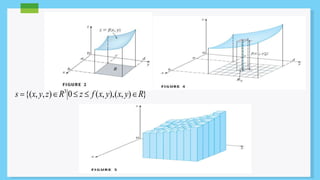
 Let the function z=f(x,y) be defined on some region R 
 Divide the region R into small parts by drawing lines parallel to X-axis and Y-axis within the region 
R. 
 These parts are in the form of rectangle of lengths x & 
,except some of the parts at the boundaries of the region. 
 Let the number of such rectangles be n. Each of area 
 Choose any point in any area 
 If we take then all the small parts wthin the region will approximately behave like 
rectangles. 
k k x y 
 Then the following limit of sums over region R : 
 
 y 
( *, *)  A  x* y 
n   
lim ( *, *) 
1 
n 
n k k k 
k 
f x y  A 
 
 
{( , , ) 0 ( , ),( , ) } 3 s  x y z R  z  f x y x y R
MULTIPLE INTEGRAL 
DOUBLE INTEGRAL 
 Is known as the double integral of f(x,y) over R and can be written as 
 f (x, y)dA
MULTIPLE INTEGRAL 
Fubini’s theorm 
 If f(x,y) is continuous throught the rectangular region 
 f ( x , y ) dA    f ( x , y ) 
dxdy 
 f x y dA    f x y dydx 
& 
d b 
R c a 
b d 
( , ) ( , ) 
R a c 
d b d b 
  f ( x , y ) dxdy   [  f ( x , y ) dx ] 
dy 
c a c a
MULTIPLE INTEGRAL 
For example 
2 1 
  (13xy)dxdy 
1 0 
2 2 
x y 
1 
0 
I   x  dy 
1 
3 
[ ] 
2 
2 
I    dy 
1 
3 
y 
(1 ) 
2 
2 
2 
1 
3 
y 
 y  
[ ] 
4 
12 3 
    
[2 1 ] 
4 4 
3 
 4 
 
4
MULTIPLE INTEGRAL 
 Algebraic properties 
Properties: 
1. cf(x,y)dA  
c f(x,y)dA 
  
R R 
   
2. (f(x,y)  g(x,y))dA  f(x,y)dA  
g(x,y)dA 
R R R 
3. If f(x,y)  g(x,y)  (x,y)  
R, then 
 
  
 
R R 
R 
f(x,y)dA g(x,y)dA 
4 f(x,y) dA 0, if f (x, y) 0 on R 
 
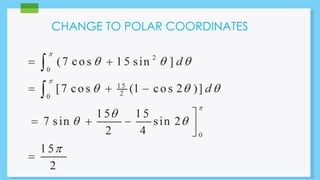
CHANGE TO POLAR COORDINATES 
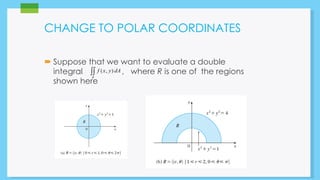
 Suppose that we want to evaluate a double 
integral , where R is one of the regions 
shown here
CHANGE TO POLAR COORDINATES 
Double integrals in polar coordinate 
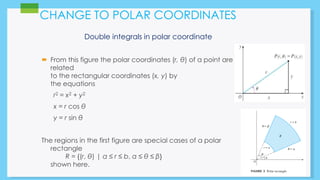
 From this figure the polar coordinates (r, θ) of a point are 
related 
to the rectangular coordinates (x, y) by 
the equations 
r2 = x2 + y2 
x = r cos θ 
y = r sin θ 
The regions in the first figure are special cases of a polar 
rectangle 
R = {(r, θ) | a ≤ r ≤ b, α ≤ θ ≤ β} 
shown here.
CHANGE TO POLAR COORDINATES 
 To compute the double integral 
 where R is a polar rectangle, we divide: 
 The interval [a, b] into m subintervals [ri–1, ri] 
of equal width Δr = (b – a)/m. 
The interval [α ,β] into n subintervals [θj–1, θi] 
of equal width Δθ = (β – α)/n.
CHANGE TO POLAR COORDINATES 
Then, the circles r = ri and the rays θ = θi 
divide the polar rectangle R into the small 
polar rectangles shown here
CHANGE TO POLAR COORDINATES 
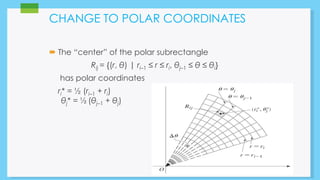
 The “center” of the polar subrectangle 
Rij = {(r, θ) | ri–1 ≤ r ≤ ri, θj–1 ≤ θ ≤ θi} 
has polar coordinates 
ri* = ½ (ri–1 + ri) 
θj* = ½(θj–1 + θj)
CHANGE TO POLAR COORDINATES 
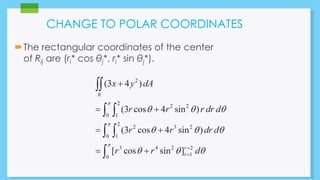
The rectangular coordinates of the center 
of Rij are (ri* cos θj*, ri* sin θj*).
CHANGE TO POLAR COORDINATES
Triple integrals 
 We consider a continuous function f(x,y,z) defined over a 
bounded by a solid region D in three dimensional space .We 
divide a solid region D into small rectangular parallelepiped 
by drawing planes parallel to coordinate planes . 
 Consider any point in one of the cells with 
volume 
 If we partition the solid region D into large number of such cells 
then the following limits of the approximation of sum 
Vk  xk . yk . zk 
Triple integrals 
 Is known as triple integral of f(x,y,z) over D and can be written as: 
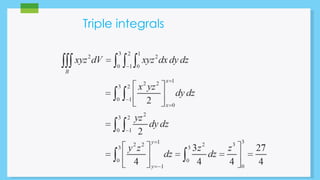
Example 1 
Evaluate the triple integral 
where B is the rectangular box
Triple integrals
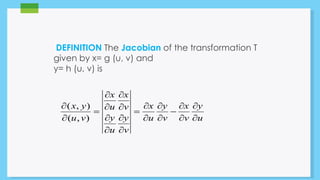
DEFINITION The Jacobian of the transformation T 
given by x= g (u, v) and 
y= h (u, v) is 
y 
 
u 
x 
 
v 
y 
 
v 
x 
 
u 
x 
 
y 
v 
x 
 
y 
 
u 
v 
u 
x y 
 
( , ) 
( , ) 
u v 
 
 
 
 
 
 
 
 
 
 
 
 

CHANGE OF VARIABLES IN A DOUBLE INTEGRAL Suppose 
that T is a C1 
transformation whose Jacobian is nonzero and that maps 
a region S in the uv-plane onto a region R in the xy-plane. 
Suppose that f is continuous on R and that R and S are type 
I or type II plane regions. Suppose also that T is one-to-one, 
except perhaps on the boundary of . S. Then 
 
 
( , ) 
   
R S 
dudv 
x y 
u v 
f x y dA f x u v y u v 
( , ) 
( , ) ( ( , ), ( , ))
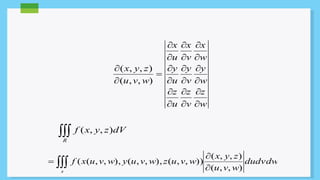
Let T be a transformation that maps a region S in 
uvw-space onto a region R in xyz-space by means of 
the equations 
x=g (u, v, w) y=h (u, v, w) z=k (u, v, w) 
The Jacobian of T is the following 3X3 determinant:
 
R 
x y z 
 
( , , ) 
( u , v , w 
) 
 
f (x, y, z)dV 
x 
 
w 
y 
 
 
w 
z 
 
 
w 
 
x 
 
v 
 
y 
 
v 
 
z 
 
v 
x 
 
u 
y 
 
 
u 
z 
 
 
u 
 
 
 
 
  
 
s 
dudvdw 
x y z 
( , , ) 
u v w 
f x u v w y u v w z u v w 
( , , ) 
( ( , , ), ( , , ), ( , , ))
multiple intrigral lit

multiple intrigral lit

  • 1.
    LAXMI INSTITUTE OFTECHNOLOGY, SARIGAM MULTIPLE INTRIGRALS calculus
  • 2.
    Laxmi Institute ofTechnology , Sarigam Branch: Mechanical Engineering Div.: A Subject : CALCULUS Guided By : Mr. GAURAV GANDHI , Mr. DARPAN BULSARA Prepared By : Roll no. 23 - 33
  • 3.
    BRANCH - MECHANICAL-A ACADAMIC YEAR – 2014-2015 SUBJECT - CALCULAS SEM. – 1  23- RAHUL SINGH  24- SUDHANSHU DAS  25- RAJAT SINGH  26-ASHWIN GUPTA  27- AMIT YADAV  28- MUDDASIR KHAN  29- VIVEK DUBEY  30- ANKUR RANA  31- FARUKH SHAIKH  32- RAVINDRA YADAV  33- AKSHAY AHIRE  140860119097  140860119019  140860119  140860119023  140860119122  140860119028  140860119  140860119  140860119105  140860119123  140860119004
  • 4.
    contents: Double integral Fubini’s theorem Algebraic Properties Double integrals in polar coordinate Triple integration
  • 5.
    MULTIPLE INTEGRALS DOUBLEINTEGRALS  Let the function z=f(x,y) be defined on some region R  Divide the region R into small parts by drawing lines parallel to X-axis and Y-axis within the region R.  These parts are in the form of rectangle of lengths x & ,except some of the parts at the boundaries of the region.  Let the number of such rectangles be n. Each of area  Choose any point in any area  If we take then all the small parts wthin the region will approximately behave like rectangles. k k x y  Then the following limit of sums over region R :   y ( *, *)  A  x* y n   lim ( *, *) 1 n n k k k k f x y  A   
  • 6.
    {( , ,) 0 ( , ),( , ) } 3 s  x y z R  z  f x y x y R
  • 7.
    MULTIPLE INTEGRAL DOUBLEINTEGRAL  Is known as the double integral of f(x,y) over R and can be written as  f (x, y)dA
  • 8.
    MULTIPLE INTEGRAL Fubini’stheorm  If f(x,y) is continuous throught the rectangular region  f ( x , y ) dA    f ( x , y ) dxdy  f x y dA    f x y dydx & d b R c a b d ( , ) ( , ) R a c d b d b   f ( x , y ) dxdy   [  f ( x , y ) dx ] dy c a c a
  • 9.
    MULTIPLE INTEGRAL Forexample 2 1   (13xy)dxdy 1 0 2 2 x y 1 0 I   x  dy 1 3 [ ] 2 2 I    dy 1 3 y (1 ) 2 2 2 1 3 y  y  [ ] 4 12 3     [2 1 ] 4 4 3  4  4
  • 10.
    MULTIPLE INTEGRAL Algebraic properties Properties: 1. cf(x,y)dA  c f(x,y)dA   R R    2. (f(x,y)  g(x,y))dA  f(x,y)dA  g(x,y)dA R R R 3. If f(x,y)  g(x,y)  (x,y)  R, then     R R R f(x,y)dA g(x,y)dA 4 f(x,y) dA 0, if f (x, y) 0 on R  
  • 11.
    CHANGE TO POLARCOORDINATES  Suppose that we want to evaluate a double integral , where R is one of the regions shown here
  • 12.
    CHANGE TO POLARCOORDINATES Double integrals in polar coordinate  From this figure the polar coordinates (r, θ) of a point are related to the rectangular coordinates (x, y) by the equations r2 = x2 + y2 x = r cos θ y = r sin θ The regions in the first figure are special cases of a polar rectangle R = {(r, θ) | a ≤ r ≤ b, α ≤ θ ≤ β} shown here.
  • 13.
    CHANGE TO POLARCOORDINATES  To compute the double integral  where R is a polar rectangle, we divide:  The interval [a, b] into m subintervals [ri–1, ri] of equal width Δr = (b – a)/m. The interval [α ,β] into n subintervals [θj–1, θi] of equal width Δθ = (β – α)/n.
  • 14.
    CHANGE TO POLARCOORDINATES Then, the circles r = ri and the rays θ = θi divide the polar rectangle R into the small polar rectangles shown here
  • 15.
    CHANGE TO POLARCOORDINATES  The “center” of the polar subrectangle Rij = {(r, θ) | ri–1 ≤ r ≤ ri, θj–1 ≤ θ ≤ θi} has polar coordinates ri* = ½ (ri–1 + ri) θj* = ½(θj–1 + θj)
  • 16.
    CHANGE TO POLARCOORDINATES The rectangular coordinates of the center of Rij are (ri* cos θj*, ri* sin θj*).
  • 17.
    CHANGE TO POLARCOORDINATES
  • 18.
    Triple integrals We consider a continuous function f(x,y,z) defined over a bounded by a solid region D in three dimensional space .We divide a solid region D into small rectangular parallelepiped by drawing planes parallel to coordinate planes .  Consider any point in one of the cells with volume  If we partition the solid region D into large number of such cells then the following limits of the approximation of sum Vk  xk . yk . zk 
  • 19.
    Triple integrals Is known as triple integral of f(x,y,z) over D and can be written as: Example 1 Evaluate the triple integral where B is the rectangular box
  • 20.
  • 21.
    DEFINITION The Jacobianof the transformation T given by x= g (u, v) and y= h (u, v) is y  u x  v y  v x  u x  y v x  y  u v u x y  ( , ) ( , ) u v             
  • 22.
    CHANGE OF VARIABLESIN A DOUBLE INTEGRAL Suppose that T is a C1 transformation whose Jacobian is nonzero and that maps a region S in the uv-plane onto a region R in the xy-plane. Suppose that f is continuous on R and that R and S are type I or type II plane regions. Suppose also that T is one-to-one, except perhaps on the boundary of . S. Then   ( , )    R S dudv x y u v f x y dA f x u v y u v ( , ) ( , ) ( ( , ), ( , ))
  • 23.
    Let T bea transformation that maps a region S in uvw-space onto a region R in xyz-space by means of the equations x=g (u, v, w) y=h (u, v, w) z=k (u, v, w) The Jacobian of T is the following 3X3 determinant:
  • 24.
     R xy z  ( , , ) ( u , v , w )  f (x, y, z)dV x  w y   w z   w  x  v  y  v  z  v x  u y   u z   u        s dudvdw x y z ( , , ) u v w f x u v w y u v w z u v w ( , , ) ( ( , , ), ( , , ), ( , , ))